Deploying an Optimized Energy Efficient Intelligent Leach-C
Protocol in Wireless Sensor Networks
Aditi ; Anant Srivastava & Nishant sharma
SRM University India
ABSTRACT
Wireless sensor networks are much recognized, popular and worthy technique in today’s era across the
world due to their ability to combine the physical world with the virtual world. Wireless sensor networks
are battery driven devices which consist of various sensor nodes and one or more base stations. It is
abbreviated as WSN and is supposed to be made up of a large number of sensors. These sensors are
autonomous small devices with several constraints like the battery power, network range and memory
capacity. They use transceivers to collect information from various environments and pass it on up to its
base station, where the measured and collected data can be stored and available for the end user. The
main issue with these wireless sensor networks is that energy consumption is too high in it. So we
propose an energy efficient INTELLIGENT LEACH-C having the feature of cross pollination in plants
and few features of energy efficient intelligent protocol, in our paper. Our paper mainly focuses on the
distance while choosing the cluster head in the wireless sensor network and the shape, sizes of the
sensor nodes in the network which will reduce the energy consumption in the LEACH to great extent.
INTRODUCTION
Wireless sensor network
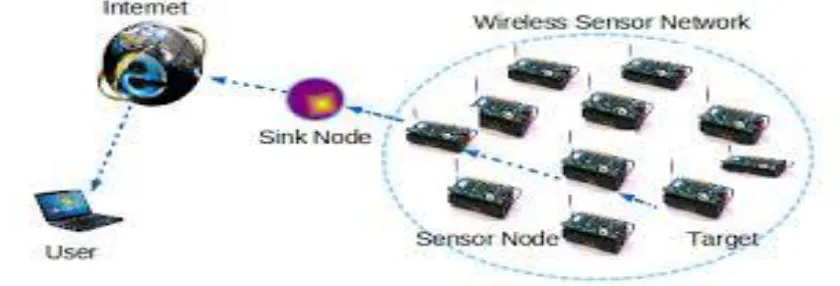
WSN are made up of various sensor nodes and a base station. These nodes collect the information from various environments and then send it to the base station which further sends these information from various place to the internet from where it is available for the end users.
Figure 1: Architecture of WSN
In almost every case, these sensors which form the network are deployed randomly and are left unattended. These nodes always perform their mission of collecting data from all over very efficiently. As these nodes are randomly deployed, node density varies along the various areas of the wireless sensor networks .Sensor networks are too much energy constrained because each individual node which the wireless sensor network is formed of are extremely energy-constrained. The communication devices present in these sensors are tiny and have limited power capacity and connection range.
Available online:http://internationaljournalofresearch.org/ P a g e | 65
Sensor nodes
Sensors nodes are made up of a Sensor which is a device to sense the information from various environment and to pass it on
to mote. These are basically used to measure the changes in physical environmental parameters. Mote + sensor =Sensor node
Fig 2 sensor node
BASE STATION
A base station is a major component of the wireless sensor network as it links the sensor network to different networks. The components of a base station are processor, radio board, antenna and USB interface. It has preprogrammed low-power networking software to communicate with the wireless sensor nodes.
LEACH PROTOCOL
LEACH was developed by W.Heinzel man as a hierarchical clustering protocol based on data aggregation for wireless sensor networks. This protocol sets the nodes in the network forming small clusters and then selects one of the nodes as the cluster-head. Now this node first senses its target, gathers the required information from it and then sends the gathered relevant information to its cluster-head. The working of the cluster head is to aggregate the data and compresses the data further received from all the nodes and then sends it to the base station. The cluster head uses more energy as compared to the other nodes present in the network because it sends data to the base station which may be far located from the place where the cluster head is present. Therefore LEACH rotates the nodes and then selects required node to be the cluster-heads to evenly distribute energy consumption in the wireless sensor network.
LEACH gave birth to many protocols but it has few disadvantages also which includes high energy consumption, limited scalability i.e. it is limited to a small region.
In LEACH-Centralized the base station gathers the location data of all the nodes and chooses which node will act as a cluster head. This is far better than the LEACH protocol but the disadvantage in this is that when the energy consumption for communicating with the base station becomes higher than the energy cost for cluster formation, this proves to more consumption of energy. LEACH-V has been introduced to reduce the energy consumption. . It was suggested that each cluster will have one CH i.e. and there will be a vice-CH node that will become a CH of the cluster when the previous CH dies. This also lacked some features it will expand the overall network lifetime. EELEACH-C was introduced to improve the energy consumption and to enhance the network lifetime of the wireless sensor network. In the EELEACH-C base station used the sorting technique to choose the cluster head, the node available with the maximum residual energy was selected as the cluster head. But this also not worked too well because of the higher cost of the assembling and the energy factor was being negotiated.
FTIEE PROTOCOL
PROPOSED WORK
In our proposed work we have designed a leach protocol that is based on the technique of cross pollination in plants for selecting which node will be the cluster head and also we have focused on the fault tolerance parameter. Fault tolerance will not allow the loss of data while sending the data from cluster head to the base station .we will design a protocol in which the cluster head will be selected on the basis of the energy and distance. Let us assume if two nodes are having the same energy, then we will see its distance from the base station, the more nearer node to the base station will be the cluster head. The node that has minimum distance from the base station will be selected as a CH. This will not only make the leach energy efficient but it will also increase its network capacity and reduce the total cost involved in it. This will make the leach protocol more energy efficient. .
Available online:http://internationaljournalofresearch.org/ P a g e | 67
Now the next thing that we propose in our paper is that we can reduce the energy consumption by focusing on other factors i.e. the quality of service like the fault tolerance , packet delivery etc. every researcher has focused on the scientific parameter because wsn’s are battery driven devices but in our paper the main focus is to maintain a balance between the different design factors which will significantly reduce the energy consumption and increase reliability. We have used the data based aggregation with learning based techniques.
The routing phase in this protocol is a very genuine step. The network will be run in periodical times which we will call as rounds. The tree structures will be reorganized because in every round CH nodes are changed. This modification will cause an overhead on the whole network. In this paper, we propose a leach protocol that will avoid wastage of energy and reduce the overhead of the wireless sensor network system and also consider the fault tolerance which will further reduce the energy consumption. The results are shown in the figures below :
Simulation of the work on MATLAB.
FUTURE SCOPE AND CONCLUSION
The future scope of this research will focus on making more balance between the design factors to reduce the
energy consumption. In this research we optimized the leach protocol using the cross pollination techniques and then employed some intelligent features like fault tolerance
and reliability to make the protocol more promising in energy consumption and provide a greater network capacity along with reliable data transfer.