International Journal of Research (IJR)
e-ISSN: 2348-6848, p- ISSN: 2348-795X Volume 2, Issue 09, September 2015Available at http://internationaljournalofresearch.org
A Study of Cognitive Styles Effect on ESL Students’ General
Writing Ability
Faezeh Shojaei¹& Dr. Kedutso Kapfo²
¹Department of Studies in Linguistics (K.I.K.S), University of Mysore, India ²Senior Reader-cum-Research Officer, Central Institute of Indian Languages, Mysore
Abstract:
The Purpose of this study is to find out the effect of field dependent-independent cognitive styles on ESL students general writing ability. 80 International ESL Iranian students studying in different colleges in Mysore City, India participated in this investigation. Two groups of 40 homogenized ESL students based on GEFT have been organized and participants were asked to do essay writing test. Based on data analysis of descriptive and independent sample t-test, it has been revealed that cognitive style has a significant effect on general writing
ability and field-independent students
outperformed field-dependent ones.
Key Words: Cognitive Style; Field-Dependent; Field-Independent; Writing Ability; ESL Students
1. Introduction
One of the most important subjects in the area of Second/Foreign Language Learning is that of different success. While it is certainly the case that some people are more intelligent than others in learning and using a foreign language, all people with normal teachers and given usual situations are better in their native language. There are, however, many reasons which have been shown to explain the difference of achievements among foreign language learners to describe why some students acquire foreign language without difficulty whereas others challenge and only attain to restricted achievements. “Cognitive Style is a term used to
International Journal of Research (IJR)
e-ISSN: 2348-6848, p- ISSN: 2348-795X Volume 2, Issue 09, September 2015Available at http://internationaljournalofresearch.org
problem solving, a high Field-Independent person is able to detect patterns and sub-patterns, while a Field-Dependent person tends to get lost in the totality of the stimuli. Consequently, a Field-Independent person is at an advantage in problem solving situations in which isolating and manipulating a critical element is important.”A Field-Dependent person, on the other hand, is more capable of perceiving the total pictures in a situation. Thus, the relationship between Field-Dependent/Field-Independent and success on a given task depends on the nature of a task. Furthermore Witkin and Goodenough say that: “Theoretically, Field-Dependent foster greater skill in interpersonal relations, while Field-Independent nurtures greater cognitive restructuring abilities on various perceptual and intellectual tasks.”(Witkin &Goodenough, 1976, p.11)
2. Review of Related Literature
In a research in 1990, Bean (quoted in Salmani-Nodoushan, 2007) discovered that a field dependent cognitive style could make difficulties for learners of English as a Second Language (ESL). He investigated English language performance and cognitive styles field-dependence (FD), and field-independence (FI). The participants in his study consisted of 157 adult Korean and Japanese ESL learners in university and community-sponsored classes. The outcomes showed that (72.5%) of the Koreans were FD than were the Japanese (20.8%); (73.6%) of the community learners demonstrated field-dependent than did the university learners (33.3%); and more of those who had stayed in the United States for a longer time, mostly Korean immigrants, had tendency to be field dependent. Additionally, the outcomes of Bean's research (1990) demonstrated that field independence related positively with English language performance and the duration of education.
Moreover, Blanton (quoted by Khodadady, 2012), studied the effect of cognitive style on standardized reading tests. She realized that cognitive style had more effects on learners’ performance on a reading comprehension standardized test than did gender or ethnicity. Kind of the exercises included in the test had a significant influence on the performance of the field-dependent learners. The results in her study represented that field-dependent learners outperformed if the reading tests were multiple-choice un-timed than the other types of tests and actually this kind of reading test resulted in more precise assessment of their reading comprehension abilities and reduced contrasts in test performance between field-dependent and independent learners.
International Journal of Research (IJR)
e-ISSN: 2348-6848, p- ISSN: 2348-795X Volume 2, Issue 09, September 2015Available at http://internationaljournalofresearch.org
linked to successful L2 proficiency learning. Another survey by Lieu (2000) investigated the relationship between students’ cognitive styles and tasks of English sentences among junior high school students in Taiwan; Lieu found that a significant correlation between FI and performance in recognizing English clauses tasks. Abraham (1981) explored the relationship between FI/FD cognitive styles of Spanish-speaking ESL students and the performance in grammatical rules. She also concluded that FI was a significant predictor of performance in a fill-in-the-blank grammar test and compositions for adult ESL students. Moreover in another research, Abraham (1983) found significant relationship between FI and the employment of the monitoring strategy by ESL learners in each of three tasks—fill-in-the-blank, proofreading and writing.
3. Hypotheses
3.1. Null Hypothesis of the Study Cognitive Style does not significantly impact on ESL Students’ General Writing Ability.
3.2. Alternative Hypothesis
Cognitive Style Significantly impacts on ESL Students’ General Writing Ability.
4. Method and Procedure
Two months before carrying out the research methodology, the researcher started to collect participants in Mysore, India. For this purpose, the researcher has visited some colleges and different departments of Mysore University in Mysore City, India and interviewed with students in Iranian Association in Mysore. Totally, 100 Iranian students in an age range of 25-33 from different colleges and departments have been collected but the data of 80 students were analyzed, because some of the students were excluded from the study based on their extreme scores on the proficiency test and neutral scores on GEFT. For guarantee the homogeneity of the participants, Nelson English Proficiency Test was administered among 100
students and the students whose scores did not fall within the range of standard deviation were eliminated. After executing the GEFT (Group Embedded Figures Test by Witkin et al., 1971), the students divided into two groups of 40 based on field dependent and field independent cognitive style. Moreover, Nelson English Language Test for intermediate learners by Fowler and Coe (1976) was administered to the classes to ensure that the participants in each group were homogenous.After that students of both groups have been given three topics to select and write an essay around 250 words. 45 minutes time was allocated for essay writing test. The writing tests were assessed according to IELTS scoring.
5. Data Analysis
The GEFT was administered among the 90 participants to find out their cognitive style preferences. The investigator neglected the mediocre of the test distribution that is the students gained scores within 1/2 stand deviation below or above the mean, have not been included in the study. The participants were divided into two groups of field-dependent and field-independent. Those who obtained scores of 17-18 were included in FI (Field-Independent) group and students who obtained scores within 0-11, considered as FD (Field-Dependent).
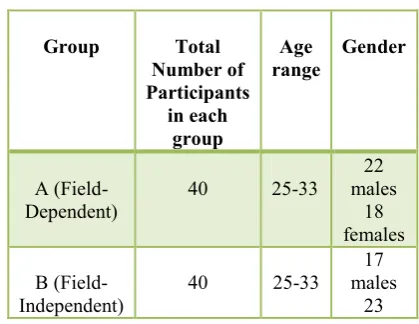
Table 5.1.Final Selected Participants in Each Group
Group Total Number of Participants
in each group
Age range
Gender
A
(Field-Dependent) 40 25-33
22 males
18 females
B (Field-Independent)
International Journal of Research (IJR)
e-ISSN: 2348-6848, p- ISSN: 2348-795X Volume 2, Issue 09, September 2015Available at http://internationaljournalofresearch.org
females
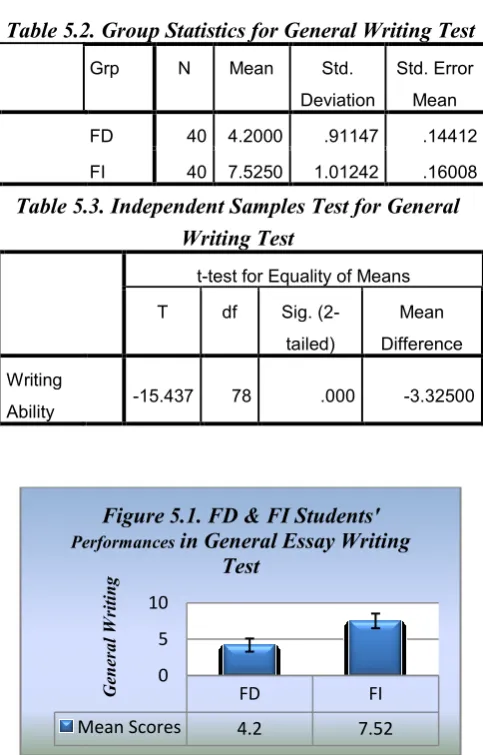
Table 5.2. Group Statistics for General Writing Test
Grp N Mean Std.
Deviation
Std. Error Mean
FD 40 4.2000 .91147 .14412
FI 40 7.5250 1.01242 .16008
Table 5.3. Independent Samples Test for General Writing Test
t-test for Equality of Means
T df Sig. (2-tailed)
Mean Difference
Writing
Ability -15.437 78 .000 -3.32500
For comparing the ESL students’ general writing ability in FD and FI groups of Cognitive Style, an independent-sample t-test was done. There is a significant difference in the scores for FD students (M=4.2, SD=0.91) and FI students (M=7.52, SD=1.01) in General Essay Writing Test; t(78)= -15.43, p = 0.00 (p<0.05) and FI students had a better performance in general essay writing test compare to FD students. Based on these data analyses, it can be found out that FD/I Cognitive Style has a significant effect on ESL students’ general writing performance. Accordingly, the hypothesis of the
study is accepted and the null hypothesis is disapproved.
6. Discussion and Conclusion
The result of this study revealed that FI students outperformed FD students in writing ability in general. This is in line with the results reported by Large (1998) and Graffin (1983). Therefore, the hypothesis of the study is accepted. The finding that field independents outperformed field dependents in writing task is in accordance with the result obtained by previous studies. Earlier researcher suggested a significant association between cognitive styles and writing as well as academic achievement (Moor & Dwyer, 2001; Lynch, et al., 1998; Nilforooshan & Afghari, 2007). Results demonstrate that field independent learners relate significantly and positively with language learning achievement in classroom. As declared by Tianjero and Paramo (1998) “Field independent subjects consistently achieve higher academic levels than field dependent subjects, whether specific subjects or global performance are considered”. As claimed by Nilforooshan and Afghari (2007) “There is a significant correlation between cognitive style and performance in general writing ability and also narrative writing in particular, whereas no significant difference was found between field dependents and field independents in argumentative writing”. The possible cause of difference between the abilities of field dependent and field independent learners may be associated with the difference between the two groups of learners in the way of thinking, reorganizing ability, the utilization of techniques in data processing and in process of writing, and retrieval of memory (Nilforooshan & Afghari, 2007). Witkin et al. (1977), describing the correlation between field-dependent/independent cognitive style and academic success, mentioned that field dependent learners use less strategies for
FD FI
Mean Scores 4.2 7.52 0
5 10
Ge
n
era
l W
riti
n
g
Figure 5.1. FD & FI Students'
Performancesin General Essay Writing
International Journal of Research (IJR)
e-ISSN: 2348-6848, p- ISSN: 2348-795X Volume 2, Issue 09, September 2015Available at http://internationaljournalofresearch.org
performing an assignment. Thus, their weak performance in opposite to field independent learners in tests is correlated to their debility in using strategies for data processing rather than cognitive incompetency. Field independent learners utilized internalized techniques like hypothesis testing, analytical reasoning, etc. that help them in doing better in inverse conditions and conceptually ambiguous tasks (Hacker, 1990). The other potential reason for achieving this result is that the teaching approaches in East Asian countries benefits field independent learners rather than field dependent ones (Zhenhui, 2001).
7. Implications:This study proposes some implications forESL/EFL teaching environments. The assumptive implication of this research is that: student’s cognitive styles and differences should be taken in account in all pervasive theory of foreign or second language teaching and learning. However, cognitive procedures associated with second language learning are not simply investigated and realized; having a knowledge regarding cognitive styles enhances the comprehension of the essence of language learning procedure. The results may assist material designers and curriculum developers in paying attention to the role of cognitive styles in foreign language learning. Various subjects and syllabus should be prepared for students with every type of field-dependence/independence cognitive style (Nilforooshan & Afghari, 2007).
References
[1] Abraham, R. (1981). The Relationship of Cognitive Style to the Use of Grammatical Rules by Spanish-speaking ESL Students in Editing
Written English. Unpublished dissertation,
University of Illinois, Illinois.
[2] Abraham, R. (1983). Relationship between use of the strategy of monitoring and cognitive
style. Studies in Second-Language Acquisition,
6, 17-32.
[3] Bean, R. E. (1990). Cognitive styles of Korean and Japanese adults learning
English in the U.S. Unpublished Maters
Thesis.
[4] Chen, B. L. (1991). The Relationship of Motivated Learning Strategy between Senior High School Students and Elementary School
Students. Unpublished master’s thesis of
National Cheng Chi University. Taipei, Taiwan.
[5] Ellis, R. (1990). Understanding Second
Language Acquisition. Oxford: Oxford
University Press.
[6] Graffin, M. C. (1983). An investigation of the relationship between students’ cognitive styles on the field dependence and independence dimension and their writing processes.
Dissertation Abstracts International, 44(1), 114.
[7] Hacker, J. (1990). The relationship of cognitive style to instructional conditions and academic achievement in second language
learners. Doctoral Dissertation, University of
Southern California, USA.
[8] Khodadady, E. (2012). Field
dependence/independence cognitive style and
performance on the IELTS listening
comprehension. International Journals of
Linguistics.http://dx.doi.org/10.5296/ijl.v4i3.23 89.
[9] Large, C. (1998). Relationship between cognitive style and written composition of
African-American ninth-grade students.
Doctoral Dissertation, Wayne State University.
International Journal of Research (IJR)
e-ISSN: 2348-6848, p- ISSN: 2348-795X Volume 2, Issue 09, September 2015Available at http://internationaljournalofresearch.org
identifying English clause tasks. Unpublished
Master thesis. National Chongshan University, Koahsiung, Taiwan.
[11]Lynch, T. G., Woelf, N. N., Hanssen, C. S., and Steele, D. J. (1998). Learning style influences students’ examination performance.
American Journal of Surgery, 176, 62-66.
[12]Moore, D. M. & Dwyer, F. M. (2001). The relationship of field dependence and color-coding to female students’ achievement.
Perceptual and Motor Skills, 93, 81-85.
[13] Naiman, N., Frohlich, M., & Stern, H. (1975). The good language learner. Toronto: The Ontario Institute for Studies in Education.
[14] Naiman, N., Frohlich, M., Stern, H., &Todesco, A. (1978). The good language teacher. Research in Education Series No.7. Toronto: Ontario Institute for Studies in Education.
[15]Nilforooshan, N., & Afghari, A. (2007). The effect of field dependence-independence as
a source of variation in EFL Learners’ Writing Performance. Iranian Journal of Language Studies (IJLS), 1(2), pp.103-118.
[16]Salmani-Nodoushan, M., A., (2007). Is field dependence or independence a predictor of EFL reading performance?. TESL Canada Journal, 24(2), 82-108.
[17]Seliger, H. (1977). Does practice make perfect? A study of interaction patterns and L2
competence. Language Learning, 27, 264-278.
[18]Tinajero, C., & Paramo, M. F. (1998). Field dependence-independence in second language
acquisition: Some forgotten aspects. The
Spanish Journal of Psychology, 1 (1), 32-38.
[19]Witkin, H.A. & Goodenough, D.R. (1976).
Field Dependence Revisited. Educational
Testing Service, Princeton. N.J.
[20]Witkin, H.A., Oltman, P., Raskin, E. & Karp, S. (1971). A Manual for the Embedded
Figures Test. Palo Alto, California: Consulting