A104 Biology
Problem 03: To dissolve or not to
dissolve
6
thPresentation
Activity owner: Sebrina ChuaIn Today’s Problem
Your task today was to:
•
Explore the differences between polar and
non-polar molecules.
•
Explore the different solubility of water
soluble and fat soluble vitamins in water.
What Do You Recognize?
• Vitamins that are fat soluble are non-polar and
vitamins that are water soluble are polar.
The solubility of a substance is related to its
molecular structure.
What is your approach?
• What is the shape of the H2O molecule?
• What is the electronegativity of different atoms? • How to determine the polarity of bonds?
• Why there is unequal sharing of bonding electrons within a water molecule?
• How to determine the polarity of the molecule?
• What are the conditions to determine polar and non-polar molecules?
• What are fat soluble molecules? • What are water soluble molecules?
• What are the differences between fat soluble and water soluble molecules?
What is the shape of the H
2O molecule?
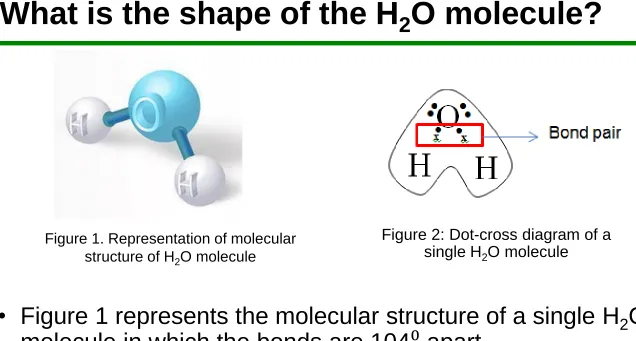
• Figure 1 represents the molecular structure of a single H2O molecule in which the bonds are 104⁰ apart.
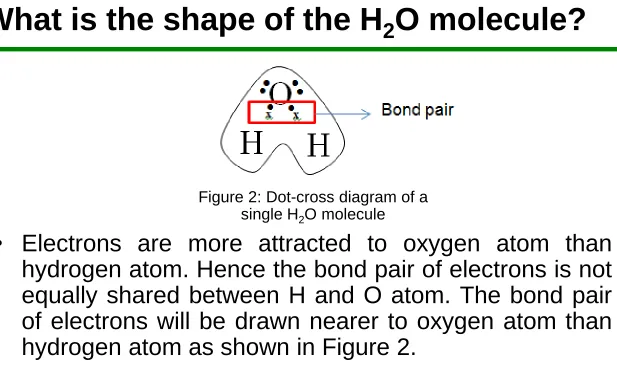
• The Dot-cross diagram in Figure 2 shows how the electrons are distributed within water molecules.
Figure 1. Representation of molecular structure of H2O molecule
What is the shape of the H
2O molecule?
• Electrons are more attracted to oxygen atom than hydrogen atom. Hence the bond pair of electrons is not equally shared between H and O atom. The bond pair of electrons will be drawn nearer to oxygen atom than hydrogen atom as shown in Figure 2.
• This tendency of attracting electrons towards itself is known as “electronegativity”.
Figure 2: Dot-cross diagram of a single H2O molecule
• Covalent bonding in many compounds is between atoms of different elements when the atoms share electrons.
Covalent bond is a type of intra-molecular bond.
• Since different atoms may have different attraction towards electrons, this also means that different atoms have
different electronegativity values.
• The atom with higher electronegativity have a tendency to pull the bonding pair of electrons towards itself.
• The electronegativity difference of the atoms in a bond determines whether the electrons are shared equally or unequally, and therefore the type of bond.
• If electrons are shared more or less equally, a non-polar covalent bond exists between the atoms (e.g. H-C). The difference in electronegativity values between the atoms will be less than 0.5.
• If electrons are shared unequally, a polar covalent bond exists between the atoms (e.g. H-O). The difference in electronegativity values between the atoms will be more than 0.5 and less than 2.0.
• In some cases, the difference in electronegativity is so great that the electrons are transferred completely. This results in the formation of an ionic bond (e.g. Na+Cl−)
with ions that have full charges. The difference in
electronegativity values between the atoms will be more than 2.0.
How to determine the polarity of bonds?
How to determine the polarity of bonds?
• For the single H2O molecule, O atom has a higher electronegativity than H atom. The value of the electronegativity of O and H is 3.44 and 2.2 respectively.
• The intra-molecular bonding in a single H2O molecule is polar
covalent since the difference in electronegativity between O atom and H atom is 1.24 (more than 0.5 but less than 2.0).
• The representation of partial charges on the H2O molecule is shown below. Sharing of electrons is not equal on the H2O molecule and leads to the formation of partial charges on molecules.
• As O has higher electronegativity, it has a tendency to pull the bonding pair of electrons towards itself. Hence, the H2O molecule has a partial negative charge (δ-) near the oxygen atom and partial positive charges (δ+) near the hydrogen atoms.
Why there is unequal sharing of bonding
electrons within a water molecule?
Partial negative
Partial positive Partial positive
H H
O
How to determine the polarity of the
molecule?
• If a molecule does not have any polar bonds, this molecule must be a non-polar molecule.
Example: H2
• The covalent bond between the two hydrogen atom is non-polar, thus H2 is a non-polar molecule
H H
• For H2O, determine if the molecule contains any polar bonds by calculating the difference in electronegativity between the O and H atoms in the bond.
• The difference in electronegativity between H and O is 1.24 (= 3.44 – 2.2). O-H bonds are polar bonds.
How to determine the polarity of the
molecule?
O
H H
Copyright © 2015
How to determine the polarity of the
molecule?
• For molecules with polar bonds, we determine if there is any net dipole moment.
• The arrows in the figure below represent the dipole moment, which indicates the shared electrons are being pulled towards O atom due to its higher
electronegativity.
• The polarity of covalent bond is measured in terms of individual dipole moment. • The electrons are attracted towards the oxygen which makes the side of the
molecule nearer to the oxygen being slightly negatively charged while the side nearer to the hydrogen being slightly positively charged.
The orange arrows
represent the dipole moment for the O-H bonds of the water
molecule.
O
H H
Copyright © 2015
How to determine the polarity of the
molecule?
• As the electron charge distribution is skewed toward one side, there exist a net positive charge on one end and a net negative charge on the other end of the water molecule as shown.
• This creates a net dipole moment for water molecule, making water molecule a polar molecule.
O
H H
δ−
δ
−
δ+
Net Dipole MomentA partial negative charge exist at
this end A partial
positive charge exist at this
end
Copyright © 2015
How to determine the polarity of the
molecule?
• Consider the Carbon dioxide molecule as shown below:
• As the difference in electronegativity between the carbon
atom C and oxygen atom O is 0.89 (= 3.44 – 2.55), there is a dipole moment between the carbon and oxygen atom on
both sides.
• However, due to their opposite directions, the two dipole moments cancel out the effect of each other. Thus, there is no net dipole moment in CO2.
Cancel each other, so no net dipole moment
Copyright © 2015
How to determine the polarity of the
molecule?
Cancel each other, so no net dipole moment
• Consider the Carbon dioxide molecule as shown below:
• The absence of any net dipole moment means that the electrons in that molecule are evenly distributed for most of the time.
• Hence, this molecule is a non-polar molecule, even though it has polar bonds.
Copyright © 2015
What are the conditions to determine polar
and non-polar molecules?
1. Non-polar molecules • Either no polar bonds OR
• Having polar bonds but no net dipole moment (dipole moments cancel out)
2. Polar molecules
What are fat soluble molecules?
• There are different types of fat soluble vitamins. • Example: Vitamin A
• Vitamin A has only one little hydroxyl (OH) group, attached to a long non-polar chain and even a big non-polar ring.
• The C-H and C-C bonds in vitamin A are non-polar, so the majority of the molecule becomes non-polar.
• Due to the non-polar bond between carbon and hydrogen (= 2.55 – 2.2), fat soluble vitamins are generally non-polar.
What are water soluble molecules?
• There are different types of water soluble vitamins. • Example: Vitamin C
• Vitamin C has a lot of hydroxyl (OH) groups. This group is very polar and can easily establish hydrogen bonds with the water. This makes vitamin C very well soluble in water.
What are the differences between fat
soluble and water soluble molecules?
• Generally molecules that have mainly carbon and
hydrogen are non-polar (fat-soluble) because
there is little to no difference in their
electronegativity.
• When there is a difference in electronegativity
between two atoms or molecules (between 0.5-2.)
and a net dipole moment, the molecule is polar
(water-soluble).
• An example is H
2O since oxygen and hydrogen
electronegativity is greater than 0.5 and a net
dipole moment exists.
What are the differences between fat
soluble and water soluble molecules?
• Vitamin C is water-soluble which means it can
dissolve in water and will be able to pass through
the kidneys and will be able to urinate it out.
• Vitamin A is fat-soluble (non-polar) which means it
will not dissolve in water and therefore cannot be
excreted.
Learning points
• Most material properties are due to its molecular structure. • When two atoms share electrons, a covalent bond is formed.
Covalent bonding in many compounds is between atoms of different elements.
• Different atoms have different electronegativities. The difference in electronegativity of the atoms that make up the bonds in a
molecule determines whether the electrons are shared equally or unequally, and therefore the type of intra-molecular bond. If
electrons are shared unequally, a polar covalent bond exists between the atoms (e.g. H-O).
• The intra-molecular bonding in a single H2O molecule is polar
covalent since the difference in electronegativity between O atom and H atom is 1.24 (more than 0.5 but less than 2.0).
• Sharing of electrons is not equal on the H2O molecule.
What you have learnt
• Depending on the shape of the molecule and the direction of all the dipole moments, dipole moments can work together or cancel out.
• A polar molecule will have polar bonds and net dipole moment (that is, the dipole moments work together).
Discussion
The figure on the right shows the 3D
representation of a molecule.
Explain whether this is a polar molecule.
Element Electronegativity
Value
Nitrogen 3.04
Hydrogen 2.2
Chlorine 3.16
Fluorine 3.98
N F H Cl Resultant direction of dipole moment