Volume 2010, Article ID 465915,14pages doi:10.1155/2010/465915
Research Article
Data Dissemination in Wireless Sensor Networks with
Network Coding
Xiumin Wang,
1, 2Jianping Wang,
2and Yinlong Xu
11School of Computer Science and Technology, University of Science and Technology of China, Hefei, Anhui, 230027, China 2Department of Computer Science, City University of Hong Kong, Kowloon, Hong Kong
Correspondence should be addressed to Jianping Wang,[email protected]
Received 28 September 2009; Revised 5 March 2010; Accepted 25 April 2010
Academic Editor: Christina Fragouli
Copyright © 2010 Xiumin Wang et al. This is an open access article distributed under the Creative Commons Attribution License, which permits unrestricted use, distribution, and reproduction in any medium, provided the original work is properly cited.
In wireless sensor networks (WSNs), it is often necessary to update the software running on sensors, which requires reliable dissemination of large data objects to each sensor with energy efficiency. During data dissemination, due to sleep scheduling designed for energy efficiency, some sensors may not receive some packets at some time slots. In the meantime, due to the unreliability of wireless communication, a sensor may not successfully receive a packet even when it is in the active mode. Thus, retransmission of such packets to those sensors is necessary, which consumes more energy and increases the delay of data dissemination cycle. In this paper, we propose a network coding-based approach in data dissemination such that data dissemination can be accomplished at the earliest time. Thus, less energy is consumed and the delay can be decreased. The impact of packet loss probability and the sleep probability of sensors on the network coding gain is analyzed. A threshold is also given to decide whether the current sleep scheduling is effective on energy saving in data dissemination process or not. Simulation results demonstrate the effectiveness and scalability of the proposed work.
1. Introduction
Recently, more research attention has been directed towards wireless sensor networks. Once deployed, sensors are expected to operate for extended periods of time, and it is impractical to physically reach all sensors. However, it is quite often necessary to update the software running on those sensors or add new functionality to the sensors [1–3]. Reprogramming the network needs to reliably disseminate large data objects (50–100 KB) to every sensor in the network
with energy efficiency [2].
Protocols for reliably disseminating large data objects in WSNs have been developed over years. Protocols in [1– 4] achieve data dissemination reliability through different mechanisms such as hop-by-hop recovery, NACKs or ACKs mechanisms, while another requirement of disseminating
large objects in WSNs, energy efficiency, has not been well
studied.
In WSNs, energy consumption is a critical issue and sleep scheduling has been well studied as a conservative approach
to minimize the energy consumption due to idle listening
[5,6]. Though sleep scheduling can save energy, sensors in sleep mode cannot receive data packets. In addition, due to the unreliability of wireless communication, a sensor may not receive the packet successfully even when it is in active mode [7]. Hence, a data packet may be transmitted several times in order to be disseminated to all sensors, which wastes energy and increases the delay of the whole data dissemination process. In other words, the data dis-semination process consists of sending native data packets and recovering “wanted” packets that each sensor has not received due to sleep scheduling and/or link unreliability. In order to complete the data dissemination process in a timely
manner and achieve energy efficiency, it is crucial to assure
that the maximum number of “wanted” packets at all sensors can be recovered at each time slot.
of the proposed XORs coding scheme over the traditional
wireless broadcast in the bandwidth efficiency through
simulations and theoretical analysis. In XORs coding, a coded packet carries both the coding vector information and the encoded data. Thus, upon receiving a coded packet, the receiver knows which packets are encoded together and how to decode the packet with the available packets at the receiver. The work in [9] has proved that optimal XORs encoding decision for wireless broadcast, which decides the coding vector of each coded packet, is an NP-hard problem. Heuristic algorithms of encoding decision problem
for wireless broadcast and multicast are proposed in [9,10].
However, the proposed encoding decision approach can only be applied to the scenario where all receivers remain active during the whole time period of recovery. Such an approach can not be applied to WSNs with sleep scheduling because
different sets of active sensors may be available at different
time slots.
In this paper, given the sleep scheduling information at
the sensors, we aim to determine an effective XORs encoding
strategy such that the minimum number of transmissions is required in order for each sensor in the network to successfully receive the whole set of disseminated data packets. Thus, energy consumption can be reduced and the data dissemination process can be accomplished in a timely manner. To achieve such an objective, it is important to maximize the expected number of active sensors that can decode out one “wanted” data packet at each time slot in the recovery process, which is the focus of this paper. The contribution of the proposed work is summarized as follows.
(i) The proposed work takes both link unreliability and sleep scheduling into consideration and proposes an XORs encoding decision algorithm to maximize the expected number of active sensors that can decode out one native packet in their “wanted” data packet sets at each time slot in the recovery process.
(ii) We analyze the impact of each link’s packet loss probability and each sensor’s sleep probability at each time slot on the network coding gain, which is an extension of the analysis given in [8].
(iii) We also study the effectiveness of sleep scheduling on
energy saving, which is offsetted by the total number
of active time slots consumed in the data dissemina-tion process. A threshold is derived to decide whether
the current sleep scheduling is effective on energy
saving or not. The simulation results also confirm the accuracy of our analysis.
The rest of the paper is organized as follows. Related
work is reviewed in Section 2. Section 3 introduces the
system architecture and data dissemination schemes. The problem description and its complexity is presented in Section 4. Section 5 describes the algorithm design.
The-oretical analysis is given in Section 6. Section 7 gives
the simulation results. Finally, we conclude the paper in Section 8.
2. Related Work
In this section, we review the related work of network coding in WSNs. Network coding is originally proposed in information theory [11] and recently has become a promising approach to improve the system throughput in wireless networks [11–16]. Adaptive network coding
is proposed in [17] to reduce traffic in the process of
software updates where linear network coding technique is used. As computation ability and the memory at sensor nodes are very limited, the complexity of linear encoding and decoding introduces extra overhead. Thus, it is more appropriate to use XORs operation in WSNs since both encoding and decoding operations are much simpler. In fact, XORs coding has been widely used in wireless networks to
reduce the complexity of linear network coding [8,10,18,
19].
COPE proposed in [18] improves the throughput of unicast with XORs coding. By exploiting the broadcast
nature of wireless medium, each node buffers overheard
packets for a short time and notifies its neighbors which packets it has heard. When a node transmits a packet, it uses its knowledge of what its neighbors have heard to perform opportunistic coding and XORs multiple packets to transmit them as a single packet while ensuring that each intended next-hop has enough information to decode the encoded packet.
Network coding with XORs operation in wireless broad-cast has also been studied in [8], which shows the advantage of the proposed network coding scheme over traditional
wireless broadcast in bandwidth efficiency through
simula-tions and theoretical analysis. However, encoding decision has not been given in [8]. The work in [9] has proved that optimal XORs encoding decision problem for wireless broadcast is an NP-hard problem.
Several heuristic algorithms for encoding decision in wireless broadcast and multicast have been proposed in [9, 10]. With the knowledge of the “wanted” packet set at each receiver, an auxiliary graph is constructed. The encoding decision during the recovery process is then converted to a clique partition problem in the auxiliary graph. However, the proposed encoding decision algorithms can only be applied to the scenario where all receivers remain active during the time period of recovery. Such an approach
cannot be applied to WSNs since different set of active
sensors may be available at different time slots. Thus,
encoding decision in WSNs with sleep scheduling cannot be converted into finding a minimum clique partition in the graph.
The work in [20] proposes a retransmission scheme, which only uses reception estimation to determine the coding set selection. However, the reception estimation at the source node may not be accurate enough, consequently, some receivers may not be able to decode useful information from the coded packet and more retransmissions will be needed. In addition, the coding decision based on reception estimation does not consider the impact of sleep scheduling,
which affects the decoding probability at the receivers in low
p0
Figure1: Hierarchical architecture.
In this paper, we propose to use XORs coding in data dissemination in a large scale WSN which is organized as a multihop cluster hierarchy [21]. A multihop cluster hierarchical architecture consists of multiple layers as shown inFigure 1. In the lowest layer, all the nodes in the network are grouped into clusters. In addition, besides being a member in a cluster, a node may act as a cluster head in
a down layer cluster, for example, p2 in the figure. Within
each cluster, the cluster head communicates with its member sensors in a one-hop fashion [22]. We also assume that each sensor is aware of its one-hop neighbors’ sleep scheduling and the reliability of the wireless links between the sensor to its neighbors. This can be easily accomplished by one-hop information exchange and link loss inference [23].
3. System Architecture and Data Dissemination
with Network Coding
Our data dissemination process is conducted at each cluster head so as to make sure that finally all the sensors obtain the updating packets. In a multihop cluster hierarchy, if a cluster head in an intermediate layer starts to transmit the received packet immediately after receiving one fresh packet, the gain of network coding cannot be fully utilized. On the other hand, if a cluster head waits and starts to transmit packets until it receives all packets from the cluster head in the upper layer, it will waste bandwidth and introduce extra delay. In
order to achieve the balance between bandwidth efficiency
and network coding gain, we propose to use a thresholdαto
determine when the current cluster head starts to transmit the packets to its member nodes. Specifically, for each cluster
head, after obtaining αM fresh native packets, where 0 <
α ≤ 1 and M is the number of native packets available
at its upper-layer cluster head, it will conduct XORs coding scheme to transmit the packets to its member nodes. In the
simulation part, we will study the impact of the thresholdα
on the delay and energy consumption.
In the rest of the paper, we focus on how a cluster head encodes the packets and transmits them to its member sensors. The coding decision at other cluster heads can use the same approach.
As we mentioned earlier, the data dissemination process consists of sending native data packets and recovering “wanted” packets for each receiver. We now give an example to show that network coding can indeed recover “wanted”
packets for all neighbors more efficiently.
Suppose that four packetsd1,d2,d3, andd4 need to be
transmitted to sensorsp1,p2,p3andp4as shown inFigure 2.
The sleep scheduling at each receiver is given inFigure 2(a)
where 1 denotes that this sensor is active at the current time slot, otherwise, it is in sleep mode. For the sake of simplicity, in this example, we assume that no packet is lost due to unreliable wireless communication, which means that a sensor can receive a packet successfully when it is in active mode. We also assume that an active sensor can only transmit or receive one packet at each time slot [5]. We show that
different data dissemination approaches will lead to different
finishing time of data dissemination.
(i) Without network coding, 4 native packets will be sent firstly, followed by sending native packets to recover
“wanted” packets at sensors. Figure 2(b) gives the
“wanted” data packet set at each sensor after 4 native packets are sent out. Without network coding, it will take 10 time slots to finish the data dissemination
process as shown inFigure 2(c).
(ii) With network coding, 4 native packets can be sent at first followed by sending encoded packets to recover “wanted” packets at sensors. Assume that our coding strategy at each time slot is to maximize the number of active receivers that can decode the encoded
packet. For example, at time t5, if d1⊕d2 is sent,
all four receivers can obtain a “wanted” packet by
d1⊕(d1⊕d2) ord2⊕(d1⊕d2). Eventually, it will
take 8 time slots to finish the data dissemination
process as shown inFigure 2(d). Under such a data
dissemination approach, as all native packets are sent at first, the available packets at sensors are most diversified. Thus, the best network coding gain can be achieved. This, however, means that each sensor
needs to buffer all received native packets in order
to decode out “wanted” packets, which might not be feasible in a WSN due to limited memories at sensors. (iii) An alternative approach will be to divide the data dissemination process into several batches where in
each batch,Mnative packets are sent followed by the
recovering process [24]. Once allMnative packets are
received by all sensors in the cluster, the cluster head proceeds to transmit the following batch of packets. The data dissemination is accomplished when all batches of packets are obtained by all sensor nodes
P1
(a) Sleep scheduling at sensors
Sending native packets:
(b) “Wanted” data packet sets at sensors after timet4
Recovery packets:
(c) Sending decision without coding
Sending native packets:
(d) The first sending decision with coding
Sending native packets:
(e) The second sending decision with coding
Figure2: Comparison with different dissemination schemes.
packets at first, followed by sending encoded packets to recover “wanted” packets of the first batch at sensors, then send the last two native packets followed by sending encoded packets to recover “wanted” packets of the second batch at sensors. It takes 9 time slots to finish the data dissemination process.
We now discuss how the cluster head can maintain “wanted” packet set at each member sensor. After send-ing out a packet, the cluster head needs to collect the “wanted” packet set at each member sensor. In order to reduce ACKs implosion, only the active receivers that have received a packet at current time slot successfully and can obtain/decode one “wanted” packet from the received packet will send an ACK message to the cluster head. Thus, according to ACKs from receivers, the cluster head can derive the “wanted” packet set for each active receiver.
With the information of “wanted” packet set of each receiver at each time slot in the recovery process, an encoding decision which aims to maximize the expected number of active sensors that can decode out one “wanted” packet at current time slot will be introduced in the following section.
4. Problem Description and Complexity
In this section, we first describe the encoding decision problem that aims to decide which native packets should be
encoded at each time slot tin the recovering process such
that the maximum expected number of active sensors at time
slot t can decode out one “wanted” native packet. Thus,
we limit our discussion to the recovery process of one data dissemination batch in a cluster, which can also be applied to other batches in all other clusters.
Suppose that D = {d1,d2,. . .,dM} is the set of data
packets in a batch which need to be disseminated to all
the sensors in a cluster. Let Pt = {pi1,pi2,. . .,pil} be the
set of active member sensors in the cluster attth time slot
At each time slot, the cluster head can obtain its neighbor sensors’ “wanted” packet set based on ACKs feedback. Let
ri,j be 1 if packet dj is not available at active sensor pi at
current time slot wheredj ∈ D, otherwise, let it be 0. Let
R(pi)= {dj | ri,j = 1 and pi ∈ Pt}be the “wanted” data
packet set of active sensorpiat current time slottas shown
inFigure 2(b). Assume thatliis the probability that sensor
pican not successfully receive a packet from the cluster head
whenpiis in active mode.
Let aj be 1 if native packet dj ∈ D is combined in
current encoded packet, otherwise, let it be 0. Let ci,j be
1 if active sensor pi can decode out one “wanted” native
packet dj from the current encoded packet where dj ∈
R(pi), otherwise, let it be 0. Considering unreliable wireless
communication, the probability that an active sensorpican
successfully obtain one “wanted” packet at the current time
number of sensors that can decode out one “wanted” packet
isi∈{i|pi∈Pt}
M
j=1ci,j(1−li), which needs to be maximized
in order to save energy.
Still takeFigure 2(d) as an example, aftert4, the cluster
head starts to recover the “wanted” packets at its member
sensors. At t5, if the cluster head sends an encoded packet
d1⊕d2, in an ideal condition where no packet will be lost,
active receivers p1,p2,p3,p4 can decode out one “wanted”
packet byd1⊕(d1⊕d2) ord2⊕(d1⊕d2). Assume thatl1=0.1,
l2 = 0.2,l3 =0.3,l4 =0.15 in a practical wireless network
where the probability of successfully receiving a packet at
p1, p2, p3, and p4 is 0.9, 0.8, 0.7 and 0.85 respectively due
to unreliable wireless communication. Thus, the expected number of active receivers that can decode out one “wanted”
packet after receiving the current encoded packet d1 ⊕d2
is 0.9∗1 + 0.8∗1 + 0.7∗1 + 0.85∗1 = 3.25, which is
maximum at the current time slot. Thus, the cluster head will
send outd1⊕d2at the current time slot. In this paper, such
an encoding decision problem using XORs coding is referred
to as network coding based data dissemination (NCDD)
problem.
4.1. Problem Formulation. We can formally formulate the
NCDD problem at time slot t in the recovery process as
follows:
In the above formulation, the term of the objective represents the expected number of active receivers that can decode out one “wanted” data packet from the encoded packet at the current time slot. Equations (2) and (6) ensure that each receiver can only decode out at most one “wanted” native packet from the encoded packet. Equations (3) and
(4) give two requirements that active receiverpican decode
out one “wanted” packetdj: (1) packetdjis inpi’s “wanted”
packet set anddj is participated in the encoded packet; (2)
all other combined native packets exceptdj in the encoded
packet have already been successfully received by receiver
pi. Equation (5) guarantees that if packetdj is available at
all active receivers at current time slot t, dj must not be
combined into the encoded packet.
4.2. Problem Complexity
Theorem 1. NCDD problem is NP-hard.
Proof. We prove the theorem by a reduction from MAXI-MUM ONE-IN-THREE SAT problem which is a well known NP-hard problem in the strong sense.
MAXIMUM ONE-IN-THREE SAT: We are given a set U= {u1,u2,. . .,uM}ofMboolean variables and a collection C = {c1,c2,. . .,cn} of clauses with exactly three literals.
Each of these clauses is a boolean formula and it is true if and only if exactly one of its three literals is true. Without
loss of generality, we assume that the three literals inciare
{ui1,ui2,ui3}. The objective of MAXIMUM ONE-IN-THREE
SAT is to find a truth assignment such that the maximum
number of clauses is true. We useOPTsto denote the optimal
solution of this problem.
Given an instance of MAXIMUM ONE-IN-THREE SAT, we can construct an instance of the decision version of the NCDD problem in polynomial time as follows. Let there
be M data packets needed to be disseminated from the
cluster head to n receiver nodes. If uj = 1, packet dj is
participated in encoding, otherwise, dj is not participated
in encoding. For each clauseci, if uj is a literal ofci, then
dj is a “wanted” packet at pi. In other words, each sensor
pi has lost exactly three packets and has all other packets.
Let the probability that an active sensor can successfully receive a packet be 100%. Then, our objective is to maximize
i∈{i|pi∈Pt}
M
j=1ci,j For a given encoded packet, pi can
decode a new native packet if and only if exactly one native
packet in Ri is encoded into the new encoded one. The
problem is to find an encoding strategy to maximize the number of receivers which can decode out one “wanted”
packet from the encoded packet. We use OPTp to refer to
the result of this objective.
(i) Suppose that there is a true assignment for MAX-IMUM ONE-IN-THREE SAT with the maximum
number of clauses. Ifciis true, there must be exactly
one true assignment for{ui1,ui2,ui3}. Without loss
of generality, we assume thatui2 is true whileui1,ui3
are both false. According to the construction of the
instance, onlydi2 is participated in encoding while
neither di1 nor di3 is participated in encoding. In
other words, only one lost packet ofpiis participated
in encoding and pi has all other packets involved
in encoding, thus, pi can decode out one “wanted”
native packetdi2. Therefore, if there is a clause which
is true in the MAXIMUM ONE-IN-THREE SAT problem, there must be a receiver which can obtain
a “wanted” native packet. Then, we have OPTs ≤
OPTp.
(ii) Suppose that there is an encoding strategy such that the maximum number of receivers can decode the
new native packet. Assume thatpican decode a new
native packetdi2from the encoded one. According to
the decoding strategy, the other two “wanted” packets
di1,di3 must not be encoded into the new one, that
In this assignment,cialso has a true value. So, we have OPTp≤OPTs.
The above analysis shows that OPTp = OPTs. Thus
NCDD problem is NP-hard.
5. Algorithm for NCDD Problem
In this section, we first introduce an auxiliary graph in which each vertex is assigned a weight. We then show that the proposed NCDD problem can be converted into finding a maximum weight clique problem in the auxiliary graph, based on which we develop a heuristic algorithm for the NCDD problem.
5.1. Model Design. At anytth time slot, letR(pi)⊆Dbe the
set of packets “wanted” by pi andH(pi)⊆ Dbe the set of
packets received by pi. We can construct an auxiliary graph
G(V,E) similar to [9] whereV = {vi,j | dj ∈ R(pi) and
pi ∈ Pt}, which means that every “wanted” packet of each
active sensor has a vertex inG. Considering two receiverspi1
and pi2, if they have lost the same packetdj, then they can
both recoverdjif only native packetdjis encoded at current
time slot. We use a linke∈Ebetweenvi1,jandvi2,jto denote
such recoverability. Ifdj1is a “wanted” packet ofpi1anddj1∈
H(pi2), whiledj2is a “wanted” packet ofpi2anddj2∈H(pi1),
thenpi1can recoverdj1when it receivesdj1⊕dj2andpi2can
recoverdj2 when it receivesdj1⊕dj2. We use a linke ∈ E
betweenvi1,j1andvi2,j2to denote such recoverability. In other
words,E = {(vi1,j1,vi2,j2) | dj2 ∈ H(pi1),dj1 ∈ H(pi2) or
already successfully obtained the packets inD− {vj}but
still requires packetvj. Thus, ifdj1⊕dj2⊕ · · · ⊕djmwhere
dj1,dj2,. . .,djm ∈ Dare encoded and sent attth time slot,
each sensor in Pwill be able to decode out one “wanted”
packet if the encoded packet can be successfully received by
all sensors in P. To consider the unreliability of wireless
communication, we assign weightwi,j =1−liin the vertex
vi,j for anyj∈ {j |vi,j ∈V}. Then the weight for cliqueQ
which is defined in
w(Q)=
(i,j)∈{(i,j)|vi,j∈Q}
wi,j, (7)
is equivalent to the expected number of active sensors which can successfully decode out one “wanted” packet if all packets
inDare encoded together. Thus, our NCDD problem which
aims to maximize the expected number of active sensors that can decode out one “wanted” packet is converted into finding
a maximum weight clique in graphG.
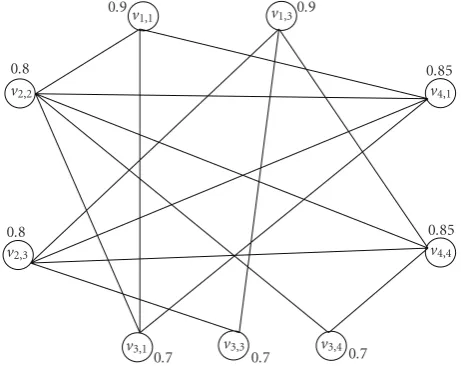
For example, after the whole 4 native packets are sent, the
“wanted” packet set inFigure 2(b) can be constructed into
Figure 3. Thus, the encoding decision for recovery process at
0.9
Figure3: Graph model.
t5is then converted into finding a maximum weight clique in
such a graph. As shown inFigure 3, the clique that consists
of{v1,1,v2,2,v3,1,v4,1}is the clique with the maximum weight
0.9 + 0.8 + 0.7 + 0.85 = 3.25. After the encoded packet
d1⊕d2is sent, active receiversp1,p2,p3,p4can decode out
d1,d2,d1,d1, respectively, if all sensors successfully receive
d1⊕d2.
5.2. Algorithm Design. Assume that the total number of
vertices in G(V,E) is N. We first sort all vertices into
nonincreasing order according to wi,j. For the example
given in Figure 3, vertices in G will be sorted into V =
{v1,1,v1,3,v4,1,v4,4,v2,2,v2,3,v3,1,v3,3,v3,4}.
For the simplicity of presentation, we abuse the
notation a little bit and assign a unique id vk for each
vertex in G, which uses one-dimensional subscript for
vertices in G instead of using two-dimensional subscripts.
Correspondingly, we use wk to denote the weight of vk.
Thus, for the example given in Figure 3, we have V =
{v1(v1,1),v2(v1,3),v3(v4,1),v4(v4,4),v5(v2,2),v6(v2,3),v7(v3,1),
v8(v3,3),v9(v3,4)}. Without loss of generality, we assume that
V= {v1,v2,. . .,vN}wherew1≥w2≥ · · · ≥wN.
LetQibe the clique with maximum weight in the
sub-graph which only contains vertices ofSi = {vi,vi+1,. . .,vN}
and let C(Qi) be the weight of cliqueQi. In other words,
Qirepresents the maximum weight clique the algorithm has
found considering of the subgraph consisting of vertices
{vi,vi1,. . .,vN}. The algorithm starts with i = N and
iteratively considers more vertices until all vertices inGare
considered. The algorithm stops whenQ1is found.
Functionwclique(Si,C(Qi),i)
Algorithm1: Maximum weight clique algorithm.
and updateSi−1, that is,Si−1=Si−1∩N(vj). IfSi−1is still not
∅, we then add another vertex whose index is the smallest in
Si−1into the cliqueQi−1. We repeat this process until there is
no vertex inSi−1, that is,Si−1= ∅. By comparing the weight
of the cliqueQiwithout includingvi−1and the weight of the
cliqueQi−1 includingvi−1, the cliqueQi−1 with maximum
weight in the subgraph including vertices in{vi−1,vi,. . .,vN}
is set to be the one with the larger weight. The detail of the
algorithm is given inAlgorithm 1. After this algorithm,Q1
gives all vertices in the found maximum weight clique. All
native packets involved inQ1 will be encoded together and
be sent out at current time slot.
We now show how to find the maximum weight clique
of the graph shown inFigure 3. Assume that Q2 has been
found, which consists of{v2,v4,v6}. Next, we will consider
Q1. Since {v1} ∪Q2 is not a clique, we need to find Q1
which includes vertexv1in the subgraph consisting ofS1 =
{v1,v2,. . .,v9}. The corresponding steps for finding suchQ1
is given inAlgorithm 2wherevk(vi1,j1) inV denotes that we
use a unique idvk in the algorithm to replace the original
vertexvi1,j1. AfterQ1is found, we compare it withQ2which
In this section, we firstly analyze the impact of packet loss probability and sleep probability on network coding gain. Then, we derive a threshold to decide whether the current sleep scheduling can save energy compared with no sleep scheduling. We only limit the analysis to one cluster in the multihop cluster hierarchy.
6.1. Impact of Packet Loss Probability and Sleep Probability on Network Coding Gain. Suppose thatNais the number of
transmissions that the data dissemination process requires
without coding and Nb is the number of transmissions
required with XORs coding. Assume that the probability that
receiver piis in sleep mode issi at each time slot, andli is
the probability that receiver pi can not successfully receive
a packet even when it is in active mode due to unreliable wireless communication. We have the following two lemmas.
Lemma 1. The total number of transmissions without coding required for transmitting sufficient large M packets to n receivers is Proof. SeeAppendix A.
Lemma 2. The total number of transmissions with XORs coding for transmitting sufficient largeMpackets tonreceivers is
Nb= M
mini∈{1,2,...,n}{(1−li)(1−si)}.
(9)
Proof. SeeAppendix B.
With the analytical result of Na andNb, we can define
analytical network coding gain as
γ=Na−Nb
1.4035 M. Then, the analytical network coding gain isγ =
0.1433.
From Lemmas1and2, we can also obtain the following
corollary.
Corollary 1. With two receivers, the maximum network coding gainγcan be achieved ifl1=l2, that is,(1−l1)(1−s1)=
(1−l2)(1−s2).
V= {v1(v1,1),v2(v1,3),v3(v4,1),v4(v4,4),v5(v2,2),v6(v2,3),v7(v3,1),v8(v3,3),v9(v3,4)}
Step 1:
Q1= {v1},S1= {v1,v2,v3,v4,v5,v6,v7,v8,v9},N(v1)= {v4,v5,v7} C(Q1)=0.9 S1=S1∩N(v1)= {v3,v5,v7} vj=v3
Q1=Q1∪ {v3} = {v1,v3} C(Q1)=0.9 + 0.85=1.75
Step 2:
N(v3)= {v1,v5,v6,v7}
S1=S1∩N(v3)= {v5,v7} vj=v5
Q1=Q1∪ {v5} = {v1,v3,v5} C(Q1)=1.75 + 0.8=2.55
Step 3:
N(v5)= {v1,v3,v4,v7,v9}
S1=S1∩N(v5)= {v7} vj=v7
Q1=Q1∪ {v7} = {v1,v3,v5,v7} C(Q1)=2.55 + 0.7=3.25
Step 4:
N(v7)= {v1,v3,v5} S1=S1∩N(v5)=Φ
Terminate;
Algorithm2: The steps of findingQ1.
6.2. Impact of Sleep Probability on Energy Consumption. Though sleep scheduling can save energy consumption due to idle listening, sensors in sleep mode cannot receive data packets, which imposes retransmission and may consume
more energy. If sensor pi is active attth time slot, we say
that tth time slot is an active time slot for sensor pi. We
know that only at its active time slot, sensorpiconsumes its
energy. Thus, we can use the total number of active time slots consumed for the sensors to successfully receive the whole set of packets as the energy consumption for data dissemination.
We define a threshold as follows:
ε=
n
i=1
(1−si)− n
lmin
min
i∈{1,2,...,n}{(1−li)(1−si)}, (11)
wherelmin=1−maxi∈{1,2,...,n}{li}.
Then, we have the following lemma.
Lemma 3. In XORs coding, ifε <0, the current sleep schedul-ing can save energy consumed by idle listenschedul-ing; otherwise, the current sleep scheduling has no contribution to energy saving.
Proof. SeeAppendix D.
Take two receivers with l1 = 0.23, s1 = 0.15, l2 =
0.27,s2 = 0.18 as an example, according to (11), we have
ε > 0. Thus, the energy saving with sleep scheduling is
offsetted by more retransmissions. In this case, the cluster
head should wake up more sensors. An interesting problem is how to design an optimal sleep scheduling such that energy
saving of sleep scheduling will not be offsetted by more
retransmission, which is out of the scope of this paper.
7. Simulation Results
In this section, we demonstrate the effectiveness of our
dissemination schemes through simulations using C++ simulator. In our simulations, a multihop cluster hierarchical
WSN is randomly generated with the fixed value of the number of sensors if without specification. We group the
packets required to send into batches, and each batch hasM
packets. Recovery process with network coding starts after
every M native packets are transmitted. In a cluster, we
randomly generate sensorpi’s sleep scheduling according to
its sleeping probabilitysi.
To demonstrate the advantage of our coding scheme,
we introduce two baseline algorithms, namely,
dissemi-nation without coding algorithm and dissemination with random coding algorithm. Dissemination without coding algorithm randomly transmits a native “wanted” packet at each time slot until all receivers obtain their “wanted” data
packets while dissemination with random coding algorithm
transmits an XORs packet which is randomly generated at each time slot until all receivers obtain their “wanted” packets.
In the simulation, we are interested in evaluating the performance of our coding schemes from the following perspectives.
(i) The number of active receivers that can obtain a new “wanted” packet at one time slot and the total number of transmissions required in one batch data dissemination within one cluster.
(ii) The impact of the number of receiver sensorsn, batch
sizeM, sleep probability and packet loss probability
on the network coding gain under different
dissemi-nation schemes within one cluster.
(iii) How close the performance of our proposed algo-rithms is to the derived analytical results within one cluster.
(iv) The impact of the thresholdαon the delay and the
total number of transmissions required in a multihop cluster hierarchy.
5
Number of active receiver nodes Dissemination with our coding scheme Dissemination with random coding Dissemination without coding
Figure4: The number of receivers that can obtain a new “wanted” packet at a time slot versus the number of receiver nodes.
7.1. Comparison with Different Data Dissemination Schemes.
The effectiveness of our coding scheme for maximizing the
expected number of sensors that can obtain one “wanted” packet at one time slot is demonstrated by comparing with dissemination without coding algorithm and dissemination with random codingalgorithm.
We evaluate the performance of our algorithms by varying the number of active sensors within a cluster at one
time slot in the range of [10, 40] forM =50, andli =0.2.
As shown inFigure 4, the number of active sensors that can
obtain one “wanted” packet by our coding scheme is much
more than that by dissemination without codingalgorithm
and dissemination with random codingalgorithm.
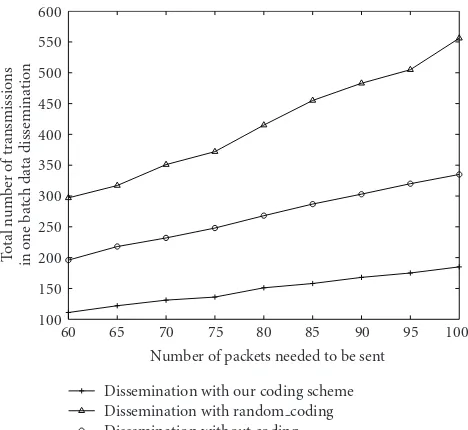
For one batch data dissemination process within a cluster, to demonstrate the performance of our coding scheme, the total number of transmissions required is also compared
with the other two baseline algorithms: dissemination
without coding and dissemination with random coding algorithms. We vary the number of packets needed to be sent
in the range of [60, 100] for n = 10, si = 0.3,li = 0.2.
As shown in Figure 5, the total number of transmissions
required in one batch dissemination by our coding scheme
is much less than that by dissemination without coding
and dissemination with random coding algorithms. Hence, for data dissemination with a large set of packets, our
XORs coding scheme can efficiently decrease the number of
transmissions required. Thus, more energy can be saved.
7.2. Network Coding Gain Comparison with Analytical Results.
We demonstrate the effectiveness of the proposed network
coding algorithm by comparing the network coding gain obtained through simulation with the analytical network coding gain.
Number of packets needed to be sent Dissemination with our coding scheme Dissemination with random coding Dissemination without coding
Figure5: Total number of transmissions versus number of packets needed to be sent.
We start with a simple experiment where there are only
two members sensors in a cluster. We fixl1 to 0.2 and vary
l2 in the range of [0.1, 0.4] forn = 2,si = 0.3,M = 100.
As shown inFigure 6(a), the network coding gain obtained
by our simulation follows the same trend as the analytical results. In addition, the maximum network coding gain is
achieved whenl1=l2=1−(1−0.2)(1−0.3)=0.44 with both
our simulation results and analytical results, which verifies Corollary 1. Whenl1 =l2, most likely the “wanted” packets
at one receiver are the packets available at another receiver, thus, coding opportunity is high, which achieves maximum network coding gain.
We also extend the simulation to 10 receivers in a cluster.
The loss probability ofp1is varied along the x-axis forM =
100;si =0.2, 1≤i≤5;si =0.3, 6≤i≤10 andl2=l3 =
l1+ 0.02,l4=l5=l1+ 0.04,l6=l7=l1+ 0.06,l8=l1+ 0.08,
l9 =l10 =l1+ 0.1. As shown inFigure 6(b), the simulation
results are very close to the analytical results. In addition, Figure 6verifies that network coding indeed can bring gains on reducing the number of transmissions required.
In Figure 7, we vary the sleep probability at sensors,
similar results asFigure 6can be observed and the network
coding gain obtained through simulations is quite close to the analytical results.
7.3. The Impact of Sleep Scheduling on Energy Saving. We now study the impact of sleep scheduling on the energy consump-tion. Our simulation is conducted within one cluster. We use the total number of active time slots consumed to denote the energy consumption in data dissemination process.
Suppose that XORs coding is applied. Letηsbe the total
number of active time slots consumed for data dissemination
with sleep scheduling andηns be the total number of
0.15 Lost probability ofp2
Analytical results Lost probability ofp1
Analytical results Simulation results
l2=l3=l1+ 0.02,l4=l5=l1+ 0.04,l6=l7=l1+
0.06,l8=l1+ 0.08,l9=l10=l1+ 0.1
(b) Withn=10
Figure6: Network coding gain versus packet loss probability of sensor.
0.13 Sleep probability ofp2
Analytical results Sleep probability ofp1
Analytical results Simulation results
s2=s3=l4=s5=s1+ 0.04,s6=s7=s8=s9=s10=s1+ 0.08
(b) Withn=10
Figure7: Network coding gain versus sleep probability of sensor.
The energy saving in XORs coding with sleep scheduling over that without sleep scheduling is
δ=ηns−ηs
ηns .
(12)
For data dissemination without coding, we can define energy saving with sleep scheduling over that without sleep scheduling in a similar way.
We evaluate the performance of our algorithm by varying
s2in [0, 0.3] forn=2,l1=0.1,l2=0.25,s1=0.15,M=50.
As shown inFigure 8, the simulation results are very close to
the analytical results.
For our XORs coding, from the figure, we know that the energy consumption with sleep scheduling is less than that
without sleep scheduling when s2 is less than 0.15. When
s2 = 0.15, the energy consumption with sleep scheduling
is equal to that without sleep scheduling. Whens2 is larger
−0.1 Sleep probability ofp2
Analytical results with XORs coding Horizontal line
Simulation with XORs coding Analytical results without coding Simulation without coding
l1=0.1,l2=0.25,s1=0.15
Figure8: Energy saving versus sleep probability of sensorp2.
since when the number of sleep sensors becomes larger, more retransmissions are required, which imposes more energy consumption. In this case, the energy saving with
sleep scheduling is offsetted by more retransmissions, which
means that the thresholdε > 0 and the cluster head should
wake up more sensors to receive packets in order to save energy.
7.4. The Impact of Threshold α on the Delay and the Total Number of Transmissions Required. We now study the impact
of thresholdαon the delay of the data dissemination process
in a multihop cluster hierarchical WSN. The thresholdαis
varied in the range of [0.2, 1.0] forM =30, 40, 50.Figure 9
gives the delay required for data dissemination when the number of layers is 5 and 6, respectively. We can see that
the delay increases with the thresholdα. This is because the
cluster heads need to wait more time before they can transmit their available packets to their members with the increasing
ofα. Thus, the cluster heads in down layers can do nothing
for a long time. Specifically, whenα= 1, each cluster head
cannot transmit its available packets until receiving all M
packets. In this case, concurrent transmissions cannot be allowed even if there is no collision between them, which
thus increases the delay. FromFigure 9, we can also see that
the delay increases with the number of layers, because the number of receivers increases with the number of layers.
We further study the impact of the thresholdαon the
total number of transmissions required under a multihop
cluster hierarchical WSN. The thresholdαis also varied in the
range of [0.2, 1.0] forM=30, 40, 50. As shown inFigure 10,
the total number of transmissions required decreases with
the thresholdα. Whenαis small, the cluster heads transmit
the packets to their members more quickly. Therefore, the
number of fresh packets available at cluster heads is small, which can not fully utilize the network coding gain. Hence, the total number of transmissions required is more than with
larger thresholdα.
8. Conclusion
This paper studies data dissemination in wireless sensor
networks with network coding to achieve energy efficiency.
In order to quickly complete the whole process of data dissemination, at each time slot in the recovery process, we aim to transmit an encoded packet such that the expected number of active sensors that can decode out one “wanted” packet is maximized. A maximum weight clique model is proposed here to achieve such an objective. We further study the impact of packet loss probability and sleep probability on network coding gain. We also analyze the impact of sleep probability on energy saving gain and derive a threshold which can be used to decide whether the current
sleep scheduling is effective on energy saving or not. The
simulation results verify the work proposed in the paper.
Appendices
A. Proof of
Lemma 1
According to [8], we can obtain that the total num-ber of transmissions without coding to successfully deliver
sufficient large M packets to n receivers is i1,i2,...,in
((−1)i1+i2+···+in−1/(1−(l
1)i1(l2)i2· · ·(ln)in))M, where each
receiver keeps in active mode during data transmission process.
However, in the data dissemination process, receiver
sensor pi may be in sleep mode and can not successfully
receive a packet. Therefore, the probability that sensorpican
successfully receive the packet at any time slot is (1−li)(1−si).
In other words, the probability that sensor pi will lose the
packet is 1−(1−li)(1−si). Thus, considering sleep scheduling,
the total number of transmissions required without coding is
Na=
From [8], we know that the total number of transmissions
with XORs coding to successfully deliver sufficient largeM
packets tonreceivers isM/(1−maxi∈{1,2,...,n}{li}), where each
receiver keeps in active mode during the data transmission process.
As in Appendix A , the probability that sensor pi can
not successfully receive the packet with sleep scheduling is
250
(a) Hierarchy with 5 layers
250
(b) Hierarchy with 6 layers
Figure9: The total delay (time units) versus the thresholdα.
1400
(a) Hierarchy with 5 layers
3000
(b) Hierarchy with 6 layers
Figure10: The total number of transmissions required versus the thresholdα.
of transmissions required with XORs coding to transmit
sufficient largeMpackets tonreceivers is
Nb= M
C. Proof of
Corollary 1
With two receivers, from Lemma 1, the total number of
transmissions required forMpackets without coding isNa=
M/(1−l1) +M/(1−l2)−M/(1−l1l2), and fromLemma 2,
the total number of transmissions with XORs coding isNb=
M/min{1−l1, 1−l2}, whereli=1−(1−li)(1−si).
Without loss of generality, suppose thatl1 ≥l2andl2 =
γ=Na−Nb
easily prove that f(β) is an increasing function. Thus, when
βis 1, the value of functionf(β) is maximum. That is when
l1=l2, the network coding gainγis maximum, which proves
ourCorollary 1.
D. Proof of
Lemma 3
From the analysis in the previous section, we can see that the total number of active time slots consumed for data dissemination with XORs coding is
ηs=Nb
wheresiis the probability that sensor piis in sleep mode at
each time slot.
However, if there is no sleep scheduling at sensors, that is
si =0, the total number of transmissions for disseminating
sufficient largeMpackets tonreceivers with XORs coding is
Nb=
M
1−maxi∈{1,2,...,n}{li}.
(D.5)
Since no sensors are in sleep mode, the total number of active time slots consumed for disseminating packets with XORs coding is
sleep scheduling has contribution to save energy consumed byidle listening, otherwise, the retransmission due to sleep scheduling in sensors imposes more energy consumption.
The aboveηs< ηnschanges into
Thus, if (D.8) can be satisfied, the current sleep schedul-ing must have contribution to save energy compared with no sleep scheduling.
Acknowledgment
This paper is supported by the National Science Foundation of China under Grant no. 60773036.
References
[1] J. W. Hui and D. Culler, “The dynamic behavior of a data dissemination protocol for network programming at scale,” in Proceedings of the 2nd International Conference on Embedded Networked Sensor Systems (SenSys ’04), pp. 81–94, Baltimore, Md, USA, November 2004.
[2] C.-J. M. Liang, R. Musˇaloiu-E., and A. Terzis, “Typhoon: a reliable data dissemination protocol for wireless sensor networks,” inProceedings of the 5th European Conference on Wireless Sensor Networks (EWSN ’08), vol. 4913 of Lecture Notes in Computer Science, pp. 268–285, January 2008. [3] C.-Y. Wan, A. T. Campbell, and L. Krishnamurthy, “PSFQ: a
reliable transport protocol for wireless sensor networks,” in Proceedings of the 1st ACM International Workshop on Wireless Sensor Networks and Applications, pp. 1–11, Atlanta, Ga, USA, September 2002.
[4] S. S. Kulkarni and L. Wang, “MNP: multihop network repro-gramming service for sensor networks,” inProceedings of the 25th IEEE International Conference on Distributed Computing Systems (ICDCS ’05), pp. 7–16, June 2005.
[5] G. Lu, N. Sadagopan, B. Krishnamachari, and A. Goel, “Delay efficient sleep scheduling in wireless sensor networks,” in Proceedings of the 24th IEEE Annual Joint Conference of the Computer and Communications Societies (INFOCOM ’05), vol. 4, pp. 2470–2481, Miami, Fla, USA, 2005.
[6] W. Ye, J. Heidemann, and D. Estrin, “An energy-efficient MAC protocol for wireless sensor networks,” inProceedings of the 21st IEEE Annual Joint Conference of the Computer and Communications Societies (INFOCOM ’02), vol. 3, pp. 1567– 1576, 2002.
[7] A. Cerpa, J. L. Wong, L. Kuang, M. Potkonjak, and D. Estrin, “Statistical model of lossy links in wireless sensor networks,” in Proceedings of the 4th International Symposium on Information Processing in Sensor Networks (IPSN ’05), pp. 81–88, Los Angeles, Calif, USA, 2005.
[8] D. Nguyen, T. Tran, T. Nguyen, and B. Bose, “Wireless broad-cast using network coding,”IEEE Transactions on Vehicular Technology, vol. 58, no. 2, pp. 914–925, 2009.
[9] S. Y. El Rouayheb, M. A. R. Chaudhry, and A. Sprintson, “On the minimum number of transmissions in single-hop wireless coding networks,” in Proceedings of the IEEE Information Theory Workshop (ITW ’07), pp. 120–125, Tahoe City, Calif, USA, September 2007.
[10] C. Zhan, Y. Xu, J. Wang, and V. Lee, “Reliable multicast in wireless networks using network coding,” inProceedings of the 6th International Conference on Mobile Adhoc and Sensor Systems (MASS ’09), pp. 506–515, Macau, China, 2009. [11] R. Ahlswede, N. Cai, S.-Y. R. Li, and R. W. Yeung, “Network
[12] C. Fragouli and E. Soljanin, “Information flow decomposition for network coding,”IEEE Transactions on Information Theory, vol. 52, no. 3, pp. 829–848, 2006.
[13] C. Fragouli, J.-Y. Le Boudec, and J. Widmer, “Network coding: an instant primer,”Computer Communication Review, vol. 36, no. 1, pp. 63–68.
[14] S. Deb, M. Effros, and T. Ho, “Network coding for wireless applications: a brief tutorial,” inProceedings of the Interna-tional Workshop on Wireless Adhoc Networks (IWWAN ’05), May 2005.
[15] M. Ghaderi, D. Towsley, and J. Kurose, “Reliability gain of network coding in lossy wireless networks,” in Proceedings of the 27th IEEE Conference on Computer Communications (INFOCOM ’08), pp. 2171–2179, Phoenix, Ariz, USA, April 2008.
[16] Y. Lin, B. Liang, and B. Li, “Data persistence in large-scale sensor networks with decentralized fountain codes,” inProceedings of the 26th IEEE International Conference on Computer Communications (INFOCOM ’07), pp. 1658–1666, Anchorage, Alaska, USA, May 2007.
[17] I.-H. Hou, Y.-E. Tsai, T. F. Abdelzaher, and I. Gupta, “Adap-Code: adaptive network coding for code updates in wireless sensor networks,” inProceedings of the 27th IEEE Conference on Computer Communications (INFOCOM ’08), pp. 1517–1525, Phoenix, Aariz, USA, 2008.
[18] S. Katti, H. Rahul, W. Hu, D. Katabi, M. Medard, and J. Crowcroft, “XORs in the air: practical wireless network coding,”IEEE/ACM Transactions on Networking, vol. 16, no. 3, pp. 497–510, 2008.
[19] S. Rayanchu, S. Sen, J. Wu, S. Baneriee, and S. Senqupta, “Loss-aware network coding for unicast wireless sessions: design, implementation, and performance evaluation,” inProceedings of the ACM International Conference on Measurement and Modeling of Computer Systems (SIGMETRICS ’08), pp. 85–96, Annapolis, Md, USA, 2008.
[20] F.-C. Kuo, K. Tan, X. Y. Li, J. Zhang, and X. Fu, “XOR rescue: exploiting network coding in lossy wireless networks,” inProceedings of the 6th Annual IEEE Communications Society Conference on Sensor, Mesh and Ad Hoc Communications and Networks (SECON ’09), pp. 1–9, Rome, Italy, June 2009. [21] S. Banerjee and S. Khuller, “A clustering scheme for
hier-archical control in wireless networks,” inProceedings of the 20th IEEE Annual Joint Conference of the Computer and Communications Societies (INFOCOM ’01), pp. 1028–1037, 2001.
[22] K. Iwanicki and M. Van Steen, “Multi-hop cluster hierarchy maintenance in wireless sensor networks: a case for gossip-based protocols,” inProceedings of the 6th European Conference on Wireless Sensor Networks, pp. 102–117, Springer, Cork, Ireland, February 2009.
[23] G. Hartl and B. Li, “Loss inference in wireless sensor networks based on data aggregation,” inProceedings of the 3rd International Symposium on Information Processing in Sensor Networks (IPSN ’04), pp. 396–404, April 2004.