R E S E A R C H
Open Access
Interval-valued functional integro-differential
equations
Ngo Van Hoa
1, Nguyen Dinh Phu
2, Tran Thanh Tung
3*and Le Thanh Quang
2*Correspondence:
[email protected]; [email protected]
3Faculty of Natural Science and
Technology, Tay Nguyen University, 567 Le Duan Road, Buon Ma Thuot City, Daklak Province, Vietnam Full list of author information is available at the end of the article
Abstract
This paper is devoted to studying the local and global existence and uniqueness results for interval-valued functional integro-differential equations (IFIDEs). In the paper, for the local existence and uniqueness, the method of successive
approximations is used and for the global existence and uniqueness, the contraction principle is a good tool in investigating. Some examples are given to illustrate the results.
MSC: 34G20; 34A12; 34K30
Keywords: interval-valued differential equations; generalized Hukuhara derivative; functional integro-differential equations
1 Introduction
Functional differential equations (or, as they are called, delay differential equations) play an important role in an increasing number of system models in biology, engineering, physics and other sciences. There exists an extensive amount of literature dealing with functional differential equations and their applications; the reader is referred to the monographs [–] and the references therein.
The set-valued differential and integral equations are an important part of the theory of set-valued analysis. They have an important value in theory and application in con-trol theory; and they were studied in by De Blasi and Iervolino []. Recently, set-valued differential equations have been studied by many authors due to their application in many areas. For many results in the theory of set-valued differential and integral equa-tions, the readers can be referred to the following books and papers [–] and the ref-erences therein. The interval-valued analysis and interval-valued differential equations (IDEs) are the particular cases of the set-valued analysis and set differential equations, re-spectively. In many cases, when modeling real-world phenomena, information about the behavior of a dynamic system is uncertain, and we have to consider these uncertainties to gain more models. The interval-valued differential and integro-differential equations can be used to model dynamic systems subject to uncertainties. Recently, many works have been done by several authors in the theory of interval-valued differential equations (see, e.g., [–]). These equations can be studied with a framework of the Hukuhara derivative []. However, it causes that the solutions have increasing length of their values. Stefanini and Bede [] proposed to consider the so-called strongly generalized derivative of interval-valued functions. The interval-valued differential equations with this
tive can have solutions with decreasing length of their values. This approach was the start-ing point for the topic of interval-valued differential equations (see [, ]). Besides that, some very important extensions of the interval-valued differential equations are the set differential equations (see [, , –, , , , , –]).
The connection between the fuzzy analysis and the interval analysis is very well known (Moore and Lodwick []). Interval analysis and fuzzy analysis were introduced as an attempt to handle interval uncertainty that appears in many mathematical or com-puter models of some deterministic real-world phenomena. Based on the results in [], there are some very important extensions, and the development related to the subject of the present paper is in the field of fuzzy sets, i.e., fuzzy calculus and fuzzy differ-ential equations under generalized Hukuhara derivative. Recently, several works, e.g., [, , , , –], have been done on fuzzy differential equations and fuzzy integro-differential equations, the fuzzy stochastic integro-differential equations [–], fractional fuzzy differential equations [, –], and some methods for solving fuzzy differential equa-tions [, ].
In the papers [–], one can find the studies on interval-valued differential equations under generalized Hukuhara differentiability,i.e., equations of the form
DgHX(t) =Ft,X(t), X(t) =X∈KC(R), t∈[t,t+p], (.)
whereDgHdenotes two kinds of derivatives, namely the classical Hukuhara derivative and the second-type Hukuhara derivative (generalized Hukuhara differentiability). The exis-tence and uniqueness of a Cauchy problem is then obtained under an assumption that the coefficients satisfy a condition with the Lipschitz constant (see []). The proof is based on the application of the Banach fixed point theorem. In [], under the gener-alized Lipschitz condition, Malinowski obtained the existence and uniqueness of solu-tions to both kinds of IDEs. In this paper, we study two kinds of solusolu-tions to IFIDEs. The different types of solutions to IFIDEs are generated by the usage of two different con-cepts of interval-valued derivative. Furthermore, in [], Lupulescu established the local and global existence and uniqueness results for fuzzy functional differential equations. Malinowski [] studied the existence and uniqueness result of solution to the delay set-valued differential equations under the condition that the right-hand side of an equation is Lipschitzian in the functional variable. Inspired and motivated by the results of Ste-fanini and Bede [], Malinowski [, ] and Lupulescu [], we consider the interval-valued functional integro-differential equations under generalized Hukuhara derivative. The paper is organized as follows. As preliminaries, we recall some basic concepts and notations about interval analysis and interval-valued differential equations. In Section , we present the local and global existence and uniqueness theorem of solution of IFIDEs under generalized Hukuhara derivatives. In the last section, we give some examples as simple illustrations of the theory of interval-valued functional integro-differential equa-tions.
2 Preliminaries
Let us denote byKC(R) the set of any nonempty compact intervals of the real lineR. The
A= [A,A],B= [B,B], whereA≤A,B≤B, andλ≥, then we have
A+B= [A+B,A+B], λA= [λA,λA] –λA= [–λA, –λA].
Furthermore, let A∈KC(R), λ,λ,λ,λ,∈R andλλ ≥, then we have λ(λA) = (λλ)Aand (λ+λ)A=λA+λA. LetA,B∈KC(R) as above, the Hausdorff metricHin
KC(R) is defined as follows:
H[A,B] =max|A–B|,|A–B|. (.)
It is known that (KC(R),H) is a complete, separable and locally compact metric space. We
define the magnitude and the length ofA∈KC(R) by
H[A, ] =A=max|A|,|A|, len(A) =A–A,
respectively, where is the zero element ofKC(R) which is regarded as one point.
The Hausdorff metric (.) satisfies the following properties:
H[A+C,B+C] =H[A,B] and H[A,B] =H[B,A],
H[A+B,C+D]≤H[A,C] +H[B,D],
H[λA,λB] =|λ|H[A,B]
for allA,B,C,D∈KC(R) andλ∈R. LetA,B∈KC(R). If there exists an intervalC∈KC(R)
such thatA=B+C, then we callCthe Hukuhara difference ofAandB. We denote the intervalCbyAB. Note thatAB=A+ (–)B. It is known thatABexists in the case
len(A)≥len(B). Besides that, we can see the following properties forA,B,C,D∈KC(R)
(see []):
- IfAB,ACexist, thenH[AB,AC] =H[B,C]; - IfAB,CDexist, thenH[AB,CD] =H[A+D,B+C];
- IfAB,A(B+C)exist, then there exist(AB)Cand(AB)C=A(B+C); - IfAB,AC,CBexist, then there exist(AB)(AC)and
(AB)(AC) =CB.
Definition . We say that the interval-valued mappingX: [a,b]⊂R+→K
C(R) is
con-tinuous at the pointt∈[a,b] if for everyε> there existsδ=δ(t,ε) > such that
HX(t),X(s)≤ε
for alls∈[a,b] with|t–s|<δ.
The strongly generalized differentiability was introduced in [] and studied in [, , , , –].
Definition . LetX: (a,b)→KC(R) andt∈(a,b). We say thatXis strongly generalized
(i) for allh> sufficiently small,∃X(t+h)X(t),∃X(t)X(t–h)and
lim hH
X(t+h)X(t)
h ,D
g
HX(t) = ,
lim hH
X(t)X(t–h)
h ,D
g
HX(t) = ,
or
(ii) for allh> sufficiently small,∃X(t)X(t+h),∃X(t–h)X(t)and
lim hH
X(t)X(t+h)
–h ,D
g
HX(t) = ,
lim hH
X(t–h)X(t)
–h ,D
g
HX(t) = ,
or
(iii) for allh> sufficiently small,∃X(t+h)X(t),∃X(t–h)X(t)and
lim hH
X(t+h)X(t)
h ,D
g
HX(t) = ,
lim hH
X(t–h)X(t)
–h ,D
g
HX(t) = ,
or
(iv) for allh> sufficiently small,∃X(t)X(t+h),∃X(t)X(t–h)and the limits
lim hH
X(t)X(t+h)
–h ,D
g
HX(t) = ,
lim hH
X(t)X(t–h)
h ,D
g
HX(t) =
(hat denominators meansh).
In this definition, case (i) ((i)-differentiability for short) corresponds to the classical H-derivative, so this differentiability concept is a generalization of the Hukuhara deriva-tive. In this paper we consider only the two first of Definition .. In the other cases, the derivative is trivial because it is reduced to a crisp element (more precisely,DgHX(t)∈R). Further, we say thatXis (i)-differentiable or (ii)-differentiable on [a,b], if it is differentiable in the sense (i) or (ii) of Definition ., respectively.
Theorem . Let X: (a,b)→KC(R)be(i)-differentiable or(ii)-differentiable on(a,b),and
assume that the derivative DgHX is integrable over(a,b).We have (a) ifXis(i)-differentiable on(a,b),thenabDHgX(t)dt=X(b)X(a); (b) ifXis(ii)-differentiable on(a,b),thenabDHgX(t)dt= (–)(X(a)X(b)). Provided that,the above Hukuhara differences exist.
Lemma .(see [–]) Assume that F: [t,t+p]×KC(R)→KC(R)is continuous.
The interval-valued differential equation(.)is equivalent to one of the following integral equations:
X(t) =X(t) + t
t
if X is(i)-differentiable,and
X(t) =X(t)(–) t
t
Fs,X(s)ds, ∀t∈[t,t+p]
if X is(ii)-differentiable,provided that the H-difference exists.
The following well-known result is useful in the next section.
Lemma . Let a(t),b(t)and c(t)be real-valued nonnegative continuous functions defined onR+,d≥is a constant for which the inequality
a(t)≤d+ t
b(s)a(s) +b(s) s
c(r)a(r)dr ds (.)
holds for all t∈R+.Then
a(t)≤d
+
t
b(s)exp
s
b(r) +c(r)dr
ds .
Corollary .(see [–]) Let X: [t,t+p]→KC(R)be given.Denote X(t) = [X(t),X(t)]
for t∈[t,t+p],where X,X: [t,t+p]→R.
(i) If the mappingXis(i)-differentiable(i.e.,classical Hukuhara differentiable)at t∈[t,t+p],then the real-valued functionsX,Xare differentiable attand DgHX(t) = [X(t),X(t)].
(ii) If the mappingXis(ii)-differentiable att∈[t,t+p],then the real-valued functions X,Xare differentiable attandDgHX(t) = [X(t),X(t)].
3 Main results
For a positive numberσ, we denote byCσ =C([–σ, ],KC(R)) the space of continuous
mappings from [–σ, ] toKC(R). Define a metricHσ inCσ by
Hσ[X,Y] = sup
t∈[–σ,]
HX(t),Y(t).
Letp> . DenoteI= [t,t+p],J= [t–σ,t]∪I= [t–σ,t+p]. For anyt∈I, denoteXt
by the element ofCσ defined byXt(s) =X(t+s) fors∈[–σ, ].
Let us consider the interval-valued functional integro-differential equations (IFIDEs) with the generalized Hukuhara derivative under the form
DgHX(t) =F(t,Xt) +
t
tG(t,s,Xs)ds, t≥t, X(t) =ϕ(t–t) =ϕ, t≥t≥t–σ,
(.)
whereF:I×Cσ →KC(R),G:I×I×Cσ →KC(R),ϕ∈Cσ and the symbolDgHdenotes
the generalized Hukuhara derivative from Definition .. By a solution to equation (.) we mean an interval-valued mappingX∈C(J,KC(R)) that satisfies X(t) =ϕ(t–t) for t∈[t–σ,t],Xis differentiable on [t,t+p] andDgHX(t) =F(t,Xt) +
t
Lemma . Assume that F ∈ C(I ×Cσ,KC(R)), G∈ C(I ×I × Cσ,KC(R)) and X ∈
C(J,KC(R)).Then the interval-valued mapping t→F(t,Xt) +
t
tG(t,s,Xs)ds belongs to C(I,KC(R)).
Remark . Under assumptions of the lemma above, the mappingt→F(t,Xt) +
t tG(t,s, Xs)dsis integrable over the intervalI.
Remark . If F:I×Cσ →KC(R),G:I×I×Cσ →KC(R) are continuous andX∈
C(J,KC(R)), then the mappingt→F(t,Xt) +
t
tG(t,s,Xs)dsis bounded onI. Also, the functiont→F(t, ) +ttG(t,s, )dsis bounded onI.
Lemma . Assume that F:I×Cσ →KC(R),G:I×I×Cσ →KC(R)are continuous.An
interval-valued mapping X:J→KC(R)is called a local solution to problem(.)on J if
and only if X is a continuous interval-valued mapping and it satisfies one of the following interval-valued integral equations:
(S)
X(t) =ϕ(t–t) for t∈[t–σ,t], X(t) =ϕ() +tt
(F(s,Xs) + t
tG(t,s,Xs)ds)ds, t∈I,
(.)
if X is(i)-differentiable,
(S)
X(t) =ϕ(t–t) for t∈[t–σ,t], X(t) =ϕ()(–)tt
(F(s,Xs) + t
tG(t,s,Xs)ds)ds, t∈I,
(.)
if X is(ii)-differentiable.We remark that in(.),the following statement is hidden:there exists the Hukuhara differenceϕ()(–)tt
(F(s,Xs) + t
tG(t,s,Xs)ds)ds.
Proof We prove the case of (ii)-differentiability, the proof of the other case being similar. Assume thatX: [t,t+p]→KC(R) is a solution to problem (.). HenceXis
(ii)-differ-entiable on [t,t+p] andDgHXis integrable as a continuous function. Applying
Theo-rem ., we obtain that
X(t) =X(t) + (–) t
t
DgHX(s)ds
for everyt∈[t,tp]. SinceX(t) =ϕ() andDgHX(s) =F(s,Xs) +
s
tG(s,τ,Xτ)dτ fors∈ [t,t+p], we easily obtain
X(t) =ϕ(t–t) fort∈[t–σ,t], X(t) =ϕ()(–)tt
(F(s,Xs) + t
tG(t,s,Xs)ds)ds, t∈I.
To show that the opposite implication is true, let us assume thatX: [t,t+p]→KC(R) is
a continuous interval-valued mapping and it satisfies equation (.). Equation (.) allows us to claim thatϕ() =X(t) and that there exists the Hukuhara difference
ϕ()(–) t
t
F(s,Xs) +
t
t
G(t,s,Xs)ds
Now, lett∈[t,t+p) andhbe such thatt+h∈[t,t+p]. We observe that
Indeed, we have by direct computation
X(t+h) + (–)
Similarly to (.), we can obtain
X(t–h)X(t) = (–) by Definition . thatXis (ii)-differentiable, and consequently
Proceeding as above, we can obtain
lim h→+
X(t–h)X(t)
–h =F(t,Xt) +
t
t
G(t,s,Xs)ds.
The proof is complete.
Definition . Let X :J →KC(R) be an interval-valued function which is
(i)-differ-entiable. IfXand its derivative satisfy problem (.), we say thatXis (i)-solution of problem (.). (i)-solutionX:J→KC(R) is unique if it holdsH[X(t),Y(t)] = for anyY:J→KC(R)
which is (i)-solution of (.).
Definition . Let X:J→KC(R) be an interval-valued function which is
(ii)-differ-entiable. If X and its derivative satisfy problem (.), we say that X is (ii)-solution of problem (.). (ii)-solutionX:J→KC(R) is unique if it holdsH[X(t),Y(t)] = for any
X:J→KC(R) which is (ii)-solution of (.).
Theorem . Letϕ(t–t)∈Cσ and suppose that F∈C(I×Cσ,KC(R)),G∈C(I×I×
Cσ,KC(R))satisfy the conditions:there exists a constant L> such that
maxHF(t,X),F(t,Y),HG(t,s,X),G(t,s,Y)≤LHσ[X,Y]
for every t∈[t,t+p], (t,s)∈[t,t+p]×[t,t+p]and X,Y∈Cσ.Moreover,there
ex-ists M> such thatmax{H[F(t,X), ],H[G(t,s,X), ]} ≤M.Then the following successive approximations given by
X(t) =
ϕ(t–t), t∈[t–σ,t],
ϕ(), t∈I,
Xn+(t) =
ϕ(t–t), t∈[t–σ,t],
ϕ() +tt(F(s,Xsn) +tsG(s,τ,Xτn)dτ)ds
(.)
for the case of(i)-differentiability,and
X(t) =
ϕ(t–t), t∈[t–σ,t],
ϕ(), t∈[t,t+d],
Xn+(t) =
ϕ(t–t), t∈[t–σ,t],
ϕ()(–)tt (F(s,X
n s) +
s
tG(s,τ,X
n
τ)dτ)ds
(.)
for the case of(ii)-differentiability(where <d≤p such that equation(.)is well defined, i.e.,the foregoing Hukuhara differences do exist),converge uniformly to two unique solutions
X(t)andX(t)of(.),respectively,on[a,a+r]where r=min{p,d}.
Proof We prove that for the case of (ii)-differentiability, the proof of the other case is sim-ilar. From assumptions of the theorem, we have
HX(t),X(t)
=H
ϕ()(–) t
t
Fs,Xs+ s
t
Gs,τ,Xτ
dτ
≤
In particular, from (.) it follows that
Thus, by mathematical induction, for everyn≥, we deduce that
HXn(t+h),Xn(t)→
ash→+. A similar inequality is obtained forH[Xn(t–h),Xn(t)]→ ash→+. In the sequel, we shall show that for{Xn(t)}the Cauchy convergence condition is satisfied
uni-formly int, and as a consequence{Xn(·)}is uniformly convergent. Forn>m> , from
for everyt∈[t,t+r]. Therefore,Xis the (ii)-solution of (.), due to Lemma . it follows thatXis the (ii)-solution of (.). For the uniqueness of the (ii)-solutionX, let us assume thatX,Y∈C([t–σ,t+r],KC(R)) are two solutions of (.). By definition of the solution,
X(t) =Y(t) ift∈[t–σ,t]. Note that fort∈[t,t+r],
HX(t),Y(t)
≤L
t
t
sup
θ∈[s–σ,s]
HX(θ),Y(θ)+ s
t
sup
υ∈[τ–σ,τ]
HX(υ),Y(υ)dτ
ds.
If we puta(s) =supr∈[s–σ,s]H[X(r),Y(r)],s∈[t,t]⊂[t,t+r], then we obtain
a(t)≤L
t
t
a(s) + s
t a(τ)dτ
ds,
and by Lemma . we obtain thata(t) = on [t,t+r]. This proves the uniqueness of the
(ii)-solution for (.)
Remark . The existence and uniqueness results for solutions of problem (.) can be obtained by using the contraction principle.
Now, we present the studies and results concerning the global existence and uniqueness of two solutions for (.), each one corresponding to a different type of differentiability, by using the contraction principle, which was studied in [] for fuzzy functional differential equations. In the following, for a givenk> , we consider the setSk of all continuous
interval-valued functionsX∈C([t–σ,∞),KC(R)) such thatX(t) =ϕ(t–t) on [t–σ,t] andsupt≥t–σ{H[X(t), ]exp(–kt)}<∞. OnSkwe can define the following metric:
Hk[X,Y] = sup t≥t–σ
HX(t),Y(t)exp(–kt), (.)
wherek> is chosen suitably later. It is easy to prove that the space (Sk,Hk) of
contin-uous interval-valued functionsX: [t,∞)→KC(R) is a complete metric space with
dis-tance (.).
Theorem . Assume that
(i) F∈C([t,∞)×Cσ,KC(R)),G∈C([t,∞)×[t,∞)×Cσ,KC(R))and there exists a
constantL> such that
maxHF(t,X),F(t,Y),HG(t,s,X),G(t,s,Y)≤LHσ[X,Y]
for allX,Y∈Cσ andt,s≥t;
(ii) there existM> andb> such that
maxHF(t, ), ,HG(t,s, ), ≤Mexp(bt)
Then
(a) the interval-valued functional integro-differential equation(.)has(i)-solution on [t,∞);
(b) the interval-valued functional integro-differential equation(.)has(ii)-solution on [t,∞)if the following condition holds:
Proof Since the way of the proof is similar for both cases, we only consider the case of (ii)-differentiability forX. Note that the space (Sk,Hk) under inequality (.) depends on
the positive constantk, the functionsF,Gand the initial conditionϕ. In (Sk,Hk), the
conti-nuity ofF,Gguarantees thatSkunder inequality (.) is a closed set inC([t,∞),KC(R)),
so thatSkunder inequality (.) is a complete metric space considering the distanceHk.
We consider the complete metric space (Sk,Hk) and define an operator
T:Sk→Sk,
SinceX∈Sk, there existsρ> such thatH[X(t), ] <ρexp(kt) for allt≥t–σ. Therefore,
the Banach fixed point theorem provides the existence of a unique fixed point forT, and the unique fixed point ofTis in the spaceSk, that is, a unique solution for (.) in the case
of (ii)-differentiability.
4 Illustrations
with considering the following interval-valued functional integro-differential equation:
DgHX(t) =F(t,Xt) +
t
tk(t,s)Xsds, t∈J,
X(t) =ϕ(t–t), t∈[–σ,t], (.)
whereF:I×Cσ →KC(R),k(t,s) :I×I→R. LetX(t) = [X(t),X(t)]. By using Corollary .,
we have the following two cases.
If we consider the derivative ofX(t) by using (i)-differentiability, then from Corollary ., we haveDgHX(t) = [X(t),X(t)] fort≥t. Therefore, (.) is translated into the following delay integro-differential system:
⎧ ⎪ ⎪ ⎪ ⎪ ⎨ ⎪ ⎪ ⎪ ⎪ ⎩
X(t) =F(t,Xt,Xt) +
t
tk(t,s)Xsds, t≥t, X(t) =F(t,Xt,Xt) +
t
tk(t,s)Xsds, t≥t, X(t) =ϕ(t–t), σ≤t≤t,
X(t) =ϕ(t–t), σ≤t≤t.
(.)
If we consider the derivative of X(t) by using (ii)-differentiability, then from Corol-lary ., we haveDgHX(t) = [X(t),X(t)] fort≥t. Therefore, (.) is translated into the following delay integro-differential system:
⎧ ⎪ ⎪ ⎪ ⎪ ⎨ ⎪ ⎪ ⎪ ⎪ ⎩
X(t) =F(t,Xt,Xt) +
t
tk(t,s)Xsds, t≥t, X(t) =F(t,Xt,Xt) +
t
tk(t,s)Xsds, t≥t, X(t) =ϕ(t–t), σ≤t≤t,
X(t) =ϕ(t–t), σ≤t≤t,
(.)
where
k(t,s)Xs=
k(t,s)Xs, k(t,s)≥, k(t,s)Xs, k(t,s) < ,
k(t,s)Xs=
k(t,s)Xs, k(t,s)≥,
k(t,s)Xs, k(t,s) < .
Remark . If we ensure that the solutions (X(t),X(t)) of systems (.) and (.) respec-tively are valid sets of interval-valued functions and if the derivatives (X(t),X(t)) are valid sets of interval-valued functions with two kinds of differentiability respectively, then we can construct the solution of interval-valued functional differential equation (.).
Next, we shall consider two examples being a simple illustration for the theory of interval-valued functional integro-differential equations.
Example . Let us consider the linear interval-valued functional integro-differential equation (withk(t,s)≡) under two kinds of Hukuhara derivatives
DgHX(t) = –λX(t–),
X(t) =ϕ(t), t∈[–, ], (.)
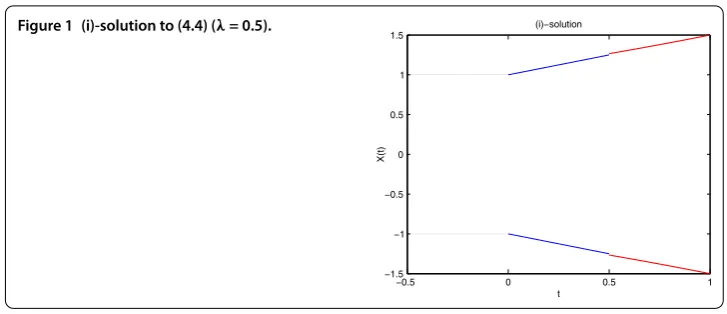
Figure 1 (i)-solution to (4.4) (λ= 0.5).
Case . Considering (i)-differentiability, problem (.) is translated into the following delay system:
⎧ ⎪ ⎪ ⎪ ⎨ ⎪ ⎪ ⎪ ⎩
X(t) = –λX(t–), t≥, X(t) = –λX(t–), t≥, X(t) = –, –
≤t≤, X(t) = , –≤t≤.
(.)
Solving delay system (.) by using the method of steps, we obtain a unique (i)-solution to (.) defined on [, ] and it is of the form
X(t) =
[–( +λt), ( +λt)] fort∈[,
], [–( +λt+λ(t–)), +λt+λ(t–)] fort∈[, ].
The (i)-solution is illustrated in Figure .
Case . Considering (ii)-differentiability, problem (.) is translated into the following delay system:
⎧ ⎪ ⎪ ⎪ ⎨ ⎪ ⎪ ⎪ ⎩
X(t) = –λX(t–), t≥, X(t) = –λX(t–), t≥, X(t) = –, – ≤t≤, X(t) = , –≤t≤.
(.)
We obtain a unique (ii)-solution to (.) defined on [, ] and it is of the form
X(t) =
[λt– , –λt] fort∈[,],
[–( –λt+λ(t–)), –λt+λ(t–)] fort∈[, ].
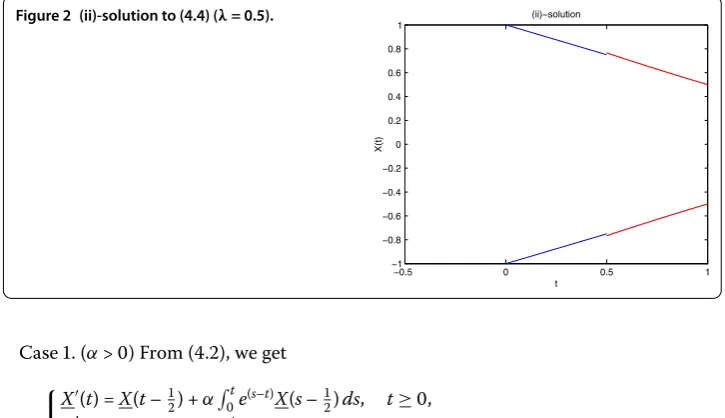
The (ii)-solution is illustrated in Figure .
Example . Let us consider the linear interval-valued functional integro-differential equation under two kinds of Hukuhara derivatives
DgHX(t) =X(t–) +αtt
e
(s–t)X(s– )ds,
X(t) =ϕ(t), t∈[–, ], (.)
Figure 2 (ii)-solution to (4.4) (λ= 0.5).
Following the method of steps, we obtain the (i)-solution to (.) defined on [, /] and it is of the form
From (.) we obtain ⎧
In Figures and , (i)-solution and (ii)-solution curves of (.) are given. Case . (α< ) From (.) we get
By solving delay integro-differential system (.), we obtain (i)-solution
X(t) =
Figure 3 Graphs ofX(t),X(t) fort∈[–12,12], α= 0.1.
Figure 4 Graphs ofX(t),X(t) fort∈[–12,12], α= 0.1.
Figure 5 Graphs ofX(t),X(t) fort∈[–12,12], α= –0.1.
From (.) we obtain ⎧
⎪ ⎪ ⎪ ⎨ ⎪ ⎪ ⎪ ⎩
X(t) =X(t– ) +α
t
e(s–t)X(s–)ds, t≥, X(t) =X(t–) +αte(s–t)X(s–
)ds, t≥, X(t) = , – ≤t≤,
X(t) = –t, –
≤t≤.
(.)
By solving delay integro-differential systems (.), we obtain (ii)-solution
X(t) =
+ t–t
+
α
–e–t, + t
+α
–t– e–t , t∈[, /].
Figure 6 Graphs ofX(t),X(t) fort∈[–12,12], α= –0.1.
5 Conclusion
In this study, we have established the local and global existence and uniqueness results of two solutions for interval-valued functional integro-differential equations. For the lo-cal existence and uniqueness, we use the method of successive approximations under the Lipschitz condition, and for global existence and uniqueness, we use the contraction prin-ciple under suitable conditions. In our further work, we would like to use these results to study the local and global existence and uniqueness results of solutions for interval-valued functional integro-differential equations under Caputo-type interval-interval-valued frac-tional derivatives.
Competing interests
The authors declare that they have no competing interests.
Authors’ contributions
All authors contributed equally to the writing of this paper. All authors read and approved the final version of the manuscript.
Author details
1Division of Computational Mathematics and Engineering, Institute for Computational Science, Ton Duc Thang University,
Ho Chi Minh City, Vietnam.2Faculty of Mathematics and Computer Science, University of Science, VNU, Ho Chi Minh City,
Vietnam.3Faculty of Natural Science and Technology, Tay Nguyen University, 567 Le Duan Road, Buon Ma Thuot City,
Daklak Province, Vietnam.
Acknowledgements
The authors would like to express their gratitude to the anonymous referees for their helpful comments and suggestions, which have greatly improved the paper.
Received: 16 February 2014 Accepted: 28 June 2014 Published:22 Jul 2014
References
1. Hale, JK: Theory of Functional Differential Equations. Springer, New York (1977)
2. Kolmanovskii, VB, Myshkis, A: Applied Theory of Functional Differential Equations. Kluwer Academic, Dordrecht (1992) 3. Kuang, Y: Delay Differential Equations with Applications in Population Dynamics. Academic Press, Boston (1993) 4. Lupulescu, V: On a class of functional differential equations in Banach spaces. Electron. J. Qual. Theory Differ. Equ.
2010, 64 (2010)
5. Lupulescu, V: On a class of fuzzy functional differential equations. Fuzzy Sets Syst.160, 1547-1562 (2009) 6. Malinowski, MT: Second type Hukuhara differentiable solutions to the delay set-valued differential equations. Appl.
Math. Comput.218(18), 9427-9437 (2012)
7. De Blasi, FS, Iervolino, F: Equazioni differenziali con soluzioni a valore compatto convesso. Boll. Unione Mat. Ital.4(2), 491-501 (1969)
8. Agarwal, RP, O’Regan, D: Existence for set differential equations via multivalued operator equations. Differ. Equ. Appl. 5, 1-5 (2007)
9. Agarwal, RP, O’Regan, D, Lakshmikantham, V: Viability theory and fuzzy differential equations. Fuzzy Sets Syst.151(3), 563-580 (2005)
10. Agarwal, RP, O’Regan, D, Lakshmikantham, V: A stacking theorem approach for fuzzy differential equations. Nonlinear Anal. TMA55(3), 299-312 (2003)
12. De Blasi, FS, Lakshmikantham, V, Bhaskar, TG: An existence theorem for set differential inclusions in a semilinear metric space. Control Cybern.36(3), 571-582 (2007)
13. Devi, JV: Generalized monotone iterative technique for set differential equations involving causal operators with memory. Int. J. Adv. Eng. Sci. Appl. Math.8(3), 74-83 (2011)
14. Hoa, NV, Phu, ND: On maximal and minimal solutions for set-valued differential equations with feedback control. Abstr. Appl. Anal.2012, Article ID 816218 (2012)
15. Kaleva, O: Fuzzy differential equations. Fuzzy Sets Syst.24, 301-317 (1987)
16. Lakshmikantham, V, Bhaskar, TG, Devi, JV: Theory of Set Differential Equations in Metric Spaces. Cambridge Scientific Publishers, Cambridge (2006)
17. Lakshmikantham, V, Mohapatra, R: Theory of Fuzzy Differential Equations and Inclusions. Taylor & Francis, London (2003)
18. Lakshmikantham, V, Tolstonogov, AA: Existence and interrelation between set and fuzzy differential equations. Nonlinear Anal. TMA55(3), 255-268 (2003)
19. Phu, ND, Quang, LT, Tung, TT: Stability criteria for set control differential equations. Nonlinear Anal. TMA69, 3715-3721 (2008)
20. Phu, ND, Tung, TT: Some results on sheaf-solutions of sheaf set control problems. Nonlinear Anal. TMA67, 1309-1315 (2007)
21. Puri, M, Ralescu, D: Differentials of fuzzy functions. J. Math. Anal. Appl.91, 552-558 (1983)
22. Song, S, Wu, C: Existence and uniqueness of solutions to Cauchy problem of fuzzy differential equations. Fuzzy Sets Syst.110, 55-67 (2000)
23. Tu, NN, Tung, TT: Stability of set differential equations and applications. Nonlinear Anal. TMA71, 1526-1533 (2009) 24. Malinowski, MT: Interval Cauchy problem with a second type Hukuhara derivative. Inf. Sci.213, 94-105 (2012) 25. Malinowski, MT: Interval differential equations with a second type Hukuhara derivative. Appl. Math. Lett.24,
2118-2123 (2011)
26. Stefanini, L, Bede, B: Generalized Hukuhara differentiability of interval-valued functions and interval differential equations. Nonlinear Anal. TMA71, 1311-1328 (2009)
27. Hukuhara, M: Intégration des applications mesurables dont la valeur est un compact convexe. Funkc. Ekvacioj10, 205-229 (1967)
28. Agarwal, RP, Arshad, S, O’Regan, D, Lupulescu, V: A Schauder fixed point theorem in semilinear spaces and applications. Fixed Point Theory Appl.2013, 306 (2013)
29. Chalco-Cano, Y, Rufián-Lizana, A, Román-Flores, H, Jiménez-Gamero, MD: Calculus for interval-valued functions using generalized Hukuhara derivative and applications. Fuzzy Sets Syst.219, 49-67 (2013)
30. Khastan, A, Nieto, JJ, Rodríguez-López, R: Schauder fixed-point theorem in semilinear spaces and its application to fractional differential equations with uncertainty. Fixed Point Theory Appl.2014, 21 (2014)
31. Malinowski, MT: On set differential equations in Banach spaces - a second type Hukuhara differentiability approach. Appl. Math. Comput.219(1), 289-305 (2012)
32. Moore, R, Lodwick, W: Interval analysis and fuzzy set theory. Fuzzy Sets Syst.135(1), 5-9 (2003)
33. Bede, B, Gal, SG: Generalizations of the differentiability of fuzzy-number-valued functions with applications to fuzzy differential equations. Fuzzy Sets Syst.151, 581-599 (2005)
34. Alikhani, R, Bahrami, F, Jabbari, A: Existence of global solutions to nonlinear fuzzy Volterra integro-differential equations. Nonlinear Anal. TMA75(4), 810-1821 (2012)
35. Allahviranloo, T, Hajighasemi, S, Khezerloo, M, Khorasany, M, Salahshour, S: Existence and uniqueness of solutions of fuzzy Volterra integro-differential equations. In: Information Processing and Management of Uncertainty in Knowledge-Based Systems. Applications. Communications in Computer and Information Science, vol. 81, pp. 491-500 (2010)
36. Bede, B: A note on ‘Two-point boundary value problems associated with non-linear fuzzy differential equations’. Fuzzy Sets Syst.157(7), 986-989 (2006)
37. Bede, B, Rudas, IJ, Bencsik, AL: First order linear fuzzy differential equations under generalized differentiability. Inf. Sci. 177, 1648-1662 (2007)
38. Bede, B, Stefanini, L: Generalized differentiability of fuzzy-valued functions. Fuzzy Sets Syst.230, 119-141 (2013) 39. Chalco-Cano, Y, Román-Flores, H: On new solutions of fuzzy differential equations. Chaos Solitons Fractals38,
112-119 (2008)
40. Lupulescu, V: Initial value problem for fuzzy differential equations under dissipative conditions. Inf. Sci.178(23), 4523-4533 (2008)
41. Malinowski, MT: Random fuzzy differential equations under generalized Lipschitz condition. Nonlinear Anal., Real World Appl.13(2), 860-881 (2012)
42. Malinowski, MT: Existence theorems for solutions to random fuzzy differential equations. Nonlinear Anal. TMA73(6), 1515-1532 (2010)
43. Malinowski, MT: On random fuzzy differential equations. Fuzzy Sets Syst.160(21), 3152-3165 (2009)
44. Stefanini, L, Sorini, L, Guerra, ML: Parametric representation of fuzzy numbers and application to fuzzy calculus. Fuzzy Sets Syst.157, 2423-2455 (2006)
45. Mizukoshi, MT, Barros, LC, Chalco-Cano, Y, Román-Flores, H, Bassanezi, RC: Fuzzy differential equations and the extension principle. Inf. Sci.177, 3627-3635 (2007)
46. Malinowski, MT: Strong solutions to stochastic fuzzy differential equations of Itô type. Math. Comput. Model.55, 918-928 (2012)
47. Malinowski, MT: Itô type stochastic fuzzy differential equations with delay. Syst. Control Lett.61, 692-701 (2012) 48. Malinowski, MT: Some properties of strong solutions to stochastic fuzzy differential equations. Inf. Sci.252, 62-80
(2013)
49. Malinowski, MT: Approximation schemes for fuzzy stochastic integral equations. Appl. Math. Comput.219, 11278-11290 (2013)
51. Malinowski, MT: Modeling with stochastic fuzzy differential equations. In: Chakraverty, S (ed.) Mathematics of Uncertainty Modeling in the Analysis of Engineering and Science Problems, pp. 150-172. IGI Global, Hershey (2014) 52. Agarwal, RP, Arshad, S, O’Regan, D, Lupulescu, V: Fuzzy fractional integral equations under compactness type
condition. Fract. Calc. Appl. Anal.15, 572-590 (2012)
53. Arshad, S, Lupulescu, V: On the fractional differential equations with uncertainty. Nonlinear Anal. TMA74(11), 3685-3693 (2011)
54. Arshad, S, Lupulescu, V: Fractional differential equation with fuzzy initial condition. Electron. J. Differ. Equ.2011, 34 (2011)
55. Allahviranloo, T, Salahshour, S, Abbasbandy, S: Solving fuzzy fractional differential equations by fuzzy Laplace transforms. Commun. Nonlinear Sci. Numer. Simul.17(3), 1372-1381 (2012)
56. Allahviranloo, T, Abbasbandy, S, Sedaghatfar, O, Darabi, P: A new method for solving fuzzy integro-differential equation under generalized differentiability. Neural Comput. Appl.21(1), 191-196 (2012)
57. Allahviranloo, T, Amirteimoori, A, Khezerloo, M, Khezerloo, S: A new method for solving fuzzy Volterra integro-differential equations. Aust. J. Basic Appl. Sci.5(4), 154-164 (2011)
10.1186/1687-1847-2014-177