R E S E A R C H
Open Access
A robust ICI suppression based on an
adaptive equalizer for very fast time-varying
channels in LTE-R systems
Hanbyeog Cho
1, Tien Hoa Nguyen
2*, Huu Nghia Nguyen
2, Hyun-Kyun Choi
1, Jin-Kyu Choi
3,
Soonghwan Ro
4and Van Duc Nguyen
2Abstract
High-speed railway communication implemented based on Long-Term Evolution-Railway (LTE-R) Platform has strict requirements for quality of services to support high data-rate transmission for numerous mobile users. In such environment, there often exists inter-carrier interference. In this paper, we exploit a robust channel estimation method in the time domain for very fast time-varying LTE-railway channels, and then, we propose an effective and adaptive frequency-domain equalizer that can offer a tradeoff between performance and computational complexity. The simulation results show the robustness of our proposed method compared with previous ones. The computational complexity of the proposed method retain at a decent number by exploiting specified properties of channel matrices.
Keywords: LTE-R, Channel equalization, OFDM, ICI cancellation
1 Introduction
Long-Term Evolution-Railway (LTE-R) is becoming a key feature supported for intelligent transportation sys-tems (ITS) for the last two decades to replace the cur-rent Global System for Mobile Communication-Railway (GSM-R) technology. One of the most important elements of ITS is the high-speed railway (HSR), which is becoming a trending future transportation with tens of thousands kilometers length of HSR lines in Korea, Japan, and China [1]. Therefore, a number of standardizations for HSR have been set up, which are known as European Train Control System (ETCS) or International Union of Railway (UIC). The UIC is expected to complete operation and func-tional requirements determination by 2017. A schedule of standardization and establishment of LTE-R is given in [2,3].
Thanks to various advantages, orthogonal frequency-division multiplexing (OFDM) has been used as a fun-damental technique in physical layer of many standards. A train speed of up to 500 km/h causes a very fast
*Correspondence:[email protected]
2School of Electronics and Telecommunications, Hanoi University of Science
and Technology, Hanoi, Vietnam
Full list of author information is available at the end of the article
time-varying channel and leads to the impairment of orthogonality among subcarriers. This is because of the Doppler shift and phase noise, which results in inter-carrier interference (ICI). The consequences of these phenomena on the performance of OFDM systems have been widely analyzed (see e.g. [4–7]). To overcome that problem, it is required that all channel state informa-tions (CSIs) be estimated in each OFDM symbol dura-tion. Assuming a perfect channel knowledge scenario, a channel matrix [8] specified by estimated CSIs is normally used for equalizing in the frequency domain. The only problem is that this conventional equalizer requires a huge computational complexity as a cubic function of number of subcarriers. Therefore, various researches in reducing that complexity as well as improv-ing the performance are taken. An ICI self-cancellation scheme [9] is a technique where a number of redun-dant data is transmitted onto adjacent subcarriers. The main idea is that a single symbol is modulated onto a group of adjacent subcarriers with particular coef-ficients, so that the ICI components generated within this group can be self-cancelled. These methods, how-ever, are compatible with a system wherein constant
frequency offset exists. An OFDM system suffers from different Doppler frequencies that makes this method inappropriate to LTE-R network. Furthermore, the main drawback of this method is the reduction in band-width efficiency as a same symbol occupies several subcarriers.
Other studies have been developed using either filter in frequency domain or windowing function in the time domain [10,11]. The main purpose of filter is to reduce the amplitude of side lobes, which leads to the signifi-cant decrease in the ICI power. This method increases the performance noticeably in comparison with ICI self-cancellation methods; however, the drawback of this method is caused by its high complexity and suitability with constant frequency shift. Authors in [12] developed a method to compensate signal dispersion caused by time-varying channels. However, this method is only applicable for media in which line-of-sight signal is extremely dom-inant. A partial FFT method was introduced in [13] in order to avoid the frequency-domain equalizer. Although this approach has an acceptable complexity, it only assumes that channel parameters vary slowly compared to the OFDM symbol duration. That makes this method weak against the LTE-R scenario. In [14], a low-complexity equalizer was proposed using channel matrix in the fre-quency domain. This method possesses a low complex-ity; however, the analyzed channel matrix was lacking of important corner elements. Considering a full matrix [8], such low complexity is unable to be attained. With the same channel matrix, authors in [15] proposed frequency-domain equalizer using sub-matrices. Usually, the best performance can be achieved by conventional equalizer, which finds the inverse of the entire channel matrix. However, conventional method suffers from high com-plexity and singular matrix problem. Proposed method in [15] solved these problems but paid the penalty of performance.
In this work, we take both issues into consideration and develop a new technique to obtain better perfor-mance without costing resource. First, we use WINNER II [16] scenario for modelling a fast time-varying chan-nel. After that, corresponding to this channel, we utilize an optimal training sequence together with an effective estimator proposed in [17] . Intentionally, this estimation method is designed to meet requirements of the LTE-R scenario. Then, we propose an adaptive ICI canceller to bring the balance of performance and complexity. This method tends to have the performance close to conven-tional method, while having complexity as low as possible. The rest of this paper is organized as follows. The math-ematical description of the proposed method is presented in Section 2. Section 3 includes the simulation results as well as our discussions. We conclude this paper in Section4.
2 Methods
The radio access technology for railway communications researched on the LTE platform is strongly expected to replace the Global System for Mobile Communications. The special attention of data transmission on railroad leads to significant problems in terms of performance sim-ulation and measurement in particular environment. We exploited the WINNER II channel model, which was ver-ified by the Railway Technology Research Project funded by the Ministry of Land, Infrastructure and Transport of the Korean government. All system parameters of the so-called LTE-R technology were provided by the Electronics and Telecommunications Research Institute, Korea. The very fast time-varying channel was modelled by using the Monte Carlo method. We proposed our equalization technique and evaluated by simulation using MATLAB software. In terms of assessment, we accounted the com-plexity and the error rate performances. The comcom-plexity was figured based on the function of basic mathematic operators, considering the worst cases. Simulation results were obtained in the same experimental conditions (i.e. using the same hardware and software version).
3 Proposal of channel equalization method
Let us assume that an OFDM system has the FFT length ofN. The received signalyis expressed in vector form as follows [15]
Mi= the size of a sub-matrix.Si defines the summation ofMi and the transpose matrixMTi
Si=Mi+MTi . (4)
We can also rewriteMi = Si−MTi . Using property of matrix multiplication, sub-matrixMiis expanded as
Mi= I−MTi S−i1
Si, (5)
withIas the identity matrix, which also has the size ofq. Now, we calculate the inverse of sub-matrixMiby
M−i 1= I−MTi S−i1
Considering each element, it is worth noting that we can prove (8),Sican be clarified as a diagonal matrix as
Si=
Since it is a diagonal matrix, the inverse matrix S−i 1 is readily derived by taking the reciprocal of each element, which costs q divisions. On the other hand, the term
MTi S−i1is expressed in matrix form as
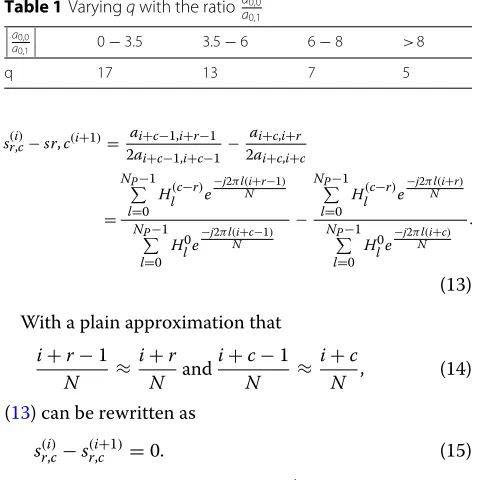
similarly as in (10). Let matrixidefine the difference of two consecutive matricesMTi S−i 1andMTi+1S−i+11
i=MTi S−i 1−MTi+1S−i+11, (11)
or in matrix form
i=
Table 1Varyingqwith the ratioa0,0a0,1
With a plain approximation that
i+r−1 regardless of index i. Therefore, we have no significant
affect to the result by assuming that I−MTi S−i1
−1
is also constant corresponding toi ∈ {0, ...,N−1}. How-ever, due to approximation errors, the assumption in (14) is valid only if
i+Nr− i+r+k N
≤ε, (16) whereεis the minimum error threshold defined by engi-neer. k is a factor that we should consider to update
the value of I−MTi S−i 1
−1
. That is, afterk−1 cycles,
I−MTi S−i 1
−1
should be re-calculated. The analysis in the next section shows that the complexity order is inde-pendent ofk. Therefore, the valueεandkare chosen to afford the best simulation results, asε=0.01 andk=10. After figuringM−i 1, transmitted symbolsxiare recovered by Here, we neglect the impact of addictive white noise.xiis acquired by taking the middle element ofxi. By turns,x
Table 2System parameters
Parameter Value
Bandwidth (MHz) 10
Number of FFT points 1024
Number of guard samples 4
Constellation QAM 16
Table 3Power delay profile of scenario D2a
Path index Delay [ns] Power [dB]
1 0 0
2 100 -18.1
2 200 -17.35
can be calculated completely. Our method can be followed by a pseudo-code below.
As mentioned earlier, the sizeqof a sub-matrix should be adaptive, since channel condition varies from symbol to symbol. In case the instant channel is not varying rapidly, it is not worth to use a large value ofqso as to maintain the least computational complexity. To adjust this value, we consider two following conditions and give our selection by the rule of thumb in Table1
• The computational complexity of proposed method is as low as possible.
• Symol error rate (SER) performance reaches closely to the performance of conventional equalization.
4 Simulation results and discussions
In this section, we present the Monte Carlo simulation results to compare our proposed method with the con-ventional one based on full-size inverse matrix and the methods in [15] (banded matrix) and [9] (AC method), since the banded matrix has the same approach which is closely related to our method, and AC method has been widely cited. System parameters are given in Table2and the tapped delay line channel model [18] is shown in Table3.
In LTE-R, the train speed will be very high, up to 500 km/h. With the recommended operating frequen-cies which are 0.7, 1.8, and 2.6 GHz, the highest Doppler frequency is up to 1204 Hz, equivalent to a normalized Doppler of fDmax/f = 0.12. The Doppler frequencies
are summarized in the Table4.
Figure1gives the power delay profile (PDP) of the mul-tipath channel. It is derived from scenario D2a [16] which includes eight channel taps. With the system bandwidth
Table 4Doppler frequencies
Velocity of train (km/h) Center frequency (GHz) Doppler frequency (Hz)
0 50 100 150 200 250 (ns)
0 0.2 0.4 0.6 0.8 1
Original PDP of Scenario D2a Modified PDP of Scenario D2a
Linear Interpolated PDP of Scenario D2a
Fig. 1Modified PDP
of 10 MHz, the interpolated PDP is obtained at the time
t=i1B,i∈ {1, 2, ...}.
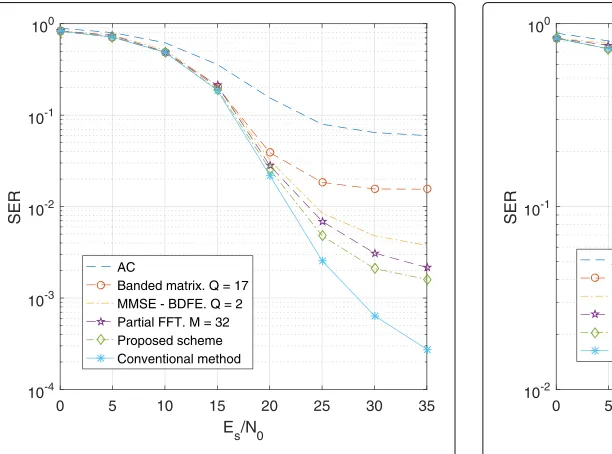
Figure2 shows symbol error rate (SER) versus Es/N0
performance while taking our proposed technique and previous ones into consideration. In this scenario, we consider ICI self-cancellation (adjacent cancellation (AC)) in [9], banded matrix method in [15], MMSE-BDFE in [14], partial FFT in [13], and our proposed scheme. It can be seen that our approach gains better performance than MMSE-BDFE and partial FFT while outperforms banded matrix and AC methods. Conventional frequency domain equalizer based on channel matrix (conventional method) obtains the best performance due to considering all ICI coefficients but, however, pays the worst complex-ity. Its complexity varies according to a cubic function of the number of FFT points, while our proposed scheme suffers from a linear function of that. For the purpose
0 5 10 15 20 25 30 35
Es/N0 10-4
10-3 10-2 10-1 100
SER
AC
Banded matrix. Q = 17 MMSE - BDFE. Q = 2 Partial FFT. M = 32 Proposed scheme Conventional method
Fig. 2SER vs.Es/N0withfDmax=833 Hz
of deploying a real-time system, our method has better resource efficiency than the conventional method.
Figure 3 gives the comparison among the techniques mentioned earlier. The maximum Doppler frequency in this case is 1204 Hz, equivalent to fc = 2.6 GHz and the train speed of 500 km/h. The same result is obtained by our performance approach and by the con-ventional method. Partial FFT method is slightly worse than ours, but they have lower complexity (see Table5). That can be attributed as the trade-off between perfor-mance and complexity. Similarly, MMSE-BDFE carries the lowest complexity while maintaining the medium performance. The lowest complexity can be obtained by using LDL decomposition, which is not able to be applied in our algorithm. AC method is too simple to be implemented, so no doubt it gives a very poor performance.
0 5 10 15 20 25 30 35
Es/N0 10-2
10-1 100
SER
AC
Banded matrix. Q = 17 MMSE - BDFE. Q = 2 Partial FFT. M = 32 Proposed scheme Conventional method
Table 5Comparison of complexity order
Equalization algorithm Complexity order Number of complex operators
Conventional method O(N3) 1.07×10⁹
Banded matrix O((N−q)q3) 4.95×10⁶
MMSE-BDFE O((8Q2+22Q+4)N) 8.2×10⁴
Partial FFT O(NlogK)+O(NM2)+O(NMS) 1.1×10⁶
Proposed scheme O73q3N 1.1×10⁷
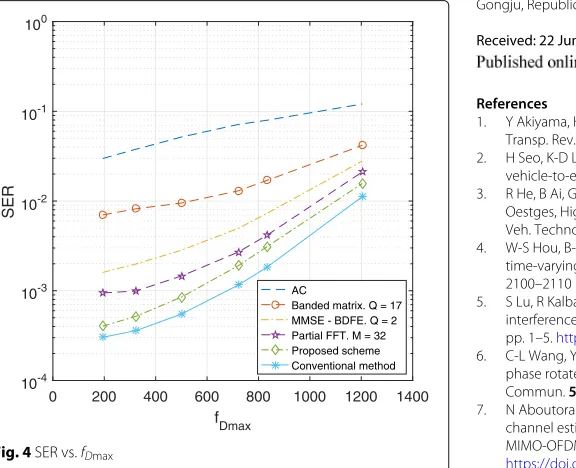
Figure 4 shows the SER performance for different Doppler frequencies at Es/N0 = 25 dB. Our proposed
method has a tight match to the conventional equal-ization. While the conventional equalizer has to suffer from the complexity order ofO(N3), which is the high-est cost compared with other techniques, our technique has the order of O(7/3q3N), which is a cubic function of parameter q. It is worth noting that this parameter varies from 5 to 17 (see Table 1). In the case of suc-cessful channel estimation, q can be 5, which means that the lowest complexity is achieved. It is observed that the proposed technique gains better performance than most of others except for conventional one. Con-sidering trading-off between performance and complex-ity, our technique appears to be robust against very fast time-varying channel.
5 Conclusions
In this paper, we have proposed an ICI cancellation method to combat the very fast time-varying channels in LTE-R systems. This method makes use of the relation
0 200 400 600 800 1000 1200 1400 fDmax
10-4 10-3 10-2 10-1 100
SER
AC
Banded matrix. Q = 17 MMSE - BDFE. Q = 2 Partial FFT. M = 32 Proposed scheme Conventional method
Fig. 4SER vs.fDmax
among sub-matrices and reduces the complexity signifi-cantly compared with conventional method. However, the performance is not degraded much as one of the advan-tages of the proposed method. Another improvement is that it offers the engineer to configure the receiver as they can decide which is their priority between system per-formance and resource use. Further work is to develop this method to gain the lowest complexity bound and to combat with very ill channel conditions where channel estimation is not fully sufficient.
Abbreviations
CSI: Channel state information; FFT: Fast Fourier transform; GSM-R: Global system for mobile communication-railway; HSR: High-speed railway; ICI: Inter-carrier interference; LTE-R: Long-term evolution-railway; OFDM: Orthogonal frequency-division multiplexing; PDP: Power delay profile; SER: System error rate
Funding
This research was supported by a grant (16RTRP-B089546-03) from the Railway Technology Research Project funded by the Ministry of Land, Infra-structure and Transport (MOLIT) of the Korean government, and by the Korea Agency for Infrastructure Technology Advancement (KAIA).
Authors’ contributions
HC and SR conceived the project and designed the study. HNN took charge of most analyses. H-KC and J-KC performed the simulation. VDN verified all the results. THN drafted the manuscript. All authors read and approved the final manuscript.
Competing interests
The authors declare that they have no competing interests.
Publisher’s Note
Springer Nature remains neutral with regard to jurisdictional claims in published maps and institutional affiliations.
Author details
1Smart Mobility Research Department of ETRI, Daejeon, Republic of Korea. 2School of Electronics and Telecommunications, Hanoi University of Science
and Technology, Hanoi, Vietnam.3Electronics and Telecommunications
Research Institute, Daejeon, Republic of Korea.4Kongju National University,
Gongju, Republic of Korea.
Received: 22 June 2017 Accepted: 5 January 2018
References
1. Y Akiyama, High-speed rail worldwide—past and future. Jpn. Railw. Transp. Rev.64(64), 36–47 (2014)
2. H Seo, K-D Lee, S Yasukawa, Y Peng, P Sartori, LTE evolution for vehicle-to-everything services. IEEE Commun. Mag.54(6), 22–28 (2016) 3. R He, B Ai, G Wang, K Guan, Z Zhong, AF Molisch, C Briso-Rodriguez, CP Oestges, High-speed railway communications: from GSM-R to LTE-R. IEEE Veh. Technol. Mag.11(3), 49–58 (2016)
4. W-S Hou, B-S Chen, ICI cancellation for OFDM communication systems in time-varying multipath fading channels. IEEE Trans. Wirel. Commun.4(5), 2100–2110 (2005)
5. S Lu, R Kalbasi, N Al-Dhahir, inProc. IEEE Vehicular Technology Conf. OFDM interference mitigation algorithms for doubly-selective channels, (2006), pp. 1–5.https://doi.org/10.1109/VTCF.2006.295
6. C-L Wang, Y-C Huang, Intercarrier interference cancellation using general phase rotated conjugate transmission for OFDM systems. IEEE Trans. Commun.58(3), 812–819 (2010)
7. N Aboutorab, W Hardjawana, B Vucetic, A new iterative Doppler-assisted channel estimation joint with parallel ICI cancellation for high-mobility MIMO-OFDM systems. IEEE Trans. Veh. Technol.61(4), 1577–1589 (2012).
8. J Wu, P Fan, A survey on high mobility wireless communications: challenges, opportunities and solutions. IEEE Access.4, 450–476 (2016) 9. Y Zhao, S-G Haggman, Intercarrier interference self-cancellation scheme
for OFDM mobile communication systems. IEEE Trans. Commun.49(7), 1185–1191 (2001)
10. M Bensan, VPS Kirar, K Burse, inProc. Fourth Int. Conf. Computational Intelligence and Communication Networks. Phase noise reduction and tracking in OFDM using extended Kalman filter, (2012), pp. 402–406.
https://doi.org/10.1109/CICN.2012.161
11. A Diliyanzah, RP Astuti, B Syihabuddin, inProc. 2nd Int. Conf. Information and Communication Technology (ICoICT). Inter-carrier interference reduction in broadband wireless access technology using extended Kalman filter, (2014), pp. 266–271.https://doi.org/10.1109/ICoICT.2014. 6914077
12. P Baracca, S Tomasin, L Vangelista, N Benvenuto, A Morello, Per sub-block equalization of very long OFDM blocks in mobile communications. IEEE Trans. Commun.59(2), 363–368 (2011)
13. S Yerramalli, M Stojanovic, U Mitra, Partial FFT demodulation: a detection method for highly Doppler distorted OFDM systems. IEEE Trans. Signal Process.60(11), 5906–5918 (2012)
14. L Rugini, P Banelli, G Leus, Low-complexity banded equalizers for ofdm systems in doppler spread channels. EURASIP J. Adv. Signal Process.
2006(1), 067404 (2006)
15. WG Jeon, KH Chang, YS Cho, An equalization technique for orthogonal frequency-division multiplexing systems in time-variant multipath channels. IEEE Trans. Commun.47(1), 27–32 (1999)
16. P Kyosti, J Meinila, L Hentila, X Zhao, Winner II channel models: part I channel models version 1.2. WINNER and Information Society Technologies,” Technical Report (2007)
17. JK Choi, VD Nguyen, HN Nguyen, VV Duong, TH Nguyen, H Cho, HK Choi, SG Park, A time-domain estimation method of rapidly time-varying channels for OFDM-based LTE-R systems. Digital Communications and Networks. In Press