R E S E A R C H
Open Access
Robust iterative learning control design
for linear systems with time-varying delays
and packet dropouts
Bu Xuhui
1*, Hou Zhanwei
2, Hou Zhongsheng
3and Yang Junqi
1*Correspondence: [email protected]
1School of Electrical Engineering & Automation, Henan Polytechnic University, Jiaozuo, China Full list of author information is available at the end of the article
Abstract
This paper proposes the robust iterative learning control (ILC) design for uncertain linear systems with time-varying delays and random packet dropouts. The packet dropout is modeled by an arbitrary stochastic sequence satisfying the Bernoulli binary distribution, which renders the ILC system to be stochastic instead of a deterministic one. The main idea of this paper is to transform the ILC design into robust stability for a two-dimensional (2D) stochastic system described by the Roesser model with a delay varying in a range. A delay-dependent stability condition, which can guarantee mean-square asymptotic stability of such a 2D stochastic system, is derived in terms of linear matrix inequalities (LMIs), and formulas can be given for the ILC law design. An example for the injection molding is given to demonstrate the effectiveness of the proposed ILC method.
Keywords: iterative learning control; 2D stochastic system; time-varying delay; packet dropout; robust design
1 Introduction
Iterative learning control (ILC) is an effective technique for systems that could perform the same task over a finite time interval repetitively. It updates the control input signal only depending on I/O data of previous iteration, and the tracking performance can become better and better. Due to its simplicity and effectiveness, ILC has been widely applied in many practical systems such as robotics, chemical batch processes, hard disk drives and urban traffic systems [–].
Time delay, which is a source of instability and poor performance, often appears in prac-tical systems due to the finite speed of signal transmission and information processing. As a result, studies on batch process control have attracted considerable attention [–]. Re-cently, ILC has been introduced to systems with time delays to improve the tracking per-formance. In [], a new ILC method is proposed for a class of linear systems with time delay using a holding mechanism. In [], an ILC algorithm integrated with Smith predic-tor for batch processes with fixed time delay is proposed and analyzed in the frequency domain; itcan obtain perfect tracking performance under certain conditions. In [], an ILC scheme is proposed for systems with time delay and model uncertainties based on the internal model control principle. In [], a two-dimensional (D) model based on ILC
methods for systems both with state delays and with input delays is presented; necessary and sufficient conditions for the stability of ILC are also provided. In [], the problem of ILC design for time-delay systems in the presence of initial shifts is considered, and the D system theory is employed to develop a convergence condition for both asymptotic stability and monotonic convergence of ILC.
In these existing studies [–], the time delay considered is known and fixed constants. As we know, many practical systems suffer from time-varying delays, which are less con-servative than constant delays. It is a challenge to design ILC for systems with time-varying delays. There have already been a few results on this issue. In [], a robust state feedback integrated with ILC scheme is proposed for batch processes with interval time-varying delay. The design is considered using a D Roesser model based on the general D system theory []. In [], a robust closed-loop ILC scheme is proposed for batch processes with state delay and time-varying uncertainties, and the batch processes are described as a D FM model. In [], a robust output feedback incorporated with ILC scheme is proposed for a kind of batch process with uncertainties and interval time-varying delay. The batch process is transformed into a D FM model with a delay varying in a range, and the de-sign is cast as a robustH∞control for uncertain D systems. It is noticed that almost all available results on ILC systems with time delays are based on an implicit assumption that sensor output measurement is perfect. However, the assumption is often not true in most cases in practice. The main reason is that sensors may suffer from probabilistic signal missing especially in a networked environment [–].
Actually, the problem of ILC for networked control systems (NCSs) with packet dropouts has received some attention in the research field. The stability of ILC for linear and nonlinear systems with intermittent measurement is investigated in [, ]. Some robust ILC designs are proposed for NCSs to suppress the effect of data dropouts in [– ]. However, to our best knowledge, no work considering ILC systems with data dropouts and time delay simultaneously has been done up to now.
This paper proposes a robust ILC design scheme for uncertain linear systems with time-varying delays and random packet dropouts. Here the considered systems are im-plemented in a network environment, where data packet may be missed during transmis-sion. For convenience, only the measurement packet dropout is taken into account. The packet dropout is modeled by an arbitrary stochastic sequence satisfying the Bernoulli bi-nary distribution, which renders the ILC system to be stochastic instead of a deterministic one. Then, a D stochastic Roesser model with a delay varying in a range is established to describe the entire dynamics. Based on D system theory, the ILC law is designed to guarantee mean-square asymptotic stability of the considered D stochastic systems. Af-terwards, a delay-dependent stability condition is derived in terms of linear matrix in-equalities (LMIs), and formulas can be given for the ILC law design. Finally, an example for the injection molding is given to demonstrate the effectiveness of the proposed ILC method.
xconditional ony, respectively. Matrices, if the dimensions are not explicitly stated, are assumed to be compatible for algebraic operations.
2 Problem formulation and 2D system representation
Consider the following linear discrete time system with time-varying delay:
⎧ ⎪ ⎨ ⎪ ⎩
x(t+ ,k) = (A+A)x(t,k) + (Ad+Ad)x(t–d(t),k) +Bu(t,k), y(t,k) =Cx(t,k),
x(,k) =xk,
()
wherekdenotes iteration,tdenotes discrete time.x(t,k),u(t,k),y(t,k) are state, input and output variables,A,Ad,B,Care the matrices with appropriate dimensions describing the system in the state space. xk stands for the initial condition of the process in thekth iteration.d(t) is time-varying delay satisfying
dm≤d(t)≤dM,
wheredm,dMdenote the lower and upper delay bounds.A,Addenote admissible un-certain perturbations of matricesAandAd, which can be represented as
A=EF, Ad=EF,
whereE,F,Fare known real constant matrices characterizing the structures of uncertain perturbations, andis an uncertain perturbation of the system that satisfiesT≤I.
For system (), design the following ILC update law:
u(t,k+ ) =u(t,k) +u(t,k), ()
whereu(t,k) is the ILC update law to be designed.
Denotee(t,k) =yd(t) –y(t,k),η(t,k) =x(t– ,k+ ) –x(t– ,k). From () and (), we can obtain
η(t+ ,k) e(t,k+ )
=A˜
η(t,k) e(t,k)
+A˜d
η(t–d(t),k) e(t,k–h(k))
+Bu(t¯ – ,k), ()
where
˜
A=A¯ +A,¯ A˜d= (A¯d+A¯d),
¯ A=
A
–CA I
, A¯d=
Ad –CAd
, B¯=
B –CB
,
A¯=E¯ F¯, A¯d=E¯ F¯,
¯ E=
E –CE
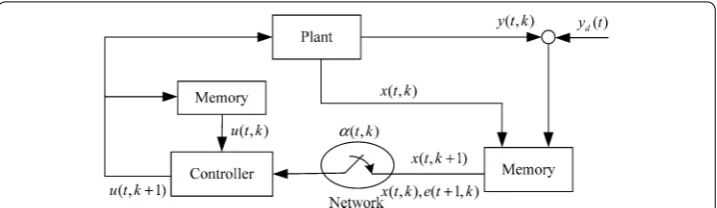
Figure 1 Schematic diagram of the ILC systems with data dropouts.
h(k) is a new delay variable satisfyinghm≤h(k)≤hMwithhm,hMdenoting the lower and upper delay bounds. The new vectore(t,k–h(k)) is introduced here as is also done in [] so that system () can be modeled as a normal D system with interval time delay.
Consider the following ILC update laws:
u(t– ,k) =K
x(t– ,k+ ) –x(t– ,k) e(t,k)
, ()
whereK= [K,K] is a gain matrix to be designed. ILC law () contains two parts: a P-type ILC law and a state feedback control law. This control scheme has the advantages of feed-back loop such as robustness and meanwhile enjoys the extra performance improvement from ILC.
It is assumed that the ILC law is implemented in a networked control system as shown in Figure , where the network only exists on the side from plant to controller for conve-nience. The datax(t,k+ ),x(t,k),e(t,k) are transferred as one whole packet from the plant to the controller. It is further supposed that the controller can detect whether the packet is dropped or not. If the data packet is missed, thenu(t,k) = , that is,u(t,k+ ) =u(t,k). If the data packet is not missed, the termu(t,k) is calculated as (). In this case, the ILC update law () can be described as
u(t– ,k) =α(t,k)K
x(t– ,k+ ) –x(t– ,k) e(t,k)
, ()
where the stochastic parameterα(t,k) is a random Bernoulli variable taking the values of and with
Probα(t,k) = =Eα(t,k) =α, Eα(t,k) =α( –α),
()
in whichαsatisfying ≤α≤ is a known constant. From () and (), it can be derived
η(t+ ,k) e(t,k+ )
=A˜+α(t,k)BK¯
η(t,k) e(t,k)
+A˜d
η(t–d(t),k) e(t,k–h(k))
Denoteη(t,k) =xh(i,j),e(t,k) =xv(i,j), system () can be rewritten as the following typical D Roesser system:
xh(i+ ,j) xv(i,j+ )
=A˜+α(i,j)BK¯
xh(i,j) xv(i,j)
+A˜d
xh(i–d(i),j) xv(i,j–h(j))
, ()
where the bounded conditions are defined by
xh(i,j) =ρ
ij, ∀≤j<r, –dM≤i< , xv(i,j) =σij, ∀≤i<r, –hM≤j< , ρ=σ,
()
wherer<∞andr<∞are positive integers,ρijandσijare given vectors.
Remark It is worth pointing out that D system () is a stochastic system due to the
introduction of the stochastic variableα(i,j). It differs from the deterministic D or ILC systems with time delay in recent works such as [–]. Here, the ILC design should be discussed under the framework of stochastic stability. To this end, we need to give the following definition of stochastic stability for D systems.
Definition ([]) For all initial bound conditions in (), D system () is said to be
mean-square asymptotically stable if the following is satisfied:
lim
i+j→∞Ex(i,j)
= .
3 Stability analysis and controller design
3.1 Stability analysis
In this section, we focus on the problem of robust stability and robust stabilization for D stochastic system () using an LMI technique. The following lemma is needed in the proof of our main result.
Lemma ([]) For any vectorδ(t)∈Rn,two positive integersκ
,κand matrix <R∈
Rn×n,the following inequality holds:
–(κ–κ+ ) κ
t=κ
δT(t)Rδ(t)≤– κ
t=κ δT(t)R
κ
t=κ δ(t).
Now, we can give our main result.
Theorem Given positive integers dm,dM,hm,hM, D system()is mean-square
asymp-totically stable if there exists a positive definite symmetric matrix P=Ph Pv
,Q=Qh Qv
M=Mh
such that the following matrix inequality holds:
⎡
Consider the following Lyapunov function candidate:
Vvxv(i,j)= Define the following index:
J=EVx(i,j)|(i,j)
Calculating () along the solutions of system (), we can obtain
Sinceα˜i,jis independent withx(i,j) andxd(i,j), we have
From ()-() and using the result in (), we can obtain
J≤EϕT(i,j)ψ ϕ(i,j)|(i,j) ,
By using Schur complements, it is obvious that () is equivalent to (). Sinceψ< , it is obvious that
EVhxh(i+ ,j)–Vhxh(i,j)+Vvxv(i,j+ )–Vvxv(i,j)|(i,j) < . ()
Taking mathematical expectation on both sides of () leads to
EVhxh(i+ ,j)+Vvxv(i,j+ ) ≤EVhxh(i,j)+Vvxv(i,j) . ()
Summing up both sides of () fromNto with respect toiand toNwith respect toj, for any nonnegative integerNand considering boundary conditions (), we have
≤E
V
xh(,N) xv(,N)
+· · ·+V
xh(N, ) xv(N, )
=
i+j=N E
V
xh(i,j) xv(i,j)
. ()
It is clear that the sum of the Lyapunov functional value decreases along the state trajec-tories. Then, from [], we can conclude that
lim
i+j→∞Ex(i,j)
= ,
which implies that system () is asymptotically stable.
This completes the proof of Theorem .
Remark Theorem provides a sufficient condition for D uncertain systems with a delay varying in a range and random packet dropouts. If the communication link existing between the plant and the controller is perfect, that is, there is no packet dropout during their transmission, thenα= andθ= . In this case, the condition in Theorem becomes the condition obtained in [, ] for a D deterministic system with time delay. From this point of view, Theorem can be seen as an extension to D time-delay systems with packet dropout.
3.2 Controller design
Theorem gives a mean-square asymptotic stability condition where the controller gain matrixKis known. However, our eventual purpose is to determine a suitableKby system matricesA,Ad,B,E,F,Fand parameterα.
Lemma ([]) Let U,V,and W be real matrices of appropriate dimensions with W satisfying W=WT,then for allT≤I,
W+UV+VTTUT< ,
if and only if there existsε> such that
W+ε–UUT+εVTV< .
Now, we can give the following result.
Theorem Given positive integers dm,dM,hm,hM, D system()is mean-square asymp-totically stable if there exist a positive definite symmetric matrix L=Lh
Lv
,S=Sh
Sv
,
M= Mh
Mv
, M=
Mh Mv
,X=Xh Xv
matrix Y and positive scalar εsuch that the following matrix inequality holds:
⎡ ⎢ ⎢ ⎢ ⎣
∗
where Schur complements and lettingL=P–, the following LMI can be obtained:
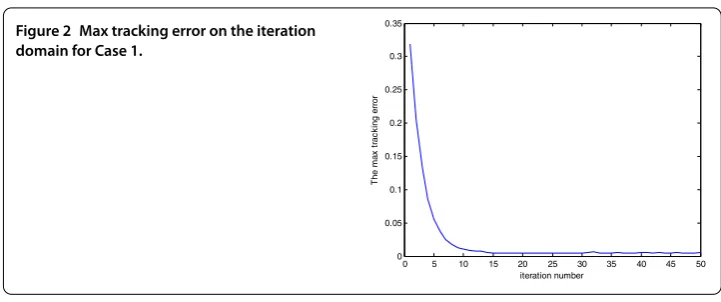
Figure 2 Max tracking error on the iteration domain for Case 1.
By Lemma , () holds if and only if there exists a scalarε> such that
⎡ ⎢ ⎢ ⎢ ⎢ ⎢ ⎢ ⎢ ⎣
˜
ψ L LA¯T+αYTB¯T θYTB¯T LA¯T+αYTB¯T–L θYTB¯T
–S LA¯T
d LA¯Td
–M–X
εE¯TE¯–L
εE¯TE¯–L
∗ εE¯TE¯–H–G–
εE¯TE¯–H–G– ⎤ ⎥ ⎥ ⎥ ⎥ ⎥ ⎥ ⎥ ⎦
+ε– ⎡ ⎢ ⎢ ⎢ ⎢ ⎢ ⎢ ⎢ ⎣
LF¯T
LF¯T
⎤ ⎥ ⎥ ⎥ ⎥ ⎥ ⎥ ⎥ ⎦
¯
FL F¯L
< . ()
Using Schur complements, condition () implies that the condition in Theorem
holds.
Remark Note that the condition in Theorem is no longer LMIs owing to the term
LX–Linψ˜. The available LMI tools cannot be used directly to obtain a feasible solution. However, we can use the idea of iterative algorithms in combination with LMI convex op-timization problems as is done in [, ]. Then an available control law can be obtained.
Remark It is noticed that the data dropout may occur on both system output and con-trol input sides in NCSs. In this paper, we only consider output measurement missing for the sake of convenience, as is also done in most existing works. However, the result in this paper can be extended to the control input signal dropouts.
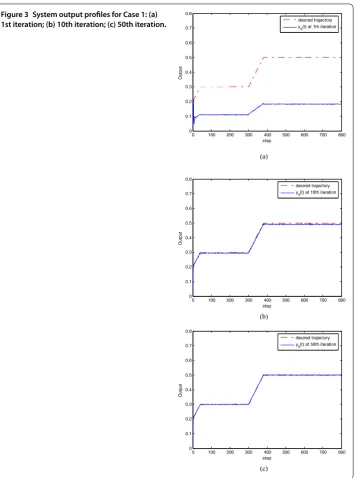
Figure 3 System output profiles for Case 1: (a) 1st iteration; (b) 10th iteration; (c) 50th iteration.
optimal ILC with monotonic convergence and fast convergence speed such that learning transient behavior is reduced.
4 Illustrative example
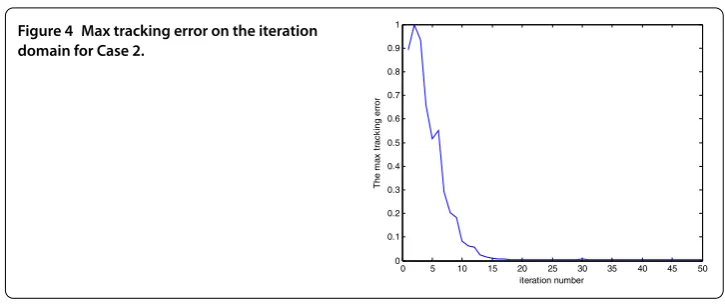
state-Figure 4 Max tracking error on the iteration domain for Case 2.
space representation of injection molding velocity control can be described as follows:
x(k,t+ ) = (A+A)x(k,t) + (Ad+Ad)x(k,t–d(t)) +Bu(k,t), y(k,t) =Cx(k,t),
where matricesA= [. –. ],B= [
],C= [. –.].A=EF,Ad=EF indi-cate uncertain parameter perturbation with
E=
. .
, F=
, F=
. .
,
=
ξ ξ
, |ξ|< ,|ξ|< ,
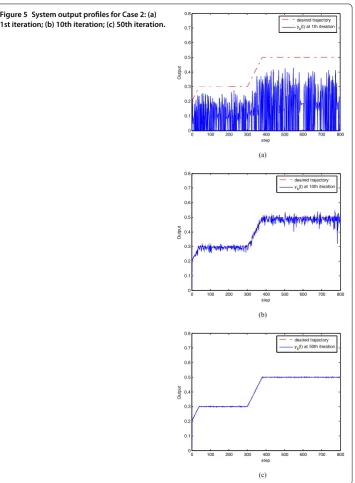
whereξ,are unknown variables. The values of time-varying delays are chosen as .≤ d(t)≤ and .≤h(k)≤, which is derived from [].
The desired trajectory is given as follows:
yd(t) =
⎧ ⎪ ⎪ ⎪ ⎨ ⎪ ⎪ ⎪ ⎩
. + .t, t≤,
., <t≤,
. + .(t– ), <t≤,
., <t≤.
In simulation, the initial states are given asx(,k) =x(,k) = for allk, and the control input is selected asu(t, ) = for allt. The time-varying delayd(t) changes randomly with d(t)∈[. ]. The uncertain parametersξ, are assumed to vary randomly within [ ] along with both time and iteration direction.
Figure 5 System output profiles for Case 2: (a) 1st iteration; (b) 10th iteration; (c) 50th iteration.
5 Conclusions
The robust ILC design is considered for uncertain linear systems with time-varying delays and random packet dropouts. By modeling the packet dropout as an arbitrary stochastic sequence satisfying the Bernoulli binary distribution, the considered system can be trans-formed into a D stochastic system described by the Roesser model with a delay varying in a range. Then, a delay-dependent stability condition is derived in terms of linear ma-trix inequalities (LMIs), and formulas can be given for the ILC law design. The results on injection velocity control have illustrated the feasibility and effectiveness of the proposed design.
Competing interests
The authors declare that they have no competing interests.
Authors’ contributions
BXH and HZW carried out the main part of this article. HZS and YJQ corrected and revised the manuscript. All authors have read and approved the final manuscript.
Author details
1School of Electrical Engineering & Automation, Henan Polytechnic University, Jiaozuo, China.2College of Computer Science and Technology, Henan Polytechnic University, Jiaozuo, China.3Advanced Control Systems Lab., School of Electronics and Information Engineering, Beijing Jiaotong University, Beijing, China.
Acknowledgements
This work was supported by the National Natural Science Foundation of China (Nos. 61573129, 61433002, 61573130), the Program for Science & Technology Innovation Talents in Universities of Henan Province (16HASTIT046), the Fundamental Research Funds for the Universities of Henan Province, the program of Key Young Teacher of Higher Education of Henan Province (2014GGJS-041), the program of Key Young Teacher of Henan Polytechnic University, the Science and Technology Innovation Talents Project of Henan Province (164100510004) and the Innovation Scientists and Technicians Troop Construction Projects of Henan Province (CXTD2016054).
Publisher’s Note
Springer Nature remains neutral with regard to jurisdictional claims in published maps and institutional affiliations.
Received: 5 November 2016 Accepted: 10 March 2017 References
1. Arimoto, S, Kawamura, S, Miyazaki, F: Bettering operation of robots by learning. J. Robot. Syst.1(2), 123-140 (1984) 2. Bristow, DA, Tharayil, M, Alleyne, AG: A survey of iterative learning control. IEEE Control Syst. Mag.26(3), 96-114 (2006) 3. Ahn, HS, Chen, Y, Moore, KL: Iterative learning control: brief survey and categorization. IEEE Trans. Syst. Man Cybern.,
Part C, Appl. Rev.37(6), 1099-1121 (2007)
4. Li, Y, Jiang, W: Fractional order nonlinear systems with delay in iterative learning control. Appl. Math. Comput.257, 546-552 (2015)
5. Meng, DY, Jia, YM: Iterative learning approaches to design finite-time consensus protocols for multi-agent systems. Syst. Control Lett.61(1), 187-194 (2012)
6. Chi, RH, Hou, ZS, Xu, JX: A discrete-time adaptive ILC for systems with iteration-varying trajectory and random initial condition. Automatica44(8), 2207-2213 (2008)
7. Xu, JX: A survey on iterative learning control for nonlinear systems. Int. J. Control84(7), 1275-1294 (2011) 8. Li, JS, Li, JM: Iterative learning control approach for a kind of heterogeneous multi-agent systems with distributed
initial state learning. Appl. Math. Comput.257, 1044-1057 (2015)
9. Nam, PT, Trinh, H, Pathirana, PN: Discrete inequalities based on multiple auxiliary functions and their applications to stability analysis of time-delay systems. J. Franklin Inst.352(12), 5810-5831 (2015)
10. Seuret, A, Gouaisbaut, F, Fridman, E: Stability of discrete-time systems with time-varying delays via a novel summation inequality. IEEE Trans. Autom. Control60(10), 2740-2745 (2015)
11. Zhang, XM, Han, QL: Abel lemma-based finite-sum inequality and its application to stability analysis for linear discrete time-delay system. Automatica57, 199-202 (2015)
12. Zhang, CK, He, Y, Jiang, L, Wu, M: An improved summation inequality to discrete-time systems with time-varying delay. Automatica74, 10-15 (2016)
13. Zhang, CK, He, Y, Jiang, L, Wu, M, Zeng, HB: Delay-variation-dependent stability of delayed discrete-time systems. IEEE Trans. Autom. Control61(9), 2663-2669 (2016)
14. Park, KH, Bien, Z, Hwang, DH: Design of an iterative learning controller for a class of linear dynamic systems with time delay. IEE Proc., Control Theory Appl.145(6), 507-512 (1998)
15. Xu, JX, Hu, Q, Lee, TH, Yamamoto, S: Iterative learning control with Smith time delay compensator for batch processes. J. Process Control11(3), 321-328 (2001)
17. Li, XD, Chow, TWS, Ho, JKL: 2D system theory based iterative learning control for linear continuous systems with time delays. IEEE Trans. Circuits Syst. I, Regul. Pap.52(7), 1421-1430 (2005)
18. Meng, DY, Jia, YM, Du, JP, Yu, FS: Robust design of a class of time-delay iterative learning control systems with initial shifts. IEEE Trans. Circuits Syst. I, Regul. Pap.56(8), 1744-1757 (2009)
19. Wang, LM, Mo, SY, Zhou, DH, Gao, FR: Robust design of feedback integrated with iterative learning control for batch processes with uncertainties and interval time-varying delays. J. Process Control21(7), 987-996 (2011)
20. Chen, SF: Delay-dependent stability for 2D systems with time-varying delay subject to state saturation in the Roesser model. Appl. Math. Comput.216(9), 2613-2622 (2010)
21. Liu, T, Gao, F: Robust two-dimensional iterative learning control for batch processes with state delay and time-varying uncertainties. Chem. Eng. Sci.65(23), 6134-6144 (2010)
22. Wang, LM, Mo, SY, Zhou, DH, Gao, FR:H∞Design of 2D controller for batch processes with uncertainties and interval time-varying delays. Control Eng. Pract.21(10), 1321-1333 (2013)
23. Fang, H, Ye, H, Zhong, M: Fault diagnosis of networked control systems. Annu. Rev. Control31(1), 55-68 (2007) 24. Jiang, S, Fang, H:H∞Static output feedback control for nonlinear networked control systems with time delays and
packet dropouts. ISA Trans.52(2), 215-222 (2013)
25. Zheng, X, Fang, H: Recursive state estimation for discrete-time nonlinear systems with event-triggered data transmission norm-bounded uncertainties and multiple missing measurements. Int. J. Robust Nonlinear Control
26(17), 3673-3695 (2016)
26. Bu, XH, Hou, ZS: Stability of iterative learning control with data dropouts via asynchronous dynamical system. Int. J. Autom. Comput.8(1), 29-36 (2011)
27. Bu, XH, Yu, FS, Hou, ZS, Wang, FZ: Iterative learning control for a class of nonlinear systems with random packet losses. Nonlinear Anal., Real World Appl.14(1), 567-580 (2013)
28. Ahn, HS, Chen, Y, Moore, KL: Intermittent iterative learning control. In: Proc. of the IEEE Int. Symposium on Intelligent Control, Germany, pp. 832-837 (2006)
29. Ahn, HS, Chen, YQ, Moore, KL: Discrete-time intermittent iterative learning control with independent data dropouts. In: Proceedings of 17th IFAC World Congress, Korea, pp. 12442-12447 (2008)
30. Liu, CP, Xu, JX, Wu, J: Iterative learning control for network systems with communication delay or data dropout. In: Proceedings of 48rd IEEE Conference on Decision and Control, China, pp. 4858-4863 (2009)
31. Bu, XH, Hou, ZS, Yu, FS, Wang, FZ:H∞Iterative learning controller design for a class of discrete-time systems with data dropouts. Int. J. Syst. Sci.45(9), 1902-1912 (2014)
32. Bu, XH, Hou, ZS, Jin, ST, Chi, RH: An iterative learning control design approach for networked control systems with data dropouts. Int. J. Robust Nonlinear Control26(1), 91-109 (2016)
33. Shen, D, Wang, YQ: ILC for networked nonlinear systems with unknown control direction through random Lossy channel. Syst. Control Lett.77, 30-39 (2015)
34. Qiu, J, Xia, Y, Yang, H, Zhang, J: Robust stabilisation for a class of discrete-time systems with time-varying delays via delta operators. IET Control Theory Appl.2(1), 87-93 (2008)
35. Boyd, S, Ghaoui, LE, Feron, E, Balakrishnan, V: Linear Matrix Inequalities in System and Control Theory. SIAM, Philadelphia (1994)
36. Ghaoui, EL, Oustry, F, Aitrami, M: A cone complementarity linearization algorithms for static output feedback and related problems. IEEE Trans. Autom. Control42(8), 1171-1176 (1997)
37. Moon, YS, Park, P, Kwon, WH, Lee, YS: Delay-dependent robust stabilisation of uncertain state delayed systems. Int. J. Control74(14), 1447-1455 (2001)