Simulation-based flexible ureteroscopy training using a novel
ureteroscopy part-task trainer
Udi Blankstein, MD;
*Andrea G. Lantz, MD, FRCSC;
†R. John D’A Honey, MD, FRCSC;
*Kenneth T. Pace, MD, FRCSC;
*Michael Ordon, MD, FRCSC;
*Jason Young Lee, MD, FRCSC
**Division of Urology, St Michael’s Hospital, University of Toronto, Toronto, ON; †Department of Urology, Dalhousie University, Halifax, NS
See related commentary on page 336.
Cite as: Can Urol Assoc J 2015;9(9-10):331-5. http://dx.doi.org/10.5489/cuaj.2811 Published online October 13, 2015.
Abstract
Introduction: Simulation-based training (SBT) is being
increas-ingly used for novice trainees as a means of overcoming the early learning curve associated with new surgical skills. We designed a SBT flexible ureteroscopy (fURS) course using a novel inanimate training model (Cook Medical, Bloomington, IN; URS model). We evaluated the course and validated this Cook URS model.
Methods: A 2-week SBT fURS course was designed for junior
level urology trainees at 2 Canadian universities. The curriculum included didactic lectures, hands-on training, independent train-ing sessions with expert feedback, and use of the Cook URS part-task model. Baseline and post-course assessments of trainee fURS skills were conducted using a standardized test task (fURS with basket manipulation of a calyceal stone). Performances were video-recorded and reviewed by 2 blinded experts using a validated assessment device.
Results: Fifteen residents (postgraduate years [PGY] 0–3)
partici-pated in the course. Of the participants, 80% rated the Cook URS model as realistic (mean = 4.2/5) and 5 endourology experts rated it as useful as a training device (mean = 4.9/5), providing both face and content validity. The mean overall performance scores, task completion times, and passing ratings correlated with trainee clini-cal fURS experience – demonstrating construct validity for the Cook URS model. The mean post-course task completion times (15.76 vs. 9.37 minutes, p = 0.001) and overall performance scores (19.20 vs. 25.25, p = 0.007) were significantly better than at baseline. Post-course performance was better in all domains assessed by the validated assessment device.
Conclusions: This study demonstrates that a SBT curriculum for
fURS can lead to improved short-term technical skills among junior level urology residents. The Cook URS model demonstrated good face, content and construct validity.
Introduction
In recent years, there have been significant changes in the surgical training landscape, and as such, it has become necessary for educators to carefully modify training cur-ricula to respond to such changes. With the introduction of several novel surgical platforms, the traditional method of apprenticeship training alone no longer meets the educa-tional needs of the modern surgical trainee.1 With an influx
of innovative surgical technologies, even training at a high-volume centres does not necessarily promise adequate case volume necessary to produce proficient and experienced
surgeons in all procedures, old and new.2
Simulation-based training (SBT) has quickly emerged as a mainstay in the modern training curriculum.3 This form of
training has become increasingly valuable as it allows for deliberate practice in a low-stakes environment and for time-ly feedback. SBT is particulartime-ly useful for novice trainees.
With the increasing incidence of urinary stone disease, the need for surgical management has also increased. Although advances in science and technology have improved the safe-ty and utilisafe-ty of flexible ureteroscopy (fURS) to treat urolithia-sis, learning to perform fURS appropriately and effectively is still difficult.4 Indeed, SBT may ideal in assisting trainees
to conquer the steep learning curve associated with fURS
without potentially compromising patient outcomes.5
Increasingly realistic surgical training models and virtual-reality simulators have been developed.6 Regardless of the
complexity or fidelity of these simulators, their usefulness as educational tools are only as good as the curriculum in which they are utilized. Moreover, they must have the valid-ity evidence to support their use.
whether the performance of an individual on the simulator matches the actual skill or experience level of that particular individual.3
The goal of this study was to determine the face, content and construct validity of a novel inanimate URS part-task model (Cook Medical, Bloomington, IN) and to evaluate the impact of a SBT curriculum on fURS skill acquisition. We hypothesize that the use of this novel inanimate model, as part of a more comprehensive curriculum, will improve technical performance. Specifically, given that the partici-pants are largely junior level trainees, performance domains that involve mainly manual dexterity without the need for significant judgment or decision-making will improve the most.
Methods
Curriculum
A comprehensive, simulation-based fURS course was devel-oped for novice to intermediate-level urology trainees. The course involved a comprehensive SBT curriculum specifi-cally designed for junior level trainees; it included an initial didactic lecture on the cognitive objectives of basic ureteros-copy and urolithiasis management. Following the lecture, each participant engaged in an interactive, hands-on dem-onstration of basic fURS instrumentation and techniques. Finally, the trainees participated in 3 independent practice sessions, each 30-minutes in duration, over 2 weeks.
For the independent practice sessions, each participant was provided with a full array of fURS instruments and was also provided a passive surgical assistant to help with han-dling of guidewires and baskets. Participants were provided with the Cook URS model and were instructed on how to use this part-task training model to simulate fURS. During one of the independent practice sessions, each participant received individual feedback by an expert endourologist.
Model
The Cook URS model (Fig. 1) includes 3 main training com-ponents: a dual calyceal system (left), a complete left KUB (kidney, ureter, bladder) system (centre) and a tortuous ure-ter system (right). It is cased in a platform made of acrylic and polycarbonate plastic. Braided reinforced polyurethane tubing is used to simulate tortuous anatomy. The bladder, single calyceal and double calyceal models are 3D printed with a translucent, acrylonitrile butadiene styrene (ABS)-like, plastic material and dyed red to simulate internal colour and translucency. The model requires filling with water and includes an easy to fill and drain system. Each component of the model also includes a motorized suction system for
the removal/filtration of “stone” debris from the working areas, which simulates high-pressure irrigation and provides the surgeon with improved visualization while any form of intracorporeal lithotripsy is used.
Validation task
Assessment of endourological skill was conducted at 2 points: an initial baseline (pre-training) assessment and a post-training assessment. Each participant completed a stan-dardized, simulated fURS task: rigid cystoscopy, placement of a ureteral access sheath, and flexible ureterorenoscopy with repositioning of a lower pole renal stone to an upper pole calyx using a flexible ureteroscope (Flex-X2, Storz) and a 1.3Fr Cook tipless nitinol basket. The trainees were assessed on the complete procedure with the aid of a pas-sive surgical assistant who was instructed to only act upon prompting to help hold guidewires, open and close the bas-ket – just like an experience in the operating room with a non-urological assistant.
Each participant completed a demographics question-naire at the start of the course, and an exit survey was used to assess the participant’s rating of the model. Five expert endourologists assessed the URS model for content validity. The baseline and post-course performance of the valida-tion task were video-recorded using electronic recording devices used only for study purposes. Recordings did not include sound or any identifying features of the trainees. The recordings were scored by 2 blinded expert endourolo-gists who used a previously validated global rating scale for fURS.7 This global rating scale includes 7 specific domains:
(1) respect for tissue, (2) time and motion, (3) instrument handling, (4) handling of the endoscope, (5) flow of the procedure, (6) use of assistants, and (7) knowledge of the procedure.
Analysis
Data were analyzed using using SPSS version 21. Descriptive statistics were used to evaluate sample demographics, as
well as to describe face and content validity. Two-tailed paired sample t-tests (with the significance level set at
p < 0.05) were employed to examine pre- and post-course
differences. Lastly, Spearman’s correlations were employed to evaluate the construct validity.
Results
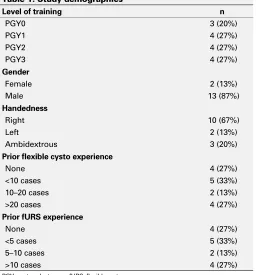
We included 15 participants from the University of Toronto and Dalhousie University from differing levels of training, ranging from final year medical students accepted into urology residency training programs (PGY0) to third year urology residents (PGY3). The participants had never used the Cook URS training model prior to the course; however, prior clinical fURS experience varied between study par-ticipants. Of the participants, 80% had completed over 20 flexible cystoscopy cases during their prior clinical training (Table 1); however, few had prior extensive fURS experi-ence. The trainees rated the Cook URS model as realistic (4.07/5, mean = 4.20) and 5 expert endourologists with prior experience with the model considered it a useful training device (mean score = 4.9/5.0).
Participant training level significantly correlated with per-formance scores(r = 0.44, p = 0.02) and task time-to-com-pletion (r = -0.38, p = 0.04). Flexible URS experience sig-nificantly correlated with task performance score (r = 0.53,
p < 0.01) and time (r = -0.41, p = 0.03). Flexible cystoscopy
experience correlated with time (r = -0.40, p = 0.03), but did not correlate with task performance score (r = 0.35,
p = 0.06).
When looking at the specific technical skills assessed by the validated global rating scale, most skills correlated with PGY and experience, including mean scores for Time and Motion (r = 0.58, p < 0.01), Instrument Handling (r = 0.60,
p < 0.01), Flow of Procedure (r = 0.54, p < 0.01), and
Knowledge of Procedure (r = 0.44, p = 0.02), but not mean score for Handling of Endoscope (r = 0.22, p = 0.24) or Use of Assistants (r = 0.24, p = 0.21).
With respect to evaluating the educational value of the SBT course, all 15 trainees felt the course was extremely valuable (mean 5.0/5) and post-course performance sig-nificantly improved in comparison to baseline pre-course performance of the standardized fURS task (Table 2). This was seen for task completion time and for task performance score (overall and for each independent domain).
Discussion
New surgical part-task training models are being created and promoted at an increasingly high rate. It is essential to assess the validity of these emerging training models by analyz-ing the utility of the simulators in relation to their ability to mimic real world skill and competency. To our knowledge, this is the first validation study of the Cook URS model. Our results showed that the training model demonstrated good face, content and construct validity.
Many studies within the urological community emphasize enhanced learning and skill retention with the use of SBT.8
Unfortunately, there is a high financial cost to many of these simulators, particularly the complex virtual-reality computer-based simulators. But an expensive simulation model does not always equate to an effective teaching tool.6 The Cook
URS model is not overly expensive to manufacture (about $650 US) and is easy to assemble and care for. Our results indicate that models like this one are sufficient for trainee use and can allow trainees to improve their fURS skills in a
Table 1. Study demographics
PGY: postgraduate year; fURS: flexible ureteroscopy.
Table 2. Pre- and post-course performance
Performance metrics (mean) Pre-score
Post-score p value
Task completion time (min) 15.24 9.1 <0.05
Overall performance score (max 35) 18.1 24.2 <0.05
Respect for Tissue domain 2.8 3.4 <0.05
Time and Motion domain 2.4 3.2 <0.05
Instrument Handling domain 2.2 3.0 <0.05
Handling of Endoscope domain 2.4 3.3 <0.05
Flow of Procedure domain 2.7 3.4 <0.05
Use of Assistants domain 2.8 3.5 <0.05
low-stakes environment. It is important to note that with the advent of new technologies, such as 3D printing, the current costs will only become lower in the near future. This trend is already happening in other surgical fields and increases the allure of using relatively low-tech simulation models.9
A training simulator is only as good as the accompanying teaching. The endourological community has been slow to develop effective training curricula to accompany existing simulation models. Without a proper framework for learning, the usefulness of SBT decreases.10 A recent study of senior
medical students showed that those who participated in a SBT course showed better performance in laparoscopic skills than their peers who did not engage in training.11 Similarly,
a randomized, single-blinded trial demonstrated that general surgery residents who underwent an organized curriculum, consisting of simulation and case-based learning, had superi-or skills compared to their peers who did not take part of the course.12 Palter and colleagues have shown similar results
in other training paradigms.13 Research has shown that even
short educational models are effective. More specifically within the field of urology, even within a limited time frame of a few hours, Matsumoto and colleagues demonstrated that didactic teaching with supervised hands-on training increased skill level in an endourological simulation model.7
Similar to published reports, our results showed that the trainees improved their time and performance scores after completing the 2-week SBT fURS course. These results are due to two essential components that were built into the course curriculum. Firstly, we included both expert instruc-tion and individual feedback. The provision of timely feed-back facilitates the cognitive retention of the task at hand and allows learners to cement their technical skills in the context of this cognitive knowledge. Based on the works of Fitts and Posner,14 we currently know that the cognitive
and contextual components of learning within a structured course are extremely important in surgical skills training. This cognitive component complements the additional psychomotor phases of learning and allows for better task automation.15 While the cognitive component has classically
been given via a didactic lecture setting, it is now not limited to physical space confinements. Online and video-based lectures can be viewed at any time. The use of such tools is effective. With more people viewing the videos, more people become better at these surgical skills and retain the information.16
Secondly, the success of this course was the allotment of independent training sessions, which permitted deliberate practice over an extended duration. Not surprisingly, this has
been shown to enhance skill acquisition.17 We deployed a
distributed independent practice model (3 sessions within a 2-week period) that has consistently led to better results than practice within a very short, concentrated period.15
This simulation-based fURS training curriculum, or other
similarly structured curricula, can benefit junior-level train-ees with minimal clinical experience with fURS. The use of such training curricula can perhaps shorten the learning curve for urology residents and improve intra-operative per-formance and likely is best integrated in a spaced-learning structure over the first few years of residency training.
Our study has its limitations. The small sample size may have resulted in bias. We were unable to control for clini-cal fURS experience in the operating room during the study period. This may have skewed the results as some study par-ticipants may have gained additional practice outside of the designated practice time. This study did not assess long-term skill retention, but focused on short-term acquisition and dis-play of technical ability. Also, we did not include senior resi-dents, fellows, or expert staff. While the results of the study may not be generalizable to those already experienced with the procedure, our results suggest that the Cook URS model is useful in training of junior level urology trainees. Lastly, while the participants clearly improved following the SBT course, we do not have comparative data to assess whether improvements within the confines of the SBT course resulted in improvements in clinical skills in the operating room.
Conclusion
Our study demonstrated that the Cook URS model has good face, content and construct validity. Additionally, our find-ings suggest that a comprehensive SBT curriculum for fURS can lead to improved short-term technical skills among junior level urology trainees.
Competing interests: The authors all declare no competing financial or personal interests.
This paper has been peer-reviewed.
References
1. Gallagher AG, Ritter EM, Champion H, et al. Virtual reality simulation for the operating room: Proficiency-based training as a paradigm shift in surgical skills training. Ann Surg 2005;241:364-72. http://dx.doi. org/10.1097/01.sla.0000151982.85062.80
2. Reznick RK, MacRae. Teaching surgical skills--changes in the wind. N Engl J Med 2006;355:2664-9. http://dx.doi.org/10.1056/NEJMra054785
3. McDougall EM. Validation of surgical simulators. J Endourol 2007;21:244-7.
4. Wignall GR, Denstedt JD, Preminger GM, et al. Surgical simulation: A urological perspective. J Urol 2008;179:1690-9. http://dx.doi.org/10.1016/j.juro.2008.01.014
5. Olweny EO, Pearle MS. Update on resident training models for ureteroscopy. Curr Urol Rep 2011;12:115-20. http://dx.doi.org/10.1007/s11934-010-0169-6
6. Mishra S, Sharma R, Kumar A, et al. Comparative performance of high-fidelity training models for flexible ureteroscopy: Are all models effective? Indian J Urol 2011;27:451-6. http://dx.doi.org/10.4103/0970-1591.91431
8. Matsumoto ED, Pace KT, RJ DAH. Virtual reality ureteroscopy simulator as a valid tool for assessing endourological skills. Int J Urol 2006;13:896-901.
9. Cheung CL, Looi T, Lendvay TS, et al. Use of 3-dimensional printing technology and silicone modeling in surgical simulation: Development and face validation in pediatric laparoscopic pyeloplasty. J Surg Educ 2014;71:762-7. http://dx.doi.org/10.1016/j.jsurg.2014.03.001
10. Kneebone R. Simulation in surgical training: Educational issues and practical im-plications. Med Educ 2003;37:267-77. http://dx.doi.org/10.1046/j.1365-2923.2003.01440.x
11. De Win G, Van Bruwaene S, Allen C, et al. Design and implementation of a proficiency-based, structured endoscopy course for medical students applying for a surgical specialty. Adv Med Educ Pract 2013;4:103-115. http://dx.doi.org/10.2147/AMEP.S41681
12. Palter VN, Orzech N, Reznick RK, et al. Validation of a structured training and assessment curriculum for technical skill acquisition in minimally invasive surgery: A randomized controlled trial. Ann Surg 2013;257:224-30. http://dx.doi.org/10.1097/SLA.0b013e31827051cd
13. Palter VN, Grantcharov TP. Development and validation of a comprehensive cur-riculum to teach an advanced minimally invasive procedure: A randomized con-trolled trial. Ann Surg 2012;256:25-32. http://dx.doi.org/10.1097/SLA.0b013e318258f5aa
14. Fitts PM, Posner MI. Human Performance. Belmont, CA: Brooks/Cole; 1967.
15. Moulton CA, Dubrowski A, Macrae H, et al. Teaching surgical skills: What kind of practice makes per-fect? A randomized, controlled trial. Ann Surg 2006;244:400-9. http://dx.doi.org/10.1097/01. sla.0000234808.85789.6a
16. Gyorki D, Shaw T, Nicholson J, et al. Improving the impact of didactic resident training with online spaced education. ANZ J Surg 2013;83:477-80. http://dx.doi.org/10.1111/ans.12166
17. Ericsson KA. Deliberate practice and the acquisition and maintenance of expert performance in medicine and related domains. Acad Med 2004;79:S70-81. http://dx.doi.org/10.1097/00001888-200410001-00022