_____________________________________________________________________________________________________
*Corresponding author: E-mail: [email protected]; www.sciencedomain.org
Effects of a 12-week Minimum Program for
Preventive Medical Purposes
Michael Despeghel
1and Karsten Krüger
1*1
Department of Sports Medicine, Justus Liebig-University Giessen, Giessen, Germany.
Authors’ contributions
This work was carried out in collaboration between both authors. Author MD designed the study wrote the protocol and managed the experimental process. Author KK wrote the first draft and the final manuscript. Author KK managed the literature searches. Both authors read and approved the final manuscript.
Article Information
DOI: 10.9734/BJMMR/2016/27358
Editor(s):
(1) Ashish Anand, Department of Orthopaedic Surgery, GV Montgomery Veteran Affairs Medical Center, Jackson, MS, USA.
Reviewers:
(1) Naufal Zagidullin, Bashkir State Medical University, Russia. (2)Hugo Ramos, National University of Cordoba, Cordoba, Argentina. (3)Heethal Jaiprakash, MAHSA University, Jalan Elmu off Jalan University, Kuala Lumpur, Malaysia. Complete Peer review History:http://www.sciencedomain.org/review-history/15492
Received 30th May 2016 Accepted 6th July 2016 Published 24th July 2016
ABSTRACT
Current study aimed to investigate the effects of a minimal training program combined with a nutritional intervention, an introductory health seminar and an individual health coaching on parameters for cardiovascular health in adult office workers.
Methods: 49 healthy male and female subjects were recruited from a cohort of office workers and performed a 12-weeks intervention program. The program included a lecture about the health consequence of a lack of movement. Exercise training was performed home based and included two times per week endurance and two times per week strength training for a duration of totally 80 minutes. Nutrition intervention encompassed eating a more Mediterranean style and the record of calorie consumption. Subjects were continuously supervised and motivated online. Body weight, body composition, and metabolic parameters including blood lipid profile were measured before and after intervention.
Results: During the intervention a weight loss (5.7±13.6 kg, p<0.01), a reduction of body mass index (BMI) (from 27.5±3.7 to 25.8±3.3 kg/m², p<0.05), a reduction of overall cholesterol levels (from 205.8±29.8 to 192.7±29.1 mg/dl; p<0.01), a decrease of low density lipoprotein (LDL) (from
124.0±29.0 to 113.3±24.6 mg/dl, p<0.01), a decrease of triglyceride levels (from 144.2±74.5 to 123.0±69.1 mg/dl, p<0.01) and a reduction of uric acid levels (from 6.4±1.1 to 5.5±1.1 mg/dl, p<0.01) occurred.
Conclusion: A moderate adjustment of personal lifestyle within a 12 week prevention program is effective in improving various risk factors for cardiovascular disease. The knowledge about the minimum time requirements might help to overcome a central barrier of being active.
Keywords: Preventative medicine; low-threshold training; strength training; weight loss; BMI; triglyceride; uric acid; body fat.
1. INTRODUCTION
It is well established that physical activity is an important lifestyle factor in the prevention of most metabolic and cardiopulmonary diseases. For several diseases like cardiovascular disease, thromboembolic stroke, hypertension, type 2 diabetes mellitus, osteoporosis, obesity, breast cancer, and depression, it was demonstrated in prospective observational studies that disease outcomes are inversely related to regular physical activity [1]. Although most people be aware of the positive effects of physical activity for health, it appears that practical implementation of this knowledge has barely occurred in Western civilization [2]. Consequently, several studies tried to analyze the perceived barriers to increased activity. Here it was found that one of the most frequently cited barriers to more-regular participation were insufficient time. Therefore, less time-consuming interventions may be more attractive [3]. Consequently, it was tried to establish alternative exercise programs which share both high effectivity for health as well as small time requirements [4]. Here it was found that for healthy adults aged 18 to 65 years a minimum of 30min of moderate-intensity aerobic (endurance) physical activity is needed to provide significant effects for health [5]. If somebody wants to spend less time than 30min per day for activity, exercise programs have to be combined with other lifestyle modifications like nutritional interventions for a more successful improvement of cardiovascular risk factors [5,6].
Therefore, current study aimed to investigate the effects of a minimal training program combined with a nutritional intervention, an introductory health seminar and an individual health coaching via email on several parameters for cardiovascular health in adult office workers. Thereby, the training load did not exceed 80 minutes per week. We hypothesized that this low-threshold program positively affects metabolism and cardiovascular risk factors.
2. METHODS
2.1 Subjects
49 healthy male and female subjects were recruited from a cohort of office workers. They were invited to attend the study after completing an informed consent according to standard ethical issues. Thereby, subjects were informed about the nature, purpose, protection of data privacy and potential risks of the study. The personal characteristics of the subjects were as follows: 36 men, age 45.7±7.1 yrs, BMI 27.0±3.7 kg/m2 and 13 women, age 43.3±8.2 years; BMI 28.7±3.4 kg/m2. At the beginning of the study, general health level was also determined through a common medical history form.
2.2 Interventions and Training Program
The 12-weeks intervention program included a minimal training program combined with a nutritional intervention, an introductory health seminar and an individual health coaching via email.
The introductory health seminar was a lecture about the health consequence of a lack of movement, included practical sessions on heart-rate controlled endurance training (walking, running, bicycle ergometer), as well as information about doing effective strength and stretching exercises at home. Regarding nutrition, the subjects were taught about calorie-reduced diets in a Mediterranean style. In combination with the health seminar, blood pressure and lactate values were measured during a continuous exercise test.
maximum volume of at about 20 minutes (each session) per week.
In terms of nutrition, the subjects should try to eat in a more Mediterranean style – often replacing meat with fish, eating two portions of fruit and 500 grams of vegetables per day, and drinking enough to ensure a liquid uptake of 30ml/kg body weight. In the coming 12 weeks, the participants were invited to record their calorie consumption at least 4 days per week.
During the 12-week investigation time, subjects were continuously supervised and motivated online by sports scientists. At the end of every week they had to submit a training and nutrition diary, which they then quickly received feedback for.
2.3 Analysis of Body Composition and Biochemical Analysis
The following parameters were determined at the beginning of the intervention (T1) and in the re-test at the end (T2): Body weight was measured using a digital set of scales (TANITA Body Fat Monitor/Scale, Model TBF-538, Illinois 60005, USA). Measurement of body composition done by using the near-infrared method with the Advanced Body Composition And Fitness Analyser FUTREX®-6100 XL by VicMedic Systems GmbH, ZELLTEC diagnostics, Höhenkirchen-Siegertsbrunn, Germany. Total cholesterol, LDL cholesterol, HDL cholesterol, triglycerides, uric acid and glucose were potentiometrically or photometrically analyzed using a HITACHI 911 Automatic Analyser (Tokio, Japan). Lactate values were quantified using a Dr. Lange Miniphotometer LP 20 (Dr. Lange cuvette test LKM 40, Germany).
2.4 Statistics
Data are presented as means±standard deviation (SD). Differences between pre-intervention (T1) and post-pre-intervention (T2) values were compared using the Wilcoxon test (non-parametric tests) with the statistics program SPSS 9.0 for Windows. The following significance limits were used for the investigation: p ≤ 0.05 significant, p ≤ 0.01 highly significant.
3. RESULTS
3.1 Body Composition
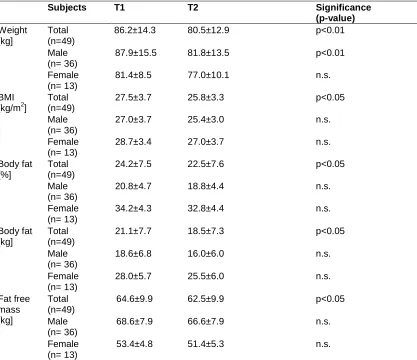
Between T 1 and T2, a significant decrease of body weight was found (p<0.01). Thereby, the
decrease in male subjects was higher (6.9%, p<0.01) compared to female subjects (-5.4%) Similarly, BMI decreased significantly in the total cohort (p<0.05), whereat it failed to be significant in the gender subgroups (Table 1). Both percentage as well as absolute body fat mass decreased significantly in total subjects (p<0.05) without any differences in the gender subgroups. In addition, a slight decrease was found in the absolute fat free mass (p<0.05) (Table 1).
3.2 Biochemical Measurements
Total cholesterol significantly decreased between T1 and T2 (-6,4%, p<0.01). These changes failed to be significant in the gender subgroups. While no significant changes for observed in HDL cholesterol, a significant decrease was found in LDL cholesterol (-8.7%, p<0.01). Similarly, both triglycerides as well as uric acid decreased significantly between T1 and T2 (triglycerides: -14,7%, p<0.01, uric acid -14,1%, p<0.01). Gender differences were not found in the parameters. However, no significant changes were observed in basal glucose levels (Table 2).
4. DISCUSSION
The current study demonstrated that 12-week preventative exercise and nutrition program was effective in changing both body composition as well as lipid profile of previously sedentary subjects. Accordingly, healthy office workers are able to improve their cardiovascular risk profile with just moderate changes in lifestyle, including a physical activity program of less than 80 minutes per week when combined with a nutrition intervention and an individual health coaching via email.
The study focused on selected parameters of body composition and metabolic markers in blood which are used as simple indicators of the card cardiovascular risk profile. From a medical point of view, the priority is to decrease body weight by loosing body fat and to improve blood lipids and lipid profile [7].
the BMI includes also information about the relative body mass. The body mass index is commonly used to examine the obesity-mortality association even though BMI is not an accurate measure of obesity. It rather indicates overweight for height but does not discriminate between fat mass and fat-free mass (FFM). The health effects of overweight on height and body composition in relation to cardiovascular disease risk factors seems to be better measured by analyzing fat mass and fat-free mass [9]. Therefore, body composition analysis using the near-infrared method allows a more qualitative investigation of weight loss. The intervention program was accompanied by a reduction of body fat mass by 1.7% (males: 2.0%; females: -1.4%). Accordingly, the combination of low fat diet and endurance exercise was effective in reducing body fat. Since other studies proved a direct relation between body fatness and
all-cause mortality and cardiovascular disease, these changes might be favorable for the subjects [9].
The results of an improvement of body
composition including body weight, body mass index, percent body fat after a 12
weeks lifestyle program were supported by other
studies [10-12]. Here it was found that lifestyle programs which include exercise were
effective in the improvement of several variables in the health hazards of obesity in adolescent girls, obese adults and healthy office workers [11-13]. In this regard, Aldana et al. [13] found that working adults who participated in a randomized clinical trial of an intensive lifestyle intervention including nutrition and physical activity, improved their body weight and body composition after about only 6 weeks of intervention.
Table 1. Effects of the 12 weeks preventive health program on subjects weight, BMI (body mass index), body fat, and fat free mass
Subjects T1 T2 Significance
(p-value) Weight
[kg]
Total (n=49)
86.2±14.3 80.5±12.9 p<0.01
Male (n= 36)
87.9±15.5 81.8±13.5 p<0.01
Female (n= 13)
81.4±8.5 77.0±10.1 n.s.
BMI [kg/m2]
Total (n=49)
27.5±3.7 25.8±3.3 p<0.05
Male (n= 36)
27.0±3.7 25.4±3.0 n.s.
Female (n= 13)
28.7±3.4 27.0±3.7 n.s.
Body fat [%]
Total (n=49)
24.2±7.5 22.5±7.6 p<0.05
Male (n= 36)
20.8±4.7 18.8±4.4 n.s.
Female (n= 13)
34.2±4.3 32.8±4.4 n.s.
Body fat [kg]
Total (n=49)
21.1±7.7 18.5±7.3 p<0.05
Male (n= 36)
18.6±6.8 16.0±6.0 n.s.
Female (n= 13)
28.0±5.7 25.5±6.0 n.s.
Fat free mass [kg]
Total (n=49)
64.6±9.9 62.5±9.9 p<0.05
Male (n= 36)
68.6±7.9 66.6±7.9 n.s.
Female (n= 13)
53.4±4.8 51.4±5.3 n.s.
Table 2. Effects of the 12 weeks preventive health program on subjects total cholesterol, high-density lipoproteins (HDL) cholesterol, low-high-density lipoproteins (HDL) cholesterol,
triglycerides, uric acid and glucose levels
Subjects T1 T2 Significance
(p-value) Total cholesterol
[mg/dl]
Total (n=49)
205.8±29.8 192.7±29.1 p<0.01
Male (n= 36)
205.1±29.4 191.8±30.6 n.s.
Female (n= 13)
207.8±30.9 195.3±23.8 n.s.
HDL cholesterol [mg/dl]
Total (n=49)
52.9 ±15.2 54.9±16.4 n.s.
Male (n= 36)
27.0±3.7 25.4±3.0 n.s.
Female (n= 13)
56.7±13.5 57.2±18.3 n.s.
LDL cholesterol [mg/dl]
Total (n=49)
124.0±29.0 113.3±24.6 p<0.01
Male (n= 36)
123.9±29.0 113.7±26.6 n.s.
Female (n= 13)
124.5±28.9 111.9±17.5 n.s.
Triglycerides [mg/dl]
Total (n=49)
144.2±74.5 123.0±69.1 p<0.01
Male (n= 36)
147.7±75.0 120.5±67.3 n.s.
Female (n= 13)
133.7±72.2 130.6±73.7 n.s.
Uric Acid [mg/dl]
Total (n=49)
6.4±1.1 5.5±1.1 p<0.01
Male (n= 36)
6.8±1.0 5.9±0.7 n.s.
Female (n= 13)
5.6±1.0 4.6±1.2 n.s.
Glucose [mg/dl]
Total (n=49)
86.0±10.4 84.0±11.2 n.s.
Male (n= 36)
85.7±11.1 83.9±12.2 n.s.
Female (n= 13)
86.8±7.7 84.2±7.4 n.s.
(n.s. means not significant)
In the current study, also a reduction of fat free mass was found. Because fat free mass in mainly represented by muscle tissue, this was not really a desired health effect. A loss of protein accompanies a lower basal metabolic rate, making further weight loss more difficult [9]. However, in future interventions the loss of fat free mass should be prevented by including more effective strength exercise into the intervention program [14].
the individual cardiovascular risk more accurately, LDL and HDL were analyzed separately [9]. In the overall group, HDL levels increased only by tendency. Accordingly, the intervention was able to move the subjects closer to the aimed range of 60 mg/dl. The extent of the change in HDL levels was between 1 and 20 mg/dl. It is assumed that the intensity or duration of exercise was to low. Other studies, which were successful in increasing HDL levels by exercise, implemented exercise programs which more intensive [15]. In contrast, LDL levels decreased between T1 and T2 by about 8-9 percent. Concentration of LDL cholesterol is the fundamental index of risk of vascular disease. It is an estimate of the mass of cholesterol in the LDL fraction in plasma [16]. Despite the significant improvement the LDL levels at T2 did not meet the preventative ideal level of below 100 mg/dl [16]. However, it is suggested that also the time span of 12 weeks might be not long enough to affect both HDL as well as LDL levels more distinctly. Analyzing LDL/HDL ratio, there was an average improvement from 2.3 to 2.1. Accordingly, subjects cardiovascular risk profile at T1 was not enhanced, and the slight improvement of the LDL/HDL ratio might stabilize their health conditions. Changes in blood lipids were comparable with previous studies in overweight and obese subjects and healthy employees [10,13]. Thereby, Aldana et al. [13] found changes in disease risk factors and health behaviors apparent after 6 weeks of participation in a comprehensive lifestyle program including instruction for risk factors and healthy food, regular exercise training and a weekly contact to experts.
Uric acid levels of the total cohort were reduced during the program, from the high end to the middle of the normal range, which is desirable for preventative medicine. It is suggested that the combination of increased physical activity and reduced meat consumption seems to be reason the uric acid decrease. Increased levels of uric acid from excess purines may accumulate in tissues, and form crystals. Uric acid formation may occur when the blood uric acid level rises above 7 mg/dl. Problems, such as kidney stones, and accumulation of uric acid crystals in the joints, may occur [17,18].
5. CONCLUSION
Current data indicate that a home based exercise training program of less than 80 minutes per week combined with a nutritional intervention, an
introductory health seminar and an individual health coaching via email positively affect several parameters for mortality and cardiovascular health in adult office workers. Accordingly, moderate adjustments to personal lifestyle within a 12 week prevention program can positively various risk factors for cardiovascular disease. We are aware of the limitations that number of subjects is small, and the sex is not balanced in this study. Nevertheless we could show that health related lifestyle changes have minimum time requirements which might help to overcome a central barrier of being active, which is represented by a lack of time. However, we also demonstrated that more pronounced changes in lipid profiles require a longer and possibly more intensive exercise intervention. Moreover, the loss of fat free mass should be counteracted by giving strength or resistance training a substantial importance.
COMPETING INTERESTS
Authors have declared that no competing interests exist.
REFERENCES
1. Kesaniemi YA, Danforth Jr. E, Jensen MD, Kopelman PG, Lefebvre P, Reeder BA. Dose-response issues concerning physical activity and health: An evidence-based symposium. Med. Sci. Sport Exerc. 2001;33(6 Suppl):S531-S538.
2. Hamilton MT, Healy GN, Dunstan DW, Zderic TW, Owen N. Too little exercise and too much sitting: Inactivity physiology and the need for new recommendations on sedentary behavior. Curr Cardiovasc Risk Rep. 2008;2(4):292-298.
3. Booth ML, Bauman A, Owen N, Gore CJ. Physical activity preferences, preferred sources of assistance and perceived barriers to increased activity among physically inactive Australians. Prev Med. 1997;26(1):131-7.
4. Hood MS, Little JP, Tarnopolsky MA, Myslik F, Gibala MJ. Low-volume interval training improves muscle oxidative capacity in sedentary adults. Med Sci Sports Exerc. 2011;43:1849e56.
the American Heart Association. Med Sci Sports Exerc. 2007;39(8):1423-34.
6. Gallotta MC, Iazzoni S, Emerenziani GP, Meucci M, Migliaccio S, Guidetti L, Baldari C. Effects of combined physical education
and nutritional programs on
schoolchildren's healthy habits. Peer J. 2016;11:4:e1880.
7. Fuster JJ, Ouchi N, Gokce N, Walsh K. Obesity-Induced changes in adipose tissue microenvironment and their impact on cardiovascular disease. Circ Res. 2016;118(11):1786-807.
8. Van Itallie TB. Health implications of overweight and obesity in the United States. Ann Intern Med. 1985;103:983–8. 9. Lee CD, Blair SN, Jackson AS.
Cardiorespiratory fitness, body composition, and all-cause and cardiovascular disease mortality in men. Am J Clin Nutr. 1999;69(3):373-80.
10. Park TG, Hong HR, Lee J, Kang HS. Lifestyle plus exercise intervention improves metabolic syndrome markers without change in adiponectin in obese girls. Ann Nutr Metab. 2007;51(3):197-203. 11. Ho SS, Dhaliwal SS, Hills AP, Pal S. The effect of 12 weeks of aerobic, resistance or combination exercise training on cardiovascular risk factors in the
overweight and obese in a randomized trial. BMC Public Health. 2012;12:704. 12. Herring LY, Wagstaff C, Scott A. The
efficacy of 12 weeks supervised exercise in obesity management. Clin Obes. 2014;4(4):220-7.
13. Aldana SG, Greenlaw RL, Diehl HA, Salberg A, Merrill RM, Ohmine S. The effects of a worksite chronic disease prevention program. J Occup Environ Med. 2005;47(6):558-64.
14. Strasser B, Pesta D. Resistance training for diabetes prevention and therapy: Experimental findings and molecular
mechanisms. Biomed Res Int.
2013;2013:805217.
15. Kessler HS, Sisson SB, Short KR. The potential for high-intensity interval training to reduce cardiometabolic disease risk. Sports Med. 2012;42:489e 509.
16. Parto P, Lavie CJ, Swift D, Sui X. The role of cardiorespiratory fitness on plasma lipid levels. Expert Rev Cardiovasc Ther. 2015;13(11):1177-83.
17. Farnier M. Future lipid-altering therapeutic options targeting residual cardiovascular risk. Curr Cardiol Rep. 2016;18(7):65.
18. Kuwabara M. Hyperuricemia,
cardiovascular disease, and hypertension. Pulse (Basel). 2016;3(3-4):242-52.
_________________________________________________________________________________ © 2016 Despeghel and Krüger; This is an Open Access article distributed under the terms of the Creative Commons Attribution License (http://creativecommons.org/licenses/by/4.0), which permits unrestricted use, distribution, and reproduction in any medium, provided the original work is properly cited.
Peer-review history: