EFFECTIVE EXTRACTION OF SEMANTIC CONTENT IN
VIDEOS USING META-ONTOLOGY
1K.PRIYA
1Asst Prof., Department of Information Technology, Sathyabama University, Chennai, India
E-mail: [email protected]
ABSTRACT
The growth of using videos in different areas like surveillance cameras, Intruder detection, sports, news, etc., increases the research on utilizing these videos. Unauthorized persons, thefts and malpractices are detected by these videos. Large volumes of recorded data through these cameras are stored but not utilized or processed. Tracking of an objects and extraction of features from videos are done through several methods. The events and objects can difficult to detect in populated area. Semantic Content Extraction (SCE) was proposed to extracting objects and events along with their relations using ontology. Ontology construction for these videos gives spatial, temporal and topological relations between different video frames. This results the events or actions performed in the video which intends to give semantic content from the video.
Keywords: Semantic content, Ontology, Spatial Relations, Temporal Relations, Topological Relations, Event Extraction
1.
INTRODUCTIONThe growth in utilizing video content is increasing day-to-day. Large volumes of video data are simply dumped but not processed. By processing these dumped data we can extract features from the video along with the events happening in the video, which helps in the areas of video surveillance. The main intention here is to extract semantic contents from those videos. This semantic content provides meaningful data to the user.
The video has three types of content namely raw video that contains basic physical video units along with some video attributes like format, length, and frame rate, Low-level features that audio, text and features that are visible like texture, color distribution, shape, motion, etc. and semantic content that gives meaningful content that contains high-level features like objects and events occurred in the video.
Several existing systems like Human activity detection from online video surveillance detect single activity of the human. Several methods are introduced to track and extract the features from these videos to detect objects and events that occur in the video. But, the detection of objects and events in videos will mismatch in crowded areas. Detection of events is complex in such areas. In our
existing technologies ontologies that provide perfect relations of objects or events were not used. Rules that are constructed on these spatial and temporal relations cause effective extraction of semantic content from videos.
The increase in utilizing videos extends to the vast research on processing these videos. Several systems proposed tracking of objects, extraction of images or events from these videos. These systems are just focusing on events and objects, but not on semantic content from the videos. This semantic
content provides meaningful data from the videos
which helps great extent to the end user. To extract this semantic content an effective approach is proposed.
As video has sequence of frames and shots, they have to be processed to get objects and its instances in an easier way. By tracking the objects from the videos, relations between different objects in the video are extracted. To find Spatial and Temporal relations use some rules like near, far, etc. Finally, semantic content should be extracted from the videos using these relations and ontology construction.
Performance analysis in section 5 and conclusion and future work in section 6.
2.
RELATED WORKSemantic Annotation and Retrieval of Video Events Using Multimedia Ontologies [1] efficient content annotation and retrieval tools are used to make the multimedia digital libraries efficiently. In this paper, includes both the linguistic and dynamic also presented the soccer domain. With the proposed ontology concept, high level annotation clips can be used, also make difficult queries to compare the actions and its temporal evolutions and video sequence has created with extended text commentaries.
Limitations:In the above scenario, the events are
retrieved by multimedia ontologies. It gives only the events occurred in the video. It doesn’t provide the semantic content to the user.
Semantic Event Extraction from Basketball
Games Using Multi-Modal Analysis [2].
Webcasting text and broadcast videos are used for semantic event extraction. Novel provides the
analysis on text for event detection and extraction,
also the video analysis provides the events structure modeling and motion detection, text and video alignments are for to deduct the boundaries as well, and this has been proposed in this paper. Low level and high level features (mainly on games videos) and gap between those has discussed in this paper.
Firstly, faster motion and scenes are highly
availablein basketball play which leads to negative
positive and base in event detection.
Secondly, time storage and sudden play break in the basketball game makes lot of challenges for alignments in web casting text and event moments in the video which broadcasting.
Limitations: The detection of gap between
low-level and high-low-level features are discussed here. But, construction of ontologies is the main fact missing here.
Automatic detection of salient objects and spatial relations in videos for a video database system [3]. Multimedia databases is efficiently growing now-a-days because of its efficient indexing, retrieval and analysis of data which can be achieved via labeling on data prior to storage querying. So manually tasks are impossible since large amount of data stored. To make it easy and for automatic detection, they propose the tool of auto detection and tracking the salient objects and spatio temporal and it's relationship between them. In this labeling can be
done only once for each objects in every frame. A
scalable architecture framework has been also
proposed.
Limitations: Here Ontologies are not used so the
performance of finding relationships is less.
Ontology-supported object and event extraction with a genetic algorithms approach for object classification [7]. Solutions available currently are far away from reach the ultimate goal, also the end users to retrieve the excepted video from the huge amount of video data in a semantic meaningful manner. With this study, a video database model (OVDAM) that provides automatic object, event and concept extraction was proposed. Low level object relations and objects are determined by training sets and options by experts. N-Cut image segmentation algorithm is used to determine segments in video key frames and the genetic algorithm-based classifier is used to make classification of segments (candidate objects) to objects. At the top level ontology of objects, events
and concepts areused. All these information used
to generate concepts for objects and events. Reliable data model has been used and it provides to the users to make the fuzzy querying with ontology-supported. RDF is used to represent metadata. Ontology and RDQL are represented by using OWL. Events, Objects, Spatio temporal clauses are available in queries which handles the low level features and concepts.
Limitations: In the above system extraction of
objects are detected using ontologies. Using this metadata by constructing rules performance can get increased.
3. SYSTEM ARCHITECTURE
[image:2.595.309.506.541.718.2]
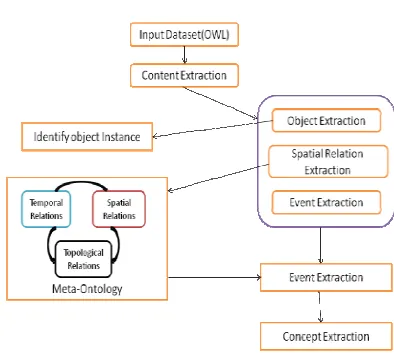
The extraction of semantic content (Fig 1) from videos using meta-ontology. Large volumes of dumped videos are to be processed. Objects from these videos should be extracted.
Ontology should be constructed by using relations of the objects that gives events. These events provide a spatio-temporal relation that gives extraction of concept. This concept retrieves semantic content.
4. EXTRACTION OF SEMANTIC CONTENT FROM VIDEO
4.1 Shot Conversion
Video contains large volumes of information like images, colour, texture, etc. It also contains objects and its instances. As video is a sequence of images or key frames, it should be converted into key frames or shots to extract objects and its instances from the video. Several open source softwares are there to convert videos to shots.
Videos are converted to images, by converting into sequence of frames and further to shots.
4.2 Extraction of the Objects
Images are extracted from videos and key features like color, shape, texture, etc., are extracted from images
The linguistic part of SCM contains classes and also relationship between these classes. Few of these classes provide the semantic content types like Objects and Events. Also few of others classes are provides the process of automatic semantic content
extraction. Ontology-based structure has used to develop the SCM, and in that structure, semantic content types and relations between them are collected under classes of SCM. SCM Data Properties are associated classes and constants, also SCM Object Properties provides the relationship between the classes. As well as few of the domain independent classes are available. The SCM properties consist of four additional relation like temporal relation, object relation, movement individuals and spatial relation. These relations are split out by class, because these relations are defined by classes itself, and it mean that uses predicate individuals “an entity is defined as an individual of a class” in the formal representation of classes.
4.3 Ontology Construction
Figure 2: Conversion of videos to shots
Figure 3: Object Extraction
The above figure shows ontology construction with its relationships.
Ontology is the concept that contains concepts along structure. It contains interrelationships and its types. It uses some vocabulary for understanding these relations.
An algorithm called ontology creation algorithm is implemented to develop ontology.
4.3.1 Ontology construction algorithm:
Step1 : Object, event and component individuals are defined.
Step2 : Spatial and temporal relations are defined. Step3 : Using spatial and object movements notice
spatial changes.
Step4 : Temporal spatial change component is
described using temporal relations
between spatial changes.
Step5 :Using these changes ontology is constructed.
4.4. Extraction of the Semantic Content:
Domain Ontology definitions provides the necessary knowledge and the concepts detections provides the extensibility and interoperability are the advanced for all analysis and also treated as
ontological concepts. Concept Component
individuals and extracted object event, and concept instances are used in the concept extraction process. Objects, Events and concepts are related in the components of concepts.
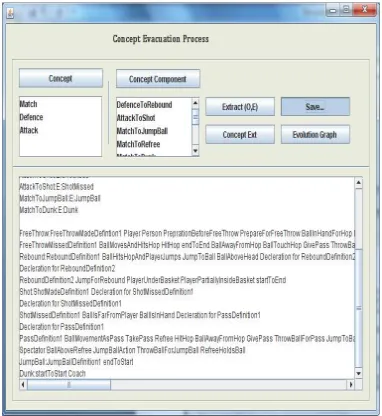
An object or event will be extracted when those are used in the definition and also the related concepts automatically extracted in the relevant degree available in that definition. In addition, more concepts will be extracted from the extracted components on similarity individuals. The final step of the concept extraction process is executing concept rule definitions.
The membership values lie between 0 and 1 for event extraction. This example shows the extraction of the concept. Event individual E and Object individual O are related components with the Concept individual C. Event E and Object O have relevance values for representing the concept C.
4.5. Event Extraction Algorithm:
Step 1 :
Define SRC individuals in the ontology and extract SRC instances to maintain all individual def.
Step 2 :
Execute SR rule def
Step 3 :
Define SMC individuals in the ontology
and extract SMC instances to maintain all individual def for all SMCs
Step 4 : Define SC individuals in the ontology
and check for there are any SRC or SMC instances
Step 5 :
For
TSC individuals in the ontology,extract SC instances to maintain the individual def.
Step 6 :
Define all ED individuals in the ontology
and check for there are any SC, SR or TSC instances to maintain the individual def.
Step 7 : Ensure all E individuals in the ontology and check for any of the ED instances that to maintain the individual def.
Step 8 :Define all of the Event individuals that are
having Temporal Event Component individuals, extract Event instances that satisfy the individual def.
Step 9 : For all S individuals in the ontology, extract E instances to maintain the individual def.
Step 10 : Run all the rules defined for all E
individuals to extract for additional events.
5. PERFORMANCE ANALYSIS
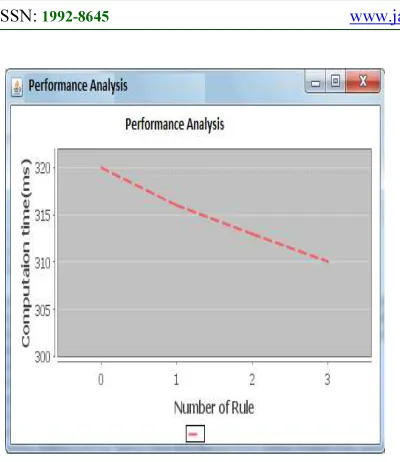
[image:4.595.94.285.485.693.2]Performance analysis is mainly deals with performance evaluation and results obtained with the implementation of the paper.
A graph was produced as it consumes less execution time. X-axis is plotted with number of rules and Y-axisis plotted with computation time in milli-seconds. As long as the number of rules get increased the computational time decreases.
5. CONCLUSION AND FUTURE WORK
The main aim of this paper is to extract the semantic content from videos effectively. It uses open source softwares for converting videos to shots. As we used ontologies here, extraction of objects and events performed by them is much simpler. Using these objects and events the temporal and spatial relations are extracted, which provides effective extraction of meaningful data from videos. This meaningful data is called semantic content of the videos.
The extended work is to develop various advanced methods for processing videos and to track the exact object from those videos. Tracking objects is not a matter but finding the event occurring in the videos along with the semantic concepts is difficult. Videos recorded from different angles should also be processed with advance processing techniques. Detecting the actions from the videos leads to be more useful for detecting the malpractices.
REFERENCES:
[1] Bagdanov .A.D, Bertini .M, Del Bimbo .A., Torniai .C, and Serra .G, “Semantic Annotation
and Retrieval of Video Events Using
Multimedia Ontologies,” Proc. IEEE Int’l Conf.
Semantic Computing (ICSC).
[2]Yifan, ChangshengXu , YongRui , Jinqiao,Wang ,” Semantic Event Extraction from Basketball
Games using Multi-Modal Analysis,”
Multimedia and Expo, 2007 IEEE International Conference.
[3] J Sevilmis .T, Bastan .M, Gu¨du¨ kbay .U, and Ulusoy .O, “Automatic Detection of Salient Objects and Spatial Relations in Videos for a Video Database System,” Image Vision Computing, vol. 26, no. 10, pp. 1384-1396. [4] Song .D, Liu .H.T, Cho .M, Kim .H, and Kim
.P, “Domain Knowledge Ontology Building for Semantic Video Event Description,” Proc. Int’l Conf. Image and Video Retrieval (CIVR), pp. 267-275.
[5] Xu .C, Wang .J, Wan .K, Li .Y, and Duan .L, “Live Sports Event Detection Based on Broadcast Video and Web-Casting Text,” MULTIMEDIA ’06: Proc. 14th Ann. ACM Int’l Conf. Multimedia, pp. 221-230.
[6] Yildirim .Y, Yilmaz .T, and Yazici .A,
“Ontology-Supported Object and Event
Extraction with a Genetic Algorithms Approach for Object Classification,” Proc. Sixth ACM Int’l Conf. Image and Video Retrieval (CIVR ’07), pp. 202-209.
[7] Yildirim .Y and Yazici .A, “Ontology-Supported Video Modeling and Retrieval,” Proc. Fourth Int’l Conf. Adaptive Multimedia Retrieval: User, Context, and Feedback (AMR), pp. 28- 41.
[image:5.595.91.291.107.338.2][8] Yildirim .Y, “Automatic Semantic Content Extraction in Video Using a Spatio-Temporal Ontology Model,” PhD dissertation, Computer Eng. Dept., METU, Turkey.