USING THE DELPHI METHOD TO ASSESS THE
POTENTIAL OF TAIWAN’S HOT SPRINGS TOURISM
SECTOR
Dr Cheng-Fei Lee & Professor Brian King Centre for Hospitality & Tourism Research
Victoria University PO Box 14428 MC Melbourne Victoria
Australia 8001 Telephone: 03 9919 4430
Fax: 03 9919 4931
Email: [email protected]
USING THE DELPHI METHOD TO ASSESS THE
POTENTIAL OF TAIWAN’S HOT SPRINGS TOURISM
Using The Delphi Method To Assess The Potential of Taiwan’s Hot Springs Tourism Sector
Abstract
The purpose of the present study is to identify the various factors which influence the competitiveness of the hot springs tourism sector and to evaluate their relative importance. The research draws on the models of Dwyer and Kim (2003), Enright and Newton (2004), and Ritchie and Crouch (2000), who concluded that destination competitiveness is determined by three major components: resources and attractors, destination strategies and environments. The investigation produced both qualitative and quantitative data using the Delphi technique. An expert panel reached consensus about priorities for the development of Taiwan‟s hot springs tourism sector and provided written justifications for their responses. This paper reports on the qualitative findings of the three-round Delphi survey, and provides a supply-side perspective on Taiwan‟s hot springs tourism sector. An examination of the expert comments concluded that the Taiwanese are increasingly concerned with good health and longevity. This emerging characteristic offers new business opportunities for the providers of hot springs tourism experiences to extend their appeal into health protection and medical treatments. However, if they are to achieve sustainable development and ensure high quality visitor experiences, hot springs proprietors will need to work closely with local governments and communities to promote sustainable use of natural hot springs and to conduct routine inspections of spa premises. Overall the future of the hot springs tourism sector appears to be promising.
Introduction
Visiting hot springs destinations is one of the fastest growing markets for the tourism sector in Taiwan. Since Taiwan is situated on the fault line at the meeting point of the Euro-Asian and Philippine continental plates, natural hot springs are abundant and widely distributed. These offer a diversity of water mineral content and smoothness and could form the basis for the development of Taiwan as a desirable hot springs tourism destination. To date, however, the Taiwanese authorities have paid little attention to the managed development of hot springs resources. Nor have the various hot springs proprietors come together into a formal grouping. There has also been an absence of legislation to protect use of the water which is endemic in the hot springs area. In many cases this has led to over-exploitation of the natural environment and its resources. According to the Taiwan National Hot Springs Association, only half of the 230 hot springs establishments around the island possess the required water and land use permits (Taipei Journal, 2002). This is indicative of a loosely regulated environment.
Despite these limitations, the appeal of hot springs bathing has been growing. According to recent survey findings, the percentage of the Taiwanese population who have visited hot springs jumped from 2 per cent in early 1999 to 23 per cent in late 2002, with the latter percentage equating to 4 million visits annually (Taipei Journal, 2002; Central Geological Survey, 2003). One impetus for this growth has been an increasing awareness of the importance of good health. A survey by the Directorate General of Budget, Accounting and Statistics, (cited in Chang, Hsiao and Wu, 2003, p.55) reported that the most desired lifestyle for the Taiwanese involves the maintenance of good health (59%), followed by enjoying family time (26.7%), and having a wealthy life (26%). The increased availability of leisure time has also played a part, notably the two-day weekend which was implemented in 1998 (previously Saturdays were half-work days). This initiative has provided the Taiwanese with more time for relaxation and outdoor recreation activities. According to the Travel Survey (Taiwan Tourism Bureau, 2004), 102 million domestic tourist trips were undertaken in 2003, an increase of 55 per cent over 1998 (66 million). In light of the rise of good health as a travel motivation, it appears likely that hot springs tourism will develop from both a supply and a demand perspective.
2002). In 1999 the Taiwan authorities introduced the „Hot Springs Development Management Program‟ in an effort to improve the quality of experience provided in the various hot springs areas. Subsequently a „Spa Law‟ has been introduced to formalise the conservation and sustainable use of natural hot springs resources. Despite the recent progress made by the industry and government sectors, much remains to be done. The present study uses the Delphi technique to explore the key determinants of destination competitiveness from a supply-side perspective. It is hoped that the findings can help to establish a guiding framework for the future development of Taiwan‟s hot springs tourism sector. This paper focuses exclusively on the qualitative part of a Delphi study undertaken by the authors and documents the key commonalities and differences evident amongst the various expert respondents. It also attempts to highlight some key obstacles to the achievement of sustainable development.
Literature Review
Spa development
The following section examines the historical developments of spa tourism in both Western countries (where spa tourism is highly developed) and Asian countries (where the sector is in its infancy stage). Searching out special places which offer curative powers of natural, thermal and mineral springs has long been popular in Western societies. European spas have traditionally been engaged in providing medical care or treatment to people suffering from certain types of illness. However, several current trends are challenging the traditional spas whose ethos is based on medical cures and mineral springs. In countries such as Germany, Italy and France, the rules on eligibility for reimbursement have tightened up considerably, despite the long established tradition of taking the waters. The increasing reluctance on the part of private or state-run medical insurance companies to reimburse the cost of spa treatments has let to a reduction in the growth prospects for the traditional spa market (Cockerell, 1996; Smith and Jenner, 2000). However he growing number of health and fitness enthusiasts, together with an increased interest in pampering, relaxation and beauty treatments has generated a new market. Cockerell (1996) has observed that in Europe, the spa sector is composed of two market segments: those visiting spas and health resorts primarily for medical reasons and those visiting for purposes more closely aligned to traditional tourism motivations. Many spa and health resorts are responding to this change by blending medicine and tourism in an effort to keep their traditional medical clientele, while adjusting their image and products to meet the perceived needs of a growing health tourism market (Bywater, 1990). While there is little empirical evidence to prove the success of such strategies, the
Comment [VU1]: Needs to be a
hybrid approach has clearly blurred the distinction between the traditional medical cure and mineral springs-based spas.
The spa tourism movement in the United States has become more leisure-oriented than its counterpart in Europe. Many North American spas no longer describe themselves exclusively in terms of the therapeutic properties associated with their natural mineral waters. Related consumer options now extend to spas on cruise ships, club spas, day spas, destination spas, medical spas, resort/hotel spas, and mineral springs spas. These emerging concepts offer a range of programs targeted at physical, emotional and spiritual self-improvement (International Spa Association, 2001). In developing spa and health options within the resorts sector, Australia seems to be following the U.S. model. A recent study by Bennett, King and Milner (2004) profiled the spa and health resort sector in Australia. It was found that the largest group of health resorts may be described as mainstream and as offering a tourism focus, with a much smaller group focussing on alternative and medical treatments. Australia does not have the strong „spa culture‟ tradition of Europe. This limitation has provided an opportunity for emerging spa and health resorts to broaden their scope beyond the established attributes of a traditional medical-orientation. In reviewing the evolution of spa and health resort developments and participation rates in Europe, the United States and Australia, Douglas (2001) concludes that Europeans go to spa and health resorts because they are sick whereas Americans and Australians go because they are healthy and want to stay that way. While the spa and health resort sector has been enjoying mixed fortunes (Bywater, 1990),the growing interest in health and fitness has been broadly detrimental to the traditional medical cure and mineral-based spas. However there is considerable growth potential within the leisure side of the spa and health resort business with its emphasis on relaxation, fitness, stress reduction and beauty (Douglas, 2001; Smith and Jenner, 2000).
Whereas much earlier spa development was prompted by demand from European consumers, more recently developments have catered to the Asian market (King and McVey, 1996). A number of Asian destinations have tapped into this increasingly lucrative market, sometimes irrespective of the quality of their mineral springs natural resources. Japan is one of the few countries in the world with abundant hot springs. Areas which adjoin these natural attributes, play an important role as health and leisure resorts targeting the domestic market. A survey by the Japan Tourist Association showed that in 1999, 45.8 per cent of overnight tourists cited “onsen baths” as their main purpose of holiday travel. Onsen also ranked as the second most popular choice of activity for excursionists (7.2%), outranked only by nature scenery sightseeing (9.2%). The recent increase in health consciousness has prompted a more proactive approach to the development of natural thermal springs. These developments
Comment [VU2]: Needs to be a
address the ageing population, promote the health benefits arising from soaking in hot springs, encourage the view that soaking in hot springs maintains youth and beauty amongst females, and most importantly capitalise upon the resurgent popularity of the „back to nature‟ ethos. The health-oriented social trend and the pursuit of togetherness with nature may lead the typical leisure-oriented onsen resort towards either a true „hot springs health resort‟ or to a traditional European-style „health resort‟ (Kobayashi, 2000; Nakata, 2000). In Thailand‟s case the spa sector has recently witnessed phenomenal growth. Key strengths include high quality diverse spa services and products integrating traditional Thai herbal recipes and ancient remedies, value for money, friendly and competent spa staff, architectural design, atmosphere, and ambience and cleanliness. (Tourism Authority of Thailand, 2003). Malaysia is another newcomer to the spa and health tourism market. The Malaysian government has marketed health-related tourism aggressively via international advertising and trade and investment missions in order to create and promote awareness. Local hotels have tapped into this emerging market segment by providing comprehensive wellness facilities and by offering spa holidays and health rejuvenation tourism packages. A combination of cultural diversity and rich heritage plus well-established and affordable health-related facilities and services, have enabled Malaysia to compete effectively with other well-established healthcare tourism destinations in the region such as Singapore and Thailand (Wong, 2003).
From the foregoing discussion, it is clear that the development of the hot springs tourism sector in Asia has differed from its equivalent in the West. The latter has undergone a remarkable transformation from a medical treatment focus into tourism and leisure pursuits, whereas the former is increasingly emphasising the health benefits and curative qualities of hot springs bathing, and is expanding the traditional leisure-oriented applications of natural springs into the medical and therapeutic fields. The literature has shown that two alternative paths of development may be pursued, namely a health promotion and leisure focus or an exclusively purely medical treatment focus. This distinction should provide some insights into the possible future directions for Taiwan‟s hot springs tourism sector.
Destination competitiveness
Drawing upon Porter‟s diamond model of national competitiveness, the Crouch-Ritchie model of destination competitiveness is considered to be the most detailed work within the tourism literature and encompasses various factors of competitiveness - nation-specific, industry-specific and firm-specific (Kim, 2000). First developed in 1993, this model has been progressively modified. It proposes that a destination‟s competitive position is shaped by global or macro-environmental forces and trends, and by competitive or micro-environmental influences and circumstances. Destination competitiveness is conceptualized as a function of core resources and attractors, supporting factors and resources, destination management and qualifying determinants. The core resources and attractors are the primary elements attracting tourists. These are considered to be the “fundamental reasons that prospective visitors choose one destination over another” (Crouch and Ritchie, 1999, p. 146). An assemblage of the relevant supporting factors and resources provides the foundations for a strong tourism sector. Qualifying determinants include factors which have the capacity to modify the influence of the other components, either positively or negatively. These qualifying determinants may limit the capacity of a destination to attract and subsequently to satisfy potential tourists, thereby impacting upon destination competitiveness. Destination management involves understanding activities which will enhance the appeal of the core resources and attractors, strengthening the quality and effectiveness of the various supporting factors, and minimising any constraints arising as a result of the qualifying determinants. The subsequent model proposed by Ritchie and Crouch (2000) has provided a further adaptation. A comparison of the current version with previous models shows that destination policy, planning and development has been identified as a distinct and significant component. This is indicative of the desire to ensure that tourism flourishes in a responsible, balanced and sustainable manner. It is acknowledged that the various destination management related factors which were incorporated within earlier versions paid insufficient attention to critical issues of policy, planning and development (Ritchie and Crouch, 2000).
situational conditions and demand conditions. The authors view destination competitiveness as an intermediate goal along the path to achieving national or regional economic prosperity. Dwyer and Kim have attempted to provide a more realistic display of the linkages between the various elements of destination competitiveness, than was the case with the Crouch-Ritchie model. More recently, Enright and Newton (2004) have proposed a broader and more comprehensive model of destination competitiveness which integrates generic factors of competitiveness derived from the industry setting and mainstream factors of destination attractiveness. The model assumes that competitive tourism destinations are capable of attracting and satisfying potential tourists and that competitiveness is determined both by tourism-specific factors and by more general factors influencing the destination and the industry specific context. According to this approach, the conceptualisation of destination competitiveness should combine an internal analysis of destination tourism attractors with an external analysis of business-related competitiveness factors.
______________________________________________________________________
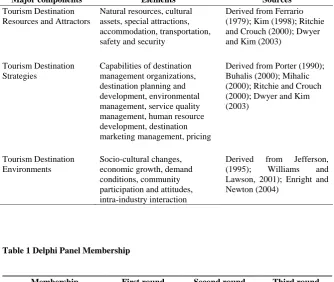
Insert Figure 1 about here
______________________________________________________________________
Research Design
successive rounds to a panel of experts. The use of questionnaires enables a geographically dispersed group of experts to complete their questionnaire at their leisure. This reduces time pressure and allows for more reflection and contemplation of response (Linstone and Turoff, 1975).
The Delphi technique has been applied extensively in tourism and hospitality settings, most commonly to forecast alternative future developments (Kaynak and Macaulay, 1984; Lloyd, La Lopa and Braunlich, 2000; Moeller and Shafer, 1994; Weber and Ladkin, 2003; Yong, Keng and Leng, 1989). The technique helps to facilitate group inputs for the development of ideas and problem-solving, such as identifying the environmental impacts of tourism (Green, Hunter and Moore, 1990) and developing sustainable tourism indicators (Miller, 2001). Previous applications of the Delphi technique in tourism have used a range of approaches for the selection of panellists, the design of questionnaires, the determination on the number of rounds to be conducted and what constitutes consensus. These experiences provided a useful reference point for the design of the present study.
The expert panel
A review of previous studies (Faulkner, Fredline and Oppermann, 1999; Gearing, Swat and Var., 1974; Hudson, Ritchie and Timur, 2004) has shown that the most common research method used for the assessment of tourism competitiveness is from the supply side perspective (eg. governments at all levels, hotel associations and tourism organizations, travel agencies and tour operators). It is believed that a supply side investigation involving those who possess knowledge about the entire portfolio of destination competitive resources and are in regular contact with the relevant consumer group may provide insights into the realities of the current marketplace. Another reason for undertaking a supply-side approach was that domestic and international tourists have less destination knowledge than the tourism providers themselves. Given that data collection is difficult, costly and time consuming and the results obtained are sometimes questionable, a simple and effective information gathering procedure involves drawing upon the judgements of an expert panel as surrogates for primary data gained from tourists themselves (Kaynak and Macaulay, 1984).
„experts‟ should include individuals from a wide range of backgrounds to ensure representative and comprehensive of insights (Smith, 1995; Rowe et al., 1991; Wheeler, Hart and Whysall, 1990). Several criteria were used to assess the suitability of prospective participants. In the case of the industry grouping, participants should be currently employed in the tourism industry; have a minimum of five years working experience; and hold membership of a relevant tourism association. In the case of the public sector, participants must have a minimum of five years working experience in a decision-making capacity within a government related tourism organization. For academic participants, the requirement was for a minimum of five years teaching experience in tourism at a university; evidence of tourism publications relevant to Taiwan‟s tourism sector; and an interest in recreation and/or tourism management research. A form of snowball sampling technique was used, relying on referrals from initial participants to generate additional participants. Snowball sampling is most suitable for collecting information from individuals who have specific characteristics or knowledge, but are very difficult to locate and contact (Cavana, Delahaye and Sekaran, 2001). The final sample was limited to those who had been suggested and approached through word of mouth communication and had expressed a willingness to participate.
Procedure
Questionnaire development
Given the exploratory nature of the study, each round of the questionnaire contained a combination of both open-ended and close-ended questions. These sought the views of expert respondents on: (1) the extent to which tourism resources and attractors contribute to the attractiveness and character of the hot springs tourism sector; (2) the extent to which tourism strategies ensure the sustainability of the hot springs tourism sector; and (3) the extent to which external, competitive environment affects the growth potential of the hot springs tourism sector. Respondents were provided with closed-ended, 5-point Likert scale questions in order to elicit their level of agreement with a series of statements regarding the relative importance of tourism destination resources and attractions, tourism destination strategies, and tourism destination environments in determining the competitiveness of the hot springs tourism sector. The use of open-ended questions allowed respondents to elaborate on the reasons underlying the answers that they had provided in response to the closed format questions.The results obtained from previous rounds were collated and then presented to participants to determine whether their responses were in agreement with the average participant responses. As each round was completed, the opinions of the group moved progressively towards consensus.
Data analysis
Descriptive statistics were used to analyse the quantitative data. These included mean, median, standard deviation, inter-quartile range, frequency counts and percentage. Such statistics provided an indication of the extent of group consensus. For the qualitative data, content analysis was undertaken in order to identify and record a range of ideas, opinions, values and/or judgements. Content analysis is a highly flexible approach that seeks to quantify unstructured information into predetermined categories in a systematic and replicable manner (Bryman, 2001). With a view to ensuring the anonymity of respondents and to assisting readers, each of the respondents was assigned a number somewhere between 1 and 31 based upon an alphabetical ordering of their name. For reporting purposes, gender (′M′ for male and ′F′ for female) and organization type (′G′ for government officer, ′H′ for hot springs proprietor, and ′A′ for academic researcher) were noted.
Results and Discussions
the expert panel is shown in Table 1. Although the sample size is small, the key issue for such research is achieving quality rather than quantity. It is more important to select panellists based on their high level of expertise, which enables them to judge and comment on the key issues that have been proposed. The small number does however satisfy the threshold of 25 proposed by Dalkey, Brown and Cochran (1969) as sufficient for minimizing error rates and improving reliability of outcomes.
Insert Table 1 about here
The various comments received from the expert panel have been summarized and discussed under three main themes. The themes are: Tourism Destination Resources and Attractors, Tourism Destination Strategies, and Tourism Destination Environments. These have been subsequently grouped into 19 sub-themes, which were identified previously in the destination competitiveness literature and are shown in Figure 1. The framework and proposed concepts provide an integrated approach for the identification and prioritization of areas critical for the sustainability and competitiveness of Taiwan‟s hot springs tourism sector.
Tourism Destination Resources and Attractors
Written comments on the relative importance of tourism resources and attractors to destination competitiveness were grouped into seven main sub-themes: natural resources, cultural assets, special attractions, accommodation, cuisine, transportation, and safety and security. The codings were based on the identification of key words.
Natural resources.Most respondents agreed that the concentration and variety of natural hot
resources are one of the most important contributors to the overall attractiveness of the hot springs tourism sector.
Cultural assets. Respondents generally agreed that cultural and historical assets add another
appealing dimension to the hot springs experience. In particular, souvenir shopping is recognized as an integral part of the cultural experience. Respondent 6 (M, H) wrote that 'Tourists may want reminders what they see in the areas they visit. This in turn necessitates the existence of souvenirs. The products in the souvenirs shops are goods made of local materials and are strongly linked to areas tourists visit. They also reflect the daily lifestyles, material and historical values traditions and cultures of the people.′ While most comments were positive, some respondents argued that cultural attractions are just an added bonus, making little contribution to the overall competitiveness of the hot springs tourism sector. Respondent 5 (M, H) commented that ′Cultural assets would certainly increase the breadth and depth of the destination experience, and deepen visitors‟ understanding of the destination. But their existence was not considered to be absolutely necessary for the development of the hot springs tourism sector.′ Based on these comments, it is concluded that cultural assets are desirable, but not essential.
Special attractions. A large majority of respondents saw considerable merit in organizing
activities, events and festivals at the community level to help to overcome seasonality constraints. While activities tend to be physically or mentally demanding, events and festivals provide a sense of „being there‟ (Ritchie and Crouch, 2000). Respondent 29 (M, A) viewed special attractions as a useful tool for enriching the tourist experience, for increasing community exposure and for maximizing business opportunities. He suggested that activities, events and festivals should be themed around hot springs, should be available year round or be held annually. The summary of the written panellist responses revealed that special attractions play a similar but more important role than cultural assets in reinforcing the potential for hot springs tourism. They are viewed as the best solution for overcoming limitations of seasonality.
Accommodation. According to respondents, the provision of accommodation must be
atmosphere in harmony with natural surroundings.′ Incorporating authenticity into accommodation products leads to a sense of place which can enhance visitor satisfaction and ensure that the historical integrity of a destination is maintained (King, 1994). The written comments confirmed that the accommodation sector plays a significant role in encouraging visitors to extend their length of stay.
Cuisine. The panel attached considerable importance to the role of local cuisine in the
promotion of hot springs tourism.Most respondents believed that visitors would be impressed by the wide availability and variety of Taiwanese cuisine. The utilization of authentic home-style Taiwanese cuisine would definitely add value to the hot springs tourism experience. Respondent 15 (M, G) further emphasized the necessity of creating health-conscious menus, with a focus on locally sourced and seasonal ingredients, in response to the growth in real incomes, living standards and ageing population. Interest in food is common amongst travellers, irrespective of their trip motivation (Handszuh, 2000).Food is an important aspect of tourism, which can play a part in expanding tourism offerings, adding value to the visitor experience and raising destination awareness.
Transportation. The role of transportation in tourism development is of significance as it
provides a critical linkage between the source market and the destination (Gunn, 1994). Hot springs tourism in Taiwan has expanded considerably in recent years, stimulated in part by the comprehensive, island wide, multi-modal transportation network. However, this growth has been accompanied by traffic congestion and high demand for parking space. To ease these problems, some respondents insisted on improved planning and scheduling of public transport, while others argued that the Taiwanese prefer to travel by car and that it is pointless trying to improve public transport provision. Respondent 5 (M, H) remarked that ′the drawbacks of providing public transport services outweigh its benefits.′ Although the written comments on transportation varied, there was general consensus that an excellent transportation infrastructure is made up of three basic elements: well-connected transport routes between major cities and hot springs scenic spots, clear road signs and guideposts, and sufficient parking spaces. All were viewed as being of equal importance. It was agreed that the infrastructure would be ineffective if any one of them breaks down.
maintain the safety and security of all visitors on hot springs premises but equally important to educate them about courteous and safe manners for hot springs bathing.' Hot springs tourism activity involves drinking and bathing in mineral waters. Any incidents encountered over the course of a trip are likely to have an adverse effect on both international and domestic tourism. Previous studies have indicated that safety and security concerns are strong predictors of travel intention and have a substantial impact on tourist destination choices (Floyd et al., 2003; George, 2003; Sonmez and Graefe, 1998).
Tourism Destination Strategies
A wide array of tourism assets forms the basis for the potential development of hot springs tourism in Taiwan. To achieve sustainable growth, a set of strategies and policies based on tourism resources and attractors should be formulated and implemented. In the present investigation the analysis of written comments on the relative importance of destination strategies to destination competitiveness focused on the following seven areas: capabilities of destination management organizations, destination planning and development, environmental management, service quality management, human resource development, destination marketing management and pricing.
Capabilities of destination management organizations. Nearly all respondents characterized
destination management organisations (DOMs) as government organizations responsible for fostering a good environment for business and investment. Respondent 5 (M, H) pointed out that ' government assistance, advice and guidance can help hot springs proprietors improve operational efficiency and effectiveness which in turn enhance the overall quality and image of the sector.' Their roles and activities can be divided into two main groups depending on the nature of the task: general and specialized. General tasks are those activities associated with coordination, legislation, promotion, research and the provision of tourist information (Choy, 1993). Specialized tasks relate to the unique characteristics of the hot springs tourism sector, including the creation of hot springs databases and the inspection of the quality of hot springs water. Respondent 28 (M, A) noted that, 'The purpose of the database is to help the public better understand the mineral content of the hot springs water and their therapeutic benefits, moving the sector towards more health- and therapy-oriented.' Furthermore, a regular inspection of hot springs properties (eg. water quality, water supply equipment) is intended to raise public awareness and confidence in the safety and security of the hot springs spa properties. Respondent 2 (M, H) noted that 'DMOs are required to perform a range of regulatory functions in the hot springs tourism sector such as the granting of operating licenses, the inspection of facilities to maintain standard of quality and safety, and the classification and grading of hot springs properties into different levels, although these tasks
Comment [VU3]: Needs to be the
are often carried out under social pressure.' Written comments clearly portrayed a range of
roles and functions for the DMO – from a marketing or promotion focus to a broader effort of building capacity for the strategic management of the hot springs tourism sector.
Destination planning and development. Destination planning and development is a process of
establishing a long-term vision for an area and creating sustainable patterns of development (Mill and Morrison, 1992).Many written comments indicated that the focus on destination planning and development at all levels of government should be oriented towards regulating the use of land and hot springs resources, strengthening the incentives for entrepreneurial investment, and reorganizing the existing hot springs scenic spots. Several respondents even stressed the urgency of quickly establishing a series of hot springs demonstrate sites as a way to exemplify the best management practices, improve environmental sustainability and assure minimal environmental from operations. The application of sustainability principles into strategic level destination planning and development is essential to ensure that the hot springs tourism sector has a clear idea of where it is going and what it needs to become successful in the longer term.
Environmental management. The majority of respondents recognized the importance and
urgency of environmental management in protecting the health of natural ecology and improving the quality of community life. Fundamental to achieving a sustainable future for both visitors and host community is systematically protecting and managing the natural environment. It also requires coordination and collaboration across government and with industry to ensure the protection of community environmental values and interests. According to the expert panel, the environmental management approach is composed of four basic elements: third-party certificate and accreditation, hot springs water rights (hot springs allocation system), reconstruction of pipe and pumping systems, and upgrading sewage system infrastructure and wastewater treatment facilities. Respondent 6 (M, H) reported that the greatest benefit of accredited third-party certification is gaining wide market opportunities and establishing a strong brand which guarantees a certainty and consistency of quality. While hot springs treasures are now being listed as one of the significant tourism attractions in Taiwan, environmental management has been considered as an effective and successful tool in achieving the aims of sustainable development.
Service quality management. The written responses supported the establishment of standards
studies have identified two key dimensions namely: functional quality (how the service was delivered) and technical quality (what was delivered) (Ferguson et al., 1999; Mueller and Kaufmann, 2001; Snoj and Mumel, 2002). A majority of respondents emphasised the functional aspects of the service rather than the technical aspects. This finding leads to the conclusion that the knowledge, skills and attitudes of service personnel are key determinants of how customers evaluate the quality of their hot springs experience. The quality of the service personnel is inseparable from the quality of service.
Human resource development. Maintaining a highly qualified and effective workforce is
critical to the success of an individual tourism enterprise and to the industry as a whole (Ritchie and Echtner, 1995).Education and training are essential elements of human resource development (Baum, 1995). Some respondents were convinced that in-house training is the most effective type of human resource development for the sector in terms of cost efficiency, focus, time effectiveness, impact and empowerment. Respondents viewed education and training as closely related and suggested that an integrated approach is a prerequisite for successful human resource development. Respondent 17 (M, G) noted that 'The integrated approach will open doors of opportunity for people working in the (hot springs) tourism sector to continue to learn, to adapt to and develop new knowledge, skills and technologies, to move flexibly between occupations, to take responsibility for personal performance, to set and achieve high standards, and to work cooperatively. Respondent 8 (M, A) agreed with this proposition but expressed concern over the shortage of highly qualified and experienced teachers in the professional field of spa resort management. The hot springs tourism sector, is a service-oriented industry and its success depends on the availability of a highly qualified workforce.
Destination marketing management. With a view gaining positive profile in an increasingly
health and wellness'. The promotion of health and prevention of disease will definitely broaden the marketability and appeal of Taiwan‟s hot springs tourism sector and diversify its product offerings.
Pricing. Pricing is another issue which was discussed in some depth by respondents. Written
comments revealed that discounting is ineffective as a way of creating and stimulating tourism demand. There was however general agreement that hot springs experiences should be delivered at an affordable price without compromising quality. Respondent 17 (M, G) explained that: 'prices are determined in a market by demand and supply. Hot springs proprietors alone have little influence on price, not to mention setting a unified price for the hot springs sector.' From the above, it may be concluded that the most important aspect of pricing is to ensure an optimal balance between price and added value from the tourist perspective.
Tourism Destination Environments
It is important that the government and industry sectors have a proper understanding of the favourable external conditions for future development, in addition to diversifying the tourism base and carrying out tourism strategy. Written comments on the relative importance of external environmental forces contributing to destination competitiveness were analysed and placed into the following five categories: socio-cultural changes, economic growth, demand conditions, community participation and attitudes, and intra-industry interactions.
Socio-cultural changes. The implementation of the two-day weekend system in 2001, not
only increased leisure time for the Taiwanese, but also promoted changes in lifestyle and modes of expenditure. Many respondents expressed a strong view that hot springs tourism is set to become more popular amongst health conscious consumers who are seeking to enhance their well- being through travel. The ageing of the population is also likely to have a significant impact on domestic tourism. Such changes are creating new business opportunities for hot springs proprietors to market the medicinal and therapeutic value of hot springs bathing. The future growth of the hot springs tourism sector is closely tied to the increasing proportion of the population that is in the older age bracket and more health-conscious.
Economic growth. A substantial proportion of respondents believed that the rapid growth and
sector.' Some dissenting arguments were however expressed. Respondent 14 (M, G) in particular, reiterated that 'Taiwanese people prefer overseas to domestic travel. Compared with the overseas tourism sector domestic tourism has not shared in the recent increase in disposable income to the same extent.' Although there is disagreement about the extent to which economic growth contributes to the development of hot springs tourism, all respondents acknowledged its importance.
Demand conditions. Several respondents stressed the importance of strengthening the
domestic market before exploring foreign markets, on the basis that the latter will not be in a position to replace the former. This is consistent with the views of Porter (1990), who has indicated that domestic demand is more important than foreign demand because it is easier and faster to observe and understand the consumer needs and preferences of nearby markets. Strong local demand leads to a greater prospect of securing government financial support for basic infrastructural improvement, of establishing the unique nature and character of the tourism industry, of stimulating new products, market development and business innovation, of improving the quality of the tourism experience, and most importantly of expediting the penetration of foreign markets (Ritchie and Crouch, 2003). None of the respondents felt that Taiwan has established a strong position in the international market or is attractive enough to induce foreign tourists at its present stage of development. This may be why Taiwan has been suffering from an imbalance between inbound and outbound tourism. Inbound tourism is however showing signs of improvement. Under severe pressure, the Taiwan authorities have launched several initiatives aimed at relaxing certain restrictions on inbound travel. With an anticipated increase in international tourist arrivals, a corresponding increase in domestic tourism generally and hot springs tourism in particular is likely to follow. According to the Travel Survey (Taiwan Tourism Bureau, 2004), 102 million domestic tourist trips were undertaken in 2003, with an increase of 55 per cent over 1998 (66 million). With an anticipated increase in domestic tourism, a corresponding increase in hot springs tourism is likely to follow.
Community participation and attitudes. Degradation of the environment as a result of
may have a number of effects, including: diminishing the level of support of local residents for tourism in their community; eroding the host community‟s tolerance of tourism; and heightening sensitivity towards further tourism development (Sheldon and Abenoja, 2001). It is, however difficult to involve of local residents in planning for tourism development. One possible alternative is that local residents become service providers, establishing or operating their own businesses within the community. One possible alternative, as suggested by Respondent 2 (M, H), is that local residents become service providers, establishing or operating their own businesses within the community. Concurring with this viewpoint, Respondent 2 (M, H) cautioned that 'Local residents often hold a passive attitude to destination planning and development, unless they are the owner of the properties.' In summary, the reconstruction of the hot springs tourism sector relies on achieving community support through active participation in destination planning projects and the creation of positive attitudes towards destination development.
Intra-industry interactions. Special emphasis should be placed on the relationship and
interactions between small and medium-sized tourism enterprises because they have the potential to work closely to deliver a streamlined hot springs experience. The panel generally agreed that the process of either competition or co-operation leads to service delivery efficiencies and to product improvements, which in turn strengthens the competitiveness of the hot springs tourism sector. Hot springs proprietors within the region may compete with each other in certain aspects on the basis of their individual strengths, but co-operate to highlight the distinctive features of their immediate region. This perspective is best evidenced by Respondent 5 (M, H) who noted that, 'The competition is far more fierce amongst the sub-sectors of the tourism industry than within one sub-sector (hot springs tourism sector).' While the dilemma of competition versus co-operation remains unsolved, hot springs proprietors must build and maintain good relationships to create mutually shared benefits as an ideal outcome.
Conclusions and Opportunities for Future Research
drinking and bathing in mineral waters, any incidents encountered over the course of a trip can adversely affect the entire sector. Secondly, natural hot springs are unique, rare and irreplaceable assets that have already proven to be of significant economic value. While they are marketed as „tourism products‟, the next development phase will require the pursuit of economic and environmental sustainability on the part of both industry and government. The primary function of hot springs enterprises is to develop and maintain profitable operations within the framework of sustainable development, whereas the responsibility of government is to oversee enterprise-level operations and provide the most appropriate assistance. Thirdly, accommodation, cuisine and transportation constitute supporting infrastructure which complements the overall hot springs tourism experience. The development of „service infrastructure‟ would enable visitors to increase their length of stay and spending and ease travel movements. Fourthly, given the multiplicity of service providers, every part of the hot springs sector must be committed to delivering a quality value-for-money visitor experience. To achieve this goal, the sector is exceptionally dependent on a highly qualified workforce capable of delivering services. Finally, the Taiwanese people are becoming more aware of the need to maintain good health by participating in tourism and recreational activities. This phenomenon creates favourable conditions and incentives to expand the application of natural hot springs into the fields of health promotion and medical treatment.
The Delphi technique is an appropriate methodology for identifying the significant issues which determine the competitiveness of the hot springs tourism sector. The anonymity that the technique provides to respondents is particularly suitable for use in an orderly society such as Taiwan, which attaches great importance to achieving group consensus and communal levels of decision-making. Despite the relatively small number of participants, all possessed sufficient expertise to be able to judge and comment on the issues in question. This ensured that this study was representative of the target population.
Japan (where hot springs tourism is highly developed) and in mainland China (where the sector is at the infant stage).In terms of its practical contribution, the present study provides industry and government decision makers with a systematic exploration of what determines destination competitiveness, serving as an initial guidance for further development of the hot springs tourism sector. Future studies might consider improving the accuracy and reliability of conclusions obtained from a consensus of experts by conducting a large-scale quantitative survey which brings an increased number of better qualified experts from diverse backgrounds and experiences into the discussion, and compares the views prevalent amongst these three groups. The incorporation of overseas perspectives could be particularly useful. Such a study might obtain a more objective assessment of the current and potential competitiveness of Taiwan‟s hot springs tourism sector relative to other destinations. This paper has examined expert opinions about the key determinants of destination competitiveness with a particular application to Taiwan‟s hot springs tourism sector. It presents the qualitative findings of the three-round survey with a view to defining directions and priorities for further development of the sector. The quantitative findings in relation to the relative importance of key determinants of destination competitiveness will be reported subsequently.
References
Baum, T. (1995). The Role of the Public Sector in the Development and Implementation of Human Resource Policies in Tourism. Tourism Recreation Research, 2(2).
Bennett, M., King, B., & Milner, L. (2004). The Health Resort Sector in Australia: A Positioning Study. Journal of Vacation Marketing, 10(2), 122-137.
Bryman, A. (2001). Social Research Methods. New York: Oxford.
Buhalis, D. (2000). Marketing the Competitive Destination of the Future. Tourism
Management, 21(1), 97-116.
Bywater, M. (1990). Spas and Health Resorts in the EC. Travel and Tourist Analyst, 6, 52-67.
Cavana, R. Y., Delahaye, B. L., & Sekaran, U. (2001). Applied Business Research: Qualitative
Central Geological Survey, Ministry of Economic Affairs. (2003). Taiwan Hot Springs. Retrieved 11/08, 2003, from www.moeacgs.gov.tw
Chang, K. C., Hsiao, Y. C., & Wu, R. (2003). A Research on Appling Health Concept to
Promote Hot Springs Recreation Industry. Paper presented at the 2003 Health, Leisure,
Tourism and Hospitality Conference Proceeding, Tainan, Taiwan.
Choy, D. J. L. (1993). Alternative Roles of National Tourism Organization. Tourism
Management, 14(5), 358-365.
Cockerell, N. (1996). Spas and Health Resorts in Europe. Travel and Tourism Analyst, 1, 53-77.
Crouch, G. I., & Ritchie, J. R. B. (1999). Tourism, Competitiveness, and Societal Prosperity.
Journal of Business Research, 44, 137-152.
Dalkey, N. C., Brown, B., & Cochran, S. (1969). The Delphi Methods III: Use of Self Rating to
Improve Group Estimates. The Rand Corporation.
Delbecq, A. L., Van de Ven, A. H., & Gustafson, D. H. (1975). Group Techniques for Program
Planning: A Guide to Nominal Group and Delphi Processes. Glenview, Illinois: Scott
Foresman.
Douglas, N. (2001). Travelling for Health: Spa and Health Resorts. Milton, Queensland: John Wiley.
Dwyer, L., & Kim, C. (2003). Destination Competitiveness: Determinants and Indicators.
Current Issues in Tourism, 6(5), 369-414.
Enright, M. J., & Newton, J. (2004). Tourism Destination Competitiveness: a Quantitative Approach. Tourism Management, 25(6), 777-788.
Faulkner, B., Fredline, E., & Oppermann, M. (1999). Destination Competitiveness: An Exploratory Examination of South Australia's Core Attractions. Journal of Vacation
Ferguson, R. J., Paulin, M., Pigeassou, C., & Gauduchon, R. (1999). Assessing Service Management Effectiveness in a Health Resort: Implications of Technical and Functional Quality. Managing Service Quality, 9(1), 58-65.
Ferrario, F. F. (1979). The Evaluation of Tourist Resources: An Applied Methodology. Journal
of Travel Research, 17(3), 18-22.
Floyd, M., Gibson, H., Pennington-Gray, L., & Thapa, B. (2003). The Effect of Risk Perceptions on Intentions to Travel in the Aftermath of September 11, 2001. In C. M. Hall, D. J. Timothy & D. T. Duval (Eds.), Safety and Security in Tourism: Relationships, Management,
and Marketing. New York: The Haworth Hospitality Press.
Frechtling, D. C. (1996). Practical Tourism Forecasting. Oxford: Butterworth-Heinemann.
Gearing, C., Swat, W., & Var, T. (1974). Establishing a Measure of Touristic Attractiveness.
Journal of Travel Research, 12(4), 1-8.
George, R. (2003). Tourist's Perceptions of Safety and Security While Visiting Cape Town.
Tourism Management, 24(5), 575-585.
Green, H., Hunter, C., & Moore, B. (1990). Application of the Delphi Technique in Tourism.
Journal of Travel Research, 17, 270-279.
Gunn, C. A. (1994). Tourism Planning: Basics, Concepts, Cases (3rd edn). Washington DC: Taylor and Francis.
Handszuh, H. F. (2000). Local Food in Tourism Policies. Madrid, Spain: World Tourism Organization.
Helmer, O. (1983). Looking Forward: A Guide to Futures Research. Beverly Hills, California: Sage Publications.
Hofstede, G. (1980). Culture’s Consequences: International Differences in Work-Related
Hudson, S., Ritchie, J. B. R., & Timur, S. (2004). Measuring Destination Competitiveness: An Empirical Study of Canadian Ski Resorts. Tourism and Hospitality Planning and Development, 1(1), 79-94.
International Spa Association (ISPA) (2001). International Spa Association’s 2001 Member
Survey. Retrieved 15/02, 2004 from www.spas.about.com/library/weekly/aa110401a.html
Jefferson, A. (1995). Prospects for Tourism: A Practitioner's View. Tourism Management, 16(2), 101-105.
Kaynak, E., & Macaulay, J. A. (1984). The Delphi Technique in The Measurement of Tourism Market Potential: The Case of Nova Scotia. Tourism Management, 5(2), 87-101.
Kim, C. (2000). A Model Development for Measuring Global Competitiveness of the Tourism
Industry in the Asia-Pacific Region. Seoul, Korea: Korea Institute for International Economic
Policy.
Kim, H.-B. (1998). Perceived Attractiveness of Korean Destinations. Annals of Tourism
Research, 25(2), 340-361.
King, B., & McVey, M. (1996). Resorts in Asia. Travel and Tourism Analyst, 4, 35-50.
King, B. (1994). Bringing out the Authentic in Australian Hospitality Products for the International Tourist: A Service Management Approach. Australian Journal of Hospitality
Management, 1(1), 1-7.
Kobayashi, H. (2000). Onsen in Japan: Towards a Strong Focus on Nature and Health.The Forum on Thermalism in Japan, Tokyo.
Kotler, P., Haider, D. H., & Rein, I. (1993). Marketing Places: Attracting Investment, Industry,
and Tourism to Cities, States, and Nations. New York: Free Press.
Linstone, H. A., & Turoff, M. (1975). Introduction. In H. A. Linstone & M. Turoff (Eds.), The
Lloyd, J., La Lopa, J. M., & Braunlich, C. G. (2000). Predicting Changes in Hong Kong‟s Hotel Industry Given the Changes in Sovereignty from Britain to China in 1997. Journal of Travel
Research, 38, 405-410.
Mill, R. C., & Morrison, A. M. (1992). The Tourism System: An Introductory Text. Englewood Cliffs, New Jersey: Prentice Hall.
Miller, G. (2001). The Development of Indicators for Sustainable Tourism: Results of a Delphi Survey of Tourism Researchers. Tourism Management, 22, 351-362.
Moeller, G. H., & Shafer, E. L. (1994). The Delphi Technique: A Tool for Long-Range Travel and Tourism Planning. In J. R. B. Ritchie & C. R. Goeldner (Eds.), Travel, Tourism and
Hospitality Research: A Handbook for Managers and Researchers (pp. 473-480). New York:
Wiley and Sons.
Mihalic, T. (2000). Environmental Management of a Tourist Destination A Factor of Tourism Competitiveness. Tourism Management, 21(1), 65-78.
Mueller, H., & Kaufmann, E. L. (2001). Wellness Tourism: Market Analysis of a Specific Health Tourism Segment and Implications for the Hotel Industry. Journal of Vacation
Marketing, 7(1), 5-17.
Nakata, Y. (2000). Japan’s Onsen Tourism Challenges and Future Directions.The Forum on Thermalism in Japan, Tokyo.
Porter, M. E. (1990). The Competitive Advantage of Nations. New York: Free Press.
Ritchie, J. R. B., & Crouch, G. I. (1993). Competitiveness in International Tourism: A Framework for Understanding and Analysis. In Proceedings of the 43rd Congress of the Association Internationale d’Experts Scientifique due Tourisme on Competitiveness of
Long-Haul Tourist Destinations, San Carlos de Bariloche, Argentina, pp. 23-71.
Ritchie, J. R. B., & Crouch, G. I. (2000). The Competitive Destination: A Sustainability Perspective. Tourism Management, 21(1), 1-7.
Ritchie, J. R. B., & Crouch, G. I. (2003). The Competitive Destination: A Sustainable Tourism
Ritchie, J. B. R., & Echtner, C. M. (1995). Tourism Education and Human Resource Development. Tourism Recreation Research, 10(2), 1-2.
Sheldon, P. J., & Abenoja, T. (2001). Resident Attitudes in a Mature Destination: The Case of Waikiki. Tourism Management, 22(5), 435-443.
Smith, C., & Jenner, P. (2000). Health Tourism in Europe. Travel and Tourism Analyst, 1, 41-59.
Smith, S. L. J. (1995). Tourism Analysis: A Handbook (2nd edn). Harlow, Essex, England: Longman Group.
Snoj, B., & Mumel, D. (2002). The Measurement of Perceived Differences in Service Quality: The Case of Health Spas in Slovenia. Journal of Vacation Marketing, 8(4), 362-379.
Sonmez, S. F., & Graefe, A. R. (1998). Influence of Terrorism Risk on Foreign Tourism Decisions. Annals of Tourism Research, 25(1), 112-144.
Taipei Journal (2002). Natural Spring Resorts Enjoy New Popularity. Retrieved 20/08, 2003, from www.taiwanheadlines.gov.tw/20020527/20020521f1.html
Taiwan Tourism Bureau (2002). Hot Springs Tour. Retrieved 10/08, 2003, from
http://www.taiwan.net
Taiwan Tourism Bureau (2004). 2004 Survey of Travel by R.O.C. Citizens. Retrieved 18/08, 2004, from http://202.39.225.136/statistics/File/200312/92domestic.htm
Tourism Authority of Thailand (2003). Spa Sensation: Thailand's Rise to Spa Capital of Asia. Retrieved 21/02, 2004, from http://www.tatnews.org/emagazine/19
Turoff, M. (1970). The Design of a Policy Delphi. Technological Forecasting and Social
Change, 2(2), 141-171.
Williams, J., & Lawson, R. (2001). Community Issues and the Resident Opinions of Tourism.
Annals of Tourism Research, 28(2), 269-290.
Wheeller, B., Hart, T., & Whysall, P. (1990). Application of the Delphi Technique: A Reply to Green, Hunter and Moore. Tourism Management, 11(2), 121-122.
Wong, C. (2003). Health Tourism to Drive Earnings: Malaysian Institute of Economic Research.
Figure 1 Construction of Determinants of Destination Competitiveness for Hot Springs
Tourism Sector
Major components Elements Sources
Tourism Destination Resources and Attractors
Natural resources, cultural assets, special attractions, accommodation, transportation, safety and security
Derived from Ferrario (1979); Kim (1998); Ritchie and Crouch (2000); Dwyer and Kim (2003)
Tourism Destination Strategies
Capabilities of destination management organizations, destination planning and development, environmental management, service quality management, human resource development, destination marketing management, pricing
Derived from Porter (1990); Buhalis (2000); Mihalic (2000); Ritchie and Crouch (2000); Dwyer and Kim (2003)
Tourism Destination Environments
Socio-cultural changes, economic growth, demand conditions, community participation and attitudes, intra-industry interaction
Derived from Jefferson, (1995); Williams and Lawson, 2001); Enright and Newton (2004)
Table 1 Delphi Panel Membership
Membership First round Second round Third round
Government officer 14 13 14 Hot springs proprietor 11 10 9 Academic scholar 6 5 4