www.ijiset.com
An Efficient Way of Data Gathering From Multiple Sensors in
WSN Using Sencar Movement
Tanzil Shadan1, Dr. Dayanand Jamkhandikar2
1PG Student, Department of Computer Science and Engineering, 2 Professor, Department of Computer Science and Engineering,
Guru Nanak Dev Engineering College, Bidar, Karnataka State, India.
Abstract - The increase in the execution of budget, low-power, dynamic sensors has made WSN a well known information accumulation paradigm for withdrawing limited information of interest. In such applications, sensors are usually deployed very closely. They are also haphazardly scattered over a detecting field and left unattended after data being sent. This makes it troublesome to recharge or supplant their batteries. After sensors structure into autonomous associations, those sensors close to the information sink typically exhaust their batteries much quicker than others due to additionally handing-off movement. At the point when sensors around the information sink deplete their vitality, system availability and coverage may not be ensured. Because of these limitations, it is crucial to outline a vitality effective information accumulation plan that consumes vitality consistently over the detecting field to achieve long system lifetime. Besides, as sensing data in a few applications are time-delicate, information collection may be required to be performed inside a predetermined time allotment. In this way, a productive, substantial scale information collection scheme ought to go for good versatility, long system life time and low information dormancy. A few methodologies have been proposed for effective information accumulation.
Keywords - Low Power, Data Gathering.
1.INTRODUCTION
In most of the applications in WSN sensors are placed much closed to each other. After they form into autonomous associations, the sensors nearer to the sink consume much more vitality than other and exhaust their batteries quickly. To overcome these limitations information collection scheme may be required that ought to go for good versatility and increase system life time. A few methodologies have been proposed for effective information accumulation. The main class is upgraded transfer directing in which information are handed-off among sensors. The second classification sorts out sensors into bunch and permit group heads to assume liability for sending information to the information sink [1]. The third classification is to make utilization of versatile authorities to take the weight of information steering from sensors. In bunch based plans, group heads will definitely devour considerably more vitality than different sensors because of taking care of intra-group accumulation and entomb bunch information sending. In spite of the fact that utilizing versatile authorities may mitigate non-uniform vitality utilization, it might bring about unacceptable information gathering idleness [2]. Taking into account these perceptions, in this we proposed three
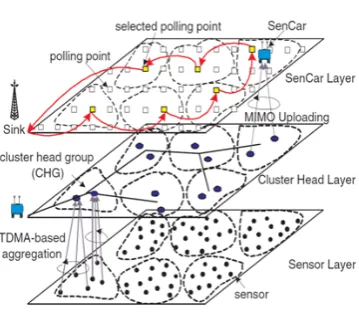
layers portable information accumulation structure LBC_DDU stands for load balanced clustering with dual data uploading. It consists of three layers. At the bottom layer there is sensor layer which self organizes sensors into cluster. The intermediate layer is bunch head layer which selects cluster head. The last layer is sencar layer which consists of sencar responsible for effective information gathering. Albeit some works give successful answers for data collection in WSNs, their not working condition have been looked. Interestingly[3], in transfer directing plans, minimizing energy consumption on the sending way does not necessarily prolong system lifetime, since some basic sensors on the way may come up short on vitality quicker than others. In this a 3 layer structure LBC_DDU is proposed that utilizes disseminated load adjusted grouping and double information transferring.
2.LITERATURESURVEY
Literature survey is the most important step in software development process. Before improving the tools it is compulsory to decide the economy strength, time factor. Once the programmer‘s create the structure tools as programmer require a lot of external support, this type of support can be done by senior programmers, from websites or from books. The authors in the paper [4] discussed about algorithms for scheduling TDMA transmissions in multi-jump arranges where the most part decide the littlest length strife free task of spaces in which every connection or hub is initiated at any rate once. This depends on the suspicion that there are numerous free indicate point streams in the system. In sensor arranges however frequently information is exchanged from the sensor hubs to a couple of focal information authorities. The booking issue is subsequently to decide the littlest length struggle free task of openings amid which the parcels created at every hub achieve their destination. The clashing hub transmissions are resolved in light of an obstruction chart, which might be unique in relation to availability diagram because of the telecast way of remote transmissions. Creator demonstrates that this issue is NP-finished. They first propose two brought together heuristic calculations: one taking into account direct planning of the hubs or hub based booking, which is adjusted from established multi-jump booking calculations for general impromptu systems, and the other in light of planning the levels in the steering tree before booking the hubs or level based booking, which is a novel planning calculation for some to-one correspondence in sensor systems.
www.ijiset.com
The execution of these calculations relies on upon the appropriation of the hubs over the levels. At that point propose a dispersed calculation in light of the disseminated shading of the hubs, that builds the deferral by a variable of 10–70 over brought together calculations for 1000 hubs, likewise get upper destined for these timetables as an element of the aggregate number of bundles produced in the system The authors proposed a considerable measure of existing examination endeavors in [5] to broaden the lifetime of a remote sensor system (WSN) by outlining vitality proficient systems administration conventions, the effect of arbitrary gadget sending on framework lifetime is not focused on enough. Some examination endeavors have attempted to streamline gadget organization as for lifetime by expecting gadgets can be put intentionally. Be that as it may, the approaches and arrangements in that are not material to an arbitrarily conveyed vast scale WSN. In this examination, creator proposes three irregular organization methodologies for transfer hubs in a heterogeneous WSN, in particular, connectivity oriented, lifetime-situated and cross breed arrangement. They examine how a system can influence both availability and system lifetime of a multi-jump heterogeneous WSN, in which hand-off hubs transmit information to the base station by means of multi-bounce hand-off. The execution of the three methodologies is assessed through reenactments. The consequences of this examination give a practical answer for the issue of upgrading provisioning of an expansive scale heterogeneous WSN.The paper [6] discussed about vitality proficiency which is basic for remote sensor systems. The information gathering process must be deliberately intended to moderate vitality and broaden system lifetime. For applications where every sensor consistently screens nature and intermittently messages to the main place, a tree-based topology is regularly used to gather information from sensor hubs. In this work, creator first study the development of an information taking information when there is a solitary base station in the system. The goal is to boost the system lifetime, which is characterized as the time until the primary hub drains its vitality. The issue is appeared to be NPcomplete. They plan a calculation which begins from a discretionary tree and iteratively decreases the heap on bottleneck (hubs liable to soon drain their vitality because of high degree or low remaining vitality). They then extend our work to the situation when there are different base stations, and collect the development of a most extreme lifetime information gathering backwoods. They demonstrate that both the tree and backwoods development calculations end in polynomial time and are provably close ideal. They then confirm the proficiency of calculations by means of numerical correlations. The authors stated in the work [7] that Wireless sensor systems bear the cost of another chance to watch and interface with physical wonders at a remarkable constancy. To completely understand this vision, these systems must act naturally arranging, self healing, practical and vitality proficient at the same time. Since the correspondence
assignment is a huge force purchaser, there are different endeavors to present energy awareness inside the correspondence stack. Hub grouping, to diminish direct transmission to the base station, is one such endeavor to control vitality dissemination for sensor information gathering. In this work, they propose an effective element bunching calculation to accomplish a system wide vitality decrease in a multihop setting. They likewise display a practical vitality scattering model taking into account the outcomes from stochastic geometry to precisely evaluate vitality utilization utilizing the proposed bunching calculation for different sensor hub densities, system zones and handset properties. The two-layered heterogeneous sensor systems are discussed in [8] where two sorts of hubs are conveyed in the system: essential sensor hubs and group head hubs. Essential sensor hubs are straightforward and modest, while bunch head hubs are much capable and much wealthier in vitality. A bunch head hub sorts out the essential sensor hubs around it into a group. An essential sensor hub does information accumulations and sends the information bundles when surveyed by the bunch head. By presenting chain of importance, such a two-layered heterogeneous sensor system has preferred adaptability over homogeneous sensor systems. It likewise has a littler general expense subsequent to systems administration functionalities are moved from sensors to the bunch head. It additionally has a more drawn out life time, as sensors send parcels just when surveyed by the bunch head and less vitality is devoured in crashes and sits out of gear tuning in. This kind of system will be in a perfect world suited for applications, for example, ecological checking. This spotlights on discovering vitality productive and crash free surveying plans in the multi-jump group. To lessen vitality utilization out of gear tuning in, a calendar is ideal on the off chance that it utilizes least time. The issue of finding an ideal timetable is Nphard, and afterward gives a quick on-line calculation furthermore think about partitioning as a group into areas to assist diminishes the unmoving listening time of sensors.
3. SYSTEM ARCHITECTURE
Fig 3.1: System Architecture
www.ijiset.com
To perform information gathering by TDMA methods [9], LBC_DDU framework is proposed. It consists of three layers namely sensor layer, bunch (cluster head) layer and sencar layer. At the sensor layer sensors self organise themselves into cluster. At the Bunch head layer bunch head is selected and the sencar layer consists of sencar. To begin with, every bunch head will convey a reference point message with its underlying need and neighbourhood clock data to different hubs in the cluster head group (CHG). At that point it inspects the signal messages to check whether the need of a reference point message is higher. On the answer yes, it changes its nearby clock as indicated by the timestamp of the guide message. In our system, such synchronization of Sencar’s sensor among group heads is just performed while Sencar is gathering information. Since information accumulation is not exceptionally visit in most portable information gathering applications, message overhead is unquestionably sensible inside a bunch.
4.METHODOLOGY
To gather information as quick as could reasonably be expected, Sencar ought to stop at places in the group that can accomplish greatest limit. In principle [10], since Sencar sensor is versatile, it has the flexibility to pick any favored position. In any case, this is infeasible practically speaking, since it is difficult to gauge channel conditions for all conceivable positions. Along these lines, we just consider a limited arrangement of areas. To moderate the effect from element of the network, Sencar sensor measures channel state data before every information gathering visit to choose applicant areas for information accumulation. We call these as conceivable areas; Sencar can stop to perform simultaneous information accumulations surveying focuses. Indeed, Sencar does not need to visit all the surveying focuses. Rather, it figures some surveying focuses which are open and we call them chose surveying focuses. Likewise [11], we have to decide the arrangement for Sencar sensor to go to these chose surveying focuses such that information accumulation inactivity is minimized. Since Sencar has pre-information about the areas of surveying focuses, it can locate a decent direction by looking for the briefest course that visits each chose surveying point precisely once and afterward comes back to the information sink.
Contrasted and information accumulation by means of a static sink, presenting versatility for information gathering appreciates the advantages of adjusting vitality utilizations in the system and interfacing separated locales. Shah et al. [12] examined versatility under arbitrary walk where the portable gatherer gets information from close-by sensors, cushions lastly offloads information to the wired access point. In any case, arbitrary direction can’t promise inertness limits. Further to see control information to cross the detecting field along simultaneously correct lines and gather information from
adjacent sensors with multi-jump transmissions. This plan functions admirably in a consistently conveyed sensor system. To accomplish more adaptable information gathering [13] visit for versatile authorities, a productive moving way arranging calculation by deciding some defining moments on the straight lines, this is versatile to the sensor conveyance and can viably maintain a strategic distance from impediments on the way. In [14][15], they on the other hand proposed a solitary bounce information gathering plan to seek after the ideal consistency of vitality, where a portable gatherer called Sencar is enhanced[16] to stop at a few areas to accumulate information from sensors in the vicinity by means of single-bounce transmission.
Fig 4.1 Use case diagram
5.IMPLEMENTATION
Network simulator 2 is used as the simulation tool in this project. It has an open source code that can be modified and extended and is an object–oriented, discrete event simulator for networking and provides substantial support for simulation. It is written in C++, with an Otcl interpreter as a command and configuration interface. C++ is a compiled programming language needs to be compiled (i.e., translated) into the executable machine code where as Otcl is an interpreted programming language. Upon execution, the interpreter translates Otcl instructions to machine code understandable to the operating system line by line.
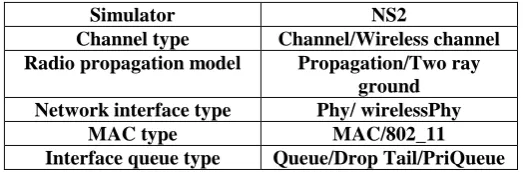
To evaluate the performance following simulation parameters are used:
Simulator NS2
Channel type Channel/Wireless channel Radio propagation model Propagation/Two ray
ground Network interface type Phy/ wirelessPhy
MAC type MAC/802_11 Interface queue type Queue/Drop Tail/PriQueue
www.ijiset.com
Link layer type LL
Antenna model Antenna/Omni antenna Max packet in ifq 50
Number of mobile nodes 57 Routing protocol AODV X dimension of topography 800 Y dimension of topography 600 Time of simulation end 30.0
Table5.1: Simulation Parameters used
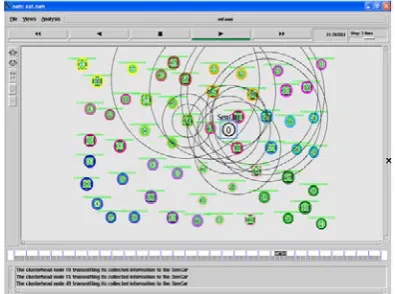
The simulation of the proposed system is shown in below Fig 5.1. It consists of 57 mobile nodes. At this point, the sencar is near cluster head node 49 and the cluster head node is transmitting its collected information to sencar
Fig 5.1 simulation window
6.RESULTSANDDISCUSSION
By using the above parameters a simulation was carried out. To evaluate the performance of the proposed approach the following parameters are considered.
• Maximum energy consumption.
• Throughput.
The below table shows the values of maximum energy consumption. The resulting graph is plotted in fig 6.1
Distance (m) Energy Consumtion (J) 100 500 200 350 400 250
Table 6.1 Maximum energy consumption
Fig 6.1: Maximum energy consumption Graph
The above X-graph explains about the maximum energy consumption in the network, since cluster heads can directly transfer their data to sencar so as the distance increases energy consumption decreases which was initially high. Initially energy consumed was 500 joules, by utilizing sencar it has been reduced to 250 joules.
The below table shows the values of throughput achieved. The resulting graph is plotted in the fig 6.2
Time(ms) Throughput(BPMS)
5 160
20 460
30 650
Table 6.2 Throughput achieved
Fig 6.2: Throughput Graph
The above X-graph explains about throughput in terms of time. By utilizing sencar more amount of data is transferred i.e. throughput increases, 650 bits are transmitted in 30ms
www.ijiset.com
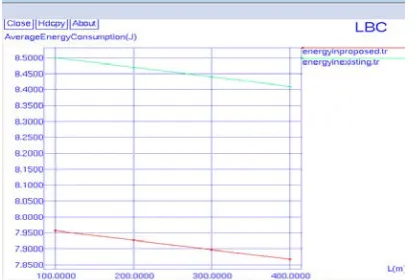
Fig 6.3 Average energy consumption comparison graph
Finally the average energy consumption comparison graph is plotted which indicates the average energy consumption in proposed system i.e. by utilizing sencar is less than the existing single input single output method. The average energy consumed in proposed system is 7.850 joules which is less than 8.400 joules consumed by existing method.
7.CONCLUSION
The LBC_DDU system for versatile information gathering in a WSN is proposed. It comprises of sensor layer, bunch (cluster) head layer and Sencar layer. It utilizes circulated load adjusted bunching for sensor self-association, receives share between group correspondence for vitality proficient transmissions among cluster head groups, utilizes double information transferring for quick information gathering, and upgrades Sencar's versatility to completely appreciate the advantages of multi input multi output method. The execution study shows the adequacy of the proposed system. The outcomes demonstrate that LBC_DDU can significantly diminish vitality utilizations by easing directing weights on hubs and adjusting workload among bunch heads, which accomplishes 20 percent less information accumulation time contrasted with single input portable information gathering and more than 60 percent vitality saving money on group heads.
REFERENCES
[1] B. Krishnamachari, Networking Wireless Sensors. Cambridge, U.K.: Cambridge Univ. Press, Dec. 2005.
[2] R. Shorey, A. Ananda, M. C. Chan, and W. T. Ooi, Mobile, Wireless, Sensor Networks. Piscataway, NJ, USA: IEEE Press, Mar. 2006.
[3] I. F. Akyildiz, W. Su, Y. Sankarasubramaniam, and E. Cayirci, “A survey on sensor networks,” IEEE Commun. Mag., vol. 40, no. 8, pp. 102–114, Aug. 2002.
[4] S. C. Ergen and P. Varaiya, “TDMA scheduling algorithms for wireless sensor networks,” Wireless Netw., vol. 16, no. 4, pp. 985– 997, May 2010.
[5] K. Xu, H. Hassanein, G. Takahara, and Q. Wang, “Relay node deployment strategies in heterogeneous wireless sensor networks,” IEEE Trans. Mobile Comput., vol. 9, no. 2, pp. 145–159, Feb. 2010.
[6]Y. Wu, Z. Mao, S. Fahmy, and N. Shroff, “Constructing maximum- lifetime data-gathering forests in sensor networks,” IEEE/ ACM Trans. Netw., vol. 18, no. 5, pp. 1571–1584, Oct. 2010.
[7]D. Gong, Y. Yang, and Z. Pan, “Energy-efficient clustering in lossy wireless sensor networks,” J. Parallel Distrib. Comput., vol. 73, no. 9, pp. 1323–1336, Sep. 2013.
[8]M. Zhao, M. Ma, and Y. Yang, “Efficient data gathering with mobile collectors and space-division multiple access technique in wireless sensor networks,” IEEE Trans. Comput., vol. 60, no. 3, pp. 400–417, Mar. 2011.
[9] D. Jea, A. A. Somasundara, and M. B. Srivastava, “Multiple controlled mobile elements (data mules) for data collection in sensor networks,” in Proc. IEEE/ACM Int. Conf. Distrib. Comput. Sensor Syst., Jun. 2005, pp. 244–257. [10] M. Ma, Y. Yang, and M. Zhao, “Tour planning for mobile data gathering mechanisms in wireless sensor networks,” IEEE Trans. Veh. Technol., vol. 62, no. 4, pp. 1472–1483, May 2013.
[11] A. A. Somasundara, A. Ramamoorthy, and M. B. Srivastava,, “Mobile element scheduling for efficient data collection in wireless sensor networks with dynamic deadlines,” in Proc. 25th IEEE Int. Real-Time Syst. Symp., Dec. 2004, pp. 296–305.
[12]R. Shah, S. Roy, S. Jain, and W. Brunette, “Data MULEs: Modeling a three-tier architecture for sparse sensor networks,” Elsevier Ad Hoc Netw. J., vol. 1, pp. 215–233, Sep. 2003. [13]M. Zhao and Y. Yang, “Bounded relay hop mobile data gathering in wireless sensor networks,” IEEE Trans. Comput., vol. 61, no. 2, pp. 265–271, Feb. 2012.
[14] W. Ajib and D. Haccoun, “An overview of scheduling algorithms in MIMO-based fourth-generation wireless systems,” IEEE Netw., vol. 19, no. 5, Sep./Oct. 2005, pp. 43– 48.
[15] S. Cui, A. J. Goldsmith, and A. Bahai, “Energy-efficiency of MIMO and cooperative MIMO techniques in sensor networks,” IEEE J. Sel. Areas Commun., vol. 22, no. 6, pp. 1089–1098, Aug. 2004.
[16] B. Gedik, L. Liu, and P. S. Yu, “ASAP: An adaptive sampling approach to data collection in sensor networks,” IEEE Trans. Parallel Distrib. Syst., vol. 18, no. 12, pp. 1766– 1783, Dec. 2007.