The Hunting of the SNARK
∗Nir Bitansky† Ran Canetti‡ Alessandro Chiesa§ Shafi Goldwasser§ Huijia Lin¶ Aviad Rubinstein† Eran Tromer†
July 24, 2014
Abstract
The existence of succinct non-interactive arguments for NP (i.e., non-interactive computationally-sound proofs where the verifier’s work is essentially independent of the complexity of the NP nonde-terministic verifier) has been an intriguing question for the past two decades. Other than CS proofs in the random oracle model [Micali, FOCS ’94], the only existing candidate construction is based on an elaborate assumption that is tailored to a specific protocol [Di Crescenzo and Lipmaa, CiE ’08].
We formulate a general and relatively natural notion of anextractable collision-resistant hash func-tion (ECRH)and show that, if ECRHs exist, then a modified version of Di Crescenzo and Lipmaa’s protocol is a succinct non-interactive argument for NP. Furthermore, the modified protocol is actually a succinct non-interactiveadaptive argument of knowledge (SNARK).We then propose several candidate constructions for ECRHs and relaxations thereof.
We demonstrate the applicability of SNARKs to various forms of delegation of computation, to suc-cinct non-interactive zero knowledge arguments, and to sucsuc-cinct two-party secure computation. Finally, we show that SNARKs essentially imply the existence of ECRHs, thus demonstrating the necessity of the assumption.
Going beyond ECRHs, we formulate the notion of extractable one-way functions (EOWFs). As-suming the existence of a natural variant of EOWFs, we construct a2-message selective-opening-attack secure commitment scheme and a 3-round zero-knowledge argument of knowledge. Furthermore, if the EOWFs are concurrently extractable, the 3-round knowledge protocol is also concurrent zero-knowledge. Our constructions circumvent previous black-box impossibility results regarding these pro-tocols by relying on EOWFs as the non-black-box component in the security reductions.
∗
This research was supported by the Check Point Institute for Information Security, by the Israeli Centers of Research Excellence (I-CORE) program (center No. 4/11), by the European Community’s Seventh Framework Programme (FP7/2007-2013) grant 240258, by a European Union Marie Curie grant, by the Israeli Science Foundation, and by the Israeli Ministry of Science and Technology.
This paper is a merge of [BCCT11] and [GLR11]. A preliminary version including part of the results appeared in ITCS 2012.
†
Tel Aviv University,{nirbitan,tromer,aviadrub}@tau.ac.il ‡
Boston University and Tel Aviv University,[email protected] §
MIT,{alexch,shafi}@csail.mit.edu ¶
Contents
1 Introduction 1
1.1 Summary of Our Results . . . 3
1.2 ECRHs, SNARKs, and Applications . . . 4
1.3 ECRH Candidate Constructions and Sufficient Relaxations . . . 6
1.4 High-Level Proof Strategy for Theorem 1 . . . 9
1.5 Discussion . . . 12
1.6 Organization . . . 12
2 Other Related Work 13 3 Preliminaries 14 3.1 Interactive Proofs, Zero Knowledge and Witness Indistinguishability . . . 14
3.2 Proofs and Arguments of Knowledge . . . 16
3.3 Commitment Scheme . . . 16
3.4 Collision-Resistant Hashes . . . 16
3.5 Merkle Trees . . . 16
3.6 Private Information Retrieval . . . 17
3.7 Probabilistically Checkable Proofs of Knowledge . . . 18
4 SNARKs 18 4.1 The Universal Relation andNPRelations . . . 18
4.2 Succinct Non-Interactive Arguments . . . 19
5 From ECRHs to SNARKs 20 5.1 Construction Details . . . 21
5.2 Proof of Security . . . 23
5.3 Extension to Universal Arguments . . . 27
6 ECRHs: a Closer Look 28 6.1 ECRHs . . . 28
6.2 PECRHs . . . 30
6.3 Weak PECRHs . . . 30
7 From SNARKs to PECRHs (and More) 32 7.1 From SNARKs to PECRHs . . . 33
7.2 From Leakage-Resilient Primitives and SNARKs to Extractable Primitives . . . 34
8 Candidate ECRH and PECRH Constructions 36 8.1 ECRHs fromt-Knowledge of Exponent . . . 36
8.2 PECRHs from Knowledge of Knapsack . . . 37
9 Zero-Knowledge SNARKs 42 9.1 SNARK on top of NIZK . . . 42
9.2 NIZK on top of SNARK . . . 43
10 Applications of SNARKs and zkSNARKs 44 10.1 Delegation of Computation . . . 44
11 Extractable One-Way Functions and Their Applications 48
11.1 Definitions of sEOWFs and scEOWFs . . . 49
11.2 A Special 3-round ZKAOK protocol . . . 51
11.3 A 3-round Concurrent ZK Protocol . . . 54
11.4 Two-message Selective Opening Attack Secure Commitments . . . 55
11.5 Candidate Constructions of sEOWF and scEOWF . . . 57
Acknowledgements 58
1
Introduction
For the Snark’s a peculiar creature, that won’t Be caught in a commonplace way.
Do all that you know, and try all that you don’t: Not a chance must be wasted to-day!
The Hunting of the Snark,
Lewis Carroll
The notion of interactive proof systems [GMR89] is central to both modern cryptography and complex-ity theory. One extensively studied aspect of interactive proof systems is their expressiveness; this study culminated with the celebrated result thatIP=PSPACE[Sha92]. Another aspect of such systems, which is the focus of this work, is that proofs for rather complexNP-statements can potentially be verified much faster than by direct checking of anNPwitness.
We know that if statistical soundness is required then any non-trivial savings would cause unlikely complexity-theoretic collapses (see, e.g., [BHZ87, GH98, GVW02, Wee05]). However, if we settle for proof systems with only computational soundness (also known as interactive arguments [BCC88]) then significant savings can be made. Indeed, using collision-resistant hash functions (CRHs), Kilian [Kil92] shows a four-message interactive argument forNP: the prover first uses a Merkle hash tree to bind itself to a polynomial-size PCP (Probabilistically Checkable Proof) string for the statement, and then answers the PCP verifier’s queries while demonstrating consistency with the Merkle tree. This way, membership of an instanceyin anNPlanguageLcan be verified in time that is bounded byp(k,|y|,logt), wheretis the time to evaluate theNPverification relation forLon inputy,pis a fixed polynomial independent ofL, andkis a security parameter that determines the soundness error. Following tradition, we call such argument systems
succinct.
Can we have succinct argument systems which are non-interactive? Having posed and motivated this question, Micali [Mic00] provides a one-message succinct non-interactive argument forNP, in the random oracle model, by applying the Fiat-Shamir paradigm [FS87] to Kilian’s protocol. In the standard model, such “totally non-interactive” succinct arguments (against non-uniform provers) do not exist except for “quasi-trivial” languages (i.e., languages in BPtime(npolylogn)), because the impossibility results for statistical soundness can be directly extended to this case. Nonetheless, it may still be possible to obtain a slightly weaker notion of non-interactivity:
Definition 1.1. Asuccinct non-interactive argument (SNARG)is a succinct argument where the verifier (or a trusted entity) generates ahead of time a succinct verifier-generated reference string(VGRS) and sends it to the prover. The prover can then use the VGRS to generate a succinct non-interactive proof π for a statement y of his choice. (The VGRS is thus independent of the statements to be proven later, and the definition requires “adaptive soundness”, sinceyis chosen by the prover, potentially based on the VGRS.)
In this paper, we consider the following questions:
Can SNARGs forNPexist in the standard model? And if so, under what assumptions can we prove their existence?
to access the PCP oracle as a long database. The verifier’s first message consists of the queries of the underlying PCP verifier, encrypted using the PIR chooser algorithm. The prover applies the PIR sender algorithm to the PCP oracle, and the verifier then runs the underlying PCP verifier on the values obtained from the PIR protocol. However, Dwork et al. [DLN+04] point out that this “PCP+PIR approach” is inherently problematic, because a cheating prover could “zigzag” and answer different queries according to different databases.1 (Natural extensions that try to force consistency by using multiple PIR instances run into trouble due to potential PIR malleability.)
Di Crescenzo and Lipmaa [DCL08] propose to address this problem by further requiring the prover to bind itself (in the clear) to a specific database using a Merkle Tree (MT) as in Kilian’s protocol. Intuitively, the prover should now be forced to answer according to a single PCP string. In a sense, this “PCP+MT+PIR approach” squashes Kilian’s four-message protocol down to two messages “under the PIR”. However, while initially appealing, it is not a-priori clear how this intuition can be turned into a proof of security under some well defined properties of the Merkle tree hash. Indeed, to prove soundness of their protocol Di Crescenzo and Lipmaa use an assumption that is non-standard in two main ways: first, it is a “knowledge assumption,” in the sense that any adversary that generates a value of a certain form is assumed to “know” a corresponding preimage (see more discussion on such assumptions below). Furthermore, their assumption is very specific and intimately tied to the actual hash, PIR, and PCP schemes in use, as well as the language under consid-eration. Two other non-interactive arguments forNP, based on more concise knowledge assumptions, are due to Mie [Mie08] and Groth [Gro10]. However, neither of these protocols is succinct: in both protocols the verifier’s runtime is polynomially related to the time needed to directly verify theNPwitness.
Recently, Gentry and Wichs [GW11] showed that some of the difficulty is indeed inherent by proving that no SNARG construction can be proved secure via a black-box reduction to an efficiently falsifiable assumption[Nao03]. For example, the assertion that one-way functions exist or that fully-homomorphic encryption exists are both falsifiable assumptions; in general, an assumption is efficiently falsifiable if it can be modeled as a game between an adversary and a challenger, where the challenger canefficientlydecide whether the adversary has won the game. The impossibility result of Gentry and Wichs holds even for
designated-verifierprotocols, where the verifier needs secret randomness in order to verify. This suggests that non-standard assumptions, such as the knowledge (extractability) assumptions described next, may be inherent.
Knowledge (extractability) assumptions. Knowledge (or extractability) assumptions capture our belief that certain computational tasks can be achieved efficiently only by (essentially) going through specific intermediate stages and thereby obtaining, along the way, some specific intermediate values. Such an as-sumption asserts that, for any efficient algorithm that achieves the task, there exists aknowledge extractor
algorithm that efficiently recovers the said intermediate values.
A number of different extractability assumptions exist in the literature, most of which are specific num-ber theoretic assumptions (such as several variants of theknowledge of exponentassumption [Dam92]). It is indeed hard to gain assurance regarding their relative strengths. Abstracting from such specific assump-tions, one can formulate general notions of extractability for one-way functions and other basic primitives (see [CD09, Dak09]). That is, say that a function familyF isextractableif, given a randomf ← F, it is infeasible to producey ∈ Image(f)without actually “knowing”xsuch that f(x) = y. This is expressed by saying that for any efficient adversaryA there is an efficient extractorEA such that, if A(f) = f(x)
for some x, then EA(f) almost always outputs x0 such that f(x0) = f(x). Typically, for such a family
1
to be interesting, F should also have some sort of hardness property, e.g., one-wayness. Assuming that a certain function family is extractable does not typically fit in he mold of efficiently falsifiable assumptions. In particular, the impossibility result of Gentry and Wichs [GW11] does not apply to such assumptions.
1.1 Summary of Our Results
• We formulate a general and relatively-natural notion ofextractable collision-resistant hash functions
(ECRHs). We then show that if ECRHs exist then the modified construction is a SNARG for NP. Concretely, we revisit the PCP+MT+PIR approach of [DCL08], and show that it can be modified in a way that allows us to prove (adaptive) soundness when using an ECRH to construct the Merkle tree.
Furthermore, we show that the construction is aproof of knowledge. We are thus able to obtain a
SNARG of knowledge(SNARK) forNP.
• We propose a candidate ECRH construction, based on a Knowledge of Exponent assumption (that is a variant of the one found in [Gro10]) and the hardness of taking discrete logs. We also define
proximity ECRHs, a weaker variant of ECRHs that are still sufficient for the construction of SNARKs; we propose two candidate PECRH constructions, based on knapsack (subset-sum) problems related to hard problems on lattices. Finally, we show how proximity ECRHs can be further weakened to obtain a (still sufficient) primitive for which it seems plausible to conjecture that “unstructured” hash functions such as (randomized) SHA-2 satisfy it.
• We show that existence of SNARKs for NPimplies existence of (the weaker variants of) ECRHs, as well as extractable variants of some other cryptographic primitives; in other words, (proximity) ECRHs are not only sufficient but also necessary for the existence of SNARKs.
• We describe some applications of SNARKs: (a) to delegation of computations (even with long delega-tor input and with worker input), (b) to constructingzero-knowledgeSNARKs, and (c) for constructing succinct non-interactive secure computation (in the common reference string model). See more below.
• We consider the related notion of extractable one-way functions (EOWFs). We formulate two natural variants of EOWFs and show that as ECRHs they help circumvent previous black-box impossibility results. Namely, we construct a two-message selective-opening-attack secure commitment scheme and a 3-round public-coin concurrent zero-knowledge (ZK) argument-of-knowledge, which in turn implies a 3-round simultaneously-resettable ZK protocol, (all assuming additionally the existence of enhanced trapdoor permutations). Previous works have shown that (under standard assumptions) these protocols can not be proven secure from standard assumptions using black-box reductions or simulation [Pas11, CKPR01].
The rest of the introduction describes these results in more detail. Before proceeding, though, we wish to highlight a prominent application of SNARGs that further motivates the need for proofs of knowledge.
A SNARG forNPcould improve on these by minimizing both interaction and the verifier’s computa-tional effort. (Note that adaptive soundness of the SNARG seems crucial for this application since a cheating worker might choose a bogus result of the computation based on the delegators first message.2)
However, the application to delegation schemes brings with it additional security concerns.
For example, the untrusted worker may store a long database zwhose short Merkle hashh = MT(z)
is known to the delegator; the delegator may then ask the worker to computeF(z) for some functionF. However, from the delegator’s perspective, merely being convinced that “there existsz˜such thath=MT(˜z)
andF(˜z) =f” is not enough. The delegator should also be convinced that the workerknowssuch az˜, which implies due to collision resistance of MT that indeedz˜=z.
Thus, the delegator may not only be interested in establishing that a witness for a claimed theorem
exists, but also want that such a witness can beextractedfrom a convincing prover. That is, we requireproof of knowledge(or rather, anargument of knowledge) and thus SNARKs (rather than merely SNARGs) are needed. The ability to efficiently extract a witness for an adaptively-chosen theorem seems almost essential for making use of a delegation scheme when the untrusted worker is expected to contribute its own input (such as a database, as in the above example, or a signature, and so on) to a computation.
Another application where adaptive proofs of knowledge are crucial is recursive proof composition, a technique that has already been shown to enable desirable cryptographic tasks [Val08, CT10, BSW11, BCCT13].
1.2 ECRHs, SNARKs, and Applications
(i) Extractable collision-resistant hash functions.We start by defining a natural strengthening of collision-resistant hash functions (CRHs): a function ensembleH={Hk}kis an extractable CRH (ECRH) if (a) it is
collision-resistant in the standard sense, and (b) it is extractable in the sense that for any efficient adversary that is able to produce a valid evaluation of the function there is an extractor that is able to produce a corresponding preimage. More precisely, extractability is defined as follows:
Definition 1. A function ensemble H = {Hk}k mapping {0,1}`(k) to {0,1}k is extractableif for any
polynomial-size adversaryAthere exists a polynomial-size extractorEAsuch that for large enough security parameterk∈Nand any auxiliary inputz∈ {0,1}poly(k):
Pr
h←Hk
y← A(h, z) ∃x:h(x) =y ∧
x0 ← E(h, z)
h(x0)6=y
≤negl(k) .
We do not require that there is an efficient way to tell whether a given string in{0,1}kis in the image of a
givenh∈ Hk. We note that:
• For extractability and collision resistance (or one-wayness) to coexist, it should be hard to “obliviously sample images”; in particular, this implies that the image of almost anyh ∈ Hkshould be sparse in {0,1}k, i.e., with cardinality at most2k−ω(logk). (This remark is a bit over-simplified and not entirely
accurate; see discussion in Section 6.1.)
• For simplicity of exposition, the above definition accounts for the most general case of arbitrary polynomial-size auxiliary-input; this is, in fact, too strong and cannot be achieved assuming indistin-guishability obfuscation [BCPR14, BP13]. However, for our main result, we can actually settle for a
2
relaxed definition that only considers a specific distribution over auxiliary inputs of a-priori bounded size. See further discussion in Section 6.1.
(ii) From ECRHs to adaptive succinct arguments of knowledge, and back again. We modify the “PCP+MT+PIR” construction of [DCL08] and show that the modified construction can be proven to be a SNARK based solely on the existence of ECRHs and PIR schemes with polylogarithmic complexity.3
Theorem 1(informal). If there exist ECRHs and (appropriate) PIRs then there exist SNARKs (forNP).
A single VGRS in our construction suffices for only logarithmically many proofs; however, since the VGRS can be succincly generated, the cost of occasionally resending a new one is limited.
We complement Theorem 1 by showing that ECRHs are in factessentialfor SNARKs:
Theorem 2(informal). If there exist SNARKs and (standard) CRHs then there exist ECRHs.
More accurately, we show that SNARKs and CRHs imply a slightly relaxed notion of ECRHs that we call
proximity ECRHs, and which is still sufficient for our construction of SNARKs. To simplify the exposition of our main results we defer the discussion of the details of this relaxation to Section 1.3.
We also show that SNARKs can be used to construct extractable variants of other cryptographic primitives. A na¨ıve strategy to obtain this may be to “add a succinct proof of knowledge of a preimage to the output”. While this strategy does not work as such because the proof may leak secret information, we show that in many cases this difficulty can be overcome by combining SNARKs with (non-extractable)leakage-resilient
primitives. For example, since CRHs and subexponentially-hard OWFs are leakage-resilient, we obtain:
Theorem 3 (informal). Assume SNARKs and (standard) CRHs exist. Then there exist extractable one-way functions and extractable computationally hiding and binding commitments. Alternatively, if there exist SNARKs and (standard) subexponentially-hard way functions then there exist extractable one-way functions. Furthermore, if these functions are one-to-one, then we can construct perfectly-binding computationally-hiding extractable commitments.
We believe that this approach merits further investigation. One question, for example, is whether extractable pseudorandom generators and extractable pseudorandom functions can be constructed from generic ex-tractable primitives (as was asked and left open in [CD09]). Seemingly, our SNARK-based approach can be used to obtain the weaker variants of extractable pseudo-entropy generators and pseudo-entropy func-tions, by relying on previous results regarding leakage-resilience of PRGs [DK08, RTTV08, GW11] and leakage-resilient pseudo-entropy functions [BHK11].
(iii) Applications of SNARKs. As discussed earlier, SNARKs directly enable non-interactive delegation of computation, including settings where the delegator has a very long input or where the worker supplies his own input to the computation. An important property of SNARK-based delegation is that it does not require expensive preprocessing and (as a result) soundness can be maintained even when the prover learns the verifier’s responses between successive delegation sessions because a fresh VGRS can simply be resent for each time.
In addition, SNARKs can be used to obtain zkSNARKs, that is,zero-knowledgesuccinct non-interactive arguments of knowledge in the common reference string (CRS) model. We provide two constructions to do so, depending on whether the succinct argument is “on top or below” the NIZK.
3
In an additional step, it is possible to obtain non-interactive two party secure computation (against ma-licious adversaries) between a powerful sender and a weak receiver. To do so, start with a non-interactive two-party computation protocol that is secure against “almost” honest-but-curious adversaries, who are al-lowed to choose arbitrary randomness; such protocols are known to exist, e.g., based on fully-homomorphic encryption [Gen09]. Then, to make the protocol resilient to malicious adversaries, let the sender attach to his message a zkSNARK that his computation was performed honestly. The succinct receiver can use a standard NIZK to prove knowledge of his inputs. As for the sender, if his input is short he can also prove knowledge using a standard NIZK (as also done in [DFH11]); otherwise, he must rely on the zkSNARK proof of knowledge. In particular, in the latter case, we only get non-concurrent security (rather than UC security) as the simulation relies on the non-black-box SNARK extractor.
In summary, SNARKs can be used for a number of applications:
Corollary 1.2(informal). If there exist SNARKs, then:
1. There exist non-interactive delegation schemes where the verifier’s response need not remain secret.
(Furthermore, there are such schemes that allow the worker to contribute it own input, as well as ones allowing to delegate memory and data streams [CTY10, CKLR11].)
2. In the CRS model, there exist zero-knowledge SNARKs.
3. In the CRS model, there exist succinct non-interactive secure computation schemes (with UC security for short sender input and non-concurrent security for long sender input).
For more details on the aforementioned applications see the respective sections Section 9, Section 10.1, and Section 10.2.
(iii) Applications of EOWFs. As demonstrated by the construction of SNARK from ECRHs, extractable functions can be used to circumvent impossibilities of constructing certain primitives using black-box secu-rity reductions. We explore this direction, and show that new feasibility results can be shown using EOWFs. Specifically, we first formalize a stronger variant of EOWFs—called strong EOWFs (sEOWF)—where ev-ery function in the ensemble is one-to-one and evev-ery sequence of functions is one-way. Using sEOWFs, we construct a two-message selective-opening-attack-secure (SOA-secure) commitment scheme. It was shown by Pass [Pas11] that such a commitment scheme cannot be proven secure via black-box security reductions from any assumptions that can be formulated as a game between a challenger and an adversary (a.k.a. falsifiable assumptions [Nao03]) of bounded rounds. In contrast, our scheme is proven secure using a non-black-box reduction from enhanced trapdoor permutations.
Furthermore, sEOWFs can be used to construct a 3-round zero-knowledge argument of knowledge (ZKAOK), and if the sEOWFs are “concurrently extractable” then the protocol is also concurrent ZK. Addi-tionally, the 3-round protocol is public-coin; thus by applying standard transformations [BGGL01, DGS09], it yields a 3-round simultaneously resettable ZK protocol. It is known that these protocols do not admit black-box simulation [GK96, CKPR01]; our constructions indeed have non-black-box simulation utilizing the extractability of EOWFs.
For more details on the definitions and applications of (variants of) EOWFs see Section 11.
1.3 ECRH Candidate Constructions and Sufficient Relaxations
(ort-KEA for short) proceeds as follows. For any polynomial-size adversary, there exists a polynomial-size extractor such that, on inputg1, . . . , gt, gα1, . . . , gtα where eachgi is a random generator (of an appropriate
group) andα is a random exponent: if the adversary outputs(f, fα), then the extractor finds a vector of “coefficients”(x1, . . . , xt)such thatf =
Q
i∈[t]g
xi
i . This assumption can be viewed as a simplified version
of the assumption used by Groth in [Gro10] (the formal relation between the assumptions is discussed in Section 8.1). Similarly to Groth’s assumption,t-KEA holds in thegeneric group model.
Theorem 4(informal). Ift-KEA holds in a group where taking discrete logs is hard, then there exists an ECRH whose compression is proportional tot.
The construction is straightforward: the function family is parameterized by(g1, . . . , gt, g1α, . . . , gαt). Given
input (x1, . . . , xt), the function outputs the two group elements (Qi∈[t]g
xi
i ,
Q
i∈[t]g
αxi
i ). Extractability
directly follows fromt-KEA, while collision resistance is ensured by the hardness of taking discrete logs. See Section 8.1 for more details.
Next we proceed to propose ECRH candidates that are based on the subset sum problem in finite groups. Here, however, we are only able to construct candidates for somewhat weaker variants of ECRHs that are still sufficient for constructing SNARKs. While these variants are as not elegantly and concisely stated as the “vanilla”ECRH notion, they are still natural. Furthermore, we can show that these variants are necessary for SNARKs. We next proceed to formulate these weaker variants.
1.3.1 Proximity ECRH
We say thatHdefined on domainDis aproximity ECRH(PECRH) if (for anyh∈ H) there exist a reflexive “proximity” relation≈h on values in the range and an extension of the hash to a larger domainDh ⊇ D
fulfilling the following: (a)proximity collision resistance:givenh← H, it is hard to findx, x0 ∈Dhsuch
thath(x) ≈h h(x0), and (b)proximity extraction: for any poly-time adversaryAthere exists an extractor
Esuch that, wheneverAoutputsy ∈h(D),Eoutputsx∈Dhsuch thath(x)
h
≈y. (See Definition 6.2 for further details.)
Harder to find collisions, easier to extract. The notions of proximity extraction and proximity collision resistance are the same as standard extraction and collision resistance in the “strict” case, wherex ≈h yis the equality relation and the domain is not extended (Dh ={0,1}`(k),¯h=h).
However, in general, proximity collision resistance is stronger than (standard) collision resistance, be-cause even “near collisions” (i.e.,x 6= ysuch thath¯(x) ≈h ¯h(y)) must not be efficiently discoverable, not even over the extended domainDh. Conversely, proximity extraction is weaker than (standard) extraction,
since it suffices that the extractor finds a point mapping merely close the the adversary’s output (i.e., findsx0
such that¯h(x0) ≈h y); moreover, it suffices that the point is in the extended domainDh. Thus, the notion of
PECRH captures another, somewhat more flexible tradeoff between the requirements of extractability and collision resistance.
We show that any point on this tradeoff (i.e., any choice of≈h,Dhand¯hfulfilling the conditions) suffices
for the construction of SNARKs:
Theorem 5(informal). If there exist PECRHs and (appropriate) PIRs then there exist SNARKs forNP.
already discussed, we start from a standard knapsack hashf = Q
i∈[t]g
xi
i and extend it to a “sparsified”
knapsack hash(f, fα)for a secretα. While fort-KEA this step is enough for plausibly assuming precise
extractability (leading to a full fledged ECRH), for other knapsack-based CRHs this is not the case.
For example, let us consider the task of sparsifying modular subset-sum [Reg03]. Here, the hash function is given by random coefficientsl1, . . . , lt ∈ ZN and the hash ofx ∈ {0,1}tis simply the corresponding
modular subset-sum P
i:xi=1li modN. A standard way to sparsify the function is, instead of drawing
random coefficients, drawing them from a distribution of noisy multiples of some secret integer. However, by doing so, we lose the “algebraic structure” of the problem. Hence, now we also have to deal with new “oblivious image-sampling attacks” that exploit the noisy structure. For example, slightly perturbing an honestly computed subset-sum is likely to “hit” another image of the function. This is where the relaxed notion of proximity extraction comes into play: it allows the extractor to output the preimage of the nearby (honest) image and, more generally, to thwart “perturbation attacks”.
Sparsification of modular subset-sum in fact introduces additional problems. For instance, an attacker may take “small-norm” combinations of the coefficients that are not0/1and still obtain an element in the image (e.g., if there are two even coefficients); to account for this, we need to further relax the notion of extraction by allowing the extractor to output a preimage in an extended domain, while ensuring that (proximity) collision resistance still holds for the extended domain too. Additionally, in some cases a direct na¨ıve sparsification is not sufficient and we also need to consider amplified knapsacks.
The relaxations of extractability discussed above have to be matched by a corresponding strengthening of collision resistance following the definition of PECRH. Fortunately, this can still be done under standard hardness assumptions.
A similar approach can be taken in order to sparsify the modular matrix subset-sum CRH [Ajt96, GGH96], resulting in a a noisy inner-product knapsack hash based on the LWE assumption [Reg05]. Over-all, we propose three candidate for PECRHs:
Theorem 6(informal). There exist PECRHs under any of the following assumptions:
1. A Knowledge of Knapsack of Exponent assumption (which in fact follows fromt-KEA) and hardness of discrete logs.
2. A Knowledge of Knapsack of Noisy Multiples assumption and lattice assumptions.
3. A Knowledge of Knapsack of Noisy Inner Products assumption and learning with errors.
1.3.2 Weak PECRHs4
Our second weakening is essentially orthogonal to the first one and relates to the condition that determines when the extractor has to “work”. The ECRH and PECRH definitions required extraction whenever the ad-versary outputs a valid image; here the sparseness of the image appears to be key. In particular, unstructured CRHs where one can sample elements in the image obliviously of their preimage have no hope to be either ECRH or PECRH. However, for our purposes it seems sufficient to only require the extractor to “work” when the adversary outputs an imageytogether with extra encoding of a preimage that can be verified given proper trapdoor information; oblivious image-sampling, on its own, is no longer sufficient for failing the extractor.
More formally, a familyHof functions is weakly extractable if for any efficient adversaryAthere exists an efficient extractorEAHsuch that for any auxiliary inputzand efficient decoderY, the probability of the
4
event thatAoutputs, givenz and a random functionh from the family, valuesy andesuch that: (a)EH A,
givenzandh, does not find a preimage ofy, but (b)Y, givene, does find a preimage ofy, is negligible. See Definition 6.3 for further details.
We stress that the decoder circuitY is allowed to arbitrarily depend on the auxiliary inputz. This isY’s advantage over the extractorEH
A (that must be efficient inz); in particular, the extractability condition is not
trivially true. Another interpretation of the above definition is the following: The definition requires that there exists a single extractorEAHthat does as well as any other efficient extractor (that may depend onz); namely, any given decoder circuitY can be thought of as a candidate extractor and the extractorEH
A has to
succeed wheneverYdoes despite being efficient in the auxiliary input. In particular, whenever extraction is possible when given a trapdoor information related to the auxiliary input, it should also be possible without such trapdoor information. Indeed, the ability of the extractor to forgo the trapdoor is the key to a successful use of the above definition in our construction of SNARKs:
Theorem 7(informal). If there exist weak PECRHs and (appropriate) PIRs then there exist SNARKs forNP.
Unlike ECRHs and PECRHs, weak ECRHs may in principle not require sparsity of the image or al-gebraic structure. For example, it may be plausible to assume that (a properly keyed) SHA-2 is a weak ECRHs.
We remark that the notion of weak ECRH is somewhat reminiscent of the notion ofpreimage awareness
considered by Dodis et al. [DRS09]. Their notion, however, is set in an idealized model where the hash function can only be accessed as a black-box. When ported to such an ideal model, our definition can be viewed as a strengthening of the [DRS09] definition to account for auxiliary input. Similarly to the [DRS09] definition, the idealized version of our definition also holds in the (compressing)random oracle model. (We do not know if an idealized ECRH or PECRH can be constructed unconditionally in the random oracle model; however, assuming the existence of standard CRHs, so that a concise description for a CRH is available, it is possible to construct PECRHs in the random oracle model using CS proofs of knowledge.)
1.4 High-Level Proof Strategy for Theorem 1
In this section we provide some high level intuition for the proof of our main technical result: showing that the existence of ECRHs and (appropriate) PIR schemes imply the existence of SNARKs. At a very high-level, our construction follows the “PCP+MT+PIR approach” of [DCL08], which in turn is build upon Kilian’s 4-message succinct interactive argument system [Kil92]. So let’s start by reviewing them.
Kilian’s Construction: In [Kil92], Kilian presents a succinct special zero-knowledge argument forNP,
(Pk, Vk), where the proverPkuses a Merkle tree in order to provide toVk“virtual access” to a PCP proof.
More precisely, to prove a statement x ∈ L, the verifierVkstarts by sending the prover a CRHF H. The
prover on private input a witnessw, constructs a PCP-proof π. In order to yield efficient verifiability,Pk
cannot sendVkthe witnesswnorπ. Rather,Pkbuilds a Merkle tree with the proofπas the leaf values (using
the collision-free hash functionH from the verifier) producing a root valuerv. It then “commits” itself to
πby sendingrvto the verifierVk. The verifierVktosses a fixed polynomial number of random coinsrand
sends them to the prover. Both the proverPk and the verifierVk computes the PCP queries by internally
running the PCP verifier on input xand r. The prover Pk sends back answers to those queries, together
with “proofs”—called authentication paths—that each answer is consistent with the root of the Merkle tree. Finally, the verifier accepts if all the answers are consistent with the root valuerv, and convinces the PCP verifier.
length, all independent of the length of the witness. At a very high-level, the soundness follows from the fact that the Merkle tree provides the verifier “virtual access” to the PCP proof, in the sense that given the root value of the Merkle tree, for every queryq, it is infeasible for a cheating prover to answerqdifferently depending on the queries. Therefore, interacting with the prover is “equivalent” to having access to a PCP proof oracle. Then it follows from the soundness of the PCP system that Kilian’s protocol is sound.
The “PCP+MT+PIR approach”:The work of [DCL08] proposed the “PCP+MT+PIR approach” to “squash” Kilian’s four-message protocol into a two-message protocol as follows. In Kilian’s protocol, the verifier ob-tains from the prover a Merkle hash to a PCP oracle and only then asks the prover to locally open the queries requested by the PCP verifier. In [DCL08]’s protocol, the verifier sends also in the first message, a PIR-encrypted version of the PCP queries (the first message of a PIR scheme can be viewed as an encryption to the queries); the prover then prepares the required PCP oracle, computes and sends a Merkle hash of it, and answers the verifier’s queries by replying to the PIR queries according to a database that contains the answer (as well as the authentication path with respect to the Merkle hash) to every possible verifier’s query.
[DCL08] proved the soundness of the above scheme based on the assumption that any convincing prover
P∗must essentially behave as an honest prover: Namely, if a proof is accepting, then the prover must have in mind afullPCP oracleπ, which maps under the Merkle hash procedure to the claimed root, and such a proofπ can be obtained by an efficient extractorEP∗.5 [DCL08] then showed that, if this is the case, the
extracted stringπmust be consistent with the answers the prover provides to the PCP queries, for otherwise the extractor can be used to obtain collisions of the hash function underlying the Merkle tree. Therefore, the extracted stringπalso passes the PCP test, where the queries are encrypted under PIR. Then, it follows from the privacy of the PIR scheme that, the stringπis “computationally independent” of the query. Hence from the soundness of PCP, they conclude that the statement must be true.
1.4.1 The main challenges and our solutions.
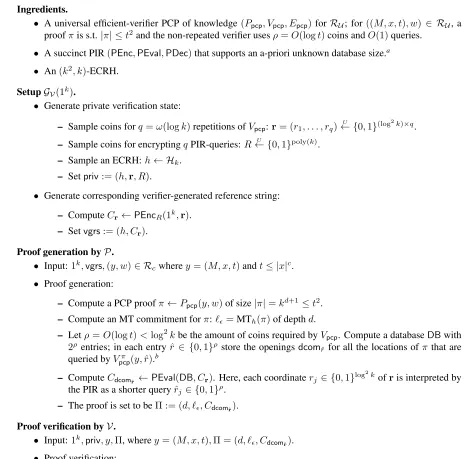
Our goal is to obtain the stronger notion of SNARK, based on the more restricted assumption that ECRHs exist. At a very high-level, our construction follows the “PCP+MT+PIR approach” but replacing the CRH underlying the Merkle tree in their construction with an ECRH. Unlike[DCL08] which directly assumed the “global extraction” guarantees from a Merkle tree, we show that we canliftthe “local extraction” guarantee provided by the ECRH, to the “global extraction” guarantee on the entire Merkle tree. More precisely, by relying on the (local) ECRH extraction guarantee, we show that for every convincing prover, there is an extractor that can efficiently extract a PCP proofπ˜ that is “sufficiently satisfying” (i.e., a PCP verifier givenπ˜ accepts with high probability). Furthermore, to obtain the argument of knowledge property, we instantiate the underlying PCP system with PCPs of knowledge, which allows for extracting a witness from any sufficiently-satisfying proof oracle. (See details for the requisite PCP system in Section 3.7.) We next describe the high-level ideas for achieving global extraction guarantees from the local extraction of ECRHs. Full details are contained in Section 5, and the construction is summarized in Figure 1.
From local to global extraction. The main technical challenge lies in establishing a “global” knowledge feature (i.e., informally, extraction of a sufficiently satisfying proofπ˜from a convincing prover given that it outputs the root of a Merkle tree) from a very “local” one (namely, extraction of a preimage from a machine that outputs a valid hash value of the ECRHh). A natural attempt is to start from the root of the Merkle tree
5
and extract the values of the intermediate nodes of the Merkle tree layer by layer towards the leaves; that is, to extract a candidate proof˜πby recursively applying the ECRH-extractor to extract the entire Merkle tree
g
MT, where the leaves should correspond toπ˜.
However, recursively composing ECRH-extractors encounters a difficulty: each time applying the ECRH extraction incurs a polynomial blowup in extraction time. Therefore, (without making a very strong assump-tion on the amount of “blowup” incurred by the extractor,) we can only apply the ECRH extracassump-tion recur-sively a constant number of times; as a result, we can only extract from Merkle trees of a constant depth. We address this problem by opting to use a “squashed” Merkle tree, where the fan-in of each intermediate node is polynomial rather than binary as in the traditional case. Consequently, for every NP-statement, since its PCP proof is of polynomial length, the depth`of the Merkle tree built over the PCP proof is a constant. Then, we can apply the ECRH extraction procedure recursively to extract the whole Merkle tree, while overall incurring polynomial overhead in the size of the extractor.
A technical problem that arises when applying the above recursive extraction procedure is that we might not be able to extract out a full Merkle tree (where all paths have the same length). More precisely, after applying the ECRH extraction recursively `times, we obtain the values for the intermediate nodes up to level ` (thinking about the root as level zero). However, at each intermediate node, when applying the ECRH extractor, extraction could have failed to extract a preimage if the given intermediate node is not a valid hash image under the ECRH. Hence, the extracted tree might be at some points “disconnected”.6 Nevertheless, we show (relying solely on ECRH extraction) that the leaves in the extracted (perhaps partial) tree connected to the root are sufficiently satisfying for witness-extraction.
Proof at high level.Given the foregoing discussion, we show the correctness of the extraction procedure in two steps:
• Step 1: “local consistency”. We first show that whenever the verifier is convinced, the recursively extracted stringπ˜ contains valid answers to the verifier’s PCP queries specified in its PIR queries. Otherwise, it is possible to find collisions within the ECRHh as follows. A collision finder could simulate the PIR-encryption on its own, invoke both the extraction procedure and the prover, and obtain two paths that map to the same root but must differ somewhere (as one is satisfying and the other is not) and therefore obtain a collision.
• Step 2: “from local to global consistency”.Next, using the privacy guarantees of the PIR scheme, we show that, whenever we extract a set of leaves that are satisfying with respect to the PIR-encrypted queries, the same set of leaves must also be satisfying for almost all other possible PCP queries and is thus sufficient for witness-extraction. Indeed, if this was not the case then we would be able to use the polynomial-size extraction circuit to break the semantic security of the PIR.
For further details of the proof we refer the reader to Section 5.2.
Our construction ensures that the communication complexity and the verifier’s time complexity are bounded by a polynomial in the security parameter, the size of the instance, and the logarithm of the time it takes to verify a valid witness for the instance; furthermore, this polynomial isindependentof the specific
NPlanguage at hand.
On Adaptive Soundness:The soundness requirement of SNARK prevents a cheating prover from proving any false statement even if it is allowed to choose the statementafter seeing the verifier’s first message (or, rather, the verifier-generated reference string). In the above construction, the verfier sends in the fisrt message the PIR-encrypted PCP queries. However, in general, the PCP queries may depend on the statement
6
to be proven, and hence limit the construction to be only statically sound. To resolve this problem, we modify the above protocol as follows: In the first message, the verifier PIR-encrypt the PCP verifier’s random coins rather than its actual queries (as the former are independent of the statement), and require the prover to prepare an appropriate database (containing all the possible answers for each setting of the coins, rather than a proof oracle). One subtle problem with this approach is that in general, the number of random coins tossed by the PIR verifier may depend on the size of the database (or a known upper bound on the size of the database). Therefore, to handle the case where no a-priori bound on the time of verifying the witness is given, and thus no a-priori bound on the size of the corresponding PCP oracle (which is the database), we require that the PIR supports random queries with respect to a-priori unknown database size.
On Universal Soundness: As for soundness, our main construction is not universal, in the sense that the verifier needs to know a constantc such that the verification time of an instance y does not exceed |y|c.
Fortunately, this very weak dependence on the specificNPlanguage at hand (weak because it does not even depend on the Turing machine verifying witnesses) does not affect the application to delegation of computa-tion, because the delegator, having in mind a specific poly-time task to delegate,knowsc. Furthermore, we also show how, by assuming the existence of exponentially-hard one-way functions, our main construction can be extended to be auniversalSNARK, that is, a single protocol that can simultaneously work with all
NPlanguages.
1.5 Discussion
We conclude the introduction with an attempt to briefly motivate the premise of this work. Our main contri-bution can be seen as providing additional understanding of the security of a construction that has frustrated researchers. Towards this goal we prove strong security properties of the scheme based on a new cryp-tographic primitive, ECRHs, that, while not fitting into the mold of “standard crypcryp-tographic primitives or assumptions”, can be defined concisely and investigated separately.
Furthermore, we investigate a number of relaxations of ECRHs as well as a number of candidate con-structions that have quite different underlying properties. Looking beyond the context of our particular protocol, this work can be seen as another step towards understanding the nature of extractability assump-tions and their power in cryptography.
1.6 Organization
2
Other Related Work
Knowledge assumptions. A popular class of knowledge assumptions, which have been successfully used to solve a number of (at times notoriously open) cryptographic problems, is that ofKnowledge of Exponent
assumptions. These have the following flavor: if an efficient circuit, given the description of a finite group along with some other public information, computes a list of group elements that satisfies a certain algebraic relation, then there exists a knowledge extractor that outputs some related values that “explain” how the public information was put together to satisfy the relation. Most such assumptions have been proven secure against generic algorithms (see Nechaev [Nec94], Shoup [Sho97], and Dent [Den06]), thus offering some evidence for their truth. In the following we briefly survey prior works which, like ours, relied on Knowledge of Exponent assumptions.
Damg˚ard [Dam92] first introduced a Knowledge of Exponent assumption to construct a CCA-secure encryption scheme. Later, Hada and Tanaka [HT98] showed how to use two Knowledge of Exponent as-sumptions to construct the first three-round zero-knowledge argument. Bellare and Palacio [BP04] then showed that one of the assumptions of [HT98] was likely to be false, and proposed a modified assumption, using which they constructed a three-round zero-knowledge argument.
More recently, Abe and Fehr [AF07] extended the assumption of [BP04] to construct the first perfect NIZK forNPwith “full” adaptive soundness. Prabhakaran and Xue [PX09] constructed statistically-hiding sets for trapdoor DDH groups [DG06] using a new Knowledge of Exponent assumption. Gennaro et al. [GKR10] used another Knowledge of Exponent assumption (with an interactive flavor) to prove that a modi-fied version of the Okamoto-Tanaka key-agreement protocol [OT89] satisfies perfect forward secrecy against fully active attackers.
In a different direction, Canetti and Dakdouk [CD08, CD09, Dak09] studyextractable functions. Roughly, a functionf is extractable if finding a valuexin the image off implies knowledge of a preimage ofx. The motivation of Canetti and Dakdouk for introducing extractable functions is to capture the abstract essence of prior knowledge assumptions, and to formalize the “knowledge of query” property that is sometimes used in proofs in the Random Oracle Model. They also study which security reductions are “knowledge-preserving” (e.g., whether it possible to obtain extractable commitment schemes from extractable one-way functions).
[BCPR14, BP13] show that, assuming indistinguishability obfuscation [BGI+12], extractable one-way functions (and thus also ECRHs) cannot be constructed against adversaries with arbitrary polynomial-size auxiliary-input if the (efficient) extractor is universally fixed before the adversary’s auxiliary input. On the other hand, they show that, under standard assumptions, extractable one-way functions are achievable against adversaries with a-prori bounded auxiliary input. (It is still not known whether such ECRHs can also be constructed under standard assumptions).
Prior (somewhat) succinct arguments from Knowledge of Exponent assumptions. Knowledge of Ex-ponent assumptions have been used to obtain somewhat succinct arguments, in the sense the non-interactive proof is short, but the verifier’s running time is long.
Recently, Groth [Gro10] introduced a family of knowledge of expenonent assumptions, generalizing those of [AF07], and used them to construct extractable length-reducing commitments, as a building block for short non-interactive perfect zero-knowledge arguments system for circuit satisfiability. These arguments have very succinct proofs (independent of the circuit size), though the public key is large: quadratic in the size of the circuit. Groth’s assumption holds in the generic group model. For a comparison between our
t-KEA assumption and Groth’s assumptions see Section 8.1.
de-crypted values, or, equivalently, must “know” a database consistent with those answers (by arbitrarily setting the rest of the database). Mie then shows how to make the PIR scheme of Gentry and Ramzan [GR05] PIR-aware, based on Damg˚ard’s Knowledge of Exponent assumption [Dam92]; unfortunately, while the commu-nication complexity is very low, the receiver in [GR05], and thus also the verifier in [Mie08], are inefficient relative to the database size. We note that PIR schemes with database awareness can be constructed directly from ECRHs (without going through the PCPs of a SNARK construction); moreover, if one is willing to use PCPs to obtain a SNARK, one would then be able to obtain various stronger notions of database awareness.
Delegation of computation. An important application of succinct arguments isdelegation of computation
schemes, where one usually also cares about privacy, and not only soundness, guarantees. Specifically, a succinct argument can be usually combined in a trivial way with fully-homomorphic encryption [Gen09] (in order to ensure privacy) to obtain a delegation scheme where the delegator runs in time polylogarithmic in the running time of the computation (see Section 10.1).
Within the setting of delegation, however, where the same weak delegator may be asking a power-ful untrusted worker to evaluate an expensive function on many different inputs, a weaker preprocessing approach may still be meaningful. In such a setting, the delegator performs a one-time function-specific expensive setup phase, followed by inexpensive input-specific delegations to amortize the initial expensive phase. Indeed, in the preprocessing setting a number of prior works have already achieved constructions where the online stage is only two messages [GGP10, CKV10, AIK10]. These constructions do not al-low for an untrusted worker to contribute his own input to the computation, namely they are “P-delegation schemes” rather than “NP-delegation schemes”. Note that all of these works do not rely on any knowledge assumption; indeed, the impossibility results of [GW11] only apply forNPand not forP.
However, even given that the preprocessing model is very strong, all of the mentioned works maintain soundness over many delegations only as long as the verifier’s answers remain secret. (A notable exception is the work of Benabbas et al. [BGV11], though their constructions are not generic, and are only for specific functionalities such as polynomial functions.)
Goldwasser et al. [GKR08] construct interactive proofs for log-space uniformNCwhere the verifier run-ning time is quasi-linear. When combirun-ning [GKR08] with the PIR-based squashing technique of Kalai and Raz [KR06], one can obtain a succinct two-message delegation scheme. Canetti et al. [CRR11] introduce an alternative way of squashing [GKR08], in the preprocessing setting; their scheme is of the public coin type and hence the verifier’s answers need not remain secret (another bonus is that the preprocessing state is publicly verifiable and can thus be used by anyone).
3
Preliminaries
In this section we give basic definitions for the cryptographic primitives that we use (along with any non-standard properties that we may need). Throughout,negl(k)is any negligible function ink.
3.1 Interactive Proofs, Zero Knowledge and Witness Indistinguishability
We use the standard definitions of interactive proofs (and interactive Turing machines) [GMR89] and argu-ments (also known as computationally-sound proofs) [BCC88]. Given a pair of interactive Turing machines,
Definition 3.1 (Interactive Proof System). A pair (P, V) of interactive machines is called an interactive proof system for a languageLif there is a negligible functionν(·)such that the following two conditions hold :
• Completeness:For everyx∈Landw∈RL(x),Pr[hP(w), Vi(x) = 1] = 1.
• Soundness:For everyx∈ {0,1}n\L, and every interactive machineB,Pr[hB, Vi(x) = 1]≤ν(n)
In case that the soundness condition is required to hold only with respect to a computationally bounded prover, the pairhP, Viis called an interactiveargumentsystem.
Zero-Knowledge. An interactive proof is said to bezero-knowledge (ZK) if a verifierV learns nothing beyond the validity of the assertion being proved. Because “feasible computation” is typically captured through the notion of probabilistic polynomial-time, the ZK property is formalized by requiring that the output of every (possibly malicious) verifier interacting with the honest prover P can be simulated by a probabilistic (expected) polynomial-time machine S, known as the the simulator. The idea behind this definition is that the anyone can learn by himself, by running the simulator S, whatever V∗ learns by interacting withP.
The notion of ZK was introduced and formalized by Goldwasser, Micali and Rackoff in [GMR89]. We present their definition below.
Definition 3.2 (ZK). Let L be a language in NP, RL a witness relation for L, (P, V) an interactive
proof (argument) system for L. We say that (P, V) is statistical/computational ZK, if for every prob-abilistic polynomial-time interactive machineV there exists a probabilistic algorithm S whose expected running-time is polynomial in the length of its first input, such that the following ensembles are statistically close/computationally indistinguishable overL.
• nViewV[hP(y), V(z)i(x)]
o
n∈N,x∈{0,1}n∩L,y∈R
L(x),z∈{0,1}∗
• nS(x, z)o
n∈N,x∈{0,1}n∩L,y∈R
L(x),z∈{0,1}∗
whereView[hP(y), V(z)i(x)]denote the random variable describing the view ofV in interaction withP
on common inputxand private inputsyandzrespectively.
Witness-Indistinguishable Proofs. An interactive proof is said to be witness indistinguishable(WI) if the verifier’s output is “computationally independent” of the witness used by the prover for proving the statement. In this context, we focus on languages L ∈ NP with a corresponding witness relation RL.
Namely, we consider interactions in which, on common inputx, the prover is given a witness in RL(x).
By saying that the output is computationally independent of the witness, we mean that for any two possible
NP-witnesses that could be used by the prover to prove the statementx∈L, the corresponding outputs are computationally indistinguishable.
Definition 3.3 (Witness indistinguishability). Let (P, V) be an interactive proof system for a language
L ∈ NP. We say that(P, V) iswitness-indistinguishable forRL, if for every probabilistic
polynomial-time interactive machineV∗ and for every two sequences {w1n,x}n∈N,x∈L and{w2n,x}n∈N,x∈L, such that
w1n,x, w2n,x ∈ RL(x) for everyx ∈ L∩ {0,1}n, the following probability ensembles are computationally
indistinguishable overn∈N.
• {ViewV[hP(w1n,x), V∗(z)i(x)]}n∈N,x∈L∩{0,1}n,z∈{0,1}∗
3.2 Proofs and Arguments of Knowledge
Given a languageL ∈ NPand an instancex, aproof or argument of knowledge(POK or AOK) not only convinces the verifier thatx∈L, but also to demonstrate that the prover possesses anNP-witness forx. This is formalized by the existence of anextractor: given black-box access to a machine that can successfully complete the proof or argument of knowledge on inputx, the extractor can compute a witness forx.
Definition 3.4 (Proofs and arguments of knowledge). An interactive protocol Π = (P, V) is aproof of knowledge (resp. argument of knowledge) ofNP-language L with respect to witness relationRL ifΠ is
indeed an interactive proof (resp. argument) forL. Additionally, there exists a polynomialq, a negligible function ν, and a PPT oracle machine E, such that for every interactive machine P∗ (resp. for every polynomially-sized machineP∗), everyx ∈ Land every auxiliary inputz ∈ {0,1}∗, the following holds: On inputxand oracle access toP∗(x, z), machineE outputs a string from theRL(x) with probablity at
leastq(Pr[hP∗(z), Vi(x) = 1])−ν(|x|). The machineEis called the knowledge extractor.
3.3 Commitment Scheme
A commitment scheme (C, R) consists of a pair of PPTITMs C andR that interact in a commit stage and a reveal stage. In this work, we consider commitment schemes that are computationally binding and computationally hiding. The computational-binding property asserts that the probability that a malicious commitment, after the interaction with an honest receiver, can decommit to two different values is negligi-ble. The computational-hiding property guarantees that commitments to any two different values are com-putationally indistinguishable. (See [Gol01] for a formal definition.) Furthermore, we restrict our attention to commitment schemes where the reveal phase is non-interactive—the committer decommits to valuevby simply sending a decommitment pair(v, d). One-message statistically-binding commitment schemes can be constructed using any one-to-one one-way function (see Section 4.4.1 of [Gol01]). Allowing some minimal interaction (in which the receiver first sends a single random initialization message), statistically-binding commitment schemes can be obtained from any one-way function [Nao91, HILL99].
3.4 Collision-Resistant Hashes
Acollision-resistant hash(CRH) is a function ensemble for which it is hard to find two inputs that map to the same output. Formally:
Definition 3.5. A function ensembleHis a CRH if it is collision-resistant in the following sense: for every polynomial-size adversaryA,
Pr
h←Hk
x6=y
h(x) =h(y) : (x, y)←A(h)
≤negl(k) .
We say that a function ensembleHis(`(k), k)-compressingif eachh∈ Hkmaps strings of length`(k)to strings of lengthk < `(k).
3.5 Merkle Trees
|π|/`(k)parts (padding with0’s if needed) and evaluateshon each of these; the same operation is applied to the resulting string, and so on, until one reaches the singlek-bit root. For|π|= (`/k)d+1, this results in
a tree of depthd, whose nodes are all the intermediatek-bit hash images. An opening to a leaf inπ(or any bit within it) includes all the nodes and their siblings along the path from the root to the leaf, and is of size
`d. Typically,`(k) = 2k, resulting in a binary tree of depthlogπ. In this work, we shall also be interested in “wide trees” with polynomial fan-in (relying on CRHs with polynomial compression); see Section 5.1.
3.6 Private Information Retrieval
A (single-server) polylogarithmicprivate information retrieval(PIR) scheme [CMS99] consists of a triple of algorithms(PEnc,PEval,PDec)where:
• PEncR(1k, i)outputs an encryptionCi of queryito a databaseDBusing randomnessR,
• PEval(DB, Ci)outputs a succinct blobei“containing” the answerDB[i], and
• PDecR(ei)decrypts the blobeito an answerDB[i].
Formally:
Definition 3.6. A triple of algorithms(PEnc,PEval,PDec)is a PIR if it has the following properties:
1. Correctness.For any databaseDB, any queryi∈ {1, . . . ,|DB|}, and security parameterk∈N,
Pr
R
PDecR(ei) =DB[i] :
Ci←PEncR(1k, i)
ei ←PEval(DB, Ci)
= 1 ,
wherePEval(DB, Ci)runs inpoly(k,|DB|)time.
2. Succinctness.The running time of bothPEncR(1k, i)andPEval(DB, Ci)is bounded by
poly(k,log|DB|) .
In particular, the sizes of the two messagesCi andeiare also so bounded.
3. Semantic security. The query encryption is semantically secure for multiple queries, i.e., for any polynomial-sizeA, all large enough security parameter k ∈ N and any two tuples of queriesi = (i1· · ·iq),i0 = (i01· · ·i0q)∈ {0,1}poly(k),
PrhA(PEncR(1k,i)) = 1
i
−PrhA(PEncR(1k,i0)) = 1
i
≤negl(k) ,
wherePEncR(1k,i)the coordinate-wise encryption the tuplei.
PIR schemes with the above properties have been constructed under various hardness assumptions such as
ΦHA [CMS99] or LWE [BV11].
A-priori unknown database size.In certain cases, we want the server to be able to specify the databaseDB
onlyafterreceiving the query. In such cases, the client might not known the database’s size when generating his query, but will only know some superpolynomial bound, such as|DB| ≤2log2k. In this case we require that the PIR scheme allows the server to deduce from an encrypted (long) queryr ∈ {0,1}log2ka shorter
ρ-bit query rˆ ∈ {0,1}ρ that works for |DB| = 2ρ. In FHE-based schemes, such as the one in [BV11]
3.7 Probabilistically Checkable Proofs of Knowledge
A (verifier-efficient)probabilistically checkable proof (PCP) of knowledge for the universal relationRUis a
triple of algorithms(Ppcp, Vpcp, Epcp), wherePpcpis the prover,Vpcpis the (randomized) verifier, andEpcp
is the knowledge extractor.
Given(y, w)∈ RU,Ppcp(y, w)generates a proofπof lengthpoly(t)and runs in timepoly(|y|, t). The
verifierVpcpπ (y, r)runs in timepoly(|y|) = poly(|M|+|x|+ logt), while accessingpolylog(t)locations in the proofπand usingρ=O(logt)random bits. We require:
1. Completeness.For every(y, w) = (M, x, t), w
∈ RU,π←Ppcp(y, w):
Pr
r←{0,1}ρ(t)
Vpcpπ (y, r) = 1
= 1 .
2. Proof of knowledge (PoK).There is a constantεsuch that for anyy= (M, x, t)if
Pr
r←{0,1}ρ(t)
Vpcpπ (y, r) = 1
≥1−ε ,
thenEpcp(y, π)outputs a witnesswsuch that(y, w)∈ RU, and runs in timepoly(|y|, t).
(Note that proof of knowledge in particular implies that the soundness error is at mostε.)
PCPs of knowledge as defined above can be based on the efficient-verifier PCPs of [BSS08, BSGH+05]. (See [Val08] for a simple example of how a PCP of proximity can yield a PCP with a proof of knowledge.) Moreover, the latter PCPs’ proof length is quasi-linear int; for simplicity, we shall settle for a bound oft2.
We shall typically invoke the verifierVpcp forq(k)times to reduce the proof-of-knowledge threshold
to(1−ε)q(k), wherekis the security parameter andq(k) =ω(logk). Namely, extraction should succeed wheneverPrr
Vpcpπ (y,r) = 1
≥(1−ε)q, wherer= (ri)i∈[q]andVpcpπ (y,r) =
V
i∈[q]Vpcpπ (y, ri).
4
SNARKs
In this section we formally introduce the main cryptographic primitive studied in this paper — the SNARK.
4.1 The Universal Relation andNPRelations
The universal relation [BG08] is defined to be the setRU of instance-witness pairs (y, w), wherey = (M, x, t),|w| ≤ t, andM is a Turing machine, such thatM accepts(x, w)after at mosttsteps. While the witnesswfor each instancey = (M, x, t)is of size at mostt, there isno a-prioripolynomial boundingtin terms of|x|.
Also, for anyc∈N, we denote byRcthe subset ofRUconsisting of those pairs(y, w) = (M, x, t), w
for whicht≤ |x|c. This is a “generalized”NPrelation, where we do not insist on the same Turing machine
4.2 Succinct Non-Interactive Arguments
Asuccinct non-interactive argument(SNARG) is a triple of algorithms(P,GV,V). For a security parameter
k, the verifier runsGV(1k)to generate(vgrs,priv), wherevgrsis a (public) verifier-generated reference string
andprivare corresponding private verification coins; the honest proverP(y, w,vgrs)produces a proofΠfor the statementy = (M, x, t)given a witnessw; thenV(priv, y,Π)verifies the validity ofΠ. The SNARG is
adaptiveif the prover may choose the statementafterseeing thevgrs, otherwise, it isnon-adaptive.
Definition 4.1. A triple of algorithms(P,GV,V) is a SNARG for the relationR ⊆ RU if the following conditions are satisfied:
1. Completeness.For any(y, w)∈ R,
Pr
V(priv, y,Π) = 1 : (vgrs,priv)← GV(1
k)
Π← P(y, w,vgrs)
= 1 .
In addition,P(y, w,vgrs)runs in timepoly(k,|y|, t).
2. Succinctness. The length of the proofΠ that P(y, w,vgrs)outputs, as well as the running time of V(priv, y,Π), is bounded by
p(k+|y|) =p(k+|M|+|x|+ logt) ,
where p is a universal polynomial that does not depend on R. In addition, GV(1k) runs in time poly(k); in particular,(vgrs,priv)are of lengthpoly(k).
3. Soundness.Depending on the notion of adaptivity:
• Non-adaptive soundness. For all polynomial-size proverP∗, large enoughk∈N, andy /∈ LR,
Pr
V(priv, y,Π) = 1 : (vgrs,priv)← GV(1
k)
Π← P∗(y,vgrs)
≤negl(k) .
• Adaptive soundness. For all polynomial-size proverP∗ and large enoughk∈ N,
Pr
V(priv, y,Π) = 1 :
(vgrs,priv)← GV(1k) (y,Π)← P∗(vgrs)
y /∈ LR
≤negl(k) .
ASNARG of knowledge, or SNARK for short, is a SNARG where soundness is strengthened as follows:
Definition 4.2. A triple of algorithms(P,GV,V)is a SNARK if it is a SNARG where adaptive soundness is replaced by the following stronger requirement:
• Adaptive proof of knowledge.7 For any polynomial-size proverP∗ there exists a polynomial-size extractorEP∗such that for all large enoughk∈Nand all auxiliary inputsz∈ {0,1}poly(k),
Pr
(vgrs,priv)← GV(1k) (y,Π)← P∗(z,vgrs)
V(priv, y,Π) = 1
∧ (y, w)← EP∗(z,vgrs)
w /∈ R(y)
≤negl(k) .
7
Universal arguments vs. weaker notions. A SNARG for the relationR=RU is called auniversal argu-ment.8A weaker notion that we will also consider is a SNARG for the relationR=Rcfor a constantc∈N. In this case, soundness is only required to hold with respect toRc; in particular, the verifier algorithm may
depend onc. Nevertheless, we require (and achieve)universal succinctness, where a universal polynomial
p, independent ofc, upper bounds the length of every proof and the verification time.
Designated verifiers vs. public verification. In apublicly-verifiableSNARG the verifier does not require a private statepriv. In this work, however, we concentrate ondesignated verifierSNARGs, whereprivmust remain secret for soundness to hold.
The verifier-generated reference string. A very desirable property is the ability to generate the verifier-generated reference stringvgrsonce and for all and then reuse it in polynomially-many proofs (potentially by different provers). In publicly verifiable SNARGs, thismulti-theorem soundnessis automatically guar-anteed; in designated verifier SNARGs, however, multi-theorem soundness needs to be required explicitly as an additional property. Usually, this is achieved by ensuring that the verifier’s response “leaks” only a negligible amount of information aboutpriv. (Note thatO(logk)-theorem soundness always holds; the “non-trivial” case is wheneverω(logk). Weaker solutions to support more theorems include assuming that the verifier’s responses remain secret, or re-generatingvgrsevery logarithmically-many rejections, e.g., as in [KR06, Mie08, GKR08, KR09, GGP10, CKV10].)
The SNARK extractorE and auxiliary input. Above, we require that any polynomial-size family of circuitsP∗has a specific polynomial-size family of extractorsEP∗; in particular, we allow the extractor to
be of arbitrary polynomial-size and to be “more non-uniform” than P∗. In addition, we require that for
any prover auxiliary inputz ∈ {0,1}poly(k), the polynomial-size extractor manages to perform its
witness-extraction task given the same auxiliary inputz. As shown in [BCPR14, BP13], this aspect of the definition is too strong assuming indistinguishability obfuscation [BGI+12]. The definition can be naturally relaxed to consider only specific distributions of auxiliary inputs according to the required application. (In our setting, the restrictions on the input handled by the knowledge extractor will be related to the auxiliary-input that the underlying ECRH extractor can handle. See further discussion in Section 6.1.)
5
From ECRHs to SNARKs
In this section we describe and analyze our construction of adaptive SNARKs forNP based on ECRHs. (Recall that an ECRH is a CRH as in Definition 3.5 that is extractable as in Definition 1).
In Section 5.3 we discuss the universal features of our constructions, and the difficulties in extending it to a full-fledged universal argument; we propose a solution that can overcome the difficulties based on exponentially hard one-way functions.
Our modified approach.We modify the PCP+MT+PIR approach of [DCL08] and show that the knowledge assumption of [DCL08] (which involves the entire PIR+MT structure) can be replaced by the simpler generic assumption that ECRHs exist. Furthermore, our modification enables us to improve the result from a two-message succinct argument with non-adaptive soundness to an adaptive SNARG of knowledge (SNARK) — this improvement is crucial cryptographic applications. Specifically, we perform two modifications:
1. We instantiate the Merkle tree hash using an ECRH and, unlike the traditional construction where a
8Barak and Goldreich [BG08] define universal arguments forRwith a black-box “weak proof-of-knowledge” property; in