S. Selvakumar*, U. Madhan kumar, A.Prashanth, J. Sindhuja, Barnali Sarkar Department of Industrial BioTechnology, Bharath University, Chennai, India.
*Corresponding author’s E-mail:[email protected]
Received: 20-08-2017; Revised: 25-09-2017; Accepted: 12-10-2017. ABSTRACT
The objective of this study to determine the bio active and pharmaceutical components of the Chloroform extract of a poly herbal formulation Nalla Marunthu. The phytoconstituents of Chloroform extract of a poly herbal formulation of Nalla marunthu were analysed by GC-MS. Our results indicate that the presence of 48 phyto constituents of a poly herbal formulation of Nalla marunthu. Medicinal plants have been exhaustively studied for their potential value as a source of drugs. Obviously natural products will continue to be extremely important as sources of medicinal agents.
Keywords: Nalla marunthu, phyto constituents, medicinal agents, poly herbal formulation, molecular structure, GC-MS analysis.
INTRODUCTION
he focus on herbal therapy is not only in third world developing countries but also in developed countries. The studies regarding their assessment of risks and benefits, identifying pharmacologically active components/ principles and biological activities; scientific validation and revealing ethno medical values are going on worldwide with regards to thousands of herbs and their extracts, preparations and products which altogether would play vital role in perpetuating, propagating, popularizing and promoting the wider usages of drugs/medicines based on herbs. Herbal plants have been used as a source of valuable medication in virtually all cultures worldwide due to presence of important antimicrobial principles, immune modulatory activities, and maintenance of general health, precious therapeutic properties and healing potentials; thus ensure prevention and cure for several diseases and disorders of humans and animal 1. In India large number of plant species had been screened for their pharmacological properties but still, a vast wealth of plant species is unexplored. Medicinal plants are at interest to the field of therapeutics, as most of the drug industries depend in part of plants for the production of pharmaceutical compounds 2. India is endowed with a rich wealth of medicinal plants and it is one of the 12 mega bio-diversity centres having 45,000 plant species. In India around 20,000 medicinal plants have been recorded recently, but more than 500 traditional communities use 800 plant species for curing different disease Natural products, such as plant extracts, either as pure compounds or as standardized extracts, provide unlimited opportunities for new drug discoveries because of the unmatched availability of chemical diversity3. According to the World Health Organization (WHO), more than 80% of the world's population relies on traditional medicine for their primary healthcare needs. The use of herbal
medicines in Asia represents a long history of human interactions with the environment. Plants used for traditional medicine contain a wide range of substances that can be used to treat chronic as well as infectious diseases .Due to the development of adverse effects and microbial resistance to the chemically synthesized drugs, men turned to ethno pharmacognosy. They found literally thousands of phytochemicals from plants as safe and broadly effective alternatives with less adverse effect. Many beneficial biological activity such as anticancer, antimicrobial, antioxidant, antidiarrheal, analgesic and wound healing activity were reported. In many cases the people claim the good benefit of certain natural or herbal products4.
Croton bonplandianus belongs to the family of
Euphorbiaceae or Caster family. A much branched woody herb and 20-50 cm tall, branches stellate hairy to glabrous. Leaves alternate or subopposite, shortly petiolate; lamina 1.2-3.2 cm long, narrowly ovatelanceolate, apex acute, cuneate at base. Inflorescence terminal, 5-7 cm long, flowers laxly distributed. Male flowers small, white occupies the upper portion of the inflorescence. Female flowers few at the base of the inflorescence. Capsule 0.45 x 0.4 cm, oblong-ellipsoid, shallowly 3-lobed. Actions and uses: Juice of 3-4 leaves is given for 3-4 days to cure cough. Seed paste is applied locally on eczema and ringworm to cure. Latex is used to heal cuts and wounds. EtOH (50%) extract of plant is hypotensive and spasmolytic. The leaf extract shows antiviral activity against tomato spotted with virus coepia. The plant extract is also effective against green gram leaf curl disease5.
Trianthema portulacastrum Linn. is an herb used in
Ayurvedic medicine. Trianthema portulacastrum Linn, belonging to the family Aizoaceae, is one of the common weed, which has enormous traditional uses against diseases and some bioactive compounds have been
Determination of Bio active and Pharmaceutical Components of Chloroform Extract of a
Herbal Formulation
Nalla Marunthu
by GC – MS Analysis.
T
isolated from this weed. It is an exotic weed and a native of tropical America. It is growing throughout most tropical countries, such as Baluchistan, Ceylon, and India 6. It is .now naturalized throughout India in cultivated fields, river beds, waste ground, etc 7. Its infestation is very common in various agricultural and vegetable crops, such as mustard, maize, pigeon pea, mung bean, potato, onion, cotton, soybean, pearl millet, and sugarcane, especially during the rainy seasons. This is not cultivated commercially, but it is found throughout India as a tropical problematic terrestrial weed by virtue of its infestation in plains, river beds, and in wastelands. It also grows automatically in cultivated fields with agriculture and vegetable crops, especially in the rainy seasons8.
Amaranthus polygonoides is a herb the pharmacological
properties of Amaranth products are considered of vital importance . For reducing tissue swelling the leaves are well thought-out to be constructive, and they have a cleansing effect too. The plant has also been used curatively for diarrhea, dysentery, excessive menstrual flow, ulcers and intestinal hemorrhaging. For the treatment of intestinal bleeding, excessive menstruation, diarrhea and other related problems, a tea made from its leaves are used9.
The plant Indigofera tinctoria belongs to the family of Fabaceae, its commonly known as “True Indigo’’ and called as Neeli or Avuri in Tamil. I. tinctoria is a shrub, distributed throughout the India. The different parts of the plants are used for variety of diseases. The seeds of I.
tinctoria containing galactomannon composed of
galactose and mannose. Roots and leaves are used in epilepsy and hydrophophia.The aerial parts of I.
tinctoria used in treatment of antiproliferative activity in
human lung cancer10. Different solvent extracts of I.
tinctoria showed antibacterial activity11. Dry powder of I.
tinctoria used to treatment of asthma12.The leaves of I.
tinctoria used as antiinflamatory traditionally. Indirubin is
the active compounds isolated from I. tinctoria leaves active as effective anticancer drug13. Indigotin is the active compounds isolated from this leaves possess hepatoprotective activity14.
MATERIALS AND METHODS
Collection of medicinal plants
The poly herbal formulation were used for this study contains the equal amount of aerial parts of the plants
such as Croton bonplandianus, Trianthema
portulacastrum, Indigofera tinctoria and Amaranthus
polygonoides were collected from the nearby medicinal
gardens, Chennai, India. The parts of the plants were authenticated by botanist and herbal formulations were prepared by as the available litrature.
Plant Materials
The Chloroform extract of a herbal formulation NallaMarunthu were used for this study
Preparation of Plant extracts
The extraction of the poly herbal powder was carried out using known standard procedures. The plant materials were dried in shade and powdered in a mechanical grinder. The powder (25.0 g) of the plant materials were initially defatted with petroleum ether (60-80°C), followed by 900 ml of hydroalcohol by using a Soxhlet extractor for 72 hours at a temperature not exceeding the boiling point of the solvent. The extracts were filtered using Whatman filter paper (No.1) while hot, concentrated in vacuum under reduced pressure using rotary flask evaporator, and dried in a desiccator. The hydroalcoholic extract yields a dark greenish solid residue weighing 5.750 g (23.0% w/w). More yields of extracts were collected by this method of extractions. The extracts were then kept in sterile bottles, under refrigerated conditions, until further use. The dry weight of the plant extracts was obtained by the solvent evaporation and used to determine concentration in mg/ml. The extract was preserved at 2- to 4°C. This crude extracts was used for further investigation for potential of antimicrobial properties.
Chemicals and Reagents
All chemicals were used for this project were purchased from M/s. Sigma Chemicals, USA.
GC-MS analysis of Chloroform extract of Nalla Marunthu.
Preparation of plant extract
25gm of the powdered poly herbal powder were soaked in 95% chloroform for 12hrs. The extracts were then filtered through Whatman filter No.41 along with 2gm sodium sulfate to remove the sediments and traces of water in the filtrate. Before filtering, the filter paper was made wet with 95% ethanol along with sodium sulphate. The filtrate was then concentrated by bubbling nitrogen gas into the solution. The extract contained both polar and non-polar phyto-components in the plant material. 2µl of this solution was employed for GC-MS analysis. The herbal powder was extracted with chloroform and analyzed using GC-MS (GC Clarius 500 Perkin Elmer) analyzer. The data were obtained on an Elite-1(100% Dimethyl poly siloxane) column (30 0.25mm 1µmdf). Helium (99.999%) was used as the carrier gas with a flow rate of 1ml/min in the split mode (10:1). An aliquot of 2µl of ethanol solution of the sample was injected into the column with the injector temperature at 250ºC. GC oven temperature started at 110ºC and holding for 2min and it was raised to 200ºC at the rate of 10ºC/min, without holding. Holding was allowed at 280ºC for 9 min with program rate of 5ºC/min. The injector and detector temperatures were set at 250ºC and 280ºC respectively. Ion source temperature was maintained at 200ºC.
mass units). A scan interval of 0.5 seconds and fragments from 45 to 450 Da was maintained. The total running time was 36 minutes15.
Identification of components
Identification was based on the molecular structure, molecular mass and calculated fragments. Interpretation on mass spectrum GC-MS was conducted using the database of National Institute Standard and Technology (NIST) having more than 62,000 patterns. The name, molecular weight and structure of the components of the test materials were ascertained. The relative percentage amount of each component was calculated by comparing its average peak area to the total areas. The spectrum of the unknown component was compared with the spectrum of the component stored in the NIST library version (2005), software, Turbomas 5.2.
RESULTS AND DISCUSSION
Plants have many phytochemicals with various bioactivities, including antioxidant, anti-inflammatory and anticancer properties. Some studies have reported that extracts from natural products such as fruits, vegetables and medicinal herbs have positive effects against cancer compared with chemotherapy or hormonal treatments.
The antidiuretic, anti-inflammatory, anticancer, antiviral, antimalaria and antibacterial activities of the medicinal plants are due to the presence of secondary metabolites such as alkaloids, flavonoids, terpenoids, phlobatannins and reducing sugars. Medicinal plants are used for discovering and screening of the phytochemical constituents for the manufacturing of new drugs. The phytochemical analyses of the medicinal plants have commercial interest in research institutions and pharmaceutical companies for manufacturing new drugs for the treatment of various diseases16.
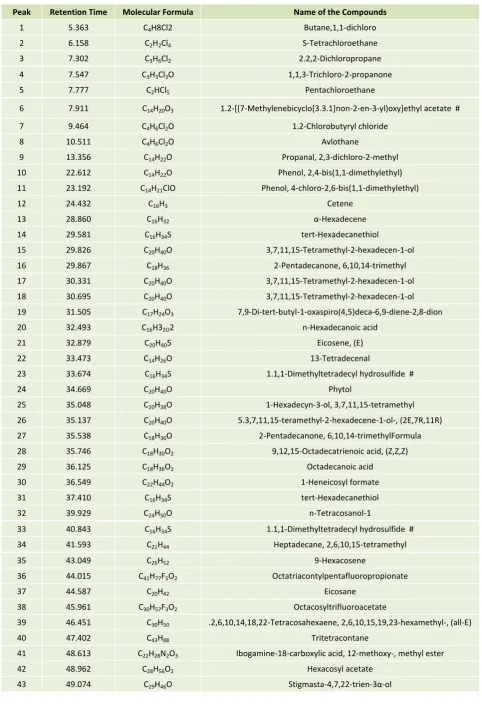
Table 1: GC-MS analysis of Chloroform extract of Nalla marunthu.
Peak Retention Time Molecular Formula Name of the Compounds
1 5.363 C4H8Cl2 Butane,1,1-dichloro
2 6.158 C2H2Cl4 S-Tetrachloroethane
3 7.302 C3H6Cl2 2.2,2-Dichloropropane
4 7.547 C3H3Cl3O 1,1,3-Trichloro-2-propanone
5 7.777 C2HCl5 Pentachloroethane
6 7.911 C14H20O3 1.2-[(7-Methylenebicyclo[3.3.1]non-2-en-3-yl)oxy]ethyl acetate #
7 9.464 C4H6Cl2O 1.2-Chlorobutyryl chloride
8 10.511 C4H6Cl2O Avlothane
9 13.356 C14H22O Propanal, 2,3-dichloro-2-methyl
10 22.612 C14H22O Phenol, 2,4-bis(1,1-dimethylethyl)
11 23.192 C14H21ClO Phenol, 4-chloro-2,6-bis(1,1-dimethylethyl)
12 24.432 C16H3 Cetene
13 28.860 C16H32 α-Hexadecene
14 29.581 C16H34S tert-Hexadecanethiol
15 29.826 C20H40O 3,7,11,15-Tetramethyl-2-hexadecen-1-ol
16 29.867 C18H36 2-Pentadecanone, 6,10,14-trimethyl
17 30.331 C20H40O 3,7,11,15-Tetramethyl-2-hexadecen-1-ol
18 30.695 C20H40O 3,7,11,15-Tetramethyl-2-hexadecen-1-ol
19 31.505 C17H24O3 7,9-Di-tert-butyl-1-oxaspiro(4,5)deca-6,9-diene-2,8-dion
20 32.493 C16H32O2 n-Hexadecanoic acid
21 32.879 C20H405 Eicosene, (E)
22 33.473 C14H26O 13-Tetradecenal
23 33.674 C16H34S 1.1,1-Dimethyltetradecyl hydrosulfide #
24 34.669 C20H40O Phytol
25 35.048 C20H38O 1-Hexadecyn-3-ol, 3,7,11,15-tetramethyl 26 35.137 C20H40O 5.3,7,11,15-teramethyl-2-hexadecene-1-ol-, (2E,7R,11R) 27 35.538 C18H36O 2-Pentadecanone, 6,10,14-trimethylFormula 28 35.746 C18H30O2 9,12,15-Octadecatrienoic acid, (Z,Z,Z)
29 36.125 C18H36O2 Octadecanoic acid
30 36.549 C22H44O2 1-Heneicosyl formate
31 37.410 C16H34S tert-Hexadecanethiol
32 39.929 C24H50O n-Tetracosanol-1
33 40.843 C16H34S 1.1,1-Dimethyltetradecyl hydrosulfide #
34 41.593 C21H44 Heptadecane, 2,6,10,15-tetramethyl
35 43.049 C26H52 9-Hexacosene
36 44.015 C41H77F5O2 Octatriacontylpentafluoropropionate
37 44.587 C20H42 Eicosane
38 45.961 C30H57F3O2 Octacosyltrifluoroacetate
39 46.451 C30H50 .2,6,10,14,18,22-Tetracosahexaene, 2,6,10,15,19,23-hexamethyl-, (all-E)
40 47.402 C43H88 Tritetracontane
41 48.613 C22H28N2O3 Ibogamine-18-carboxylic acid, 12-methoxy-, methyl ester
42 48.962 C28H56O2 Hexacosyl acetate
44 49.386 C18H36O Octadecanal
45 49.972 C27H44O Cholesta-4,6-dien-3-ol, (3β)
46 50.463 C27H56O 1-Heptacosanol
47 51.050 C29H50O2 Vitamin E
48 52.825 C28H48O Campesterol
CONCLUSION
Based on the results of the present study, it may be concluded that the important phytochemicals are present in the chloroform extract of Nalla marunthu may play an important role in various diseases in near future. However, further studies are required to establish their efficacy using human cell lines and also to observe any adverse effects in normal cells.
REFERENCES
1. Selva kumar, Sivagnanam and Valliammai R. Determination of Bioactive and Pharmaceutical Components of Croton bonplandianus by GC-MS Analysis. Int J Pharmaceu Sci and NanoTechnol, 9(5), 2016, 1-6.
2. Selvakumar S. Preliminary phytochemical analysis of aerial parts of Crossandra infundibuliformis. Journal of Chemical and Pharmaceutical Research, 7(12), 2015, 784-787. 3. Harborne JB. Phytochemical methods: A guide to modern
techniques of plant and Hall. 1973, pp 279–319.Newyork. 4. Duraipandiyan V,Ayyanar M, Ignacimuthu S. Antimicrobial
activity of some ethnomedicinal plants used by Paliyar tribe from Tamil Nadu, India. BMC Complementary AlternMed, 6, 2006, 35–41.
5. Aslam N, Stevenson PC, Phythian SJ, Veitch NC, Hall DR. Synthesis of cicerfuran, an antifungal hydroxylatedbenzofuran from chickpea roots and its analogues, Tetrahedron , 62, 2006, 421-426.
6. Kumar A, Saluja AK, Shah UDand Mayavanshi AV. Pharmacological potential of Albizzialeb bneck, A review. Pharmacogn Rev, 1, 2007, 171–4.
7. Kirtikar KRand Basu BD. Indian Medicinal Plants. Vol. 2.Allabahad: LalitMohenBasu; 1975. pp. 1180–1.
8. Randhawa MA, Khan MA, Khan NH. Influence of Trianthema
portulacastrum infestation and plant spacing on the yield
and quality of maize grain, Int J Agric Biol, 11, 2009, 225–7.
9. RosaNilda CJ, Raul Dias S, Alessandra M. Effects of defatted amaranth (Amaranthus caudatus L.) snacks on lipid metabolism of patients with moderate hyper cholesterolemia. Ciência e Tecnologia de Alimentos, 30, 2010, 1007-1010.
10.Kameswaran, TR and Ramanibai, R. The antiproliferative activity of flavanoidal fraction of Indigo feratinctoria is through cell cycle arrest and apoptotic pathway in A-549 cell lines”, JBiol Sci,2008,8: 584-590.
11.Ramanibai, R and Madhavarani, A (2012), “Phytochemical Screening and invitro antibacterial activity of leaf extracts
of Indigofera tinctoria linn, Int. J of Advances
inPhramaceutical Res, 2012; 3: 872-877.
12. Savithramma NCH and Rao SKN. Treatment in asthma of dry powder of Indigofera tinctoria linn” Ethanopharmacology, 113, 2007, 54-61.
13.Han R. Highlights on the studies of anticancer drugs delivered from plants in china”, Stem Cells, 12, 1994, 53-63. 14.Singh B, Saxena AK and Chandan BK. “Hepatoprotective
activity of indigotone – a bioactive fraction from Indigofera
tinctoria linn”, Phytother Res, 15, 2001, 294-297.
15.Merlin NJ, Parthasarathy V, Manavala R and Kumaravel S. Chemical investigation of aerial parts of Gmelinaasiatica Linn by GC-MS.Pharmacog Res, 1(3), 2009, 152-156.
16.Balakrishnan N, Sharma A. Preliminary phytochemical and pharmacological activities of Luffa cylindrical fruit. Asian J Pharm Clin Res, 6, 2013, 851-856.
17.Stevenson DE and Hurst R D. Polyphenolic phytochemicals--just antioxidants or much more Cell Mol. Life Sci, 64, 2007, 2900-2916.
18.Ronald Hites A. Gas Chromatography Mass Spectroscopy: Handbook of Instrumental Techniques for Analytical Chemistry, 1, 1997, 609-611.