Article
1
Effect of
Spirulina maxima
Supplementation and a
2
Systematic Physical Exercise Program on Body
3
Composition and Cardiorespiratory Fitness of
4
Overweight or Obese Subjects: A Double Blind
5
Randomized, Crossover Controlled Trial
6
Marco Antonio Hernández-Lepe1, José Alberto López-Díaz1, Marco Antonio Juárez-Oropeza2,
7
Rosa Patricia Hernández-Torres3, Abraham Wall-Medrano1, and Arnulfo Ramos-Jiménez1*
8
1 Instituto de Ciencias Biomédicas, Universidad Autónoma de Ciudad Juárez, Chihuahua, México;
9
[email protected] , [email protected] , [email protected] , [email protected]
10
2 Departamento de Bioquímica, Facultad de Medicina, Universidad Nacional Autónoma de México, Ciudad
11
de México; [email protected]
12
3 Facultad de Ciencias de la Cultura Física, Universidad Autónoma de Chihuahua, Chihuahua, México;
13
14
* Correspondence: [email protected]; Tel.: +52 656 1679309
15
16
Abstract
17
Background: Overweight and obesity are major risk factors for many chronic diseases, and
18
weight-loss interventions often include systematic exercising and nutritional supplements. The
19
purpose of this study was to determine the independent/synergistic effects of Spirulina maxima
20
supplementation (6-week, 4.5g/day) and a systematic physical exercise program (6 weeks/ 2 times)
21
on body composition and cardiorespiratory fitness of overweight and obese subjects. Methods: 27
22
overweight and 25 obese sedentary male subjects were assigned to four interventions through a
23
randomized double-blind, crossover controlled trial: Physical exercise program with (SE) or
24
without (Ex) Spirulina maxima or no-exercise program with (Sm) and without (C) Spirulina maxima.
25
Body composition and cardiorespiratory fitness parameters were taken during a maximum
26
intensity test. Results: As compared to C group, SE, Sm and Ex groups reduced (p<0.05) their body
27
fat percentage while improving their maximal oxygen uptake (r= -0.40), being obese subjects more
28
benefited. Weight loss, time to reach fatigue and onset of blood lactate accumulation were
29
improved in both Spirulina maxima supplemented groups, regardless the subjects’ body
30
composition. Conclusions: Spirulina maxima supplementation synergistically improves the effects of
31
systematic exercise in body composition and cardiorespiratory fitness parameters in overweight
32
but mostly in obese adults.
33
Key words: Overweight; obesity; body fat; maximal oxygen uptake; double-blind; randomized
34
controlled trial.
35
Trial registration: Clinical Trials, NCT02837666. Registered July 19 2016,
36
https://clinicaltrials.gov/ct2/show/NCT02837666?cond=Hypolipidemic+and+Antioxidant+Capacity
37
+of+Spirulina+and+Exercise&rank=1.
38
1. Introduction
39
Overweight and obesity [body mass index (BMI)≥ 25 kg•m-2] are major risk factors for many
40
non-communicable chronic diseases including type-2 diabetes, cardiovascular diseases (CVD) and
41
cancer [1]. Behavioral-based interventions focused on promoting a healthy diet and physical activity,
42
have proven to be effective in reducing people’s body weight (BW) and body fat stores [2].
43
Systematic exercise practice improves people’s general fitness [e.g. higher maximal oxygen uptake
44
(VO2max)], a prolonged onset of blood lactate accumulation (OBLA), a better ventilatory anaerobic
45
threshold, and overall improvement of resting heart rate (RHR) and body fat mobilization [3,4].
46
However, behavioral-based interventions are even more effective when combined with prescribed
47
drugs or nutritional supplements aimed to reduce fat stores and the body’s energy expenditure [5,6].
48
Marine product-based supplements are important sources of bioactive compounds [7], in this sense,
49
Spirulina sp., a group of cyanobacteria cultivated around the world, is a marine
50
nutritional/nutraceutical supplement due to its content of phytochemicals (phenolic compounds,
51
carotenoids and tocopherols) and essential nutrients (proteins, n-3 and n-6 fatty acids) [8].
52
Recently, studies reporting the use of Spirulina maxima (S. maxima) have been focused on
53
demonstrating the biological activity of its components including but not restricted to its antioxidant
54
and hypolipidemic activity [9,10]. However, most studies have been conducted in animal models,
55
with scarce studies focused on its effects in humans [11,12] and no controlled studies focused on
56
the effect of the administration of S. maxima and a systematic exercise program in humans have been
57
reported yet [13]. Therefore, the goal of this study was to evaluate the independent and synergistic
58
effect of S. maxima supplementation with or without a systematic physical exercise program on
59
body composition [BW and body fat percentage(%BF)] and cardiorespiratory fitness [VO2max,
60
anaerobic threshold, RHR, OBLA and time to fatigue (TF)] parameters. The differential effects in
61
overweight and obese male adults are also reported.
62
2. Results
63
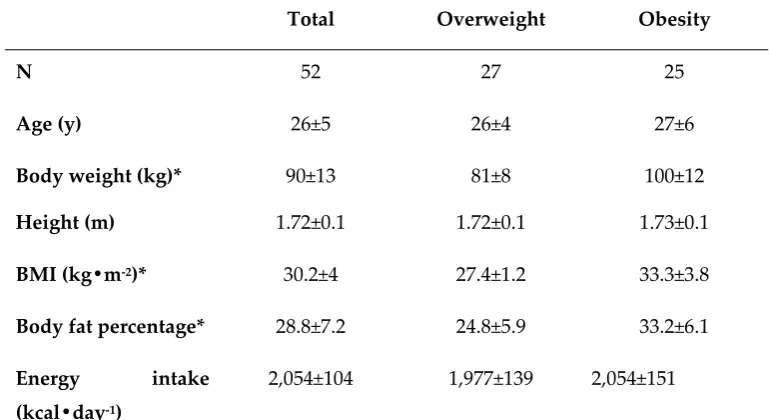
Baseline measurements of study participants (27 overweight and 25 obese) are shown on Table 1,
64
while results in body composition and cardiorespiratory fitness of all four intervention groups
65
[Physical exercise program with (SE) or without (Ex) S. maxima or no-exercise program with (Sm)
66
and without (C) S. maxima] are depicted in Figures 1-4.
67
68
Table 1. Anthropometric and physiological characteristics of participants.
69
Total Overweight Obesity
N 52 27 25
Age (y) 26±5 26±4 27±6
Body weight (kg)* 90±13 81±8 100±12
Height (m) 1.72±0.1 1.72±0.1 1.73±0.1
BMI (kg•m-2)* 30.2±4 27.4±1.2 33.3±3.8
Body fat percentage* 28.8±7.2 24.8±5.9 33.2±6.1
Energy intake
(kcal•day-1)
Maximal Respiratory
exchange ratio
1.19±0 1.19±0 1.18±0.1
Resting HR (bpm) 64.4±9.3 63.8±6.9 65.2±11.4
%HR at OBLA 61.9±11.8 62.9±11.5 60.8±12.2
VO2max
(mL•kg-1•min-1)*
35.4±6.9 39.6±5.1 30.8±5.6
Data is expressed as mean±SD. Asterisk means statistical differences between overweight and obese individuals
(p<0.05); N= Sample size, BMI= Body mass index, HR= Heart rate, OBLA= Onset blood lactate accumulation,
VO2max= Maximal oxygen uptake.
70
Individual differences are often of wide range, for that reason the results are shown as differences
71
between initial evaluations and after treatments. Also, since one individual (either performing or not
72
the exercise protocol) underwent a crossover trial with or without S. maxima, all changes depicted in
73
Figures 1-4 were corrected for basal BW and BMI.
74
2.1. Diet
75
Daily energy intake during the six weeks supplementation showed no statistical significant
76
differences (p<0.05) between treatments for dietary variables at the beginning (2054±104 kcal•day-1)
77
compared with the final of the study (2146±98 kcal•day-1). No dietary or S. maxima supplementation
78
adverse effects were reported during the study.
79
2.2. Body Composition
80
Initially, obese individuals had a higher BMI (5.9 kg•m-2) and %BF (8.4%) than overweight
81
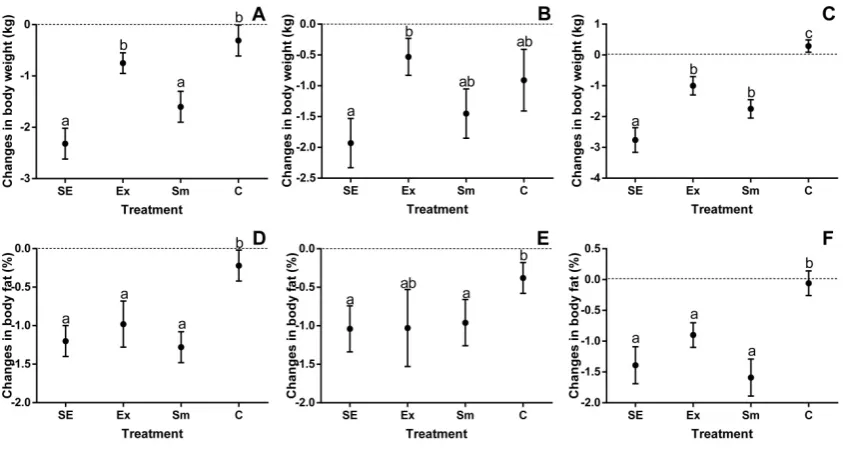
individuals (Table 1). According to Figure 1A, BW changes were more evident (p<0.05) in S.
82
maxima-supplemented groups [-2.2 kg (SE) and -1.6 kg (Sm)] than that observed for
83
non-supplemented ones [-0.8 kg (Ex) and -0.3 kg (C)], but obese subjects (Figure 1C) were more
84
benefited than those overweight (Figure 1B). SE, Sm and Ex groups also reduced (p<0.05) their %BF
85
(Figure 1D), regardless the subjects’ BW status. Lastly, according to Table 2, body weight change
86
(ΔBW) was statistically (p< 0.05) related to changes in body fat (r= 0.3) and RHR (r= 0.3), and to TF (r=
87
0.5) and VO2max (r= -0.5) during the maximal intensity test (MIT).
88
90
Figure 1. Changes in body weight and body fat percentage by treatments. SE: Spirulina and exercise; Ex:
91
Exercise and placebo; Sm: Spirulina without exercise; C: Control (Placebo treatment). A) Body weight changes in
92
total of subjects B) Body weight changes in overweight subjects C) Body weight changes in obesity subjects D)
93
Body fat changes in total of subjects E) Body fat changes in overweight subjects F) Body fat changes in obesity
94
subjects. Data presented like mean ± SEM. Different letters indicate statistical difference between groups
95
(p<0.05).
96
97
Table 2. Correlation matrix among physical and physiological variables.
98
Δ BW Δ %BF Δ VO2max Δ OBLA Δ RHR
Δ %BF 0.33** 1
Δ VO2max -0.54** -0.40** 1
Δ OBLA -0.17 -0.14 0.11 1
Δ RHR 0.34** 0.06 -0.22* -0.04 1
Δ TF -0.50** -0.19 0.36** 0.16 -0.38**
Δ= differences between before and after the study, BW= Body weight, %BF= percentage of body fat, VO2max= Maximal oxygen uptake, OBLA= Onset blood lactate accumulation, RHR= Resting heart rate, TF= Time to
fatigue. * p<05, ** p<0.01
2.3. Cardiorespiratory Fitness
99
The maximal oxygen uptake (VO2max) in overweight subjects was 8.8 ml.kg-1.min-1 more than that of
100
obese individuals but resting HR in both groups was not different (Table 1). Changes in TF by
101
treatments (Figure 2) mainly favored obese subjects (Figure 2C); RHR (Figure 3A) and OBLA
102
(Figure 3D) both with no apparent effect of BMI status were mostly improved in S. maxima
103
supplemented groups (SE and Sm).
104
106
Figure 2. Changes in time to fatigue by treatments.SE: Spirulina and exercise; Ex: Exercise and placebo; Sm:
107
Spirulina without exercise; C: Control (Placebo treatment). A) Time to fatigue changes in total of subjects B)
108
Time to fatigue changes in overweight subjects C) Time to fatigue changes in obesity subjects. Data presented
109
like mean ± SEM. Different letters indicate statistical difference between groups (p<0.05).
110
111
112
Figure 3. Changes in resting heart rate and onset blood lactate accumulation by treatments. HR: Heart rate;
113
OBLA: Onset blood lactate accumulation; %HR: Percentage of maximal heart rateSE: Spirulina and exercise; Ex:
114
Exercise and placebo; Sm: Spirulina without exercise; C: Control (Placebo treatment). A) Resting HR changes in
115
total of subjects B) Resting HR changes in overweight subjects C) Resting HR changes in obesity subjects D)
116
OBLA changes in total of subjects E) OBLA changes in overweight subjects F) OBLA changes in obesity subjects.
117
Data presented like mean ± SEM. Different letters indicate statistical difference between groups (p<0.05).
118
119
Also, VO2max improved in SE, Sm and Ex groups as compared to C group (Figure 4A), being obese
120
individuals (Figure 4C) more benefited than overweight ones (Figure 4B). According to Table 2,
121
besides correlating with Δ%BW,ΔVO2max also correlated (r) with Δ%BF (-0.4), ΔTF (0.4) and ΔRHR
122
(-0.2).
123
125
Figure 4. Changes in maximal oxygen uptake by treatments. VO2max: maximal oxygen uptake.SE: Spirulina
126
and exercise; Ex: Exercise and placebo; Sm: Spirulina without exercise; C: Control (Placebo treatment). A)
127
VO2max changes in total of subjects B) VO2max changes in overweight subjects C) VO2max changes in obesity
128
subjects. Data presented like mean ± SEM. Different letters indicate statistical difference between groups
129
(p<0.05).
130
3. Discussion
131
This study is the first focused on examining the effects of S. maxima supplementation in body
132
composition in humans using a double-blind, randomized, crossover trial design. The main findings
133
of this study about the effects of S. maxima supplementation (4.5 g) alone or together with the
134
systematic practice of exercise on body composition were a significant decrease in BW and %BF,
135
during six weeks of treatment. About the cardiorespiratory parameters it was found that there is a
136
significant improvement in RHR, TF, VO2max, and %HR at OBLA according to the S. maxima
137
supplementation and/or systematic practice of exercise.
138
3.1. Body Composition
139
The study of the potential effects of nutraceutical supplements is increasing. Miczke et al [14],
140
reported the effect of 2 g•day-1 of S. maxima supplementation on 40 hypertension subjects in a
141
double-blind, placebo-controlled randomized trial for three months. After the intervention, they
142
reported a significant reduction of BW, BMI and blood pressure in the group supplemented with S.
143
maxima compared with that of the placebo group. Mazokopakis et al [15], studied the effect of
144
Spirulina supplementation (1 g•day-1) during three months in BW, BMI, and lipid profile in patients
145
with dyslipidemia and reported a significant decrease in total cholesterol, triacylglycerols, and
146
cholesterol associated to low-density lipoproteins. In our study, we found a significant decrease on
147
BW, and %BF in all treatments compared with that of the control; even though there was difference
148
between treatments in both groups, there was a tendency to an additive effect of S. maxima and
149
exercise. The inconsistent results in the Ex group was probably due there exist a considerable
150
interindividual variability in the magnitude of weight loss produced by exercise and there doesn’t
151
exist a specific kind of exercise program to overweight and obese persons [16]. The S. maxima
152
groups showed better results about body composition probably due their specific action mechanism
153
in the organism, Fujimoto et al [17], hypothesized that some Spirulina compounds could reduce the
154
macrophages infiltration into visceral fat and prevents liver lipids accumulation, resulting in weight
155
reduction, specifically body fat, what would explain our clinical trial results, but there are necessary
156
studies focused in elucidate the specific compounds and action mechanisms by which Spirulina
157
3.2. Cardiorespiratory Fitness
159
3.2.1. Time to Fatigue
160
The effects granted by S. maxima observed in the present study strengthen the data reported by
161
Kalafati et al [12], who studied the effect of S. maxima supplementation (6 g•day-1) in nine
162
recreational runners training at least two days a week, 45 min per session, obtaining a significant
163
improvement in TF in a submaximal exercise test (~40 s) after 4 weeks of the clinical trial. In addition
164
to the VO2max increase observed here, it is probable that some of the compounds present in S.
165
maxima like phycocyanins, essential fatty acids, carotenoids or phenolic compounds act individually
166
in different metabolic processes to improve cardiorespiratory fitness; these effects are discussed in
167
the next sections.
168
3.2.2. Resting Heart Rate and OBLA
169
A high RHR has been associated with cardiovascular mortality in numerous epidemiologic studies
170
[18,19]. Torres-Duran et al [20], studied the effect of S. maxima supplementation (5 g•day-1) during 15
171
days in lactate concentration of recreational runners (n=41) before and after an intensive exercise.
172
Their results showed a trend to lower lactate concentration (mM) before exercise with S. maxima
173
supplementation (1.7±0.6) compared with exercise without supplementation (2.3±2.2); and, the
174
results were similar in lactate concentrations after exercise with S. maxima supplementation
175
(12.8±6.3) compared with exercise without supplementation (15.5±4.2). Moreover, they did not
176
quantify the lactate concentrations through the exercise test, for that reason it was not possible to
177
determine the OBLA, but our results in the decrease of RHR can be directly related only with the
178
increase of the VO2max in each MIT; and, even though the trial duration was of short term, we found
179
minimum but statistical differences after treatments. Lu et al [21], examined the effect of Spirulina
180
supplementation (7.5 g•day-1) in lactate concentrations before maximal athletic activity in a
181
randomized double-blind placebo-controlled study in 16 young students. They reported a statistical
182
decrease (p<0.05) in blood lactate concentration (mM) after supplementation (three weeks)
183
compared with the control before performing a maximal athletic activity (2.3±0.3 vs 3±0.4). This
184
study strengthens our results that a high protein content nutraceutical like Spirulina can improve
185
some biochemical parameters like RHR and blood lactate concentration, which can be the starting
186
point to focus studies in these response variables in different kinds of populations. Our results in
187
RHR and %HR at OBLA may be due S. maxima proteins exert an anti-inflammatory role or indirectly
188
modulate the inflammatory state and the balance of muscle cells in order to favor the biological
189
response and the adaptation of the muscle tissue during the MIT; the possible action mechanism
190
may involve the suppression of skeletal muscle proteolysis and the stimulation of protein synthesis
191
due the high quality proteins content in S. maxima [22]. Regarding OBLA, conclusions of different
192
researches suggest the utilization of anaerobic exercise sessions with high-intensity interval training
193
(HIIT) to induce blood lactate accumulation provides stimulus to improve aerobic performance
194
markers such as OBLA [23]; our OBLA results could not have correlation with any of the other
195
cardiorespiratory parameters analyzed due the physiological adaptations in sedentary overweight
196
and obese subjects to exercise could be lower than in active population [24].
197
3.2.3. Maximal Oxygen Uptake
198
In our study, there was a low but statistical increase in VO2max in SE and Sm groups; this increase
199
improvement in cardiorespiratory fitness. Similar to our results, De Strijcker et al [25], reported an
201
intervention with 10 weeks of HIIT (twice a week) in 16 male overweight/obese subjects. They
202
showed a low but statistical increase in VO2max (~0.2 ml•min-1•kg-1) and a decrease in BW (~1 kg).
203
According to this, a growing body of evidence suggests that regular exercise training improves
204
health benefits like VO2max and body mass, but the optimal intensity and volume necessary to
205
obtain maximal benefits remains to be defined [26]. The VO2 improvements can be affected by both
206
aerobic capacity and the intensity of exercise [27], and even in our study the training intensity of
207
sedentary subjects was according to the one recommended by the American College of Sport
208
Medicine (ACSM) to improve cardiorespiratory fitness (>40% of VO2max) [24]. The ideal length and
209
duration of studies in sedentary adults are not well defined, showing clinical effects from 20
210
min•day-1 during five weeks at 55% of VO2max to 36 min•day-1 during 24 weeks at 50% of VO2max
211
[28]. For that reason, we considered that using a training program at a moderated and high intensity
212
of 30 min•day-1 for 12 weeks was appropriate to the improvement of the cardiorespiratory
213
parameters of our study population.
214
The correlation between body composition and VO2max could be due the exercise program effect
215
was granted by the cyanobacteria due to: 1) Spirulina regulates lipolysis due to the adipose tissue
216
effect showed probably by action of its fatty acids composition[29]: 2) The proteins content in S.
217
maxima (~65%) inhibits the gut lipid absorption[30], resulting in mild steatorrhea [31], but the
218
research has focused mainly in animal models, so studies are required to prove this is similar in
219
humans.
220
Our positive results in S. maxima intake groups in the cardiorespiratory parameters suggest a high
221
bioavailability of antioxidant compounds present in the cyanobacteria could have a synergistic effect
222
against oxidative stress caused by the MIT; carotenoids present in S. maxima could be exceptional
223
quenchers of reactive oxygen species induced by extenuate physical activity, inhibiting lipid
224
peroxidation [32], resulting in an improve of cardiorespiratory performance at major utilization of
225
lipids like energy substrates. This indicates that focusing clinical studies on the intake of S. maxima,
226
could result in positive effects not only in body composition and cardiorespiratory fitness, but also
227
in diseases related to oxidative stress.
228
Even though the present study shows evidence of clinical importance of S. maxima supplementation
229
and exercise, there is a limitation to determinate the correct action mechanisms due to the variety of
230
compounds present in S. maxima [33]. Further studies are necessary to elucidate the S. maxima action
231
mechanisms and to determine the optimal intake for humans to improve general fitness; among
232
them, increase the sample, the duration of the treatments, and study different populations of both
233
sexes.
234
4. Materials and Methods
235
Spirulina maxima was obtained commercially from Alimentos Esenciales para la Humanidad S.A. de
236
C.V. (Mexico City, Mexico) on January 2017, and was characterized (Supplementary File 1) before
237
the clinical trial.
238
The Consolidated Standards of Reporting Trials (CONSORT) Checklist (Supplementary File 2) and
239
the CONSORT Flow Diagram (Supplementary File 3) of the progress of the phases through the trial
240
published [34]. All participants were informed of study purposes, physical, clinical and biochemical
242
procedures, also about the physical intensity tests´ risks. Their acceptance was formalized by means
243
of informed consent and their confidentiality was strictly enforced. The Universidad Autónoma de
244
Ciudad Juárez (UACJ) Review Board approved the study and all procedures (Reference number:
245
CBE.ICB/062.09-15); the trial registration number at clinicaltrials.gov is NCT02837666
246
(Hypolipidemic and Antioxidant Capacity of Spirulina and Exercise). This study was conducted in
247
accordance with the Declaration of Helsinki.
248
4.1. Participants’ Eligibility
249
Fifty-two sedentary [daily energy expenditure <4 metabolic equivalents (METs) as measured by a
250
continuous physical activity questionnaire (IPAQ)] male adults with BMI over 25 kg•m-2
251
volunteered to participate from May to September, 2017. The exclusion criteria of subjects were
252
drinking more than 100 mL of alcohol a week, taking drugs and/or diet supplements, present a
253
chronic disease, or an impediment to practice regular physical exercise.
254
4.2. Baseline Measurements
255
At the beginning of the study subjects visited the exercise physiology laboratory at UACJ for
256
baseline measurements. Body measurements were performed with subjects lightly dressed and
257
barefoot using an electronic balance while standing height was measured with a stadiometer.
258
Participant’s RHR was measured after five min of lying down in a bed. %BF was measured by
259
plethysmography (BodPod, COSMED, Rome, Italy) according to the manufacturers’ guidelines. All
260
measurements were repeated before each MIT.
261
4.3. Study Design
262
The clinical trial consisted of S. maxima intake during 12 weeks in a randomized, double-blind,
263
placebo-controlled, counterbalanced, crossover design aimed to eliminate inter-individual bias as
264
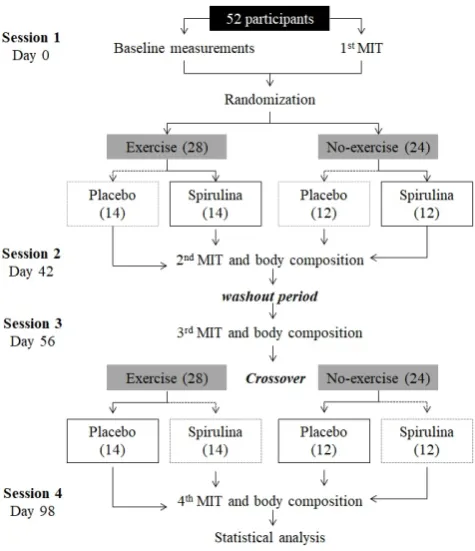
well as boosting the reliability of results. 52 eligible participants were assigned to four interventions
265
through a randomized double-blind, crossover controlled trial: Physical exercise with (SE) or
266
without (Ex) S. maxima or no-exercise (sedentary) with (Sm) and without (C) S. maxima (Figure 5).
267
Initial allocation was performed in such way that each group had almost the same proportion of
268
overweight/obese (1:1) individuals using a computer-generated random schedule stratified by site
269
and the baseline score of the Action Arm Research Test using permuted blocks of random sizes,
270
receiving either 4.5 g placebo (low calorie saccharine powder) or S. maxima daily, in a
271
non-transparent capsule (to mask appearance and taste) with or without exercise, 2×2 crossover. The
272
first period of treatment was carried out in six weeks, followed by a two weeks wash out period and
273
finally six weeks for the second intervention groups (Figure 5). Participants’ group allocation was
274
performed by an independent researcher who did not have any other participation during the study
275
(double-blind). The sample size was determined by using the statistical program G*Power [35],
276
selecting a sample of minimum 52 subjects with α=0.05 and power=0.85.
277
279
Figure 5. Experimental design for independent and additive effect of Spirulina maxima and exercise. MIT:
280
Maximum intensity test.
281
4.4 Maximum Intensity Test (MIT)
282
Each subject participated in four stress tests performed at maximum intensity during the study;
283
during MIT, consumed O2 and produced CO2 were taken by a gas analyzer (Cortex MetaLyzer® 3B,
284
Germany), HR with a Polar H7 sensor (Polar Electro, Lake Success, NY). The anaerobic threshold
285
was determined when OBLA reached 4 mM. The MIT protocol consisted of using a cycle ergometer
286
(Monark ergomedic 828 E; Monark exercise AB, 105 Vansbro, Sweden) initiating with a workload of
287
50-75 W with increments of 15-30 W every 3 min for a minimum of 9 min and until 15 min. At the
288
end of each increment load, capillary blood samples were taken to determine lactate using a YSI 1500
289
Sport Lactate Analyzer (YSI Life sciences, OH, USA). HR was recorded, and the physical perceived
290
effort was registered by using the Borg CR-10 scale. The anaerobic threshold was recorded through
291
%HR at OBLA. According to the ACSM guidelines [24], the MIT was considered maximal if at least
292
three of the following judgments were reached: failure of HR to increase with increases in workload,
293
a peak respiratory exchange ratio≥ 1.1, blood lactate concentration >8 mM, VO2 plateau [failure of
294
VO2 to increase (150 mL•min-1) despite increasing working rate], rating of perceived exertion at peak
295
exercise>7.
296
The first MIT was performed before beginning the first treatment, the day after the first
297
supplementation period, subjects returned to perform the second MIT with identical conditions to
298
the first one. The third MIT was performed after a washout period of two weeks to remove the
299
effects of treatment and avoid any possible delayed effect of S. maxima in the organism. The last MIT
300
was performed after the second treatment with identical conditions to the previous three times.
301
4.5. Dietary Analysis
302
All participants were subjected to a nutritional survey to define the daily calories required to
303
including the 24 h recall (which investigates intake over a specific day), and the food frequency
305
questionnaire (a summary of usual intake of different categories of foods). Dietary intake
306
evaluations were performed at each MIT of the study to record the possible variability in food
307
consumption patterns. The diet records were analyzed for total calories, protein, carbohydrate, and
308
fat intake (Diet Analysis Plus, ESHA Research, Salem, OR).
309
4.6. Physical Exercise Protocol
310
SE and Ex participants exercised five days a week with the following protocol: between 5 and 10 min
311
of warm-up exercise, between 20-30 min muscular endurance exercise and 20-30 minutes of aerobic
312
exercise (cardiovascular exercise): walking, jogging, running and/or cycling, and five final minutes
313
of stretching. The cardiovascular exercise was divided into three days a week, aerobic intensity
314
between 50% and 80% of maximal HR reserve, and two days between 80% and 90% using HIIT.
315
4.7. Main Physiological Outcomes
316
The primary outcome of the study was the body composition response because the excess body fat is
317
one of the major risk factor to CVD and health organizations around the world recommend studies
318
focused in this response variable [1].
319
We included like secondary endpoints the cardiorespiratory fitness variables, including TF, RHR,
320
%HR at OBLA and VO2max; due they have been associated to cardiovascular mortality in numerous
321
epidemiologic studies, regardless of whether people presented any CVD [36].
322
4.8. Statistical Analysis
323
Data distribution normality was examined by the Shapiro-Wilk test on each response variable. In
324
order to analyze differences between overweight and obesity subjects, a Mann-Whitney U test was
325
performed; and to analyze differences between treatments before and after the study, the Δ were
326
analyzed by Kruskal-Wallis H and Mann-Whitney U tests. To evaluate the association among
327
variables a Spearman correlation was performed. Statistical significance was considered when
328
p<0.05, using the software SPSS 22.0 (SPSS Inc., Chicago, IL) in all analyses.
329
5. Conclusions
330
Spirulina maxima intake together a systematic physical exercise program, have an individual and
331
synergistic beneficial effect on body composition (decrease of BW and %BF) and cardiorespiratory
332
parameters (increase of TF, VO2max, OBLA, and reduction of RHR) in overweight but mostly in
333
obese male adults.
334
Supplementary Materials: The following are available online, Supplementary File 1: Partial chemical
335
characterization of Spirulina maxima, Supplementary File 2: CONSORT 2010 Checklist of information to include
336
when reporting a randomized trial, Supplementary File 3: CONSORT 2010 Flow Diagram of the progress
337
through the phases of the trial.
338
Author Contributions: First author, MAHL was commissioned to the participants’ recruitment and led the
339
development of this manuscript. ARJ and MAJO designed the study procedures and perform the statistical
340
analyses of the data. RPHT conducted the physical exercise program. AWL and JALD designed the diet
341
individual dietary recommendations to all the participants of the study. All authors made critical revisions to
342
the manuscript a number of times and approved the final version.
343
Funding: This research was funded by Programa para el Desarrollo Profesional Docente en Educación Superior
344
(PRODEP).
345
Acknowledgments: Marco Hernandez-Lepe was supported by a PhD. scholarship from the Consejo Nacional
346
Bolado, Head of the Scientific Paper Translation Department, from División de Investigación at Facultad de
348
Medicina, UNAM, for editing the English-language version of this manuscript.
349
Conflicts of Interest: All authors have completed the ICMJE uniform disclosure form at
350
http://www.icmje.org/conflicts-of-interest/ and are available on request from the corresponding author. All
351
authors declare that they have no conflicts of interest related to this work.
352
References
353
1. WHO, World Health Organization. Fact sheet N°317. 2017. Available online:
354
http://www.who.int/mediacentre/factsheets/fs317/en/ (Accessed on 18 August 2018).
355
2. Ramos-Jiménez, A.; Hernández-Torres, R.P.; Torres-Durán, P.V.; Romero-González, J.; Mascher, D.;
356
Posadas-Romero, C.; Juárez-Oropeza, M.A. The respiratory exchange ratio is associated with fitness
357
indicators both in trained and untrained men: a possible application for people with reduced exercise
358
tolerance. Clin. Med. 2008, 2, 1; DOI: 10.4137/CCRPM.S449.
359
3. Ghosh, A.K. Anaerobic threshold: its concept and role in endurance sport. Malays. J. Med. Sci.2004, 11, 24.
360
4. Hurley, B.F.; Hagberg, J.M.; Allen, W.K.; Seals, D.R.; Young, J.C.; Cuddihee, R.W.; Holloszy, J.O. Effect of
361
training on blood lactate levels during submaximal exercise. J. Appl. Physiol. Respir. Environ. Exerc. Physiol.
362
1984, 56, 1260–1264; DOI: 10.1152/jappl.1984.56.5.1260.
363
5. Gillison, F.; Stathi, A.; Reddy, P.; Perry, R.; Taylor, G.; Bennett, P.; Dunbar, J.; Greaves, C. Processes of
364
behavior change and weight loss in a theory-based weight loss intervention program: a test of the process
365
model for lifestyle behavior change. Int. J. Behav. Nutr. Physical Act. 2015, 12, 2; DOI:
366
10.1186/s12966-014-0160-6.
367
6. Khera, R.; Murad, M.H.; Chandar, A.K.; Dulai, P.S.; Wang, Z.; Prokop, L.J; Loomba, R.; Camilleri, M.;
368
Singh, S. Association of pharmacological treatments for obesity with weight loss and adverse events: a
369
systematic review and meta-analysis. JAMA.2016, 315, 2424-2434; DOI: 10.1001/jama.2016.7602.
370
7. Méndez, L.; Dasilva, G.; Taltavull, N.; Romeu, M.; Medina, I. Marine Lipids on Cardiovascular Diseases
371
and Other Chronic Diseases Induced by Diet: An Insight Provided by Proteomics and Lipidomics. Mar.
372
Drugs. 2017, 15, 258; DOI: 10.3390/md15080258.
373
8. Sommella, E.; Conte, G.M.; Salviati, E.; Pepe, G.; Bertamino, A.; Ostacolo, C.; Sansone, F.; Del Prete, F.;
374
Aquino, R.P.; Campiglia, P. Fast Profiling of Natural Pigments in Different Spirulina (Arthrospira
375
platensis) Dietary Supplements by DI-FT-ICR and Evaluation of their Antioxidant Potential by
376
Pre-Column DPPH-UHPLC Assay. Molecules. 2018, 23, 1152. DOI: 10.3390/molecules23051152.
377
9. Riss, J.; Décordé, K.; Sutra, T.; Delage, M.; Baccou, J.C.;Jouy, N.; Brune, J.P.; Oréal, H.; Cristol, J.P.; Rouanet,
378
J.M. Phycobiliprotein C-phycocyanin from spirulina platensis is powerfully responsible for reducing
379
oxidative stress and NADPH oxidase expression induced by an atherogenic diet in hamsters. J. Agric. Food
380
Chem. 2007, 55, 7962–7967; DOI: 10.1021/jf070529g.
381
10. Torres-Duran, P.V.; Ferreira-Hermosillo, A.; Juarez-Oropeza, M.A. Antihyperlipemic and
382
antihypertensive effects of Spirulina maxima in an open sample of Mexican population: a preliminary
383
report. Lipids Health Dis. 2007, 6, 33; DOI: 10.1186/1476-511X-6-33.
384
11. Becker, E.W.; Jakober, B.; Luft, D.; Schmulling, R.M. Clinical and biochemical evaluations of the alga
385
Spirulina with regard to its application in the treatment of obesity. A double-blind cross-over study. Nutr.
386
Rep. Int.1986, 33, 565-574.
387
12. Kalafati, M.; Jamurtas, A.Z.; Nikolaidis, M.G.; Paschalis, V.; Theodorou, A.A.; Sakellariou, G,K.;
388
Koutedakis, Y.; Kouretas, D. Ergogenic and antioxidant effects of spirulina supplementation in humans.
389
Med. Sci. Sports Exerc.2010, 42, 142-51; DOI: 10.1249/MSS.0b013e3181ac7a45.
390
13. Hernández-Lepe, M.A.; Wall-Medrano, A.; Juárez-Oropeza, M.A.; Ramos-Jiménez, A.; Hernández-Torres,
391
R.P. Spirulina y su efecto hipolipemiante y antioxidante en humanos: una revisión sistemática. Nutr. Hosp.
392
2015, 32, 2; DOI: 10.3305/nh.2015.32.2.9100.
393
14. Miczke, A.; SzulInska, M.; Hansdorfer-Korzon, R.; Kregielska-Narozna, M.; Suliburska, J.; Walkowiak, J.;
394
Bogdanski, P. Effects of spirulina consumption on body weight, blood pressure, and endothelial function
395
in overweight hypertensive Caucasians: a double blind, placebo-controlled, randomized trial. Eur. Rev.
396
Med. Pharmacol. Sci.2016, 20, 150-156.
397
15. Mazokopakis, E.E.; Starakis, I.K.; Papadomanolaki, M.G.; Kregielsk-Narozna, M.; Suliburska, J.;
398
Walkowiak, J. The hypolipidaemic effects of Spirulina (Arthrospira platensis) supplementation in a Cretan
399
16. Foright, R.M.; Presby, D.M.; Sherk, V.D.; Kahn, D.; Checkley, L.A.; Giles, E.D.; Bergouignan, A.; Higgins,
401
J.A.; Jackman, M.R.; Hill, J.O.; MacLean, P.S. Is regular exercise an effective strategy for weight loss
402
maintenance?. Physiol. Behav. 2018, 188, 86-93; DOI: 10.1016/j.physbeh.2018.01.025.
403
17. Fujimoto, M.; Tsuneyama, K.; Fujimoto, T.; Selmi, C.; Gershwin, M.E.; Shimada, Y. Spirulina improves
404
non-alcoholic steatohepatitis, visceral fat macrophage aggregation, and serum leptin in a mouse model of
405
metabolic syndrome. Digest. Liver Dis. 2012, 44, 767-774; DOI: 10.1016/j.dld.2012.02.002.
406
18. Diaz, A.; Bourassa, M.G.; Guertin, M.C.; Tardif, J.C. Long-term prognostic value of resting heart rate in
407
patients with suspected or proven coronary artery disease. Eur. Heart J. 2005, 26, 967-974; DOI:
408
10.1093/eurheartj/ehi190.
409
19. Jouven, X.; Zureik, M.; Desnos, M.; Guérot, C.; Ducimetière, P. Resting heart rate as a predictive risk factor
410
for sudden death in middle-aged men. Cardiovasc. Res. 2001, 50, 373-378; DOI:
411
10.1016/S0008-6363(01)00230-9.
412
20. Torres-Durán, P.V.; Ferreira-Hermosillo, A.; Ramos-Jiménez, A.; Hernández-Torres, R.P.; Juárez-Oropeza,
413
M.A. Effect of Spirulina maxima on postprandial lipemia in young runners: a preliminary report. J. Med.
414
Food.2012, 15, 753-757; DOI: 10.1089/jmf.2011.0309.
415
21. Lu, H.K.; Hsieh, C.C.; Hsu, J.J.; Yang, Y.K.; Chou, H.N. Preventive effects of Spirulina platensis on skeletal
416
muscle damage under exercise-induced oxidative stress. Eur. J. Appl. Physiol. 2006, 98, 220-226; DOI:
417
10.1007/s00421-006-0263-0.
418
22. Gutiérrez-Salmeán, G.; Fabila-Castillo, L.; Chamorro-Cevallos, G. Nutritional and toxicological aspects of
419
Spirulina (Arthrospira). Nutr. Hosp. 2015, 32, 34-40; DOI: 10.3305/nh.2015.32.1.9001.
420
23. Billat, L.V. Interval training for performance: a scientific and empirical practice. Sports Med. 2001, 31,
421
13-31.
422
24. American College of Sports Medicine. ACSM's Guidelines for Exercise Testing and Prescription. 10th Ed.
423
Lippincott Williams & Wilkins2016, 111-142.
424
25. De Strijcker, D.; Lapauw, B.; Ouwens, M.; Van de Velde, D.; Hansen, D.; Petrovic, M.; Cuvelier, C.; Tonoli,
425
C.; Calders, P. High intensity interval training is associated with greater impact on physical fitness, insulin
426
sensitivity and muscle mitochondrial content in males with overweight/obesity, as opposed to continuous
427
endurance training: a randomized controlled trial. J. Musculoskel. Neuron. 2018, 18, 215-226.
428
26. Tjonna, A.E.; Leinan, I.M.; Bartnes, A.T.; Jenssen, B.M.; Gibala, M.J.; Winett, R.A.; Wisloff, U. Low-and
429
high-volume of intensive endurance training significantly improves maximal oxygen uptake after
430
10-weeks of training in healthy men. PloS One.2013, 8, e65382; DOI: 10.1371/journal.pone.0065382.
431
27. Swain, D.P.; Leutholtz, B.C. Heart rate reserve is equivalent to% VO2 reserve, not to% VO2 max. Med. Sci.
432
Sports Exerc.1997, 29, 410-414; DOI: 10.1097/00005768-199703000-00018.
433
28. Swain, D.P.; Franklin, B.A. VO2 reserve and the minimal intensity for improving cardiorespiratory fitness.
434
Med.Sci. Sports Exerc.2002, 34, 152-157.
435
29. Ötleş, S.; Pire, R. Fatty acid composition of Chlorella and Spirulina microalgae species. J. AOAC Int.2001,
436
84, 1708-1714.
437
30. Becker, E.W. Micro-algae as a source of protein. Biotechnol. Adv. 2007, 25, 207-210; DOI:
438
10.1016/j.biotechadv.2006.11.002.
439
31. Ku, C.S.; Yang, Y.; Park, Y.; Lee, J. Health benefits of blue-green algae: prevention of cardiovascular
440
disease and nonalcoholic fatty liver disease. J. Med. Food.2013, 16, 103-111; DOI: 10.1089/jmf.2012.2468.
441
32. Fiedor, J.; Burda, K. Potential role of carotenoids as antioxidants in human health and disease. Nutrients.
442
2014, 6, 466-488; DOI: 10.3390/nu6020466.
443
33. Gershwin, M.E.; Belay, A. Spirulina in human nutrition and health. CRC Press.2007, 11-35.
444
34. Hernández-Lepe, M.A.; López-Díaz, J.A.; de la Rosa, L.A.; Hernández-Torres, R.P.; Wall-Medrano, A.;
445
Juarez-Oropeza, M.A.; Pedraza-Chaverri, J.; Urquidez-Romero, R.; Ramos-Jiménez, A. Double-blind
446
randomised controlled trial of the independent and synergistic effect of Spirulina maxima with exercise
447
(ISESE) on general fitness, lipid profile and redox status in overweight and obese subjects: study protocol.
448
BMJ Open.2017, 7, e013744; DOI: 10.1136/bmjopen-2016-013744.
449
35. Faul, F.; Erdfelder, E.; Lang, A.G.; Buchner, A. G* Power 3: A flexible statistical power analysis program
450
for the social, behavioral, and biomedical sciences. Behav. Res. Methods.2007, 39, 175-191.
451
36. Nauman, J.; Nes, B.M.; Lavie, C.J.; Jackson, A.S.; Sui, X.; Coombes, J.S.; Blair, S.N.; Wisløff, U. Prediction of
452
cardiovascular mortality by estimated cardiorespiratory fitness independent of traditional risk factors: the
453
37. USEPA, United States Enviromental Protection Agency. Methods for the determinations of metals in
455
enviromental samples. Cincinnati, OH. EPA-600/4-91-010. 1991.
456
38. Laemmli, U.K. Cleavage of structural proteins during the assembly of the head of bacteriophage T4.
457
Nature. 1970, 227, 680.
458
39. Garcia-Galaz, A.; Gutiérrez-Millán, L.E.; Valdés-Covarrubias, M.A.; Acedo-Félix, E.; Burgos-Hernández,
459
A.; López-Torres, M.A.; Burboa-Zazueta, M.G. Antiproliferative and antibacterial activity evaluation of
460
red microalgae Rhodosorus marinus. Afr. J. Biotechnol. 2014, 13, 4169-4175; DOI: 10.5897/AJB2014.13943.
461
40. Álvarez-Parrilla, E.; Mercado-Mercado, G.; de la Rosa, L.A.; López-Díaz, J.A.; Wall-Medrano, A.;
462
González-Aguilar, G.A. Antioxidant activity and prevention of pork meat lipid oxidation using traditional
463
Mexican condiments (pasilla dry pepper, achiote, and mole sauce). Food Sci. Tech-Brazil. 2014, 34, 371-378;
464
DOI: 10.1590/fst.2014.0052.
465
41. Jensen, A. Chlorophyll and carotenoids. In Hallebust JA, Craigie JS (eds) Handbook of
466
Physiochemical and Biochemical Methods. Cambridge University Press, Cambridge, UK. 1978, 5-70.
467
42. Chethana, S.; Nayak, C.A.; Madhusudhan, M.C.; Raghavarao, K.S.M.S. Single step aqueous two-phase
468
extraction for downstream processing of C-phycocyanin from Spirulina platensis. J.Food Sci. Tech. 2015, 52,