Problems with the sources of the observed gravitational waves and their
res-olution
A.D. Dolgov1,2,a
1NSU, Novosibirsk, 630090, Russia 2ITEP, Moscow, 117218, Russia
Abstract.Recent direct registration of gravitational waves by LIGO and astronomical observations of the uni-verse at redshifts 5-10 demonstrate that the standard astrophysics and cosmology are in tension with the data. The origin of the source of the GW150914 event, which presumably is a binary of coalescing black holes with masses about 30 solar masses, each with zero spin, as well as the densely populated universe at z=5-10 by superheavy black holes, blight galaxies, supernovae, and dust does not fit the standard astrophysical picture. It is shown here that the model of primordial black hole (PBH) formation, suggested in 1993, nicely explains all these and more puzzles, including those in contemporary universe, such as MACHOs and the mass spectrum of the observed solar mass black holes.. The mass spectrum and density of PBH is predicted. The scenario may possibly lead to abundant antimatter in the universe and even in the Galaxy.
1 Introduction
The standard cosmological ΛCDM model (here CMD stands for Cold Dark Matter andΛfor vacuum-like dark energy, or, what is the same,Λ-term) very well describes gross features of the universe such as the spectrum of per-turbations at large scales, features of CMB (especially the shape of the angular fluctuation spectrum), baryogenesis, big bang nucleosynthesis,etcat expense of a few param-eters. However many ingredients of the standard cosmol-ogy are absent in the minimal standard model (MSM) of particle physics, in particular, dark matter, dark energy, baryogenesis, and vacuum energy. To be more precise, the situation with vacuum energy is opposite: there is too much vacuum energy in the MSM. For example the energy of the gluon and quark condensate established by quan-tum chromodynamics are roughly 45 orders of magnitude higher than the observed magnitude of the dark energy.
So we have to conclude that new physics beyond the frameworks of MSM is a necessity. Still, except for the vacuum energy problem, the new physics may be almost the old one with introduction of some new fields of parti-cles, while it is quite possible that for the solution of the vacuum energy problem a revolutionary modification of the existing theory would be necessary.
In addition to these well known good old problems the last several years revealed many features which look surprising and even completely mysterious in the frame-works of theΛCDM model. These recent discoveries are reviewed in what follows. It is argued that all them can be explained by formation of heavy primordial black holes (PBHs) through the mechanisms suggested and discussed
ae-mail: [email protected]
in detail in papers [1]. This mechanism allows for forma-tion of PBHs with the masses in the range from a fracforma-tion of the solar mass, say, up to 104
Mor even higher. Usu-ally only the PBHs with rather low masses∼1020g were considered.
Moreover, the puzzling properties of the sources of the gravitational waves recently discovered by LIGO [2] are explained by the same scenario of heavy PBH formation.
The content of the talk is the following: 1. GW observation by LIGO.
2. Problems with the GW sources. 3. Solution of the problems and predictions.
4. Dense population of the universe atz∼10 by the ob-jects which could not be there. They include in particularly supermassive BHs, early supernovae and gamma-bursters, evolved chemistry and dust in highzuniverse.
5. Problems in present day universe: MACHOs, PBH dark matter, supermassive BHs in large galaxies and even in al-most empty space.
The talk is based on several our papers [3–7], where the relevant references can be found.
2 Direct discovery of gravitations waves
On February 11, LIGO (Laser Interferometer Gravita-tional wave Observatory) collaborations announced dis-covery of gravitational waves from a coalescing binary systems of black holes [2]. Two more events were reported shortly, see below Table. 1.
The shape of the signal is in perfect agreement with the theory of BH interactions in the strong (Schwarzschild) sefl-fields, so it can be considered as a first direct proof of BH existence and a persuasive confirmation of General
Relativity for a large deviation of geometry from the flat Minkowsky one. All the previous tests were about weak fields only.
This discovery opened a new era of gravitational waves telescopes which will presumably allow to observe several (many) such catastrophic events per year. The anticipated increase of the LIGO sensitivity by factor three will give enhance the number of the registered events 27-fold. With the expected onset of operation of VIRGO (Italy) and KA-GRA (The Kamioka Gravitational Wave Detector, Japan) the direction to the sources can be reliably established, so the sources can be studied by optical and other electro-magnetic telescopes. New discoveries are imminent.
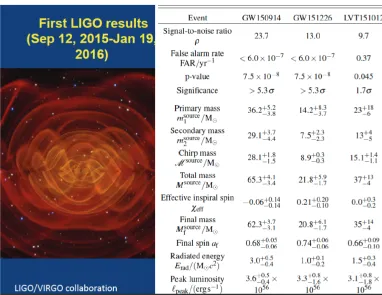
In Table I, copied from ref. [2], the properties of the two coalescing black holes, which produced the power-ful burst of gravitational waves, are presented. The mass and spin of the final BH, and the total energy radiated in gravitational waves are estimated by the fits to nu-merical simulations of binary black hole mergers. The estimated total energy radiated in gravitational waves is (3.0±0.5)Mand the peak of gravitational-wave luminos-ity is 3.0+0.5
−0.4×10
56erg/sec equivalent to 200M
/sec, more than whole radiation power of the visible universe. Rota-tional energy (outside the BH) is about 0.3M. It may be in principle extracted.
Three GW event observed to the present time are de-scribed in Fig. 1. The last event is questionable while the first two look reliable enough. The essential difference be-tween GW150914 and GW151226 is the following: the masses of the sources in the first case are very high, they are are 36 and 29 solar masses, while in the second case they are 14Mand 7M, which look astrophysically nor-mal. The spins of both progenitors in the first case are low, compatible with zero. In the second case one of the black holes has noticeable spina > 0.2. The formation mechanism of the initial back holes in the first case de-mands some unknown, unusual astrophysical processes, while each of the companions on the second pair may be created through the usual astrophysical channel. However, the formation of the binaries in both cases is not well un-derstood, see below.
There are essentially three problems in the standard theory:
1. Origin of heavy BHs (∼30M). 2. Low spins of the coalescing BHs.
3. Formation of BH binaries from original stellar binaries. The first problem is a heavy BH origin. Such BHs are believed to be created by massive star collapse, though a convincing theory is still lacking. To form so heavy BHs, the progenitors should haveM>100Mand a low metal abundance to avoid too much mass loss during the evo-lution. Such heavy stars might be present in young star-forming galaxies but they are not yet observed in suffi -ciently high number.
Another problem is the low value of the BH spins in GW150914. It strongly constrains astrophysical BH for-mation from close binary systems. However, the dynam-ical formation of double massive low-spin BHs in dense stellar clusters is not excluded. The second reliable LIGO detection, GW151226, turned out to be closer to the stan-dard binary BH system.
Last but not the least is the problem of formation of BH binaries. Stellar binaries were formed from common inter-stellar gas clouds and are quite frequent in galaxies. If BH is created through stellar collapse, a small non-sphericity of collapse results in a huge velocity of the BH and the binary is destroyed. An indirect evidence for that is pre-sented by large velocities of pulsars in the Galaxy. Their velocities are about 1000 km/sec, while the average star velocities are only 200 - 300 km/sec. Moreover, the BH formation from PopIII stars and subsequent formation of BH binaries with∼(30+30)Mis analyzed in the litera-ture and is found to be negligible.
All these problems are solved if the observed sources of GWs are the binaries of primordial black holes (PBH). Here a model of PBH formation is presented which nat-urally reproduces the puzzling properties of GW150914, the rate of binary BH merging events inferred from the first LIGO science run, and provides seeds for early super-massive BH formation. These PBHs are created at rest and so their mutual capture to form a binary is not inhibited af-ter they loose their relative velocity due e.g. to dynamical friction. The spins of the original BHs are naturally zero because rotational perturbations are absent in the early uni-verse.
In addition, the mechanism explains an avalanche of mysteries discovered recently and may provide all or a large fraction of cosmological DM in the form of PBHs with rather wide mass spectrum.
3 Mechanism of massive PBH formation.
The basic ingredient of the Affleck-Dine (AD) sce-nario is a scalar fieldχwith non-zero baryonic number,
B0. As is well known, scalar baryons must exist in su-persymmetric theories. Generically the potential of such field has the so called flat directions along which the po-tential does not rise. We can take as toy model example the potential of the form:
Uλ(χ)=λ|χ|4(1−cos 4θ), (1)
whereθis the phase of the complex fieldχ=|χ|exp(iθ). Such bosons,χ, may condense along flat directions of this potential accumulating large baryonic number. To be more precise, the baryonic number is accumulated not in the large amplitude ofχbut in its angular momentum asso-ciated with variation ofθ(t), see eq. (4).
In addition to the quartic potential there may exist quadratic mass term, m2χ2+
m∗2χ∗2, which also could have flat directions generally different from those in quar-tic poteetial:
Um(χ)=m2|χ|2[1−cos(2θ+2α),], (2)
whereχ=|χ|exp(iθ) andm=|m|eiα. Ifα0, C and CP are broken. In GUT SUSY baryonic number is naturally non-conserved. In out model this non-conservation is in-duced by non-invariance ofU(χ) w.r.t. the phase rotation ofχ.
Initially (after inflation)χwas naturally away from the origin due to rising quantum fluctuations of light fields. After inflation terminated,χstarted to evolve down to the equilibrium point,χ=0, according to the its equation of motion, which for homogenous field formally coincides with the equation of motion for point-like body in the Newtonian mechanics:
¨
χ+3Hχ˙+U(χ)=0. (3)
The second term in this equation, induced by the universe expansion, is called the Hubble friction term. In the me-chanical analogy it is equivalent to liquid friction.
The baryonic number ofχis equivalent to the angu-lar momentum ofχ-rotation in two dimensional complex plane [Reχ,Imχ]:
Bχ=θ˙|χ|2. (4)
Later the decays ofχtransferred its baryonic number to baryonic number of quarks in B-conserving process. The Affleck-Dine baryogenesis could lead to the cosmological baryon asymmetry of order of unity, much larger than the observed valueβ=NB/Nγ∼10−9.
When inflation terminated and the Hubble friction drastically dropped down, the fieldχstarted to move to the origin,χ = 0, along the flat direction of the quartic potential. At sufficiently smallχthe quadratic mass term started to dominate andχmoved from the quartic valley to the quadratic one gaining nonzero and typically large an-gular momentum. This process occurred if the quartic and quadratic flat directions are different. This surely happens ifα0 but may also happen even withα=0 if initiallyχ was in a different quartic valley from that of the quadratic
Um(χ) (2).
If the CP-odd phaseαis small but non-vanishing, both baryonic and antibaryonic regions are possible with dom-inance of one of them. Matter and antimatter domain may exist but globallyB0.
In ref. [1] a general renormalizable coupling ofχto the inflaton fieldΦwas introduced:
δU=g|χ|2(Φ−Φ1)2, (5)
wheregis a dimensionless coupling constant andΦ1is a value of the inflaton which it passed during inflation. This potential looks as a very special one, but it is not so. It contains three renormalizable contributions: quartic, cu-bic, and quadratic terms. The only mild tuning of this po-tential is the value ofΦ1.
With the new term and with an account of the so called Coleman-Weinberg contribution [9], arising from one-loop radiation corrections, the total potential govern-ing the evolution ofχtakes the form:
U = g|χ|2
(Φ−Φ1)2+λ|χ|4ln |χ|2
σ2
+ λ1
χ4+
h.c.+(m2χ2+
h.c.). (6)
The shape of this potential as a function of|χ|for different values ofΦis presented in Fig. 2.
WhenΦis close toΦ1, the window to the flat direc-tions is open but only for a relatively short period. At this stage cosmologically small but possibly astronomi-cally large bubbles with high values ofχ could be cre-ated. Later these highχregions would create bubbles with very high baryonic number density occupying a small frac-tion of the universe volume, while the rest of the universe would have the normal baryon asymmetryβ≈6·10−10, created in the dominant part of the universe with smallχ. The process whenχreaches large value but with low prob-ability can be called phase transition of 3/2 order, since in a sense such a behavior is between first and second order phase transitions.
The density contrast between the bubbles with high baryonic density (high B bubbles or HBB) and the low B average cosmological background is initially small, since before the QCD phase transition quarks populating the cosmological plasma are essentially massless, so the ini-tial density perturbations are predominantly isocurvature. However, after the phase transition to the quark confine-ment phase quarks turned into heavy nucleons and the den-sity contrast between HBB and the rest of the universe be-came large. Note that the contribution of HBBs into the total cosmological energy/mass density can be higher than the contribution of the normal free baryons.
The distributions of high baryon density bubbles over length and mass have log-normal form [1]:
dN
dM =CMexp [−γln
2
(M/M0)] (7)
whereCM,γ, andM0are constant parameters. The spec-trum is practically model independent, it is basically de-termined by inflation.
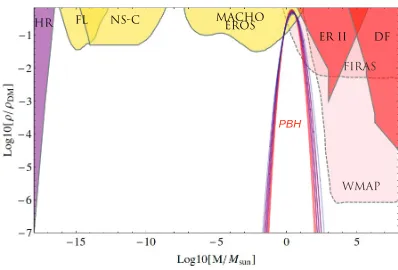
Adjusting parameters of the mass spectrum (7) using available astronomical data and constraints, we can pre-dict the density of PBHs produced by the considered here mechanism. The prediction as a function of the black hole mass together with the existing observational bounds is presented in Fig. 3.
4 Problems in contemporary and near
contemporary universe.
4.1 Dense population ofz=5−10universe
Astronomical data accumulated during the last few years have revealed that the early,z∼10, universe is unexpect-edly dense, populated by the evolved objects which de-mand much more time for their creation than was available at that high redshifts. Among them there are bright but too young galaxies, QSO/supermassive BHs, and gamma-bursters (supernovae). Moreover, the early universe con-tains much more dust than can be reasonably expected. A more detailed review and the list of literature is presented in ref. [4]. Here we discuss only the most striking crea-tures.
About 40 quasars withz>6 are already known, each quasar containing BH withM∼109M
. Such black holes, when the Universe was less than one billion years old, present substantial challenges to theories of the formation and growth of black holes and the coevolution of black holes and galaxies. Even the origin of supermassive black holes in contemporary universe, which had 14 Gyr for their creation, is difficult to explain.
Very recently a new monster was discovered "An ul-traluminous quasar with a twelve billion solar mass black hole at redshift 6.30" [10]. There is already a serious prob-lem with formation of ten times lighter and less luminous quasars, which is multifold deepened with this new "crea-ture". A formation of the new one with M≈1010
Mis absolutely impossible in the standard approach.
The premature appearance of supermassive black holes atz∼6 emerged as a great surprise. It is very dif-ficult to understand how 109
Mblack holes appeared so quickly after the big bang without invoking non-standard accretion physics and the formation of massive seeds, both of which are not observed in the local Universe [11]. On the other hand, such massive seeds are exactly the objects which are supplied by the HBBs discussed in the previous section.
Several galaxies have been observed at high redshifts, with natural gravitational lens “telescopes. Their creation was also unexpectedly early. E.g. a galaxy atz≈9.6 was discovered [12], which was created when the universe was
about 0.5 Gyr old. Moreover a galaxy atz≈11 has been observed [13], which was formed earlier than the universe age was 0.41 Gyr (or even shorter with larger H advocated by the recent traditional astronomical measurements).
An observation of not so young but extremely lumi-nous galaxy is reported [14]. Its luminosity is thousand times higher than that of the Milky way: L=3·1014
L, while the age is only∼1.3 Gyr. The galactic seeds, or embryonic black holes, might be bigger than thought pos-sible. According to one of the authors of the discovery P. Eisenhardt: "How do you get an elephant? One way is start with a baby elephant." However, the origin of the baby elephant" is mysterious. The seed black hole should be already billions of solar masses, when our universe was only a tenth of its present age of 13.8 billion years. There is no way to create such a seed with standard mechanisms. The medium around the observed early quasars con-tains considerable amount of “metals” (elements heavier than He). According to the standard picture, only elements up to4He and traces of Li, Be, B were formed by the big bang nucleosynthesis, while heavier elements were cre-ated much later by stellar nucleosynthesis and dispersed in the interstellar space by supernova explosions. It already demands non-negligible time.
Much later molecular dust could form. Nevertheless it was discovered recently that the young universe atz>6 is quite dusty [15]. Dusty galaxies show up at redshifts cor-responding to a Universe which is only about 500 Myr old. The highest redshift such object, HFLS3, lies at z=6.34 and numerous other sources have been found [16].
Hence, prior to or simultaneously with the QSO forma-tion a rapid star formaforma-tion should take place. These stars should evolve to a large number of supernovae enriching interstellar space by metals through their explosions which later make molecules and dust. (We all are dust from SN explosions, but probably at much later time.)
Another possibility is a non-standard BBN due to very high baryonic density, which allows for formation of heavy elements beyond lithium.
Observations of high redshift gamma ray bursters (GBR) also indicate a high abundance of supernova at large redshifts. The highest redshift of the observed GBR is 9.4 and there are a few more GBRs with smaller but still high redshifts. The necessary star formation rate for expla-nation of these early GBRs is at odds with the canonical star formation theory.
All such early supernovae can be HBBs which were not massive enough to make PBHs but some compact stel-lar like objects which is also possible according to the dis-cussed in sec. 3 scenario.
4.2 Back to the future.
Similar and possibly related mysteries exist in contempo-rary and near-contempocontempo-rary universe.
Figure 1.Three registered gravitational wave events.
objects separated by cosmological distances, so the chance of finding a quadruple quasar is∼10−7. It implies that
the most massive structures in the distant universe have a tremendous supply (∼1011
M) of cool dense (n≈1/cm3)
gas, in conflict with current cosmological simulations." Every large galaxy and some smaller ones contain central supermassive BHs whose masses are larger than 109
Min giant elliptical and compact lenticular galaxies and∼106M
in spiral galaxies like Milky Way. The ori-gin of these superheavy BHs is not understood. Moreover, SHBs are observed in several small galaxies, where is no material to make a supermassive BH.
It is intriguing if the type of the galaxy is determined by the mass of the original black hole seed.
The mass of BH is typically 0.1% of the mass of the stellar bulge of galaxy but some galaxies may have huge BH: e.g. NGC 1277 has the central BH of 1.7×10¹⁰
M, or 60% of its bulge mass [18]. This fact creates serious problems for the standard scenario of formation of central supermassive BHs by accretion of matter in the central part of a galaxy.
Figure 2. Evolution of the potential (6) as a function ofχfor different values ofΦ.
NS-C FL
HR MACHOEROS
ER II DF
FIRAS
WMAP
Figure 3. Constraints on PBH fraction in DM, f =ρPBH/ρDM, where the PBH mass distribution is taken as ρPBH(M) = M2dN/dM. The existing constraints (extragalacticγ-rays from evaporation (HR), femtolensing ofγ-ray bursts (F), neutron-star capture constraints (NS-C), MACHO, EROS, OGLE microlens-ing (MACHO, EROS) survival of star cluster in Eridanus II (E), dynamical friction on halo objects (DF), and accretion effects (WMAP, FIRAS)). The PBH distribution is shown for ADBD parametersμ=10−43Mpc−1,
M0=γ+0.1×γ2−0.2×γ3with γ=0.75−1.1 (red solid lines), andγ=0.6−0.9 (blue solid lines).
galaxy suggests. The dynamical effects of such ultramas-sive central black holes is unclear.
Several more observations of too heavy black holes in poor galaxies are presented in ref. [4] but the most striking one is given in the recent publication [20], where a super-massive BH was observed in practically empty space
Thus the inverted picture is more plausible: first a su-permassive black hole was formed and attracted matter serving as a seed for subsequent galaxy formation [1, 21].
4.3 Old stars, black holes, and MACHOS in the Milky Way
Some more, at first sight unrelated, but probably the same kind problems are demonstrated by the contemporary uni-verse. There are stars in the Milky Way, older than the Galaxy and even older than the universe (more than two sigma) and even one very old rocky planet. The mass dis-tribution of black holes in the Galaxy and abundant MA-CHOs are also at odds with the standard astrophysics.
The new recently developed precise measurements al-lowed to determine age of several stars in the Milky Way with unprecedented accuracy. The results showed that quite a few stars are consuderably older than it was ear-lier expected.
Employing thorium and uranium abundances in com-parison with each other and with several stable elements the age of metal-poor, halo star BD+17o 3248 was esti-mated as 13.8±4 Gyr[22]. For comparison the age of in-ner halo of the Galaxy 11.4±0.7 Gyr [23].
The age of a star in the galactic halo, HE 1523-0901, was estimated to be about 13.2 Gyr [24]. First time many different chronometers, such as the U/Th, U/Ir, Th/Eu, and Th/Os ratios to measure the star age have been employed. Even more striking, the metal deficient high velocity subgiant in the solar neighborhood HD 140283 has the age 14.46±0.31 Gyr [25]. The central value exceeds the universe age by two standard deviations, ifH=67.3 km/sec/Mpc andtU=13.8 Gyr. The excess is even bigger forH=74 km/sec/Mpc, whentU =12.5 Gyr.
A discovery of a surprisingly old planet was recently announced [26] Its age is estimated as 10.6+1.5
−1.3Gyr. (The
age of the Earth: 4.54 Gyr.) A supenova explosion must precede formation of this planet.
The considered in this report scenario of HBB for-mation may explain these striking discoveries, because if the initial chemical content of a star is different from the canonical one, it may look older than it is in reality.
Some more mysteries are revealed by the black holes observed in the Galaxy. It was found that the BH masses are concentrated in the narrow range (7.8±1.2)M[27].
This result agrees with another paper where a peak around 8M, a paucity of sources with masses below 5M, and a sharp drop-offabove 10Mare observed [28].
These features are not expected in the standard model, but may fit our model with the log-normal mass spectrum of PBHs.
5 Conclusion
1. Supersymmetric baryogenesis could lead to abundant formation of PBHs and compact stellar-like objects in the early universe after the QCD phase transition atz∼1012 ort10−5sec.
2. These objects have log-normal mass spectrum. 3. Adjusting the spectrum parameters is possible to ex-plain the peculiar features of the sources of the gravita-tional waves observed by LIGO.
4. The considered mechanism solves the numerous mys-teries ofz∼10 universe: abundant population of super-massive black holes, early created gamma-bursters and su-pernovae, early bright galaxies, and evolved chemistry in-cluding dust.
5. There is persuasive data in favor of the inverted picture of galaxy formation, when first a supermassive BH seeds are formed and later they accrete surrounding matter form-ing galaxies.
6. An existence of supermassive black holes observed in all large and some small galaxies and even in almost empty environment is naturally explained.
7. "Older than the universe" stars may exist.
8. Existence and high density of invisible "stars" (machos) can be understood.
9. Some noticeable fraction of dark matter or even all of it can be made of PBHs.
10. Large amount of astronomical data the data strongly demand abundant cosmological population of PBH with wide mass spectrum.
Testable predictions:
A. Rate and masses of the BH sources of the coming GW events.
B. Possible existence of antimatter in our neighborhood, even in the Galaxy.
Acknowledgement
This work was supported by the Grant of President of Rus-sian Federation for the leading scientific schools of the Russian Federation, NSh-9022.2016.2.
References
[1] A. Dolgov and J. Silk, Phys.Rev.D47, 4244 (1993); A.D. Dolgov, M. Kawasaki, and N. Kevlishvili, Nucl.
Phys.B807, 229 (2009).
[2] B. P. Abbott et al, Phys. Rev. Lett. 116, 061102 (2016).
[3] S. Blinnikov, A. Dolgov, N.K. Porajko, and K. Post-nov, JCAP1611, 036 (2016).
[4] A.D. Dolgov, Int. J. Mod. Phys.A31, 1645029 (2016); A.D. Dolgov, arXiv:1605.06749, Conference: C16-02-16.1.
[5] S.I. Blinnikov, A.D. Dolgov, and K.A. Postnov, Phys. Rev.D92, 023516 (2015).
[6] A.D. Dolgov and S.I. Biinnikov, Phys. Rev.D892, 021301 (2014).
[7] C. Bambi and A. D. Dolgov, Nuclear PhysicsB 784, 132 (2007).
[8] I. Affleck and M. Dine, Nucl. Phys. B249, 361 (1985). [9] S.R. Coleman and E. Weinberg, Phys. Rev.D7, 1888
(1973).
[10] Xue-Bing Wu et al, Nature518, 512 (2015). [11] F. Melia, Astron. J.147, 120 (2014). [12] W. Zheng,et al, Nature489, 406 (2012). [13] D. Coeet alAstrophys. J.762, 32 (2013).
[14] Chao-Wei Tsai, P.R.M. Eisenhardt et al, arXiv:1410.1751, Ap.J. in press.
[15] M. Manciniet al1505.01841. [16] L. Mattsson, arXiv:1505.04758v1.
[17] J.F. Hennawiet al, Science,348, 779 (2015). [18] R. C. E., Gebhardtet al, Nature,491, 729 (2012). [19] F. Khan, K. Holley-Bockelmann, P. Berczik,
arXiv:1405.6425v1.
[20] J. J. Condon, J. Darling, Y. Y. Kovalev, L. Petrov, arXiv:1606.04067.
[21] R. C. E. van den Bosch et al, Nature, 491, 729 (2012).
[22] J.J. Cowanet al, Ap.J.572, 861 (2002). [23] J. Kalirai, Nature486, 90 (2012).
[24] A. Frebe, N. Christlieb, J.E. Norris, C. Thom Astro-phys. J.660, L117 (2007).