121 | P a g e
STUDY ON BEHAVIOUR OF FLEXIBLE PAVEMENTS
BY USING MATERIALS AND
GEO-SYNTHETICS IN CBR TEST
P Gopaiah
1, J Sowjanya
21* M.Tech Student, MVR College of Engineering & Technology, Kanchikacherla, India.
2* Assistant Professor,
MVR College of Engineering & Technology,
Kanchikacherla
, India.ABSTRACT
The term “soil” in soil engineering is a loose unconsolidated material produced by the weathering of
rocks and abundantly available in nature. Due to this soil has vast application in foundation, retaining structures, embankments, underground structures (tunnels, hafts and conduits), and pavement design and earth dams. Due to the difference in the weathering process, different soils are formed with different characteristics. Due to this, sometimes, weak soils are also formed in the nature. Weak soil denotes the soil weak in the strength. Another geomaterial, Fly ash is a solid waste generated by thermal power plants where coal is used as fuel. It has been successfully demonstrated that fly ash can be utilized in major construction projects such as dams, ash dyke, landfills, roads and pavements, soil stabilization and for other purposes such as brick manufacture, cement industry, tiles, and paint industry. Many researchers have worked different ways to treat such soils in different ways viz., mechanical modifications, addition of various materials (cement, lime, bitumen, flyash, reinforcement, etc.). Later, with the advent of geosynthetics, they are considered as one of effective method to improve the strength properties of the soil. Also, different studies have showed the use of geotextiles have been used in the construction of unpaved roads over the soft soils. With this in view, the current study is proposed to understand the strength change in the soil when added with different materials such as geotextile, geogrid, geocomposite. A comparison has been made to understand the effect of each inclusion in the soil and flyash. Such a study would be useful in selecting the material based on the different site condition, adaptability and the strength gain along with the economy.
Key words :- Black cotton soil, Geomaterials, fly ash, Geosynthetics,
I INTRODUCTION
Soil is defined as sediments or other accumulation of mineral particles produced by the physical or
chemical disintegration of rocks plus the air, water, organic matter and other substances that may be included.
Soil is typically a non-homogeneous, porous, earthen material whose engineering behavior is influenced by
changes on moisture content and density. Based on the origin, soil can be broadly classified as organic and
122 | P a g e skeleton or shell of small organism. Inorganic soils are derived from the mechanical or chemical weathering of
rocks. Inorganic soil that is still located at the place where it was formed is referred to residual soil. If the soil has
been moved to another location by gravity, water or wind, it is referred to as transported soil.
METHODOLOGY
SPECIFIC GRAVITY
Specific gravity of solid is an important parameter to determine the void ratio and particle size. The
specific gravity of a soil mass is the indication of its average value of all the solid particles present in the soil
mass. The specific gravity of solid particle (G) is defined as the ratio of the mass of a given volume of solids to
the mass of an equal volume of water at 4oc. Thus, the specific gravity is given by
==(W2 -W1) / (W2 -W1)-(W3 -W4)
Where W1 = empty weight of density bottle
W2 = weight of density bottle + soil
W3 = weight of density bottle + soil + water
W4 = weight of density bottle + water
W1 W2 W3 W4
Fig: 3.1 specific gravity bottle
LIQUID LIMIT
The liquid limit of a soil is the moisture content at which the soil changes from liquid state to plastic
state. The device used to determine liquid limit is casagrande’s apparatus consists of a brass cup can be drops
onto the base by a cam when operated by crank. About 120 g of an air dried soil sample passing through 425 μm
IS sieve is taken in a porcelain dish and mixed with distilled water to form a uniform paste. To perform the liquid
limit test, one must place a soil paste in the cup. A groove is then cut at the centre of the soil pat with the
standard grooving tool with a distance of 12.7 mm. By the use of the crank-operated cam, the cup is lifted and
dropped from a height of 10 mm. The moisture content, in percent, required to close a distance of 12.7 mm along
123 | P a g e a) Fig : casagrande’s apparatus b) Fig : sample which is cut into 2 parts
RESULTS AND DISCUSSIONS
The results of various tests performed on clay and fly ash are discussed in this section. With the aim to
understand the changes in the CBR values of the soil with the introduction of geo-synthetic material, the CBR
test has been conducted on the soil and also fly ash, with different geo-synthetics placed at different layers. The
soil in the CBR mould has been divided into 5 layers with equal weights (considering constant density and
volume per layer) and the various geo-synthetic material viz., geo-textile, GT, geo-grid, GG, geo-composite, GC
(textile and grid) has been placed accordingly to understand the best possible location of the
geo-synthetic material to yield maximum CBR value. Also, as the part of this study, polypropylene fibers (PF) in the
ratios of 0.1%, 0.2%, 0.3%, 0.4%, 1% and 2% by the weight of the soil and tire powder, i.e. the crushed tire
material in the ratios of 2%, 5% and 10% has been mixed thoroughly and the CBR tests have been performed for
each combination. The results obtained in all the tests have been analyzed and the discussion has been included
herein.
Property Clay Fly ash
Specific
G 2.67 2.39
Gravity
Gravel (%) 0 0
Sand (%) 18 48
Silt (%) 65 47
Clay (%) 17 5
Consistency limits
Liquid Limit LL 26 0
Plastic Limit PL 21 0
124 | P a g e
Material Properties
S No Details
Fly ash
Trial 1 Trial 2 Trial 3
1 Weight of empty bottle with stopper 53.43 53.43 53.44
(W1) (g)
2 Weight of bottle with stopper +dry 73.56 73.41 73.92
soil (W2) (g)
3 Weight of bottle with stopper +dry 159.12 159.06 159.53
soil +water (W3) (g)
4 Weight of bottle with stopper +water 147.47 147.47 147.47
(w4) (g)
Specific gravity 2.37 2.38 2.43
Specific gravity average 2.39
4.2 Wet Sieve analysis
Table 4.2.1
Clay
S No Sieve size Weight of Percentage of Cumulative Percentage
retained retained Percentage of fine
(g) of retained (N)
1 4.75 mm 0.3 0.30 0.3 99.70
2 2.36 mm 0.2 0.20 0.50 99.50
3 1.18 mm 1.1 1.10 1.60 98.40
4 600 µ 4.9 4.90 6.50 93.50
5 300 µ 4.5 4.50 11.00 89.00
6 180 µ 4.1 4.10 15.10 84.90
7 150 µ 0.2 0.20 15.30 84.70
8 75 µ 2.5 2.50 17.80 82.20
9 pan 82.2 82.20 100.00 0.00
125 | P a g e
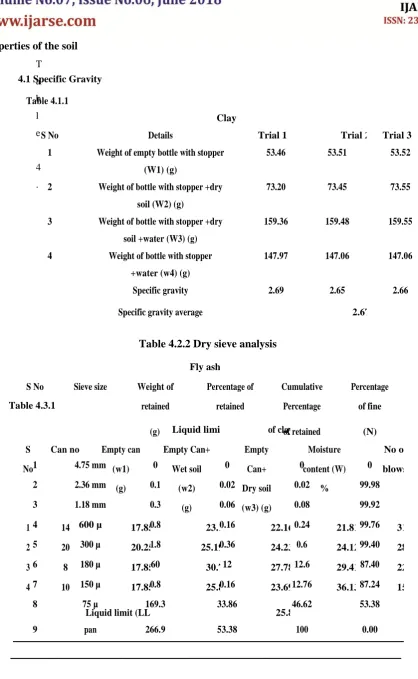
Properties of the soil
T a b l e 4 .
Table 4.2.2 Dry sieve analysis
4.1 Specific Gravity
Table 4.1.1
Clay
S No Details Trial 1 Trial 2 Trial 3
1 Weight of empty bottle with stopper 53.46 53.51 53.52
(W1) (g)
2 Weight of bottle with stopper +dry 73.20 73.45 73.55
soil (W2) (g)
3 Weight of bottle with stopper +dry 159.36 159.48 159.55
soil +water (W3) (g)
4 Weight of bottle with stopper 147.97 147.06 147.06
+water (w4) (g)
Specific gravity 2.69 2.65 2.66
Specific gravity average 2.67
Fly ash
S No Sieve size Weight of Percentage of Cumulative Percentage
retained retained Percentage of fine
(g) of retained (N)
1 4.75 mm 0 0 0 0
2 2.36 mm 0.1 0.02 0.02 99.98
3 1.18 mm 0.3 0.06 0.08 99.92
4 600 µ 0.8 0.16 0.24 99.76
5 300 µ 1.8 0.36 0.6 99.40
6 180 µ 60 12 12.6 87.40
7 150 µ 0.8 0.16 12.76 87.24
8 75 µ 169.3 33.86 46.62 53.38
9 pan 266.9 53.38 100 0.00
Table 4.3.1
Liquid limit of clay
S Can no Empty can Empty Can+ Empty Moisture No of
No (w1) Wet soil Can+ content (W) blows
(g) (w2) Dry soil %
(g) (w3) (g)
1 14 17.85 23.1 22.16 21.81 31
2 20 20.25 25.19 24.23 24.12 28
3 8 17.85 30.7 27.78 29.41 22
4 10 17.85 25.8 23.69 36.13 15
Liquid limit (LL) 25.8
126 | P a g e
Properties of geo-synthetics
In the present study, the three geo-synthetics used are geo-textile; geo-grid and geo-composite have been
considered.
Effect of Soil type
Fig. 4.2 depicts that the results obtained from CBR test conducted on clay and fly ash without any admixture.
From the above graph, it can be observed that fly ash has higher CBR values compared to that of black cotton
soil
California bearing ratio test
CBR values of Clay
sl.no strain gauge penetration (mm) proving ring load
reading reading (kg)=PRR*
1.176)
1 50 0.5 1.3 1.53
2 100 1.0 2.1 2.47
3 150 1.5 2.6 3.06
4 200 2.0 3.1 3.65
5 250 2.5 3.4 4.00
6 300 3.0 3.6 4.23
7 350 3.5 3.8 4.47
8 400 4.0 3.9 4.59
9 500 5.0 4.1 4.82
10 750 7.5 4.4 5.17
11 1000 10.0 4.7 5.53
12 1250 12.5 5.0 5.88
CBR AT 2.5mm =4.82/2055*100 =0.29%
127 | P a g e
CONCLUSION
From the project work, we got to know that we have limited quantity of good quality of earth soil is
available. It is not possible to provide good quality soil for every construction, in such circumstances we need to
go for the modification methods. An attempt has been made to use the waste materials such as fly ash to modify
the properties of the soil which is available in bulk quantity with inclusion of GT, GG, GC. The disposal of these
materials are utilizing several acres of land which can be used for agriculture, buildings, transportation,
commercial complexes’ etc.,
The CBR values of BC soil and FA without addition of materials, FA gives more CBR values compared
with BC soil.
With inclusion of geosynthetics (such as GT, GG, GC) in Black cotton soil and FA in layers within the soil sample in different combination, it proved that GT gives more CBR values in both the cases.
With inclusion of GT in layers within the soil sample such as layer 1, layer 2, layer 3, layer 4 from thestudy it shows that GT at layer 2 in BC soil and GT at layer 1 in FA gives more CBR values.
With inclusion of GG, GC in layers within the soil sample from the study it shows that GG and GC at layer 3 in BC soil and FA gives more CBR values
By increasing the CBR we can reduce the pavement thickness. By doing the modification we can reduce the excessive usage of the good quality earth materials thus avoiding the pollution.REFERRENCES
H. P. Singh (2011),” Improvement in CBR value of soil reinforced with jute geotextile layers”,International Journal of Environmental Science and Engineering, 05, 1438-1442.
Mona and Bilsel (2012), “Effect of polypropylene fiber on mechanical behavior of expansive soils”, EJGE, Electronic Journal of Geotechnical Engineering , 17,55-63.128 | P a g e
Singh and Yachang (2012), “Use of fly ash reinforced with jute geotextile as a pavement subgrade”,International Journal of Earth Science and Engineering, 05, 562-567.
Dr.P.Purushotham raj , Ground improvement techniques, first edition, 199-229
Oikonomou and Mavridou (2009), “Use of waste tire rubber in civil engineering works”, Technical Note, Aristotle University of Thessaloniki, Greece, 213-238.
Fannin and Sigurdsson (1996),” Field observations on stabilization of unpaved roads with geosynthetics”, Journal of Geotechnical Engineering, 122,544-553.
Praveen Kumar, Mehndiratta, Chandanarayan and, (2005), “Effect of randomly distributed fibers on fly ash embankments”, IE (I) Journal, 86,113-118.
Mandeep and anupam (2014), “A review on the soil stabilization with waste materials”, International Journal of Engineering Research and Applications (IJERA), 11-16.
Behzad et al., (2010), “Effect of polypropylene fibers on the California bearing ratio of air cured stabilized tropical peat soil”, American J. of Engineering and Applied Sciences, 3(1), 1-6.
Chore et al., (2011),” Performance evaluation of polypropylene fibers on sand-fly ash mixtures inhighways”, Journal of civil engineering, 39(1), 91-102.
H.P.Singh(2013), “Strength and stiffness response of Itanagar fly ash reinforced with coir fiber”, International Journal of Research in Science, Engineering Innovative and Technology, 02,4500-4509.
Kalpana, Desai and Vinesd (2011),” Performance of fiber reinforced clayey soil”, EJGE ElectronicJournal of Geotechnical Engineering, 16, 1067-1082.