Organizer and axes formation as a self-organizing process
HANS MEINHARDT
Max-Planck-Institut für Entwicklungsbiologie, Tübingen, Germany
ABSTRACT It is a widely held view that axis formation is based essentially on pre-localized determi-nants. However, the robustness of early development, the pattern regulation observed after experi-mental interferences and the existence of systems that don’t require maternal determinants suggest that self-regulating pattern forming systems are also involved. A model is proposed that allows axes formation by a chain of reactions based on local self-enhancement and long-range inhibition. Their appropriate linkage ensures that the intermediary patterns emerge in the correct sequence and have the correct spatial relation to each other. Specifically, the model comprises the following events: the generation of a pole by a pattern-forming process, the formation of a second organizer eccentric to the pole (e.g. the Nieuwkoop center), the ecto-meso-endo subdivision, the generation of the Spemann-Mangold organizer with its anterior-posterior subdivision under the influence of the Nieuwkoop center, the conversion of the Spemann-Mangold organizer (a hot spot) into the notochord (a hot stripe), and the marking of the left side of the organism by a patterning reaction influenced by the midline. The pattern forming reactions do not depend on but can make use of maternally pre-localized determinants or asymmetries. Comparison with known genes and molecules reveals that many of the expected ingredients are present. Computer simulations show that the model accounts for many regulatory features reported in the literature. The computer simulations are available in an animated form at http://www.eb.tuebingen.mpg.de/abt.4/meinhardt/theory.html
KEY WORDS:
Spemann-Mangold Organizer, embryonic axes, pattern formation, self-organization,
reac-tion-diffusion mechanism.
0214-6282/2001/$25.00
© UBC Press Printed in Spain
www.ijdb.ehu.es
*Address correspondence to: H. Meinhardt. Max-Planck-Institut für Entwicklungsbiologie, Spemannstr. 35, D72076 Tübingen, Germany. FAX: +49-7071-601-498. e-mail: [email protected]
Introduction
Organizer formation: more than a chain of induction
The discovery of the amphibian organizer by Spemann and Mangold (1924) was the beginning of an intensive research to understand the generation of the embryonic axes in development. Based on the findings in amphibians, it is now a widely accepted view that localized determinants deposited under maternal influ-ence and the asymmetry imposed by the sperm entry are crucial. The remaining development is usually regarded as a chain of inductions. However, a comparison with other vertebrates reveals that a chain of induction cannot be the complete story. In the mouse, any cell of the 8-cell blastula can give rise to the complete animal. Three mouse blastocysts can be fused and form a single organism (Markert and Petters, 1978). These observations argue strongly against a decisive role of pre-localized determinants in this system. Observations made in early chick development point in a similar direction. A fragment of the early blastodisc not containing the posterior marginal zone, i.e., the organizer, can nevertheless produce a complete embryo (Lutz, 1949, Spratt and Haas, 1960). Its orientation can be independent of the gravitation-induced
asymmetry orienting normal development (Kochav and Eyal-Giladi, 1971). Even in amphibians, organizer formation can also take place after removal of the asymmetry imposed by the sperm entry. Nieuwkoop (1973, 1992) confronted aggregates from dissociated animal and vegetal cells. He observed not only the induction of mesodermal tissue at a region where the two cell types are juxtaposed but also to the formation of notochord and somites, a clear indication for the de-novo formation of organizing regions within this mesodermal zone. Upon cell dissociation, the asymme-try imposed by sperm enasymme-try and cortical rotation is certainly lost. In a posthumously published paper he concluded: “This behavior can only be explained by assuming an intrinsic self-organizing capacity of the induced meso-endoderm” (Nieuwkoop, 1999, p 617). The involvement of both maternal determinants and genuine pattern forming reactions in axes formation is not limited to vertebrates. In Drosophila, embryonic axes are determined by maternal determi-nants. In contrast, in polyembryonic insects, a primary morula becomes partitioned into as many as two thousand morulae that develop all into individual larvae within the same egg (Grbicet al., 1998). It is inconceivable that the mother supplies a precise coordinate system for each of these of embryos, indicating that self-organizing processes are involved.
Models that are realistic in molecular terms and allow axes formation without initial determinants will be discussed. According to this view, the formation of organizing regions is based on genuine pattern forming events. The observed complexity of molecular interactions in amphibians becomes understandable, in part, if it is realized that conserved patterning mechanisms must be involved that function in other systems without pre-localized determinants. A case will be made that localized determinants are advantageous if fields are large such that communication between cells would have to cover large distances. On the other hand, the involvement of self-regulating systems reduces the sensitivity of the pattern to the precise amount and the details of the distribution of the pre-localized determinants. This is crucial to making development a robust proc-ess. The theory makes predictions about the types of molecular interactions required. A comparison with known components shows that many of the expected ingredients required for genuine pattern formation indeed exist even in systems in which pre-localized determinants play a major role.
Pattern-forming interactions will be discussed that account for the following steps:
1. Generation of a local high concentration of a signaling substance (as required for the definition of the vegetal pole and other organizing regions).
2. Separation into well-defined and stable zones (as required for the ecto-meso-endoderm separation).
3. Generation of a second organizing region next to a primary one (as required for the localization of the Nieuwkoop center and amplifi-cation of the left-right asymmetry).
4. Generation of an organizing region with a strip-like extension (as required for the elongation of the notochord).
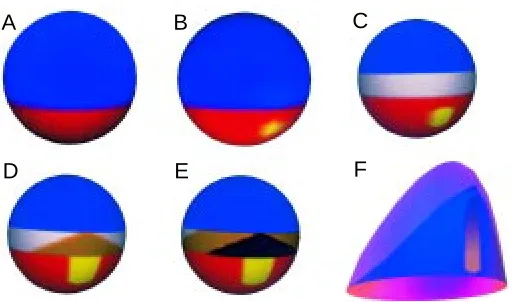
5. Fading of the competence to form particular structures (as re-quired to avoid the formation of multiple organizers, see Appendix). It is shown that the complete set of axes can be generated in a self-organizing way by an appropriate coupling of several of such reactions. A scheme of the assumed steps is depicted in Fig. 1.
Making a hot spot: the generation of local high
concen-trations by self-enhancement and long range inhibition
Based on theoretical considerations we have proposed that local high concentrations and graded distributions of signaling substances are generated by the coupling of a self-enhancing feedback loop of short range with an inhibitory reaction of long range (Gierer and Meinhardt, 1972, Meinhardt, 1982, 1996, 2000). The simplest molecular realization of such a pattern forming system consists of an autocatalytic ‘activator’ that also controls the production of a long ranging ‘inhibitor’, which, in turn, limits the activator production. Such an interaction creates an unstable situation in an initial near-uniform distribution of the substances. A small local elevation of the activator concentration above average increases further due to the autocatalysis. The concomitantly produced surplus of inhibitor spreads into the surrounding where it suppresses activator production. A stable situation is reached when the activator maximum is in a dynamic equilibrium with the surrounding cloud of inhibition (Fig. 2A). The result is a stable, self-regulating pattern. We have formulated such interactions in a mathematically precise way, which allows the study of the proper-ties of these interactions by computer simulations (see Appendix). Many different molecular systems are compatible with this scheme. For instance, the activation of a larger patch of cells can be accounted for by the model if the self-enhancing reaction can spread from cell to cell. This occurs until no further spread is possible due to the increasing strength of the long ranging inhibi-tion. It has turned out that transcription factors, which are localized to the nucleus and cannot diffuse, are involved in many pattern-forming reactions. However, transcription factors often act in concert with signaling molecules to form autoregulatory loops, and the signaling components can extend the activation to neighboring cells. Examples of this include the mutual positive regulation of the secreted factor FGF and the transcription factor Brachyury in-volved in mesoderm formation (Schulte-Merker and Smith, 1995), and the VegT – derriere loop in the specification of the endodermal pathway (Sun et al., 1999)
The self-enhancing reaction can be indirect, resulting from a chain of several substances. For instance, if two substances inhibit each other, an increase of the one substance would lead to an increased inhibition of the second, providing an even stronger advantage for the first, and so on, as if the first substance were autocatalytic. The mutual inhibition of chordin/noggin and BMP-4 (for review, see Harland and Gerhart, 1997) is assumed to play this role. To stabilize the region-specific expression of these groups, a long-ranging substance is expected to be involved that has its highest expression in the organizing region and that has, counter-intuitively, an inhibitory influence on the expression of marker genes characteristic for the organizer. A possible candidate is a TGF-ß homologue related to BMP-3 (Moos et al., 1995). As expected from the model, it has the highest concentration in the organizer region but its over-expression leads to a down-regulation of all organizer-specific genes.
The long-range inhibition may result from a long-range activa-tion of a secondary feedback loop that locally competes with the first. As discussed further below, this is one way to generate a sequence of discrete zones. The antagonistic reaction can also result from the depletion of a factor that is required for the positive feedback loop. Again, to accomplish a localization of the activation, this factor has to spread much more rapidly compared with the
Fig. 1. Schematic representation of the steps in axis formation. (A) First, a hot spot is generated, marking the ventral pole and causing endoderm formation (simulation in Fig. 2A). (B) Displaced from the center but within the endoderm, a second hot spot is formed, the Nieuwkoop center (simulation in Fig. 2B). (C) At the interface between ecto- and endoderm, mesoderm is formed (as in Fig. 2C). (D,E) Signals from the Nieuwkoop center promote mesodermal cells from a default state first to trunk (D), (brown) and eventually, if the concentration is high enough, to head mesoderm (E),
(black) (simulation in Fig. 3). (F) The long extended AP axis requires a conversion of a spot- into a stripe-like pattern (simulation in Fig. 4).
A
B
C
components of the self-enhancing loop. Computational details, demonstration that this model covers essential regulatory features, and a model for the regulation of competence are given in the Appendix.
The animal-vegetal axis
A precondition to form an amphibian organizer is the formation of mesoderm at an equatorial zone between the animal and vegetal pole. If the patterning of vertebrate embryos is possible even in the absence of maternal determinants, mechanisms that allow the de novo generation of the animal-vegetal axis must also exist. Al-though in amphibians this axis is clearly fixed by maternal determi-nants, recent work indicates that pattern formation along this axis also depends on a highly dynamic process. Therefore, if the formation of this axis is based on the mechanisms described above, a self-enhancing feedback loop combined with inhibitory components of longer range must exist. A key gene for the endodermal pathway is T-box transcription factor VegT (Zhang and King, 1996; Clements et al., 1999; Kofron et al., 1999). The mutual activation of VegT and derriere (Sun et al., 1999) and possibly other TGF-ß related signaling molecules satisfy the con-dition of autoregulation. The evidence for the existence of a long-range inhibitory component is more circumstantial. Despite the fact that the signaling via TGF-ß like factors should enable a wave-like spread of VegT, its activation remains restricted to the vegetal pole. The animal cap assay demonstrates that this is not because the remaining cells are not competent. To the contrary, injection of VegT RNA together with a lineage tracer into a single animal cap cell at the 32-cell stage has revealed that only a fraction of the progenitor cells express that gene later, suggesting that the exten-sion of the region in which the gene becomes activated is confined by an inhibitory reaction of longer range (Clements et al., 1999). Therefore, all the ingredients predicted by our general model of pattern formation seem to be present. VegT together with a diffusible TGF-ß-like factor presumably function as activator. To initiate a self-enhancing reaction some basal activity is required. The maternally supplied VegT RNA can fulfill this function. Its asymmetric deposition would be decisive as to where the maxi-mum will arise. A simulation based on this interaction is provided in Fig. 2 A.
The endo- meso- ectoderm subdivision
High activity of VegT not only gives rise to the endoderm but also induces ectodermal cells to form mesoderm at the zone of juxtapo-sition. The selective activation of genes to decide between different pathways requires molecular interactions that have strong paral-lels to those that generates patterns: autoregulation and competi-tion. The reason for this correspondence is easy to see. Patterning in space requires activation at a particular location and inhibition in the remaining field. Analogously, the selection of a particular pathway requires the activation of particular feedback loops (genes) and the suppression of others that would lead to alternative pathways. Cell determination can be regarded as pattern formation among alternative gene activities. Based on this analogy, I have proposed that stable gene activation requires autoregulation of genes, as well as the competition between alternative genes (Meinhardt, 1978, 1982). Since then, many genes have been found
that are regulated in this way. The genes Deformed (Regulski et al., 1991) or twist(Leptin, 1991) are examples. The interaction pro-posed leads to an unambiguous response by cells with well-defined thresholds, and allows the maintenance of gene activation even when the evoking signals are no longer present. A positive feedback loop can then play different roles, and the degree to which the antagonistic reaction can spread is a good indicator of its function. If it remains local, the feedback loop is presumably involved in the choice of a particular pathway. If its spreads, neighboring regions will be hindered to follow the same path and pattern formation in space will occur. Due to this close correspond-ence between pattern formation in space and among cell states, combinations and transitions between both mechanisms are con-ceivable.
To model the separation of germ layers we start with ectodermal tissue in which a pattern forming system, like the one in Fig. 2A, generates a patch-like activation causing endoderm formation. The endoderm, in turn, acts as a local source of a long ranging signal that activates the feedback loop responsible for mesoderm formation (Fig. 2C). TGF-ß related factors are candidates for the signaling (Clements et al., 1999; Kofron et al., 1999), and the FGF/ brachyury loop (Schulte-Merker and Smith, 1995) for the mesoder-mal specification. Thus, although for instance, both Xnr-1 and eFGF are secreted factors that activate the pan-mesodermal marker brachyury, in terms of the model, both have non-redundant
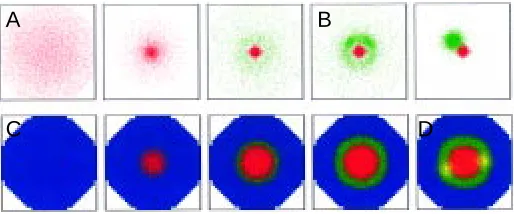
Fig. 2. Pattern formation, induction of a second “hot spot” and induc-tion of zones. (A) The interaction of a short ranging positive feedback loop (activator, red) and a long ranging inhibitory substance (not shown) resem-bles an unstable system. In the simulation a small initial elevation of the activator leads to a focal activation. In a system without pre-localized determinants, such a reaction could be responsible for the formation of the vegetal pole. (B) A second such system (green) forms a second hot spot next to the first if it is activated on long range and locally repressed by the first. This process can accomplish a symmetry break. According to the model, this corresponds to the Nieuwkoop-center at a position displaced from the pole.
(C) A model for the zonal separation of ectoderm, endoderm and, induced by the latter, mesoderm. Positive feedback loops are assumed that compete with each other such that in one cell only one of these loops can be active. Endoderm (red) forms as shown in (A) from a default ectodermal state (blue). By a long range activating signal, a mesodermal zone is formed (green). Although the latter activation can spread (as suggested in the text, by involvement of secreted FGF in the FGF/Xbra feedback loop), the mesoder-mal zone obtains a characteristic width. In the simulation, this is achieved by an additional self-inhibitory influence of the mesoderm. The mesoderm resembles therefore a stripe forming system (see Appendix). (D) An activation of a further organizing region (yellow) corresponding to the Spemann-Mangold organizer within the mesoderm (green) would imply a competition over relatively long distances. This bears the danger that two organizing regions are formed. The involvement of a strong asymmetry as shown in (B) would solve this problem (see Fig. 8) and suggest a reason for the existence of the Nieuwkoop center.
A
B
functions. The first causes the long-range activation by the endo-derm; the latter is involved in its maintenance through a mesoderm-specific feedback loop. After this concentration-dependent induc-tion, the mechanism that leads to mesoderm formation may rapidly become a complete pattern forming process. In addition to the self-amplifying loop, a synthesis of an inhibitory substance has been observed in the mesoderm that restricts the amount of mesoderm formation (Cheng et al., 2000). If so, it must have the property of a stripe forming system (see Appendix).
In more general terms, a correct subdivision into different cell types occurs if feedback loops exist that exclude each other locally, but activate each other at long range (Meinhardt and Gierer, 1980). In this way, one structure generates the precondition that another structure appears in the neighborhood. This activation can be mutual (as in the engrailed-wingless interaction during segmentation) or unidirectional (as presumably in mesoderm induction). In the simulations, mutual activation shows a better size regulation.
Separation of the germ layers: zones or individual cells?
In amphibians, well-separated zones with endo- and mesodermal specification, respectively, are formed before gastrulation begins. In the zebra fish, both cell types are more intermingled and the progeny of a single cell can give rise to both cell types, indicating that the pattern formation is still going on (Warga and Nüsslein-Volhard, 1999; Rodaway et al., 1999). Similarly, in the chick, individual cells separate from the epiblast and ingress to form meso- and endoderm. In some cnidaria including hydra, the intermingled determination of ecto- and endoderm seems to be even more extreme. First a single layered coeloblastua is formed from which individual cells delaminate and ingress to form later the endoderm of the gastric cavity (for review see Martin et al., 1997). Although molecular data are not yet available, this behavior suggests that the choice between the two pathways is made in a salt and pepper-like fashion in a single-layered cell sheet.
Since the separation into ecto- and endoderm can be assumed to be highly conserved, a model mechanism should account for both the zonation and for the more scattered pattern. In the model proposed above, whether differentiated cells emerge collectively in zones or individually on a cell-by-cell basis depends on the following factors. If the self-enhancing reaction can spread (for instance, by the FGF-brachyury loop in mesoderm formation), large coherent patches are expected (community effect). In this case, if preferential initiation sites exist for these patches (e.g. by maternal determinants or preceding pattern forming reactions), they emerge at predictable positions and form zones. Alternatively, if the feedback loops do not involve secreted molecules or their spread is limited, the decision is made on a cell-by-cell basis and random fluctuations can be decisive. Clearly, all intermediate patterns between zonation and salt-and-pepper distribution are possible under the appropriate conditions. If the formation of each cell type either needs factors from or has a spreading negative influence on other cell types, these systems have the property that the different cell types emerge in the correct proportion.
A rationale for the Nieuwkoop-center
In amphibians, which are polarized by sperm entry and subse-quent cortical rotation, a high ß-catenin concentration arises at a position displaced from the vegetal pole. In the absence of an
external asymmetry, the formation of a second hot spot can be accomplished if the first organizer activates the second at long-range, but inhibits it locally (Fig. 2B). With the help of other molecules of the WNT-pathway and genes such as siamois and Tcf3, the Nieuwkoop center is formed in the endoderm. This center, in turn, induces the Spemann-Mangold organizer in the mesoderm. The question then arises as to why the Nieuwkoop center is implemented as an intermediate step? Why does the Spemann-Mangold organ-izer not result directly, as a hot spot, from a pattern-forming reaction in the mesoderm? Corresponding simulations pointed to an unex-pected feature that may provide an answer. Since the diameter of the marginal zone is large, an inhibitor produced in the incipient organ-izing region would dilute excessively by spreading into the whole blastula and become incapable of repressing the formation of a second organizer at the opposite side of the mesodermal ring (Fig. 2D). The intermediate formation of a signaling center displaced from the poles provides a solution: If an organizing region (which later induces the Spemann-Mangold organizer) is generated close to but displaced from a pole (as suggested in Fig. 2B), only a smaller region is involved in the pattern-forming reaction. This allows for rapid and efficient patterning and ensures that only one hot spot survives. Moreover, the pattern-forming process can occur at a much earlier stage, before mesoderm is formed and before cleavage has led to many cells that may hamper the exchange of molecules. The strong asymmetry provided by the signal displaced from the center ensures that in further patterning events the most dorsal position is clearly distinguished. Thus, the formation of an early eccentric organizing region (e. g., the Nieuwkoop center) may be the crucial pattern forming step ascertaining that only a single dorsal organizer emerges at later stages.
As mentioned, Nieuwkoop observed that the notochord and the neural tube could also form in aggregates, i.e., after waiving out the asymmetric localization of determinants. Together with the function of the Nieuwkoop center discussed above, this suggests that the ß-catenin – siamois pathway is not only involved in bringing pre-localized determinants to function but is also part of a real pattern forming system. This is supported by the experimental findings that siamois has a feedback on its own activation (Fan et al., 1998) and that an ectopic activation can cause a complete secondary axis (Carnac et al., 1996). As further confirmation of the model, it would be very interesting to learn whether siamois activation or other elements of the WNT pathway also become locally active in Nieuwkoop aggregates.
The formation of the A-P polarity within the
Spemann-Mangold organizer
concentration-dependent manner with gsc at its highest point. In the chick, a similar early subdivision of the organizer, Hensens’s node, into adjacent anterior and posterior portions has been observed (Bachvarova et al., 1998). It takes place under the influence of the posterior marginal zone, the equivalent of the Nieuwkoop center.
As mentioned above, the stable activation of alternative genes can be achieved by competing feedback loops. Based on observa-tions in early insect experiments (Sander, 1976) I have proposed that a concentration-dependent selection between different pathways occurs by stepwise and irreversible transitions from the activation of a default gene to genes higher in a hierarchy. This stepping through comes to rest when that gene is active that corresponds to the local morphogen concentration (Meinhardt, 1978, 1982). Due to au-toregulation and competition, the cells have to make an unequivocal choice. Particular genes become active in sharply separated zones since near a threshold only a small increase of the morphogen concentrations is sufficient for a switch. This model predicted particu-lar regulatory features. After promotion is completed, a subsequent increase of the signal can lead to a further promotion (‘distal transfor-mation’, ratchet – like transitions). In contrast, a decrease of the signal is without effect because each transition from one gene activation to the next is essentially irreversible. The activation of brachyury and goosecoid by different concentrations of Activin (Gurdon et al., 1995) shows this behavior. In the zebrafish, Gritsman et al. (2000) have shown that low concentrations of the nodal-related factors cyclops and squint activate floating head, a gene that is required for notochord formation in the trunk. Higher concentrations leads to goosecoid activation. If goosecoid activation is abolished by blocking a necessary co-factor, the expression of the gene that is activated already at low concentrations expands into the region in which normally the ‘high’ gene is expressed, i.e., notochord enlarges on the expense of prechordal plate, as expected. From the model it is expected that each of these genes has positive and negative autoregulatory elements. Indications for both have been found for goosecoid (Blumberg et al., 1991; Danilov et al., 1998).
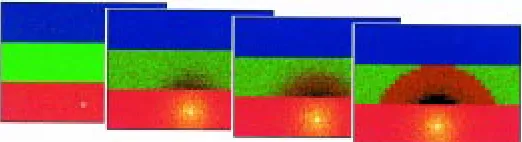
The formation of the A-P polarity within the Spemann-Mangold organizer is simulated in Fig. 3 (view from the dorsal side). The Nieuwkoop center in the endoderm secretes a signal that leads to a concentration-dependent promotion in the mesoderm. Mesodermal cells next to the Nieuwkoop center are exposed to the highest concentration and activate goosecoid (forming the head organizer); cells in more animal and more lateral regions activate genes responsible for trunk formation.
From organizer to notochord: a hot spot induces its own
shift and leaves behind a hot stripe
There is much controversy about the orientation of the AP and DV axes in the pre-gastrula (for a recent discussion, see Lane and Smith, 1999). A remarkable coincidence of both axes exist: anterior and dorsal structures map close to the organizer while posterior and ventral structures map at larger distances. It is clear, however, that in the final organism these axes must be oriented perpendicular to each other. Some posterior parts must obtain also dorsal structures and vice versa. The coincidence of both axes in the pre-gastrula is not so surprising. If, as discussed above, the Nieuwkoop center pro-duces a signal that causes anterior structures at high concentrations and at low concentrations posterior ones, the concentration of this signal decreases towards the animal pole in the same manner as
towards the antipode of the organizer, usually assigned as the ventral pole. Thus, at this stage, the AP and the DV axes are not yet separated.
During gastrulation the notochord is formed. This long thin struc-ture marking the midline within the mesoderm inherits organizer function. Many genes expressed in the organizer are also expressed in the notochord after gastrulation. Measuring the distance from this line (and not earlier from the patch-like organizer) can provide positional information for the DV axis.
At early stages, the prospective notochord is a regulating pattern forming system: a removal leads to a re-expression of corresponding markers in chick and in Xenopus (Psychoyos and Stern, 1996; Yuan et al., 1995; Levin and Mercola, 1998). This suggests that the cells next to the notochord are competent, but that the notochord sup-presses its own further extension by some sort of lateral inhibition. However, if lateral inhibition is involved, why does the notochord (or more generally speaking the midline pattern) not decay into sepa-rated patches? Why does the lateral inhibition works only to the sides and not along the long extension? According to the model, a stripe-like activation is stable if the self-enhancing reaction has an upper bound (see Appendix). In this arrangement each activated cell has activated neighbors (along the stripe) but non-activated cells into which the inhibitor can be diffuse are also closed by. If under this condition a patterning system is initiated by random fluctuations, somewhat meandering stripes are formed, reminiscent of the pat-terns on a zebra or to skin patpat-terns of some tropical fishes. However, it is not possible to generate a single straight and long-extended structure using this mechanism alone since stripe formation requires a restricted lateral inhibition and other nearby stripes would not be suppressed. This is in contrast to the formation of a single spot-like activation (see Fig. 2A) in which the lateral inhibition need not be restricted by an upper bound of the activator concentration. In the following, an argument is made that a “hot stripe” system such as the notochord is induced by the unique hot spot system (organizer) while, in turn, the hot stripe induces a shift of the hot spot. The moving hot spot leaves behind, in the course of time, the long extended midline pattern of the future organism (Meinhardt, 2000).
Fig. 3. Stages of the formation of the AP organizer in the mesoderm
V
D (N)
V
A
P
L
M
L
mediolateral position
AP-position
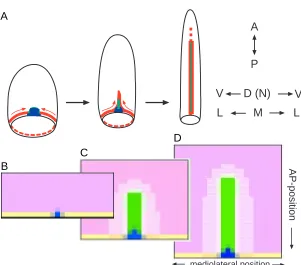
The generation of the long and extended AP axis depends on the conversion - extension movement: cells move towards the dorsal midline where their intercalation leads to a longer and longer extension in the AP dimension (Keller et al., 1985). Obser-vations in amphibians led to the impression that this occurs more or less simultaneously along the AP axis. However, the develop-ment of the chick suggests a different mode. The organizer, Hensen’s node, remains sharply localized. Cells approach this node from the side and leave it at more or less right angles (Joubin and Stern, 1999). The cells that pass the center of the node form the future midline. It is only a matter of reference system whether one regards the node as moving, leaving behind the notochord, or whether the node is assumed to remain at a fixed position and cells move away from the node. In the frog and zebra fish, cells from both sides of the mesodermal ring are attracted by the organizer and are left behind as a unified band. This leads to a ring – rod conversion of the mesoderm (Fig. 4). The situation is reminiscent of axons growing first towards guideposts. In axis formation, lateral cells are first attracted by the organizer and change their behavior once they become close.
The following simple model captures essential elements of this hot spot – hot stripe conversion (Meinhardt, 2000): the spot-shaped organizer induces a stripe-forming system. The latter, in turn, inhibits the spot-forming system, forcing a shift of its activation into a neighboring region, elongating in this way the midline system (Fig. 4). Thus, particular cells gain organizer function and loose it later in favor of forming midline structures, in agreement with the observation of Joubin and Stern (1999) in Hensen’s node.
Cells originally closer to the organizer form more anterior struc-tures (Fig. 3); they pass the node earlier. In this way, the sequentially generated midline obtains an AP pattern. With the formation of the
midline, positional information can be generated that provides a measure for the distance from the midline. Chordin- and noggin are produced in the notochord and bind the ubiquitously produced BMP4 (or BMP-2 in the zebrafish). This generates a symmetric pattern perpendicular to the midline. Both mechanisms together form an orthogonal coordinate system. Thus, the DV and medio-lateral patterns exist only after midline formation.
The left-right polarity: a second pattern is squeezed to
the side
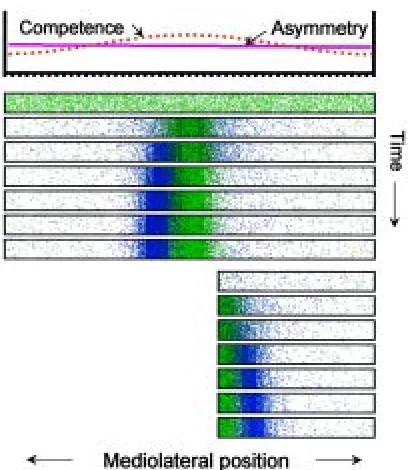
Considerable progress has been made in the understanding of the left-right pattern (for a recent review see Capdevila et al., 2000). In the following, it will be shown that many observation can be accounted for by the assuming that two pattern forming systems exist: A primary system forms the midline, which induces at long range and represses at short range a secondary system that marks the left side. Therefore, the ‘left‘ system depends on the midline system, but is shifted to the side (Fig. 5). The capacity of the notochord mentioned above to regenerate indicates that the mid-line system is indeed a pattern forming system.
If the midline pattern induces at longer range a second patterning system but locally suppress its full activation, the activation will be squeezed to lateral positions. An activation that eventually marks, e.g., the future left side, may transiently become activated on both sides of the notochord. However, these two regions will start to compete with each other due to the long-range inhibition inherent in the left-system. As a rule, only one of the two sides will form a full activation. Experimentally, it has been shown that the correct activation of nodal on the left side requires a long-range commu-nication between the left and right sides (Levin and Mercola, 1999).
Fig. 4. Formation of the midline and enfolding of the AP axis.(A) Scheme. Cells close to the blastoporus (red) move from both sides towards the organizer (blue). After being close to the organizer once, the cells change behaviour, are no longer attracted to it and leave the organizer as a unified band. In this way, a spot-like organizer causes the formation of a stripe-like organizer (like an air plane that sucks in air and leaves behind a vapour trail). Stem cells residing in the organizer may add cells to this band to form the most central elements of the midline (green). The passing through or coming close to the organizer may stop a countdown-like process in the cell, for instance, the activation of more 5’ Hox genes. This fixes their actual AP positional specification along the midline in a se-quential way. (B-D) Simplified simulation: a system that is tuned to make stripes (green) is triggered by the organizer, i.e., a system that is activated in a spot-like manner (blue). Since the stripe system (notochord) also repels the spot system (organizer), the spot system is shifted in front of the tip of the stripe, causing its straight elongation. Therefore, cells obtain temporarily organizer quality before participating in midline formation. Due a saturation in the self-enhancement, the stripe system does not disintegrate into individual patches and establishes the midline. This, in turn, generates positional information for the DV or mediolateral axis by acting as a sink for a ubiquitously produced substance (pink, e.g., BMP-4). The local concentration of the latter is a measure for the distance from the midline (Dosch et al., 1997). From this model it is expected that new cells gain organizer function temporarily and loose this property in favour of participating in the midline, in agreement with observations by Joubin and Stern (1999). In this simulation, lines of new cells are added next to the blastoporus (yellow). A more realistic model would require incorporation of the actual cell movement toward the organizer.
.
A
B
C
If gap junctional communication is abolished, nodal activation appears also on the right side, in obvious agreement with the model proposed. Many observations demonstrate an important role of the midline signal in the generation of the left-right pattern (Bisgrove et al., 1999). In the model, with a reduced activity of the midline activator, the squeezing to the neighboring regions may no longer work and the left signal can remain in the center. The inhibition of the ‘left’ system by the midline can occur relatively late in develop-ment, allowing both patterns to coincide at earlier stages. It is a property of such a system that minute asymmetries are sufficient to bias the shift in a predictable way. For mice, evidence exist that an asymmetric flow induced by flagellar movements is decisive (Nonaka et al., 1998). In the absence of such an asymmetry, the decision will be made at random.
The simulation in Fig. 5 demonstrates that the model accounts for a crucial observation. Excised tissue from the right side that does not contain notochord and, of course, no activity character-istic of the left side, regenerates first notochordal maker and later nodal, the marker for the left side (Levin and Mercola, 1998). In terms of the model, if the left side is removed, the right side has no longer a competitor. Full activation that normally occurs only on the left side will occur in the right side fragment. This outcome is independent whether the left-right asymmetry still exists or not.
Nodal has a positive feedback on its own activation and is a good candidate to be the "left"-activator in the model (Schier and Shen, 2000; Saijoh et al., 2000). It also regulates the production
of a putative inhibitor, lefty-2 (Cheng et al., 2000). The separation of the midline and left patterning systems seems to be indeed a late event since the inhibition by the nodal antagonist, antivin, appears to act at an early state on the restriction of the mesoderm pathway in general, and only later on the restriction of the nodal patch to the left (Cheng et al., 2000). The repression of nodal by the midline system, i.e., the notochord, has been shown (Lohr et al., 1998). Thus, many of the essential ingredients required by the model seem to be present. In the chick, the right side also seems to have characteristics of a pattern forming system (Activin and FGF8). As mentioned earlier, the long-range activation of two locally excluding systems (e.g., ‘left’ versus ‘right’) is equivalent to a lateral inhibition (e.g., ‘left’ or non-‘left’).
Conclusion
Axes formation in higher organisms is proposed to proceed by a chain of pattern forming reactions in which the following elemen-tary steps play a major role: (i) Organizing regions (including poles and signaling centers) are represented by local concentration maxima of substances, and are generated by local self-enhance-ment and long-range inhibition. (ii) A second organizing region can be generated at a position displaced from the first, if the first system induces the second at long-range and/or low concentrations, while excluding it at short-range and high concentrations. Minute asymmetries are sufficient for a predictable orientation of the resulting pattern. In the absence of such asymmetries, the choice of orientation will be random. Such a coupling of two centers ensures a specific polarity and is proposed to generate the dorsal side eccentric to the animal-vegetal axis and the markers for the left side to one side of the midline. (iii) Zones surrounding hot spots can be generated if the organizing region activates at long-range feedback loops that are locally exclusive. The mesoderm in the amphibian marginal zone can be generated in this way. The selective activation of genes in developmental pathways requires similar components: competing feedback loops. However, for pathway selection the competition must be more local. (iv) A concentration-dependent selection of developmental pathways can be achieved by stepwise and irreversible transitions from the activation of one default gene to genes higher in a hierarchy. This stepping through stops when the gene activation matches the local morphogen concentration. If the genes are part of competing feedback loops, particular genes become active in sharply sepa-rated zones since, close to the threshold, a minute increase of the signal can cause a complete transition into another pathway. The Spemann-Mangold organizer proper with its anterior-posterior subdivision can form in this way, utilizing (as suggested by others) a gradient generated by the Nieuwkoop center. (v) A hot spot can be converted to a hot stripe if the spot induces the stripe, and the stripe, in turn, induces a shift of the spot. An apparent movement of the organizer leaves behind a single band of activated cells. The midline system is proposed to form in this way. (vi) Tissue far from an organizer can lose the competence to perform the pattern forming reaction by a feedback of the organizing regions on the surrounding tissue. This mechanism suppresses spontaneous onsets of the pattern forming reaction at ectopic positions.
By an appropriate linkage of such steps, highly complex pat-terns can be generated that have the correct orientation relative to one another. Since these reactions show a high degree of self-regulation and are independent of pre-localized determinants, the
model accounts for the surprising robustness of early develop-ment. Pre-localized determinants might serve to “jump start” these processes so that no time-consuming competitions between the different parts are required. In addition, this also minimizes the danger of forming secondary organizing regions. Both features are especially important in large embryos such as amphibians.
The models proposed do not claim to mirror the complex process of development in all its details, and many questions remain. However, we hope they demonstrate that a theoretical
´
approach can provide substantial help in understanding the com-plex web of interactions that gives rise to a new organism in each new generation.
Acknowledgements
I am most grateful to Alfred Gierer for many years of fruitful collaboration, Rudi Winklbauer and Grenmarie Agresar for a critical reading of the manuscript, to Christoph Meinhardt for help in preparing Figure 1, and to Christian Beetz for many discussions.
Appendix
Basic regulatory features relevant to organizer formation
and regulation of competence
A prototype of a pattern forming reaction
As long as the general conditions of local self-enhancement and long-range antagonistic reaction are satisfied, many interactions are compatible with our general scheme. As an example, the following equation describes a possible interaction between an activator a(x,y,t) and an inhibitor b(x,y,t) that leads to local concen-tration maxima:
These equations are easy to read. The activator has an non-linear feedback on its own production rat (a2). The factor s describes the ability of the cells to perform the autocatalysis, i.e., the competence of the cells and may be also change with time (see below). Only the activator but not the inhibitor production is slowed down by the inhibitor (1/b). A saturation of the autocatalysis (sa > 0) can lead to stripe-like distributions. Due to the saturation-limited activation, the lateral inhibition is restricted. The activated area increases until sufficient inhibitor is produced. Due to the activator diffusion, activated cell prefer to have other activated cells in their
(1)
(2)
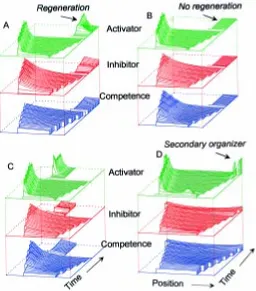
Fig. 6. Pattern formation and regulation in a system with fading competence. The activator (green) is assumed to feedback on the compe-tence, i.e., on the ability of the cells to perform the autocatalytic reaction (source density, blue). Cells become less and less competent with increas-ing distance from the activator maximum. (A) If the decay of the competence is slow and even distant cells maintain a certain competence, a new activator maximum can regenerate after removal of the activator maximum and the decay of the remnant inhibitor (red). (B,C) If cells loose the competence more rapidly, regeneration may be impossible in a distant fragment (B) but still occurs in a more proximal fragment (C). (D) If the field is initially larger and/ or cells remain competent longer, a secondary organizing region may appear at the largest possible distance from the primary organizer (see also Fig. 8).
accomplished by a chain of several substances involving secreted molecules and cell-restricted transcription factors. A small base-line production rate independent of the activator concentration (ba) can initiate the self-enhancing reaction at low activator concentra-tion, for instance, during regeneration. A baseline inhibitor produc-tion (bb) can suppress the onset of autocatalysis at low activator concentrations. This can prevent the formation of inappropriate additional activator maxima for the price that regeneration may no longer be possible. With such a basic inhibitor level, the system can be asleep until an inducing trigger is received that brings the self-amplification above a threshold. To obtain a stable pattern, the diffusion of the inhibitor must be much larger than that of the activator (Db >> Da ). Also, the inhibitor concentration must respond rapidly to a change of the activator concentration, otherwise oscillation will occur. This requires that turnover of the inhibitor is faster than that of the activator, i.e., the condition rb > ra must be satisfied. Software for simulations of pattern forming reactions on a PC is available (Meinhardt, 1998)
Basic regulatory features characteristic of organizer regions As mentioned earlier, in the chick, an early subdivision of the blastodisc can lead to the formation of an embryo in each fragment (Lutz, 1949, Spratt and Haas, 1960). Obviously, a new organizing region can emerge after a removal of the posterior marginal zone, the precursor of the organizing region. Even in amphibians, normal embryos will be formed after removal of sectors containing the organizer as long as the sector is not larger than about 3O° (Steward and Gerhart, 1990). Likewise, in the zebrafish, relatively normal animals are formed after removal of the embryonic shield (Shih and Fraser, 1996). Recent observations in hydra have revealed that organizer formation in this evolutionarily much lower organism is based on a similar molecular machinery as in verte-brates. Hydra is most famous for its regenerative capacity. About 3h after head removal, the brachyury homologue, HyBra1 (Technau and Bode, 1999), and molecules of the WNT pathway (Hobmayer et al., 2000) reappear in the remaining gastric column.
According to the model, removal of the activated region implies that the region from which the long-range inhibition spreads is also removed (Gierer and Meinhardt, 1972; Meinhardt, 1998). After the decay of the inhibitor (or after a sufficient accumulation of a substrate that is used up during activation), a new activation can be triggered. The resumed inhibitor production shapes the regenerat-ing signalregenerat-ing center (Fig. 6).
The induction of new organizing regions by implantation of tissue fragments derived from the endogenous organizing region has been investigated in the chick (Khaner and Eyal-Giladi, 1989) and extensively in hydra (Wilby and Webster, 1970). In general, implantation of such tissue at a distance from an existing organizer can be successful, while a more proximal implantation may not. Removal of the endogenous organizing region greatly enhances the probability to form a new organizing region. This behavior is a straightforward consequence of the general pattern forming mecha-nism proposed (Fig. 7 A-C).
Unspecific or spontaneous trigger of secondary organizing regions
One of the problems in the early search for molecules involved in organizer formation was that very unspecific manipulations, such as implantation of denatured tissue or injury, can trigger the
formation of a secondary embryonic axis. Waddington et al. (1936) proposed that this non-specificity results from the removal of an inhibitor. The tendency for unspecific induction is species-depend-ent. It is low in Xenopus but high in the Triturus, the model system most studied in the early days.
According to the model, a local activator maximum is necessar-ily surrounded by a field of inhibition; the inhibition decreases with distance from the maximum. Therefore, at higher distances, the inhibition may become insufficient to repress the onset of a new autoregulatory center. A region opposite to an organizer region is thus expected to be especially prone to any artificial decrease of the inhibition caused, for instance by a leakage at an injury or by a release of degrading enzymes. A secondary organizing region generated by unspecific induction is expected to be indistinguish-able of a normal maximum since it leads to a maximum of the genuine activator (Fig. 7D).
The same mechanism accounts also for the spontaneous genera-tion of a secondary organizing region. In chickens, occasionally two embryos are formed. The organizing regions emerge on opposite sides of the ring and the two primitive streaks point towards each other. This is very remarkable since in relation to the asymmetry imposed by gravity, the secondary embryo emerges at the most disfavored position. The simulations in Figs. 6D and 8B show,
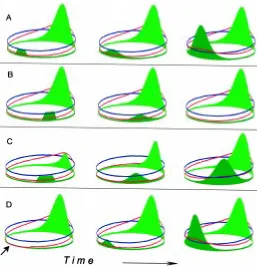
Fig. 8. Influence of an asymmetry on the formation of an organizing region within a ring of cells.(A) A substantial asymmetry in the ability of the cells to perform the self-enhancement (blue) can lead to a single maximum (green, the red ring is the inhibitor distribution. (B) A somewhat weaker asymmetry can lead to a second maximum at the most disfavored site, a characteristic feature of many systems when generating a secondary organizer. With the same set of parameters but without an asymmetry, up to three organizing regions could be formed. In a ring with only half as many cells, only a single maximum emerges even when initiated by random fluctuations alone. Shown are the initial (left), an intermediate (middle) and the final stable state (right).
however, that this is a straightforward consequence of the model proposed. If the ring is relatively large, the inhibitor concentration rising at the primary activation site may be insufficient to repress the onset of a secondary activation. This occurs at the largest possible distance from the primary one. Thus, the inhibitory influence of the primary organizer and not, e.g., the gravity-imposed asymmetry is decisive in positioning of the second organizer. Secondary maxima can only occur if the field size is larger than the range of the inhibitor. A pronounced asymmetry contributes to the prevention of secondary maxima (Fig. 8). This suggests that strong asymmetries introduced by pre-localized determinants are of advantage if development starts with relatively large eggs as in the case of amphibians. The decision of which side will win is made before the competition starts. This shortens the time required to generate the final pattern.
Gain and fading of competence
In many systems, the competence of the cells to form a pattern is not homogeneously distributed. In Xenopus, only cells close to the original organizer can regenerate a new one. Likewise, in the chicken, only cells that were originally close to the presumptive notochord regenerate notochordal markers after notochord re-moval (Yuan et al., 1995, Psychoyos and Stern, 1996) and this ability is lost at somewhat later stages. Even in hydra where all parts of the body column can regenerate a new head, tissue fragments derived from positions originally more distant to the head need substantially longer time for head regeneration. There-fore, the ability to generate an organizing region is not distributed uniformly. Competence may change with time and becomes spa-tially more restricted. For instance, only at an early stage, can an anterior fragment of a chicken blastodisc form a secondary embryo upon fragmentation.
According to the model one has to distinguish between the ability of the cells to perform the autocatalytic reaction and the actual activation of this feedback loop. We have called this ability
the source density, a property that corresponds to the observable feature of competence. Thus, there are two reasons why a cell is not activated. Either the feedback loop is down-regulated due to the inhibitor that spreads from an existing organizing region, or, even in the absence of inhibitor, the feedback loop cannot be activated since a necessary prerequisite (like a co-factor) is not present. While the removal of an organizing region leads to a rapid regulation of the inhibitor level and thus to regeneration, the change of competence is assumed to be a slow process.
This decrease of competence to form an organizing region with increasing distance from the organizer is proposed to have an essential function. As mentioned above, if the size of a field surpasses a certain extension, the long ranging inhibition may no longer be sufficient to suppress the generation of a secondary organizing region (Fig. 6D, 8B). Since most tissues grow during embryogenesis, it is therefore a problem to avoid the formation of secondary organizing regions and thus additional embryos within the same egg that may diminish the chance of their survival.
A possible solution for this problem consists of the following mechanism: an organizing region does not only inhibit surrounding tissues to become organizing properties but also counteracts the fading competence in the neighborhood of the organizing regions. In the course of time, distant regions become unable to generate secondary maxima due to the loss of competence. In this way, a unique but still regulating maximum can be maintained even in fields that grow substantially. An organizer has, therefore, a dual and seemingly conflicting effect on the surrounding tissue: it inhibits the formation of secondary organizing regions and, simul-taneously, it stabilizes the competence. In this way, the tissue obtains a polarity. Cells closer to the organizer have a better position in the competition and will win. The polarity of the tissue will be maintained (Meinhardt, 1993). The different susceptibilities against unspecific induction of secondary axes such as that observed in Xenopus and Triturus is postulated to have its base in a different fading rate of the competence.
Both effects, inhibition and fading of competence, must have different time constants. The inhibition must be a rapid process. For instance, after (partial) removal of an organizing region, the inhibition has to decay rapidly in order that regulation can occur. In contrast, the competence of a tissue should have a much longer time constant. It should remain almost unchanged at the time scale required for pattern regulation. As shown in Fig. 6, depending on how rapidly the competence decreases with distance from the organizer, regenera-tion may be possible or not. Fragments derived from regions closer to the original organizer have a better chance to regenerate.
References
AGIUS, E., OELGESCHLAGER, M., WESSELY, O., KEMP, C. and DE, R.E. (2000). Endodermal nodal-related signals and mesoderm induction in Xenopus. Develop-ment 127: 1173-1183.
BACHVAROVA, R.F., SKROMNE, I. and STERN, C.D. (1998). Induction of primitive streak and Hensen’s node by the posterior marginal zone in the early chick embryo. Development 125: 3521-3534.
BISGROVE, B.W., ESSNER, J.J. and YOST, H.J. (1999). Regulation of midline development by antagonism of lefty and nodal. Development 126: 3253-3262.
CAPDEVILA, J., VOGAN, K.J., TABIN, C.J. and IZPISUA BELMONTE, J.C. (2000). Mechanisms of left-right determination in vertebrates. Cell 101: 9-21. CARNAC, G., KODJABACHIAN, L., GURDON, J.B. and LEMAIRE, P. (1996).
The homeobox gene siamois is a target of the wnt dorsalisation pathway and triggers organizer activity in the absence of mesoderm. Development 122: 3055-3065.
CHENG, A.M.S., THISSE, B., THISSE, C. and WRIGHT, C.V.E. (2000). The lefty-related factor Xatv acts as a feedback inhibitor of nodal signaling in mesoderm induction and l-r axis development in Xenopus. Development 127: 1049-1061.
CLEMENTS, D., FRIDAY, R.V. and WOODLAND, H.R. (1999). Mode of action of VegT in mesoderm and endoderm formation. Development 126: 4903-4911. DANILOV, V., BLUM, M., SCHWEICKERT, A., CAMPIONE, M. and STEINBEISSER,
H. (1998). Negative autoregulation of the organizer-specific homeobox gene goosecoid. J. Biol. Chemistry 273: 627-635.
DOSCH, R., GAWANTKA, V., DELIUS, H., BLUMENSTOCK, C. and NIEHRS, C. (1997). Bmp-4 acts as a morphogen in dorsoventral mesoderm patterning in Xenopus. Development 124: 2325-2334.
FAN, M.J., GRUNING, W., WALZ, G. and SOKOL, S.Y. (1998). Wnt signaling and transcriptional control of siamois in Xenopus embryos. Proc. Natl. Acad. Sci. USA 95: 5626-5631.
GIERER, A. AND MEINHARDT, H. (1972). A theory of biological pattern formation. Kybernetik 12: 30-39.
GRBIC, M., NAGY, L.M. and STRAND, M.R. (1998). Development of polyembryonic insects: a major departure from typical insect embryogenesis. Dev. Genes Evol. 208: 69-81.
GRITSMAN, K., TALBOT, W.S. and SCHIER, A.F. (2000). Nodal signaling patterns the organizer. Development 127: 921-932.
GURDON, J.B., MITCHELL, A. and MAHONY, D. (1995). Direct and continuous assessment by cells of their position in a morphogen gradient. Nature 376: 520-521.
HARLAND, R. and GERHART, J. (1997). Formation and function of Spemann’s organizer. Ann. Rev. Cell Dev. Biol. 13: 611-667.
HEASMAN, J. (1997). Patterning the Xenopus blastula. Development 124: 4179-4191.
HOBMAYER, B., RENTZSCH, F., KUHN, K., HAPPEL, C.M., CRAMER VON LAUE, C., SNYDER, P., ROTHBACHER, U. and HOLSTEIN, T.W. (2000). Wnt signalling molecules act in axis formation in the diploblastic metazoan hydra. Nature 407: 186-189.
JOUBIN, K. and STERN, C.D. (1999). Molecular interactions continuously define the organizer during the cell movements of gastrulation. Cell 98: 559-571. KELLER, R.E., DANILCHIK, M., GIMLICH, R. and SHIH, J. (1985). The function of
convergent extension during gastrulation of Xenopus laevis. J. Embryol. Exp. Morph. Supplement 89: 185-209.
KHANER, O. and EYAL-GILADI, H. (1989). The chick’s marginal zone and primitive streak formation. I. Coordinative effect of induction and inhibition. Dev. Biol. 134: 206-214.
KOCHAV, S.M. and EYAL-GILADI, H. (1971). Bilateral symmetry in the chick embryo determination by gravity. Science 171: 1027-1029.
KOFRON, M., DEMEL, T., XANTHOS, J., LOHR, J., SUN, B., SIVE, H., OSADA, S., WRIGHT, C., WYLIE, C. and HEASMAN, J. (1999). Mesoderm induction in Xenopus is a zygotic event regulated by maternal vegT via TGF-ß growth factors. Development 126: 5759-5770.
LANE, M.C. and SMITH, W.C. (1999). The origin of primitive blood in Xenopus: implication for axial patterning. Development 126: 423-434.
LEPTIN, M. (1991). twist and snail as positive and negative regulators during Drosophila mesoderm development. Genes Dev. 5: 1568-1576.
LEVIN, M. and MERCOLA, M. (1998). Evolutionary conservation of mechanisms upstream of asymmetric Nodal expression: reconciling chick and Xenopus. Dev. Genetics 23: 185-193.
LEVIN, M. and MERCOLA, M. (1999). Gap junction-mediated transfer of left-right patterning signals in the early chick blastoderm is upstream of Shh asymmetry in the node. Development 126: 4703-4714.
LOHR, J.L., DANOS, M.C., GROTH, T.W. and YOST, H.J. (1998). Maintenance of asymmetric nodal expression in Xenopus laevis. Dev. Genetics 23: 194.
LUTZ, H. (1949). Sur la production experimentale de la polyembryonie et de la monstruosite double ches lez oiseaux. Arch. d’Anat. Micro. et de Morph. 38: 79-144.
MARKERT, C.L. and PETTERS, R.M. (1978). Manufactured hexaparental mice show that adults are derived from three embryonic cells. Science 202: 56-58. MARTIN, V.J., LITTLEFIELD, C.L., ARCHER, W.E. and BODE, H.R. (1997).
Embryogenesis in hydra. Biol. Bulletin 192: 345-363.
MEINHARDT, H. (1978). Space-dependent cell determination under the control of a morphogen gradient. J. Theor. Biol. 74: 307-321.
MEINHARDT, H. (1982). Models of biological pattern formation. Academic Press, London.
MEINHARDT, H. (1993). A model for pattern-formation of hypostome, tentacles, and foot in hydra: how to form structures close to each other, how to form them at a distance. Dev. Biol. 157: 321-333.
MEINHARDT, H. (1996). Modes of biological pattern-formation - common mecha-nism in plant and animal development. Int. J. Dev. Biol. 40: 123-134. MEINHARDT, H. (1998). The Algorithmic Beauty of Sea Shells (with PC-software).
Springer, Heidelberg, New York.
MEINHARDT, H. (2000). Models of organizer and notochord formation. C. R. Acad. Sci Paris, III-VIE 323: 23-30.
MEINHARDT, H. and GIERER, A. (1980). Generation and regeneration of se-quences of structures during morphogenesis. J. Theor. Biol. 85: 429-450. MOOS, M., WANG, S.W. and KRINKS, M. (1995). Anti-dorsalizing morphogenetic
protein is a novel TGF-ß homolog expressed in the Spemann organizer. Development 121: 4293-4301.
NIEUWKOOP, P. (1973). The “organization centre” of the amphibian embryo, its origin, spatial organization and morphogenetic action. Adv. Morph. 10: 1-39. NIEUWKOOP, P.D. (1992). The formation of the mesoderm in urodelean
amphib-ians. VI. The self-organizing capacity of the induced meso-endoderm. Roux’s Arch. Dev. Biol. 201: 18-29.
NIEUWKOOP, P.D. (1999). The neural induction process; its morphogenetic aspects. Intern. J. Dev. Biol. 437: 615-623.
NONAKA, S., TANAKA, Y., OKADA, Y., TAKEDA, S., HARADA, A., KANAI, Y., KIDO, M. and HIROKAWA, N. (1998). Randomization of left-right asymmetry due to loss of nodal cilia generating leftward flow of extraembryonic fluid in mice lacking KIF3B motor protein. Cell 95: 829-837.
PSYCHOYOS, D. and STERN, C.D. (1996). Restoration of the organizer after radical ablation of Hensen’s node and the anterior primitive streak an the chick embryo. Development 122: 3263-3273.
REGULSKI, M., DESSAIN, S., MCGINNIS, N. and MCGINNIS, W. (1991). High-affinity binding-sites for the deformed protein are required for the function of an autoregulatory enhancer of the deformed gene. Genes Dev. 5: 278-286. RODAWAY, A., TAKEDA, H., KOSHIDA, S., BROADBENT, J., PRICE, B., SMITH,
J.C., PATIENT, R. and HOLDER, N. (1999). Induction of the mesendoderm in the zebrafish germ ring by yolk cell-derived TGF-beta family signals and discrimination of mesoderm and endoderm by FGF. Development 126: 3067-3078.
SAIJOH, Y., ADACHI, H., SAKUMA, R., YEO, C.Y., YASHIRO, K., WATANABE, M., HASHIGUCHI, H., MOCHIDA, K., OHISHI, S. and KAWABATA, M. (2000). Left-right asymmetric expression of lefty2 and nodal is induced by a signaling pathway that includes the transcription factor FAST2. Mol. Cell 5: 35-47. SANDER, K. (1976). Formation of the basic body pattern in insect embryogenesis.
Adv. Insect Physiol. 12: 125-238.
SCHIER, A.F. and SHEN, M.M. (2000). Nodal signalling in vertebrate development. Nature 4: 385-389.
SCHULTE-MERKER, S. and SMITH, J.C. (1995). Mesoderm formation in response to brachyury requires FGF signaling. Curr. Biol. 5: 62-67.
SHIH, J. and FRASER, S.E. (1996). Characterizing the zebrafish organizer -microsurgical analysis at the early-shield stage. Development 122: 1313-1322. SPEMANN, H. AND MANGOLD, H. (1924). Über Induktion von Embryonalanlagen durch Implantation artfremder Organisatoren. Wilhelm Roux’ Arch. Entw. mech. Org. 100: 599-638.
STEWARD, R.M. and GERHART, J.C. (1990). The anterior extent of dorsal develop-ment of the Xenopus embryonic axis depends on the quantity of organizer in the late blastula. Development 109: 363-373.
SUN, B.I., BUSH, S.M., COLLINS-RACIE, L.A., LAVALLIE, E.R., DIBLASIO-SMITH, E.A., WOLFMAN, N.M., MCCOY, J.M. and SIVE, H.L. (1999). derriere: a TGF-beta family member required for posterior development in Xenopus. Development 126: 1467-1482. TECHNAU, U. and BODE, H.R. (1999). HyBra1, a Brachyury homologue, acts during
head formation in Hydra. Development 126: 999-1010.
WADDINGTON, C.H., NEEDHAM, J. and BRACHET, J. (1936). Studies on the nature of the amphibian organizing centre. III. The activation of the evocator, Proc. Roy. Soc. B 120: 173-190.
WARGA, R.M. and NÜSSLEIN-VOLHARD, C. (1999). Origin and development of the zebrafish endoderm. Development 126: 827-838.
WILBY, O.K. and WEBSTER, G. (1970). Studies on the transmission of hypostome inhibition in hydra. J. Embryol. exp. Morphol. 24: 583-593.
YUAN, S., DARNELL, D.K. and SCHOENWOLF, G.C. (1995). Mesodermal patterning during avian gastrulation and neurulation: Experimental induction of notochord from non-notochordal precursor cells. Dev. Genetics 17: 38-54.