ROLE OF SURFACE FUNCTIONALIZATION OF
NANOPARTICLES IN NANO-BIO INTERACTION
Sumistha Das
1, Anil Kumar
2, Nitai Debnath
3Amity Institute of Biotechnology, Amity University Haryana,
Gurgaon, (India)
ABSTRACT
With the advent of broad spectrum application of nanoparticles (NPs) in biological domain, there is paramount
importance to evaluate nano-bio interaction in more detail. Not only the size and shape of NPs but also the
surface capping material plays a pivotal role in cross talk between NPs and biological world. Here the role of
surface ligand in determining the stability of NPs in different solvents is discussed especially in case of gold
NPs. The toxicity parameters also get changed depending on the capping material present on the surface. In a
bioassay it was revealed that NPs of same size and shape but with different surface functionalization interact
differently with the surface of the virus called as Bombyx mori nuclear polyhedrosis virus. So it can be
concluded that surface capping agents play a pivotal role in determining the interaction of NPs with biological
domain.
Keywords: Bmnpv, Capping Agent, Dispersion Property, Murine Toxicity, Surface Contour
I. INTRODUCTION
Nanotechnology can be defined as the postulated ability to manufacture objects and structures with atomic
precision, specifically atom by atom. Even from the basic research perspective, nanoscience is very much
interesting because materials at their nanoscale emerge with unique properties associated with quantized effects
and preponderance of surfaces and interfaces. That is why research in the field of nanotechnology is a highly
interactive amalgamation of relatively traditional disciplines of physics, chemistry, biology, computer science
and engineering. Compared to the bulk counterpart, nanoparticles (NPs) are inherently unstable due to their
immense surface-to-volume ratio and the consequent high surface free energy [1]. In general, they have to be
stabilized by a matrix which, in the simplest case, may be a mono-molecular coating of organic molecules, such
as dodecanethiol coated gold NPs (GNPs). The interaction between the functional group of these molecules and
the NP surface passivates the surface energy of the latter, but in the process the entropy may not be maximized.
In particular, the organic molecules may be constrained to a smaller set of conformational states than in the bulk
[2]. This lowered entropy produces a force which tries to oppose the lowering and acts as driving force for the
interaction of the NPs with their surroundings. Therefore, a coated NP, as described above, when applied on
cells and tissues, may interact strongly with such systems, leading to some very striking effects. The capping
materials mostly define the dispersion property and stability of the NPs synthesized and ultimately dictates the
Nowadays NPs are being used in various fields of daily life starting from electronics [3] to food packaging [4],
medical diagnostics [5], drug delivery [6] etc. In a nutshell every day we are getting more and more exposed to
different NPs. Thus study of interaction of nanomaterials with the biological interface has paramount
importance. As the capping molecules play a pivotal role in dictating the overall property of the NPs, the
interaction of these surface ligands with the biological interface should be studied carefully. In this article the
role of surface capping agents particularly in case of GNPs is highlighted in determining their stability and
toxicity in murine model system. Moreover, the nature of interaction of GNPs and few other NPs having
different surface capping agents with the polyhedra body of Bombyx mori nuclear polyhedrosis virus (BmNPV)
is also highlighted here.
II. ROLE OF SURFACE FUNCTIONALIZATION ON DISPERSION PROPERTY AND
STABILITY OF GOLD NANOPARTICLES
GNPs were functionalized with different surface capping agents like aspartate (GNPA), bovine serum albumin
(BSA), citrate (GNPC) and thiol (GNPT). It was found that change in molar ratio of reactant contents have
strong relation with the size of NP produced. But not only the concentration and specificity of reducing material
is important but also surface stabilizing material plays pivotal role in determination of their final shape and size.
Capping material mostly defines the dispersion of GNPs synthesized. As for example, thiol capping enabled
GNPT to disperse in only organic solvent whereas citrate, aspartate and BSA capping made GNPA, GNPB and
GNPC soluble in polar solvent [7]. Dispersion of NPs to their respective solvents has strong relation with their
interaction to the biological world. Although thiol capping renders interesting catalytic property to GNPs but
water dispersible GNPs are more popular for biological usage.
As we are considering interaction at nano-bio domain, the stability study of the synthesized NPs in different
buffers and molecules of biological relevance is also immensely important. The stability of GNPs was tested in
NaCl solution, phosphate buffer saline (PBS), foetal bovine serum (FBS) of different concentration and at
different pH. In this case, it was also found that surface functionality had significant implication. GNPs of
nearly similar size but with different surface properties behaved differently with respect to their stability in
different solvents. GNPA was found to be most vulnerable in losing stability and thus prone to agglomeration.
GNPC was almost stable except in extreme NaCl and PBS concentrations used. GNPB, with long BSA chain
was able to maintain normal helicity in all conditions [7].
III. INTERACTION OF NANOPARTICLE WITH SURFACE OF VIRAL POLYHEDRAL
In spite of large amount of initiative including bed disinfectants and plant material based therapeutic approaches
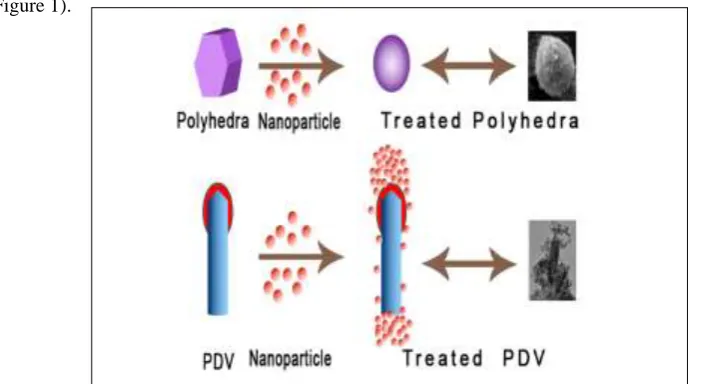
proper surface functionalization can prevent BmNPV infection by acting on the surface of the viral polyhedra
(Figure 1).
Figure 1. Morphological transition of BmNPV polyhedra caused by nanoparticle treatment.
The interaction of four NPs (with different surface cappings) with BmNPV polyhedra body was screened.
Different types of NPs used in this bioassay were GNPA, GNPB, GNPC, hydrophilic, hydrophobic and
lipophilically coated silica NPs (SNPs) and zinc oxide NPs (ZNPs), and hydrophilic Alumina NPs in the
hexagonal close-packed α structure and cubic γ structure (ANPα and ANPγ respectively). Here it was observed
that similar NPs with different surface property interacted with polyhedra body differentially. Lipophilically
coated SNP was most effective in distorting the viral surface contour, followed by moderately effective ANP.
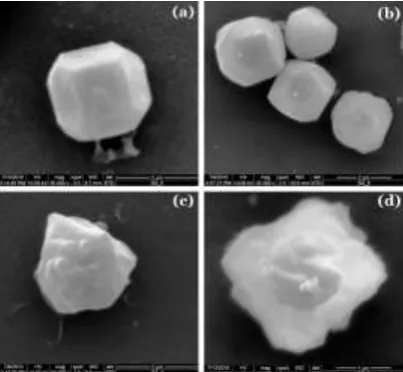
Though lipophilcally coated SNP caused morphological transition in BmNPV, hydrophilic and hydrophobic SNP
was not much effective in this regard (Figure 2). These finding also corroborated our initial results where we
found that along with type of nanomaterial surface property also plays a crucial role in nano-bio interaction [8].
SNPL not only deformed viral structure but also controlled the lethal infection both in vitro and in vivo.
Mechanism of action behind antiviral potential of SNPL was different from other approaches taken so far to
control grasserie infection. SNPL caused severe distortion to viral morphology with roughening transition of the
surface contour and ultimately the polygonal structure was transformed into a nearly spherical one and ultimately
it gave the silkworm larvae a prophylactic treatment to the infection [9]. This approach not only protected the
infection to a considerable amount but also expanded the life of infected silkworm significantly. But in our
SNPL mediated prophylactic approach the larval pupation was in time, cocoon was formed and mature ones
emerged thereafter. These adults were able to lay egg form where second generation larvae emerged. Spraying of
NPs on mulberry leaves, the primary source of baculovirus polyhedra body through food to the larvae, will
render much more reduced infection due to NP mediated inactivation of virus prior to their ingestion. It will not
Figure 2. The extent of deformation of BmNPV polyhedra caused by treatment of differently
functionalized silica nanoparticles. (a) hydrophilic, (b) hydrophobic and (c) lipophilically coated silica
nanoparticle. In all cases BmNPV polyhedra was exposed to these nanoparticles at 7000 ppm of dosage.
IV. NANO-BIO INTERACTION IN TERMS OF TOXICITY
Ultimately the in vivo toxicity of differently capped GNPs was examined in murine model system. For many
years colloidal gold is being used as elixir of life. But GNP related toxicity which may differ with its surface
cappings was never studied thoroughly in mammalian model system. This toxicity study revealed that different
GNPs (GNPA, GNPB and GNPC) had differential pattern of interaction with mice health especially to liver and
kidney parameters. As for example, in vivo assay with very high dosage showed some abnormalities in liver and
kidney parameters for GNPA and GNPC treatment, as these two organs are primary repository of any foreign
substances. GNPB was found to be non-toxic to these two organs. Results from histopathological parameters
were also having correlation with biochemical parameters obtained from treated mice serum sample. Although
mice exposed to GNPs did not exhibit any significant alteration in weight of organs, tissue damage or lesions in
any of the sections of brain, heart, lungs, spleen, testis and ovary. Mortality or any other deleterious symptoms of
any disease was not evident in any cases. Further long term toxicity analysis is needed.
V. CONCLUSION
This study reveals that surface capping material of NPs is an important factor to be considered during nano-bio
interaction for their successful implication in different biological applications. Study of interaction of NPs with
BmNPV polyhedra in controlling grasserie disease of silk worm will have far reaching implication in NP based
novel approach to combat virus inactivation in general. Toxicity and stability analysis of NPs can ensure their
[2] H. Mori, D.C. Seng, M. Zhang, A.H.E. Müller. Hybrid nanoparticles with hyperbranched polymer shells via
self-condensing atom transfer radical polymerization from silica surfaces. Langmuir 18 (2002) 3682-3693.
[3] L. Polavarapu, K.K. Manga, K. Yu, P.K. Ang, H.D. Cao, J. Balapanuru, K.P. Loh, Q.H. Xu, Alkylamine
capped metal nanoparticle ‘‘inks’’ for printable SERS substrates, electronics and broadband photodetectors.
Nanoscale, 3 (2011) 2268-2274.
[4] TV Duncan. Applications of nanotechnology in food packaging and food safety: barrier materials,
antimicrobials and sensors. J Colloid Interface Sci. 363(1) (2011) 1-24.
[5] Y Jin, C Jia, SW Huang, M O’Donnell, X Gao. Multifunctional nanoparticles as coupled contrast agents.
Nature Communication 1 (2010) 41.
[6] Q He, Z Zhang, F Gao, Y Li, J Shi. In vivo biodistribution and urinary excretion of mesoporous silica
nanoparticles: effects of particle size and PEGylation. Small 7 (2011) 271–280.
[7] S Das, N Debnath, S Mitra, A Datta, A Goswami. Comparative analysis of stability and toxicity profile of
three differently capped gold nanoparticles for biomedical usage. Biometals. 25 ((2012) 1009-1022.
[8] S Das, A Bhattacharya, N Debnath, A Datta, A Goswami. Nanoparticle induced morphological transition of
Bombyx mori nucleopolyhedrovirus: A novel method to treat silkworm grasserie disease. Applied
Microbiology and Biotechnology. 97(13) (2013) 6019-6030.
[9] S Das, A Datta, S Mukherjee, N Biswas, A Goswami. Evolution of nanoparticle induced distortion on viral