COMPUTER INTEGRATED MANUFACTURING CIM
IMPLEMENTATION FOR DEVELOPED AND
DEVELOPING COUNTRIES
Himanshu Shakyawal
1, Arun Verma
2,Durgesh Singh
31,2
B.Tech. Scholar,
3Assistant Professor,Vedant College of Engineering and Technology,
Bundi, Rajasthan (India)
ABSTRACT
Searchable Implementing integrated advanced technologies is an effective approach towards solving most
problems in today’s competitive global market Computer Integrated Manufacturing (CIM) technologies are
presented as a solution to manufacturing organizations which need to perform well
This research describes the major issues and problems facing developing countries that wish to implement CIM
In this investigation, Libya is taken as an example of a developing country, while Ireland is used as a model of a
more developed country, which has already implemented components of the CIM technology in some of its
industrial companies This research demonstrates the effect of CIM technology on Irish industry by investigating
the cost effectiveness of implementing CIM, reduction of the production time, reduction of the product cost and
management efficiency
To carry out this study, in Indian manufacturing companies in order to help establish the status of CIM within
manufacturing companies, to study the effect of CIM on industries were investigated to assess the CIM level in
their companies and the possibility of implementing CIM technology The aim findings of this research are that
successful implementation of CIM depends on sufficient initial and continued investment from within the country
and outside Furthermore, in order to implement CIM successfully it is vital that there is sufficient expertise and
trained workers.
Keywords: component:
CIM Computer Integrated Manufacturing, CIT computer integrated
technology
I. INTRODUCTION
Due to rapid developments both in new technologies and new production management techniques the industrial
environment is changing and the pace of change is accelerating (1) Resources, markets, manufacturing
processes and product strategies are also significantly changing Increasing international competition means that
only the most productive and cost-effective industries will survive (2) Globalization has increased opportunities
for across border trade, and higher standards of living in a world where technology has become the driving force
This vital power, however, resides in the productive enterprises, and is derived from their ability to introduce
technological innovation continuously Enterprises introduce technological innovation through acquisition
(technology transfer) or self-generation (technology development) to enhance their market competitiveness
Thus, proper management of technological change, particularly at the productive enterprise level, has become
the most important consideration for development (3) Computer Integrated Manufacturing (CIM) is a
management and manufacturing strategy which entails the integration of design, engineering, manufacturing,
logistics, warehousing and distribution, customers and suppliers, sales and marketing activities, financial
management and the overall control of the enterprise (4) “CIM stands as innovative application for yesterdays
proposals and the newer application required today and for the future ” (5)
the application of computer integrated technology They explain that implementing integrated advanced
technologies provides opportunities to achieve competitive advantage, which is financially viable m an
intermediate to long-term time frame, making it an effective approach towards solving the problems of
decreased productivity relative to labor costs and consequent rise in unit costs, which are continually plaguing
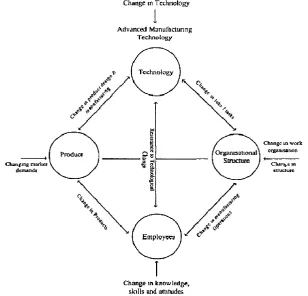
present day manufacturing managers Indeed, any changes m the technology have an effect on products,
employees and organizational structure and the relationships between them, as shown in Figure 1
Figure 1 Conceptual Framework of Technological Change and Posited Relationship
II. AIM AND RESEARCH OBJECTIVES
The primary aim of this research is to estimate the benefits gained from the successful implementation of the
demonstrate the importance of these benefits to overcome problems faced by industries today This research also
aims to review the evidence of CIM effectiveness and efficiency in helping industry to survive in today‟s
competitive global market
The research has been broken into three main objectives
1 To conduct a literature review on The CIM system and establish the rationale behind CIM, the components of
a CIM system, it‟s benefits and a critique of the CIM system.
2 To distribute questionnaires to manufacturing companies to establish the status of CIM within manufacturing
companies.
3 To conducting interviews with some manufacturing professionals in a sample of companies to explore why
they do not currently use CIM and the possibility of implementing CIM in the future.
III. DISCUSSION OF IMPLEMENTATION AND NOT IMPLEMENTATION CIM
The primary aim of this research is to estimate the benefits gained from the successful implementation of
components of a Computer Integrated Manufacturing (CIM) system in some companies and demonstrate the
importance of these benefits to overcome today‟s industrial problems. This research also aimed to review the evidence of CIM effectiveness and efficiency in helping industry to survive in today‟s competitive global market. This research explores the possibility of encouraging developing countries‟ industries to start investing
and implementing CIM. The purpose of this research was to critically analyses CIM technology in the Irish
manufacturing economy and establish if CIM technology is cost effective, reduces production time, improves
quality, reduces cost and if it is an efficient tool for management.
Manufacturing is fundamental to economies around the world Today‟s industry competes in a truly international
marketplace. For any country to compete in this market, it must have companies that provide high-quality
products to their customers in a timely manner. The global competition, which exists today, not only from
developed industrial countries, but also from low labor cost countries such as China, forces manufacturing
managers to consider and adopt innovative and advanced technologies (13). Implementation of CIM could help
companies achieve their competitive goals to survive in the global market environment as long as the
technologies chosen are appropriate to meet their objectives. Application of CIM has been proposed as a
necessary step towards the future in manufacturing to face competitive challenges.
This research emphasizes the significant role of Computer Integrated Manufacturing (CIM) to a country‟s
economy. Also, the results of the literature survey indicate that introducing a new technology in any enterprise
can lead to reduced costs, and this is the main target of any manufacturing management in today‟s competitive
global industry and market, such as decreased labor cost and consequent decrease in unit costs. Considering the
costly, complicated and lengthy processes of CIM implementation, it is necessary to gain a comprehensive and
reliable picture of CIM implementation in a country where CIM technology is already being implemented.
The current status of CIM implementations in Irish manufacturing companies.
where it was also necessary to conduct interviews with manufacturing managers and production engineers to
analyses the level of awareness of the benefits of CIM technology.
By establishing the benefits of CIM technology in manufacturing companies
There are several issues arising from the literature review and the primary research conducted during the course
of this dissertation. Based on the literature review it is evident that companies need to reduce Lead-time, Costs
and Inventory. While, companies need to increase quality and responsiveness
to customers. Based on the literature review there is evidence to suggest that implementing CIM can produce an
increase of productivity of some 40-70%. Both design costs and the in-shop time of a part can also be reduced
by 15-30% and 30-69% respectively. Scrap can also be reduced by 20-50%, leading to better product quality
(19).
Results from an empirical investigation into the use of Computer Integrated Manufacturing in German hardware
manufacturing indicate a large number of reasons encouraging firms to invest in CIM. The most prominent of
these reasons are a reduction in order processing time, an increase in scheduling effectiveness, and shorter
delivery delay. These findings are supported in the results of the primary research conducted in this dissertation.
This research Paper showed that Irish companies using CIM have identified four
Clear benefits of using CIM:
□ Improved product. □ Reduced production time. □ Reduced inventory.
□ Cost reduction and cost effectiveness.
When considering whether or not to implement CIM, companies it should bear in mind these obvious benefits of
CIM.
IV. CIM IMPLEMENTATION AND COST EFFECTIVE
“Although the cost o f such a totally automated system is still unacceptably high, some companies have made
considerable steps toward CIM with the goal o f gaining a competitive advantage in the world marketplace”
(16). The results showed that implementing CIM components is an expensive undertaking. Of those who use
CIM, 54% chose quite expensive and 19% chose very expensive. 33% of those not using CIM who answered
the question chose financial obstacles as a reason for not using CIM. So cost is one of the major obstacles
toward implementing CIM. This is also true for companies in Libya. Most of the interviewees stated that the
cost of CIM was a reason for not considering the introduction of CIM. Implementing CIM components requires
a big budget or a large investment from a company. Many countries should consider investment from foreign
sources as an effective way in helping to implement CIM in a country that cannot offer this kind of initial
investment.
The results of the survey showed Ireland has huge foreign investment especially from developed industrial
countries. For example 26% of the companies surveyed are USA owned. This supports the finding of Hashmi
and Cuddy that the majority of the larger manufacturing industries in India who use new technological
„U.S. investment has been particularly important to the growth and modernization of Irish industry over the past
25 years, providing new technology, export capabilities, and employment opportunities‟. It is evident from the
interview results that Libya‟s industry needs investment from inside and outside to achieve competitiveness in
the market place. Despite the high income generated in Libya through the oil industry, there is a low level of
inside investment in the broader industrial sector. In Libya, there is little foreign investment due to the political
nature of the country to date. In recent times, Libya‟s industry has diversified from public sector to encouraging
private investment and ownership. At present there are several foreign owned industries competing to invest in
Libya and take advantage of the incentives offered .
Once investment is secured it is important for all managers to take into account the overall costs of
implementing CIM including the cost of new equipment and skills training. These costs may result in some
managers resisting the implementation of CIM technology. Small to Medium sized Enterprises (SMEs) need
external assistance and technical recourses to implement CIM as they may lack some or most of these facilities
themselves. When cross tabulation was used to analyse the numbers of small to medium sized companies using
CIM compared to larger companies, it showed that a far greater percentage of larger companies were using
some components of CIM (86%), in comparison to medium (60%) or smaller (50%) sized companies.
Considering the high cost of implementing CIM components, a sequential implementation strategy is an
important approach. Investment in CIM can be, or perhaps even should be, started with one or only a few
components at a time. Further elements can be added on a step-by-step basis, as production facilities require, or
financial and human resources permit the investment. Most of the CIM components can be implemented
individually, thus allowing CIM to be approached in a step-by-step manner (16). This makes CIM both
attractive and feasible for smaller and medium sized companies. Due to this sequential implementation strategy
option, the benefits of CIM are not restricted to large companies. It is important however, that companies
continue to add to the components they use. It can be seen from the results of this research that some companies
in Ireland are not using CIM to its full potential as they currently limit their use of CIM to only one or two
components. They should continue to invest in the other CIM components to gain the full benefits of CIM. As
Milling has confirmed, investment in isolated CIM components- CAD equipment, for example, that is used as a
stand-alone tool will have limited effect on productivity. Only if it is connected to and shares its data with other
equipment, can an over proportionate return on investment be expected.
Cost Effectiveness of CIM
As stated in the literature review, some of the previous studies have highlighted that one of the barriers to
implementing CIM is the difficulty in justifying investment in CIM. This study confirmed that CIM is a cost
effective system as 67% of the surveyed companies using CIM, stated that CIM is cost effective.
Other results from the questionnaire support this finding. For instance, 83% of respondents using CIM
emphasized that using CIM has improved their product and 80% stated that it has reduced production time.
Product improvement and reduced production time are important aims for most industries.
V. CONCLUSION
1. Due to the fact that CIM would reduce costs and increase competitiveness, the successful implementation of
CIM is essential in today‟s global market.
2. Although they may take some time to be seen, successful implementation of CIM has wide-reaching benefits
for companies.
□ Operational - reduced costs, reduced cycle time, improved quality and productivity. □ Managerial - Better resource management.
3. The successful implementation of CIM is dependent on adequate investment.
□ Implementing CIM is costly, but cost-effective.
□ Investment can be a combination of national and foreign investment.
□ Where funds are limited step-by-step investment and implementation can be a highly successful
method.
4. Investment in CIM is quite expensive, so a long-term commitment to the investment must be made and
management must consider the investment as essential to achieve the company‟s long-term goals. CIM funding
should be part of the future planning because CIM is evolutionary.
5. The successful implementation of CIM is dependent on sufficient expertise and skilled workers.
□ Raising awareness of CIM is dependent on research and sufficient links between industry and
relevant third level institutions.
□ Employees accept new technologies if they have access to sufficient training. □ Adequate training depends on sufficient investment in this area.
REFERENCES
[1] AlirezaAnvari(2011) A Study on Total Quality Management and Lean Manufacturing: Through Lean
Thinking Approach World Applied Sciences Journal 12 (9): 1585-1596, ISSN 1818-4952 © IDOSI
Publications, 2011
[2] Mr. Amit Sharma (2013) Different strategies of optimization used in Indian Manufacturing Companies,
International Journal of Scientific and Research Publications, Volume 3, Issue 12, December 2013 ISSN
2250-3153
[3] Karkoszka T, Honorowicz J. Kaizen philosophy (2009) a manner of continuous improvement of processes
and products. Journal of Achievements in Materials and Manufacturing Engineering 2009; 35(2):197-03.
[4] Khalid SAS. (2011) Productivity improvement of a motor vehicle inspection station using motion and time
study techniques. Journal of King Saud University- Engineering Sciences 2011; 23:33–41.
[5] Khamis N, Rahman MNA, Jamaludin KR, Ismail AR, Ghani JA and Zulkifli R.(2009) Development of 5S
Practice Checklist for Manufacturing Industry. Proceedings of the World Congress on Engineering 2009;
1:978-88.
[6] Deif A (2012) Implementation of Lean tools and techniques in automotive industry. Journal of Applied Sciences 2012; 12(10):1032-37.
[7] Lewoc JB, Izworski A, Skowronski SF, Kieleczawa A and Kopacek, P. (2012) Emerging Smart
Research and Applications 2012; 2(4):930-36.
[8] Masood T and Khan I.(2004) Productivity Improvement through Computer Integrated Manufacturing in Post
WTO Scenario, National Conference on Emerging Technologies 2004.
[9] Moin CJ, Haque R and Mahabubuzzaman AK.(2010) A study on Computer integrated manufacturing
method in Bangladeshi textile industry. Journal of Innovative development strategy. 2010; 4(1):5-11.
[10] Nagalingam SV and Lin GCI.(1999) Latest developments in CIM. Robotics and Computer Integrated
Manufacturing 1999; 15:423-30.
[11] Titu MA, Oprean C and Grecu D. (2010) Applying the Kaizen Method and the 5S Technique in the
Activity of Post-Sale Services in the Knowledge-Based Organization. Proceedings of the International
Multi conference of engineers & computer scientists 2010; 3:978-88.
[12] Upadhye N, Deshmukh SG, Garg S. (2010) Lean manufacturing system for medium size manufacturing
enterprises: an Indian case. International Journal of Management Science and Engineering Management
2010; 5(5):362-75.
[13] Veeramani D, Tserng HP, Russell JS.(1998) Computer-integrated collaborative design and operation in the
construction industry. Automation in Construction 1998; 7:485-92.
[14] Vendan SP, Sakthidhasan K.(2010) Reduction of Wastages in Motor Manufacturing Industry. Jordan
Journal of Mechanical and Industrial Engineering 2010; 4(5):579-90.
[15] Wang L.(2008) Wise-shop floor: An integrated approach for Web-based Collaborative Manufacturing.
IEEE Transactions on Systems, Man, and Cybernetics- Part C: Applications and Reviews 2008;
38(4):562-73. Wikipedia.
[16] Xu X. (2012) From Cloud computing to cloud manufacturing. Robotics and Computer-Integrated
Manufacturing 2012; 28:75-86.
[17] Battini D, Faccio M, Persona A, Sgarbossa F.(2010) "supermarket warehouses": Stocking policies
optimization in an assembly-to-order environment. International Journal of Advanced Manufacturing
Technology.2010;50 (5-8):775-88.
[18] Dimitrov D and Saxer M.(2012) Productivity Improvement in Tooling Manufacture through High Speed 5
Axis Machining, Procedia CIRP 1 2012 277 – 82.
[19] Gupta A and Kundra TK. (2012) A review of designing machine tool for leanness. Indian Academy of
Sciences. 2012;37(2):241–59.
[20] Jyothi V.E., Rao K.N., (2012), Effective Implementation of Agile Practices – In coordination with Lean