LEBANESE AMERICAN UNIVERSITY
THREE-PHASE APPROACH FOR
CURRICULUM-BASED COURSE TIMETABLING
PROBLEM
By
HANAA SALEM EL-JAZZAR
A thesis submitted in partial fulfillment of the requirements for the degree of Master of Science in Computer Science
School of Arts and Sciences
L e b a n e s e A m e r i c a n U n i v e r s i t y
School of Arts and Sciences - Beirut Campus
L e b a n e s e A m e r i c a n U n i v e r s i t y
School of Arts and Sciences - Beirut CampusThesis Defense Result Form
L e b a n e s e A m e r i c a n U n i v e r s i t y
School of Arts and Sciences - Beirut CampusThesis Approval Form
LEBANE LICENSE By signing to Lebane translate abstract) w not limite content, t preservatio submissio the submi contained best of you material fo the unrest by this lic acknowled IS BASED AN AGEN THAT Y OBLIGAT will clearl will not submissio Name: Signature
THES
SE AMER E g and subm ese Americ (as defined worldwide i ed to audio translate th on. You al n for purpo ssion is you in this lice ur knowled for which yo tricted perm cense, and dged within D UPON W NCY OR O YOU HAVE TIONS RE ly identify y make any n. HanaaIS COPY
RICAN UN mitting this l can Univer d below), in print and o or video. e submissi lso agree t oses of secu ur original ense. You a dge, infringe ou do not h mission of th that such t n the text or WORK THA ORGANIZA E FULFIL QUIRED B your name(s alteration, a SalemEl-YRIGH
NIVERSITY icense, you rsity (LAU) and/or dis d electronic You agree on to any that LAU urity, back¬ work, and t also represe e upon anyo hold copyrig he copyrigh third-party r content of AT HAS BE ATION OT LLED ANY BY SUCH s) as the aut other than -JazzarT RELE
Y NON-EX u (the author ) the non-tribute you format and e that LAU medium o may keep ¬up and pre that you ha ent that you one's copyri ght, you rep ht owner to owned mat f the submi EEN SPONS THER THA Y RIGHT CONTRAC thor(s) or ow n as allowEASE FO
XCLUSIVE r(s) or copy exclusive r ur submiss d in any med U may, wit or format f more than eservation. ave the rightur submissi ight. If the s present that grant LAU terial is cle ission. IF T SORED OR AN LAU, Y OF REVI CT OR AG wner(s) of t wed by thi Date: June
ORM
E DISTRIB yright owne right to rep ion (includ dium, inclu thout chang for the pur n one copy You repres t to grant th on does no submission t you have o U the rights early identi THE SUBM R SUPPORT YOU REPR IEW OR GREEMEN the submiss s license, e 8, 2012 BUTION r) grants produce, ding the uding but ging the rpose of y of this sent that he rights ot, to the contains obtained required fied and MISSION TED BY RESENT OTHER T. LAU sion, and to yourPLAG
I certify th failure to against me This work my own I Name: SignatureGIARISM
hat I have r comply w e. k is substant have indica HanaaM POLI
read and un with this Po tially my ow ated that by a Salem ElICY CO
derstood LA licy can le wn, and to t acknowled -JazzarMPLIAN
AU’s Plagia ead to acad the extent th dging its souNCE ST
arism Polic demic and d
hat any part urces. Da
TATEME
y. I underst disciplinary t of this wo ate: June 8,ENT
tand that y actions ork is not , 2012To my adorable and lovely family,
To my special loving and caring parents,
To my beloved LAU, my second big family
ACKNOWLEDGMENTS
I would like to sincerely thank my supervisor Dr. Nashaat Mansour who guided me and supported me during all my thesis work. His support for me over the years, since I entered LAU, was a great push for me to continue my thesis, and not to surrender easily to the external pressures of life.
I would like to thank greatly my family, my father, my mother, my fiancé, my sister and my brothers, for supporting me, standing by my side, and being so patient with me. Without them, I couldn’t make it. I would like also to thank all my true friends whose words were really innovative for me.
I like to give unique thanks to Dr. Tarek Nawas who was like my second father and special thanks to Dr. Ramzi Haraty, Dr. Samer Habre, and Dr. Faisal Abukhzam since they were like our big brothers during our study at LAU. I would like to thank them from inside my heart because they helped me to fulfill my dreams and get both of my degrees, the BS and the MS, from LAU, my beloved university and my second family.
Finally, I would like to sincerely thank Dr. Sanaa Sharafeddine and Dr. Abbas Tarhini for being in my thesis committee and for their support for me during my study at LAU.
Three-Phase Approach for Curriculum Based Course
Timetabling Problem
Hanaa Salem El-Jazzar
Abstract
University course timetabling is an important problem for scheduling courses into predefined periods and rooms over a week with a given set of constraints. This problem is NP-complete and, thus, heuristics are required to produce good suboptimal timetables. This work considers the curriculum based course timetabling problem (CCTP) and proposes three-phase heuristics algorithm that fulfils the requirements of zero hard constraints values and minimal values for soft constraints. The three algorithms are simulated annealing (SA), scatter search (SS) and a tuning heuristic (THEU). We have run our algorithm on subject problems listed at the international timetabling competition in 2007 (ITC2007) and we have compared our results with those of the winner of ITC2007, which is Muller’s hybrid algorithm. Our results show that our approach produces better results than Muller’s for larger or more complex problems.
Keywords: Metaheuristics; Scatter search algorithm; Simulated annealing;
TABLE OF CONTENTS
LIST OF TABLES XIII
LIST OF FIGURES XIV
LIST OF CHARTS XVI
LIST OF ABBREVIATIONS AND ACRONYMS XVII
1 CHAPTER 1 1-5
INTRODUCTION 1
1.1 TIMETABLING PROBLEMS 1
1.2 UNIVERSITY COURSE TIMETABLING 2
1.2.1 Post-Enrolment Course Timetabling 2
1.2.1.1 Problem Formulation 2
1.2.2 Curriculum-Based Course Timetabling 4
1.3 RESEARCH OBJECTIVES AND CONTRIBUTION 4
1.4 THESIS ORGANIZATION 5
2 CHAPTER 2 6-41
PREVIOUS METHODS FOR UNIVERSITY COURSE TIMETABLING PROBLEMS 6
2.1 GENERAL UNIVERSITY COURSE TIMETABLING PROBLEMS 6
2.1.1 A Combination of Local Search with Particle Swarm Optimization 6
2.1.2 Iterative Forward Search Algorithm to Solve a Hard Course Timetabling
Problem 9
2.1.3 A Steady State Genetic Algorithm 14
2.1.4 A Genetic Algorithm Optimizer 15
2.1.5 Multi Agents (Artificial Intelligence) Approach 18
2.1.6 A Simulated Annealing Algorithm implemented with a new Structure of
Neighborhood 20
2.2 POST-ENROLMENT BASED COURSE TIMETABLING PROBLEMS 22
2.2.1 Hybrid Multi-Neighborhood Particle Collision Algorithm 22
2.2.2 A Hybrid Approach Using Simulated Annealing 24
2.2.3 Ant Colony Optimization Algorithm 25
2.2.4 An Extended Great Deluge Algorithm 27
2.3 CURRICULUM-BASED COURSE TIMETABLING PROBLEMS 28
2.3.1 Muller’s Hybrid Approach with Iterative Forward Search, Hill Climbing,
Great Deluge and Simulated Annealing 28
2.3.3 Great Deluge Algorithm with Kempe Chain Neighborhood Structure 35
2.3.4 A Repair-Based Heuristic Search 36
2.3.5 A Round Robin Strategy over Multi-Algorithms 39
3 CHAPTER 3 42-50
CURRICULUM-BASED COURSE TIMETABLING PROBLEM 42
3.1 PROBLEM DESCRIPTION AND MAIN ENTITIES 42
3.2 PROBLEM CONSTRAINTS 43
3.2.1 Hard constraints 43
3.2.2 Soft Constraints 44
3.3 DESCRIPTION OF INSTANCES AND FILE FORMATS 44
3.3.1 Input Structure 45
3.3.2 Output Structure 46
3.4 STANDARD SOLUTION VALIDATION 46
3.5 USEFUL PROBLEM SPECIFIC NOTATIONS AND OBJECTIVE FUNCTION
FORMULATION 47
3.5.1 Problem Specific Notations and Counters 47
3.5.2 Problem Specific Hard Constraints Parameters 48
3.5.3 Problem Specific Soft Constraints Parameters 49
3.5.4 Objective Function 49
4 CHAPTER 4 51-81
THREE-PHASE APPROACH DESIGN FOR SOLVING CURRICULUM-BASED COURSE
TIMETABLING 51
4.1 OVERVIEW OF THE THREE-PHASE HEURISTICS ALGORITHM 51
4.2 SOLUTION REPRESENTATION AND INITIAL SOLUTION CONSTRUCTION 52
4.2.1 Solution Representation 52
4.2.2 Initial Solution Construction 53
4.3 PHASE ONE:SIMULATED ANNEALING ALGORITHM 55
4.3.1 Simulated Annealing Algorithm and Energy Function 55
4.3.2 The Metropolis Algorithm and the Perturbation Function 56
4.3.3 The Cooling Schedule 58
4.3.4 Partial Calculation of Objective Function 59
4.3.4.1 Time Availability Hard Constraint Partial Penalty Value 59
4.3.4.2 Teacher Conflicts Hard Constraint Partial Penalty Value 59
4.3.4.3 Curriculum Conflicts Hard Constraint Partial Penalty Value 61
4.4 PHASE TWO:SCATTER SEARCH ALGORITHM 62
4.4.1 Partial Calculation of Objective Function for Scatter Search 65
4.4.2 The Diversification Generation Method 65
4.4.2.1 Diversification Generation Method 65
4.4.2.2 Solution Equality 67
4.4.3 The Improvement Method 67
4.4.3.1 Improvement Method 67
4.4.3.2 Problem Specific Moves 68
4.4.4 Reference Set Update Method 70
4.4.5 Subset Generation Method 73
4.4.5.1 The Adapted Subset Generation Method 73
4.4.5.2 Partially Dynamic Subset Generation Method 74
4.4.6 Combination Method 76
4.4.6.1 The Combination Procedure 76
4.4.6.2 The Repair Heuristic 80
4.4.7 Termination Condition 80
4.5 TUNING HEURISTIC PHASE 81
5 CHAPTER 5 82-89
EMPIRICAL RESULTS AND DISCUSSIONS 82
5.1 EXPERIMENTAL PROCEDURE 82
5.2 RESULTS AND DISCUSSIONS 83
6 CHAPTER 6 90-91
CONCLUSION AND FUTURE WORK 90
REFERENCES 92-98
7 APPENDIX I 99-106
BACKGROUND ON SCATTER SEARCH 99
I.1 HISTORICAL BACKGROUND 99
I.2 SCATTER SEARCH TEMPLATE AND BASIC DESIGN 100
I.3 SCATTER SEARCH VERSES GENETIC ALGORITHM 104
I.4 SCATTER SEARCH APPLICATION ON DIFFERENT PROBLEMS 105
LIST OF TABLES
Table Table Title Page
Table 2.1: Subjects Allocations for UCTP 7
Table 2.2: Characteristics of the Problems to be Tested (Spring 2007) 10
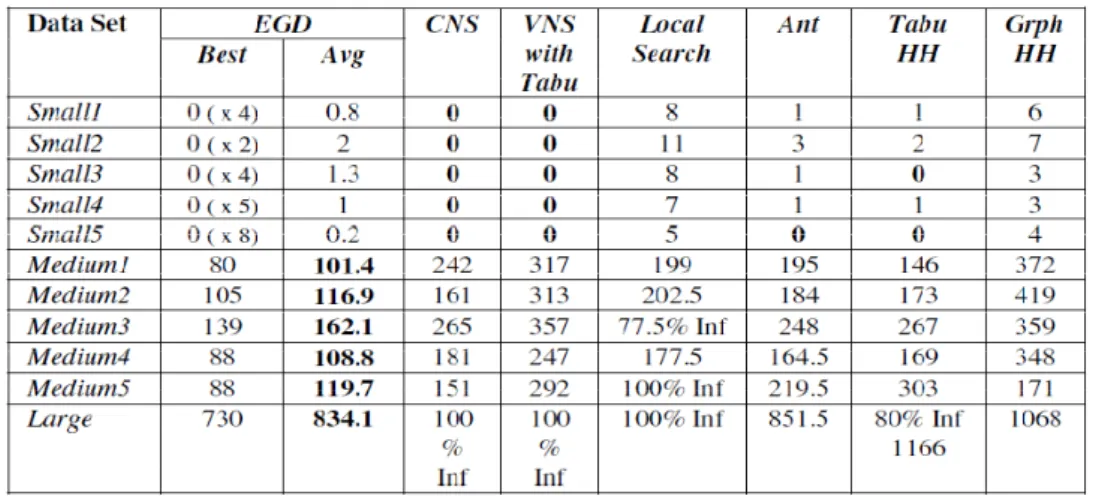
Table 2.3: Experimental Results for EGDA 28
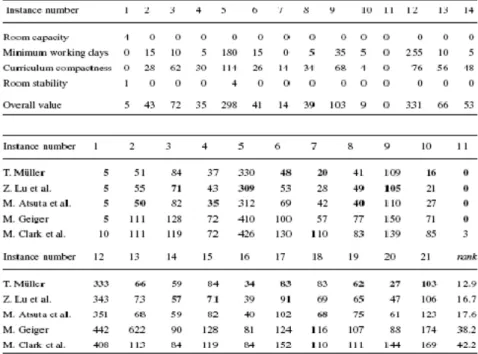
Table 2.4: Top Table Shows Submitted results of Muller, Bottom Table shows the best
recorded scores of finalists 32
Table 2.5: Results of QuikFix Tests. 38
Table 2.6: The Best Run Result of Abdulla's et al. Approach in Comparison with Other
Approaches. 41
Table 4.1: Summary of Useful Notations and Symbols Used in SS Algorithm 63
Table 5.1: Input Instances (Subject Problems) Properties. 84
Table 5.2: Three-Phase Heuristic Approach and Muller’s Hybrid Approach Testing
Results for CCTP 84
Table I.1: SS Application on Different Types of NP Problems 105
LIST OF FIGURES
Figure Figure Title Page
Figure 2.1: PSO Along with Local Search 8
Figure 2.2: Pseudo-Code of the Search Algorithm. 11
Figure 2.3: IFS Algorithm (Step 1) 12
Figure 2.4: IFS Algorithm (Step 2) 12
Figure 2.5: IFS Algorithm (Step 3) 12
Figure 2.6: IFS Algorithm (Step 4) 12
Figure 2.7: Constraint-Based Statistics Array Format and Example. 13
Figure 2.8: The Agents Communication 19
Figure 2.9: Schematic Diagram of CBS when SA is used 30
Figure 2.10: GD Algorithm Schema in Minimization Context 30
Figure 2.11: Altered Great Deluge Algorithm Schema in Minimization Context 31
Figure 2.12: Pseudo-Code of the Hybrid GA 33
Figure 2.13: The Kempe Chain Move 35
Figure 2.14: Improvement Method Pseudo-code 40
Figure 3.1: Input Format 45
Figure 3.2: Sample Input Data 45
Figure 3.3: Output Line Format and Sample Solution for ExampleProblem in Figure 16 46
Figure 3.4: Validator’s Result for the ExampleProblem 47
Figure 4.1: Solution Representation 53
Figure 4.2: Semi-Random Initial Solution Generation Using Controlled Randomization
Technique 54
Figure 4.3: SA Algorithm for solving hard constraints violations in CCTP 56
Figure 4.4: Perturbation Operation of our Simulated Annealing algorithm 57
Figure 4.5: Pseudo Code for Calculating T0 58
Figure 4.6: The Change in Teachers Conflicts Penalty When a Swap Move is Applied. 60
Figure 4.7: General Scatter Search Pseudo-code used in our implementation 65
Figure 4.8: Pseudo-code for the Diversification Generation Method of Scatter Search 67
Figure 4.9: Improvement Method Pseudo-code 68
Figure 4.10: Reference Set Update Method Pseudo-code (2nd case) 72
Figure 4.12: Partially Dynamic Subset Generation and RefSet Update Methods Pseudo-Code
for Subsets of Type 1 and 2 76
Figure 4.13: Combination Method Pseudo-code for Subset Types 1 and 2 79
Figure 4.14: Reference Set Update Method Pseudo-code (2nd case) 80
Figure 4.15: The Cycle of Generating Feasible Trial Solutions 81
Figure I.1: Schematic Diagram of the Basic SS Algorithm Design 102
LIST OF CHARTS
Chart Chart Title Page
Chart 5.1: Line Chart for Best Soft Constraints Violations Values for Both Approaches 85
Chart 5.2: Bar Chart for Best Soft Constraints Violations Values for Both Approaches 85
Chart 5.3: Line Chart for Average Values of Soft Constraints Violations for Both
Approaches 86
Chart 5.4: Bar Chart for Average Values of Soft Constraints Violations for Both
Approaches 86
Chart 5.5: Best Values of OFEvals for Both Approaches 87
Chart 5.6: Average Values of OFEvals for Both Approaches 87
Chart 5.7: SD Values for SCV 89
LIST OF ABBREVIATIONS AND ACRONYMS
SS: Scatter Search
SA: Simulated Annealing
THEU: Tuning Heuristic
CTP: Course Timetabling Problem
CCTP: Curriculum-Based Course Timetabling Problem
UCT: University Course Timetabling
UCTP: University Course Timetabling Problem
PECTP: Post-Enrollment Based Course Timetabling Problem
PATAT: International Series of Conferences on the Practice and Theory of Automated Timetabling
WATT: EURO Working Group on Automated Timetabling
ITC2007: Second International Timetabling Competition sponsored by PATAT and
WATT.
OF: Objective Function
EF: Energy Function
GA: Genetic Algorithm
SSGA: Steady State Genetic Algorithm
MGA: Modified Genetic Algorithm
CGA: Cooperative Genetic Algorithm
EA: Evolutionary Approaches or Algorithms
LOP: Linear Ordering Problem
NN: Neural Network
TSP: Travelling Salesman Problem
MAX-SAT: Maximum Satisfiability Problem
HC: Hill Climbing
PSO: Particle Swarm Optimization
PCA: Particle Collision Algorithm
MPCA: Multi-Neighborhood Collision Algorithm
GD: Great Deluge
AGD: Altered Great Deluge
IFS: Iterative Forward Search
CBS: Constraint-Based Statistics
PSN: Problem Specific Neighborhood
RMO: Ranking Mutation Operator
IFO: Intersection Filter Operator
ACO: Ant Colony Optimization
MMAS: MAX-MIN Ant System
ACS: Ant Colony System
RR: Round Robin
RBH: Repair-Based Heuristic
DGM: Diversification Generation Method
IMP: Improvement Method
SGM: Subset Generation Method
1
C
HAPTER
1
I
NTRODUCTION
1.1
Timetabling Problems
Timetabling problems are one of the most challenging problems of time-based scheduling and combinatorial optimization nature that tend to be solved using a combination of search-based metaheuristic techniques and methods that usually leads to “acceptable” and “good” but “sub-optimal” solutions in a reasonable time. Timetable scheduling problems are known to be computationally NP-complete, hard and complex problems because there is no deterministic polynomial time algorithm that can solve them especially with a large number of instances (Chu and Fang, 1999). Moreover, using advanced search and constraint satisfaction techniques based on different meta-heuristic methods showed effectiveness in pruning the search space but it does not guarantee the foundation of an optimal solution since meta-heuristics work as general methodologies (templates) that need to be tailored to solve different timetabling instances, as Talbi (2009) defined them, as well as those techniques concentrate on solving hard constraints while it is more difficult to handle soft constraints (Chu, Chen and Ho, 2006). Thus, here we have to distinguish between two types of constraints: hard and soft. Hard constraints are rigidly enforced and they must be satisfied in the solution. Feasible solutions are the solutions that satisfy the hard constraints. On the other hand, the soft constraints are those that are desirable to
satisfy, but they are not essential. In real-world timetabling problems, it is almost impossible to solve all of the soft constraints violations.
Timetabling problems can be categorized among one of the most important real life problems and can be divided into various types, like, for example, transportation timetabling, university timetabling (examination timetabling, courses timetabling, …), nursing timetabling, …etc, by considering different specific constraints, processes and resources. In each timetable scheduling problem, there are events that should be spread over certain times taking into consideration satisfying several problem constraints. However, it is difficult to come up with a general algorithmic method that can solve all instances of a timetabling problem because each particular problem instance has its own certain special constraints as well as because of the need to use some simplification assumptions to lessen the problem hardness. Besides
that, real-life timetabling problems often involve constraints that cannot be represented or stated (Chu and Fang, 1999). Performance evaluation for any algorithmic approach used is based on the time spent in producing a feasible timetable (solution) as well as on evaluating the quality of this solution that can be assessed on the basis of how well the soft constraints are satisfied.
1.2
University Course Timetabling
Among all timetabling problems, university course and exam timetabling problems have captured the attention over the years because of their importance in the academic administrative activities that almost all academic institutions need to deal with on regular basis on regular basis. In general, university timetabling is a combinatorial optimization problem of practical relevance defined as assigning a set of events (courses or exams) to a finite number of timeslots while trying to satisfy a set of hard and soft constraints (Qu and burke, 2009). University timetabling problems need much (human or computing) efforts in coming up with solutions that are both effective and of a high quality. University course timetabling problem (UCTP) can be categorized into two types: curriculum-based course timetabling problem (CCTP) and post-enrolment course timetabling problem (PECTP) as defined by ITC2007.
1.2.1 Post-Enrolment Course Timetabling
In general, post-enrollment course timetabling (PECT) problem is a combinatorial optimization problem based on real world course scheduling instances where the schedule is generated after the students enroll or register in different courses and events offered by the department or the institution seeking the timetable. This timetable construction method is usually favored by many educational institutions like universities because it provides the students with the capability of maximizing their choices while making sure that the available resources are used effectively and as efficiently as much as possible, though this construction method is quite a risky option since there is a small room for error in it.
1.2.1.1 Problem Formulation
The PECTP as explained by Di Gaspero, McCollum and Schaerf (2007), in the
1- Set of events/courses that need to be scheduled into periods (timeslots*days);
2- Set of rooms in which the courses will be given where each room has a specific capacity;
3- Set of students registered/enrolled in courses where each student is registered in specific number of courses;
4- Set of features and constraints that need to be satisfied by the rooms, required by the courses as well as the students. For example, some courses can be assigned to specific periods in the timetable.
Hard Constraints
In order to have a feasible timetable, all the following hard constraints of the produced solution for PECTP should be satisfied:
1- Each student is not allowed to be present at more than one course at a time; 2- Every room should not occupy a number of students more than its allowed
capacity as well as it should satisfy the course requirements;
3- Courses’ conflicts are not allowed; i.e. only one course is allowed to be scheduled at specific period in a specific room;
4- Each course has available periods in which it is allowed to be scheduled in; 5- Courses are scheduled in specific week.
Soft Constraints
On the other hand, when any of the following soft constraints takes place, a timetable will be penalized equally for each violation:
1- When a student is registered in a class at the day last timeslot. 2- When a student is registered in more than two consecutive classes. 3- When a student has only one class in one of days.
Solution Evaluation
To evaluate the solution, first of all, the validity of the hard constraints should be checked. If any of those constraints are violated in the problem solution, then this solution is ineligible. On the other hand, some courses are allowed to remain unassigned (unplaced). In such a case, a distance to feasibility measure should be calculated in the following way: Determine the number of students attending each unplaced course; then, the summation of these numbers will result in the distance to feasibility of the generated solution. After that, the soft constraints violations penalty value/score is calculated by, first, counting the number of occurrences for each
student having just one class on a day, then adding to them the number of occurrences for each student having more than two consecutive classes (e.g. three consecutive classes has penalty score 1, while four consecutive classes count as 2, ...etc), as well as adding the number of occurrences for each student having a class in the day last timeslot. Therefore, the best solution will be the one having the lowest “Distance to Feasibility” value, or the solution having the smallest value of soft constraints violations.
1.2.2 Curriculum-Based Course Timetabling
Di Gaspero et al. (2007), in ITC2007 competition, defined the curriculum-based course timetabling problem (CCTP) as a combinatorial optimization problem defined to be the weekly scheduling of courses’ to a given number of rooms and time periods, which consist of days and slots, while satisfying the hard and soft constraints. CCTP constraints are mainly based on courses’ conflicts that are based on the curricula determined by the university or by the educational institution and not on the post enrollment data-basis as described in details in Chapter 3.
1.3
Research Objectives and Contribution
ITC2007 is the Second International Timetabling Competition sponsored by
PATAT and WATT. It was composed of three main tracks (adding to the previous two types, the Exam Timetabling problem) as described in the content of the ITC2007
website: http://www.cs.qub.ac.uk/itc2007/. Although there is much overlap between
them, these tracks correspond to different problems in the area of educational timetabling from the practical and the research point of view.
Our objectives in this work is to provide some knowledge about previously existing approaches and algorithms used to solve university course timetabling (UCT) problems, in general, and to solve curriculum-based course timetabling problem (CCTP) in specific, given its constraints and restrictions from ITC2007
through which we noticed that many concentrated on developing faster solutions based on exhaustive search and the forgot that those approaches has to be applied on large-scale real life problems. Therefore, in our study we propose the use of Three-Phase Heauristics approach to solve CCTPusing Simulated Annealing (SA), Scatter Search (SS) (Glover, 1977, 1998; Laguna and Marti, 2003) and a greedy Final Tuning Heuristic (THEU), test its performance over five benchmark datasets and aim to prove that our proposed approach is able to produce competitive results in
comparison to those of Muller’s hybrid algorithm (2008, 2009) that participated in the competition and that we will talk more about it in Chapter 2, section 2.3.1. We are also targeting to have a scalable algorithm that can work on large-scale problems for this we chose to combine the effect of those three heuristics together. To the best of our knowledge, there is not any published and available work that is mainly based on Scatter Search algorithm to resolve CCTPalong with the other algorithms used.
According to Di Gaspero et al. (2007), the description of CCTP model, which is proposed by the ITC2007 competition, contains many characteristics that exist in some Italian and European universities. Based on that specific problem modeling, the input instances used for testing purposes are real data from Udine University in Italy. Twenty one instances were available for the competitors and they were provided by the competition organizers. Not only this, but the competition organizers also provided the solution validator C++ source code that takes the input file and the output file to produce the overall solution evaluation with some detailed descriptions for all the violations of hard and soft constraints.
In this work, we designed and implemented the three heuristics algorithm in a way that takes into consideration the objectives of CCTP. Those objectives are represented as the hard and soft constraints that need to be satisfied along with specific weights. The summation of the multiplication of those weights with the accompanying constraints constructs the objective function for CCTP whose minimization is essential to generate good and feasible course timetable. Then, we carry out some experimental tests and runs of this algorithm and compare our results with those of Muller (2008, 2009).
1.4
Thesis Organization
In the rest of this work, a closer investigation for previously developed algorithms used to solve UCTPs in general and CCTPs in specific will be presented in Chapter 2. Then, CCTP description in details as it came in ITC2007 will be in
Chapter 3. After that, in Chapter 4, we will talk about our proposed algorithm design used to solve CCTP with all its different phases and adapted methods. Furthermore, we will present the analysis of our empirical results in Chapter 5. After that, we will have the conclusion and some suggestions for further possible future work in
Chapter 6. Finally, in Appendix I, we will give a brief description and overview of SS design template.
2
C
HAPTER
2
P
REVIOUS
M
ETHODS FOR
U
NIVERSITY
C
OURSE
T
IMETABLING
P
ROBLEMS
This chapter talks about some previous approaches and methods used to solve university course timetabling problems (UCTPs) and that quietly differ in their description. The main two types of course timetabling we are concentrating on are curriculum-based course timetabling problem (CCTP) as well as post-enrolment based course timetabling problem (PECTP) along with other general university course timetabling problems.
Various different methods have been previously applied to solve different versions of university course timetabling problems (UCTPs). In the following sections, we are going to see how those different methods have been used, modified and enhanced to solve the different types of course timetabling problems. Some of those algorithms used are like hill climbing (HC), tabu search (TS), local search, great deluge (GD), artificial intelligence heuristics, genetic algorithm (GA), particle swarm optimization (PSO), …etc. Moreover, many of those algorithms concentrate on producing feasible solutions (i.e. with no hard constraints violations) in the first stage, then in the next stage, they attempt to minimize (optimize) soft constraints violations.
2.1
General University Course Timetabling Problems
In this section, we will talk about various algorithms used to solve UCTPs with different formulations from different universities.
2.1.1 A Combination of Local Search with Particle Swarm Optimization
In 2009, Irene, Deris and Mohd Hashim defined the problem of course timetabling as the organization of a set of subjects into pairs of rooms (resources) and times (as timeslots) in order to satisfy a set of constraints. They used particle swarm optimization (PSO) along with Local Search algorithm to solve University Course Timetabling (UCT) while their work mainly concentrated on two major issues: The quality of the produced university course timetable, and the time spent in producing it.
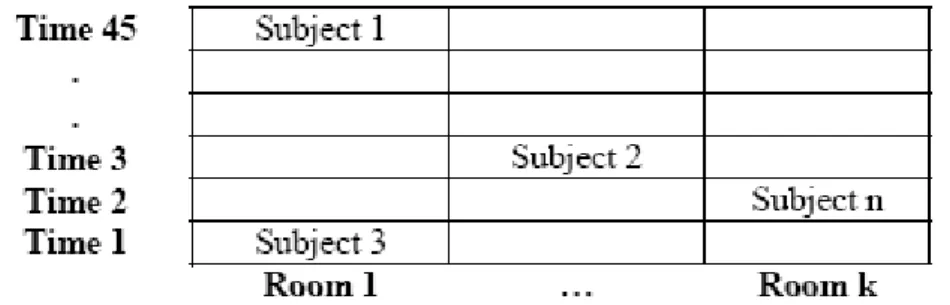
In this UCT, as a hard constraint, no two subjects are allowed to be assigned in one specific room at the same timeslot. The university courses are distributed over five days per week where each day has nine timeslots from 8 AM till 5 PM (i.e. equal distribution of one hour for each timeslot). In the Course Timetable framework used by Irene et al. (2009), 1,2,…,n are the subjects where n is the maximum number of available subjects that need to be scheduled, the timeslots are numbered from 1 up to 45 (9 * 5) and they represent the y-axis while the rooms are numbered from 1,2,…,k where k is the maximum number of rooms and they represent the x-axis as shown in
Table 2.1.
Table 2.1: Subjects Allocations for UCTP
In 1995, Kennedy and Eberhart were the first to introduce the PSO algorithm as a problem optimization heuristic is inspired by the intelligence of the swarm such as the fish schooling, the bird flocking, and the human social behavior. On the other hand, local search is a search iterative heuristic algorithm that move from a candidate solution X to another X’ in the neighborhood according to certain criteria and to a problem-specific neighborhood structure as explained in Talbi’s book (2009).
To solve university course timetabling problem (UCTP), Irene, Deris and Mohd Hashim (2009) proposed an algorithm that combines PSO and local search each representing a specific stage in their search approach. Figure 2.1 demonstrates the flowchart of the algorithm that combines PSO with local search solve UCTP.
Irene et al. (2009) have tested the algorithm on three different datasets of different complexity levels. Timetable had five days from Monday to Friday and particle size of ten (in PSO). Irene et al. algorithm was tested five times with only a single clash with penalty 5000 points. They compared their work results with those produced by the hybrid GA Constraint-Based Reasoning (CBR) technique (as cited in Zalmiyah, 2001) and with standard PSO. The experimental results showed that the combination of PSO with local search has better results in solving UCTP.
Figure 2.1: PSO Along with Local Search
In Irene et al. paper (2009), it is true that the combination of PSO and local search showed promising results by being more efficient in producing a feasible university course timetable in comparison with other published approaches on the same datasets, but they only had one hard constraint in their problem and the timeslots have fixed lengths over fixed number of days (i.e. over simplification and limitation of the problem) that leads some doubts regarding the scalability of the algorithm with more complex real-life timetabling problems. Therefore, more enhancements on the problem side should be made as well as on the algorithm side so that it will give better results for more complicated problems. Therefore, more constraints should be included (other soft and hard constraints) as well as further tuning of the PSO algorithm’s coefficients and study of their effects. Not only this,
but also different datasets can be used to further validate the algorithm and apply this technique on different timetabling techniques.
2.1.2 Iterative Forward Search Algorithm to Solve a Hard Course Timetabling Problem
In 2007, Murray, Muller and Rudová discussed some solution and modeling methods that can be used to automate the construction of UCTs at the University of Purdue (a large university). It dealt with a complex real world course timetabling problem through the complex structure of courses. The problem is transformed into a constraint-satisfaction and optimization problem using a multi-layer structural approach applying IFS heuristic and dividing the complex problem into multiple sub-problems along with applying student sectioning and scheduling as well.
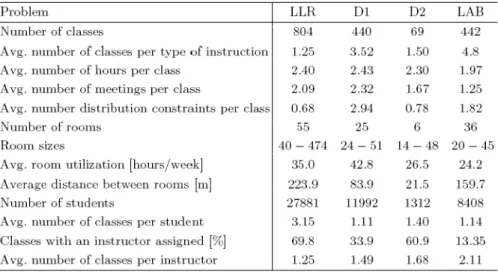
Murray et al. worked on the student sectioning and course timetabling problem at University of Purdue which applies to the following structure: Create course timetables that meet student course demands in a good way. Minimize conflicts by following a good approach to permit the students to be assigned to different courses. It is a large scale university-wide problem such that the problem includes 9,000 classes, 570 rooms, 39,000 students with 259,000 class requests. Decompose the problem into several problems (large lectures, departmental timetables). For example, the problem is divided into large lecture room (LLR), computer laboratory (LAB), and two selected departments (D1, D2) problems each with specific characteristics as shown in Table 2.2. Departmental schedule managers needed so that each is responsible for his own solutions.
Hard Constraints
This problem implements the following hard constraints:
− Resource constraints: Only one course or class can be taught by a teacher
at any time, and only one room can be assigned for it at a time.
− Distribution constraints: This constraint expresses the must be there
relations between different classes. For example, some classes should be given one after the other or two lectures of the same course cannot be given at the same timeslot.
Soft Constraints
− Soft constraints on rooms and timeslots.
− Every student can register in different classes, and the algorithm should try to minimize the student conflicts’ value among them.
− Soft distribution constraints that state the favored or the discouraged relations between different sets of classes.
Table 2.2: Characteristics of the Problems to be Tested (Spring 2007)
For each class, the information needed is the time and student requirements as well as the meeting pattern, the room necessities and preferences like the capacity, necessary equipment, room/building preference and building distances. Information about instructors…etc
System Architecture
Murray et al. modeled the problem using three-layer architecture:
− Presentation Layer: consists of the user interface, and contains course
modeling structure, classes, instructors, rooms, constraints, and requirements as submitted by the users.
− Timetabling (solver implementation) Layer: contains the timetable solver
data modeling, solver implementation as well as problem specific heuristics.
− Constraint Satisfaction (solver abstract) Layer: includes the
implementation of the optimization solver. The solver is guided by a general set of heuristics without knowledge of any classes, rooms or other timetabling specific primitives. This will help in constructing a general framework that can be used on different timetabling problems.
Timetabling Solver
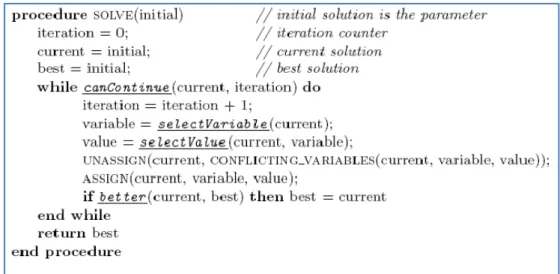
Muller’s solver is built on the basics of Iterative Forward Search (IFS) algorithm (2005) as shown in Figure 2.2. The algorithm is a combination of local search and backtracking techniques. It gradually produces feasible assignments. It is applicable to different timetabling problems and scenarios. It could be extended easily. And it uses Constraint-Based Statistics (CBS) technique (Muller, 2004, 2005).
The solver built the model of the problem and the constraints structure based on the difficulty of all the courses. Also, the problem model considers data consistency; For example, the solver has the capability of identifying and presenting any inconsistencies and possible problems that might happen in the input data.
Figure 2.2: Pseudo-Code of the Search Algorithm.
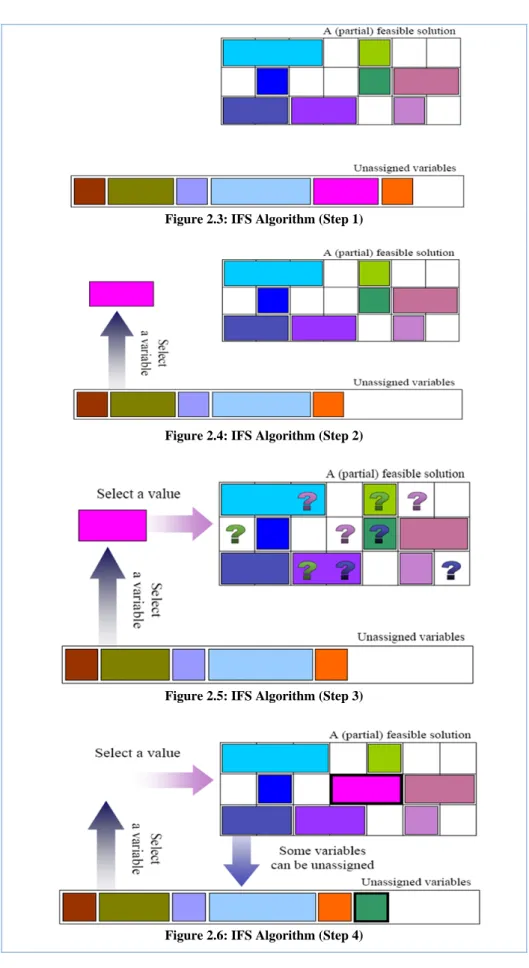
IFS algorithm starts with a solution in which all the lectures are still unassigned. Then, at each iteration, IFS algorithm selects an unassigned lecture randomly or it finds this variable among those most difficult to assign depending on the selection criteria (Figure 2.4) and it is also assigned to a best value chosen from its specific domain (Figure 2.5). If any hard constraints violations occurred with this assignment, then the conflicting lecture will be unassigned (Figure 2.6).
Figure 2.3: IFS Algorithm (Step 1)
Figure 2.4: IFS Algorithm (Step 2)
Figure 2.5: IFS Algorithm (Step 3)
Figure 2.6: IFS Algorithm (Step 4)
The value selection criteria depends on choosing the value whose assignment will decrease the solution overall cost by decreasing the number of those conflicting lectures that need to be unscheduled to take the solution back to its feasibility state.
At the first stage, the soft constraints violations can be ignore. Therefore, the value selection procedure will concentrate on selecting a value that minimizes the violations of hard constraints. The search stops when all the variables got assigned.
During those steps, Conflict-Based Statistics (CBS) (Muller et al., 2004) has been applied in order to memorize the conflicting assignments and discourage their potential repetition. Each conflict is weighted by its occurrence in the past. Furthermore, CBS is a data structure that memorizes specifically hard conflicts that occur during the search procedure. It stores the conflicts frequency and the assignments values that caused them as shown in Figure 2.7. This does not mean that it prevent such assignment from happening again, but during the value selection procedure, each hard constraint violation is weighted by its frequency which means that it is evaluated by the number of past un-assignments of the conflicting variables caused by this assignment.
Figure 2.7: Constraint-Based Statistics Array Format and Example.
Student Sectioning
In course timetabling problems, students usually request courses and the system will determine the classes (sections). The system has to respect the course structure, reservations, and student choices.
The student sectioning procedure is divided into two major phases:
− Initial sectioning of students to classes takes place during timetabling. It
aims at minimizing the potential student conflicts. This can be achieved by moving the students from one class to the other belonging to the same course throughout or following the search.
− Final Sectioning (re-sectioning) is done after the timetable for the whole
university is created, or according to user’s inquiry. The re-sectioning stands over local search algorithm with some neighborhood moves like, for
example, two students registered in the same course can exchange their class (lecture) assignment.
The system was tested on data from Spring 2007 semester from Purdue University. The departmental data was entered by separate departments’ manager each responsible for the part of the system related to them. According to the results of the tests, it became clear that the complex scheduling problems can be solved by dividing them into smaller sub-problems and solving each separately at the start.
Murray et al. faced so many challenges during their work on a complex university course timetabling and student sectioning among which is the ability to understand the structure of the problem and be able to address the concerns that the users have along the basic solution methods. Developing the framework in a three-tiered structure was a good idea that helped in developing a flexible approach to solve different problems. Also, during this work, it has been proven that it is possible to build up some models that could be comprehensive enough on a broad set of problems. This is true in concept, but it has not been tested on different wide range of data from different universities with different complexity of the course timetabling problems with different complex course structures. In this paper, it has not been mentioned clearly how the verification process of the solution took place or how the solution verification procedure for such complex problems can be done. Also, considerable training has to be performed for scheduling managers because they have to be trained on the use of the servers and this might exhaust some time and some university resources. Thus, this issue should be taken care of seriously.
2.1.3 A Steady State Genetic Algorithm
In 2002, Ozcan and Alkan presented a steady state genetic algorithm (SSGA) to solve a multi-constraint UCTP. What characterizes this approach is that it makes no distinction between hard and soft constraints. Also, it introduced ranking mutation operator (RMO), which is a new mutation operator that showed to be successful, as well as the initial experimental results look promising. In addition, a configurable application has been coded, named TEDI using SSGA.
The algorithm is targeted for a specific university in Turkey, and hence it defines the university imposed constraints on the problem. Some of these constraints are for example:
− A regular undergraduate student must complete 5-8 courses depending on the curriculum.
− Lectures of a course must not be scheduled in the same day.
− Schedule courses that belong to the same curriculum and of a specific teacher in a way that assigned periods must not conflict.
First, the algorithm creates a random initial population of individuals in which mapping of timeslots to class periods of all available courses take place. The quality of these individual solutions are measured and determined using a fitness function, and by assigning penalties to those that do not satisfy a certain constraint.
The approach defines a new operator, RMO, which chooses a gene to apply the mutation operator on it by taking the fitness contributions of genes into considerations and it uses the strategy of ranking. And because using crossover and mutation can lead to an infeasible solution, Intersection Filter (IFO) algorithm is used as a filtering repair method. The process continues until the number of generations exceeds 200,000 or the best fitness is achieved.
Preliminary tests were performed to fine-tune SSGA parameters and test the different newly developed operators. The input data consists of 66 given courses, with 205 classes’ hours need to be assigned to a timetable with 115 course gatherings. SSGA with one point crossover, RMO and IFO did the best. Ozcan and Alkan’s algorithm (2002) defines its own constraints since it is built for a specific university; thus, abiding by the university rules. Although the results that were obtained are reported to be good by the paper, the approach does not differentiate between hard and soft constraints, and hence making it a bit more unusable for standard timetabling problems. Moreover, the ranking strategy that the defined operator uses is not explained, and the filtering algorithm was not elaborated on or referenced in the paper. It appears that the algorithm is a slight variation of the classical GA. As possible future work, a method should be developed that modifies that the penalties associated with the different constraints forming the fitness function and TEDI will be adjusted to control different classroom assignments along with high school class timetabling.
2.1.4 A Genetic Algorithm Optimizer
Ghaemi, Vakili and Aghagolzadeh (2007) used computational evolutionary algorithms like GA to solve timetabling problems. The main target was to optimize
the number of conflicts in each timetable. They applied a modified GA and cooperative GA.
The timetables they used for testing came from input data for undergraduate courses for the faculty of electrical engineering in Tabriz University. The students are divided into four groups. The day is divided into four timeslots and each one consists of 90 minutes lecture time and 30 minutes break. Each course is taught for one or two timeslots per week. Five main entities define the problem and they are the Teacher, Student, Subject, Classroom location and Timeslot. Those are the main objects that will need to be directly assigned in a complete schedule.
Hard constraints:
− Every teacher can teach one class at a time.
− Only one class can be taught in one classroom at a time.
− Conflicts are no allowed to happen between subjects for students belonging to the same group.
Soft Constraints:
− The lectures of the same subject should be scheduled on different days.
− The second subject time should not be scheduled on the next day of the first time.
− No subject should be assigned to a time not allowed for it by the head of the department.
− The course/subject should not be allocated to a time period that a lecturer does not demand.
− The course/subject should not be assigned to a time period not available for the teacher of the course.
Genetic Operators (Approach)
The approach uses the following crossover, selection and mutation operators:
− Crossover: They applied three crossover types. They are single point (SX),
Uniform (UX), and modified uniform (MUX) crossover types.
− Selection: They chose to apply two selection methods. They are the
roulette wheel weighting technique and the Tournament selection in which three candidate individual chromosomes are used to select one parent.
The repair function
The chromosome coming from the crossover of the mutation methods might lose its feasibility. Then, a deterministic repair method is used (cited by Michalewicz, 1996).
Algorithm Implementation
Ghaemi et al. (2007) applied Modified GA and Cooperative GA on the problem:
− The Modified Genetic Algorithm (MGA): The algorithm begins with
pop1 and pop2, two initial sets of chromosomes. They are randomly generated. The single chromosome consists of 40 genes. To create a complete chromosome, the algorithm randomly selects from pop1 three candidate chromosomes. Then, each one of those selected chromosomes contributes with the chromosomes in pop2 to produce a complete chromosome. This approach works on both populations sets in the same way. It has the advantage of lessening the single population size as well as the results can be now reached faster and at a shorter run time.
− The Cooperative Genetic Algorithm (CGA): Usually, GAs works slowly
on large search spaces. Hence, for speeding up the execution, now apply the co-evolution method; thus, placing pop1 and pop2 respectively in species1
and species2. Separate these two species as you are independently constructing those. Moreover, their contribution will lead to the reduction in objective function cost value. Hence, co-evolution of cooperative type is being used. Accordingly, another three candidate individual chromosomes are chosen randomly from species1 and species2.
The testing results show that MGA improved considerably the algorithm’s performance by simply using some adapted genetic operators. Therefore, the overall value of the solution as well as the overall behavior of the algorithms enhanced greatly with the help of such intelligent. Not only this, but also the overall performance of the algorithm enhanced remarkably by using CGA approach.
You should note that less number of bits is needed to represent such type of chromosomes. Moreover, now the algorithm will consume less time at each run. Also, the testing results showed that the use the use of smaller population size than the one used in GA for MGA and CGA lead to better results and speeded up the
developed algorithm. Also, you can observe that the number of violated constraints in CGA is less than that produced in MGA method. However, the algorithm needs to be tested on UCTPs and on larger scale real-life problems.
2.1.5 Multi Agents (Artificial Intelligence) Approach
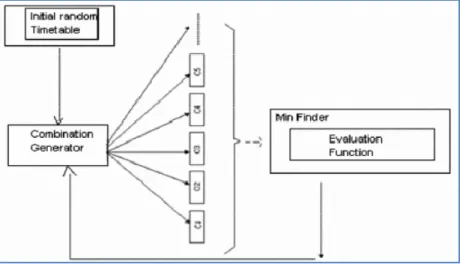
In this paper, Nandhini and Kanmani (2009) solve course timetabling problem with multi agents by using a proposed steepest ascent hill climbing approach. The following two agents are used in this approach:
− CombinationGenerator which generates the maximum possible
combinations for the input timetable.
− MinFinder which finds a timetable combination with minimum evaluation
function for further examination.
They consider a course timetabling problem model followed by Pondicherry University. It has set of five teachers T, set of five Subjects S and two Practical sessions P. They suppose that each teacher need to be assigned one subject to teach; The lectures of each subject has to be distributed over four or five different periods per week while the practical sessions has to be allocated in three successive periods only in the afternoon two distinct days. The whole timetable should satisfy the limit of having maximum thirty hours per week to schedule the subjects and the practical sessions on.
Hard Constraints
− Lectures of a teacher for a subject must be scheduled at different time slots in a week.
− All timeslots in a week should be scheduled.
Soft Constraints
− Maximum number of time slots for a subject in a day could be two.
− There could be a min of two timeslots gap between same subjects in a day.
− At least once, each subject should come in the first timeslot of the week.
− A subject should be allotted in minimum of 3 days in a week.
− Maximum in two days of a week, a subject can come in the same time slot.
− Adjacent days of a week could not have same subjects in the same timeslots.
Agents Description
The agent named CombinationGenerator is developed to work on the hard constraints violations in collaboration with the suggested heuristic processes:
− Adjacent timeslots could not have the same subjects, and teacher’s workload in a week should be equally distributed.
− When a timetable is assigned to an agent, it generates the various combinations satisfying the constraints and heuristics.
On the other hand, the agent named MinFinder is developed to work on the soft constraints and while trying to find the suitable collaboration with the minimum evaluation function. Weights are assigned to the soft constraints based on their importance. For all the combined solution generated by CombinationGenerator, their evaluation objective function value is measured by using the weights and costs of soft constraints violations. Then, the solution combination with the minimum evaluation function value is chosen by the MinFinder and it is passed through Hill Climbing for further as shown in Figure 2.8.
Figure 2.8: The Agents Communication
It is mentioned that the algorithm produces effective result, but the results data was not published in this paper. Applying those heuristics to generate different solution combinations helps tremendously in reducing the search space, and yielding the optimal solution in a faster way. The introduction of the agents, CombinationGenerator and MinFinder, helped in significantly decreasing the complexity of the problem since the work is now divided over them. The formulation of the first two soft constraints makes it hard to calculate their penalties since they are based on a probabilistic condition. Moreover, the solution encoding is not elaborated in this paper, and hence is left ambiguous. Also, unlike real world problems, their problem model only has two hard constraints which make it easier but, unfortunately, far from practical. They promised to extend this in their future
work. Lastly, the communication between the agents seems to be synchronous, and hence the agents will have to wait for each other’s input to move on. Therefore, introducing some distinction between hard and soft constraints, and using some efficient heuristics to enhance the search process should have been there.
2.1.6 A Simulated Annealing Algorithm implemented with a new Structure of Neighborhood
Liu, Zhang and Leung (2009) presented in their paper a new neighborhood structure. This neighborhood is attained after applying a number of consecutive swaps of periods in contradiction with the standard neighborhood where only one move is applied at a time. Now, SA can work on solving the course timetabling problem while using the new neighborhood structure.
There is quite some difference between university course timetabling and high school course timetabling. Usually, in high schools, the students are distributed over different classes where each one has specific classroom assigned for it, and the teachers are given specific lesson assignments to teach for different classes. High School Timetabling problems are described as the assignment of timeslots to different lessons where taking into consideration a different set of constraints.
Hard Constraints
− A teacher conflict might occur if it is assigned to two or more lessons at the same period.
− Each class is not allowed to be assigned to two or more lessons at the same period.
− Each teacher must teach exactly the lessons specified for him.
− Each class must be present at the exact lessons assigned.
− Every teacher must teach in the available timeslots allowed for him.
− Each class must have consecutive class hours during the day.
− The class is allowed to have a no-class hour only at the last period of the day.
Soft Constraints
− The teaching hours of each teacher should be continuous during the day.
− Teacher’s teaching hours should be balanced throughout the week.
− Each class should not attend the same lesson twice or more on one day.
A two-dimensional matrix CXP is needed to represent the solution, where the rows represent the classes the school has and the columns represent the periods to be assigned to teachers. Therefore, when teacher t has a lesson in class c at time p, you will find t located in row c and column p. A feasible solution should have all the (teacher,class) assignments.
Neighborhood Structure
The standard neighborhood structure is used to be the set of solutions that can be reached from the currently used solution by applying only a single move (as cited by Avella et al., 2007). However, in the new neighborhood structure, the neighborhood is constructed by applying a set of consecutive swaps between two periods and the decision whether this swap is accepted or not is taken by the SA algoritm.
Algorithm
This algorithm includes two phases. At the first phase, a feasible solution will be produced, while in the second phase, SA tries to improve the quality of the solution while keeping its feasibility.
− Phase 1: A feasible timetable construction: at this phase, only hard
constraints are considered. A stochastic strategy is adapted at this phase in which for each SA loop, a period is selected randomly (hard constraints violations might occur) and choose another one also randomly from the rest of periods. After that, a set of consecutive swaps between these chosen periods will be generated.
− Phase 2: Feasible solution optimization: After finding a feasible solution,
Liu et al. tries to decrease soft constraints penalty value while keeping the feasibility of the solution and by using a tabu search approach.
The testing of this approach was done with two benchmark data input instances based on real-world high schools scheduling problems, and the computational results showed that the SA algorithm that adopted the new neighborhood structure was able to compete with other existing methods. The results show that Liu’s et al. algorithm is capable of producing high quality solutions that can compete with those produced by other algorithms. Though their performance was good so far, but they should try to adopt this new neighborhood with other heuristics and try to solve larger-scale CTPs.
2.2
Post-Enrolment Based Course Timetabling Problems
In this section, we will talk about various algorithms used to solve course timetabling problems with different formulations from different universities while being based on students’ enrolment/registration in courses prior to scheduling them.
2.2.1 Hybrid Multi-Neighborhood Particle Collision Algorithm
In Abuhamdah and Ayob’s (2009) paper, a multi-neighborhood collision algorithm (MPCA) is introduced. It improves the PCA method suggested by Sacco for policy optimization (cited by Sacco et al., 2005). The algorithm operates on university course timetabling, and the results prove that MPCA performed better that the other existing methods in some of the instances and that it is able to give good solutions in an acceptable time. The paper uses the following same hard and soft constraints that were set in ITC2002 for post-enrollment course timetabling.
Hard Constraints
Each student cannot attend more than one course at the same allowed period. Each room should be large enough so it can hold all the attending students and, at the same time, it should be able to satisfy all the features needed by the course. Only one course can be given in any room at specific timeslot/period.
Soft Constraints
In the last period of the day, no student should have any class. A student cannot have more than two classes assigned successively. A student should not have only one class per day.
The quality of the solution timetable is calculated by incrementing the penalty value for each kind of violations of soft constraints by one point. MPCA consists of two stages. First, the constructive stage which produces a feasible solution, and second, the improvement stage which tries to optimize the soft constraints penalty value.
Problem Moves
The algorithm uses the following stage 1 and 2 moves.
Stage 1 Moves:
− Select two courses randomly and try to swap their periods’ values (and rooms if needed).
− Select randomly two periods and simply try to swap all the courses in one period with all the courses in the other period.
− Select randomly four courses and try to swap their periods (and rooms if necessary)
Stage 2 Moves:
− Select a course randomly, then select a feasible period and feasible room, and move the course to the new period assignment (and move the course to the new room if needed).
Constructive Algorithm
An initial solution is found using a constructive graph coloring heuristic. Next, a feasible solution is attained by using the following three steps successively:
− Step1: Highest Degree Heuristic: All the courses that do not conflict are
assigned. Then, the courses that were left unassigned while having a high number of conflicts to timeslots are assigned randomly. Then different rooms are selected to be assigned to different courses by applying the maximum matching method for bipartite graph.
− Step2: Local Search: If the previous step does not give a feasible timetable
still, the algorithm executes this step where two neighborhood moves (move 1 and 2) are used to produce a feasible timetable. If not feasible yet, the algorithm executes the next step.
− Step3: Tabu Search: TSis applied using only move 1. The local search is
repeated and the Tabu search until a feasible solution is obtained.
The Algorithm
MPCA is almost similar to PCA. The major difference between PCA and MPCA is that MPCA does not depend on the user-defined parameters and it has an improvement phase which is considered to be the exploration phase in which MPCA differs from PCA mainly by the use of hill climbing as an “exploration” method to do the required local search. PCA performs local search in the construction and in the scattering stage, while MPCA performs local search based on hill climbing only in the scattering stage, and this gives it the capability of running away from getting stuck at the local optima. In addition to that, while PCA employs the same neighborhood in stage 1 and 2, MPCA uses different neighborhood structures in both phases.
The criterion of accepting the solutions in the “Scattering” function are similar for both PCA and MPCA, where the approach is more probable to accept some bad solutions in order to escape local optima and solve the UCTP.
The experimental results conducted by Abuhamdah and Ayob (2009) indicate that MPCA has good performance using the multi-neighborhood structure and achieved a high quality solution for different datasets sizes. For small datasets, the results showed scores similar to those of already existing published methods. However, for medium datasets, their results were better than those previously published work. However, unlike other meta-heuristics in the literature that can be tuned towards solving more than one type of course timetabling problems and yet give acceptable results, the MPCA results proves that the approach competes with other existing methods in the literature which is not bad, but is only appropriate for solving CTPs. Some algorithms like the one for generating the initial solution were not elaborated on in this paper, or referenced, thus how to obtain an initial solution is not very clear. Therefore, the authors should look forward to combine MPCA with other optimization approaches and to enhance it with different neighborhood structures among a bigger set of neighborhoods and use it on ITC2007 input datasets.
2.2.2 A Hybrid Approach Using Simulated Annealing
In this paper, Abdullah and Hamdan (2008) considered the course timetabling problem with the following constraints:
Hard Constraints
There is no student who can register for more than one course at the same period. Each course might have specific characteristics and features that need to be taken care of when you try to assign a room for it. For example, the capacity of the room chosen to be assigned to the course must larger or equal to the number of students attending the course. And at last, there must not be any course assigned to a period and a room already assigned for another lecture.
Soft Constraints
The weights over the soft constraints penalties are equal. It happens when a course of a student got scheduled at the last timeslot of the day. Each student should have more than two successive courses. Each student should have only one course per day.
The Algorithm
Abdullah and Hamdan (2008) presented in their paper a hybrid approach that consists of three phases. In phase one, an initial feasible solution will be constructed by applying the construction heuristic. In the second phase, an improvement method that includes an iterative algorithm along with a complex neighborhood structure will be applied as well as it will apply SAas an acceptance criterion. In the third phase, a hill climbing technique will be used to further enhance the quality of the timetable.
Experiments has been conducted for the proposed approach using benchmark
CTPs (cited by Socha et al., 2002) which are divided into five small, five medium and one large datasets/problems. The tests showed that this method is capable of generating feasible solutions for all dataset instances. This paper proved that SA
acceptance criterion could help in minimizing the objective function for this problem and showed better performance in comparison to the Monte-Carlo acceptance criterion (cited by Abdulla et al., 2006) that only concentrates on the solution quality, while SA’s cooling schedule might accept some bad solutions with higher acceptance probability at the start of the search and this probability decreases with the decrease in temperature leading to intensifying the search to get a better local optimal. Therefore, this approach showed good results in comparison to other previously published approaches. However, only one large dataset was used for testing, so it cannot be said that the results are hundred percent reliable. Therefore, more tests need to be done with large datasets. Not only this, but also the data used for testing are benchmark data and not from the real-world course timetabling problem. Hence, testing on real-world data should be done.
2.2.3 Ant Colony Optimization Algorithm
This paper written by Socha, Sampels and Manfrin (2003) worked on solving a basic version for UCTP because they are targeting to perform a comparison between two ant approaches; ant-colony system and MAX-MIN ant system.
This paper uses a version of UCTP where each student has already been assigned a subset of events. In his problem, a feasible timetable has all its events assigned to a period and room assignment with the next hard constraints respected: each student is allowed to register for only one course at a time, the selected room for assignment must have a capacity higher than the number of students registered for that course, each course might have specific requirements and features that need to
be taken care of when you try to assign a room for it, and one course must be assigned to a room at specific period to avoid conflicts. In addition to those hard constraints, the weights applied over the soft constraints penalties applied over the feasible solution produced are equal. The soft constraints of the problem are as follows: when the student registers in a class at the last timeslot of the day, when the student registers in more than two courses in a row and they give one point of penalty for each attended class, and, at last, when the student got registered in only one course during one of the days of the week.
Ant algorithms
There ecists at least two variations of ant-colony optimization: The MAX-MIN ant system (MMAS) and ant-colony system (ACS). The basic operation idea is similar for both of the methods, but the main difference is in the way each update the pheromone.
Both Ant algorithms have exposed the ability to give good solutions for UCTP input data. A comparison has been done between ACS and other recent meta-heuristics, while the comparison of MMAS with some random restart local search methods showed that MMAS produced better outcome. However, both algorithms were never compared against each other.
Some Differences between the two algorithms
The main difference between those two algorithms is in their different ways of using the currently present information, of using the local search techniques, and of how they update their pheromone matrix structures. Not only this, but those two algorithms differ also in their distinct ways of dealing with the heuristic information itself that MMAS does not use at all, while the ACS tries to use it before every neighborhood move. MMAS and ACS have one more last difference in the way each one employs the local search methods. In MMAS, the solution with the minimum soft constraints violations is chosen to be passed through the improvement local search method, while, on the other hand, ACS uses local search technique over every solution it produces in order to optimize it further.
All the way through comparing these two ant algorithms against other heuristics on small instances, it was more than obvious that Simulated Annealing did much better than any of the above algorithms or better than even the Random Restart Local Search (RRLS) algorithm itself. Therefore, MMAS performed much better