130 |
P a g e
STRUCTURAL & THERMAL ANALYSIS OF IC
ENGINE PISTON USING DIFFERENT MATERIAL
Mohd Nawajish
1,
I. A. Rizvi
2, Aman kumar
31,3
Student of M. Tech, Mechanical Engineering Department,
IEC College of Engineering & Technology, Greater Noida, U.P., (India)
2
Associate Professor, Mechanical Engineering Department,
IEC College of Engineering & Technology, Greater Noida, U.P., (India)
ABSTRACT
In this work Structural and thermal analyses has been carried out on the piston of 4 stroke petrol engine. Piston model is designed in the CAD software called “SOLIDWORKS” and structural and thermal analyses are performed on this model. The stress, strain and deformation are analyzed for the piston by applying pressure on it in Structural analysis. The thermal flux, temperature distribution is analyzed by applying temperature on the piston surface in Thermal analysis. By observing the both analyses results, we can decide whether our designed piston is safe or not under applied load conditions. Thus in the end a comparative study is made by showing different results of Analysis of piston using three different materials viz; Al 6061, Al 7050 T7451, Gray Cast iron . And a meaningful effort has been done to find out the best suitable material for the Piston.
KEYWORDS- Displacement, Engine piston, Factor of safety, Heat flux, Structural Analysis,
Thermal Analysis Solidworks, von mises stress, von mises strain.
I.INTRODUCTION
The piston is a component of the internal combustion engine. It forms a mechanism called crank mechanism
with the help of connecting rod and crankshaft. The main function of the piston is to transform the pressure
generated by the burning air-fuel mixture into force, acting on the crankshaft. Piston contributes in heat
dissipation generated during combustion to the walls of the cylinders. It ensures the sealing of the combustion
chamber, preventing gas leakages from it and oil penetration into the combustion chamber and guides
the movement of the connecting rod. Piston also ensures to the continuous change of gases in the combustion
chamber and thus generates the variable volume in the combustion chamber. Zeng et al. [2] has setup a
geometry model of a diesel engines piston in UG graphics. The temperature fields of the piston for burning
diesel and DME separately are calculated using finite element analysis tool. The result shows that The
temperature of the DME fueled diesel engine decreases along the piston axis from top to bottom. The
temperature of the piston of DME fueled engine increase as a whole comparing with burning diesel. However,
131 |
P a g e
chamber center to the edge, and decreases again to the edge of the piston top. Saad et al. [1], has done numericalanalysis to analyze the stresses due to thermal cycle with different aluminum alloy of piston .Finite element
method was used to evaluate the coupling field (thermal –stress) on the piston. ANSYS5.4 Finite element code
is used to carry out the modeling process to determine the coupling stress .Two models with three dimensions
are created .The first is used to evaluate the temperature distribution through the piston volume, and the second
is used to evaluate the thermal stress distribution due to heat gradient and different materials. The result show
the maximum range of temperatures is 4.3 °C and increases with decreasing of material thermal conductivity
.Thermal stress is concentrated on the piston edges and depends on the material types. Reddy et al. [6] In that
work, the main emphasis is placed on the study of thermal behavior of functionally graded coatings
obtained by means of using a commercial code, ANSYS on aluminium and zirconium coated aluminium
piston surfaces. The analysis is carried out to reduce the stress concentration on the upper end of the piston i.e.
(piston head/crown and piston skirt and sleeve). With using computer aided design NX/Catia software the
structural model of a piston will be developed. Furthermore, the finite element analysis is done using Computer
Aided Simulation software ANSYS.
II.MATERIAL PROPERTIES
Material properties are tabulated in the table given below
Table No.-1
Material Elastic
modulus
(N/mm2)
Density
(Kg/m3)
Yield strength (Mpa) Tensile strength (Mpa) Poison Ratio Thermal conductivity (w/(m-k)) Al 7050 T7451
72000 2830 470 525 0.33 157
Al 6061 69000 2700 227.53 240 0.33 154
Gray cast iron 66178 7200 228 151.66 0.27 45
III.DESIGN OF PISTON
Piston in an IC engine must possess the following characteristics:
Strength to resist gas pressure. Must have minimum weight.
132 |
P a g e
Must have sufficient bearing area to prevent wear. Must seal the gas from top and oil from the bottom. Must disperse the heat generated during combustion.
Must have good resistance to distortion under heavy forces and heavy temperature.
From machine design and data hand books, following dimensions of the piston have been calculated according
to the given design procedure. The dimensions are in terms of SI Units.
3.1. DESIGN FOR AL 7050 T7451
Thickness of the piston head (th)
th= √((3PD2)/(16𝝈t))
Where P= maximum pressure in N/mm²
D= cylinder bore/outside diameter of the piston in mm.
σt = permissible tensile stress for the material of the piston.
Where 𝝈t= σut/2.25 = 470/2.25 =208.8 Mpa
th= 90√((3*7)/(16*208.8))
th= 7.1mm
Width of Top land (b1)
b1= th to 1.2th
b1= 9.12mm
Radial thickness of Piston rings (t1)
t1=D√(3Pw/σp)
Where, D = cylinder bore in mm
Pw= pressure of fuel on cylinder wall in N/mm². Its value is limited from 0.025N/mm² to 0.0667 N/mm² For
present material, σp is 120Mpa
t1= 90√(3*0.025/120)
t1= 2.25mm
Axial thickness of Piston ring (t2)
t2=D/(10*nr)
t2= 90/(10*3)
133 |
P a g e
Width of Ring land (b2)b2= 0.7t2 to t2
b2= 2.1mm
Maximum thickness of barrel (t3)
t3= 0.03D+t1+4.9
t3= 0.03*90+2.25+4.9
t3= 9.8mm
Length of the Skirt (ls)
ls= 0.6D to 0.8D
ls= 62mm
Piston pin diameter (d0)
d0= 0.28D to 0.38D
d0= 34mm
3.2. DESIGN FOR AL 6061
th= 10.2mm
b1= 12.3mm
t1= 2.25mm
t2= 3mm
b2=2.1mm
t3= 9.8mm
ls= 68mm
d0= 34mm
3.3. DESIGN FOR GRAY CAST IRON
th= 10.24mm
b1= 12.28mm
t1= 2.19mm
134 |
P a g e
b2= 2.1mmt3= 9.7mm
ls= 70mm
d0= 34.2mm
fig.1: 3D model of piston fig.2: mesh view of piston
IV. STRUCTURAL ANALYSIS RESULTS FOR DIFFERENT MATERIALS
Structural analysisis done by applying the 7Mpa pressure on the top surface of the piston
135 |
P a g e
fig.5: von mises strain for Al 6061 fig.6: factor of safety for Al 6061
fig.7: von mises stress for Al 7075 T7451 fig.8: Deformation for Al 7075 T7451
136 |
P a g e
fig.11: von mises stress for gray cast iron fig.12: deformation for gray cast iron
fig.13: von mises strain for gray cast iron fig.14: factor of safety for gray cast iron
V.THERMAL ANALYSIS RESULTS FOR DIFFERENT MATERIALS
Thermal analysis is done by applying 3000c temperature on the top surface of the piston and a mean convection
coefficient of 1200 w/m2/k on the piston.
137 |
P a g e
fig.17: Temp. Distribution for Al 7075 T7451 fig.18: max total heat flux for Al 7075 T7451
fig.19: temp. distribution for gray cast iron fig.20: max. total heat flux for gray cast iron
VI.RESULTS AND DISCUSSION
From the above figures all the results of the structural analysis are tabulated in the table given below.
Table No.-2
S. No. Parameter Al 6061 Al 7050 T7451 Cast iron
1 Max. Von mises Stress
(Mpa)
191.8 191.8 196.8
2 Max. Von mises Strain 0.0021 0.0020 0.0022
3 Max. Deformation (mm) 0.1362 0.1305 0.1452
138 |
P a g e
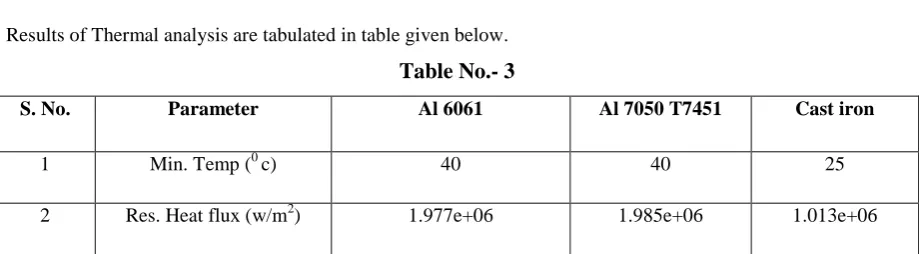
Results of Thermal analysis are tabulated in table given below.Table No.- 3
S. No. Parameter Al 6061 Al 7050 T7451 Cast iron
1 Min. Temp (0 c) 40 40 25
2 Res. Heat flux (w/m2) 1.977e+06 1.985e+06 1.013e+06
It is cleared from the above figures & tables that maximum von mises stress occurs at piston’s crown surface, It
is clear from the Table-2 that the maximum deformation is observed in the piston made of Gray Cast iron and
minimum in Al 7050 T7451. As it is expected maximum deformation is observed at the top of the centre of the
piston. It is shown in the Table-2 that the maximum stress intensity is observed in Gray Cast iron with 196MPa
and same for Al 7050 T7451 & Al 6061 with 191.8Mpa. Whereas the yield strength of the piston is very high in
Al 7050 T7451 piston followed by Gray Cast iron and Al 6061.
Thermal analysis of piston shows that the value of maximum temperature is same for all the materials at the top
surface of the piston crown, but minimum value of temperature in the piston made of Gray Cast iron. The
highest value of minimum temperature is found in the piston of Al alloy. This is due to high thermal
conductivity of the Aluminium alloys. Minimum temperature is in the skirt of the piston is observed as shown in
figure 15, 17 & 19. Table-3 shows that max total heat flux is observed in piston of Al 7050 T7451 and piston of
Gray cast iron shows the lowest value of max total heat flux.
VII. CONCLUSON
Maximum von mises stress, Maximum von mises strain and Maximum deformation are less in Piston of Al
7050 T7451 alloy in comparison of Al 6061 & Gray cast iron. Minimum Factor of safety for all the materials is
more than 1 but among the all materials factor of safety of Al 7050 T7451 is highest which is 2.45. Hence it can
be said that our design for Al 7050 T7451 is safe. So finally it can be concluded that Al 7050 T7451 is the
suitable material for using in production of Piston.
REFERENCES
[1] Dr.Najim A.Saad, Dr. Haitham R. Abed Ali, Dr. Hayder Shakir Abudalla, “Numerical analysis of the
thermal –stresses of a petrol engine piston with different materials”, The Iraqi Journal for Mechanical and
Material Engineering,Vol.8, No.3, 2008,pp (249-256).
[2] Wu, Yi Zeng, Dongjian Feng, Zhiyuan, (2010), “Finite Element Analysis for the Thermal Load of Piston in a
139 |
P a g e
[3] Lokesh Singh, Suneer Singh Rawat, Taufeeque Hasan, Upendra Kumar, “FINITE ELEMENT ANALYSISOF PISTON IN ANSYS” International Journal of Modern Trends in Engineering and Research (IJMTER)
Volume 02, Issue 04, [April – 2015] ISSN (Online):2349–9745 ; ISSN (Print):2393-8161.
[4] Dilip Kumar Sonar, Madhura Chattopadhyay ,“Theoretical Analysis of Stress and Design of Piston Head
using CATIA & ANSYS”, International Journal of Engineering Science Invention, Volume 4 Issue 6, June
2015, PP.52-61.
[5] R.S. Khurmi and JK Gupta “Machine Design” Eurasia publishing house (pvt.) ltd. Ram Nagar, New Delhi -
110055, http://www.simpopdf.com, 2005.
[6] S. Srikanth Reddy, Dr. B. Sudheer Prem Kumar, “Thermal Analysis and Optimization of I.C. Engine Piston
Using Finite Element Method”, International Journal of Innovative Research in Science, Engineering and
Technology, Vol. 2, Issue 12, December 2013
[7] Soniya kaushik, Rayapuri Ashok, Mohammed zubair nizami, Dr. Mohd. Mohinoddin, “Parametric and
material optimization of two wheeler piston using aluminum alloy 7475-761 and aluminum alloy 6061”,
International Journal of Advanced Trends in Computer Science and Engineering, Vol.2 , No.1, Pages : 596
- 601 (2013).
[8] Mr. Jadhav Vishal, Dr. R.K. Jain, Mr. Yogendra S.Chauhan, “Stress analysis of IC engine piston for
different material and pressure load using FEA”, IJESRT, ISSN: 2277-9655.
[9] Vinod Junju, M.V. Mallikarjun and Venkata Ramesh Mamilla, “Thermo mechanical analysis of diesel