International Journal of COPD 2018:13 3425–3433
International Journal of COPD
Dove
press
submit your manuscript | www.dovepress.com 3425
O r I g I n a l r e s e a r C h
open access to scientific and medical research
Open access Full Text article
Validation of the gOlD 2017 and new
16 subgroups (1A–4D) classifications in predicting
exacerbation and mortality in COPD patients
Meng-Zhi han1,2 Tzuen-ren hsiue3 sheng-han Tsai1 Tang-hsiu huang2,3 Xin-Min liao2,3 Chiung-Zuei Chen3
1Division of general Medicine,
Department of Internal Medicine, national Cheng Kung University, College of Medicine and hospital, Tainan, Taiwan; 2Institute of Clinical
Medicine, College of Medicine, national Cheng Kung University, Tainan, Taiwan; 3Division of Pulmonary
Medicine, Department of Internal Medicine, national Cheng Kung University, College of Medicine and hospital, Tainan, Taiwan
Background and objective: A multidimensional assessment of COPD was recommended by the Global Initiative for Chronic Obstructive Lung Disease (GOLD) in 2013 and revised in 2017. We examined the ability of the GOLD 2017 and the new 16 subgroup (1A–4D) clas-sifications to predict clinical outcomes, including exacerbation and mortality, and compared them with the GOLD 2013 classifications.
Methods: Patients with COPD were recruited from January 2006 to December 2017. The predictive abilities of grades 1–4 and groups A–D were examined through a logistic regression analysis with receiver operating curve estimations and area under the curve (AUC).
Results: A total of 553 subjects with COPD were analyzed. The mortality rate was 48.6% during a median follow-up period of 5.2 years. Both the GOLD 2017 and the 2013 group A–D classifications had good predictive ability for total and severe exacerbations, for which the AUCs were 0.79 vs 0.77 and 0.79 vs 0.78, respectively. The AUCs for the GOLD 2017 groups A–D, grades 1–4, and the GOLD 2013 group A–D classifications were 0.70, 0.66, and 0.70 for all-cause mortality and 0.73, 0.71, and 0.74 for respiratory cause mortality, respectively. Combining the spirometric staging with the grouping for the GOLD 2017 subgroups (1A–4D), the all-cause mortality rate for group B and D patients was significantly increased from subgroups 1B–4B (27.7%, 50.6%, 53.3%, and 69.2%, respectively) and groups 1D–4D (55.0%, 68.8%, 82.1%, and 90.5%, respectively). The AUCs of subgroups (1A–4D) were 0.73 and 0.77 for all-cause and respiratory mortality, respectively; the new classification was determined more accurate than the GOLD 2017 for predicting mortality (P,0.0001).
Conclusion: The GOLD 2017 classification performed well by identifying individuals at risk of exacerbation, but its predictive ability for mortality was poor among COPD patients. Com-bining the spirometric staging with the grouping increased the predictive ability for all-cause and respiratory mortality.
Summary at a glance: We validate the ability of the GOLD 2017 and 16 subgroup (1A–4D) classifications to predict clinical outcome for COPD patients. The GOLD 2017 classification performed well by identifying individuals at risk of exacerbation, but its predictive ability for mortality was poor. The new 16 subgroup (1A–4D) classification combining the spirometric 1–4 staging and the A–D grouping increased the predictive ability for mortality and was better than the GOLD 2017 for predicting all-cause and respiratory mortality among COPD patients.
Keywords: multidimensional assessment, clinical outcomes, spirometric grade, predictive ability, logistic regression analysis, receiver operating curve
Introduction
COPD is a common cause of mortality in developed countries, with increasing mortality rates in developing countries.1 Globally, COPD-related deaths amount to
approximately 3 million every year.2 Measurement of disease severity is important
Correspondence: Chiung-Zuei Chen Division of Pulmonary Medicine, Department of Internal Medicine, national Cheng Kung University, College of Medicine and hospital, no 138 sheng-li road, 704 Tainan, Taiwan email [email protected]
Journal name: International Journal of COPD Article Designation: Original Research Year: 2018
Volume: 13
Running head verso: Han et al
Running head recto: Validation of GOLD 2017 and 16 subgroup (1A–4D) classifications DOI: 179048
International Journal of Chronic Obstructive Pulmonary Disease downloaded from https://www.dovepress.com/ by 118.70.13.36 on 22-Aug-2020
For personal use only.
Dovepress
han et al
to predict prognoses and initiate treatment for patients with COPD. The GOLD criteria, which was launched first in 1997 and was updated to the current version in 2017, is used to classify the severity of COPD.3
In the GOLD 2007 classifications, postbronchodilator airflow limitations based on spirometry were used to grade the severity of COPD.4 However, COPD is a heterogeneous
disease with multiple clinical manifestations and cannot be assessed based on airflow limitation only. The GOLD 2011, followed by the GOLD 2013, combined the exacerbation history and symptoms as measured by the modified Medical Research Council (mMRC) score or the COPD Assessment Test score, in addition to airflow limitation, to classify the severity of COPD.5 However, the ABCD classification was
not better than a spirometric grade in terms of predicting mortality. In addition, both airflow limitation and exacerba-tion history modified patient outcome in groups C and D.6
In the recently refined classification, GOLD 2017, spirometric grade is separated from the ABCD classification. The assessment tool includes severity of airflow (spirometric grades 1–4) and combined symptoms and risk of exacerba-tion (group A–D).3
Previous studies comparing the GOLD 2007 and 2013 classifications reported that the ABCD classification pre-dicted exacerbation better than the spirometric grade, but there was no difference in mortality predictions between the GOLD 2007 and 2013.6–9 Then, a nationwide cohort study
performed by Gedebjerg et al10 reported that neither the
GOLD 2017 nor 2011 classifications based on ABCD groups predicted mortality accurately, and they also found that the 16 subgroup (1A–4D) classification combining spirometric staging with the grouping increased the predictive ability for mortality and was more accurate for predicting mortality than either the GOLD 2017 or 2011. More evidence for the ability of the GOLD 2017 and the new 16 subgroup (1A–4D) classifications was therefore needed to measure risk of exacerbation and predictive ability for mortality in clinical practice.
We thus aimed at examining the ability of the GOLD 2017 and the subgroup (1A–4D) classifications to predict clinical outcomes, including exacerbation and mortality, in COPD patients and also to examine whether the GOLD 2017 classi-fications have greater predictive ability than the GOLD 2013 classifications.
Methods
study population
This was a retrospective study in which 628 patients diag-nosed with COPD in the pulmonary outpatient department
of National Cheng Kung University Medical Center between January 2006 and December 2017 were recruited. Some of the patients included in the present study were also in our previous study.11 All patients had received regular medical
treatment for COPD as outpatients for more than a year. According to the GOLD diagnosis guideline and criteria, COPD was defined as follows: all patients were $40 years old, had typical symptoms of COPD such as chronic and progressive dyspnea or cough with sputum production, and had a postbronchodilator ratio of forced expiratory volume in 1 second (FEV1) to forced vital capacity of ,70%. All pulmonary function tests were performed according to the joint of the American Thoracic Society and the European Respiratory Society.12
Body mass index (BMI), the score for the modified mMRC dyspnea scale, the Charlson index for the degree of comorbidity, and lung function measurements with postbronchodilator spirometric values were assessed for all participants when they were included in the study. Acute exacerbation was defined as an acute worsening of the individual’s respiratory symptoms that required additional therapy such as a short-acting bronchodilator (mild), a short course of antibiotics or oral corticosteroid (moderate), and hospitalization or a visit to the emergency room due to exac-erbation of COPD (severe).3 The numbers of exacerbation
events in the preceding year and during follow-up for 1 year were recorded by the research assistants according to the patient’s chart and self-reported data. The Charlson index for evaluation of comorbidities was identified from the patients file and detailed interviews.
Individuals with other diseases such as end-stage lung cancer before enrollment that were likely to result in death within 2 years were excluded from the study. Participants who were not followed for more than 1 year after enrollment were excluded from the exacerbation analysis.
Participants were classified using the GOLD 2017 clas-sifications into four grades (1–4) based on postbronchodilator FEV1 percent of prediction as stage 1 (FEV1$80), stage 2 (50#
FEV1,80), stage 3 (30# FEV1,50), and stage 4 (FEV1,30) into four groups (A–D) based on self-reported severity of dyspnea (mMRC) and risk of recurrent exacerbation. According to the GOLD 2017, a high risk of exacerbation is defined as two or more moderate exacerbations or one or more severe exacerbation in the preceding year. Patients with a low risk of exacerbation and fewer symptoms of dyspnea (mMRC 0–1) were classified as group A. Patients with a low risk of exacerbations and more symptoms of dyspnea (mMRC $2) were classified as group B. Patients with a high risk of exacerbations and fewer symptoms of dyspnea
International Journal of Chronic Obstructive Pulmonary Disease downloaded from https://www.dovepress.com/ by 118.70.13.36 on 22-Aug-2020
Dovepress Validation of GOLD 2017 and 16 subgroup (1A–4D) classifications
(mMRC 0–1) were classified as group C. Patients with a high risk of exacerbations and more symptoms of dyspnea (mMRC $2) were classified as group D. Moreover, in each group, patients with mild airflow limitations (FEV1$80% of predicted) were classified into subgroups 1A–1D; patients with moderate airflow limitations (80% .FEV1$50% of predicted) were classified into subgroups 2A–2D; patients with severe airflow limitations (50% .FEV1$30% of predicted) were classified into subgroups 3A–3D, and patients with very severe airflow limitations (FEV1,30% of predicted) were classified into subgroups 4A–4D.
Outcomes
The exacerbation rate was calculated and survival status was evaluated by observation as in a previous study.11 Patients
who died or were lost to follow-up in the first year were excluded from the exacerbation analyses due to that fact that follow-up for more than 1 year was needed to analyze the 1 year exacerbation rate in the study. Date and cause of death of participants who died in the hospital were recorded and verified using the hospital records. Date and cause of death of participants who died outside the hospital were obtained by research assistants by telephone contact with family members. We also verified the study cohort’s survival status and date of death by linking the Taiwan National Mortality Registry from the Health and Welfare Data Science Center. The research review board of National Cheng Kung University Medical Center approved this study, and all participants provided written informed consent.
statistical analysis
A chi-squared test was used to compare the nominal variable. Continuous variables were presented as mean and standard deviation. Between-group comparisons were performed using a chi-squared test or a Fisher’s exact test to compare the nominal variables and one-way analysis of variance test to compare the continuous variable. To determine the independent mortality variables, a multivariate analysis was used to evaluate the association with age, BMI, comor-bidities, the mMRC scale, postbronchodilator FEV1, and exacerbation history in the preceding year. The ability of the GOLD 2017 to predict exacerbations and all-cause and respiratory mortality was evaluated using a logistic regres-sion analysis with receiver operating characteristic (ROC) curve estimations and an intramodal area under the ROC curve (AUC) comparisons, and P,0.05 was considered statistically significant. Statistical analyses were performed by using the PASW statistics software version 17.0.2 (SPSS Inc., Chicago, IL, USA).
Results
A total of 628 COPD patients were recruited in the study. Mortality was analyzed in a total of 553 patients because 47 patients were excluded because of missing data and 28 were excluded because of advanced malignancy. For the exacerbation analyses, 79 patients were further excluded because they died in the first year of follow-up and 66 patients (66/553; 11.9%) were lost to follow-up in the first year. Finally, the 1-year exacerbation rate was analyzed in 408 patients.
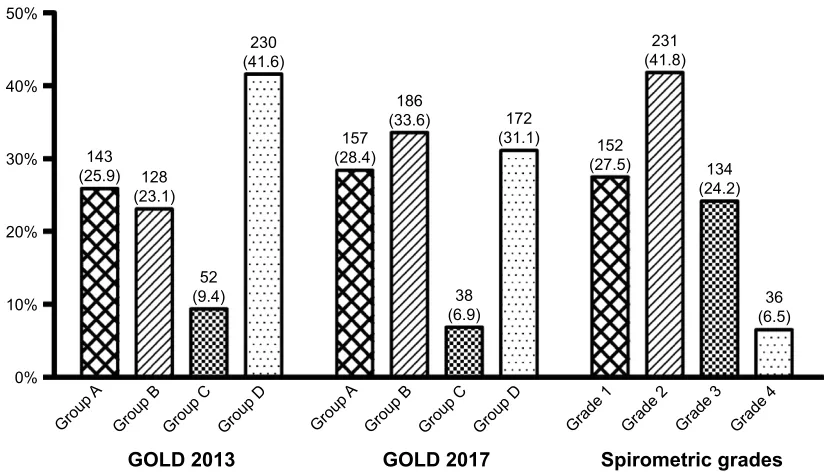
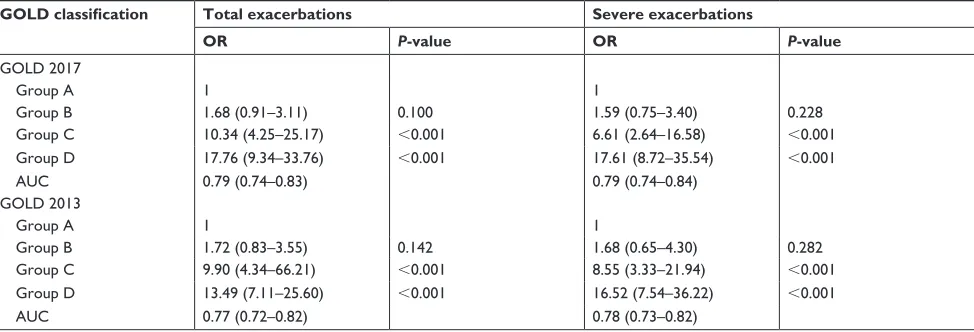
The distribution of patients in the GOLD 2013 and 2017 classifications are shown in Figure 1. Fourteen patients in group C (14/52; 26.9%) and 58 patients (58/230; 25.2%) in group D in the GOLD 2013 classification were shifted to group A and group B, respectively, in the GOLD 2017 classification. The characteristics of the subjects based on the GOLD 2017 classification groups are shown in Table 1. The median follow-up time was 5.18 (4.92–5.44) years, during which a total of 269 patients had died (269/553; 48.6%). The cause of death was respiratory-specific in 52.8%, cardiovascular-specific in 14.1%, cancer-specific in 17.1%, and related to other causes in 16%. The GOLD 2017 classification showed good ability to predict exacerbations (Table 2). Patients in the high-risk groups (groups C and D) had a higher average number of total exacerbations (3.4±4.1 vs 0.7±1.9, P,0.001) and severe exacerbations (2.0±2.8 vs 0.4±1.3, P,0.001) as compared to those in the low-risk groups (groups A and B). The logistic regression analysis showed that patients in groups C and D had a higher risk of both total and severe exacerbations as compared to those in group A, and there was no significant difference in risk of exacerbations between group B and group A (Table 3). Risk of exacerbations was higher for patients in group C than it was for those in group B, for which the odds ratio was 5.93 (95% CI, 2.58–13.62) for total exacerbations and 3.89 (95% CI, 1.72–8.28) for severe exacerbations. The ROC analysis showed good predictive ability for the GOLD 2017 classifications for total and severe exacerbations. This result was similar to the predictive ability of the GOLD 2013 clas-sification during the first year of follow-up, where the AUCs were 0.79 vs 0.77 and 0.79 vs 0.78, respectively.
In the GOLD 2017 groups A–D, the all-cause mortality rates were 26.1%, 46.8%, 31.6%, and 75.0%, respectively, and the respiratory mortality rates were 4.5%, 25.3%, 18.4%, and 47.1%, respectively (Table 2). The Kaplan–Meier analysis of all-cause mortality showed that group D had the highest mortality rate and that group B had higher mortality than group C in the GOLD 2017 classification. The GOLD 2017 and 2013 group A–D classifications had similar findings for
International Journal of Chronic Obstructive Pulmonary Disease downloaded from https://www.dovepress.com/ by 118.70.13.36 on 22-Aug-2020
Dovepress
han et al
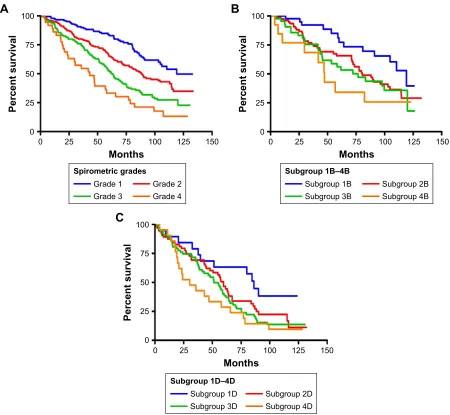
all-cause mortality (Figure 2A and B). Each quartile increase in the spirometric staging of GOLD 2017 was associated with increased mortality (Figure 3A). The AUCs for the GOLD 2017 group A–D, spirometric stage 1–4, and GOLD 2013 group A–D classifications were 0.70, 0.66, and 0.70 for all-cause mortality and 0.73, 0.71, and 0.74 for respiratory all-cause mortality, respectively (Table 4). There was no significant difference between the GOLD 2017 group A–D and the
spirometric stage 1–4 classifications (0.70 vs 0.66, P=0.15 for all-cause mortality and 0.73 vs 0.71, P=0.43 for respira-tory cause mortality).
A multivariate analysis showed significant independent predictors of mortality, including age (P=0.001), lower BMI (P=0.003), mMRC score $2 (P,0.001), the Charlson index score (P,0.001), and exacerbation risk by history (P=0.006), but FEV1,50% of prediction (P=0.236) and
Figure 1 Distribution of patients in the GOLD 2013, 2017 classifications, and spirometric grade classifications.
Note: Data are presented as the number (%) of patients.
Abbreviation: gOlD, global Initiative for Chronic Obstructive lung Disease.
*URXS $
*URXS% *URXS& *URXS' *URXS
$
*URXS% *URXS& *URXS' *UDGH *UDGH *UDGH *UDGH
'LVWULEXWLRQRI*2/'JURXSVDQGJUDGHV
*2/' *2/' 6SLURPHWULFJUDGHV
Table 1 Characteristics of 553 patients according to the GOLD 2017 classification
GOLD 2017 Group A, N=157 Group B, N=186 Group C, N=38 Group D, N=172 P-value
Males, % 93.0 93.0 94.7 94.8 0.878
age, years 67.55 (11.23) 72.37 (9.66) 68.84 (10.77) 72.94 (9.60) ,0.001
BMI, kg/m2 23.82 (3.89) 23.27 (4.31) 23.32 (4.79) 22.64 (4.22) 0.09
mMrC score 0.83 (0.42) 2.30 (0.54) 0.79 (0.41) 2.64 (0.70) ,0.001
FeV1 % pred 75.29 (19.04) 63.54 (24.04) 66.13 (19.31) 51.63 (19.95) ,0.001
Charlson index 2.01 (1.45) 2.09 (1.45) 2.50 (1.77) 2.67 (1.72) ,0.001
Current smoker, % 54.1 59.6 56.8 69.0 0.047
smoking/pack-years 46.79 (36.92) 51.96 (38.76) 53.38 (49.47) 54.34 (41.76) 0.425
Major CV diseases, % 20.4 23.7 23.7 37.2 0.003
Inhaled therapy
laBa + ICs, % 27.4 37.5 36.8 40.1 0.085
laMa, % 36.3 39.1 39.5 37.8 0.955
Triple therapy, % 4.5 7.3 13.9 11.3 0.084
Note: Data are presented as the mean (sD), unless otherwise stated.
Abbreviations: CV disease, cardiovascular disease (including old myocardial infarction, coronary artery disease, and congestive heart failure); FeV1 % pred, forced expiratory
volume in 1 second % predicted; gOlD, global Initiative for Chronic Obstructive lung Disease; laBa + ICs, acting beta2 agonists and inhaled steroid; laMa, long-acting muscarine antagonist; mMRC, modified Medical Research Council; Triple therapy, combined inhaled steroids, long-long-acting beta2 agonists, and long-long-acting muscarine antagonist.
International Journal of Chronic Obstructive Pulmonary Disease downloaded from https://www.dovepress.com/ by 118.70.13.36 on 22-Aug-2020
Dovepress Validation of GOLD 2017 and 16 subgroup (1A–4D) classifications
being a current smoker (P=0.139) were not independent predictors of mortality.
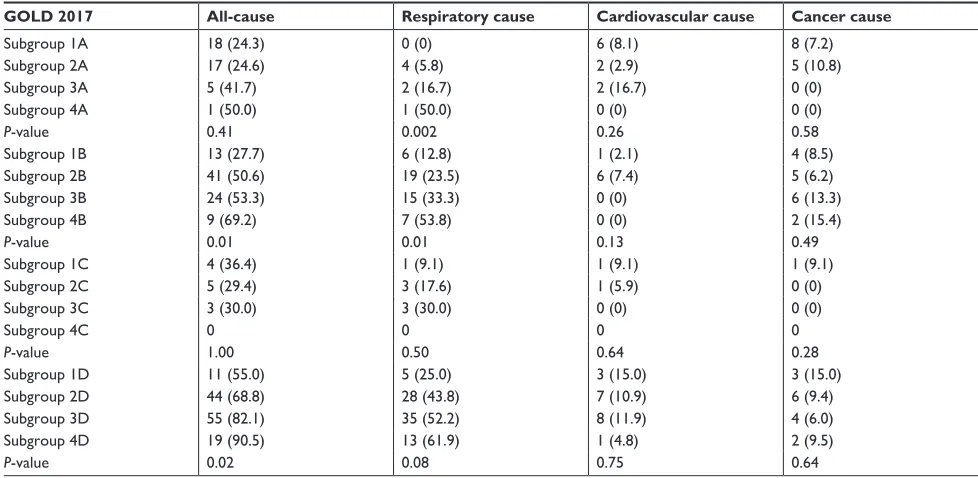
In the subgroup analysis, the all-cause mortality was signif-icantly increased in subgroups 1B–4B (27.7%, 50.6%, 53.3%, 69.2%, respectively; P=0.01) and 1D–4D (55.0%, 68.8%, 82.1%, and 90.5%, respectively; P=0.02), (Table 5), and each subgroup increase in group B (1B–4B) and group D (1D–4D) was associated with increased all-cause mortality (Figure 3B and C). The AUCs of the subgroups 1A–4D were 0.73 and 0.77 for all-cause and respiratory mortality, respectively; this new classification was more accurate than the GOLD 2017 group ABCD for predicting mortality (P,0.0001). There was no significant increase in risk of exacerbation for the subgroup 1A–4D classification.
Discussion
The main findings of this study were that the GOLD 2017 group ABCD classification showed good ability to
predict recurrent exacerbations, and this ability was similar to that of the GOLD 2013 classification. The GOLD 2017 spirometric grade and group classifications and the GOLD 2013 classifications all had poor ability to predict mortality. The new subgroup (1A–4D) classification was more accu-rate than the GOLD 2017 group ABCD for predicting mortality.
Patients in group D had the highest risk of both total and severe exacerbations in the present study. Moreover, we found that patients in group C (high risk of exacerbations and fewer symptoms) had a higher risk of exacerbations than those in group B (low risk of exacerbations and more symptoms). After simplifying the severity classification by separating the spirometric grades from the risk of exacerba-tion evaluaexacerba-tion in the GOLD 2017 ABCD classificaexacerba-tion, there was no significant difference in the predictive ability for exacerbation between the GOLD 2017 classification and the GOLD 2013 classification. Our results supported the findings Table 2 Prognosis for patients according to the GOLD 2017 classificationa
GOLD 2017 Group A, N=157 Group B, N=186 Group C, N=38 Group D, N=172 P-value
average number of exacerbation/years
Total exacerbationsb 0.32 (0.83) 0.51 (1.22) 1.59 (2.37) 2.54 (3.50) ,0.001
severe exacerbations 0.13 (0.47) 0.20 (0.58) 0.16 (0.45) 1.09 (1.91) ,0.001
Mortality, n (%)
all-cause 41 (26.1) 87 (46.8) 12 (31.6) 129 (75.0) ,0.001
respiratory cause 7 (4.5) 47 (25.3) 7 (18.4) 81 (47.1) ,0.001
Cardiovascular cause 10 (6.4) 7 (3.8) 2 (5.3) 19 (11.0) 0.052
Cancer cause 13 (8.3) 17 (9.1) 1 (2.6) 15 (8.7) 0.503
Notes: Data are presented as the mean (sD), unless otherwise stated. aIn total, 553 patients were analyzed for mortality, and 408 patients were analyzed for exacerbation
and hospitalization, where both analyses were adjusted for age. bTotal exacerbations are exacerbations including moderate (exacerbations requiring medical intervention
with steroid or antibiotics) and severe exacerbations (exacerbations requiring hospitalization).
Abbreviation: gOlD, global Initiative for Chronic Obstructive lung Disease.
Table 3 Exacerbations according to the GOLD 2017 and GOLD 2013 classifications and logistic regression analyses with receiver operating curve estimations
GOLD classification Total exacerbations Severe exacerbations
OR P-value OR P-value
gOlD 2017
group a 1 1
group B 1.68 (0.91–3.11) 0.100 1.59 (0.75–3.40) 0.228
group C 10.34 (4.25–25.17) ,0.001 6.61 (2.64–16.58) ,0.001
group D 17.76 (9.34–33.76) ,0.001 17.61 (8.72–35.54) ,0.001
aUC 0.79 (0.74–0.83) 0.79 (0.74–0.84)
gOlD 2013
group a 1 1
group B 1.72 (0.83–3.55) 0.142 1.68 (0.65–4.30) 0.282
group C 9.90 (4.34–66.21) ,0.001 8.55 (3.33–21.94) ,0.001
group D 13.49 (7.11–25.60) ,0.001 16.52 (7.54–36.22) ,0.001
aUC 0.77 (0.72–0.82) 0.78 (0.73–0.82)
Notes: Data presented as Or (95% CI) and aUC. no difference in aUC between gOlD 2017 and 2013 were found.
Abbreviations: aUC, area under curve; gOlD, global Initiative for Chronic Obstructive lung Disease.
International Journal of Chronic Obstructive Pulmonary Disease downloaded from https://www.dovepress.com/ by 118.70.13.36 on 22-Aug-2020
Dovepress
han et al
Figure 2 Kaplan–Meier survival curves according to the GOLD 2017 classification groups A–D (A) and the 2013 classification groups A–D (B).
Abbreviation: gOlD, global Initiative for Chronic Obstructive lung Disease.
0RQWKV
3UREDELOLW\RIVXUYLYDO
*2/'
*URXS$ *URXS% *URXS& *URXS'
$
0RQWKV
3UREDELOLW\RIVXUYLYDO
*2/'
*URXS$ *URXS% *URXS& *URXS'
%
Figure 3 Kaplan–Meier survival curves according to the spirometric grades 1–4 (A), subgroup 1B–4B (B), and subgroup 1D–4D (C).
0RQWKV
3HUFHQWVXUYLYDO
6SLURPHWULFJUDGHV
*UDGH *UDGH *UDGH *UDGH
$
0RQWKV
3HUFHQWVXUYLYDO
6XEJURXS%±%
6XEJURXS% 6XEJURXS% 6XEJURXS% 6XEJURXS%
%
0RQWKV
3HUFHQWVXUYLYDO
6XEJURXS'±'
6XEJURXS' 6XEJURXS' 6XEJURXS' 6XEJURXS'
&
International Journal of Chronic Obstructive Pulmonary Disease downloaded from https://www.dovepress.com/ by 118.70.13.36 on 22-Aug-2020
Dovepress Validation of GOLD 2017 and 16 subgroup (1A–4D) classifications
Table 4 Mortality according to the GOLD 2017 and GOLD 2013 classifications and spirometric grades and logistic regression analyses with rOC estimations
Classification All-cause mortality Respiratory cause mortality
OR P-value OR P-value
gOlD 2017
group a 1 1
group B 2.49 (1.57–3.93) ,0.001 7.25 (3.17–16.66) ,0.001
group C 1.31 (0.60–2.82) 0.498 4.84 (1.58–14.78) 0.006
group D 8.49 (5.17–13.94) ,0.001 19.07 (8.44–43.09) ,0.001
aUC 0.70 (0.66–0.74) 0.73 (0.69–0.78)
gOlD 2013
group a 1 1
group B 2.25 (1.34–3.78) 0.002 8.43 (2.85–24.98) ,0.001
group C 1.63 (0.82–3.25) 0.161 8.27 (2.47–27.74) 0.001
group D 7.35 (4.57–11.82) ,0.001 28.18 (10.09–78.74) ,0.001
aUC 0.70 (0.66–0.75) 0.74 (0.70–0.79)
spirometric grades
grade 1 1 1
grade 2 1.99 (1.29–3.06) 0.002 3.56 (1.83–6.91) ,0.001
grade 3 4.27 (2.60–7.00) ,0.001 8.12 (4.10–16.08) ,0.001
grade 4 9.54 (3.90–23.36) ,0.001 6.73 (3.43–39.65) ,0.001
aUC 0.66 (0.62–0.71) 0.71 (0.66–0.76)
Note: Data presented as Or (95% CI) and aUC.
Abbreviations: aUC, area under curve; gOlD, global Initiative for Chronic Obstructive lung Disease; rOC, receiver operating characteristic.
Table 5 Mortality for patients within subgroup 1A–4D according to the GOLD 2017 classificationa
GOLD 2017 All-cause Respiratory cause Cardiovascular cause Cancer cause
subgroup 1a 18 (24.3) 0 (0) 6 (8.1) 8 (7.2)
subgroup 2a 17 (24.6) 4 (5.8) 2 (2.9) 5 (10.8)
subgroup 3a 5 (41.7) 2 (16.7) 2 (16.7) 0 (0)
subgroup 4a 1 (50.0) 1 (50.0) 0 (0) 0 (0)
P-value 0.41 0.002 0.26 0.58
subgroup 1B 13 (27.7) 6 (12.8) 1 (2.1) 4 (8.5)
subgroup 2B 41 (50.6) 19 (23.5) 6 (7.4) 5 (6.2)
subgroup 3B 24 (53.3) 15 (33.3) 0 (0) 6 (13.3)
subgroup 4B 9 (69.2) 7 (53.8) 0 (0) 2 (15.4)
P-value 0.01 0.01 0.13 0.49
subgroup 1C 4 (36.4) 1 (9.1) 1 (9.1) 1 (9.1)
subgroup 2C 5 (29.4) 3 (17.6) 1 (5.9) 0 (0)
subgroup 3C 3 (30.0) 3 (30.0) 0 (0) 0 (0)
subgroup 4C 0 0 0 0
P-value 1.00 0.50 0.64 0.28
subgroup 1D 11 (55.0) 5 (25.0) 3 (15.0) 3 (15.0)
subgroup 2D 44 (68.8) 28 (43.8) 7 (10.9) 6 (9.4)
subgroup 3D 55 (82.1) 35 (52.2) 8 (11.9) 4 (6.0)
subgroup 4D 19 (90.5) 13 (61.9) 1 (4.8) 2 (9.5)
P-value 0.02 0.08 0.75 0.64
Notes: Data are presented as the number (percent). aIn total, 553 patients were analyzed for mortality. seventy-four patients in subgroup 1a, 69 patients in subgroup 2a,
12 patients in subgroup 3a, and 2 patients in subgroup 4a; 47 patients in subgroup 1B, 81 patients in subgroup 2B, 45 patients in subgroup 3B, and 13 patients in subgroup 4B; 11 patients in subgroup 1C, 17 patients in subgroup 2C, 10 patients in subgroup 3C, and 0 patients in subgroup 4C; 20 patients in subgroup 1D, 64 patients in subgroup 2D, 67 patients in subgroup 3D, and 21 patients in subgroup 4D. The statistical power for subgroups 1B–4B and 1D–4D was .0.7, but the statistical power for subgroups 1a–4a and 1C–4C was ,0.7 due to the small sample size.
Abbreviation: gOlD, global Initiative for Chronic Obstructive lung Disease.
by Hurst et al,13 suggesting that exacerbation frequency is a
strong predictor of recurrent exacerbation.
Previous studies have shown that low FEV1 is strongly associated with mortality in the case of COPD patients.14
In addition, several studies have shown that the ABCD classi-fication is not a better predictor of mortality than spirometric grades.8,15–17 In the present study, although a statistically
sig-nificant difference was observed across the ABCD groups and
International Journal of Chronic Obstructive Pulmonary Disease downloaded from https://www.dovepress.com/ by 118.70.13.36 on 22-Aug-2020
Dovepress
han et al
the spirometric grades for the GOLD 2017 classification, it did not perform well with regard to predicting mortality. The GOLD guidelines for COPD diagnosis and management do not address clinical phenotypes and comorbidities. However, classifying COPD patients according to several clinical phe-notypes, such as the asthma–COPD overlap or the frequent exacerbator with emphysema or chronic bronchitis, is useful to differentiate groups of subjects with different mortality risks.18 Comorbidities were reviewed and evaluated based on
the Charlson score in the study, and the multivariate analysis revealed that an evaluation of comorbidity using the Charlson score was an independent predictor for all-cause mortality after adjusting for age, gender, the mMRC dyspnea scale, exacerbation history, and FEV1. These findings implied that clinical phenotypes and comorbidities are important predic-tors of mortality and may skew survival in a way that is not being accounted for in the present study or in most guidelines for COPD patients.3,5
The mortality rate was higher in group B than in group C in the present study. A nationwide cohort study performed by Gedebjerg et al10 had similar results to our findings,
suggest-ing that mortality increases with increases in exacerbations and dyspnea, but mortality was higher for group B than for group C. The GenKOLS study15 also had similar results, and
the author suggested a higher prevalence of cardiovascular disease in group B as the reason for the worse survival rate. In contrast, the prevalence of cardiovascular disease was similar in group B and group C, and the Charlson index for evaluation of comorbidities in group B was lower than that in group C in this study. These findings imply that there were other important factors causing the higher mortality in group B than in group C patients that has not been mentioned before. In group B in this study, the patients were older and had more symptoms of dyspnea than those in group C. The multivariate analysis showed that age and dyspnea (mMRC scale $2) were significant independent predictors of mortality. Our findings supported the finding that dyspnea is an important predictor of mortality.10 In addition, age is
also a possible reason for the worse survival rate in group B as compared to that in group C.
A lot of patients (58/230; 25.2%) in group D in the GOLD 2013 classification were shifted to group B in the GOLD 2017 classification. The GOLD 2013 classification is based on a composite of spirometry and symptoms and exacerbation history. In the GOLD 2017 classification, spirometric grade is separated from the ABCD classification. Therefore, the distribution of spirometric grade according to lung function
(FEV1 less or higher than 50%) (Figure 1) was one of the possible reasons for the significant change in B and D group from the GOLD 2013 to 2017.
In this study, we divided each group into four subgroups according to the spirometric grades. Each subgroup increase of group B (1B–4B) and group D (1D–4D) was associated with increased all-cause mortality, and there was a significant difference across these subgroups. In the more symptomatic groups B and D, worse lung function with a lower FEV1 was associated with higher mortality. This finding implied that a lower FEV1 is a significant independent predictor of mortality in groups with more symptoms. Moreover, the predictive ability of the 16-subgroup classification (1A–4D) was better than that of GOLD 2017 ABCD classification for all-cause mortality (0.73 vs 0.70, P,0.001) and respiratory cause mor-tality (0.77 vs 0.73, P,0.001). In contrast to the PLATINO study,19 no clear pattern was observed for mortality across the
subgroups (1A–4D). Our findings were similar to the report by Gedebjerg et al,10 suggesting that the subgroup (1A–4D)
classification improved the predictive ability for mortality more than the group ABCD classification only.
The main strengths of this study are the fact that the exact date and causes of death for all patients before December 31, 2016, was verified from the Taiwan National Mortality Registry from the Health and Welfare Data Science Center. These resources provided nearly 100% of the data for mor-tality analysis. In addition, all patients had received regular medical treatment for COPD as outpatients for more than 1 year, had typical symptoms of COPD, and had a postbron-chodilator spirometry to confirm their COPD diagnosis.
There were four limitations of this study. First, this study was a retrospective study. Second, few women (6.6%) were enrolled in this study. Male smokers are the main proportion of COPD patients in Taiwan, where smoking prevalence for women is ,5%.20 In contrast to industrialized countries
in the West, COPD morbidity remains male-predominant in Asian countries.21,22 Third, the sample size of this study
was relatively small, and all patients were from one center, which limited the ability to extend our findings to the general population. Fourth, the small sample size of group C and subgroups 1A–4A and 1C–4C limited the ability to measure the associations between groups and mortality.
Conclusion
The GOLD 2017 classification performed well by identifying individuals at risk of exacerbation, but its predictive ability for mortality was poor. The new 16-subgroup (1A–4D)
International Journal of Chronic Obstructive Pulmonary Disease downloaded from https://www.dovepress.com/ by 118.70.13.36 on 22-Aug-2020
International Journal of COPD
Publish your work in this journal
Submit your manuscript here: http://www.dovepress.com/international-journal-of-chronic-obstructive-pulmonary-disease-journal
The International Journal of COPD is an international, peer-reviewed journal of therapeutics and pharmacology focusing on concise rapid reporting of clinical studies and reviews in COPD. Special focus is given to the pathophysiological processes underlying the disease, intervention programs, patient focused education, and self management protocols.
This journal is indexed on PubMed Central, MedLine and CAS. The manuscript management system is completely online and includes a very quick and fair peer-review system, which is all easy to use. Visit http://www.dovepress.com/testimonials.php to read real quotes from published authors.
Dovepress
Dove
press
Validation of GOLD 2017 and 16 subgroup (1A–4D) classifications
classification increased the predictive ability for mortality and was better than the GOLD 2017 for predicting all-cause and respiratory mortality among COPD patients.
Acknowledgment
We are grateful to Sheng-Hsiang Lin and Chih-Hui Hsu for providing statistical consulting services from the Biostatistics Consulting Center, National Cheng Kung University Hospital, and to Chia-Yin Shih from the Department of Public Health, College of Medicine, National Cheng Kung University, for helping to verify the study cohort’s survival status and date of death by linking the Taiwan National Mortality Registry from the Health and Welfare Data Science Center.
Disclosure
The authors report no conflicts of interest in this work.
References
1. Barnes PJ. Chronic obstructive pulmonary disease: a growing but neglected global epidemic. PLoS Med. 2007;4(5):e112.
2. GBD 2013 Mortality and Causes of Death Collaborators. Global, regional, and national age-sex specific all-cause and cause-specific mortality for 240 causes of death, 1990–2013: a systematic analysis for the Global Burden of Disease Study 2013. Lancet. 2015;385(9963): 117–171.
3. Vogelmeier CF, Criner G, Martinez FJ, et al. Global strategy for the diagnosis, management, and prevention of chronic obstructive lung disease 2017 report: GOLD executive summary. Am J Respir Crit Care
Med. 2017;195(5):557–582.
4. Rabe KF, Hurd S, Anzueto A, et al; Global Initiative for Chronic Obstruc-tive Lung Disease. Global strategy for the diagnosis, management, and prevention of chronic obstructive pulmonary disease: GOLD executive summary. Am J Respir Crit Care Med. 2007;176(6):532–555. 5. Vestbo J, Hurd SS, Agustí AG, et al. Global strategy for the diagnosis,
management, and prevention of chronic obstructive pulmonary dis-ease: GOLD executive summary. Am J Respir Crit Care Med. 2013; 187(4):347–365.
6. Han MK, Muellerova H, Curran-Everett D, et al. GOLD 2011 disease severity classification in COPDGene: a prospective cohort study. Lancet
Respir Med. 2013;1(1):43–50.
7. Soriano JB, Alfageme I, Almagro P, et al. Distribution and prognostic validity of the new Global Initiative for Chronic Obstructive Lung Disease grading classification. Chest. 2013;143(3):694–702.
8. Lange P, Marott JL, Vestbo J, et al. Prediction of the clinical course of chronic obstructive pulmonary disease, using the new GOLD classifi-cation: a study of the general population. Am J Respir Crit Care Med. 2012;186(10):975–981.
9. Agusti A, Edwards LD, Celli B, et al; ECLIPSE Investigators. Char-acteristics, stability and outcomes of the 2011 GOLD COPD groups in the ECLIPSE cohort. Eur Respir J. 2013;42(3):636–646.
10. Gedebjerg A, Szépligeti SK, Wackerhausen LH, et al. Prediction of mor-tality in patients with chronic obstructive pulmonary disease with the new Global Initiative for Chronic Obstructive Lung Disease 2017 clas-sification: a cohort study. Lancet Respir Med. 2018;6(3):204–212. 11. Chen CZ, Ou CY, Wang WL, et al. Using post-bronchodilator FEV1 is
better than pre-bronchodilator FEV1 in evaluation of COPD severity.
COPD. 2012;9(3):276–280.
12. American Thoracic Society; European Respiratory Society. ATS/ERS statement: raised volume forced expirations in infants: guidelines for cur-rent practice. Am J Respir Crit Care Med. 2005;172(11):1463–1471. 13. Hurst JR, Vestbo J, Anzueto A, et al; Evaluation of COPD
Longitudi-nally to Identify Predictive Surrogate Endpoints (ECLIPSE) Investiga-tors Susceptibility to exacerbation in chronic obstructive pulmonary disease. N Engl J Med. 2010;363(12):1128–1138.
14. Menezes AM, Pérez-Padilla R, Wehrmeister FC, et al; PLATINO team. FEV1 is a better predictor of mortality than FVC: the PLATINO cohort study. PLoS One. 2014;9(10):e109732.
15. Johannessen A, Nilsen RM, Storebø M, Gulsvik A, Eagan T, Bakke P. Comparison of 2011 and 2007 Global Initiative for Chronic Obstructive Lung Disease guidelines for predicting mortality and hospitalization.
Am J Respir Crit Care Med. 2013;188(1):51–59.
16. Soriano JB, Lamprecht B, Ramírez AS, et al. Mortality prediction in chronic obstructive pulmonary disease comparing the GOLD 2007 and 2011 staging systems: a pooled analysis of individual patient data.
Lancet Respir Med. 2015;3(6):443–450.
17. Chen CZ, Ou CY, Hsu CH, Hsiue TR. Validation of the GOLD 2013 classification in predicting exacerbations and mortality in Taiwanese patients with chronic obstructive pulmonary disease. J Formos Med
Assoc. 2015;114(12):1258–1266.
18. Golpe R, Suárez-Valor M, Martín-Robles I, et al. Mortality in COPD patients according to clinical phenotypes. Int J Chron Obstruct Pulmon
Dis. 2018;13:1433–1439.
19. Menezes AM, Wehrmeister FC, Perez-Padilla R, et al. The PLATINO study: description of the distribution, stability, and mortality according to the Global Initiative for Chronic Obstructive Lung Disease classifica-tion from 2007 to 2017. Int J Chron Obstruct Pulmon Dis. 2017;12: 1491–1501.
20. Jamrozik E, Musk AW. Respiratory health issues in the Asia-Pacific region: an overview. Respirology. 2011;16(1):3–12.
21. Tan WC, Ng TP. COPD in Asia: where East meets West. Chest. 2008;133(2):517–527.
22. Tan WC. Trends in chronic obstructive pulmonary disease in the Asia-Pacific regions. Curr Opin Pulm Med. 2011;17(2):56–61.
International Journal of Chronic Obstructive Pulmonary Disease downloaded from https://www.dovepress.com/ by 118.70.13.36 on 22-Aug-2020