1148 |
P a g e
Cloud Computing and Its Effects in Various Fields
Rajivkumar Mente
1, Amol Kale
2 1,2School of Computational Sciences, Solapur University, Solapur, Maharashtra.
ABSTRACT
Cloud Computing defines a way in Information Technology world, being built on decades of research it utilizes all current achievements in various fields. Cloud Computing has become a scalable services consumption, delivery platform in area of Services Computing. It is a better option to run your business. Instead of running your apps yourself, it run on a shared data center. Cloud coAmputing helps in provides easier access and distribution of information among the different medical professionals who may come in contact with each individual patient. Cloud Technology is a term that uses in all fields related to the computer fields. Cloud computing are use in Education, Social, Entertainment, Medical, Military Operations, Business and finance etc. This paper describes the effects of Cloud Computing in various fields.
Keywords:
Cloud Computing, Cloud Deployment Models, Virtualization, Effects Of Cloud Computing.
I INTRODUCTION
Cloud Computing is the use of computational resources (such as hardware and software) that are
1149 |
P a g e
Figure 1: Cloud Computing metaphor Figure 2: Service Models.
A networking group elements services provides need not be individually managed by users but the entire provider managed suite of hardware, software can be thought of as an amorphous cloud [3]. Cloud computing is a type of outsourcing of computer programs and networks, using this users are able to access software, applications from anywhere they need, while it is being hosted by third party in ―the cloud‖, which means that they do not have to worry about things like storage media and power, they can simply access the end result. In Cloud computing when talk about the cloud people still talking about the Internet and Network but it also can store all your files on the Internet in the cloud and working from web connected devices. Cloud Computing has divided into three main service types such as Infrastructure as a Service (IAAS), Platform as a Service (PAAS), Software as a Service (SAAS). Cloud Computing can be divided in two parts which is the front end and the back end, in each area unit connected with one another by a network. Front is what the user sees where as the rear end is the cloud of the system [4].
II EFFECT OF CLOUD COMPUTING IN VARIOUS AREAS:
2.1
Education System
In education the most challenges that the government faces in providing education is the lack of
infrastructure and if available, then maintenance of that infrastructure and other issue are
Procuring and maintaining a wide range of hardware and software require ongoing investment
and the skills to support them [5],[6]. The term cloud computing can provide solutions for the
above mentioned problems in education area. It enables users to manage, share and access data
1150 |
P a g e
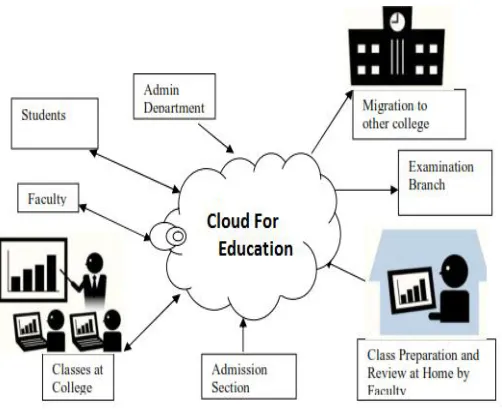
Figure 3: Cloud Education
This is useful in higher education include students, Faculty, administrative staff, Examination and Admission tasks as shown in Figure 3.
All users of an institution are connected to the cloud and individual login or ID is provided to all users for their respective tasks. Teaching faculty can upload their class data like tutorials, assignments, and tests marks on server called as cloud which students able to access all the data and information provided by the faculty through Internet using laptops, PC and other electronic devices anywhere and anytime. It will make possible for teachers to identify doubts by analyzing students study records. All these services are migrated to the cloud and access directly over the internet either as SAAS, PAAS, IAAS.
Advantages :
Personalized Learning: Cost Effectiveness: Service Availability
2.2
Social Area:
1151 |
P a g e
like businesses are now increasingly using data from social media platforms in combination with cloud-based information resources to get better services, innovations and clients requirements.
2.3
Agriculture field
India is one of the big foods producers, grains and other products, but still agriculture and its production are decentralized, unsophisticated and outdated technology being followed by the farmers. This impact on gap between the supply and demand chains of the agricultural products. This will have a negative impact on the farmer’s
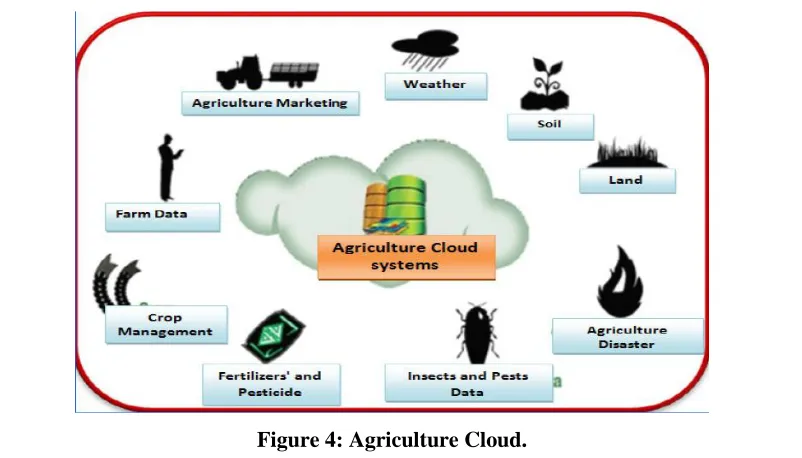
economic conditions as well the national income of the country. It can be eliminated with the use of Cloud Computing in agricultural field. The centralized location has to be set up to store all the relevant data. It can include various, Separate databases Soil-related, weather-related, Research, Crop and Farmers-related data can all be stored at a single location, and data availability can be achieved. This data can be accessed by the end-users such as farmers, experts, consultants, researchers etc easily any time from any location through the devices that are connected to the cloud system.
In agriculture there are new applications for the use of cloud computing that create a complete ecosystem, from sensors also monitoring tools for collecting soil data to agricultural field images and observations from human actors on the ground accurately feeding data repositories along with their GPS coordinates. Farmers can to access information through cloud technology from predictive analysis organizations, whereby they can have an accurate prediction on products that are in demand by different area or markets and adjust production accordingly [12] [13]. They also able to have insight on weather conditions and other parameters affecting on production. An incentive to farmers for using knowledge-based repositories including a wealth of information related to farming practices, crops input, agricultural innovations, pesticides, seeds, fertilizers, nutrients and weed resistance, equipment etc.
1152 |
P a g e
All this comes along with expert advice from a wide range of sources, for example, on farming and processing of agricultural products. While these resources can be used in developed countries with immanent Internet access, this is not as easy to accomplish in developing economies where there are issues with Internet access, bandwidth and lack of power but even in these circumstances are available on mobile phones, providing a wealth of services to farmers.
Advantages:
Data Readiness any time & any where Local and global communication
Improve economic condition of the Nation Ensure food security level
Motivation of farmers and researchers
2.4
Health Industry:
Today’s lots of healthcare sectors working on paperwork, to reduce and reform this sector cloud computing
technology is adopted. In Healthcare industry, it plays a vital role in moving the healthcare to a digital platform becoming more patient centered and data driven. This helps healthcare industry in storing large data, sharing information among hospitals and physicians. It access an infrastructure which allows medical practices, hospitals, research facilities and insurance companies to use improved technology resources at the lower initial capital. In hospital, indeed within majority of medical practices, patient charts and details, medical histories are often kept in a computer, it helps provide easier access and distribution of information among the various medical professionals who may come in contact with each individual patient[15].
Advantages:
Electronic Records
Accessing High-Powered Analytics Advanced Clinical Research Combining Efforts for Data Sharing
2.5
Business Area:
1153 |
P a g e
by consolidating their IT operations and using virtualization, that is optimizing the servers capacity to store, access and process data by hosting the servers on their own premises.
Advantages:
Reduce infrastructure cost
Faster deployment cycle
Provides dynamic resource pools
2.6
Online Entertainment:
Today, most people come on an internet for entertainment. Cloud based entertainment can reach using any device like TV, mobile, Virtual box or any other entertainment devices, it includes more than traditional media. Online Demand Entertainment has become a major expectation in current days. People are now looking for a single device which can take care of all their entertainment needs like on demand gaming, online media store, Cloud Computing provides all of these features to all users.
III CONCLUSION
The cloud is offering great new low cost, flexible solutions to all these area. This paper describes the basic of Cloud Computing, and its effects of use in the various fields. The concept of cloud computing usually reasons for adopting services based on clouds are cost saving, flexibility and start up speed. The basic field where cloud computing is use and the criteria of cloud computing its features. Businesses have a some ways to the cloud, like infrastructure, platforms and applications that are available from cloud providers as online services. Cloud computing helps to provides easier access and distribution of information in all fields which are described in this paper.
REFERENCES
[1] Shyam Patidar; Dheeraj Rane; Pritesh Jain ―A Survey Paper on Cloud Computing‖ in proceeding of Second
International Conference on Advanced Computing & Communication Technologies, 2012.
[2] Banerjee, P. (2009). An intelligent IT infrastructure for the future. 15th International Symposium on High-Performance Computer Architecture, Proceedings, Feb 14-18, 3.
[3] Liang-Jie Zhang; Qun Zhou, "CCOA: Cloud Computing Open Architecture," in proceeding of IEEE International Conference on Web Services (ICWS), 2009, pp. 607-616, 6-10 July 2009.
[4] Yashpalsinh Jadeja ; Kirit Modi, ―Cloud Computing - Concepts, Architecture and Challenges‖ in Proceeding of
1154 |
P a g e
[5] Qi Zhang, Lu Cheng and Raouf Boutaba, ―Cloud computing: state-of-the-art and research challenges‖.
[6] B. Alamri, and M. Qureshi, ‖Usability of Cloud Computing to Improve Higher Education,‖ Modern Education
and Computer Science Press, vol. 9, PP. 59-6, 2015.
[7] D. Chandra, and M. Borah, ‖Cost Benefit Analysis of Cloud Computing in Education,‖ in Proc. Int. Conf. On
Computing, Communication and Applications, 2012, pp. 1-6
[8] Developing a Cloud-Computing Strategy for Higher Education (Vol.
https://www.cisco.com/web/offer/email/43468/5/Cloud_Computing_in_Higher_Education.pdf)
[9] D. Kasi, S. Kusuma, and S. Kumar, ‖Cloud Computing Issues and Benefits Modern Education,‖ Global Journal
of Computer Science and Technology Cloud Distributed, vol. 12, no. 10, pp. 1-7, Jul. 2012.
[10] S. Yokoyama, N. Yoshioka, and T. Shida, ‖Cloud in a Cloud for Cloud Education,‖ Principles of Engineering
Service Oriented Sys- tems (PESOS), 2012 ICSE Workshop on Principles of Engineering Service-Oriented Systems, 2012, pp.63-64.
[11] WIKIPEDIA, ―Cloud Computing‖, http://en.wikipedia.org/wiki/Cloud computing, May 2008
[12] Patel, R. & Patel, M. (2013) "Application of Cloud Computing in Agricultural Development of Rural Indiaǁ ",
International Journal of Computer Science and Information Technologies, Vol. 4, No.6, pp. 922-926.
[13] Hori, M., Kawashima, E. and Yamazaki, T., (2010) "Application of cloud computing to agriculture and prospects in other fields", Fujitsu Science and Technology Journal, Vol.46, No.4, pp.446–454.
[14] Kun Qian (2012) "The Application of Cloud Computing in Agricultural Management Information System", Hubei Agricultural Sciences,Vol.5, No.1,159-162.
[15] http://www.xinn.com/cloud-computing-and-medicine
[16] Marston, S., Li, Z., Bandyopadhyay, S., Zhang, J., & Ghalsasi, A. (2011, April). Cloud computing— The business perspective. Decision Support Systems, 51(1), 176–189.
[17] Mahesh, S., Landry, B. J. L., Sridhar, T., & Walsh, K. R. (2011, July–September). A decision table for the cloud computing decision in small business. Information Resources Management Journal, 24(3), 9–25. [18] McAfee, A. (2011, November). What every CEO needs to know about the cloud. Harvard Business Review,