LIN, HESHAN High Performance Parallel and Distributed Genomic Sequence Search. (Under the direction of Dr. Xiaosong Ma).
Genomic sequence database search identifies similarities between given query se-quences and known sese-quences in a database. It forms a critical class of applications used widely and routinely in computational biology. Due to their wide application in diverse task settings, sequence search tools today are run on several types of parallel systems, including batch jobs on one or more supercomputers and interactive queries through web-based ser-vices. Despite successful parallelization of popular sequence search tools such as BLAST, in the past two decades the growth of sequence databases has outpaced that of computing hardware elements, making scalable and efficient parallel sequence search processing crucial in helping life scientists’ dealing with the ever-increasing amount of genomic information.
by Heshan Lin
A dissertation submitted to the Graduate Faculty of North Carolina State University
in partial fullfillment of the requirements for the Degree of
Doctor of Philosophy
Computer Science
Raleigh, North Carolina
2009
APPROVED BY:
Steffen Heber Frank Mueller
Douglas Reeves Nagiza Samatova
Xiaosong Ma
DEDICATION
To my parentsGuiwen Lin, Guiping Deng and
BIOGRAPHY
ACKNOWLEDGMENTS
This dissertation would not have been accomplished without the support and inspiration of many people.
First and foremost, I would like to express my sincere thanks and appreciation to my advisor, Dr. Xiaosong Ma, for her insightful guidance, consistent support, and patience in shaping me as a researcher from every perspective. She is always available for discussion even during her busiest schedule. I learned a lot from her on doing research as well as writing and presentation. I am much indebted to Dr. Nagiza Samatova for offering me a summer internship at Oak Ridge National Laboratory as well as mentoring me in the pioBLAST project during the early stage of my Ph.D. study. I would also like to express my gratitude to Dr. Wuchun Feng, who offered me three summer internships and invited me to join the mpiBLAST core development team. I want to thank Dr. Feng for his instrumental advices on the mpiBLAST-PIO project as well as many advices on how to improve my spoken and written communication skills.
I am grateful to Dr. Steffen Heber, Dr. Frank Mueller and Dr. Douglas Reeves for being a part of my dissertation committee. Their comments and questions helped me focus on important issues and avoid pitfalls during my research.
My deep appreciation also goes to many collaborators through my Ph.D. pursuit: Dr. Carlos Sosa, Dr. Pavan Balaji, Dr. Avery Ching, Dr. Mark Gardner and Jeremy Archuleta. I have benefited tremendously from our collaborations and the friendship we have kept since.
I would like to thank my great lab mates during the years: Jiangtian Li, Zhe Zhang, Alex Balik, Chao Wang, Tao Yang, Feng Ji, Amit Kulkarni, Prakash Ramaswamy, Nandan Tamineedi, Divya Dinakar and Sibin Mohan. I learned a lot from them through many spontaneous discussions and brainstorming sessions. Equally importantly, we had so much fun outside the work together which kept me refreshed from time to time.
TABLE OF CONTENTS
LIST OF TABLES . . . viii
LIST OF FIGURES . . . ix
1 Introduction . . . 1
1.1 Scaling Genomic Sequence Search on Massively Parallel Computers . . . 2
1.2 Semantics-based Distributed I/O with the ParaMEDIC Framework . . . 3
1.3 Adaptive Request Scheduling of Parallel Sequence-Search Web Servers . . . 4
1.4 Contributions . . . 5
1.5 Organization . . . 6
2 Sequence Database Search Background . . . 7
2.1 Sequence Databases . . . 7
2.2 Sequence Database Search Tools . . . 8
3 Co-scheduling Computation and I/O for Massively Parallel Genomic Se-quence Search . . . 12
3.1 Introduction . . . 12
3.2 MpiBLAST Background . . . 14
3.3 Integrated Computation and I/O Scheduling . . . 15
3.3.1 Software Architecture . . . 15
3.3.2 Fine-grained, Dynamically Load-balanced Computation Scheduling . 17 3.3.3 Scalable Distributed Results Processing . . . 20
3.3.4 Parallel Output Scheduling . . . 23
3.4 Performance Evaluation . . . 28
3.4.1 Experiment Setup . . . 29
3.4.2 Scalability Comparison of Output Strategies . . . 31
3.4.3 Fine-grained Dynamically Load Balancing . . . 33
3.4.4 Overall System Scalability . . . 36
3.5 Case Study on IBM Blue Gene/P Supercomputer . . . 37
3.5.1 Overview of the Blue Gene/P Architecture . . . 38
3.5.2 Problem Description . . . 39
3.5.3 Performance Results . . . 40
4 Semantic-based Distributed I/O with the ParaMEDIC Framework . . . 42
4.1 Motivation . . . 42
4.2 Distributed Environments . . . 43
4.2.1 NSF TeraGrid . . . 44
4.3 The Design of ParaMEDIC . . . 45
4.3.1 The ParaMEDIC Framework . . . 45
4.3.2 Trading Computation with I/O Cost . . . 46
4.4 Integration mpiBLAST with ParaMEDIC . . . 48
4.5 Experimental Results . . . 49
4.5.1 Experimental Testbeds . . . 50
4.5.2 Local Cluster Evaluation . . . 50
4.5.3 Distributed Setup from Argonne and VT . . . 56
4.5.4 TeraGrid Infrastructure . . . 59
5 Adaptive Request Scheduling for Clustered BLAST Web Services . . . 62
5.1 Introduction . . . 62
5.2 Parallel BLAST Web Server Architecture . . . 64
5.3 Scheduling Strategies . . . 66
5.3.1 Data-Oriented Scheduling . . . 67
5.3.2 Efficiency-Oriented Scheduling . . . 70
5.3.3 Combining PLARD and RMAP . . . 72
5.4 Performance Results . . . 73
5.4.1 Experiment Configuration . . . 73
5.4.2 Test Platform . . . 74
5.4.3 Data-Oriented Scheduling Results . . . 74
5.4.4 Efficiency-Oriented Scheduling Results . . . 77
6 Related Work . . . 81
6.1 Genomic Sequence-Search Parallelization . . . 81
6.2 Noncontiguous I/O Optimizations . . . 83
6.2.1 User Level Optimizations . . . 83
6.2.2 File System Level Optimizations . . . 85
6.3 Remote I/O in Distributed Environments . . . 86
6.4 Semantic-based Data Transformation . . . 87
6.5 Web Sever Scheduling . . . 87
6.6 Space-sharing Parallel Job Scheduling . . . 88
6.7 Online Scientific Data Processing . . . 89
7 Conclusion . . . 91
LIST OF TABLES
Table 5.1 Database characteristics. Note the Pmin values are multiples of 2, this is because our experiments are performed on a two-way SMP cluster, and we found using a compute node (2 processors) as the smallest scheduling unit yields better performance than does using an individual processor, as the former choice has better data locality. . . 73
LIST OF FIGURES
Figure 1.1 GenBank growth . . . 2
Figure 2.1 BLAST Search . . . 9
Figure 2.2 BLAST Input . . . 10
Figure 2.3 BLAST Output. . . 11
Figure 3.1 mpiBLAST-PIO software architecture. Qi and Qj are query segments fetched from the supermaster to masters, andqi1 and qj1 are query sequences that are assigned by masters to their workers. . . 15
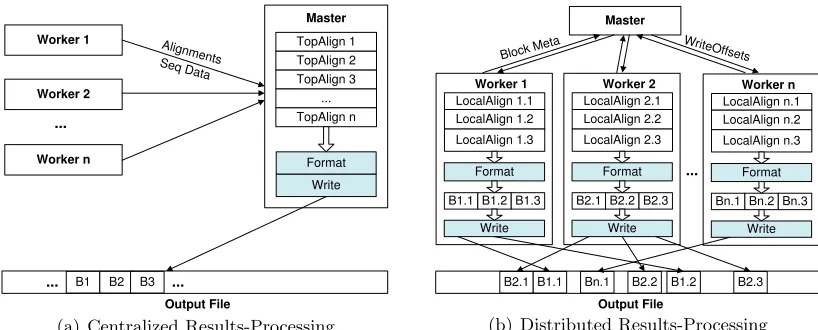
Figure 3.2 Compare centralized and distributed design of results processing. In the centralized design, the results formatting and writing is serially done by the master. While in the distributed design, the results formatting and writing is concurrently done by workers. . . 20
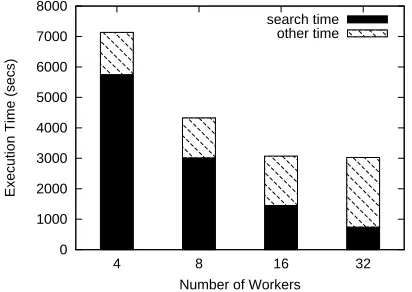
Figure 3.3 Searching 300 randomly samplednrsequences againstnritself with mpiBLAST-v1.4 on the System X cluster. Thenrdatabase is partitioned into 8 fragments, and a replica of the database is pre-distributed to every 4 workers in a round-robin fashion. . . 22
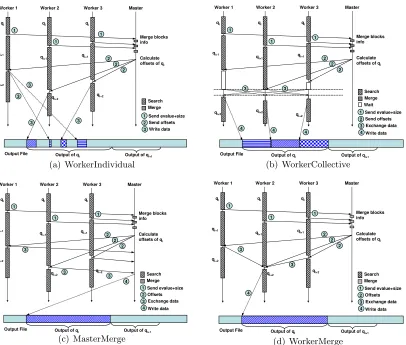
Figure 3.4 Four output strategies compared in this study. WorkerIndividual adopts the data sieving I/O technique when possible. WorkerCollective is based on the collective I/O technique. MasterMerge merges and writes output at the master. WorkerMerge is based on the proposed asynchronous, two-phase I/O technique. . . 25
Figure 3.5 Node scalability results of searching 1000 randomly sampled nt sequences on different number of workers. . . 29
Figure 3.6 Output scalability results of searching 1000 randomly sampledntsequences with different amount of output data. . . 32
Figure 3.7 Performance impacts of query segment prefetching. . . 35
available processors for one partition. Note P128 and PALL are actually the same
when running on 128 processors. . . 36
Figure 3.9 Speedup of searching 5000 nt sequences on System X with hierarchical scheduling (partition size 64). . . 38
Figure 3.10 Speedup of searching 0.25 million of microbial genome sequences against the microbial genome database itself. . . 41
Figure 4.1 ParaMEDIC Architecture . . . 46
Figure 4.2 ParaMEDIC and mpiBLAST Integration . . . 49
Figure 4.3 Impact of High Latency Networks . . . 51
Figure 4.4 Breakup of Performance with Network Delay . . . 52
Figure 4.5 Varying the Number of Worker Processes . . . 55
Figure 4.6 Varying the Number of Requested Sequences. . . 57
Figure 4.7 Impacted of Encrypted Filesystems . . . 58
Figure 4.8 Argonne to Virginia Tech Encrypted Filesystem . . . 58
Figure 4.9 NSF TeraGrid using U. Chicago and SDSC . . . 59
Figure 4.10 TeraGrid Infrastructure Performance Breakup . . . 60
Figure 5.1 Target parallel BLAST web server architecture . . . 65
Figure 5.2 Impact of data placement on the BLAST performance.. . . 67
Figure 5.3 Parallel execution efficiency of BLAST . . . 67
Figure 5.4 Normalized average number of page faults and normalized average service time. . . 75
Figure 5.5 Query load distribution among processors with the medium partition size. 76 Figure 5.6 Impact of PLARD on the average query response time. Note that the y axis uses the log2 scale, and the speedup factor brought by PLARD is shown at the top of each pair of bars. . . 77
Chapter 1
Introduction
In the past decades, research in bioinformatics has been dramatically accelerated by the ever-increasing compute power that helps people understand the composition and functional capability of biological entities and processes. A well-known outcome of the fusion between high-performance computing and high-throughput experimental biology was the assembly of the human genome by Celera Genomics using a cluster with nearly a thousand processors [1]. Computation-enabled breakthroughs like this have a tremendous impact on solving important problems in areas such as medical and environmental science.
One fundamental means to decipher the genomic information is throughsequence database searches. A sequence database-search tool compares a set of query sequences against a database of DNA or amino-acid sequences using an alignment algorithm, and reports the statistically significant matches between the query sequences and the database sequences. The found similarities between a new sequence and a sequence of known functions can help identify the functions of the new sequence and find sibling species from a common ancestor. For instance, in 2003, sequence matching helped biologists identify the similarities between the recent SARS virus and the more well-studied coronaviruses, thus enhancing the biologists’ ability to combat the new virus [2].
it is evidential that the sequence acquisition will pace even faster in the near future [6]. Efficiently searching the ever-increasing sheer volume of sequence data has been a cru-cial task to many computational biology studies. Due to their wide application in diverse task settings, sequence search tools today are run on several types of high-performance computing environments, including batched jobs on one supercomputer or across multi-ple geographically distributed supercomputers as well as interactive jobs handled through clustered web services. In this thesis, we investigate efficient and scalable parallel and dis-tributed sequence-search solutions to address the unique problems and challenges in those various execution settings.
Figure 1.1: GenBank growth
1.1
Scaling Genomic Sequence Search on Massively Parallel
Computers
are designed for processing moderate-sized databases on small to medium sized clusters, and hence are not ready to fully take advantages of modern supercomputers.
Specifically, most existing parallel sequence-search tools mainly focus on paralleliz-ing the alignment computation, with the data management issue largely overlooked. Our study revealed that the data management tasks such as merging and writing the output data can significantly limit the program’s scalability in existing sequence-search tools. In addition, unlike numerical simulations that are commonly seen in traditional scientific com-puting, genomic sequence search possesses irregular computation and I/O patterns. The computation cost of each subtask is hard to predict, and the output data generated at each process is non-contiguous with non-uniform size distributions. These runtime irregularities are not properly addressed in existing parallel sequence-search tools, which can lead to serious resource under-utilization on large-scale deployments.
In this work, we first introduce parallel I/O to remove the data management bottleneck in existing parallel sequence-search tools when processing large databases. We then address the runtime irregularities of sequence-search applications with an integrated scheduling algorithm that gracefully coordinates dynamic computation load-balancing and asynchronous high-throughput parallel I/O. The proposed scheduling approach greatly im-proves the scalability of massively parallel genomic sequence searching.
1.2
Semantics-based Distributed I/O with the ParaMEDIC
Framework
efforts of sequence analysis.
There has a lot of investments in high-speed distributed network connectivity to alleviate issues related to moving massive data across supercomputing sites. However, these high-speed networks do not provide an end-to-end connectivity to a very high percentage of scientific community. In addition, the amount of data generated by large sequence-search jobs is so large that even at 100% network efficiency, the I/O time can dominate the overall execution time.
In this work, we present a framework called “ParaMEDIC: Parallel Metadata Environment for Distributed I/O and Computing” which uses sequence-search semantic information to convert the generated data to orders-of-magnitude smaller metadata at the compute site, transfers the metadata to the storage site, and re-processes the metadata at the storage site to regenerate the output. ParaMEDIC can drastically reduce the amount of data that need to be transfered over the network, making global-scale distributed sequence search feasible.
1.3
Adaptive Request Scheduling of Parallel Sequence-Search
Web Servers
Besides large, resource-demanding sequence-search jobs, life scientists routinely need to search a small number of query sequences against public sequence databases in the sequence analysis work flow. For those small search jobs, the batch parallel processing model does not necessary provide the most convenient interface and the desired quick re-sponse time to end users. Many scientists would prefer to use the so-called service-oriented infrastructure [7], where data analysis is provided through the web interface and carried out on dedicated parallel computing resources (e.g. clusters) behind the web server. As this approach can hide the complexity of parallel job management from biologists as well as enable the effective utilizing and sharing of high-end computation resources, many research institutions are moving to hosting online genomic sequence analysis.
clustered web servers cannot be directly applied to this new context. Meanwhile, although space-sharing job scheduling on distributed memory machines has been well studied, exist-ing algorithms do not address the sharexist-ing of storage resources between jobs. Further, there lacks a comprehensive scheduling scheme that coordinates the decomposition and mapping of computation tasks, and those of the data accesses.
In this work, we propose an adaptive request scheduling algorithm that extends and integrates several existing algorithms from the content-serving web scheduling and the space-sharing parallel job scheduling. The novel combination of these algorithms allows a sequence-search web server to automatically react to the variation of system load and query access pattern for optimized query response time by comprehensively taking into account data locality and parallel efficiency in making scheduling decisions.
1.4
Contributions
We consider the major contributions of this thesis research as:
• Proposing and designing an end-to-end efficient data management framework that highly improves the scalability of searching against large sequence databases [8, 9].
• Proposing, designing and evaluating scalable computation and I/O scheduling solu-tions for massively parallel sequence search on a variety of state-of-the-art supercom-puters [10, 11].
• Developing and delivering the mpiBLAST-PIO software, an official release branch of mpiBLAST, which is a widely used open-source sequence-search tool. mpiBLAST-PIO was able to achieve 93% parallel efficiency across 32,768 cores on the IBM Blue Gene/P supercomputer.
• Proposing, designing, and evaluating an adaptive query scheduling algorithm for clus-tered sequence-search web servers. The proposed algorithm can automatically adapt system configurations for optimized query response time under various system loads and query patterns [14, 15].
While our thesis research focuses on genomic sequence-search applications, we believe that many solutions and design rationales from this research can be applied to a broad class of data-intensive scientific applications.
1.5
Organization
Chapter 2
Sequence Database Search
Background
2.1
Sequence Databases
containing structures of proteins, nucleic acids and a few carbohydrates.
2.2
Sequence Database Search Tools
Sequence database search is one of the fundamental tasks routinely performed in many computational biology research areas. A typical use of sequence search is to find similarities between newly discovered sequences and those in known nucleotide or protein databases. The searched results can then be used to predict the structures and functions of new sequences. They also allow people to estimate the evolution distance in phylogeny reconstruction and perform gnome alignments.
A sequence database-search tool compares a set of query sequences against a database of DNA or amino-acid sequences using an alignment algorithm, and reports the statistically significant matches between the query sequences and the database sequences. Sequence alignment algorithms have been extensively studied during the past decades. The Needleman-Wunsch algorithm [25] finds optimal global alignments of two sequences by maximizing the number of matched residues and minimizing the gaps necessary in aligning two sequences. Smith-Waterman [26] solves the local alignment problem with a dynamic programming algorithm. It searches every possible match position between two sequences and is highly sensitive in comparison quality. However, it is too computationally expensive to be directly applied to large databases searches. FASTA [27] and the BLAST family of alignment programs, including NCBI BLAST [28, 29], MegaBLAST [30] and WU-BLAST [28, 31, 32], speed up the alignment computation with seed-and-extend heuristic methods and make searching large sequence databases more practical. Despite different trade-offs between the search accuracy and efficiency, these seed-and-extend algorithms are similar and have quadratic computational complexity.
BLAST
Q1 Q2 … Qn
Database
Threshold (evalue)
Q1 results
Q2 results
Qn results
Query Set
Figure 2.1: BLAST Search
tools.
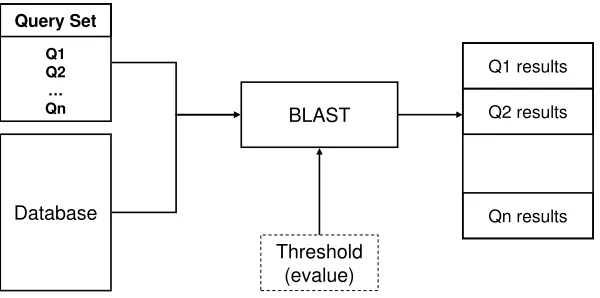
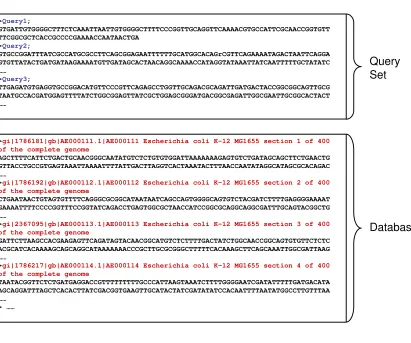
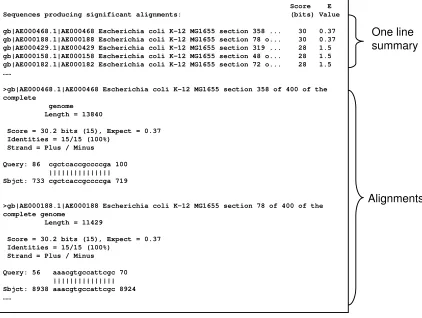
Our research will use the popular BLAST search tool as a studay case. Figure 2.1 shows the diagram of a typical BLAST search. The input includes aquery set supplied by the user, which is a collection of nucleotide or protein sequences to be searched, and a sequence database to be searched against. Figure 2.2 gives a sample section of BLAST input. In both the query set and the database, the first line of a sequence starts with a right arrow symbol indicating the sequence header, which includes information such as the sequence ID and the sequence description etc. BLAST performs Cartesian-product-style comparison between query sequences and database sequences. The results are printed to the standard output or an output file, organized by the query sequences in the order they were given in the query set. For each query sequence, the result data contains alignments between this sequence and database sequences that have closeness beyond a given threshold. The closeness is measured byevaluewhich is computed by the BLAST algorithm to represent the degree of similarities between two sequence segments. A partial sample output of searching query sequence “Query1” against the database in Figure 2.2 is given in Figure 2.3. There are two sections in the output: a one-line summary and the alignments information. In the one-line summary section, a set of result database sequences are reported to be similar to the query sequence, ordered by their evalues. The actual alignments (segments of sequences where similarity is identified) between the query sequence and result database sequences are presented in the alignments section.
tech->gi|1786181|gb|AE000111.1|AE000111 Escherichia coli K-12 MG1655 section 1 of 400 of the complete genome
AGCTTTTCATTCTGACTGCAACGGGCAATATGTCTCTGTGTGGATTAAAAAAAGAGTGTCTGATAGCAGCTTCTGAACTG GTTACCTGCCGTGAGTAAATTAAAATTTTATTGACTTAGGTCACTAAATACTTTAACCAATATAGGCATAGCGCACAGAC ……
>gi|1786192|gb|AE000112.1|AE000112 Escherichia coli K-12 MG1655 section 2 of 400 of the complete genome
CTGAATAACTGTAGTGTTTTCAGGGCGCGGCATAATAATCAGCCAGTGGGGCAGTGTCTACGATCTTTTGAGGGGAAAAT GAAAATTTTCCCCGGTTTCCGGTATCAGACCTGAGTGGCGCTAACCATCCGGCGCAGGCAGGCGATTTGCAGTACGGCTG ……
>gi|2367095|gb|AE000113.1|AE000113 Escherichia coli K-12 MG1655 section 3 of 400 of the complete genome
GATTCTTAAGCCACGAAGAGTTCAGATAGTACAACGGCATGTCTCTTTTGACTATCTGGCAACCGGCAGTGTGTTCTCTC ACGCATCACAAAAGCAGCAGGCATAAAAAAACCCGCTTGCGCGGGCTTTTTCACAAAGCTTCAGCAAATTGGCGATTAAG ……
>gi|1786217|gb|AE000114.1|AE000114 Escherichia coli K-12 MG1655 section 4 of 400 of the complete genome
TAATACGGTTCTCTGATGAGGACCGTTTTTTTTTGCCCATTAAGTAAATCTTTTGGGGAATCGATATTTTTGATGACATA AGCAGGATTTAGCTCACACTTATCGACGGTGAAGTTGCATACTATCGATATATCCACAATTTTAATATGGCCTTGTTTAA ……
> …… >Query1;
GTGATTGTGGGGCTTTCTCAAATTAATTGTGGGGCTTTTCCCGGTTGCAGGTTCAAAACGTGCCATTCGCAACCGGTGTT TTCGGCGCTCACCGCCCCGAAAACCAATAACTGA
>Query2;
GTGCCGGATTTATCGCCATGCGCCTTCAGCGGAGAATTTTTTGCATGGCACAGrCGTTCAGAAAATAGACTAATTCAGGA GTGTTATACTGATGATAAGAAAATGTTGATAGCACTAACAGGCAAAACCATAGGTATAAATTATCAATTTTTGCTATATC ……
>Query3;
TTGAGATGTGAGGTGCCGGACATGTTCCCGTTCAGAGCCTGGTTGCAGACGCAGATTGATGACTACCGGCGGCAGTTGCG TAATGCCACGATGGAGTTTTATCTGGCGGAGTTATCGCTGGAGCGGGATGACGGCGAGATTGGCGAATTGCGGCACTACT ……
Query Set
Database
Figure 2.2: BLAST Input
Score E Sequences producing significant alignments: (bits) Value
gb|AE000468.1|AE000468 Escherichia coli K-12 MG1655 section 358 ... 30 0.37 gb|AE000188.1|AE000188 Escherichia coli K-12 MG1655 section 78 o... 30 0.37 gb|AE000429.1|AE000429 Escherichia coli K-12 MG1655 section 319 ... 28 1.5 gb|AE000158.1|AE000158 Escherichia coli K-12 MG1655 section 48 o... 28 1.5 gb|AE000182.1|AE000182 Escherichia coli K-12 MG1655 section 72 o... 28 1.5 ……
>gb|AE000468.1|AE000468 Escherichia coli K-12 MG1655 section 358 of 400 of the complete
genome Length = 13840
Score = 30.2 bits (15), Expect = 0.37 Identities = 15/15 (100%)
Strand = Plus / Minus
Query: 86 cgctcaccgccccga 100 ||||||||||||||| Sbjct: 733 cgctcaccgccccga 719
>gb|AE000188.1|AE000188 Escherichia coli K-12 MG1655 section 78 of 400 of the complete genome
Length = 11429
Score = 30.2 bits (15), Expect = 0.37 Identities = 15/15 (100%)
Strand = Plus / Minus
Query: 56 aaacgtgccattcgc 70 ||||||||||||||| Sbjct: 8938 aaacgtgccattcgc 8924 ……
One line summary
Alignments
Chapter 3
Co-scheduling Computation and
I/O for Massively Parallel
Genomic Sequence Search
3.1
Introduction
Today, the collective amount of genomic information is now doubling every 10-12 months [4, 3], while the computational horsepower of a single processor is only doubling ev-ery 18-24 months. The widening disparity between the computational demand of analyzing the collective genomic data and the uniprocessor’s processing power keeps challenging the scalability and efficiency of parallel sequence-search tools. Initial studies have shown that it takes hours to days on thousands of processors to complete large sequence-search jobs such as genome-to-genome comparisons [37] and database-to-database alignments [38]. With Moore’s Law now switching to doubling the number of cores per chip instead of doubling the uniprocessor performance in every silicon generation [39], it will soon become critical for the life scientists to leverage massively parallel computers to solve their time-consuming sequence-matching problems. It is thus imperative for sequence-search applications to be able to scale efficiently on the state-of-the-art supercomputers.
• The execution time of a search task is hard to predict from the simple metrics such as the size of the input data. Tasks processing a same amount of input can have execution time differing byorders of magnitude [38].
• The output data distribution on different processes is fine-grained as well as irregular, and varies from one query to another depending on the search result [9].
The reason for these runtime irregularities is twofold. First, the amount of required compute resources and the output data distribution of a search task are dependent on the similarities between the compared sequences, which can vary significantly even between different tasks processing a same amount of input data. Second, popular sequence alignment algorithms such as BLAST [28, 29] employ heuristics to improve computational efficiency, making it hard to predict the execution time of a search task. How to efficiently handle the runtime irregularities is a major challenge in designing scalable sequence-search applications on massively parallel computers.
Efficient scheduling for irregular scientific applications has been extensively in-vestigated since the last decade, with a wealth of techniques proposed for dynamic load-balancing by leveraging applications’ runtime profiles [40, 41, 42, 43] or probabilistic signa-tures [44, 45, 46, 47, 48]. Most of these scheduling studies, however, focused on compute-intensive applications and did not address the irregular I/O issue of data-compute-intensive applica-tions. Existing studies on noncontiguous I/O optimizations [49, 50, 51, 52, 53, 54], on the other hand, emphasized on improving programs’ actual I/O performance and were often evaluated without considering the computation scheduling. Thus, the interaction between the I/O optimizations and the computation scheduling, especially for irregular scientific applications, has not been well understood.
In this work, we systematically investigate the computation and I/O scheduling for genomic sequence-search applications. We consider our contributions as follows:
• We proposed a portable, asynchronous two-phase I/O technique for writing noncon-tiguous data in irregular, data-intensive applications. This I/O approach can obtain the performance benefit of parallel I/O without synchronization overhead imposed by traditional collective I/O techniques.
• We realized our scheduling approach on top of mpiBLAST [55], a popular open-source, parallel sequence-search tool, and developed a research prototype named mpiBLAST-PIO. The efficacy and portability of our scheduling optimizations were evaluated on three general-purpose parallel computers (configurations to be described in Sec-tion 3.4). MpiBLAST-PIO scaled perfectly to hundreds of processors on the three test parallel platforms. We also conducted a case study on the IBM Blue Gene/P mas-sively parallel computer. The performance results shown MpiBLAST-PIO achieved 93% parallel efficiency across 32,768 cores on Blue Gene/P.
3.2
MpiBLAST Background
MpiBLAST [55] is an open-source sequence-search tool that parallelizes the NCBI BLAST toolkit [28]. The original design of mpiBLAST follows the database segmentation approach. Specifically, MpiBLAST organizes parallel processes into one master and many workers. The master uses a greedy algorithm to assign pre-partitioned database fragments to workers. The workers copy the assigned fragments to their local disks (if available) and perform BLAST search concurrently. Upon finishing searching one fragment, a worker reports its local results to the master for centralized result merging. The above process repeats until all the fragments have been completed. Once the master receives results from all the workers for a query sequence, it calls the standard NCBI BLAST output function to format and print out results to an output file. MpiBLAST achieves good speedup when the number of processes is small or moderate, by fitting the database into main memory and eliminating repeated scanning of disk-resident database files.
3.3
Integrated Computation and I/O Scheduling
In this section, we first present the software architecture of mpiBLAST-PIO. Then we discuss the details of our proposed computation and I/O scheduling optimizations.
3.3.1 Software Architecture
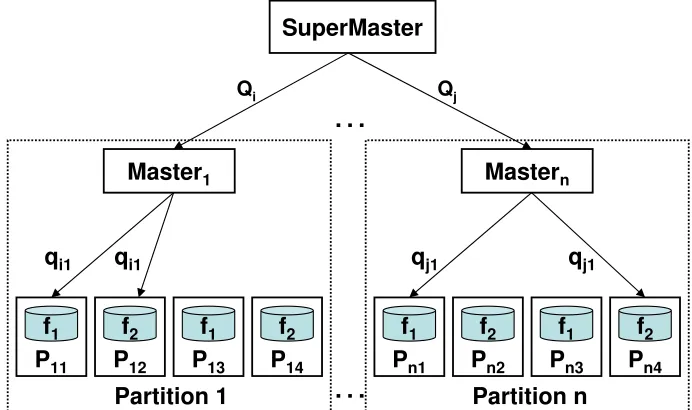
MpiBLAST-PIO adopts a hierarchical architecture as depicted in Figure 3.1. At the top level, the system is organized into equal-sized partitions, which are supervised by a dedicated supermaster process. The supermaster is responsible for assigning tasks to different partitions and handling inter-partition load balancing. Within each partition, there is one master process and many worker processes. The master is responsible for coordinating both computation and I/O scheduling in a partition. It periodically fetches a subset of query sequences (defined as aquery segment) from supermaster and assigns them to workers, as well as coordinates the output processing of queries that have been processed in the partition. Such a hierarchical design avoids creating scheduling bottleneck as the system size grows by distributing the scheduling loads on multiple masters.
SuperMaster
f1
Master1
P11
Partition 1 f2
P12
f1 P13
f2 P14 qi1 qi1
f1
Mastern
Pn1
Partition n f2
Pn2
f1 Pn3
f2 Pn4
qj1 qj1
Qi Qj
…
…
Figure 3.1: mpiBLAST-PIO software architecture. Qi and Qj are query segments fetched from the supermaster to masters, andqi1 andqj1 are query sequences that are assigned by
masters to their workers.
groups – masters and workers. In order to maximize the system throughput, it is important to keep both groups of processes equally busy so that the system idleness is minimized. The key to balance loads between masters and workers is to choose an appropriate partition size
Sp (defined as the number of workers in the partition). To this end, our design supports mapping an arbitrary number of workers to a master and allows users to determine the appropriate Sp value through initial profiling with sampled sequences from the original query1. As the master loads will increase monopoly as S
p grows, a sweet point can be found by comparing the program performance at gradually increasedSp values. Note that the optimal Sp value is platform- and workload-dependent, and automatic tuning of the parameter is out of the scope of this work.
To enable database segmentation, the sequence databases are pre-partitioned into fragments and stored on the shared file system. MpiBLAST-PIO defines two running modes, non-sharing and sharing, which distribute the database fragments to the worker nodes differently.
Thenon-sharing mode assumes input database fragments are not shared between different parallel BLAST jobs, making it suitable for platforms without locally attached disks, such as IBM Blue Gene systems. In this mode, the fragments are replicated to worker nodes’ memory in a way similar to that used in previous parallel BLAST studies [56, 10]. During the system initialization, all workers in the system are organized into temporary equal-sized replication groups, and the first group will be designated as the I/O group. All database fragments are assigned to the workers in the I/O group in a round-robin fashion. Each worker in the I/O group then reads in its assigned fragments in parallel and broadcasts them to the corresponding workers in all other groups.
In institutions where BLAST is heavily used by many users and the cluster nodes are equipped with locally attached disks, it is desirable to enable sharing of common se-quence databases between BLAST jobs to reduce the cost of data movements. In thesharing mode, the database fragments used by a BLAST job will remain on the local disks of worker nodes after the job is finished. At the beginning of execution, workers report the cached fragments on their local disks to the master. These fragments distribution information will be taken in to account in the scheduling decision.
1We found that using randomly sampled query sequences from a BLAST job to perform initial profiling
3.3.2 Fine-grained, Dynamically Load-balanced Computation Scheduling BLAST search time is highly variable and unpredictable as found in our past research [38]. To our best knowledge, there is no effective way to estimate the execution time of a given BLAST search in the existing literature. Without a priori knowledge of queries’ processing time, using a greedy scheduling algorithm to assign fine-grained tasks to idle processes seems to be sufficient to load balancing.
To effectively achieve load-balance across multiple partitions, assigning a small query segment to a partition at a time is desirable, especially for running on supercom-puters with a large number of partitions. On the other hand, fine-grained query-segment allocation incurs two problems. First, the scheduling overhead increases with smaller query segment sizes. Second, using small query segment forces frequent synchronization between the workers within each partition, leaving faster workers waiting for its slowest peer to fin-ish before acquiring a new segment of queries to work on. In particular, with small query segments, there are not enough queries to “cancel out” the per-query imbalance of search time, therefore the intra-partition load-imbalance worsens and the partition-wise resource utilization degrades.
We address the above problems associated with small scheduling granularity by usingtask-oriented scheduling and query prefetching at each partition. With task-oriented scheduling, rather than assigning each query to a fixed group of workers, its search is broken into a set of tasks corresponding to the set of database fragments this query has to be searched against. The masters dynamically maintain a window of outstanding tasks. Whenever a worker is done with its current task, it contacts the master to request another one. The set of workers that work on one particular query is thus dynamically formed. With query prefetching, the master requests the next query segment when the total number of outstanding tasks falls under a certain threshold. By combining these two techniques, workers will not be slowed down by waiting for its peers or for the next batch of query sequences.
completed by workers. When observing that the number of total uncompleted tasks of all query sequences inQLis less than the number of workers (|W|) in the partition, the master issues a query prefetching request to the supermaster. To overlap network communications with local job scheduling, the master receives the query segment in the background with a nonblocking MPI call. The new query segment received from the supermaster will be appended to the end of QL.
In the above design, the size of a prefetched query segment (Sq) is configurable. Using smallerSq can yield better load balance results but increase the number of messages sent to the supermaster. In practice, Sq can be configured to an arbitrarily small value as long as the supermaster is not overloaded by the prefetcting messages. According to our experiments on the System X cluster (configuration details will be described in Section 3.4) using 1024 processors, for typical BLAST searches the supermaster is not a performance bottleneck even when theSq is set to 1. In our case study that specially optimized for the IBM Blue Gene/P system (to be presented in Section 3.5), we found setting Sq to 5 was sufficient in a scale of 32,768 processes.
At the inner-partition level, workers periodically report to the master for assign-ments when idle. Upon receiving a task request from an idle worker (wj), the master scans
QLin the FIFO order to determine a task forwj as follows. For the current query sequence being examined (qc):
1. If wj has cached some database fragments that have not been searched against qc, the cached fragment that is least distributed (i.e., cached by fewest workers) in the partition will be assigned to the worker.
2. If wj has not cached any unsearched fragment of query sequence c and the sharing mode is used, the least-distributed fragment is assigned towj, who will then load the assigned fragment into its local cache before the search.
Algorithm 1 Master Scheduling Algorithm 11.0
Let QL={q1, q2, ...}be the list of unfinished query sequences
Let F ={f1, f2, ...} be the set of database fragments
Let U nassignedi ⊆F be the set of unassigned database fragments for query sequence qi Let W ={w1, w2, ...} be the set of workers in this partition
Let Di ⊆W be the set of workers that cached fragmentfi
Let Distributed={D1, D2, ...} be the set of Dfor each database fragment
Let Ci ⊆F be the database fragments cached by workerwi Let assignmenti refer to the assignment to theith worker
Require: |W| 6= 0
while not all query sequences have been finisheddo
if number of all unassigned fragments inQL < |W|then
Issue segment prefetching request to supermaster
end if
if Received a query segment QS from supermasterthen forqi∈QS do
Appendqi to QL
U nassignedi ←F
end for end if
Receive task request from workerwj
qc ←QL.head
assignmentj ← <∅,0>
whileqc6=QL.tailand assignmentj = <∅,0>do
if ∃fi∈U nassignedc and wj ∈Di then Findfk such that minDk⊆Distributed|Dk|
and wj ∈Dk and fk∈U nassignedc
assignmentj ← < qc, fk>
else
if sharing mode is usedthen
Find fk such thatminDk⊆Distributed|Dk|
and fk∈U nassignedc
assignmentj ← < qc, fk>
end if end if
if |U nassignedc|= 0 then
QL.head←QL.head.next
end if
qc←qc.next
workers that have cached the corresponding database fragments, our scheduling algorithm helps balance loads between workers even the search times of different tasks are highly skewed.
3.3.3 Scalable Distributed Results Processing
While most existing studies on parallel sequence search have focused on the par-allelization of the sequence alignment computation, we have found that efficient handling of output data is crucial in sustaining the parallel execution efficiency when scaling to a large number of processors. In this section, we identify several performance issues in mpiBLAST’s original processing protocol. We then present a light-weighted result-processing protocol used in mpiBLAST-PIO. The new propotocol can significantly reduce the non-search overhead of sequence-search tools using thedatabase segmentation approach as well as enables efficient processing of output-intensive queries.
TopAlign 1 TopAlign 2 TopAlign 3 Master Format Worker 1 Worker 2 Worker n ... ... TopAlign n Write
B1 B2 B3
Alignments Seq Data
... ...
Output File
(a) Centralized Results-Processing
LocalAlign 1.1 LocalAlign 1.2
LocalAlign 1.3
B1.1 B1.2 B1.3 Worker 1 Format Write LocalAlign 2.1 LocalAlign 2.2 LocalAlign 2.3
B2.1 B2.2 B2.3 Worker 2 Format Write ... LocalAlign n.1 LocalAlign n.2 LocalAlign n.3
Bn.1 Bn.2 Bn.3 Worker n
Format
Write
B2.1 B1.1 Bn.1 B2.2 B1.2 B2.3
Master
BlockMeta WriteOffsets
Output File
(b) Distributed Results-Processing
Figure 3.2: Compare centralized and distributed design of results processing. In the cen-tralized design, the results formatting and writing is serially done by the master. While in the distributed design, the results formatting and writing is concurrently done by workers.
such as sequence IDs, evalue and the locations of the hit is stored in a per-alignment data structure. Figure 3.2(a) depicts the procedures of centralized results processing. When a search task is finished, the worker sends the result alignments together with the correspond-ing sequence data to the master. The result alignments belongcorrespond-ing to the same query will be merged into a list in the order of their evalues, and the corresponding sequence data will be buffered and used later in the results formatting. A query is ready for output when the result alignments of all database fragments have been received. The result data of multiple ready queries are processed and written in their submission order. To process a ready query, the master calls the output routine of NCBI BLAST, which in turn formats each qualified alignment (in the top k range of the alignment list) and appends the corresponding result data block to the output file.
The above centralized design is based on the assumption that the results formatting and writing can be easily handled by a single compute node. This assumption, however, is not valid given the ever-growing scale of sequence databases, query workload, and parallel computers. For example, researchers have found that searching individual “hard” queries against large DNA sequence databases could yield gigabytes of output data [38]. As a result, centralized results merging and formatting become the major scalability bottleneck in mpiBLAST. Figure 3.3 shows the execution breakdown of searching 300nrsequences against the database itself with mpiBLAST v1.4 on System X at Virginia Tech (configurations to be described in Section 3.4). The “search time” refers to the average time spent on the actual BLAST search algorithm by each worker. The “other time” includes all parallel overhead, which is dominated by the results processing cost at the scale of our experiments. As shown in Figure 3.3, the search time decreases nicely as more workers are used, but the non-search overhead also increases rapidly. Consequently, the overall execution time stops decreasing at 32 workers.
to the application-visible overhead.
0 1000 2000 3000 4000 5000 6000 7000 8000
4 8 16 32
Execution Time (secs)
Number of Workers search time
other time
Figure 3.3: Searching 300 randomly samplednrsequences againstnritself with mpiBLAST-v1.4 on the System X cluster. Thenrdatabase is partitioned into 8 fragments, and a replica of the database is pre-distributed to every 4 workers in a round-robin fashion.
To address this problem, mpiBLAST-PIO adopts a distributed results-processing design to enhance its scalability in searching both individual and multiple queries on a large number of processors. Figure 3.2(b) illustrates this new output workflow. First, after generating local result alignments, workers take one more step to format the alignments into output blocks and store them in memory buffers. Each output block is stored with the evalue of the corresponding alignment. Next, workers submitblock metadata, which consists of the evalue and size of each local output block, to the master. The master then merges and filters out output blocks of unqualified alignments according to their evalues. When the block metadata of all workers have been received for one query, the master calculates the in-file offsets of globally qualified output blocks and sends the those back to the workers who buffered corresponding output blocks. Now knowing the subset of their qualified local output blocks, the workers will write the output buffers that they already prepared out to the file system. These write operations can be carried out in parallel using several strategies, to be discussed in Section 3.3.4.
master node by having all workers collaboratively buffer intermediate results. Third, only a small amount of data (i.e., evalues, sizes and write offsets of output blocks) needs to be exchanged between the master and the workers, dramatically reducing the communication volume in the system. Although the new scheme has the workers format all their interme-diate results regardless of whether these results will be included in the global output, the wasted processing is outweighed by the benefit of saving transferring bulky sequence data and parallelizing the output preparation.
3.3.4 Parallel Output Scheduling
Our dynamic computation scheduling and distributed results processing leave each involved worker a set of non-contiguous output data blocks to write to disjoint ranges in the output file. How to efficiently write those output data to the file system is another challenge to sustaining high sequence-search throughput.
The optimizations of non-contiguous I/O operations have been well studied for parallel numerical simulations, which often possess predictable data access patterns and balanced computation models. However, in our situation the unique aspects of parallel sequence-search applications complicate the I/O design in several ways:
• The output data distribution is fine-grained as well as irregular, and varies from one query to another depending on the search result [38]. Straightforward, uncoordinated I/O can result in poor I/O performance.
• Unlike in timestep simulations, where the computation time is well balanced across processes, here the computation time could be significantly imbalanced across workers searching the same query on different database fragments. In addition, there is no inherent synchronization in the computation core between searching different queries. Synchronous parallel I/O techniques may incur high parallel overhead and have neg-ative impacts on our load balancing algorithms.
strategies: WorkerIndividual, WorkerCollective, MasterMerge and WorkerMerge (as illus-trated side by side in Figure 3.4). Among them, the first three are based on existing I/O techniques, and the last one (WorkerMerge) is based on our proposed I/O optimization.
WorkerIndividual
As described in Section 5.4, once the workers receive write offsets of buffered output blocks from the master, they can go ahead and issue write requests to the shared file system to write out the buffered output blocks. Figure 3.4(a) depicts the procedure of the WorkerIndividual strategy with an example setting consisting of three workers, assuming the database is also segmented into three fragments. Whenever a worker finishes a search assignment, it checks with the master to receive offset information for previously completed queries. If such information arrives, the worker will first write local qualified output blocks to the shared file system before searching its next assignment. Note that as the results merging cannot be finalized until all workers complete searching the query sequence qi, a worker likely will not be able to proceed with output right after it finishes searching this query. Instead of blocking this worker until the write offsets for qi are released by the master, the scheduler let it go ahead to request the next query sequence, qi+1 and start
computation again.
The writing of non-contiguous output data can be done in two ways. The intuitive way is to perform a seek-and-write operation for every block via POSIX I/O calls. This is a slow solution as it will result in many small I/O requests, unfavored by typical file systems. An alternative way is to use the non-contiguous write method provided by MPI-IO [57]. Each worker first creates a file view that describes the locations to be written, then just callsMPI File write()to issue writes of all output data at once. MPI-IO libraries such as ROMIO [50] provide optimizations for this kind of non-contiguous write with data sieving [58]. In our experiments, MPI-IO calls will be used when data sieving is supported by the underlying file system, otherwise we fall back to seek-and-write with POSIX functions.
qi
Merge blocks info
qi+1
Calculate offsets of qi Worker 1 Worker 2 Worker 3 Master
qi+2 qi qi+1 qi+2 qi qi+1 qi+2 Search Merge
1 Send evalue+size 1
2 Send offsets 3 Write data 1 1 2 2 2 3 3 3 3
Output of qi Output of qi+1 Output File (a) WorkerIndividual qi Merge blocks info qi+1 Calculate offsets of qi
Output of qi Output of qi+1 qi qi+1 qi+2 qi qi+1 qi+2 1 1 1 2 2 2 Search Merge
1 Send evalue+size 2 Send offsets 3 Write data 4 Exchange data 3 3 Wait
4 4 4
qi+2
Worker 1 Worker 2 Worker 3 Master
Output File (b) WorkerCollective qi Merge blocks info qi+1 Calculate offsets of qi
qi+2 qi qi+2 qi qi+1 qi+2 1 1 1 2 2 2 4
Output of qi Output of qi+1 Search Merge
1 Send evalue+size 2 Offsets 3
3
3 Worker 1 Worker 2 Worker 3 Master
qi+1 Output File 3 Write data 4 Exchange data (c) MasterMerge qi Merge blocks info qi+1 Calculate offsets of qi
qi+2 qi qi+1 qi+2 qi qi+1 qi+2 1 1 1 2 2 2 4
Output of qi Output of qi+1 Search Merge
1 Send evalue+size 2 Offsets 3
3
Worker 1 Worker 2 Worker 3 Master
Output File 3 Write data 4 Exchange data (d) WorkerMerge
Even with data sieving, the concurrent irregular I/O requests from multiple workers would generate much contention on the file system, leading to undesirable I/O performance.
WorkerCollective
Collective I/O appears to be a natural solution when we have a large number of small, non-contiguous I/O requests accessing a shared file with an interleaving pattern. A corresponding output strategy for parallel sequence search, which we callWorkerCollective, lets the workers coordinate their write efforts into larger requests. As illustrated in Fig-ure 3.4(b), after receiving write offsets from the master, rather than performing individual writes, the workers will issue a MPI-IO collective write request. Like in the case of Work-erIndividual, the results merging of qi likely will not be done right after the search of this query is completed. To overlap the master’s result processing with workers’ searching, all the workers involved in searching qi continue with query processing, until between assign-ments they found that the file offset information regarding qi has arrived. At this point, a worker will enter the collective output call for qi. The advantage of this strategy lies in its better I/O performance compared to the non-contiguous write approach, by combining many small write requests into several large contiguous ones through extra data exchange over the network. However, even with the overlap discussed above, this strategy still incurs frequent synchronization, as collective I/O calls are essentially barriers that force work-ers to wait for each other (as shown with the white boxes in Figure 3.4(b)). While very suitable for time-step simulations, this communication pattern is undesirable for parallel sequence-searches, which are known to have imbalanced computation intervals.
MasterMerge
This approach avoids concurrent I/O by many workers on a system with limited parallel I/O support and merges small I/O requests without enforcing synchronization on workers. However, the scalability of this scheme is apparently limited on larger systems, as the master can easily become the bottleneck.
In implementing this strategy, the master’s memory constraint has to be taken into account. We defined a maximum write buffer size (M BS) in the master to coordinate incremental output communication, similar to the scheme used in common 2PIO imple-mentations [49]. That is, onlyM BS amount of data will be collected and written at each operation.
WorkerMerge
Recognizing the limitations of the aforementioned approaches, we propose Work-erMerge, an output strategy that performs asynchronous, two-phase writes with merged I/O requests. With this strategy, after the master finishes result merging for query qi, it appoints one of the workers to be the writer for this query. To minimize data communi-cation, we select the worker with the largest volume of qualified output data to play the writer role, who will collect and write the entire output for this query. The workers involved in searching qi are notified about the output data distribution and the writer assignment, and send their output data for qi to the writer. In the example depicted in Figure 3.4(d), worker 2 is selected as the merger for queryqi. After receiving output offsets, worker 1 and worker 3 send their output blocks to worker 2 using non-blocking MPI sends, then continue with the next search assignment. After worker 2 finishes searching query qi+1, it receives
output blocks sent by worker 1 and 3, then performs a contiguous write.
In our implementation, the same incremental communication strategy used in Mas-terMerge is adopted here to guard against buffer space shortage. Such data collection is conducted using non-blocking MPI communication to overlap with search computations. A writer checks the status of the collection between searching two assignments. Whenever the data is ready, it issues an individual write call to output a large chunk of data.
to be efficiently supervised by a master.
One may argue that the MPI-IO standard does provide asynchronous collective I/O withsplit collective read/write operations[57]. The split collective operations do allow the overlap of I/O and computation by separating a single blocking collective call into a pair of “begin” and “end” operations. However, our framework cannot benefit from them for two reasons. First, split collective I/O is not yet supported in popular MPI-IO libraries [50]. Second, in our target scenario, the data distribution (in terms of an MPI file view) is computed dynamically depending on the local result merging process, therefore a new file view needs to be constructed for each query’s output. Since the MPI File set view call has only a blocking form, there is no way to remove inter-worker synchronization even with split collective write functions.
In our current design, the result from each query is written by one writer pro-cess. For queries that generate large amounts of output data, using multiple writers may be beneficial. Our work targets large BLAST jobs processing many queries on supercom-puters. With a large number of concurrent groups working on queries and our proposed asynchronous writing, the underlying I/O parallelism in the system is expected to be well utilized. Therefore the main issue here is whether the individual writers will have enough memory space to buffer the single-query output, which can be addressed by our incremental buffering and writing design.
3.4
Performance Evaluation
To evaluate the computation and I/O scheduling approaches presented earlier in this paper, we performed extensive experiments with mpiBLAST-PIO on three clusters with varying sizes, architectures, interconnection types, operating systems, and file systems, whose details will be presented in Section 3.4.1.
0 1000 2000 3000 4000 5000 6000 128 64 32 16
Execution Time (secs)
Number of Workers WorkerIndividual WorkerCollective MasterMerge WorkerMerge (a) Jacquard@NERSC 0 1000 2000 3000 4000 5000 6000 7000 8000 9000 10000 128 64 32 16
Execution Time (secs)
Number of Workers WorkerIndividual WorkerCollective MasterMerge WorkerMerge (b) IA64@OSC 0 1000 2000 3000 4000 5000 6000
16 32 64 128
Execution Time (secs)
Number of Workers WorkerIndividual
MasterMerge WorkerMerge
(c) System X@VT
Figure 3.5: Node scalability results of searching 1000 randomly sampled nt sequences on different number of workers.
3.4.1 Experiment Setup
Below we give the detailed configurations of our test platforms.
Jacquard: Jacquard is a 356-node Opteron cluster running Linux, located at Na-tional Energy Research Scientific Computing Center (NERSC). Each node has dual Opteron 2.2 GHz processors and 6 GB of physical memory. The nodes are interconnected with a high-speed InfiniBand network. Shared file storage is provided by the GPFS filesystem [59]. No local storage is available for applications on the compute nodes. The MPI library is MVAPICH version 0.9.5-mlx1.0.1.
cluster is built using HP zx6000 workstations, an SGI Altix 3000 and several Altix 350s. The partition used in our experiments consists of 110 compute nodes, each has two 1.3 Gigahertz Intel Itanium 2 processors and 4 GB of physical memory. The nodes are interconnected with Myrinet and Gigabit Ethernet. Shared file storage is provided by a PVFS filesystem. A 36 Gigabytes, ultra-wide SCSI hard drive is attached to each node as local storage. The operating system is Linux and the MPI library is a version of MPICH optimized for the Myrinet high-speed interconnect.
System X: System X is a 1100-node MAC OS cluster located at Virginia Tech (VT). Each node consists of two 2.0-GHz IBM PowerPC 970 CPUs and 4 GB of physical memory. System X uses two interconnection fabrics, InfiniBand and Gigabit Ethernet. Shared file storage is provided by a ZFS [60] distributed filesystem. A 80GB hard drive is attached to each node as scratch space. The MPI library is a customized version of MPICH 1.2.5.
It worths noting that due to a special combination of the file system (ZFS) and the MPICH customization, MPI-IO (especially collective I/O) is not well supported on System X. Therefore for all experiments on System X, we only show results of three output strategies other than WorkerCollective.
The experiment database is nt, a nucleotide sequence database that contains the GenBank, EMB L, D, and PDB sequences. At the time when our experiments are per-formed, thentdatabase contained 5,454,516 sequences with a total raw size of about 20GB and a formatted size about 6.5GB. To stress test the scalability of mpiBLAST-PIO, we use sequences randomly sampled fromntitself as queries because these queries are guaranteed to find close matches in the database.
3.4.2 Scalability Comparison of Output Strategies
In this section we evaluate the scalability of four output strategies discussed in Section 3.3.4 with regard to both system sizes and output sizes. The experiment query set consists of 1000 randomly sampled nt sequences sized 5KB or less. The sequences within this length range account for 96% of overall sequences in the database. Our past experiences suggest that searching these sequences incurs high I/O demands. For all experiments in this section, we configured mpiBLAST-PIO to use only one partition. In doing so, we focus solely on I/O scalability and isolate other factors such as load balancing between partitions. Thentdatabase is partitioned into 32 fragments. These fragments are distributed on every 8 workers in a round-robin fashion. This configuration works well for the BLAST search jobs used in the experiments according to our experiences. All experiments are repeated three times and the average results are reported. The result variances are less than 5% in these experiments, hence the error bars are not included in the figures.
Figure 3.5 shows the node scalability test results, where we plot the overall execu-tion time of searching the given query set againstntas a function of the number of workers. We find that across all three platforms, the WorkerMerge approach works consistently the best. Overall, its winning margin increases as the number of workers grows. With 128 workers, it outperforms the WorkerInidividual strategy by an average factor of 1.8 over the three test systems, WorkerCollective by 5.4, and MasterMerge by 1.7. In addition, Work-erMerge achieves near-linear scaling from 16 to 128 workers on all three tested platforms. As expected, it outperforms other strategies by adopting distributed, merged I/O without enforcing additional synchronization that slows down query processing.
0 500 1000 1500 2000 2500 3000 3500 2000 1000 500 250
Execution Time (secs)
Number of Output Sequences per Query WorkerIndividual WorkerCollective MasterMerge WorkerMerge (a) Jacquard@NERSC 0 1000 2000 3000 4000 5000 6000 7000 8000 2000 1000 500 250
Execution Time (secs)
Number of Output Sequences per Query WorkerIndividual WorkerCollective MasterMerge WorkerMerge (b) IA64@OSC 0 500 1000 1500 2000
250 500 1000 2000
Execution Time
Number of Output Sequences per Query WorkerIndividual
MasterMerge WorkerMerge
(c) System X@VT
Figure 3.6: Output scalability results of searching 1000 randomly sampled nt sequences with different amount of output data.
By varying the amount of output data, our tests arguably evaluate how well different output strategies accommodate the performance trend of future sequence-search jobs. In addition, our tests address users’ needs for gathering large amounts of results; according to the feedbacks provided in mpiBLAST users’ mailing list, it is not unusual that nowadays BLAST users choose to have several thousands of result sequences reported.
Figure 3.6 shows the results of the output scalability tests, where we plot the overall execution time as a function of the number of reported result sequences. The advantage of WorkerMerge over the other strategies is more evident than in the node scalability tests. When reporting 2000 result sequences, WorkerMerge outperforms the second best strategy by a factor of 2.4, 1.8 and 1.3 on Jacquard, IA64 and System X respectively, and outperforms the worst strategy by a factor of 4.9, 8.8, and 2.1. In addition, the performance curves of WorkerMerge are much flatter than those of the other three strategies, suggesting that WorkerMerge is less sensitive to the growth of output sizes than the others.
Overall the relative performance differences between various strategies are similar to those in the node scalability tests. A new observation is that on Jacquard, the per-formance of WorkerIndividual degrades fast as more results are reported, causing a worse execution time than WorkerCollective at 2000 result database sequences. The scalability of WorkerIndividual is much better on IA64 and System X. One explanation is that the non-contiguous write approach used in WorkerIndividual is better supported by the file systems on the two platforms. In particular, PVFS (on IA64) provides special optimization for this write pattern with LIST I/O technique [52].
It is clear that for both types of scalability tests, WorkerMerge greatly outperforms the other strategies on all three tested platforms. Therefore we will configure mpiBLAST-PIO to use WorkerMerge in the rest of experiments.
3.4.3 Fine-grained Dynamically Load Balancing
In Section 3.3.2 we presented the details of our fine-grained, dynamically load-balancing algorithm. A key factor of the design is to minimize the scheduling overhead by having masters proactively prefetch query segments from the supermaster. In this section, we evaluate the efficacy of query-segment prefetching with two synthesized workloads that have different balancing sensitivity to the task granularity.
se-quences sized 1KB or less. Our past experiences suggest that the search time distribution is relatively balanced for these sequences. For this workload, the load balance results are rel-atively insensitive to the task granules. For the second workload, we purposely synthesize a query set with a skewed search time distribution, where the load balancing results are highly sensitive to the task granules. We mixed expensive queries with inexpensive ones in terms of their search times as follows. According to reference [38], expensive query sequences in thentdatabase are likely to be larger than 5KB. With this hint, we first randomly sample 10,000 query sequences under 50KB from the nt database. These sequences are separated into two groups, with the first group consisting of sequences larger than 5KB and the second group consisting of the rest. Then we extract 10% of the most expensive sequences out of group one and put them together with 10% sequences randomly extracted from group two. This results in a 1000-sequence query set with expensive ones in the beginning.
Figure 3.7(a) gives the CDF function of the processing time of each query sequence in the above two workloads when searched on 32 processors on System X. We label the first and the second workloads with “Balanced” and “Skewed” respectively. As can be seen, 98.8% of query sequences in the first workload can be processed within 10 seconds, and the longest processing time is only 50 seconds. In the second workload, most of the query sequences (96.9%) can still be processed within 10 seconds. However, the rest of the sequences are much more expensive, with processing times ranging from 40 to 400 seconds. We search the two workloads on System X using 166 processors configured into 5 partitions, with each consisting of 32 workers. The nt database is partitioned and pre-distributed in the same way as in the scalability tests. Each experiment is repeated three times and the average numbers are reported. Again, the result variance are quite small (less than 5%) so we do not include the error bars in the result figures.
to balance loads across workers in the partition, causing worker idleness. In contrast, with prefetching, the overall execution time is about the same across different segment sizes. This suggests that our query prefetching design can gracefully hide the scheduling overhead of doing fine-grained load balancing in the given setting.
0.965 0.97 0.975 0.98 0.985 0.99 0.995 1
0 50 100 150 200 250 300 350 400
Cumulative Percentage
Query Processing Time (secs) Balanced Skewed (a) CDF 0 200 400 600 800 1000 20 10 5 1 Execution Time(secs)
Query Segment Size (#sequences) Prefetch
NoPrefetch
(b) Balanced Workload
0 500 1000 1500 2000 2500 3000 3500 20 10 5 1 Execution Time(secs)
Query Segment Size (#sequences) Prefetch
NoPrefetch
(c) Skewed Workload
Figure 3.7: Performance impacts of query segment prefetching.
by the worker idleness offsets the gain of fine-grained load balancing. The worker idle issue is greatly resolved with prefetching of query segments. Consequently, with prefetching, the system achieves the best performance at the smallest task granule (query segment size 1), where the advantage of fine-grained load balancing is fully taken. In particular, the best prefetching case (query segment size 1) outperforms the best non-prefetching case (query segment size 5) by a factor of 1.4.
0 500 1000 1500 2000 2500 3000 3500 4000
1024 512
256 128
Execution Time (secs)
Number of Processors P32 P64 P128 PALL
Figure 3.8: Scalability of searching 5000ntsequences with various partition sizes on System X. Configurations of different partition sizes are labeled P32, P64 and P128 respectively. PALL refers to the single-layer master-slave configuration, using all available processors for one partition. Note P128 and PALL are actually the same when running on 128 processors.
3.4.4 Overall System Scalability
previously. The prefetched query segment size is set to one.
The performance results are shown in Figure 3.8. The first observation is that the execution times decrease nicely for all configurations as the system size grows. Surprisingly, even with a single-layer configuration (labeled PALL in the figure), mpiBLAST-PIO scales well to 1024 processors, which suggests that our inner-partition scheduling algorithm is highly efficient. However, the benefit of hierarchical scheduling on large system size is evident. With 512 processors and above, using single-layer scheduling is significantly slower than all other three configurations, simply because the master will become a performance bottleneck when managing too many workers. Specifically, PALL is slower than the best hierarchical configuration (P64) by a factor of 1.9 and 2.3 on 512 and 1024 processors respectively.
The performance impacts of using different partition sizes are determined by a combination of several factors. On the one hand, using larger partition sizes can save the number of master processes and give more horse power to the actual search computation. On the other hand, larger partition sizes could overburden the master process with increas-ing loads of schedulincreas-ing and output coordinatincreas-ing, and consequently incur higher parallel overhead. As can be seen in Figure 3.8, for this particular setting, using 128-worker parti-tions (labeled P128) is noticeably slower than the other two configuraparti-tions (P32 and P64), mainly because the master is overloaded when handling a large number of workers. Interest-ingly, P32 and P64 deliver almost identical performance. This suggests that when partition size increases from 32 to 64, the saving in search computation time is counteracted by the parallel overhead increased. Nonetheless, mpiBLAST-PIO achieves almost linear speedup up to 1024 processors when the partition size is set to 64, with a parallel efficiency of 92% on 1024 processors as shown in Figure 3.9.