Biometric System Base Secure Authentication
Service for Session Management
Nilima Deore1, Prof. C.R.Barde2
PG Student, Dept. of CSE, R.H.Sapat College of Eng ineering, Nashik, Maharashtra, India1 Assistant professor, Dept. of CSE, R.H.Sapat College of Engineering, Nashik, Maharashtra, India2
ABSTRACT: The ma in aim of this design integrated in a distributed internet service is to realize a secure authentication service, and maintain the session management for web applications.This system Provide secure user authentication for web application. Th is is traditionally based on pairs of username and password as well as bio metric techniques offer e merging solution a particular confirmation point and a solitary biometric data are not forever sufficient to assurance authenticity. Also trend inwards multi-modal b io metric and permanent confirmat ion protocols. The proposed approach for user verification is CASHMA system. Provides adaptive session timeouts as well as credentials acquired transparently. In proposed system instead of username password. We use mult iple b io metric verifications. A secure protocol is defined for perpetual authentication through continuous user verification. Finally, the use of biometric authentication allows credentials to be acquired visibly i.e. e xclusive of unequivocally notifying the user or requiring his interaction, wh ich is essential to guarantee better service usability.
KEYWORDS: Web Security, Authentication, Continuous user verification, b io metric authentication
I. INTRODUCTION
Conte xt-Aware Security by using Hierarchica l Multilevel Architectures is used in this concept. This system used for secure biometric authentication on the internet. The CASHMA is able to operate securely with any kind of web service, together with services with high security strain as online banking services. Depending on the preferences and require ments of the holder of the web service the CASHMA confirmat ion service replace the traditional authentication service. This proposed system work on a username password. We use mult iple bio metric verifications as well as provide unremitting authentication procedure by using fingerprint scan biometrics. The systems also notice the corporal attendance of the customer logged in the workstation. Safekeeping of web-based applications is a serious apprehension, due to the recent increase in the occurrence and complexity of cyber-attacks; biometric techniques offer emerging way out for protected and trusted confirmation, where username and code word are replaced by biometric information. Similarly to conventional authentication processes which rely on username and password, biometric user confirmation is typically formulated as a sole attempt providing user confirmation only all through login phase when single or more biometric traits may be mandatory. Once the user’s identity has been verified, the system property is available for a fixed period of time or until unambiguous logout from the user. This comes up to assume that a single confirmation (at the beginning of the session) is satisfactory, and that the identity of the user is unvarying at some stage in the whole session.
II. RELATED WORK
assumption that as time passes, the confidence in the acquired values decreases. A degeneracy function that measures the uncertainty of the score computed by the confirmation purpose
.
II. DRAWB ACKS
Not a single approach supports continuous confirmation.
Up-and-coming bio metric solutions permit substituting username and password with biomet ric data all through session establishment, but in such an approach still a single confirmat ion is dee med enough, and the identity of a user is considered unassailable during the entire session.IV. PROPOS ED S YS TEM
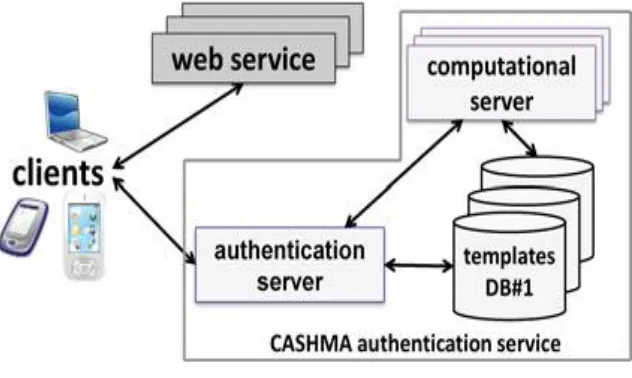
A new-fangled concept for user confirmat ion and session supervision that is applied in the context aware security by hierarchica l mu ltilevel architectures (CASHMA) system for secure biometric authentication on the Internet. CASHMA is capable to activate firmly with any kind of web service, counting services with high security burden as online banking services, and it is wished-for to be used from d iverse client devices, e.g., Sma rtphone, Desktop PCs or even biometric kiosks placed at the entrance of secure areas. Projected on the preferences and provisions of the owner of the web service, the CASHMA verification service can accompaniment a long-established authentication service, or can substitute it.
Fig 1: System A rchitecture
Our unre mitting confirmation concept is grounded on apparent attainment of bio metric data and on adaptive timeout regulation on the basis of the trust posed in the customer and in the diverse subsystems used for authentication. The user session is open and protected despite possible id le activ ity of the user, while p robable misuses are detected by constantly confirming the presence of the proper user
.
This move toward does not require that the response to a user confirmat ion disparity is e xecute by the user device but it is visibly handled by the CASHMA confirmat ion service and the web services, wh ich apply their own reaction actions provides a tradeoff linking usability and safety.V.THECAS HMASYS TEM
server verifies the user identity, and grants the access if: I) it is enrolled in the CASHMA authentication service, ii) it h as rights to access the online banking service and, iii) the acquired biometric data match those stored in the templates database associated to the provided identifier.
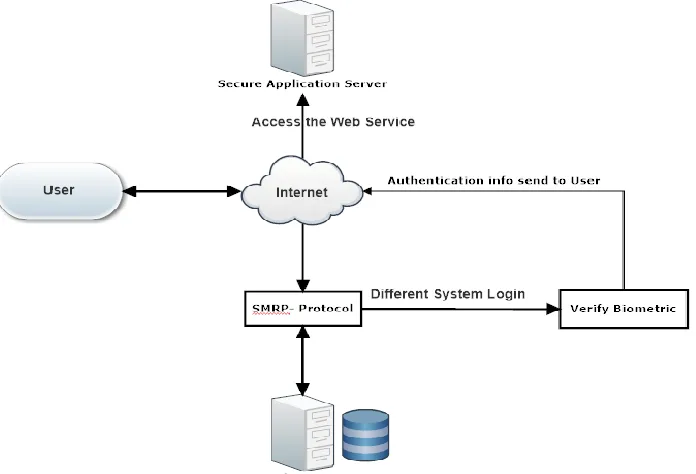
Fig 2: CASHMA Arch itecture
In case of successful user confirmation, the CASHMA authentication server releases a verification certificate to the client, proving its uniqueness to third parties, and includes a timeout that sets the highest period of the user session. The client presents this certificate to the web service, which verifies it and grants access to the client.
Conte xt-Awa re Security by Hierarch ical Multilevel Architectures This system used for secure biometric authentication on the internet
CASHMA is capable to activate firmly with any kind of web service, including services with high security demands as online banking services.
Depending on the preferences and requirements of the owner of the web service the CASHMA authentication service replace the traditional authentication service.
VI. MODUL ES
CAS HMA Cer tificate generation Module
The information contained in the body of the CASHMA certificate transmitted to the client by the CASHMA authentication server, necessary to understand details of the protocol.
It contains timestamp, sequence number, user id and it also contains expiration time of the session, dynamica lly assigned by the CASHMA authentication server.
CAS HMA initiate Module
Fig 3: In itia l Phase
Session Mai ntenance Module
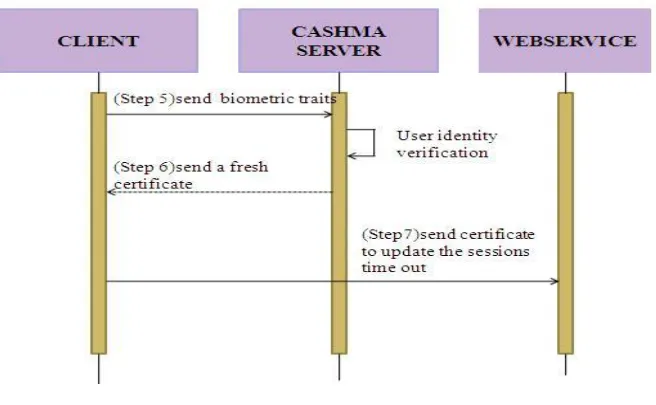
The client application acquires fresh (new) raw data (corresponding to one biometric trait ), it commun icates them to the CASHMA authentication server.
Fig 4: Maintance Phase
The biometric data can be acquired transparently to the user; the user may however decide to provide biometric data which are unlike ly acquired in a transparent way (e.g., fingerprint).
User uni que ness Module
Trust le vel Computati on Module
This module p rovides the trust at both clients as well as server’s side.
VII.CONCLUS ION
Methods used for continuous authentication using different bio metrics. Initia l one time login verification is inadequate to address the risk involved in post logged in session. Therefore this paper attempts to provide a comprehensive survey of research on the und erlying building b locks required to build a continuous biometric authentication system by choosing bio-metric. Continuous authentication verification with mu lti -modal b io metrics improves security and usability of user session. The functions proposed for the evaluation of the session timeout are selected amongst a very large set of possible alternatives.
REFERENCES
[1] Andrea Ceccarelli, Leonardo Montecchi, Francesco Brancati, Paolo Lollini, Angelo Marguglio, Andrea Bondavalli,, “ Continuous and T ransparent User Identity Verification for Secure Internet Services”, IEEE Transactions On Dependable And Secure Computing, December 2013.
[2] Lawrence O’Gorman, “ Comparing Passwords, Tokens, and Biometrics for User Authentication”, Proceedings of the IEEE, Vol. 91, No. 12, Dec. 2003, pp. 2019-2040.
[3] Omaima N. A. AL-Allaf, “ Review Of Face Detection Systems Based Artificial Neural Networks Algorithms”, T he International Journal of Multimedia & Its Applications (IJMA) Vol.6, No.1, February 2014.
[4] Arwa Alsultan and Kevin Warwick, “ Keystroke Dynamics Authentication: A Survey of Free-text Methods”, IJCSI International Journal of Computer Science Issues, Vol. 10, Issue 4, No 1, July 2013
[5] Robert Moskovitch et.al, “Identity theft, computers and behavioral biometrics”, IEEE, 2009.
[6] A. Altinok and M. T urk, “Temporal integration for continuous multimodal biometrics, Multimodal User Authentication”, pp. 11-12, 2003. [7] S.Sudarvizhi, S.Sumathi, “Review on continuous authentication using multi modal biometrics, Int ernational Journal of Emerging T echnology and Advanced Engineering”, Volume 3, Special Issue 1, January 2013.
BIOGRAPHY