CROSSING OVER MARC A. GRAUBARD'
University College, London, England
Received April 4, 1933
A consideration of the data presented in an earlier paper (GRAUBARD 1932) brings out certain facts with regard to the mechanism of crossing over in chromosome I1 of Drosophila melanogaster which may have gen- eral significance. In the previous work experiments were performed to study crossing over and interference along the entire length of the normal chromosome I1 and of the same chromosome with a median inverted sec- tion of an estimated length of 25 units. The cross was arranged so as to have eight marked genes along the chromosome covering it from one end to the other. The genes employed were aristaless (3.0) dumpy (13.0) black (48.5) purple (54.5) cinnabar (57.5) vestigial (67.0) Lobe (72.0) and speck
(107.0) (MORGAN, BRIDGES and STURTEVANT 1925).
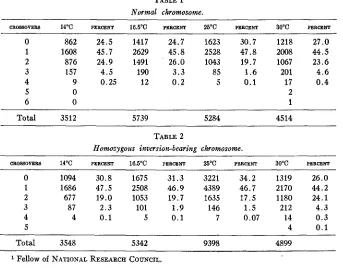
If the data given in tables 8 and 9 of the previous paper are restated so as to show the relative proportions of crossover and non-crossover flies, we get the following:
TABLE 1 Normal chromosome.
C R O S ~ O V E R ~ 14°C PERCENT 16.5"C PERCENT 25°C PERCENT 30°C PERCENT
0 862 24.5 1417 24.7 1623 30.7 1218 27.0
1 1608 45.7 2629 45.8 2528 47.8 2008 44.5
2 876 24.9 1491 26.0 1043 19.7 1067 23.6
3 157 4.5 190 3.3 85 1.6 201 4.6
4 9 0.25 12 0.2 5 0.1 17 0.4
5 0 2
6 0 1
Total 3512 5739 5284 4514
TABLE 2
Homozygous inversion-bearing chromosome.
CR0880VER8 14OC PERCENT 16.5"C PER" 25°C PERCENT 30°C PERCENT
0 1094 30.8 1675 31.3 3221 34.2 1319 26.0
1 1686 47.5 2508 46.9 4389 46.7 2170 4 4 . 2
2 677 19.0 1053 19.7 1635 17.5 1180 24.1
3 87 2.3 101 1.9 146 1.5 212 4.3
4 4 0.1 5 0.1 7 0.07 14 0.3
5 4 0.1
Total 3548 5342 9398 4899
l Fellow of NATIONAL RESEARCR COUNCIL.
84 MARC A. GRAUBARD
These results indicate that taking the chromosome as a whole the num- ber of non-crossovers is about 25 percent of the total a t 30°C, and invari- ably higher a t 25OC. The rest of the flies are distributed among the various types of single and multiple crossovers. I n the same paper experiments were also performed on crossing over in only one arm of the second chromo- some, a procedure made possible by introducing an inversion in the re- spective other arm and keeping it heterozygous. Such a condition allows crossing over to occur freely in only one arm. It must be borne in mind that the two arms are joined a t the point of spindle fiber attachment to form a V-shaped chromosome. Restating these data (tables 7 and 6) as before, we get the following:
TABLE 3
Heterozygous left inversion. Crossing over takes place i n right arm only.
14.5OC PERCENT 2 5 ° C PERCENT 3 0 ° C PERCENT
0 2042 55.6 601 53.1 1039 48.7 1 1518 41.5 495 43.8 942 44.2
2 96 2 . 7 34 3.0 145 6.8
3 1 0 . 1 1 0 . 1 4 0 . 2
Crossovers 1615 44.4 530 46.9 1091 51.3
Total 3657 1131 2130
TABLE 4
Heterozygous right inversion. Crossing over takes place in left arm only.
1 6 ° C PERCENT 2 5 ° C PERCENT 3 0 ° C PERCENT
0 2178 54.2 2225 59.9 863 51.6
1 1757 43.7 1437 38.7 725 43.3
2 79 1.9 51 1.4 77 4.6
3 4 0.3
Crossovers 1836 45.8 1488 40.1 806 48.4
Total 4014 3713 1669
I n this case we see that non-crossovers are about twice as frequent as before, giving values of approximately 50 percent at 30°C, and higher figures for the other temperatures. It is therefore apparent that whenever only one arm of this V-shaped chromosome is concerned the chance for a t least one crossover is approximately 1/2 a t 30°C, but that when the entire chromosome is involved the chance for a crossover is 3/4. At 25°C the probability for getting a crossover in each arm is less than 1/2 and for the entire chromosome the chances are less than 3/4. It should be remembered that the data of DOBZHANSKY (1931) show that the point of spindle fiber attachment is barely to the right of purple and that the two arms are ap-
Tables 1 and 2 seem to show that except a t 3OoC the percentage of non- crossovers is higher for the inversion-bearing chromosome than for the normal.
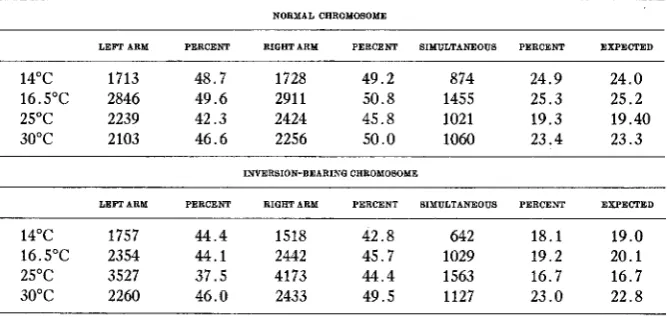
The data of tables 8 and 9 can be further restated so as to show whether the probability for a crossover or a non-crossover in one arm is equally 1/2 a t 30°C with a respective diminution a t 25°C when there is free crossing over along the entire chromosome. Under those circumstances we can ob- serve crossing over in one arm while the same process goes on unhindered in the other one as well. This is shown in table 5 where values are also given for the expected and obtained proportions of simultaneous crossovers in both arms.
TABLE 5
Percentage crossovers in each arm and simultaneous crossovers. NORMAL CKROMOSOME
LEFI ARM PERCENT RIGKT ARM PERCENT SIMULTANEOUS PERCENT EXPECTED
14°C 1713 48.7 1728 49.2 874 24.9 24.0
16.5"C 2846 49.6 291 1 50.8 1455 25.3 25.2
25°C 2239 42.3 2424 45.8 1021 19.3 19.40
30°C 2103 46.6 2256 50.0 1060 23.4 23.3
INVERSION-BEARINQ CRROMOSOME
LEFI ARM PERCENT RIGHT ARM PERCENT SIMULTANEOUS PERCENT EXPECTED
14°C 1757 44.4 1518 42.8 642 18.1 19.0
16.5"C 2354 44.1 2442 45.7 1029 19.2 20.1
25°C 3527 37.5 4173 44.4 1563 16.7 16.7
30°C 2260 46.0 2433 49.5 1127 23.0 22.8
86 MARC A. GRAUBARD
rent in the percentages of simultaneous crossovers which are lower than normal for all temperatures but 30°C.
A comparison of the total crossover values in the left arm which hap- pens to be normal, given in table 4, with the normal left from table 5, shows that in the former case when there is no crossing over in the right arm the values are 45.8 percent a t 16"C, 40.1 percent a t 25"C, and 48. percent a t 30°C and in the latter when there is free crossing over in the right arm we get 49.6 percent a t 16.5"C, 42.3 percent a t 25°C and 46.6 percent a t 30°C. The same comparison can be made for the right inversion- bearing arm. Table 3 shows that when there is no crossing over in the left arm the values for the right are 44.4 percent a t 14"C, 46.9 percent a t 25°C and 51.3 percent a t 30°C. Table 5 gives 42.8 percent a t 14"C, 44.4 percent at 25OC and 49.5 percent a t 30"C, when there is crossing over in the left. Taking the two sets together we are justified in saying that the values are not significantly different. Hence it may be concluded that whatever hap- pens in one arm by way of crossing over has no influence on the other.
Cytological evidence (DARLINGTON 1932) indicates that the mechanism of crossing over occurs as shown in figure 1. It can thus be seen that chi-
x
x
FIGURE 1.-Diagrammatic representation of crossing over. Only two strands cross a t any given point.
that there is no chiasmatization or crossing over between sister strands. While not proving DARLINGTON'S assumption that chiasmatization occurs only after crossing over has taken place, it would prove that each chiasma results in a genetic crossover whether the crossed strand goes into the egg or not. It is assumed of course, that strands are distributed in a random manner. If DARLINGTON'S hypothesis that chiasmatization always results in a potential genetic crossover is wrong, then this simple correlation of two chiasmata to one genetic crossover should not hold. By the preponder- ance of chiasmata over genetic crossovers other theories concerning the relation of chiasmatization to crossing over can be tested.
If we next arrange the data of tables 8 and 9 of the previous paper to show the proportions of double crossovers in each arm of the normal and inversion-bearing chromosomes, we observe the following:
TABLE 6
Proportion of double crossovers.
NORMAL CBBOMOBOME
LEFT A R M PERCENT RIQH'I ARM PERCENT BIYULTANEOUB PERCENT EXPECTED
14°C 141 4.0 190 5.4 8 .22 .21
16.5"C 196 3.4 248 4.3 10 .17 .15
25OC 75 1.4 152 2.8 4 .07 .04
30°C 183 4.0 290 6.4 13 .29 .26
INVERBION-BEARINQ CBROMOBOME
LEFT A R M PERCENT RIQHT ARM PERCENT BIMULTANEOUB PERCENT EXPECTED
14°C 118 3 .3 106 3.0 4 . l l .10
16.5"C 123 2 . 2 118 2 . 2 3 .06 .os
25°C 138 1 . 4 247 2.6 5 .05 .04
30°C 261 5 . 3 312 6.0 14 .29 .32
If we assume that crossing over is as likely to occur in one part of a chromosome as in another, say in the first half of an arm as in the second, then the probability of a crossover in each half arm should be 1/4 a t 30°C and the probability of doubles in each arm 1/16 or 6.3 percent, because strands that chiasmatized in the first half would still have a 1/4 probability of chiasmatizing again in the second, were there no interfering forces. The probability of simultaneous double crossovers in both arms would then be 1/256 or 0.39 percent. The last two columns of table 6 give the values for the obtained and expected percentages of simultaneous double crossovers in each arm. The numbers of flies are admittedly very small but we see that
88 MARC A. GRAUBARD
seen again that the values for the inversion-bearing chromosome are lower than those for the normal one.
It follows therefore that both arms of chromosome I1 are independent in crossing over when the arms as a whole are considered. We can check this statement by considering the cross given in table 8 (GRAUBARD 1932) as if performed for the regions al-pr and pr-sp, adjacent distances which cover approximately each arm. The following computations are obtained by treating the chromosome as if it carried only three genes-al,
pr
and sp. Hence known doubles between a1 and p r count as non-crossovers, and singles and triples as singles. The crossover values a t 25°C are 35.3 per- cent and 42.0 percent respectively. The expected value of doubles is 14.8 percent and the actual figure obtained is 15.0 percent. Similarly a t 30°C for the same cross the crossover value for the left arm is 41.4 percent and for the right 43.6 percent. The expected figure for doubles is 18.0 percent and that obtained is 18.2 percent. The same agreement is obtained for the normal chromosome. The cross reported in table 9 shows that taking the -17.3 18.8
equivalent distances, coincidence for the two arms is - at 25°C and-
17.6 18.8
at 30°C. These data show that no interference exists between the two arms. We can carry our computation further and see whether by taking sec- tions smaller than the whole arm, interference steps in. We can consider in the same manner the two adjacent regions tx-pr and p r - L in the normal chromosome (table 9). We are now dealing with central sections of chroma- tin the sum of which is a little over half the total length. The crossover value for the section to the left of the spindle fiber is 32.1 percent a t 25°C and 35.7 percent at 30°C. For the section to the right of purple the values are 17.6 percent and 20.5 percent respectively. Coincidence a t 25°C is __ and a t 30°C -
.
Hence again no interference.5 . 6 5 . 6 7.9
7 . 3
One more calculation is of interest. If we consider the distances al-cn
and cn-sp in the normal chromosome, we have one section containing a
spindle fiber attachment and a second one without a fiber connection. At 25°C the crossover values for al-cn and cn-sp are 41.7 percent and 42 per- cent and a t 30°C 43.7 percent and 42.3 percent respectively. Coincidence
17.2 18.2
17.5 18.4
at 25°C is - and at 30°C -
.
We can take similar regions in the inversion-bearing chromosome, for example, al-L and L-sp. At 25°C the crossover values are 39.2 percent and 35.7 percent and coincidence is 13.3- .
At 3OoC the crossover values are 45.9 percent and 36.0 percent 14.0These data together with those given in table 6 seem to show that if we take sufficiently large, adjacent regions there is no interference. They also show that the presence of a spindle fiber introduces no modifications. Coincidence in a V-shaped chromosome such as the second with a spindle fiber attachment in the middle seems to be dependent upon the lengths of regions rather than the spindle fiber mechanism.
However, the presence of the spindle fiber does seem to exert some in- fluence. Two small adjacent regions on either side of it, although never
---
--________1 ?
I z 3 4 5 6
Number of sections crossed.
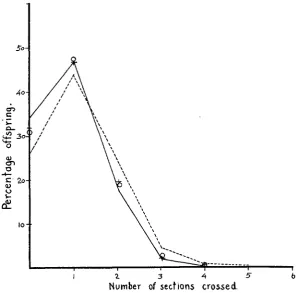
FIGURE 2.-Temperature effect on the frequency distribution of crossovers in the normal sec- ond chromosome of Drosophila melanogaster. Smooth line joins points obtained a t 25" C, broken line a t 30" C . Corresponding values a t 14" C and 16" C are marked by 0 and
+
respectively. showing a coincidence of one, show less interference than equivalent ad- jacent sections situated in one arm. Also regions lying very close to the point of spindle fiber attachment show an increase in their crossover val- ues a t the effective temperatures.As shown in figures 2 and 3 the effective temperatures always diminish the non-crossover and as a rule the single crossover classes a t the expense of an invariable increase in the number of multiple crossovers.
90 MARC A. GRAUBARD
of crossing over in one section or another. In the case of chromosome I1 the effective temperatures operate so as to raise the basic crossover proba- bility for small sections adjacent to the point of spindle fiber attachment. There is however no measurable influence on coincidence. What occurs is that due to the effective temperatures the probability of obtaining a genetic crossover in the regions adjacent to the spindle fiber is raised but
Number of sections crossed.
FIGURE 3.-Temperature effect on the frequency distribution of crossovers in the inversion- bearing second chromosome of Drosophila melanogastw. Smooth line joins points obtained at
25" C, broken line at 30" C. Corresponding values at 14" C and 16.5" C are marked by 0 and
+
respectively.the probabilities for the further sections remain unaffected. The independ- ence of the two sections still remains unaltered and the actual number of doubles is increased by exactly as much as should be expected on the basis of an increased frequency in one region only. This is demonstrated by the fact that the expected value, which is the product of the raised probability and the old probability for the unaffected section, is always in agreement with the figure actually obtained.
On the basis of
DARLINGTON'S
theory the number of chiasmata a t 3OoCfor all temperatures in more distal sections, and the number of double chiasmata in each arm should be increased only in proportion to the rise in frequency of the central sections.
Whatever theory of crossing over is assumed the genetic evidence pre- sented here seems to indicate that crossing over is so to speak, a property of a section of chromatin. For a given section there is a definite frequency of chiasmatization with a determined frequency of genetic crossing over. According to DARLINGTON'S theory the ratio of chiasmatization to genetic crossovers is 2 : l . By observing the frequency of chiasmatization that theory can be tested. If we take a section of the proper length, we get independence of crossing over between one section and another. It should therefore follow that crossing over is not a central mechanism for chromo- some I1 but a local one, and that one half of it would be equally independ- ent of the other half in crossing over even were there no spindle fiber dividing them.
Similar results showing the absence of interference in sufficiently large sections, such as the two arms of chromosome 11, are obtained if the data are calculated on the basis of crossings over instead of crossover flies, that is, when a double crossover is counted as two crossings, a triple as three, et cetera. We then find that the proportions of crossings over in the left arm are 44 percent at 25°C and 50 percent at 3OOC. The values for the right arm are 49 percent at 25OC and 56 percent at 3OOC. The percentages of crossings involved in the simultaneous crosses as calculated from the data are 40 percent and 52percent a t the two respective temperatures. The values expected on an independent basis are 42 percent and 56 per- cent.
The average percentage of crossings over in each arm of chromosome I1 is 46 percent, or 0.46 crossing per fly at
25°C.
For the total chromosome i t is 93 percent or 0.93 crossing per fly. For the whole X chromosome (BRIDGES and OLBRYCHT 1926) the respective value is 0.62 crossing per fly. Although the correlation between percentage crossings per fly is in per- fect agreement with the lengths of chromatin as measured for the X, one arm and the entire chromosome 11, i t is doubtful whether such a compari- son is fruitful. There is no reason to believe that equivalent lengths of chromatin have identical crossing over possibilities in different chromo- somes.It was noticed before (GRAUBARD 1932) that when small non-adjacent sections situated far apart are considered, as for example al-dp and vg-L
92 MARC A. GRAUBARD
longer study the interaction between the two regions selected for observa- tion but introduce disturbances known to take place.
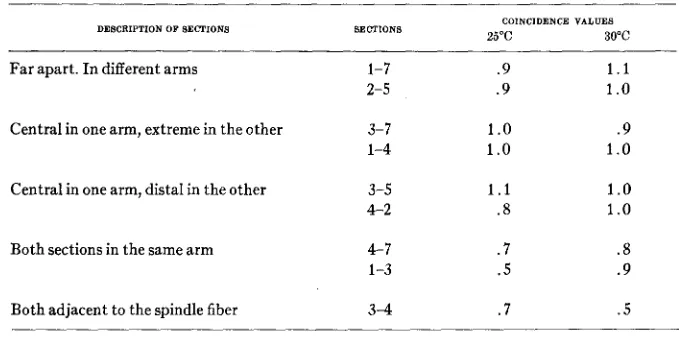
To obviate this complication we can use only those data in table 9 (GRAUBARD 1932) which are relevant and disregard the others. I n com- puting interference between al-dp (section 1) and L-sp (section 7) we must consider only four classes of flies: Non-crossovers, crossovers in region 1,
crossovers in 7, double (1-7) crossovers. The total of the flies consists of the sum of these classes. If this procedure is followed we get the following coincidence values.
TABLE 7
Corrected coincidence values for various regions.
COINCIDENCE VALUES
2 5 C 30°C
DESCRIPTION OF SECTIONS SECTIONS
Far apart. In different arms 1-7
2-5
Central in one arm, extreme in the other 3-7
1-4
Central in one arm, distal in the other 3-5
4-2
Both sections in the same arm 4-7
1-3
Both adjacent to the spindle fiber 3 4
. 9
.9
1
.o
1.o
1.1 .8 .7 .5 7 1.1 1
.o
.9 1 .o
1
.o
1
.o
.8
.9 5
We see from these figures that there is no interference between regions sufficiently far apart. The suggestion may therefore be made that the terms loop and interference are not applicable to sections further apart than the maximum loop length which is capable of exerting interference. The pic- ture of a loop was postulated to account for interference. The concept of interference presumes a tendency to form a loop after one crossing has oc- curred. Hence when a crossover occurs in region 1 and another one in region 7 there is no reason to consider that a loop in the above sense. They are two events occurring simultaneously and apparently independently.
It stands to reason that when crossings take place in regions adjacent to either one of the two, they will exert an influence. For this reason they are neglected in the above computation because only the two sections must be isolated for study if we wish t o find the influence of a cross in one upon that in the other.
side of the spindle fiber show higher coincidence than two larger, adjacent sections in one arm.
I a m indebted to Professor J. B. S. HALDANE of the Department of Zoology, UNIVERSITY COLLEGE, London, and to Mr. M. D. SCHWEITZER of the Department of Zoology, COLUMBIA UNIVERSITY, New York, for useful criticism and helpful suggestions.
CONCLUSIONS
1. On the basis of DARLINGTON’S theory of crossing over there must be on the average a t least one chiasmatization in each arm of the V-shaped second chromosome a t 30°C.
2. The effective high and low temperatures decrease the percentage of non-crossovers and increase the frequency of multiple crossing over.
3 . The effective temperatures raise the probability for getting a cross- over in the small sections adjacent to the spindle fiber. They exert no influence on coincidence. The rise in multiple crossovers is due to the in- crease in the frequency of crossovers in the sections adjacent to the spindle fiber. The resulting increase in multiples is in good agreement with the magnitude expected on the basis of the probability values.
4. If large enough sections are considered, no interference obtains in chromosome 11. Crossing over in one arm is independent of that in the other arm. No interference exists for any adjacent regions of large enough lengths regardless of whether they contain the spindle fiber toward the center or a t extreme ends. The same independence holds true for non-ad- jacent sections sufficiently wide apart, provided we consider only flies relevant to the relationship under examination. For two sections situated in the same arm interference obtains.
5. If a section of chromatin of a certain length has a given probability
of producing a crossover, then the term interference cannot be applicable to two crossovers further apart than the maximum interference-exerting, loop size. They will be two independent events occurring simultaneously. Events in the intervening regions may influence one section or the other and they must be accounted for.
LITERATURE CITED
ANDERSON, E. C., 1925 Crossing over in a case of attached X chromosomes in Drosofihila melano-
BRIDGES, C. B. and ANDERSON, E. G., 1925 Crossing over of the X chromosomes of triploid fe-
BRIDGES, C. B. and OLBRYCHT, T. M., 1926 The multiple stock“X-ple” and its uses. Genetics 11:
DARLINGTON, C. D., 1932 Recent advances in cytology. London: P. Blakiston’s Son and Co.,
gaster. Genetics 10: 403417.
males of Drosophila melanogaster. Genetics 10: 418-441. 41-56.
94 MARC A. GRAUBARL,
DOBZHANSEY, T., 1930 Translocation of the third and fourth chromosomes of Drosophila melano-
1932 Translocations involving the second and the fourth chromosomes of Drosophila melano-
gaster. Genetics 15: 347-399.
gaster. Genetics 16: 629-658.
GRAUBARD, M. A., 1932 Inversion in Drosophila melanogaster. Genetics 17: 81-105.
MORGAN, T. H., BRIDGES, C. B. and STURTEVANT, A. H., 1925 The genetics of Drosophila.
REDFIELD, H., 1930 Crossing over in the third chromosome of triploids of Drosophila melanogaster.
Bibliogr. Genet. 11, 1925.