INVESTIGATION
Predicting Functionally Informative Mutations in
Escherichia coli
BamA Using Evolutionary
Covariance Analysis
Robert S. Dwyer,* Dante P. Ricci,* Lucy J. Colwell,†,‡Thomas J. Silhavy,* and Ned S. Wingreen§,1 *Department of Molecular Biology, Princeton University, New Jersey 08544,†School of Natural Sciences, Institute for Advanced Study, Princeton, New Jersey 08540,‡Department of Applied Mathematics and Physics Theoretical (DAMPT), University of Cambridge, Cambridge CB3 0WA, United Kingdom, and§Department of Molecular Biology and Lewis-Sigler Institute for Integrative Genomics, Princeton University, New Jersey 08544
ABSTRACT The essential outer membrane b-barrel protein BamA forms a complex with four lipoprotein partners BamBCDE that assembles b-barrel proteins into the outer membrane ofEscherichia coli. Detailed genetic studies have shown that BamA cycles through multiple conformations during substrate assembly, suggesting that a complex network of residues may be involved in coordinating conformational changes and lipoprotein partner function. While genetic analysis of BamA has been informative, it has also been slow in the absence of a straightforward selection for mutants. Here we take a bioinformatic approach to identify candidate residues for mutagenesis using direct coupling analysis. Starting with the BamA paralog FhaC, we show that direct coupling analysis works well for largeb-barrel proteins, identifying pairs of residues in close proximity in tertiary structure with a true positive rate of 0.64 over the top 50 predictions. To reduce the effects of noise, we designed and incorporated a novel structured prior into the empirical correlation matrix, dramatically increasing the FhaC true positive rate from 0.64 to 0.88 over the top 50 predictions. Our direct coupling analysis of BamA implicates residues R661 and D740 in a functional interaction. Wefind that the substitutions R661G and D740G each confer OM permeability defects and destabilize the BamAb-barrel. We also identify synthetic phenotypes and cross-suppressors that suggest R661 and D740 function in a similar process and may interact directly. We expect that the direct coupling analysis approach to informed mutagenesis will be particularly useful in systems lacking adequate selections and for dynamic proteins with multiple conformations.
A
S a Gram-negative bacterium,Escherichia coliis envel-oped by two membranes, a cytoplasmic or inner mem-brane comprising a phospholipid bilayer and an outer membrane (OM) comprising an asymmetric bilayer with a phospholipid inner leaflet and a lipopolysaccharide outer leaflet (Kamio and Nikaido 1976; Silhavyet al.2010; Ricci and Silhavy 2012). An aqueous compartment called the periplasm separates the two membranes. Diffusion from the extracellular milieu into the periplasm is facilitated by b-barrel proteins embedded in the OM (OMPs) (Nikaido 2003). OMPs have additional structural and enzymaticfunc-tions (Tammet al.2004); however, all essential OMPs func-tion in OM biogenesis.
The folding and assembly of nascent OMPs is catalyzed by the b-barrel assembly machine (Bam) complex at the OM. The Bam complex is composed of BamA, itself an OMP, and four associated lipoproteins, BamBCDE (Wu et al.2005; Sklaret al.2007a). BamA is thought to be the central complex member. It containsfive periplasmic poly-peptide transport associated (POTRA) domains, which scaf-fold the lipoproteins and likely interact with substrate (Kim et al. 2007). Itsb-barrel domain contains an extended ex-tracellular loop, loop 6 (L6), which can adopt protease-sensitive and -resistant conformations, indicating that BamA undergoes conformational changes during OMP assembly (Rigel et al.2012, 2013). L6 also contains an RGF/Y motif conserved among Omp85/TpsB family members, including the BamA paralog FhaC (Moslavac et al. 2005; Jacob-Dubuisson et al. 2009). Mutations in this conserved motif Copyright © 2013 by the Genetics Society of America
doi: 10.1534/genetics.113.155861
Manuscript received June 7, 2013; accepted for publication July 30, 2013 Supporting information is available online athttp://www.genetics.org/lookup/suppl/ doi:10.1534/genetics.113.155861/-/DC1.
1Corresponding author: Lewis Thomas Laboratory, Washington Rd., Princeton, NJ
have been shown to affect function in both BamA and FhaC (Delattre et al.2010; Leonard-Rivera and Misra 2012). But despite considerable work, little is known at a mechanistic level about how the Bam complex functions. It is unclear how nascent OMPs are recognized by the complex, how folding and insertion are coordinated and catalyzed by the complex, or what roles different complex members play in these processes.
Genetics offers a natural approach to answer these questions; however, informative bam mutations have been difficult to find. Since overall complex membership and function have already been determined, genetics turns to a search for mutations that will provide insight into the details of function. This means identifying point mutations or small deletions that have subtle effects on complex func-tion. Subtlety is particularly important in the case ofbamAD, since these genes are essential (Gerdeset al.2003; Onufryk et al.2005; Wuet al.2005). But the search for functionally informative mutations is hampered by the fact that a direct selection forbammutations does not exist.
To date, the genetic approach to uncovering Bam complex function is based on random mutagenesis of complex members followed by screens for membrane-permeability defects, which manifest in the absence of proper Bam function (Ruiz et al. 2005, 2006; Malinverni et al. 2006; Sklar et al. 2007a; Vuong et al. 2008; Rigel et al. 2012). This is an inefficient process. Screens for OMP assembly defects are mostly low throughput. More-over, Bam complex members, particularly BamA, are robust to point mutation. This is not surprising given thatb-barrel OMPs are extremely stable: the first temperature-sensitive (Ts) bamAallele reported contained nine amino acid sub-stitutions (Doerrler and Raetz 2005). In some cases bam mutations have been found by selecting for suppressors of generalized membrane-permeability defects, but this too is inefficient, as there are myriad ways to reduce membrane permeability without affecting Bam function.
As the identification of informative mutations has been the rate-limiting step in our analysis of the Bam complex, we have sought means to target promising mutations using bioinformatics, specifically by using covariance analysis. Because protein sequence is constrained by selection, a protein’s evolutionary record contains information about the functional importance of its residues. This is the basis of conservation analysis, which identifies positions where se-lection favors one or a small number of specific residues. Along similar lines, covariance analysis uses the evolution-ary record to identify pairs of positions where selection favors coordinated changes to residue identity. Covariance implies a functional interaction between positions—for tional reasons, the positions coevolve. Generally these func-tional reasons can be divided into three classes: (i) direct physical interactions such as a salt bridge or a hydrogen bond, (ii) indirect physical interactions in which positions participate in a network of energetically connected residues that promote conformational changes as in the case of
allo-stery, and (iii) mechanistic interactions, e.g., in the active sites of proteins (Lockless 1999; Smocket al.2010; Reynolds et al. 2011). It follows that covariance analysis could be a useful way to identify candidate mutations: it can identify a class of positions that are functionally important but not perfectly conserved, and, by reporting pairs of interacting positions, it provides insight into related residues.
Recent advances in the number of available sequences and the quality of algorithms have made covariance analysis widely feasible (Halabiet al.2009; Coccoet al.2012; Marks et al.2012). To identify mutational targets in the Bam com-plex we employed the method of mean-field, direct coupling analysis (mfDCA or DCA) (Markset al. 2011; Morcoset al. 2011; Hopfet al.2012). The power of DCA lies in its ability to overcome the statistical noise created by chains of inter-acting residues that lead to indirect couplings between dis-tant residues. For example, if positions iandjco-vary and positionsjandkco-vary, then positionsiandkwill likely co-vary even if there is no functional basis for this covariance (Weigtet al.2009; Burger and Van Nimwegen 2010; Marks et al. 2011; Morcos et al. 2011; Hopf et al. 2012). These transitive correlations can extend beyond three positions, creating large, nonspecific networks of correlated residues (Lapedeset al.1999). DCA uses a global statistical model to exclude transitive correlations by reducing the observed cor-relations to a small subset of causative couplings that best explain the evolutionary sequence data. Whereas pre-DCA algorithms yield a true positive (TP) rate of 20–30% for the top 20 predicted pairs (as determined by proximity in known structures), DCA yields TP rates of 60–80% or better (Marks et al. 2011). DCA has been used successfully as a means of predicting protein structure, and it was recently used to identify interdomain contacts in theBacillus subtilis sensor histidine kinase KinA for targeted mutagenesis (Dago et al.2012; Szurmant and Hoch 2013).
Here we apply covariance analysis based on the DCA algorithm to predict functionally informative mutations in the central Bam complex member BamA. We identify BamA R661 and D740 as candidates for site directed mutagenesis and show by genetic means that these positions are functionally related. We also seek to optimize the DCA method andfind that our modifications greatly increase TP rates for the BamA paralog FhaC.
Methods
MSA construction
generating MSA output (-all). In accordance with Hopfet al. (2012), multiple MSAs were generated for each protein us-ing different E-value cutoffs, and an MSA for each protein was chosen to optimize the tradeoff between sequence num-ber and sequence quality. In each case the MSA with the largest number of sequences was chosen such that at least 70% of the positions to be analyzed contained no more than 30% gaps. Because sequence fragments exist in the database and partial sequences were also subject to covariance anal-ysis, any sequence fragment that did not contain a residue within our region of interest was removed from the MSA. MSA columns corresponding to gapped positions in the query sequence were also removed along with any column containing.40% gaps. The result was an MSA comprising Msequences of lengthL.
Covariance analysis
Covariance analysis was performed using DCA within a mean-field approximation. The DCA approach is well reported (Weigtet al.2009; Markset al.2011; Morcoset al. 2011; Coccoet al.2012; Hopfet al.2012) and a summary of the DCA method employed here can be found inSupporting Information,File S1. Briefly, we note that DCA involves the construction of a connected correlation matrix from reweighted frequency counts determined from the MSA according to the relationships
CijðA;BÞi6¼j ¼ fijðA;BÞ2fiðAÞfjðBÞ (1)
CijðA;BÞi¼j;A¼B ¼ fiðAÞð12fiðAÞÞ; (2)
wherefi(A) is the frequency of amino acidAin MSA column
i,fj(B) is the frequency of amino acidBin MSA columnj, and
fij(A,B) is the frequency of amino acid pair (A,B) in columns
i and j. Equation 1 is a local measure of intercolumn se-quence correlation that measures whether amino acid pair (A, B) is seen more frequently than expected by chance given the single amino acid frequencies in columns iandj. The major diagonal of the empirical correlation matrix cor-responds to the case wherei=j, and a single MSA column is being compared to itself (Equation 2); it provides a measure of sequence variance or amino acid conservation. The DCA global statistical model derives from inversion of the empir-ical correlation matrixCduring which all matrix entries in-teract. Note that direct informationDIijscores werefiltered
to remove pairs of positions separated by less than five amino acids in primary sequence. Also, in our analysis of FhaC, pairs comprising residues that are not resolved in crystal structure 2QDZ were not considered (Clantin et al. 2007).
Matrix shrinkage
To reduce the effects of noise caused by the limited number of available sequences, we used matrix shrinkage to impose structure on the empirical correlation matrixC. The resulting
composite matrix C* is a weighted sum of model M and sampleCmatrices,
C*¼aMþ ð12aÞC; (3)
where the shrinkage intensity parameteracontrols the rel-ative weighting of model and sample matrices, and M = diag(C) as described inResults. After shrinkage the compos-ite matrixC* is inverted to determine the coupling energies eij(A,B).
Sequence entropy
The sequence conservation at a given positioniis quantified using the informational entropy or Shannon entropy as in Fodor and Aldrich (2004):
Si¼X q
A¼1
fiðAÞlnðfiðAÞÞ: (4)
For aq = 21 state system,Sican range from 0.00 to 3.04
nats; however, in practice pseudocounts limit the value ofSito
between 2.12 and 3.04 nats. Pairs were classified by their minimum positional entropy, Sminði;jÞ[minfSi;Sjg, since
this value seems to limitDIijscore, the measure of pair
covari-ance returned by DCA. Pairs containing even one conserved position tend to have low DIijscores, while high-scoring pairs
generally contain two nonconserved positions (Figure S1).
DIZijscoring
DIijscores were grouped into 20 bins according to minimum
positional entropySmin(i,j). The average and standard deviation were calculated for each bin containingDIijscores and used to
calculateDIZijscores according to the relationship
DIZij¼DIij2DIBin SDIBin
; (5)
whereDIBinis the averageDIijscore for a given bin, andSDIBin is the standard deviation for that bin.DIZijscores are then
compared across all bins to generate a ranked list of all pairs ordered byDIZijscore.
Mutual information (MI)
MIijscores were calculated as
MIij¼ X q
A;B¼1
fijðA;BÞ ln fijðA;BÞ fiðAÞfjðBÞ
!
; (6)
where single and pair amino acid frequencies are calculated with sequence down-weighting but do not incorporate pseu-docounts (Atchleyet al.2000). Note that informational entropy Smin(i,j) calculations are still performed using pseudocount-based frequencies in order to maintain a similar entropy range to that obtained for DCA predictions.
Computation and graphics
modules including NumPy 1.6.2 and SciPy 0.11.0 (Jones et al. 2001). Figure 1, Figure 5, Figure S1, Figure S3, and
Figure S4were produced using the matplotlib 1.0.1 package (Hunter 2007). Figure 2 was generated using the PyMOL Molecular Graphics System, v. 1.5.0.4 (Schrödinger, LLC).
Bacterial Strains and Growth Conditions
All strains used in this study are listed inTable S1and were constructed using standard microbiological techniques. Strains were grown in LB and supplemented with 25mg/ml kanamycin when appropriate. All bacterial cultures were grown under aerobic conditions at 37° unless otherwise noted. For efficiency of plating (EOP) assays, serial dilutions of stationary-phase cultures of indicated strains were spot-ted onto LB agar containing 50 mg/ml erythromycin, 625 mg/ml bacitracin, 50 mg/ml novobiocin, 10 mg/ml ri-fampin, or 0.5% SDS + 1.0 mM EDTA.
Site-directed mutagenesis
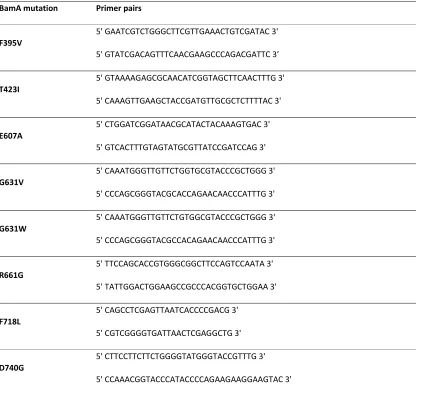
bamA missense mutants were generated in pZS21::bamA (pDPR1) using the Stratagene QuikChange site-directed mutagenesis kit per the manufacturer’s instructions. Primers
used to introduce the mutations are listed in Table S2. All mutations were confirmed by sequencing.
Western blot analysis
Cultures were grown overnight and then back-diluted 1:500 into fresh LB containing 25mg/ml kanamycin. One-milliliter samples were then collected from cultures grown under each condition at OD600=1. Harvested samples from both conditions were normalized by optical density, pelleted (50003g, 10 min), and resuspended in SDS–PAGE sample buffer. Samples were then boiled for 10 min and subjected to electrophoresis through 10% SDS–PAGE. Previously de-scribed rabbit polyclonal antibodies against BamA (1:30,000 dilution) (Wuet al.2005), BamC (1:30,000 dilution) (Sklar et al.2007b), and LamB/OmpA (1:30,000 dilution) (Walsh et al. 2003) and donkey ECL horseradish-peroxidase-conjugated anti-rabbit IgG (GE Life Sciences) (1:8,000 dilution) were used for immunoblots. Protein bands were visualized us-ing the ECL antibody detection kit (GE Healthcare) and Hyblot CLfilm (Denville Scientific).
Electrophoretic mobility assay
One-milliliter samples of the indicated strains were obtained at OD600 = 1. Cells were lysed gently to prevent OMP
Figure 1 Covariance analysis of FhaC and BamA. Predicted pairs with a mini-mum interatomic distance #8 Å in (A–C) FhaC structure 2QDZ or (D) BamA structure 3OG5 are considered true pos-itives. Only pairs separated by at least
five positions in primary sequence are considered. (A and C) Direct Coupling Analysis (DCA) was applied to FhaC positions 33–584 (see Methods). (A) Comparison of DCA and mutual infor-mation (MI) methods. True positive rates are plotted over the top 250 pairs pre-dicted by DCA and MI. (B) Dependence ofMIijscores on minimum pair entropy
Smin(i,j). MI was applied to FhaC positions
33–584. Dashed black line is the cutoff for pairs with the 50 highestMIijscores. (C and D) Dependence of DIij scores on minimum pair entropySmin(i,j)for (C)
FhaC and (D) BamA. Dashed black line is the cutoff for pairs with the 50 highest
denaturation using a previously described technique (Misra et al.1991). Briefly, samples were resuspended in a 20 mM Tris–HCl (pH 7.5) 1 mM EDTA solution containing 5 mg/ml lysozyme and subjected to repeated freeze-thawing. DNase I was added to a final concentration of 0.1 mg/ml and pro-teins were solubilized by addition of 23SDS solution (4% SDS, 40 mM Tris–HCl (ph 7.5), 20 mM EDTA). SDS–PAGE sample buffer was then added and samples were incubated at either 100°or 24°for 10 min prior to SDS–PAGE, which was conducted at 4°to prevent denaturation during electro-phoresis. BamA was detected immunologically as described above.
Genetic selection
Spontaneous SDS-resistant suppressors ofbamAD740Gwere isolated by plating overnight cultures of a strain carrying this allele at 37°on LB agar containing 0.5% SDS and 1.0 mM EDTA. Intragenic suppressor (plasmid-linked) muta-tions were mapped by purification and retransformation of the pBamAD740G plasmid into JCM320, and the causative mutations were identified by DNA sequencing.
Results
DCA of FhaC identifies pairs of interacting residues
Before analyzing covariance within BamA, we tested the ability of DCA to identify pairs of interacting positions in FhaC, a BamA paralog with a known crystal structure. Cross-referencing high-scoring pairs with their proximity in known structures offers a simple test of DCA accuracy. Throughout our analysis, we consider all high-scoring residue pairs with a minimum interatomic distance#8 Å in the corresponding crystal structure to be true positives (TPs). The 8-Å cutoff was chosen in accordance with Morcoset al.(2011).
A MSA of 6410 FhaC sequences was generated using an FhaC query fromB. pertussis. DCA was applied to FhaC res-idues 32–584, which excludes the signal sequence. The re-sult is a list of all position pairs (i,j), wherei.j, ordered by direct information scoreDIij.DIijscore is a scalar measure of
the extent to which sequence information at one position can predict sequence information at another, and it is used as a proxy for functional interaction in DCA. Pairs of posi-tions separated by less thanfive amino acids arefiltered out of the ranked DIij score list in order to avoid the trivial finding that neighboring residues interact.
We found that FhaC is amenable to DCA. As expected, DCA yields higher TP rates than earlier methods like MI, which are based on local statistical models (Figure 1A). We take the TP rate for the top 50 predictions (TP50) as a mea-sure of algorithm performance, since 50 pairs of residues is a reasonable set to test experimentally. DCA yields a TP50 rate of 0.64 compared to 0.28 for MI (Figure 1, A and B compared to 1C). Even over 250 predictions the DCA TP rate is 0.46, meaning that roughly one in two predictions repre-sent plausible physical interactions according to the FhaC crystal structure. This is 14 times the TP rate expected for randomly selected pairs.
DCA also has the advantage of identifying covariance between conserved positions. Taking the lower of the two sequence informational entropies for each pair Smin(i,j) as a measure of pair conservation, we found that the top 50 DCA predictions have a wider distribution of conservation scores than the top 50 MI predictions (compare Figure 1, B and C). The lack of conserved pairs in the MI top 50 is not surprising: it has been established that covariance algo-rithms based on local statistical models act partly as conser-vationfilters, identifying covariance in a particular range of the entropy spectrum, which varies with the algorithm (Fodor and Aldrich 2004). The fact that DCA identifies co-variance between conserved positions is particularly impor-tant for genetics applications, since we expect functionally important residues to be relatively well conserved.
DCA of BamA implicates R661 and D740 in a functional interaction
Encouraged by the promising results obtained for FhaC, we applied DCA to BamA. A BamA query sequence fromE. coli K–12 was used to construct an MSA comprising 3073 BamA
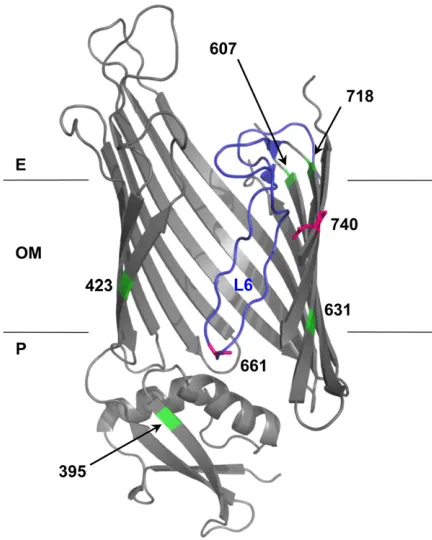
Figure 2 Structural model of BamA mutations. BamA mutation positions (661 and 740; magenta) and suppressor positions (395, 423, 607, 631, and 718; green) were mapped onto FhaC structure 2QDZ based on the alignment of BamA and FhaC query sequences. Alignment of E. coli
BamA POTRA5 (residues 347–421) andB. pertussisFhaC POTRA2 (resi-dues 165–238) was performed using the NCBI online alignment tool COBALT (Figure S2) (Papadopoulos and Agarwala 2007). The BamA–
homologs. DCA was applied to residues 347–810, correspond-ing to the BamA POTRA5 andb-barrel domains. POTRA5 was included as a positive control, as a crystal structure for this domain is available. Of the top 50 BamA pairs, 8 fall entirely within POTRA5, allowing their proximity to be determined. All 8 pairs have minimum interatomic distances below the 8Å cutoff, suggesting that BamA, like FhaC, is amenable to DCA (Figure 1D, yellow points). Again, low-entropy pairs are well represented among the top 50 predictions (Figure 1D).
The top ranked BamA pair, R661–D740, has a number of interesting features. Alignment of BamA and FhaC suggests that R661 is part of a conserved RGF/Y motif in extracellular L6 of BamA, which is thought to undergo conformational changes during OMP assembly and may fold into the lumen of theb-barrel (SeeDiscussion). As a chargedb-barrel res-idue, D740 is almost certainly facing the hydrophilic envi-ronment of theb-barrel lumen, making a direct R661–D740 interaction plausible (Figure 2, magenta). This is exactly the kind of long-distance, dynamic interaction that might pro-vide insight into BamA function. Given its prediction rank, conservation, and the structural logic described, we chose to further characterize the R661–D740 pair by genetic analysis.
BamA R661 and D740 substitutions increase OM permeability
To determine whether the covariance observed for R661 and D740 reflects a functional relationship, we introduced glycine substitutions at each of these positions and de-termined the effects of these mutations on the folding and function of BamA.bamAR661GandbamAD740Gmutations were generated on a low-copy vector (pZS21) containing the bamA ORF. Each resulting allele was introduced into
JCM320, a strain in which expression of an ectopic, chromo-somal wild-type allele ofbamAis induced by addition of arab-inose. When arabinose is excluded from the growth medium, only the plasmid-borne mutant allele ofbamAis expressed.
Because Bam is involved directly in OM biogenesis, mu-tations that compromise Bam function generally cause in-creased sensitivity to a variety of antibiotics and small molecules (Ruizet al. 2005, 2006; Malinverni et al.2006; Sklar et al. 2007a; Vuong et al. 2008; Rigel et al. 2012). To determine whether the bamAR661G and bamAD740G mutations influence OM permeability, we assessed the growth of JCM320 containing pBamAR661G, pBamAD740G, or pBamAR661G+D740Gon LB plates supplemented with var-ious antimicrobial or detergent compounds in the absence of arabinose. We found that strains expressingbamAR661Gor bamAD740Gare comparable to strains expressing the wild-type allele with respect to erythromycin and rifampin resis-tance, but unlike the wild type they do not grow in the presence of the anionic detergent SDS (Figure 3A).
Although neither individual mutation increases sensitivity to most antibiotics in the panel described above, combining the bamAR661GandbamAD740Gmutations influences OM permeability dramatically: a strain expressing the double mu-tant (bamAR661G+D740G) is highly sensitive to all com-pounds tested (Figure 3A). In addition, the double-mutant strain exhibits mucoidy and forms unusually small colonies at 42°(Figure 3B).
bamAR661G and bamAD740G mutations compromise BamA stability
The notion that R661 and D740 are functionally linked is thus far corroborated by the phenotypic similarity between
strains expressing bamAR661G and bamAD740G single mutations as well as the apparent synergism observed in the bamAR661G+D740G double-mutant strain. To test more directly the effect that these mutations have on the structure and function of BamA, we determined the steady-state levels of a model BamA substrate, the maltose channel LamB, and of BamA itself in each mutant background. We observed comparable whole-cell levels of LamB in the single mutants in comparison to the wild type, suggesting that these mutations do not compromise OMP assembly in any appreciable way (Figure 3C). However, we observed a mod-est reduction in the steady-state levels of BamA in the con-text of either the R661G or D740G substitution, suggesting that these mutations in some way perturb the biogenesis of BamA itself (Figure 3C). In thebamAR661G+D740Gdouble mutant, a LamB assembly defect was also evident even though BamA levels were unchanged from those in the sin-gle mutants (Figure 3C). Thisfinding further implies a syn-ergistic effect upon combination of these mutations.
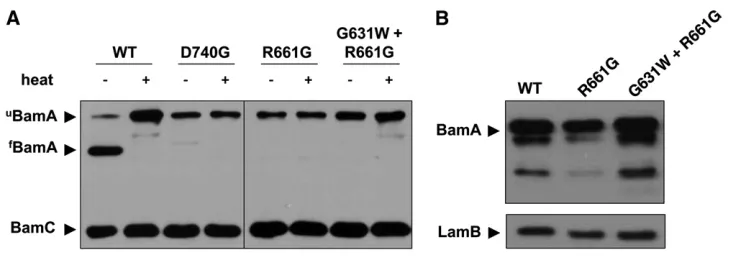
To further characterize the impact of the bamAR661G andbamAD740Gmutations on BamA folding, we exploited a well-described property common to OMb-barrel proteins known as heat modifiability. The BamAb-barrel is generally resistant to SDS denaturation but sensitive to heat denatur-ation. When cell extracts are subjected to SDS–PAGE follow-ing lysis at room temperature, BamA remains fully folded and, consequently, migrates at a lower apparent molecular weight than heat-denatured BamA (see Figure 4A). However, mutations that affect folding or stability of the BamAb-barrel domain result in unfolding of theb-barrel even at low tem-perature, thus altering electrophoretic mobility (Tellez and Misra 2012). We observe that both the bamAR661G and bamAD740Gmutations abrogate heat modifiability of BamA, sensitizing the b-barrel to SDS denaturation even at room temperature (Figure 4A).
Mutual intragenic suppressors relieve defects related to R661 and D740 substitutions
Spontaneous intragenic suppressors of thebamAD740G mu-tation were isolated by incubating the strain expressing this variant at 37° on LB plates containing 0.5% SDS/1 mM EDTA. Those colonies that arose were purified, and the
pBamAD740G plasmid was purified from each suppressor for linkage analysis. Intragenic suppressor mutations were mapped by transforming the parentalbamAdepletion strain (JCM320) with plasmid purified from each suppressor strain. The plasmid-borne bamAORF was then sequenced in those transform-ants that exhibited the suppressor phenotype (SDS/EDTAR). In addition to revertants, six independent intragenic suppressor mutations that restore the permeability barrier in the bamAD740Gmutant were identified (Table 1). Second-site substitutions in BamA that confer detergent resistance map to several locations based on sequence alignment with FhaC:b11/b12, the neighboringb-strands that are separated by Loop 6 (G631V, G631W, F718L); the extracellular end of b10 (E607A); b1 (T423I), and the C-terminal POTRA do-main (P5) within the periplasmic extension (F395V) (Figure 2, green; seeFigure S2for POTRA alignment) (Papadopoulos and Agarwala 2007; Jacob-Dubuissonet al.2009).
Given the postulated functional relationship between R661 and D740, we reasoned that if these residues indeed participate in a common chemical process, then suppressor mutations that restore OM permeability in one mutant (bamAD740G) might well have the same effect in the other (bamAR661G). To test this, we introduced each of the sup-pressor mutations listed above into pBamAR661G by site-directed mutagenesis and determined the permeability phenotypes of the resulting strains. As shown in Table 1, each mutation isolated as a suppressor of bamAD740G also restores SDS/EDTA resistance in thebamAR661G mu-tant, implying that thebamAD740GandbamAR661G muta-tions give rise to a common defect that causes detergent sensitivity.
As each of the intragenic suppressor mutations restores detergent resistance to the bamAD740G and bamAR661G mutants, we wished to determine whether heat modifiability is also restored in the presence of these mutations. Although the G631W substitution restores BamA levels and wild-type detergent sensitivity for each point mutant (Figure 4B and Table 1), BamAR661Gmigrates as an unfolded species in the absence of heat treatment even in combination with the G631W suppressor (Figure 4A). Apparently the suppressors described here need not restore function by restoring BamA b-barrel stability.
Figure 4 BamA folding and stability in the presence of barrel mutations and suppressors. (A) Samples of the indi-cated strains were lysed gently and in-cubated at either 100°(+) or 24°(2) for 10 min prior to SDS–PAGE. Stably folded BamA (fBamA) migrates at a
lower apparent molecular weight than the denatured protein (uBamA). (B)
Adding a structured prior to the empirical correlation matrix increases TP50rates for FhaC
While DCA was successful in identifying the BamA R661– D740 pair, we wondered if the algorithm might be further optimized for our purposes. There are a number of reasons to expect that OMPs like BamA and FhaC might pose a prob-lem for DCA. The b-barrel of OMPs is a unique structure, one on which DCA has not yet been tested. More generally, OMPs are large proteins, and the number of sequences re-quired to accurately estimate covariance matrix entries scales with protein length L. In this analysis the effective number of sequences used is relatively small, on the order of 3–4L, which may lead to some spurious correlations caused by noise.
To address the noise caused by small sequence sample size, we use a statistical technique calledshrinkageto regu-larize the empirical correlation matrix C(Ledoit and Wolf 2003, 2004; Joneset al.2012). Although the empirical cor-relation matrix as a whole is highly undersampled, the sin-gle-site frequencies that determine the variances along the major diagonal are well sampled. This suggests that we can use these frequencies to impose structure on the covariance matrix. To this end we calculated an estimatorC* of the true covariance matrix as a weighted average of a model matrix
Mand the empirical correlation matrixC,
C*¼aMþ ð12aÞC; (7)
wherea2(0,1) is theshrinkage intensity, which determines the amount of structure imposed on the data. (Note that for a shrinkage intensity of 0, C* equals C, and DCA is un-changed from its original form.) The model matrixMis
de-fined as
M¼diagðCÞ; (8)
where diag(C) is a matrix with the same dimensions and major diagonal as Cbut with off diagonal entries equal to zero. The model implies that tofirst order, we expect resi-dues at different sites to mutate independently of one an-other and according to the frequencies present in the data. The validity of this model is an area of ongoing investiga-tion; in this manuscript we simply ask whether applying shrinkage in this way improves our ability to identify residue pairs that are in close proximity in the FhaC structure.
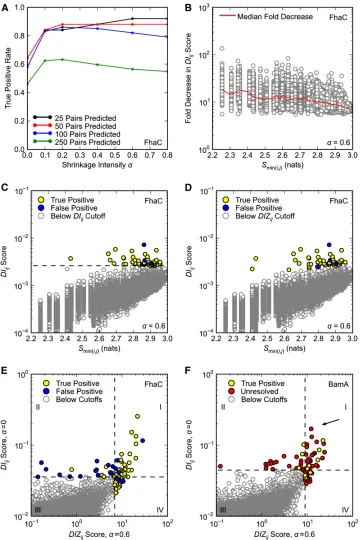
Using FhaC as a test case, we found that using a nonzero shrinkage intensity a significantly improves DCA TP rates. The TP50rate was 0.84 or above for all atested between a= 0.1 anda= 1.0 compared to 0.64 fora= 0 (Figure 5A). The positive effect of increasing acontinues through at least the top 250 predictions, where, for example,a= 0.2 improves the TP rate from 0.46 to 0.63 (Figure 5A). Throughout the rest of our analysis we employa= 0.6 as it seems to have a slight advantage over otherawhen making 50 or fewer predictions. Optimization ofais the subject of ongoing investigation.
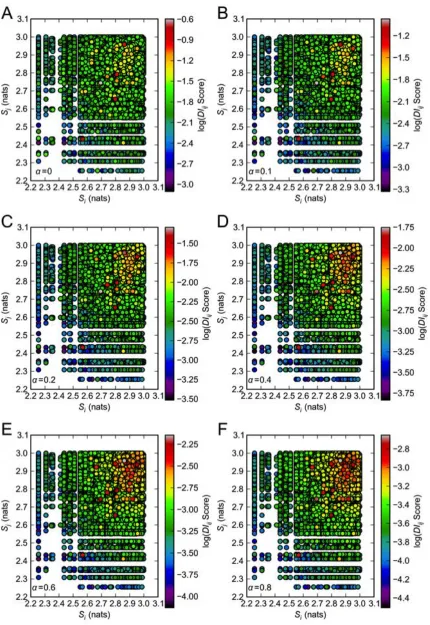
Interestingly, we found that increasingahas a dispropor-tionate effect on pairs containing conserved position(s). While settinga= 0.6 causes at least afivefold decrease in the DIij scores for all pairs, the effect is greater for more
conserved pairs as shown by the median fold decrease plot-ted in Figure 5B (red curve). This causes a relative increase in the DIij scores of less-conserved pairs (Figure 5C). The
fact that conserved pairs are less represented among top predictions whena= 0.6 is troubling from a genetics stand-point. In this context one is searching for pairs that have functional importance, i.e., pairs likely to give selectable phenotypes when mutated. To the extent that the residues in such pairs are conserved, they will be missed by a method that is overly biased toward pairs of low conservation.
To balance the bias of DIij scoring that comes with
in-creasinga, we developed a new scoring protocol. WhileDIij
scores for low entropy pairs may be an order of magnitude lower than those for pairs of high entropy, we recognize that there are local outliers even at the low end of the entropy spectrum. To identify these outliers, we begin by binning pairs according to sequence entropy and then useDIijscores
to calculateZ-scores on a per-bin basis. The resulting DIZij
scores are then compared and ordered across bins. As expected,DIZijscoring expands the distribution of entropies
among the top 50 scores to include more low-entropy pairs for a= 0.6 (compare Figure 5, C and D). Importantly, the entropy range has not simply expanded to include more false positives: DIZij scoring corrects the DIij scoring bias
fora= 0.6 with only a minor reduction in TP50rate, which drops from 0.88 to 0.86 (Figure 5, C and D).
Despite significant changes to the method, there is notable overlap between DCAa¼0
DIij and DCA
a¼0:6
DIZij predictions. Of the top 50 pairs predicted by each method, 28 are shared, including 24 TPs (Figure 5E, quadrant I). Indeed, it is
Table 1 Effect ofbamAD740Gsuppressor mutations on SDS-EDTA sensitivity
Parent allele
Intragenic secondary mutations and phenotypesa
POTRA5 b-barrel
Noneb 395V 423I 607A 631V 631W 718L
bamAWT R R R R R R R
bamAR661G S R R R R R R
bamAD740G S R R R R R R
aPhenotype refers to the growth of strains with the indicated genotypes on LB containing 0.5% SDS + 1.0 mM EDTA. Strains that exhibit growth after overnight incubation
at 37°are considered resistant (R), and those that do not are considered sensitive (S).
generally true that DCAaDI¼ij0 and DCA
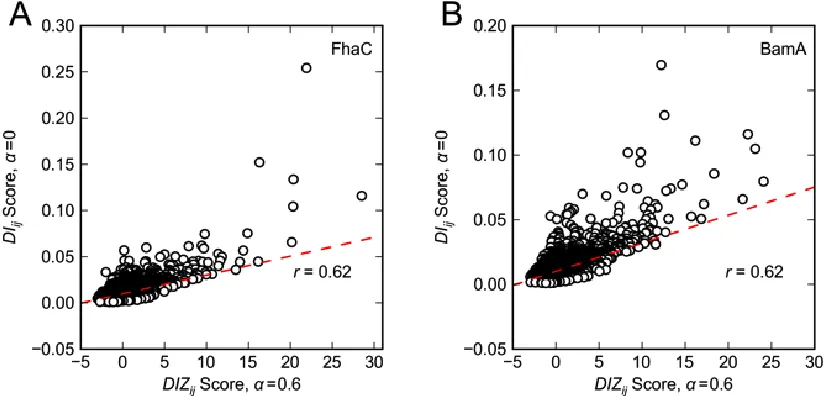
a¼0:6
DIZij scores are corre-lated (Figure S3). However, DCAaDIZ¼0ij:6also identifies a set of nonoverlapping pairs with a particularly high TP rate of 0.86, which is more than double the TP rate of the set of nonover-lapping DCAaDI¼ij0 pairs (Figure 5E, quadrants II and IV).
Encouraged by the results for FhaC, we repeated our analysis of BamA using DCAa¼0:6
DIZij . We found that of the 8 intra-POTRA5 interactions among the DIZij top 50, all are
TPs, suggesting that DCAa¼0:6
DIZij also performs well for BamA
(Figure 5F). Again there is significant overlap between DCAaDI¼ij0 and DCA
a¼0:6
DIZij predictions—28 pairs including 5 TPs (Figure 5F, quadrant I). We note that the R661–D740 pair is among these shared predictions.
Discussion
The number of available sequences poses a major problem for covariance analysis. In general for a covariance matrix to
Figure 5 Optimization of DCA. Only pairs separated by at leastfive positions in primary sequence are considered. (A–E) DCA was applied to FhaC as in Fig-ure 1, A and B, with the same definition of true positives. (A) Effect of shrinkage intensityaon DCA true positive rates. (B) Effect of shrinkage intensitya= 0.6 on
DIijscores. Fold reduction inDIijscore is plotted against the minimum pair entropy
Smin(i,j)for each pair; the red curve shows
the median fold reduction in DIij score over 50 bins of Smin(i,j). (C and D) DIij scores for shrinkage intensity a = 0.6 plotted against minimum pair entropy
Smin(i,j). The top 50 pairs according to (C) DIij and (D) DIZijscoring (a = 0.6) are highlighted. In C the dashed black line is the cutoff for pairs with the 50 highest
DIijscores. (E and F) Overlap of the top 50 (E) FhaC and (F) BamA pairs according to
be invertible, one needs at least as many independent observations as parameters and perhaps 10 times this number for a good approximation (Ledoit and Wolf 2004). When one considers estimating the covariance matrix of large proteins or protein complexes, the lack of adequate sequence data becomes overwhelming, especially since many sequences are not truly independent due to phylog-eny. Yet our successful results for FhaC (438 amino acids) and BamA (393 amino acids) agree with the findings of studies showing that DCA works relatively well even for large proteins (Hopf et al. 2012). Much of this success is likely due to the use of large numbers of pseudocounts, an approach that bears striking similarity statistical shrinkage in practice. Our results for FhaC and BamA suggest that DCA might be improved significantly by a unified approach to data regularization combining the benefits of both pseudo-counts and shrinkage.
While this is not thefirst time shrinkage has been applied to the problem of protein covariance, it is to our knowledge thefirst time it has been applied to DCA. Our model matrix
M also differs markedly from previous studies, which use a single variance measure or factor to weight all variables on the matrix diagonal. Joneset al.(2012) recently reported using the modelMs¼SIto regularize a protein covariance matrix whereSis the mean of the variances occupying the diagonal of the empirical correlation matrixC andI is the identity matrix. We found that our model matrixM, which allows for positional effects on amino acid frequencies, out-performs Ms when used with DCA, increasing FhaC TP50 rates from 0.76 to 0.88 (Figure S4). Whether the benefit of model matrix M is unique to FhaC remains to be seen; however, our results clearly suggest that shrinkage can be used to improve DCA output.
Highly conserved residues also pose a problem for co-variance analysis. Every unique sequence in a MSA repre-sents an evolutionary experiment in which selection has tested the relationship between protein sequence and function. DCA analyzes these experiments and returns a measure of positional coupling; however, our confidence in that measure depends on the number of experiments,i.e., the extent of perturbation at each position. For FhaC our
finding that finite a, which disproportionately lowers the DIij scores of conserved pairs, increases initial TP50 rates suggests that theDIijscores of conserved pairs are otherwise
overinflated. Indeed, some implementations of DCA filter out the most conserved residues to reduce initial false-positive (FP) rates (Marks et al. 2011; Hopf et al. 2012). The negative correlation between TP rates and pair conser-vation is problematic for genetics, as one expects functionally important pairs to be relatively well conserved as in the case of R661–D740 of BamA.DIZijscoring solves this problem by
including conserved pairs among the DCAa=0.6top 50 with-out significantly diminishing TP50rates, at least for FhaC.
While DCAa¼0:6
DIZij improves TP50rates, we note that our TP designation is based exclusively on residue proximity as de-termined from crystal structures. Among other possible
causes of covariance, TP rates do not account for possible direct physical interactions in alternative conformations, po-tential multimerization sites, or indirect interactions via small molecules or other factors involved in allostery or sub-strate binding. For instance, the highest ranked FhaC pair according to DCAaDIZ¼0ij:6 is T88–P118, an FP based on the FhaC crystal structure; however, T88 and P118 are sepa-rated only by 12 Å, compared to a 34-Å average separation for all FhaC residues. Furthermore, T88 and P118 each lie in a disordered and partially unresolved region linking an N-terminal b-barrel plug to POTRA1. It may be that T88 and P118 actually participate in a physical interactionin vivo. It is therefore likely that some FPs may represent true biolog-ical interactions. Similarly, it is likely that many of our TPs, while colocalizing in a given structure, may not yield select-able phenotypes when mutated. Whether DCAaDI¼ij0, DCA
a¼0:6
DIZij , or some other DCA variant is best suited to identify function-ally related residues is still an open question, and we note that both methods ranked the functionally related BamA R661–D740 pair among the top 50 predictions.
There is substantial data suggesting that BamA R661 is important for function. R661 lies in the highly conserved RGF/Y motif of L6. It has been shown that deletion or wholesale substitution of the BamA RGF/Y motif renders cells conditionally lethal when grown on rich media, confers sensitivity to membrane impermeant antibiotics, reduces levels of BamA and OMPs, and causes b-barrel instability (Leonard-Rivera and Misra 2012). A bamAR661E allele was also found to confer antibiotic sensitivity, reduce BamA levels, and destabilize the b-barrel (Leonard-Rivera and Misra 2012). The importance of R661 and the RGF/Y motif is also evident in work with the BamA paralog FhaC, a mem-ber of the two-partner secretion (TpsA/TpsB) pathway for
filamentous hemagglutinin adhesin (FHA). Deletion of FhaC L6 does not prevent its own folding and assembly but does prevent FhaC from exporting its TpsA partner, FHA. Like-wise, mutation of the R661 analog reduces FHA secretion by 90% (Clantinet al.2007; Delattreet al.2010).
While there is no prior evidence that BamA D740 is important for function, it has been established that other b-barrel residues play more than a simple structural role in BamA.b-barrel mutations have been found to suppress the severe conditional growth phenotype exhibited by bamBE double mutants (Tellez and Misra 2012). The fact that b-barrel mutations can restore function to a Bam machine lacking two lipoprotein components implies that these resi-dues contribute to overall complex function. Interestingly, bamBE double mutants show BamA b-barrel instability, which is not always corrected by suppressors of the condi-tional growth defect (Tellez and Misra 2012). But without DCA analysis there was little reason to expect that D740 in particular is important for function and none to suggest that R661 and D740 engage in a functional interaction.
confer similar phenotypes, compromising the OM perme-ability barrier, reducing levels of BamA, and decreasing b-barrel stability. The effect onb-barrel stability is the most compelling of these phenotypes because it is unique: we have a number of BamA missense mutations that affect OM permeability, OMP assembly, and BamA levels without affecting heat modifiability of the BamA b-barrel. Second, the bamAR661G+D740G double mutant shows synthetic phenotypes including increased permeability to small mole-cule antibiotics and reduced levels of the model OMP LamB. Third, we found that the bamAR661G and bamAD740G alleles share common suppressors, suggesting that each con-fers a similar defect. Together these data strongly support the DCA prediction that R661 of L6 and D740 of theb-barrel engage in a functional interaction, and we suggest that this interaction is direct.
There is precedent for a direct interaction between BamA L6 and the b-barrel. While no structure for the BamA b-barrel is currently available, a nearly full-length FhaC crystal structure has been solved (Clantinet al.2007). Res-olution of L6 is not sufficient to establish definitive interac-tions among loop andb-barrel residues; however, it is clear that L6 can fold into the lumen of the FhaCb-barrel. It has also been established that FhaC L6 has a surface-exposed conformation, which can be detected by susceptibility to exogenous protease added to whole cells (Jacob-Dubuisson et al.1999; Guédinet al.2000). Importantly, L6 is accessible to protease only when the FhaC substrate FHA is present, indicating that loop localization is related to substrate binding and secretion (Jacob-Dubuisson et al. 1999; Guédin et al. 2000). In similar protease experiments,E. coliBamA has also been shown to adopt multiple conformations (Rigel et al. 2012). Cysteine labeling with a highMrpolyethylene glycol derivative identifies two residues in L6, C690, and C700, as part of this conformational change, suggesting that, like FhaC, BamA L6 has luminal and extracellular conformations involved in substrate assembly (Rigelet al.2013).
Given the potential for L6 to interact with the b-barrel and the obvious chemical logic to an arginine–aspartate in-teraction, we propose that R661 and D740 form a salt bridge in vivo. That substitution of either residue with glycine causes destabilization of the b-barrel suggests this putative salt bridge is important for BamA stability, although it is not essential for function as neither the bamAR661G nor the bamAD740Gmutation confers a striking OMP assembly de-fect. This separability of b-barrel stability and function is further supported by the fact that suppressors of the bamAR661GandbamAD740Gmutations restore SDS–EDTA resistance without restoringb-barrel stability. It is likely that these are bypass suppressors that restore BamA function without restoring the L6–b-barrel interaction lost with dis-ruption of the R661–D740 salt bridge.
The synthetic phenotypes displayed by thebamAR661G+D740G double mutant are not readily explained by loss of the pu-tative R661–D740 salt bridge alone, since either single mu-tation would completely disrupt the ionic interaction. To
explain their synthetic phenotypes, we hypothesize that R661 and D740 have secondary functions separate from their common salt bridge, which are important for stabiliza-tion of the b-barrel. This hypothesis follows from the fact thatb-barrel stability is maintained even in the absence of BamE, a condition under which L6 shows increased dissoci-ation from theb-barrel (Tellez and Misra 2012; Rigelet al. 2012, 2013). Because the putative R661–D740 salt bridge is almost certainly disrupted when L6 adopts its loop-out con-formation, these data suggest that the salt bridge alone can-not account for stability of theb-barrel. Rather, it is likely that these residues participate in other direct—possibly ionic—interactions that stabilize theb-barrel in alternative conformations of BamA. The synthetic effects observed in a bamAR661G+D740G double mutant would then be caused by the loss of these secondary interactions.
Our current model of BamA function proposes that OMP assembly is accomplished through conformational cycling of BamA and its essential lipoprotein partner BamD (Ricci et al.2012; Rigelet al.2013). In this cycle BamA adopts at least two distinct conformations, characterized by the lu-minal and extracellular conformations of L6, each of which seems to be stabilized by R661 and D740. Given the dramatic change in substrate conformation that occurs during OMP assembly, it is not surprising that the Bam machine might undergo significant conformational changes itself.
Such a model requires that BamA integrate signals of substrate binding, folding, and assembly, of lipoprotein conformations, and of its own domain conformations in order to execute OMP assembly. This process implies a complex network of residues spanning multiple proteins that serves to communicate, transduce, and execute confor-mational changes. For instance, BamA POTRA5 has been implicated in communicating conformational changes be-tween BamAD (Ricciet al.2012). Whether R661 and D740 help regulate this process is unclear, but we note that the suppressors common to the bamAR661G and bamAD740G alleles are distributed throughout POTRA5 and the BamA b-barrel.
Acknowledgments
We thank Zemer Gitai, Mark Rose, and members of the Silhavy lab for helpful discussions. We also thank Marcin Grabowicz and Nate Rigel for critical reading of the manuscript. We are grateful to Matthew Cahn for computing help. T.J.S acknowledges support from National Institute of General Medical Sciences grant GM34821. N.S.W. acknowl-edges support from National Science Foundation Grant PHY-0957573. And L. J. C. acknowledges support from Engineering and Physical Sciences Research Council Fellow-ship EP/ H028064/1.
Literature Cited
Atchley, W. R., K. R. Wollenberg, W. M. Fitch, W. Terhalle, and A. W. Dress, 2000 Correlations among amino acid sites in bHLH protein domains: an information theoretic analysis. Mol. Biol. Evol. 17: 164–178.
Burger, L., and E. van Nimwegen, 2010 Disentangling direct from indirect co-evolution of residues in protein alignments. PLOS Comput. Biol. 6: e1000633.
Clantin, B., A.-S. Delattre, P. Rucktooa, N. Saint, A. C. Méliet al., 2007 Structure of the membrane protein FhaC: a member of the Omp85-TpsB transporter superfamily. Science 317: 957–961. Cocco, S., R. Monasson, and M. Weigt, 2012 From principal
com-ponent to direct coupling analysis of coevolution in proteins: low-eigenvalue modes are needed for structure prediction. arXiv Preprint 1212.3281. Available at: http://arxiv.org/abs/1212.3281. Dago, A. E., A. Schug, A. Procaccini, J. A. Hoch, M. Weigt et al.,
2012 Structural basis of histidine kinase autophosphorylation deduced by integrating genomics, molecular dynamics, and mu-tagenesis. Proc. Natl. Acad. Sci. USA 109: E1733–E1742. Delattre, A.-S., B. Clantin, N. Saint, C. Locht, V. Villeret et al.,
2010 Functional importance of a conserved sequence motif in FhaC, a prototypic member of the TpsB/Omp85 superfamily. FEBS J. 277: 4755–4765.
Doerrler, W. T., and C. R. H. Raetz, 2005 Loss of outer membrane proteins without inhibition of lipid export in anEscherichia coli
YaeT mutant. J. Biol. Chem. 280: 27679–27687.
Fodor, A. A., and R. W. Aldrich, 2004 Influence of conservation on calculations of amino acid covariance in multiple sequence alignments. Proteins 56: 211–221.
Gerdes, S. Y., M. D. Scholle, J. W. Campbell, G. Balázsi, M. D. Daugherty et al., 2003 Experimental determination and sys-tem level analysis of essential genes inEscherichia coliMG1655. J. Bacteriol. 185: 5673–5684.
Guédin, S., E. Willery, J. Tommassen, E. Fort, H. Drobecqet al., 2000 Novel topological features of FhaC, the outer mem-brane transporter involved in the secretion of the Bordetella pertussisfilamentous hemagglutinin. J. Biol. Chem. 275: 30202– 30210.
Halabi, N., O. Rivoire, S. Leibler, and R. Ranganathan, 2009 Protein sectors: evolutionary units of three-dimensional structure. Cell 138: 774–786.
Hopf, T. A., L. J. Colwell, R. Sheridan, B. Rost, C. Sanderet al., 2012 Three-dimensional structures of membrane proteins from genomic sequencing. Cell 149: 1607–1621.
Hunter, J. D., 2007 MATPLOTLIB : a 2D graphics environment. Comput. Sci. Eng. 9: 90–95.
Jacob-Dubuisson, F., C. El-Hamel, N. Saint, S. Guédin, E. Willery
et al., 1999 Channel formation by FhaC, the outer membrane protein involved in the secretion of theBordetella pertussisfi la-mentous hemagglutinin. J. Biol. Chem. 274: 37731–37735.
Jacob-Dubuisson, F., V. Villeret, B. Clantin, A.-S. Delattre, and N. Saint, 2009 First structural insights into the TpsB/Omp85 su-perfamily. Biol. Chem. 390: 675–684.
Jones, D. T., D. W. A. Buchan, D. Cozzetto, and M. Pontil, 2012 PSICOV: precise structural contact prediction using sparse inverse covariance estimation on large multiple sequence alignments. Bioinformatics 28: 184–190.
Jones E., Oliphant T., and Peterson P., 2001 SciPy: Open Source Scientific Tools for Python.
Kamio, Y., and H. Nikaido, 1976 Outer membrane ofSalmonella typhimurium: accessibility of phospholipid head groups to phos-pholipase c and cyanogen bromide activated dextran in the external medium. Biochemistry 15: 2561–2570.
Kim, S., J. C. Malinverni, P. Sliz, T. J. Silhavy, S. C. Harrisonet al., 2007 Structure and function of an essential component of the outer membrane protein assembly machine. Science 317: 961–964. Lapedes, A. S., B. G. Giraud, L. LonChang, and G. D. Stormo, 1999 Correlated mutations in models of protein sequences: phylogenetic and structural effects, pp. 236–256 inISM Lecture Notes, edited by F. Seillier-Moiseiwitsch. Institute of Mathemat-ical Statistics, Hayward CA.
Ledoit, O., and M. Wolf, 2003 Improved estimation of the covari-ance matrix of stock returns with an application to portfolio selection. J. Empir. Finance 10: 603–621.
Ledoit, O., and M. Wolf, 2004 A well-conditioned estimator for large-dimensional covariance matrices. J. Multivariate Anal. 88: 365–411.
Leonard-Rivera, M., and R. Misra, 2012 Conserved residues of the putative L6 loop ofEscherichia coliBamA play a critical role in the assembly of b-barrel outer membrane proteins, including that of BamA itself. J. Bacteriol. 194: 4662–4668.
Lockless, S. W., 1999 Evolutionarily conserved pathways of ener-getic connectivity in protein families. Science 286: 295–299. Malinverni, J. C., J. Werner, S. Kim, J. G. Sklar, D. Kahneet al.,
2006 YfiO stabilizes the YaeT complex and is essential for outer membrane protein assembly inEscherichia coli. Mol. Mi-crobiol. 61: 151–164.
Marks, D. S., L. J. Colwell, R. Sheridan, T. A. Hopf, A. Pagnaniet al., 2011 Protein 3D structure computed from evolutionary se-quence variation. PLoS ONE 6: e28766.
Marks, D. S., T. A. Hopf, and C. Sander, 2012 Protein structure pre-diction from sequence variation. Nat. Biotechnol. 30: 1072–1080. Misra, R., A. Peterson, T. Ferenci, and T. J. Silhavy, 1991 A genetic approach for analyzing the pathway of LamB assembly into the outer membrane ofEscherichia coli. J. Biol. Chem. 266: 13592– 13597.
Morcos, F., A. Pagnani, B. Lunt, A. Bertolino, D. S. Markset al., 2011 Direct-coupling analysis of residue coevolution captures native contacts across many protein families. Proc. Natl. Acad. Sci. USA 108: E1293–E1301.
Moslavac, S., O. Mirus, R. Bredemeier, J. Soll, A. von Haeseleret al., 2005 Conserved pore-forming regions in polypeptide-trans-porting proteins. FEBS J. 272: 1367–1378.
Nikaido, H., 2003 Molecular basis of bacterial outer membrane permeability revisited. Microbiol. Mol. Biol. Rev. 67: 593–656. Onufryk, C., M. Crouch, F. C. Fang, and C. A. Gross,
2005 Characterization of six lipoproteins in thesE regulon. J. Bacteriol. 187: 4552–4561.
Papadopoulos, J. S., and R. Agarwala, 2007 COBALT: constraint-based alignment tool for multiple protein sequences. Bioinfor-matics 23: 1073–1079.
Remmert, M., A. Biegert, A. Hauser, and J. Söding, 2012 HHblits: lightning-fast iterative protein sequence searching by HMM-HMM alignment. Nat. Methods 9: 173–175.
Ricci, D. P., and T. J. Silhavy, 2012 The Bam machine: a molecular cooper. Biochim. Biophys. Acta 1818: 1067–1084.
Ricci, D. P., C. L. Hagan, D. Kahne, and T. J. Silhavy, 2012 Activation of the Escherichia coli b-barrel assembly machine (Bam) is re-quired for essential components to interact properly with sub-strate. Proc. Natl. Acad. Sci. USA 109: 3487–3491.
Rigel, N. W., J. Schwalm, D. P. Ricci, and T. J. Silhavy, 2012 BamE modulates the Escherichia coli beta-barrel assembly machine component BamA. J. Bacteriol. 194: 1002–1008.
Rigel, N. W., D. P. Ricci, and T. J. Silhavy, 2013 Conformation-specific labeling of BamA and suppressor analysis suggest a cyclic mechanism for b-barrel assembly in Escherichia coli. Proc. Natl. Acad. Sci. USA 110: 5151–5156.
Ruiz, N., B. Falcone, D. Kahne, and T. J. Silhavy, 2005 Chemical conditionality: a genetic strategy to probe organelle assembly. Cell 121: 307–317.
Ruiz, N., T. Wu, D. Kahne, and T. J. Silhavy, 2006 Probing the barrier function of the outer membrane with chemical condi-tionality. ACS Chem. Biol. 1: 385–395.
Silhavy, T. J., D. Kahne, and S. Walker, 2010 The bacterial cell envelope. Cold Spring Harb. Perspect. Biol. 2: a000414. Sklar, J. G., T. Wu, L. S. Gronenberg, J. C. Malinverni, D. Kahne
et al., 2007a Lipoprotein SmpA is a component of the YaeT complex that assembles outer membrane proteins inEscherichia coli. Proc. Natl. Acad. Sci. USA 104: 6400–6405.
Sklar, J. G., T. Wu, D. Kahne, and T. J. Silhavy, 2007b Defining the roles of the periplasmic chaperones SurA, Skp, and DegP in
Escherichia coli. Genes Dev. 21: 2473–2484.
Smock, R. G., O. Rivoire, W. P. Russ, J. F. Swain, S. Leibleret al., 2010 An interdomain sector mediating allostery in Hsp70 mo-lecular chaperones. Mol. Syst. Biol. 6: 414.
Szurmant, H., and J. A. Hoch, 2013 Statistical analyses of protein sequence alignments identify structures and mechanisms in sig-nal activation of sensor histidine kinases. Mol. Microbiol. 87: 707–712.
Tamm, L. K., H. Hong, and B. Liang, 2004 Folding and assembly of beta-barrel membrane proteins. Biochim. Biophys. Acta 1666: 250– 263.
Tellez, R., and R. Misra, 2012 Substitutions in the BamAb-barrel domain overcome the conditional lethal phenotype of aDbamB
DbamE strain ofEscherichia coli. J. Bacteriol. 194: 317–324. Vuong, P., D. Bennion, J. Mantei, D. Frost, and R. Misra, 2008 Analysis
of YfgL and YaeT interactions through bioinformatics, mutagenesis, and biochemistry. J. Bacteriol. 190: 1507–1517.
Walsh, N. P., B. M. Alba, B. Bose, C. A. Gross, and R. T. Sauer, 2003 OMP peptide signals initiate the envelope-stress re-sponse by activating DegS protease via relief of inhibition me-diated by its PDZ domain. Cell 113: 61–71.
Weigt, M., R. A. White, H. Szurmant, J. A. Hoch, and T. Hwa, 2009 Identification of direct residue contacts in proteprotein in-teraction by message passing. Proc. Natl. Acad. Sci. USA 106: 67–72. Wu, T., J. Malinverni, N. Ruiz, S. Kim, T. J. Silhavy et al., 2005 Identification of a multicomponent complex required for outer membrane biogenesis inEscherichia coli. Cell 121: 235–245.
GENETICS
Supporting Information
http://www.genetics.org/lookup/suppl/doi:10.1534/genetics.113.155861/-/DC1
Predicting Functionally Informative Mutations in
Escherichia coli
BamA Using Evolutionary
Covariance Analysis
Robert S. Dwyer, Dante P. Ricci, Lucy J. Colwell, Thomas J. Silhavy, and Ned S. Wingreen
File S1
Supporting Methods
Sequence Reweighting and Pseudocounts
In order to control for sequence bias in our MSA, sets of sequences that exceed a certain identity threshold are down-weighted as a group (Weigt et al. 2009; Marks et al. 2011; Morcos et al. 2011; Hopf et al. 2012). For every
sequence m in an MSA, the number of “identical” sequences km is defined as
k
m
(
A
im,
B
in)
xL
i1
L
n1
M
[S1]where θ is a step function equal to one if its argument is greater than or equal to zero and zero if the summation is
negative, δ is the Kronecker symbol used for counting, which is equal to one if Aimequals Bin and to zero otherwise,
and x is the identity threshold, defined here as 0.7. When counting pair and single amino acid frequencies, the
contribution of sequence m is down-weighted by 1/km. The effective number of sequences in an alignment is
therefore not M but Meff, where
M
eff
1
k
mm1
M
. [S2]Pair and single amino acid frequencies are then calculated according to the relationships
f
i(
A
)
1
M
eff
q
1
k
m
(
A
im
,
A
)
m1
M
[S3A]
f
ij(
A
,
B
)
1
M
eff
q
2
1
k
m
(
A
i m,
A
)
(
B
j m,
B
)
m1
M
[S3B]where λ is a pseudocount term used to ameliorate statistical noise due to underrepresented amino acids and pairs.
Here we set λ equal to Meff. Note that the empirical correlation matrix is not invertible before pseudocounts are
incorporated.
DCA
According to DCA, the coupling between columns i and j in an MSA is given by the direct information, DIij,
score according to the relationship
DI
ij
P
ij(
A
,
B
)ln
P
ij(
A
,
B
)
f
i(
A
)
f
j(
B
)
A,B1
q
where Pij(A,B) represents the inferred probability of finding amino acid pair (A,B) at positions i and j in the absence of
interactions with other residues, fi(A) and fj(B) represent the single amino acid frequencies of A and B at positions i
and j, and the summation is evaluated over all 441 pairs (A,B) possible for a q = 21 state system, where the states
represent the twenty amino acids and a gap. Pij(A,B) is itself a function of the inferred coupling energy eij(A,B) and the
inferred single residue energies
˜
h
i(
A
)
and
˜
h
j(
B
)
of amino acids A and B at positions i and j according to
P
ij(
A
,
B
)
1
Z
ije
ij(
A
,
B
)
˜
h
i(
A
)
h
˜
j(
B
)
[S5]where Zij is the partition function. The coupling energies eij(A,B) are determined as described below by inverting an
empirical correlation matrix, C.
The empirical correlation matrix C is determined from the MSA according to the relationships
C
ij(
A
,
B
)
ij
f
ij(
A
,
B
)
f
i(
A
)
f
j(
B
)
[S6]
C
ij(
A
,
B
)
ij,AB
f
i(
A
) 1
f
i(
A
)
[S7]where fi(A) is the frequency of amino acid A in MSA column i, fj(B)is the frequency of amino acid B in MSA column j,
and fij(A,B) is the frequency of amino acid pair (A,B) in columns i and j. Calculation of correlations Cij(A,B) where i = j
but A ≠ B is carried out according to Equation S6. Note that pair frequencies fij(A,B) are set to zero for these entries
(despite having a finite value based on pseudocounts, as described below to reflect the fact that no protein sequence
contains two different amino acids at a single site. The empirical correlation matrix has the dimensions 20L by 20L
despite the fact that we employ a q = 21 state model. This is because one amino acid, in our case the gap, is left out
of the analysis in order to serve as a reference energy.
The global nature of the DCA algorithm derives from inversion of the empirical correlation matrix (or the
composite matrix C* described below), which results in the coupling energy matrix, e:
e
C
1. [S8]The fields
˜
h
i(
A
)
and
˜
h
j(
B
)
from Equation S5 are calculated numerically along with the partition function Zijsothat the pair probabilities recapitulate the single amino acid frequencies, fi(A) and fj(B), observed in the MSA:
P
ij(
A
,
B
)
f
i(
A
)
B1
q
[S9A]P
ij(
A
,
B
)
f
j(
B
)
A1
q
Once field and coupling energies have been determined, direct information DIij scores can be evaluated using
Equations S4 and S5. The result is a list of DIij scores representing the direct information between every pair of
Supporting Literature Cited
Hopf T. A., Colwell L. J., Sheridan R., Rost B., Sander C., Marks D. S., 2012 Three-dimensional structures of membrane
proteins from genomic sequencing. Cell 149: 1607–21.
Marks D. S., Colwell L. J., Sheridan R., Hopf T. A., Pagnani A., Zecchina R., Sander C., 2011 Protein 3D structure
computed from evolutionary sequence variation. PloS One 6: e28766.
Morcos F., Pagnani A., Lunt B., Bertolino A., Marks D. S., Sander C., Zecchina R., Onuchic J. N., Hwa T., Weigt M., 2011
Direct-coupling analysis of residue coevolution captures native contacts across many protein families. Proc Natl
Acad Sci 108: E1293–301.
Weigt M., White R. A., Szurmant H., Hoch J. A., Hwa T., 2009 Identification of direct residue contacts in
Table S1 Strains and plasmids
Strain/plasmid Genotype and relevant features Reference
E. coli K-12 strains
MC4100 F- araD139 (argF-lac)U169 rpsL150 relA1 flb5301 deoC1 ptsF25 thi Boyd et al 2000
JCM158 MC4100 arar/- Malinverni et al 2006
JCM320 JCM158 ∆bamA ∆(λatt-lom)::bla PBADbamA araC Wu et al 2005
DPR437 JCM320 pDPR1 Ricci et al 2012
DPR660 JCM320 pBamAR661G This study
DPR1345 JCM320 pBamAD740G This study
DPR1346 JCM320 pBamAD740G+R661G This study
DPR1374 JCM320 pBamAD740G+F395V This study
DPR1309 JCM320 pBamAD740G+T423I This study
DPR1310 JCM320 pBamAD740G+E607A This study
DPR1311 JCM320 pBamAD740G+G631V This study
DPR1500 JCM320 pBamAD740G+G631W This study
DPR1313 JCM320 pBamAD740G+F717L This study
DPR1317 JCM320 pBamAR661G+F395V This study
DPR1318 JCM320 pBamAR661G+T423I This study
DPR1319 JCM320 pBamAR661G+E607A This study
DPR1320 JCM320 pBamAR661G+G631V This study
DPR1501 JCM320 pBamAR661G+G631W This study
DPR1321 JCM320 pBamAR661G+F717L This study
Plasmids
pZS21 Expression vector; λ PL-driven expression, Kanr Lutz & Bujard, 1997
pBamA(pDPR1) pZS21::bamAWT Kim et al 2007
pBamAD740G pZS21::bamAD740G This study
pBamAD740G+R661G pZS21::bamAD740G+R661G This study
pBamAD740G+F395V pZS21::bamAD740G+F395V This study
pBamAD740G+T423I pZS21::bamAD740G+T423I This study
pBamAD740G+E607A pZS21::bamAD740G+E607A This study
pBamAD740G+G631W pZS21::bamAD740G+G631W This study
pBamAD740G+G631V pZS21::bamAD740G+G631V This study
pBamAD740G+F717L pZS21::bamAD740G+F717L This study
pBamAR661G+F395V pZS21::bamAR661G+F395V This study
pBamAR661G+T423I pZS21::bamAR661G+T423I This study
pBamAR661G+E607A pZS21::bamAR661G+E607A This study
pBamAR661G+G631W pZS21::bamAR661G+G631W This study
pBamAR661G+G631V pZS21::bamAR661G+G631V This study
Table S2 Primers
BamA mutation Primer pairs
F395V
5' GAATCGTCTGGGCTTCGTTGAAACTGTCGATAC 3'
5' GTATCGACAGTTTCAACGAAGCCCAGACGATTC 3’
T423I
5' GTAAAAGAGCGCAACATCGGTAGCTTCAACTTTG 3'
5' CAAAGTTGAAGCTACCGATGTTGCGCTCTTTTAC 3'
E607A
5' CTGGATCGGATAACGCATACTACAAAGTGAC 3'
5' GTCACTTTGTAGTATGCGTTATCCGATCCAG 3'
G631V
5' CAAATGGGTTGTTCTGGTGCGTACCCGCTGGG 3'
5' CCCAGCGGGTACGCACCAGAACAACCCATTTG 3'
G631W
5' CAAATGGGTTGTTCTGTGGCGTACCCGCTGGG 3'
5' CCCAGCGGGTACGCCACAGAACAACCCATTTG 3'
R661G
5' TTCCAGCACCGTGGGCGGCTTCCAGTCCAATA 3'
5' TATTGGACTGGAAGCCGCCCACGGTGCTGGAA 3'
F718L
5' CAGCCTCGAGTTAATCACCCCGACG 3'
5' CGTCGGGGTGATTAACTCGAGGCTG 3'
D740G
5' CTTCCTTCTTCTGGGGTATGGGTACCGTTTG 3'
Figure S1 Effect of sequence informational entropy Si, Sj on pair DIijscore. Log(DIij Score) is plotted against sequence
Figure S2 Alignment of BamA POTRA 5 and FhaC POTRA 2 domains. FhaC sequence comprises residues 165 to 238 of
Figure S3 Correlation of
DCA
DIij 0
and
DCA
DIZij 0.6
Figure S4 Effect of shrinkage with model matrix