LAKE-ORIENTED SUBDIVISIONS I N
NORTH
CAROLINA: DECISION FACTORS AND POLICY IMPLICATIONSFOR URBAN GROWTH PATTERNS
P a r t I
-
D e v e l o p e r D e c i s i o n sKaymond J . Burby 111 R e s e a r c h F e l l o w
C e n t e r f o r Urban and R e g i o n a l S t u d i e s I n s t i t u t e f o r R e s e a r c h i n S o c i a l S c i e n c e U n i v e r s i t y n f N o r t h C a r o l i n a a t Chapel H i l l
The work upon which t h i s p u b l l c a t ~ o n L S b a s e d was s u p p o r t e d i n p a r t by f u n d s p r o v i d e d by t h e O f f i c e of Water R e s o u r c e s R e s e a r c h , Department of t h e I n t e r i o r , t h r o u g h t h e Water R e s o u r c e s R e s e a r c h I n s t i t u t e of t h e U n i v e r s i t y of N o r t h C a r o l i n a a s a u t h o r i z e d u n d e r t h e Water R e s o u r c e s R e s e a r c h A c t o f 1964.
P r o j e c t No. A-023-NC
Agreement No. 14-01-0001-1401, F.Y. 1968
ACKNOWLEDGMENTS
Thts investigation was supported by the Water Xesources Research Institute, at the University of North Carolina, and Public Health Service Grant No. UI 00128-06 from the National Center for Urban and Industrial Health. A note of thanks is due Professor David
N.
Howells, Director ofthe Water Resources Research Institute, for his interest and encourage- ment throughout.
Professor Shirley
F.
Weiss, Associate Research Director of the Center for Urban and Re~ional Studies, provided valuable advice from the earliest stages of the project to completion of the final product.I
would also like to thank Professors Edward 3 . Kaiser and Henry C. Hightower, who provided many helpful insights and suggestions.I
am indebted to Newton Andrus who assisted in the interviewing phase of the study.
In addition, a special word of appreciation is due all the land development entrepreneurs in North Carolina who gave so freely of their tine.
I
am also indebted to numerous officials in local and state agencies, members of the real estate and appraising professions, and personnel of theU. S.
Soil Conservation Service who furnished much valuable information.A
final acknowledgment is due Barbara Goins who was responsible forTABLE OF CONTENTS
CHAPTER
I.
INTRODUCTIONXesearch Objectives
11. THE
LAND
DEVELOPPiENT PROCESS AND DEVELOPER DECISIONS: k CONCEPTUAL OVEINIEWLand Development as a Sequence of States and Decisions Agents in the Land Development Process
The Land Development Firm
The Entrepreneur and his Firm
Operating Characteristics
OF
Land Development Firms Marketability StudiesFeasibility Studies Summary
Implications for the Study of Developer Decisions An Approach to Understanding Developer k h a v i o r
An Economic Interpretation of Developer Behavior Economic Considerations and Environmental Innovation A Note of Caution
Social Aspects of Developer Behavior Summary
1x1. DETERMINANTS OF THE USE OF ENVIRONNENTAL INNOVATIONS : HYPOTHETICAL RELATIONS
Innovation, the Entrepreneur, and his Firm Access to Information
Previous Experience
Experience in Land Developmen; Type of Firm
Diversity of Business Interests Geographic Scope
of
OperationUse
of Technical PublicationsOrientation to Sources of New Ideas
Integration in the Land Development Industry Rationality of Approach
iii
Page
Innovation and Characteristics of the Site
Physical Characteristics of the Site
Price of Land
Siza of the Parcel
Percent of the Parcel not Developable
Ground Cover
Locational Characteristics of the Site
Distance to Highways
Distance to Employment
Distance to Central Business District
Distance to Convenience Shopping
Surrounding Income Level
Visual Quality of the Approach
Amount of Surrounding Development
Institutional Characteristics of the Site
Water Sys
terns
Sewer Systems
Provision of Other Governmental Services
Governmental Repzlatory Provisions
Summary
IV. ENVIRONMENTAL INNOVATION IN RESIDENTIAL DEVELOPMENTS:
EMPXRICAL FINDINGS
55Methodolo~y
55The Sarnple
56Measurement of Variables
6
1
The Dependent Variable
6
1
The Independent Variables
02Nethod of Analysis
6
7
The Determinants of Environmental Innovation: Empirical
Findings
6
7
The Entrepreneur, His Firm, and Environmental Innovation
66Access to Information
65Integration in the Land Development Industry
6 9Rationality of the Approach
G 3Status of the Entrepreneur and His Firm
7
3Market Evaluation
7
3Characteristics of the Site and Environmental Innovation
7
7
Physical Characteristics of the Site
7
7
Locational Characteristics of the Site
83
Institutional Characteristics of the Site
89
Page
V. ENVIRONMENTAL INNOVATION AND THE LOCATION OF NEW URBAN
DEVELOPMENT
9
5
Price of Raw Land
Size of Development
Amount of Developable Land
Amount
ofSurrounding Development
Access to Activities and Places
Access to Downtown
Access to Employment
Access to Convenience Shopping
Access to State, U.S., or Interstate Highways
Implications of Environmental Innovation for Modeling
Urban Growth
VI.
AFOCUSED VIEW OF EMIRONMENTAL INNOVATION AND PUBLIC POLICY:
THE CASE OF LAKE-ORIENTED SUBDIVISIONS
109
A Note on the History and Mechanics of Lake-oriented
Development
109
Public Policy and Community Lakes
--
Some Areas of Concern
111
Lakes and the Public Interest
11
1
Lakes and Public Safety
11
1
Community Lakes and Water Quality
112
Ownership and Liability
113
Toward the Adequate Control of Lake-oriented
Subdivisions:
AFirst Step
115
The Effects of Public Policy on the Provision of Lakes and
Other Environmental Innovations
11
6
VII. CONCLUSIONS AND DIRECTIONS OF FUTURE RESEARCH
119
Conclusions
Directions
ofFuture Research
APPENDIX A. NUMBER OF LAKE-ORIENTED RESIDENTIAL SUBDIVISIONS
REPORTED
IN
NORTH CAROLINA, 1967
125
APPENDIX B. INVENTORY OF LAKE-ORIENTED RESIDENTIAL
SUBDIVISIONS IN NOETH CAROLINA, 1967
APPENDIX C, LAND DEVELOPERS INTERVIEWED IN CONNECTION WITH
COMPARATIVE STUDY OF LAKE-ORIENTED AND NON-
LAKE-ORIENTED SUBDIVISIONS, SUMMER 1967
143
APPENDIX D. INTERVIEW SCHEDULE
149
LIST OF TABLES
Table
Page
1. Summary of Inventory Response
5
6
2 .
The Determinants of Environmental Innovation: Tentative
Findings for all Developers
7
0
3.
Evaluation of Consumer Desires
--
Combined Rating
7
4
4 .
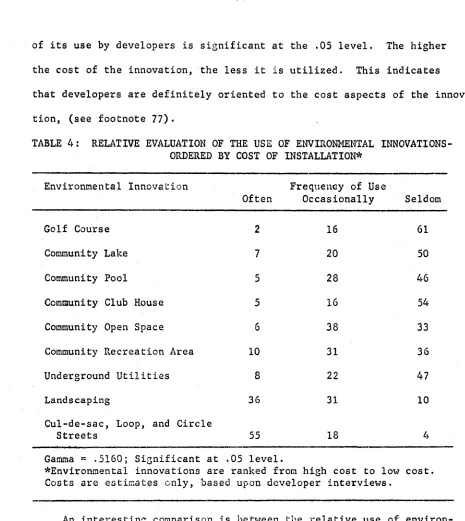
Relative Evaluation of the Use of Environmental Innovations-
Ordered by Cost of Installation
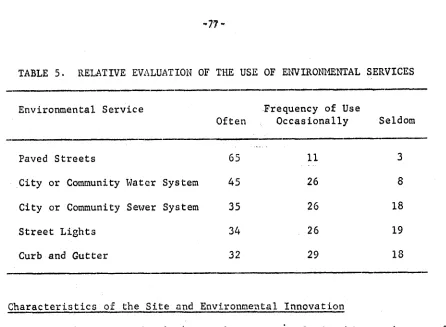
7 65. Relative Evaluation of the Use of Environmental Services
7 76.
Characteristics of the Site and Environmental Innovation:
All Firms
7
8
7. Characteristics of the Site and Environmental Innovation:
Small Firms (Less Than
40
Lots Per Year)
81
8.
Characteristics of Site and Environmental Innovation: Large
Firms
(40
or More Lots Per Year)
8
29 .
Characteristics of Site and Environmental Innovation: Lower
Price Subdivisions (Average Lot Price Under $4,500)
84
10. Characteristics of Site and Environmental Innovation: Higher
Price Subdivisions (Average Lot Price $4,500 and Over)
85
11. Environmental Innovation and the Mean Price Paid for Raw Land,
Interviews With North Carolina Developers, Summer 1967
9
312. Environmental Innovation and the Mean Size of Residential
Residential Subdivisions, Interviews with North Carolina
Developers, Summer 1967
9
9
13. Environmental Innovation and the Mean Amount of Undevelopable
Land in Residential Subdivisions, Interviews with North
Carolina Developers, Summer 1967
101
14. Environmental Innovation and the Mean Amount of Surrounding
Contiguous Development in Residential Subdivisions,
Interviews with North Carolina Developers, Summer 1967
102
/15. Environmental Innovation and the Mean Distance to the
Central Business District
ofNew Residential Subdivisions,
16. Environmental Innovation and the Mean Distance of New
Residential Developments to Employment, Interviews
with North Carolina Developers, Summer 1907
17. Environmental Innovation and the Mean Distance of New
Residential Subdivisions to Convenience Shopping,
Interviews with North Carolina Developers, Summer 1967
18. Environmental Innovation and the Nean Distance of New
Residential Subdivisions to State, U.S.,
or Interstate
Highways, Interviews with North Carolina Developers,
Summer 196
7
LIST
OF FIGURdS
Page
104
105
1.
The Residential Land Development Process: Sequence of
States, Key Decisions, and Decision Factors
92.
Conceptual Scheme of Sets of Factors Influencing Developer
Behavior
23
3.
Decision Agent Characteristics Related to Environmental
Innovations
4
2
4.
Site Characteristics and Environmental Innovation
52
5. Inventory of Lake-oriented Subdivisions in North Carolina
1967 by County
58CHAPTER
I
INTRODUCTION
Since the turn of the century studies of population growth and
distribution have indicated that the internal growth of cities has
declined in the face of an unprecedented expansion of the "urbanized"
portion of our population. At the same time peripheral growth, pri-
marily in the form of new single-family dwelling units, has soared.
The
Phenomenon has been so pronounced that many consider the suburbani-
zation of our population the most important demographic and social
11
development in twentieth century America.-
A concomitant trend has been the increasing capacity of our society
to absorb the tremendous pace of technological change which has charac-
terized the second quarter of this century. Increased productive capa-
city, rising incomes, and shorter working hours have all wrought funda-
mental changes in the structure and outlook of society, Not the least
of these changes has been the growth of leisure. Commenting on this
phenomenon, Paul
F. Douglass notes,
Americans are experiencing a change in the structure of their
lives in relationship to the content of time and the pace and
values of living. ..enjoyments once reserved for a privileged
11 Theodore Lowi, "Notes on the Politics of Suburbia," in Problems
of ~m&ica' s Expanding Metropolitan Fringe Areas, Alexander Kira (ed
.),
-
elite are becoming widely distributed
...
Already there is
emerging a new role for the family, a new concept of neigh-
borhood, a new sense of community, and a new vigor of parti-
2
1
cipation.-
The research reported in this paper is concerned with the impact
of the confluence of these two trends, suburbanization and leisure,
upon the environment created in the process of converting open land to
residential use.
The critiques of the past and current patterns of residential
development have been many and varied. As Richard Ratcliff has observed,
Intelligent, scientific land planning has not been character-
istic of much of past subdividing. The gridiron pattern has
predominated, and because lots were produced for sale rather
than use, little weight has been given the ultimate integra-
tion of the new area with the surrounding community. Other
outgrowths of shortsightedness and urge for quick profit
were the excessive land set aside for commercial use and the
3
/
lack of adequate provision for recreational and public areas.-
Nevertheless, changes in the pattern of residential development are
rapidly taking place. Where in the past the typical motivation in land
development was". ..the hope for large profits, with a sense of social
responsibility for sound community development often absent,"
environmental design has now become one of the most discussed topics in
21 Paul
F.
Douglass, Recreation in the Age of Automation, The Annals,
313 (September 1957), p. ix.
31 Richard U. Ratcliff, Urban Land Economics (New York: McGraw-
Hill :oak
Company, l949),
p.167. See also,
A .Allan Schmid, Rural to
--Urban Land Conversion, Economic Aspects and Research Needs (East Lansing:
-
Department of Agricultural Economics, Michigan State University, April
7 - -1966), p.
58, for another aspect of this criticism.
41
the land development
For the most part this interest would
seem to be the result of an "increasing awareness on the part of our
6
1
population of the quality of urban living in terns of its amenities."-
Thus, with more free time consumers have caused a demand which goes
beyond the house and, as was noted in the National Association of Home-
builders' Journal of Homebuilding, "extends to the look and 'feel' of
7
/
the community."-
In the past most research relevant to changes in our expanding
urban environment has centered on the consumer's role in this process.
Comparatively little research has been devoted to the land developer
despite the fact that,
I ' , 1
From a community stdndpoint, one of the most crucial phases
in the productive process which creates usable space is the
point at which land is taken out of agricultural use and
prepared for urban use. It is here that the basic skeleton
of the city is created and land use patterns aregcjrystallized
so that future changes are difficult and costly.-
While the consumer influences and is'-influenced by the developer, the
"developers of the land and the builders of the structures appear to be
nos
tdirectly involved in the location and tlie,:;,physical
design of suburban
: .
5/
Indicative of this trend is the Land Use Research Program
jointry sponsored by the ~ationai
Association of Homebuilders and
theUrban Land Institute which was founded in 1959 and which has become
increasingly active in recent years.
6/
Paul
F.
Wendt,,"Forecasting Land Uses,'' Urban Land (July-August,
I'1367);
p. 10.
7/ James San Jule, "Great Environmental Problems Challenging Today's
~uildzrs
,'~ournal
of
Honebuilding (July 1965)
,
pp. 59-60.
.
,subdivision developments and thus are key figures in the development
;irocess."9/
Because a lrnovledge of residential developer behavior
promises to provide us with new insights into the land development pro-
cess as well as increased ability to simulate urban growth, the Center
for Urban and Resional Studies is currently engage<: in a continuing
research effort aimed at exploring factors which contribute to this
101
behavior.
-
The Center's approach has been to view the land development pattern
of an urban region as "the cumulative result of
acomplex of decisions
and actions by individuals and groups each being guided by his own
incentives...In the aggregate, the confluence of actions may be said to
11/
zenerate land development and shape and change the urban setting."-
An initial effort was made to forecast
thespatial pattern of urban
srowth by means of a ldonte Carle type probobilistic model which distri-
12/
buted new growth on the basis of various nixes of "priming" decisions.-
While this model has been operational, .=.mtiuuing
research '.;as examined
4 I
9
PI. R . t l o l f e ,c.
L o c a t i o n a lFac'-.ors
Involved
inSuburban
-
J,,ondil
(unpublished
s t u d y , Universityof Vas!lin$torl,
136l), p .3-9.
10/ This research is summarized in, Research
Progress, (Chapel
-
Hill: Center for Urban and Regional Studies, Institute for Research in
Social Science, University of North Carolina, August, 1967), pp.
2-3,
5-6.
11/ Shirley F. Weiss, John
E.
Smith, Edward
3.Kaiser, and Kenneth
-
B.
Kenney, Residential Developer Decisions, (Chapel Hill: Center for
Urban and Regional Studies, Institute for Research in Social Science,
University of North Carolina, April, 1966),
p.1.
-
5-factors which contribute
tothe decisions of the various agents involved
13'
This work looks toward the development of
in the development process.-
a second generation of models based on the more behavioral aspects
ofland developnent decisions. These models will break the current model
into two submodels, "one focusing on land subdivision and related opera-
tions (a producer submodel), and another concerned with household selec-
tion of residence location (a consumer model) primarily from the
supply14/
of home sites provided by the producer subnodel."--
Research Objectives
The present study represents an expansion of the Center's interests
to an examination of innovation in the development of residential sub-
divisions. This effort has three primary objectives: 1) to determine
the correlates of innovative behavior in the land development industry;
2) to examine the relationship between innovation in environmental design
and the location decisions
ofresidential developers; and 3) to deter-
mine
the public policy factors which either facilitate such development
or
are affected
byits existence.
Arelated study now in progress
focuses on the locational decisions
ofconsumers with respect to this
type
ofdevelopment.
13/ See Research
&
Progress, o ~ .
c x . , p.6-
14/ Weiss, Kaiser, Kenney, Smith, and Stollenwerk, !'Developer
-
Environmental i n n o v a t i o n i s d e f i n e d i n broad terms. By e n v i r o n - ment we mean f e a t u r e s of a s u b d i v i s i o n which a r e n o t r e s t r i c t e d t o a n
i n d i v i d u a l l o t , b u t which may be enjoyed and u t i l i z e d by a l l t h e members of t h e community. T h e i r v a l u e may be e i t h e r a s a s o u r c e of v i s u a l amenity o r a means t o pursue v a r i o u s r e c r e a t i o n a l endeavors. I n many c a s e s both of t h e s e purposes a r e s e r v e d . For i n s t a n c e , a community l a k e i s a n environmental f e a t u r e w i t h t h e s e c h a r a c t e r i s t i c s .
I n n o v a t i o n i s used i n i t s most g e n e r a l s e n s e . We a r e p r i m a r i l y concerned w i t h environmental f e a t u r e s which a r e
not
i n common u s e , though they may have been f i r s t developed a number of y e a r s ago. For i n s t a n c e , g r i d i r o n s t r e e t p a t t e r n s were under a t t a c k a s e a r l y a s f o r t y y e a r s ago, b u t advanced concepts of s t r e e t d e s i g n , such a s t h e u s e of c u l s - d e - s a c , l o o p s , and c i r c l e s , a r e j u s t now approaching u n i v e r s a l use. A r t i g i c i a l l a k e s were f i r s t used i n a r e s i d e n t i a l s u b d i v i s i o n a s e a r l y a s 1885 whes a c h a i n of l a k e s was b u i l t on T u r t l e Creel: i n D a l l a s , Texas; b u t , t h i s environmental f e a t u r e i s r a r e l y found i n r e s i d e n t i a l developments. Thus, our i n t e r e s t i s n o t i n t h e development of the i n n o v a t i a n , b u t i n t h e f a c t o r s which seem t o govern i t s u s e o r acceptance.A s t u d y of t h e u s e of enPironnenta1 innovation i n r e s i d e n t i a l developments i s considered important f o r a number of r e a s o n s . F i r s t , p u b l i c a g e n c i e s , such a s t h e Department of Housing and Urban Development, have been encouraging t h e use of new d e s i g n concepts i n l a n d s u b d i v i s i o n
f o r a number of y e a r s . Yet, t h e r e h a s never been a n i n v e s t i g a t i o n of why some d e v e l o p e r s u t i l i z e such f e a t u r e s w h i l e ~ t h e r s a r e c o n t e n t t o
better methods of
disseminatingand presenting information on new design
techniques.
Second, while a number of innovations have been actively
promoted, there is little indication that various side effects of these
innovatious have been considered. For instance, it is certainly within
the realm of possibility that an innovation can cause as many additional
problems as those it solves. Third, as environmental innovations are
accepted at an increasing pace, the locational pattern
of
new residential
development may be altered. This aspect has a number of implications
for those interested
insimulating urban growth phenomenon. Finally, a
study of environmental innovation promises to increase our knowledge of
the land development process.
This report is presented in seven chapters. Chapter Two attempts
to lay a foundation for the development of hypotheses concerning the
acceptance and use of environmental innovations, and their effect upon
the
location of new residential subdivisions. Chapter Three investi-
gates the relationships which would be expected on the basis of the con-
ceptual overview and presents a comprehensive set of hypotheses. Chapter
Four discusses the methodology used ro test
thesehypotheseses
andthe colpirl-
cal findines. Chapter Five extends this discussion to
aconsideration
of the impact of environmental innovation on the location of new urban
development, Chapter Six looks at the implications of these findings for
the formulation of ?ublic policy. The use of community lakes is used
as an example for this discussion. Finally, Chapter Seven presents the
CHAPTER I1
THE
LAI?DDEVELOPMENT PROCESS AND DEVELOPER DECISIONS
:A
CONCEPTUAL OVERVIEW
g/
In order to provide a framework with which to investigate the pro-
vision of environmental innovations in residential subdivisions, this
chapter develops a conceptual overview of the land development process
and the role of the land development entrepreneur in this process.
Land Development as a Sequence of States and Decisions
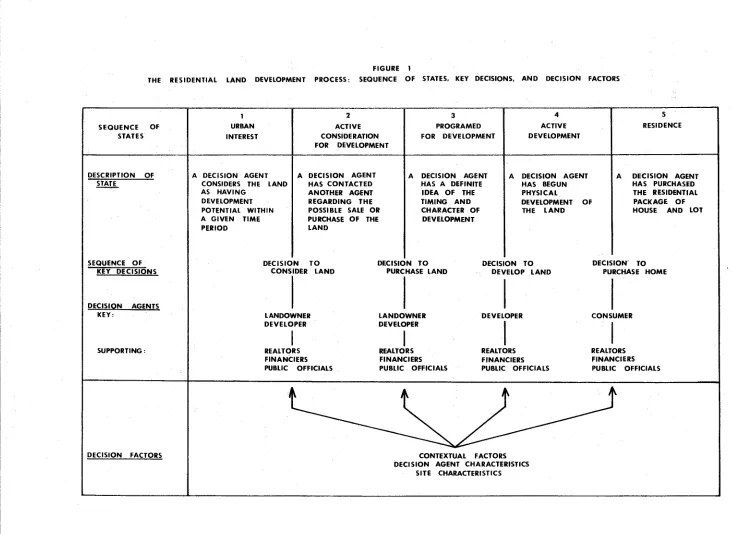
In general, urban areas grow through the conversion of vacant and
16/
agricultur~l
land on their peripheries to urban use.--
If one focuses
on
a giken site
G nthe rural-urban fringe, it may be visualized as passing
throu!;h
a ncmberof "ststes" before finally being occclied for ur'szn
residential
use.(See
F i g u r e1.) While
the siteis
initiallyvacant
and
cotin use o~ possibly
> s ? : tof an a.guLc:ilt.:;.sl enterprise,
at some"hi~her"
u s e .This may
bea
?!.annm;dizzctor rho includes the site
in a forecast
offuture urban growth or
aspecdstor looking for a Fro-
f
itnble irves
trnent
.
-
17'
We call this point in the land development process
15/ This chapter is based upon Weiss, Smith, Kaiser, and Kenney,
-
OJ.
G.
16/ Edward J. Kaiser, "Toward a Model of Residential Developer
~ e h a v z r "
(unpublished Ph.
D. dissertation, University of North Carolina,
1966), p. 2.
17/ See Marion Clawson, "Urban Sprawl and Speculation in Suburban
-
FIGURE 1
THE RESIDENTIAL L A N D DEVELOPMENT PROCESS: SEQUENCE O F STATES, KEY DECISIONS, A N D DECISION FACTORS
SEQUENCE O F STATES
I
DECISION AGENTS KEY:SUPPORTING :
DECISION FACTORS
INTEREST CONSIDERATION FOR DEVELOPMENT
A DECISION AGENT CONSIDERS THE L A N D AS H A V I N G
DEVELOPMENT POTENTIAL W I T H I N A G I V E N T I M E PERIOD
A D E C I S I O N AGENT H A S CONTACTED ANOTHER AGENT REGARDING THE POSSIBLE SALE OR PURCHASE O F THE
1 L A N D
FOR DEVELOPMENT DEVELOPMENT
A DECISION AGENT A DECISION AGENT H A S A DEFINITE H A S BEGUN I D E A O F THE PHYSICAL
T I M I N G A N D DEVELOPMENT O F CHARACTER O F THE L A N D
DEVELOPMENT
A D E C I S I O N AGENT H A S PURCHASED THE RESIDENTIAL PACKAGE O F HOUSE A N D LOT
D E C I S I O N T O DEClSll Of U T O DECISION T O D E C I S I O N TO CONSIDER L A N D PURCHASE L A N D DEVELOP L A N D PURCHASE H O M E
LANDOWNER L A N D O W N E R DEVELOPER CONSUMER DEVELOPER DEVELOPER
I
REALTORS REALTORS
I
FINANCIERS FINANCIERS PUBLIC OFFICIALS PUBLIC OFFICIALSI
REALTORS FINANCIERS PUBLIC OFFICIALS
REALTORS FINANCIERS PUBLIC OFFICIALS
CONTEXTUAL FACTORS DECISION AGENT CHARACTERISTICS
the 'state of urban interest.
The site has achieved this status through
the considered decisions of one or more of the decision agents in the land
development process, be he a landownCr, developer-builder, or public
official.
A ta later point in time an agent may see the site as having
potential for a specific urban use, such as a residential subdivision.
However, for land to move to the next "state" in the process the decision
agent, possibly supported by other secondary agents, such as realtors or
financial intermediaries, must make a conscious and identifiable decision
to actively consider the land. From this point land moves from state to
state as the land is programed for development and various improvements
are made. Finally, the improved site is sold or rented to the consumer
and a final, or long-term state of "residence" commences.
Agents in the Land Development Process
This view of the land development process is extremely valuable
in that it focuses our attention upon both the complexity of the pro-
cess itself, the number of "yes" decisions involved, and the number
of actors who become involved at one stage or another.
The
complexiry
of the process is highlighted by Wolfe, who says that,
The development of unimproved land into subdivision housing
is a complex process involving many individual, organiza-
tional, and institutional actions of a private and public
nature. Even more complex in many ways
...(
are)
...
the
factors and forces influencing the separate but interrelated
elements involved in this process.18/
One way of simplifying this complexity is to focus on the agents who
participate in the process and their contribution to the eventual pro-
duction of residential land.
18/
Wolfe,
%.g .
Thus, the landowner may either facilitate or hinder the process of
19/
land conversion depending upon his decision to hold or sell his land.-
Alternatively, he may greatly simplify the process by assuming the roles
of developer and merchandiser, that is, by developing and selling the
land himself. The developer is the central agent in the land develop-
ment process. His policies determine when land will first be considered
as suitable for residential,use,
when it will be programed for develop-
20'
Finally, the consumer,
ment, and when improvements will be made.-
although constrained in his choice of location by what developers and
landowners provide, has a direct influence on the pattern of future
211
development through his choice of residential packages.-
Other decision agents in the land development process play secondary,
though in most cases vital roles. Thus, the merchandiser or realtor has
the primary responsibility of selling the dwelling to the consumer.
19/
Factors contributing to this decision have been intensively
investigated by John E. Smith, "Toward a Theory of Landowner Behavior
on the Urban Periphery" (unpublished
M.R.P.
thesis, University of
North Carolina, 1967).
20/
For a summary of work on developer behavior see, Weiss, Smith,
-
Kaiser and Kenney,
2.
&.
21/ Related investi~ations
of the role of the consumer in the
development process include
:Shirley F. Weiss
,
Kenneth B. Kenney, and
Roger C. Steffens, '-Consumer
Preferences in Residential Location: A
Preliminary Investigation of the Home Purchase Decision,'' Research
Previews Vol. 13 (April 1966), pp. 1-32; Louis Earl Armiger, Jr.,
"Toward a Model of the Residential Location Decision Process:
Astudy
of Recent and Prospective Buyers of New and Used Homes" (unpublished
M.R.P.
thesis, University of North Carolina, 1966); Samuel Hardy Leaman,
"A
Study of Housin~
Decisions by Negro Hone Owners and Negro Renters1'
(unpublished M.R.P.
thesis, University of North Carolina, 1967); and
Mark Thomas Eldridge,
.
Explorations Into Decision Factors in the Rental
.,Housing Market" (unpublished M.R.P.
thesis, University of North Carolina,
I n a d d i t i o n , he may s e r v e a s t h e key a g e n t i n a s s e m b l i n g t r a c t s o f l a n d , o r a s a n i n t e r m e d i a r y i n t h e t r a n s f e r of l a n d . F i n a l l y , h e p e r f o r m s t h e v i t a l f u n c t i o n s o f a i d i n g i n t h e "flow of d e s i r e a t t i t u d e s between consumer and b u i l d e r . It-- 22' The r o l e o f f i n a n c i a l i n s t i t u t i o n s n e e d s l i t t l e e l a b o r a t i o n . I n a n i n d u s t r y a s u n d e r c a p i t a l i z e d a s r e s i d e n t i a l b u i l d i n g , f i n a n c i a l i n t e r m e d i a r i e s a r e i n d i s p e n s a b l e i n p r o v i d i n g t h e f u n d s t o k e e p t h e p r o c e s s i n motion.23' F i n a l l y , t h e v a r i o u s o £ f i c i a l s of l o c a l , s t a t e , and f e d e r a l a g e n c i e s h a v e a p e r v a s i v e impact on a l m o s t
24
/
e v e r y d e c i s i o n made by o t h e r a g e n t s . - -
The Land Development
%
From t h e p r e c e d i n g d e s c r i p t i o n of t h e l a n d development p r o c e s s and t h o s e i n v o l v e d i n i t , i t seems e v i d e n t t h a t a n u n d e r s t a n d i n g o f t h e u s e o f e n v i r o n m e n t a l i n n o v a r i o n s i n r e s i d e n t i a l development: must come
from a n i n v e s t i g a t i o n of t h e c e n t r a l a g e n t
--
t h e l a n d d e v e l o p e r . The E n t r e p r e n e u r and Eli; S i r n--
U n f o r t u n a t e l y , a n unambiguousd e s c r i p t i o n of t h e l a n d d e v c l q m e n t e n t r e p r e n e u r and h i s f i r m i s extremely
d i f f i c u l t . I n f a c t , t h e e x a c t n a t u r e of t h e e n t r e p r e n e u r may be a s c o n p l e x a q u e s t i o n a s t h e n a t u r e of t h e l a n d development p r o c e s s i t s e l f .
2 2 / Wolfe, 9.
~.:s.,
p . 3-15. See a l s o , E r i c C a r l s o n , T h e R e a l t o r ' s-
Role i n Raw Land T r a n s d c t i ~ ? . :
&
E x p l o r a t o r y - s t i g a t i o n R e s e a r c h-
-
-R e p o r t , (Chapel H i l l : C e n t e r f o r Urban and -R e g i o n a l S t u d i e s , I n s t i t u t e f o r R e s e a r c h i n S o c i a l S c i e n c e , U n i v e r s i t y o f N o r t h C a r o l i n a , May 1 2 , 196)).
23/ See H . O e n j a n i n F i s h e r , F i n a n c i a l T n t e r m e d i a r i e s
in
t h e Develoi--
--
merit D e c i s i o n P r o c e s s , R e s e a r c l ~ P a p e r , (Chapel H i l l : C e n t e r f o r Urban a d
-
E e g i o n a l S t u d i e s , I n s t i t u t e f o r R e s e a r c h i n S o c i a l S c i e n c e , U n i v e r s i t y
rf
Worth C a r o l i n a , September 26, 1 9 6 6 ) .
24/ See Edward J. K a i s e r and S h i r l e y F. Weiss, "Local P u b l i c P o l i c y and
the
R e s i d e n t i a l Development P r o c e s s , ' ' Law and Contemporary Proble,bsAs Ratcliff notes,
...
the producers are diversified in organization, experience, skill and financial capacity. The land developer may be an amateur with raw land to unload. Some operations are carried out as a sideline by a group of investors organized in a syndicate. Such a g r m p may contain persons who ere engaged in some aspect of the real estate business and who manage the project...
The best type of land preparation is likely to come from large real estate development companies, which regularly engaze in land development and often in building operations.Often land development is combined with a number of other business interests. For instance, a study of Atlanta developers in 1966 indica- ted that they had from one to eight concurrent business interests, with an average of 2 . 5 . - 2 6 / In the present study, comprising interviews with eighty-two firms engaged in land development in the State of North Carolina, firms had an average of 2 . 8 concurrent activities.
One of the factors which accounts
for
this diversity is the fact that land development is not a difficult field to enter, The primary requirements are land and enough capital to financea
modicum of improve- ments. However, this ease of entry into the field creates difficultiesfor the analyst, for the universe of developers is unknown and constantly shifting.
Operating Characteristics of Land Development Firms
--
While land development firms nay be extremely diversified as to background andscope of operation, each firm or entrepreneur engaging in land development
25,' Ratcliff, 1949,
2-
a*,
p. 165.-
26/
KennethB.
Kenney (unpublished manuscript,1966).
r i c t e r m i u e o b j e c t i v e s , o r g a u l z e r c s o u r c c G , and c o n t r o l t h c o p e r a t i o n s 27/ a e c e s s a r y t o t r a n s f o r m t h e raw m a t e r i a l s i n t o a f i n i s h e d p r o d u c t . -
However, tile s c e p s i n v o l v e d i n t r a n s f o r m i n s raw l a n d i n t o a
f r n i s h e d p r o d u c t r e a d y f o r r e s i d e n t i a l u s e a r e e x t r e m e l y v a r i a b l e . 25/ F u n d a m e n t a l l y , t e n b a s i c o p e r a t i c i n s a r e i n v o l v e d i n t h i s p r o c e s s : -
Analyzin:, u a r k e t c o n d i t i o n s ( d e t e r m i n i n g t h e need fo: and t h e p r o p e r t i m e f o r t h e proposed d e v e l o p m e n t ) . S e l e c t i n : a n a p p r o p r i a t e l o c a t i o n .
A n a l y z i n g t h e p r i n c i p a l f e a t u r e s of t h e s e l e c t e d t r a c t and d e v e l o p i n g p r e l i m i n a r y p l a n s and d e s i g n .
P u r c h a s i n g t h e l o c a t i o n and e s t a b l i s h i n g a method of f i n a n c i n z .
D e s i p i n g t h e l a y o u t o f t h e a r e a , l o c a t i n g t h e p r i n c i p a l f a c i l i t i e s and d e t e r m i n i n g t h e r e l a t i o n s h i p between p u b l i c and p r i v a t e l a n d u s e s .
S e c u r i n g a p p r o v a l of Qovernnent a u t h o r i t i e s a s r e q u i r e d . Arrangirlg p r o t e c t i o n a ~ a i n s t r i s k s by means o f i n s u r a n c e and b o n d s .
I n s c a l l i n z u t i l i t i e s , s t r e e t s , and t h e v a r i o u s c o n v e n i e n c e s n e c e s s a r y f o r t h e d e v e l o p n e n t .
E s t a b l i s h i n s r e s t r i c t i o n s and methods o f r e g u l a t i n g l a n d u s e s .
S e l l i n 2 p a r c e l s o r p r o c e e d i n g w i t h c o n s t r u c t i o n .
I n p r a c t i c e e a c h of t h e s e s t e p s b r e a k s down i n t o a number of s u b -
*'/
m e a t o n d e c i s i o n s , e a c h of which c a n s t y m i e t h e d e v e l o p n e n t p r o c e s s . -l i s t s some t w e n t y c r i t i c a l d e c i s i o n s i n v o l v e d i n t h e l a n d p u r c h a s e d e c i - s i o n a l o n e . 3 0 The i m p r o b a b i l i t y of a n a l y z i n ~ and w e i g h i n g t h e i m p o r t a n c e
271 A r t h u r 1.1. I J e i n e r and Homer Hoyt, R e a l E s t a t e , 5 t h E d i t i o n (New z r k : The Xonald P r e s s Company, 196G), p. 3 3 7 .
281 I b i d . , p . 33:.
-
29/ S e e W i l l i a m L. C . Wheaton, " P u b l i c and P r i v a t e A g e n t s of Change i n Urban E x p a n s i o n , " i n Explcict* i n t o Urban S t r ~ c t u r e , ~ ~ f e l v i n M. Webber,
e t . a l . , ( e d 8 . )
,
( P h i l a d e l p h i a : U n i v e r s 5 t y of P e n n s y l v a n i a P r e s s , l 3 6 7 ) ,- -
pp. 1 5 4 - 1 9 6 .
30/ I J i l l i a n L . C . Flheaton, a s m o d i f i e d by K a i s e r , 1 9 6 6 ,
2.
c i t . , p . 6 0 , L-of each of these subdecisions to the final outcome, to say nothing of
the factors which contribute to each decision, needs little elaboration.
Yet, in order to explain the use of environmental innovations by resi-
dential developers, we should have some understanding
ofwhat is involved
in at least the major decisions the developnent entrepreneur must make.
Two classes of decisions seem most inportant
--
one, the determination
that a market exists, and two, the determination of the feasibility of
developing a ~ i v e n
tract.
14arketability
-
Studies
--
Wheaton su~zests
that market criteria, the
entrepreneur's evaluation of the consumer, are the "decisive force
affecting as rxch as 90 percent of the micro-locational decisions to
31/
But, what is meant by market criteria
invest in metropolitan areas
.'I-
is somewhat elusive. In its most basic sense, market criteria are the
set of convictions
t h a tcustomers exisl: for the product. Beyond this
Wheaton suggests that market decisions have fact, the number of potential
users; judgmene, the continuity of present trends; and value, the c h o i c ~
between alternatives, elements. He feels that the fact component is
often weah because of a lack of available date.g'
Ratcliffechoes this
feeling when he notes
that,"In practice
theinterpretation
ofthe market
is often a perfunctory process, based on judgment and opinion rather
than statistical evidence. The prime test is usually the current
31/
-
Wheaton,
2 .
G.,
pp.
167-163.
32/ I x . , pp.
166-163.s a l a b i l i t y of buildin:: l o t s . ' , - 33' These c o n c l u s i o n s a r e supported by Kenney's survey of A t l a n t a developers, which i n d i c a t e d t h a t less than 25 p e r c e n t of t h e f i r m s interviewed d i d any s o r t of formal market
341 otudy.-
For purposes of t h i s s t u d y , t h e primary c o n c l u s i o n s which can be drawn from t h e n a t u r e of developer m a r k e t a b i l i t y s t u d i e s , o r t h e gene@ l a c k of t h e n , i s t h a t they, "tend t o make producer r e s p o n s e s t o changes i n t a s t e very slow and incremental."- 35' T h i s f a c t o r may account f o r tla p a s t omissions of t h e l a n d development i n d u s t r y w i t h r e g a r d t o t h e
36/ i n c l u s i o n of e n v i s o n n e n t a l a m e n i t i e s i n subdivisions.-
F e a s i b i l i t y Studies
--
When t h e development e n t r e p r e n e u r has d e t e r - . ?mined t h a t a narlcet e x i s t s f o r r e s i d e n t i a l l o t s i n a given p r i c e range and/or l o c a t i o n , t h e n e x t c r u c i a l s t e p i s t o f i n d a s u i t a b l e t r a c t of land on which t o l o c a t e t h e development. T y p i c a l l y , d e v e l o p e r s sequen- t i a l l y e v a l u a t e t r a c t s of land u n t i l they f i n d one t h a t meets t h e i r
371
In
e v a l u a t i n g a given t r a c t , t h e prime c o n s i d e r a t i o n requirements.-1.7ould seem t o be t h e , " u c a b i l i t y and m a r k e t a b i l i t y of a l l p a r t s of t h e
331 R a t c l i f f , 1949,
op.
c&., p. 16G.-
341 Kenney, 19G5,
a.
&.,
p. 42.-
* I
351 Wheaton, 2 .
g . ,
p. 170.-
361 T h i s may a l s o e x p l a i n t h e l a c k of r e l a t i o n s h i p found between l o c a t z n a l c h a r a c t e r i s t i c s of s u b d i v i s i o n s and t h e p r i c e range i n which t h e development f a l l s , which i s a market f a c t o r . That i s , i f d e v e l o p e r s a r e n o t r i p r a u s l y uarlcet o r i e n t e d , t h e i r l o c a t i o n a l behavior i s not l i k e l y t o r e f l e c t narlcet v a r i a t i o n s . See K a i s e r , 1966,
2 .
k t . , p. 187.38' Thus, d e v e l o p e r s w i l l e v a l u a t e t h e number of l o t s which may
a r e a .
"-
be produced on t h e t r a c t and t h e c o s t of p r o d u c i n g them. The n a r k e t - a b i l i t y s t u d y produces e s t i m a t e s of t h e demand f o r t h e proposed h o u s i n g a t t h e g i v e n l o c a t i o n and t r a n s l a t e s t h i s f i g u r e i n t o a n e s t i m a t e of
391 a n n u a l turnover.-
These s t u d i e s t h e n a l l o w t h e d e v e l o p e r t o weigh t h e c o s t s of develop- ment a g a i n s t t h e p o t e n t i a l r e v e n u e t o be d e r i v e d
--
i n o t h e r words t o d e t e r m i n e t h e p r o f i t a b i l i t y of t h e v e n t u r e . C o n c u r r e n t w i t h t h i s d e t e r - m i n a t i o n , t h e d e v e l o p e r must a l s o make a s e r i e s o f checks w i t h p u b l i co f f i c i a l s t o d e t e r m i n e t h e a v a i l a b i l i t y of s e r v i c e s t o t h e s i t e , t h e zoning of t h e p a r c e l and s o on. I n a number of c a s e s h e w i l l a l s o c o n t a c t a
f i n a n c i a l i n s t i t u t i o n , u s u a l l y t h e mortgage i n s u r e r o r g u a r a n t o r , t o 401 a s s u r e t h e a v a i l a b i l i t y of f i n a n c i n g f o r t h e f i n i s h e d product.-
Whether t h e d e v e l o p e r w i l l t h e n proceed w i t h t h e p u r c h a s e of t h e p a r c e l depends upon r e i n f o r c i n g d e c i s i o n s i n t h e above s t u d i e s , and, i n a d d i t i o n , such f a c t o r s a s , " t h e f i n a n c i a l p o s i t i o n of t h e f i r m , s u b s e q u e n t l a n d p u r c h a s e s , t r e n d s i n l a n d v a l u e s , t a x r e a s s e s s m e n t , s c h e d u l i n g of p u b l i c works, a n n e x a t i o n , and changing market conditions."--
411
I t s h o u l d be n o t e d , however, t h a t t h i s o u t l i n e of o p e r a t i n g p r o c e d u r e s i s n o t u n i v e r s a l l yc h a r a c t e r i s t i c of t h e l a n d development i n d u s t r y . For i n s t a n c e , a s t u d y
381 Weimer and Hoyt, 9.
&.
,
p. 341.-
391 J o h n E . Smith,
The
L o c a t i o n a l D e c i s i o n P r o c e s sof
R e s i d e n t i a l Land ~ e v e l z e r s : Toward E m p i r i c a l Model, R e s e a r c h Memorandum, (Chapel H i l l : C e n t e r f o r Urban and R e g i o n a l S t u d i e s , I n s t i t u t e f o r Kesearch i n S o c i a l S c i e n c e , U n i v e r s i t y of North C a r o l i n a , J u l y 21, l 9 6 5 ) , pp. 22-23.I b i d . , p . 26.
-
411 I b i d . , p. 3 5 .of "small scale" developers indicated that,
...
the process is rather random in nature and depends to a
large extent on the availability or listing of land for sale,
with comparatively little "bird-dogging' for land in good
development locations.. .?he variety of operation 1 approaches
427
taken by the firms interviewed was impressive.-
This variation in operating procedures indicates that one must be extremely
cautious in generalizing in this area.
While firms seem to vary a great deal in the rigor with which they
evaluate the feasibility of a parcel, the factors they consider in sucb
studies seem to be rather uniform. Weimer and Hoyt note that,
Factors important in studying both costs of development and
marketability include 1) topography;
2) limitations established
by zoning ordinances and other regulations; 3) accessibility
to places of employment, to schools, and to shopping, amusement,
and civic centers;
4)
location with respect to high-quality
neighborhoods and special attractions such as golf courses;
5) taxes; 6) potential special assessments; and 7) future pro-
bable management, financing, and maintenance costs.g/
Interviews with a cross-section of developers in the Greensboro,
N.
C.
441
area generally corroborate this list.-
Summary
--
From the preceding description of what is known of land
development firms and their operations, it can be seen that a summarizing
description of the firms and their methods of operation would be extremely
hazardous. Probably the safest generalization one could make is that it
42/ Kenneth
B.
Kenney, Locational Decisions
of
Residential Land
~evelopment
an_d
Building Firms in the Greensboro Urban Area, Research
Memorandum (Chapel Hill: Center for Urban and Regional Studies, Institute
for Research -in social Science, University of North Carolina, September
17, 1964), p.
8, 14.
43/
-
Weimer and Hoyt,
s.
c&.,p. 342.
441
Kenney,
22.
c
&
.
,
1964; Smith, op. cit., 1965.
i s n o t a good i d e a t o ~ e n e r a l i z e a t a l l . R a t c l i f f p r o v i d e s a n e x c e l l e n t a c c o u n t of t h i s s i t u a t i o n . He s t a t e s t h a t ,
The b a s i c i n f o r m a t i o n a l and a n a l y t i c problem stems from t h e c o m p l e x i t y of r e a l e s t a t e a s a n economic good, t h e d i v e r s i t y i n t h e r e a l e s t a t e market c o n d i t i o n s which a f f e c t t h e t r a n s - a c t i o n , and t h e h e t e r o g e n e i t y of t h e p a r t i e s t o t h e t r a n s a c t i o n
i n t h e i r p e r s o n a l c h a r a c t e r i s t i c s and f i n a n c i a l s i t u a t i o n s . With s u c h a l a r g e number of v a r i a b l e s impinging on e a c h t r a n s - a c t i o n , t h e p e r m u t a t i o n s and c o m b i n a t i o n s i n t h e s i g n i f i c a n t f a c t o r s which i n f l u e n c e t h e f i n a l t r a n s a c t i o n . . . a r e i n f i n i t e . It would a p p e a r t o be d i f f i c u l t indeed t o d e r i v e
~ 4 7 ~ ~ '
g e n e r a l i z a t i o n s from such a d i v e r s i f i e d u n i v e r s e . -Because of t h e c o m p l e x i t y of t h e d e c i s i o n s t h e y must make, l a n d d e v e l o p e r s u n d o u b t e d l y s i m p l i f y t h e s i t u a t i o n t o one of manageable t e r m s . I n t h e end d e c i s i o n s would seem t o t u r n on v a l u e such t h a t t h e s t r i k i n g c h a r a c t e r i s t i c of d e c i s i o n s of development e n t r e p r e n e u r s " i s t h e u n s y s t e m a t i c a p p r o a c h i n t h e : . n s l y s i s of f a c t o r s l e a d i n g t o them.
,471 D e c i s i o n s a r e a r z i v e d at: n o r e i n t a i t i v e l y , t h a n s y s t e r n s t i c a 1 l y . ' ~ -
n a t u r e of d e v e l o p e r d e c i s i o n s seems t o i n d i c a t e t h a t a n i n t e n s i v e a n a l y s i s of a l i m i t e d n u d e r of f i r m s c a n n o t p r o v i d e d a t a upon which t o b a s e
meaningful ~ e n e r a l i z a t i o n s a b o u t t h e use o r impact of e n v i r o n m e n t a l inno- An a l t e r n a t i v e i s t o employ what v a t i o n s i n r e s i d e n t i a l developments.-
451
R i c h a r d U . R a t c l i f f , Modern Real E s t a t e V a l u a t i o n , (Mqdison: Democrat P r e s s , 1 9 6 5 ) , p . 112.46/
-
Weiner a n d Hoyt,22.
a,,
p . 338.47/
K a i s e r , 1956, OJY+.c,iLt.,
p . 58. See a l s o Wheaton,op.
ciici.,
p p .167-1%; and Weimer and Koyt, 0Q- c i t . ,
-
p p . 338-339.i s known a s " c o n c e p t u a l v a r i a b l e a n a l y s i s . " - 491 E s s e n t i a l l y , t h i s method of a n a l y s i s s e e k s t o reduce human b e h a v i o r t o v a r i a b l e s and t h e i r r e l a t i o n s . The o b j e c t i v e i s t h e n t o account f o r v a r i a t i o n i n t h e dependent v a r i a b l e s . The e s s e n t i a l s t e p s i n t h i s t y p e of a n a l y s i s may be d e s c r i b e d b r i e f l y a s : 1) e x p r e s s a l l c o n c e p t s a s v a r i a b l e s ; 2) d e v e l o p h y p o t h e s e s a b o u t t h e r e l a t i o n s h i p between c o n c e p t s ( v a r i a b l e s ) , 3) d e v e l o p o p e r a t i o n a l measures of t h e v a r i a b l e s ; 4 ) c o l l e c t d a t a a b o u t t h e d i s t r i b u t i o n of t h e v a r i a b l e s i n t h e " r e a l " world; and 5) t e s t t h e d a t a f o r i t s correspondence t o t h e h y p o t h e s e s .
An Approach t o U n d e r s t a n d i n e Developer Behavior
Previous r e s e a r c h a t t h e Center f o r Urban and Regional S t u d i e s has r e s u l t e d i n t h e development of a c o n c e p t u a l scheme which promises t o
be of u s e i n a n a l y z i n g d e v e l o p e r b e h a v i o r and develop in^ u s e f u l h y p o t h e s e $ . It i s f e l t t h a t t h r e e s e t s of d e c i s i o n f a c t o r s w i l l e x p l a i n t h e d e c i s i o n s which, " i n t u r n e x p l a i n t h e e v o l u t i o n o f p r o p e r t y through t h e developmenk 501 These f a c t o r s a r e : c o n t e x t u a l , d e c i s i o n a g e n t , and p r o p e r t y p r o c e s s .
"-
c h a r a c t e r i s t i c s .
C o n t e x t u a l f a c t o r s p r o v i d e t h e macro environment f o r development d e c i s i o n s . They p r o v i d e t h e g e n e r a l i z e d areawide s e t of c o n s i d e r a t i o n s
491 T h i s method of a n a l y s i s was psoposed by Iiebert Blumer, i n " ~ o c i z o ~ i c a l A n a l y s i s and t h e ' V a r i a b l e ,
"'
American S o c i o l o p , i c a l Review, 21 (l95G), pp. 663-630.which "determine t h e o v e r a l l r a t e and type of change i n t h e urban community and t h e g e n e r a l s t r u c t u r e of t h e p o p u l a t i o n of d e c i s i o n a g e n t c h a r a c t e r -
511
Contextual f a c t o r s m y be thoughti s t i c s and p r o p e r t y c h a r a c t e r i s t i c s . " -
of a s f a l l i n g i n t o two broad c a t e z o r i e s , socioeconomic f a c t o r s and p u b l i c p o l i c i e s . I n e s s e n c e , they provide t h e broad c o n t e x t f o r d e c i s i o n s i n t h e a g g r e g a t e .
Decision a g e n t c h a r a c t e r i s t i c s r e f e r t o t h e f a c t o r s which d i s t i n g u i s h t h e v a r i o u s p a r t i c i p a n t s i n t h e land development p r o c e s s . Previous r e s e a r c h on land d e v e l o p e r s would seem t o i n d i c a t e t h a t much of t h e v a r i a t i o n i n d e c i s i o n a l behavior nay be explained by f o u r developer c h a r a c t e r i s t i c s : 1 ) t h e type of f i r n , p r i m a r i l y t h e e x t e n t of d i v e r s i f i c a t i o n ; 2) t h e s c a l e of o p e r a t i o n , t h e number of r e s i d e n t i a l l o t s p e r y e a r which a r e produced; 3) t h e e n t r e p r e n e u r i a l approach, t h e s e t of p e r s o n a l a t t i t u d e s and b e l i e f s which i n f l u e n c e t h e n a t u r e of t h e d e v e l o p e r ' s d e c i s i o n s ; and 4) t h e l i f e c y c l e of t h e f i r m , t h e e x t e n t of t h e f i r m ' s e x p e r i e n c e i n l a n d develop-
52/ n e n t
.-
S i t e c h a r a c t e r i s t i c s a r e a r e p r e s e n t a t i o n of urban s p a t i a l s t r u c t u r e a t t h e micro l e v e l
-
tile l e v e l of t h e i n d i v i d u a l s i t e . Reference t o t h e l i s t of f a c t o r s d e v e l o p e r s c o n s i d e r i n conducting f e a s i b i l i t y s t u d i e s i n d i c a t e s t h a t most of t h e s e consideraLions r e f e r t o p h y s i c a l a s p e c t s of t h e s i t e o r i t s s p a t i a l c o n t e x t i n t h e o v e r a l l s t r u c t u r e of t h e urban a r e a .511 K a i s e r and Weiss,
2.
'it,
p . 4 .-
- 2 2 -
There are several aspects of site characteristics which are important. First, site characteristics obviously have a physical dimension. This refers to the land itself
--
to factors which cannot be changed except by direct modification of the site. Not so obvious is the locational dimen- sion of site characteristics. These aspects of site characteristics adhere to the site due to its location relative to urban activities, transportation networks, and the aerial distribution of social values. Locational site characteristics are a result of "the fixity of land in space, the socioeconomic organization of the community, and the spatial pattern of social preferences."-53'
Their value is dependent upon the spatial context and cannot be changed by alteration of the site. Finally, site characteristicsmay
be seen to have an institutionai aspect. This refers to the influence of the institutions of the community, such as local government. While these aspects of site characteristics are not inherent in the site or the spatial organization of society, they seem to have a pervasive effect on the disposition of land in the community.A
well known example of an institutional site characteristic would be the site's classification in a local zoning ordinance.
As seen in F i ~ u r e
2,
this conceptual scheme considerably simplifies the complex set of factors which influence developer behavior. Further, it focuses our attention on a relatively determinate set of variables which we can expect to be related to the provision of environmental531'
Ibid., p. 17.COMCEPTUAL SCHEME
OP
SETS OF FACTORS INFLUENCING DEVELOPER BEHAVIORI
1
DECISION AGENT CHARACTERISTICS!
S I T E
i
/
CHAPICTERISTIC1
!
DEVELOPER Ii
BEHAVIORi n n o v a t i o n s i d s u b d i v i s i o n s . y e t , t h e c o n c e p t u a l scheme, a s t h u s f a r developed, does n o t provide u s w i t h a b a s i s t o p r e d i c t what t h e s e r e l a t i o n s h i p s should be l i k e . For t h i s purpose we t u r n t o a n a n a l y s i s of t h e l a n d d e v e l o p e r a s a n "economic" and a s a " s o c i a l 1 ' b e i n g .
5 4 1
An Economic I n t e r p r e t a t i o n of Developer Behavi.0~-
--
From'an economic p o i n t of view t h e r e s i d e n t i a l d e v e l o p e r and h i s f i r m a r e u n i t s of pro- d u c t i o n . That i s , r e s i d e n t i a l l o t s a r e produced through t h e t r a n s f o r - mation of v a r i o u s i n p u t s i n t o a s a l a b l e o u t p u t . The f i r m w i l l s t a y i n b u s i n e s s only s o long a s t h e revenues r e c e i v e d from t h e o u t p u t s exceed,i n t h e long run, t h e c o s t s of production. The f i r m must make a p r o f i t . 7 .
The f i r m ' s d e c i s i o n s a r e concerned w i t h determining " a l t e r n a t i v e i n p u t combinations of l a n d , c a p i t a l , and l a b o r a s t h e y a r e r e l a t e d t o
5 5 /
a l t e r n a t i v e o u t p u t r e s i d e n t i a l packages of house, l o t , and location."- P r o f i t becomes t h e primary decision-making c r i t e r i o n . The v a r i o u s f a c t o r s we have d i s c u s s e d i n t h e preceding s e c t i o n may be r e l a t e d t o d e v e l o p e rbehavior by a n a l y z i n g t h e i r r e l a t i o n s h i p t o t h e components of t h e d e v e l o p e r ' s
5 6 /
p r o f i t f u n c t i o n , a s c o n s t r a i n e d by t h e terms of t h e p r o d u c t i o n function.-5 4 1
T h i s s e c t i o n i s based on K a i s e r , 1966,=:
g.,
pp. 87-134. For purposes of t h i s s t u d y we have g r e a t l y simplified t h e a n a l y s i s i n o r d e r t o f o c u s on o n l y t h e key p o i n t s .55/
K a i s e r , Weiss, Kenney, Smith, and S t o l l e n w e r k ,2.
G.,
p. 31.-
Economic Consideraiions
andErivironnental Innovation
--
The relation-
ship between the development firm as an economic entity and environmental
innovation nay be explored by
construct in^
a hypothetical situation. Assume
the developer has conducted some sort of marketing study and has deter-
nined that
(Y'i,at~ltet
exists for lots in
agiven price range. He must then
find
alocation which combines a
s e tof site characteristics (physical,
locational, and institutional) which may bc transformed into salable resi-
dential lots at a cost which does not exceed the revenues which the fini-
5 7 /
Typically, the developer will not consider
shed product will command.-
various design features of the finished subdivision before evaluation of
58/
a site.--
That is, he views his market as being for a lot in a general
price range and location, and not for a particular "type of subdivisi~n.~'
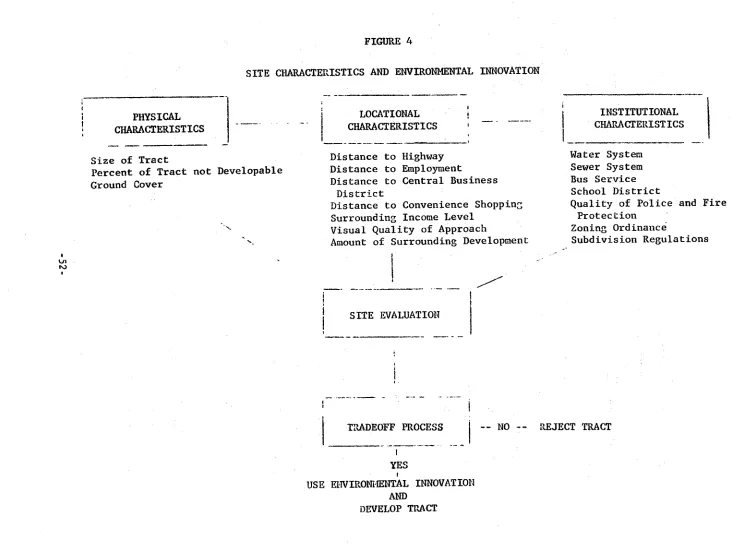
Coninz across a potentially suitable tract of land, the developer evaluates
the characteristics of the site as they affect the costs of developing
i tand the revenue which the site will produce. At this point in the process,
the developer will also begin to consider the use of various environmental
features in the design of the finished product. The extent of this
consideration depends upon the characteristics of the developer, his
57/
Contextual factors may be viewed as contributing to the determi-
nationby the developer that a market exists. The developer may actually
search for a site or another participant (for instance, a realtor) may
bring a site to his attention, which he will than inspect and evaluate.
The effect of these differing approaches on developer behavior is not
known.
- 2 5 -
evaluation
of chcr.ela:ive ccri;ri'uuticn of vazious.:~ite char,-.cteristics
to
his lrofit function,
andhis evzluaSion
05the profitability of the
environmental feature. It is important to note, however, that any given
environmental feature he nay consider cannot be analyzed apart from the
other aspects of the site. For instance, if the site contains all of the
requisites he considers necessary for a profitable subdivison, he may
never consider the use of an environmental innovation. On the other hand,
an environmental feature may offset a neeative aspect of the site and make
the whole undertakinz seen profitable.
This discussion points up several key assumptions upon which we will
base our analysis. First, we assume that the developer acts as an econo-
nic entity and profic is his primary, though not his only, motivating
force. Second, the use of an environmental innovation is seen to result
in part from evaluations emerging fron
"Lielocation decision process. Third,
the sane cost and revenue factors which contribute to the choice of a
given location also contribute to the decision to use an environmental
innovation. Finally, the use of environmental innovations can chanse the
"norr.~al'! location decisions of a developer by offsetting negative site
characteristics and lead him to accept a site for development which he
might otherwise have rejected.
A