Article
1
Personality and the moderating effect of mood on
2
verbal aggressiveness risk factor from work activity
3
María del Mar Molero Jurado 1, María del Carmen Pérez-Fuentes 2*, Ana Belén Barragán Martín 3,
4
María del Mar Simón Márquez 4, África Martos Martínez 5, and José Jesús Gázquez Linares 6
5
1 Department of Psychology, Faculty of Psychology, University of Almería, 04120 Almería, Spain;
6
7
2 Department of Psychology, Faculty of Psychology, University of Almería, 04120 Almería, Spain.
8
3 Department of Psychology, Faculty of Psychology, University of Almería, 04120 Almería, Spain;
9
10
3 Department of Psychology, Faculty of Psychology, University of Almería, 04120 Almería, Spain;
11
12
3 Department of Psychology, Faculty of Psychology, University of Almería, 04120 Almería, Spain;
13
14
4 Department of Psychology, Faculty of Psychology, University of Almería, 04120 Almería, Spain; and
15
Universidad Autónoma de Chile, 4780000, Chile; [email protected]
16
* Correspondence: [email protected]; Tel.: +34‐950015598
17
18
Abstract: One of the trends in current research in psychology explores how personal variables can
19
determine a person’s communication style. Our objective was to find out the moderating effect of
20
Mood in the relationship between the five big personality traits and an aggressive verbal
21
communication style risk factor from work activity in a sample of nursing professionals. This study
22
is a quantitative descriptive design. The final sample was 596 nurses with a range of 22 to 56 years.
23
An ad hoc questionnaire was used to collect sociodemographic data, the 10‐item Big Five
24
Inventory, the Communication Styles Inventory, and the Brief Emotional Intelligence Inventory for
25
Senior Citizens. This study showed that for nursing professionals, the “Agreeableness”,
26
“Conscientiousness” and “Neuroticism” traits have a close relationship with aggressive verbal
27
communication. Even though Mood moderates this relationship, it is only significant for those
28
individuals with high scores in “Neuroticism”. Because personality dimensions are considered
29
relatively stable over time and consistent from one situation to another, organizations should hold
30
workshops and other types of practical activities to train workers in communication skills and
31
Emotional Intelligence in order to promote employee health and that of their patients and avoid
32
risk factor from work activity in nursing.
33
Keywords: personality; emotional aspects; communication; work activity.
34
35
1. Introduction
36
Communication is a basic function of human beings, of vital importance for developing
37
interpersonal relationships and for groups, organizations and society to function well [1, 2]. Since
38
the 70s, considerable academic and professional attention has been given the study of
39
communication styles due to their practical relevance in any setting in which “Transfer of personal
40
information, knowledge, ideas, opinions and feelings play a fundamental role” (p. 507) [3]. As a result of this
41
scientific interest, the study of communication styles has undergone an increase in recent decades,
42
with a diversity of lines of research emerging which have examined the phenomenon in different job
43
contexts (e.g., education, organization, healthcare) [4‐7]. Moreover, its importance in clinical and
44
health contexts has been underlined in the literature. For example, effective communication styles
45
between nursing professionals and their patients positively influence the health, satisfaction and
46
safety of the patient [8‐10].
47
The communication style concept was originally introduced by Norton [11] to refer to “The
48
verbal and nonverbal interaction with signs which have literal meaning and must be understood, filtered and
49
interpreted” (p. 99). Verbal aggressiveness [3], widely studied by Infante et al. [12, 13], refers to a
50
destructive communication style (taunts, threats, hostility, etc.) characterized by the use of a hostile
51
language, lacking in affect and authoritarian, which does not facilitate dialogue and can cause
52
psychological damage to those who receive the message, in addition to negatively influencing the
53
quality of interpersonal relationships [14].
54
One of the trends in current research in psychology explores how personal variables, such as
55
personality, can determine a person’s communication style [2, 15, 16]. This influential line has
56
developed based on the theoretical basis of the Big Five Personality Traits Model (Five‐Factor
57
Theory of Personality) [17, 18]. From this perspective, it is understood that individuals develop a
58
certain communication style according to their personality traits and the influence of social and
59
cultural factors [7, 19].
60
In the literature reviewed, low levels of “agreeableness” and “conscientiousness” and high
61
levels of “neuroticism” have been found to predict counterproductive behaviors in the workplace,
62
specifically, the use of aggressive verbal language with coworkers and clients [20‐22]. In the study by
63
Grumm & von Collani [23] verbal aggressiveness was shown to be positively related to a personality
64
profile characterized by high levels of “neuroticism” and low “extraversion”, “agreeableness”,
65
“conscientiousness” and “openness to experience”: Similarly, Barlett & Anderson [24] found the
66
dimensions “Agreeableness” “Openness to experience” and Neuroticism” to be the best predictors
67
of a wide range of violent behaviors, while authors such as Xie, Chen, Lei, Xing, & Zhang [25]
68
demonstrated that all the personality traits except “Neuroticism”, could predict prosocial behavior.
69
In addition to the above, some studies have explored the role of emotions with regard to
70
aggressive behavior. One of the constructs studied most is Emotional Intelligence (EI), referring to
71
those skills which people have for understanding, perceiving and adaptively regulating their own
72
emotions and those of others [26]. Some empirical studies have shown a significant relationship
73
between low EI and aggressive verbal behavior [27, 28].
74
Guo, Sun and Li [29] found that EI functions as a mediator between neuroticism and prosocial
75
behavior. However, a relationship has also been found between the five personality traits and EI,
76
especially with “Responsibility” and “Neuroticism” [30, 31]. It has been suggested that EI is
77
determinant for achieving personal and social success as well. Thus people who manage their
78
emotions adequately can cope with conflictive situations in an adaptive manner [32].
79
It has likewise been shown that positiveness and optimism (“Mood”) [33] favor positive
80
interpretation of potentially stressful situations, contributing to improving their perception of their
81
ability to control their surroundings, and thereby, their wellbeing [34‐36]. However, the relationship
82
between positiveness and wellbeing is stronger in persons with high scores on “Extraversion”,
83
“Agreeableness” and “Conscientiousness” [37].
84
Our objective was to find out the moderating effect of Mood in the relationship between the five
85
big personality traits and an aggressive verbal communication style in a sample of nursing
86
professionals.
87
2. Materials and Methods
88
2.1. Participants
89
The original sample was 619 nursing professionals, but 23 were discarded (19 because random
90
answers were detected by the control questions, and four because they had not completed the entire
91
battery of questionnaires), leaving a final sample of 596 nurses.
92
The mean age of the participants was 31.53 (SD=6.55) in a range of 22 to 56 years. The sex
93
distribution in the sample was 83.7% (n=499) women and 16.3% (n=97) men, with a mean age of 31.56
94
single, 44.3% (n=264) married or stable partner, 1.8% (n=11) divorced or separated and 0.2% (n=1)
96
widow. Their employment situation at the time of the study was distributed as follows: 72.1%
97
(n=430) were working with a part‐time contract and 27.9% (n=166) with a stable contract.
98
99
2.2. Instruments
100
An ad hoc questionnaire was used to collect sociodemographic data from the participants (age,
101
sex, marital status), and also their current employment situation.
102
The 10‐item Big Five Inventory (BFI‐10) [38] as applied for the personality dimensions. This is a
103
brief version of the BI‐44 scale [39, 40], developed to provide a personality inventory for research
104
with time limitations. It enables the Five Big Personality Factors (Extraversion, Conscientiousness,
105
Agreeableness, Neuroticism, and Openness to Experience). Previous studies have demonstrated that
106
the BFI‐10 has psychometric properties comparable in size and structure to the complete BFI‐10
107
scale. There are findings that back BFI‐10 factor validity, construct validity and criterion validity [38,
108
41, 42].
109
In addition, the Communication Styles Inventory [43] consists of 96 elements for evaluating
110
communication behaviors. The items are divided in equal parts on six domain scales (16 items per
111
scale): Expressiveness, Preciseness, Verbal Aggressiveness, Questioningness, Emotionality and
112
Impression Manipulativeness. Each of the domain scales has four facets, and each of these has four
113
elements. The items are answered on a Likert‐type scale with answer choices from 1 (completely
114
disagree) to 5 (completely agree). The authors reported Cronbach’s alpha on the scales varying from
115
.82 to .88 in a sample from the general population and .83 to .87 in a sample of students. In this case,
116
we used the Verbal Aggressiveness scale with a Cronbach’s alpha of .78.
117
Finally, to measure mood, we used the scale with the same name included in the Brief
118
Emotional Intelligence Inventory for Senior Citizens (EQ‐i‐20M) [44] validated and scaled by the
119
authors for an adult Spanish population, adapted for adults from the Emotional Intelligence
120
Inventory: Young Version (EQ‐i‐YV) by Bar‐On & Parker [45]. It consists of 20 items with four
121
answer choices arranged on a Likert‐type scale. It is structured in five factors: Intrapersonal,
122
Interpersonal, Stress management, Adaptability and Mood. The Cronbach’s alpha for the Mood
123
scale used in this study was α=.88.
124
2.3. Procedure
125
Before collecting data, the participants were guaranteed compliance with information,
126
confidentiality and ethical standards in data processing. The study was approved by the Bioethics
127
Committee of the University of Almería. The questionnaires were implemented on a Web platform
128
which enabled the participants to fill them out online. A series of control questions were included to
129
detect random or incongruent answers, which were then discarded from the study sample.
130
2.4. Data analysis
131
This study is a quantitative descriptive design. The article includes as well valuable
132
recommendations for the revision of STROBE. First, frequency analyses were done to find out the
133
distribution of the sample according to the sociodemographic variables, descriptive analyses and
134
Pearson’s correlation coefficient to identify the interaction between the variables in the study. A
135
stepwise multiple linear regression analysis was performed based on these data. SPSS v.23 statistical
136
software was used for these analyses. Then a simple moderation analysis was done to identify how
137
Mood moderates each of the dimensions of personality included in the regression analysis as
138
predictors of Verbal aggressiveness. The SPSS macro was used to compute simple moderation effect
139
models [46]. Bootstrapping with 5000 bootstraps was used to estimate coefficients.
140
3. Results
Table 1 shows the descriptive statistics and correlations between the study variables. A
142
significant association was observed between Verbal aggressiveness and most of the personality
143
factors. Specifically, there was a positive correlation with Neuroticism (r=.30, p<.001) and negative
144
with Agreeableness (r=‐.35, p<.001), Conscientiousness (r=‐.34, p<.001), and Openness to Experience
145
(r=‐.13, p<.01). Mood correlated negatively with Verbal aggressiveness (r=‐.40, p<.001).
146
147
148
Table 1. Descriptive Statistics and Correlations
149
M SD 1 2 3 4 5 6 7
1. Verbal aggressiveness 2.19 .45 ̶
2. Extraversion 3.29 .81 ‐.03 ̶
3. Agreeableness 3.98 .60 ‐.35*** .02 ̶
4. Conscientiousness 3.71 .66 ‐.34*** .15*** .16*** ̶
5. Neuroticism 2.73 .82 .30*** ‐.10** ‐.14*** ‐.24*** ̶
6. Openness to experience 3.48 .75 ‐.13** .62*** .16*** .27*** ‐.09* ̶
7. Mood 2.96 .62 ‐.40*** .08* .23*** .36*** ‐.40*** .23*** ̶
150
The analysis of interaction between variables found correlations of Mood with all the
151
personality factors: positive with Extroversion (r=.08, p<.05), Agreeableness (r=.23, p<.001),
152
Conscientiousness (r=.36, p<.001) and Openness to experience (r=.23, p<.001), and negative with
153
Neuroticism (r=‐.40, p<.001).
154
3.1. Predictors of Verbal Aggressiveness in nursing personnel
155
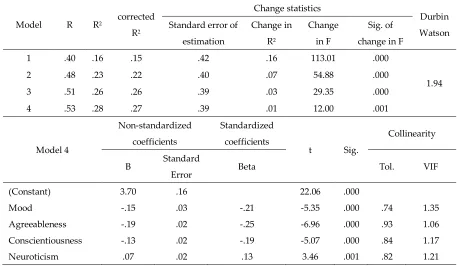
As shown in Table 2, the regression analysis found four models, the last of which had the most
156
explanatory capacity with 28.2% (R2=.28) of the variance explained by the factors included in the
157
model (Agreeableness, Mood, Conscientiousness and Neuroticism).
158
159
Table 2. Stepwise Multiple Lineal Regression Model for Verbal Aggressiveness
160
Model R R2 corrected R2
Change statistics
Durbin
Watson Standard error of
estimation
Change in
R2
Change
in F
Sig. of
change in F
1 .40 .16 .15 .42 .16 113.01 .000
1.94
2 .48 .23 .22 .40 .07 54.88 .000
3 .51 .26 .26 .39 .03 29.35 .000
4 .53 .28 .27 .39 .01 12.00 .001
Model 4
Non‐standardized
coefficients
Standardized
coefficients
t Sig.
Collinearity
B Standard
Error Beta Tol. VIF
(Constant) 3.70 .16 22.06 .000
Mood ‐.15 .03 ‐.21 ‐5.35 .000 .74 1.35
Agreeableness ‐.19 .02 ‐.25 ‐6.96 .000 .93 1.06
Conscientiousness ‐.13 .02 ‐.19 ‐5.07 .000 .84 1.17
Neuroticism .07 .02 .13 3.46 .001 .82 1.21
161
To confirm the validity of the model, residual independence was analyzed. The Durbin‐Watson
162
be observed how the t was associated with a probability of error below .05 in all cases. The
164
standardized coefficients reveal that the variable with the most explanatory weight was
165
Agreeableness, followed by Mood. Finally, from the tolerance and VIF, absence of collinearity
166
among the variables included in the model may be assumed.
167
168
3.2. The moderating effect of Mood on the predictive value of the dimensions of personality for Verbal
169
aggressiveness
170
According to Hair, Anderson, Tatham, & Black [47], moderating relationships entered could
171
modify interpretation of the regression coefficients. The coefficients of the effects of each of the
172
independent variables (Agreeableness, Conscientiousness and Neuroticism), the moderating
173
variable (Mood) and the interaction term on the dependent variable (Verbal aggressiveness) were
174
estimated based on simple moderation models. The figures below present the simple moderation
175
models proposed for their analysis.
176
177
178
Figure 1. Simple moderation models proposed.
179
The results of Model 1 report a statistically significant effect of Mood (Be_mood=‐.40, p<.01) and
180
Agreeableness (Bafab=‐.32, p<.01) on Verbal Aggressiveness. However, in this case, the coefficient of
181
the interaction term is not significant (Baree x e_mood= .04, p=.30). Model 2, which takes
182
Conscientiousness as the independent factor, had similar results: a statistically significant effect on
183
Verbal Aggressiveness, both on the independent variable (Bcons=‐.26, p<.05), and the variable
184
considered a moderator (Be_mood=‐.35, p<.05), but with no statistical significance on the interaction
185
term coefficient (Bcons x e_mood= .03, p=.38).
186
In Model 3, the effect of Mood on Verbal aggressiveness is statistically significant (Be_mood=‐.47,
187
p<.001), while the same is not true of the effect of Neuroticism (Bneuro=‐.16, p=.10). However, in this
188
case, the interaction term coefficient is significant (Bneuro x e_mood= .08, p<.01), which shows that there is
189
a moderation effect, where Mood conditions the effect of Neuroticism on Verbal aggression.
190
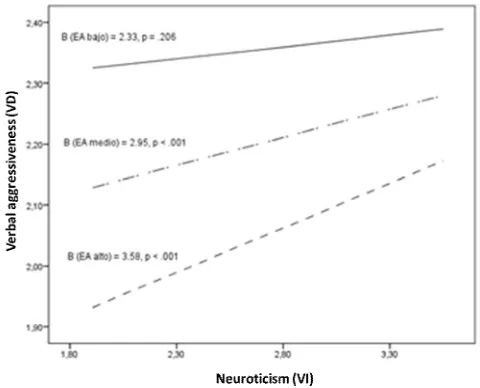
Then, using Pick‐a‐Point approach, the prediction of Neuroticism on Verbal aggressiveness was
191
calculated for low, medium and high Mood. This shows the conditional effect of the independent
192
variable on the dependent variable at different moderator strengths. Thus the results shown in
193
Figure 1 suggest that the influence of the moderator variable comes about at medium (B=2.95,
194
p<.001) and high (B=3.58, p<.001) Mood. This implies that the moderating effect of Mood takes place
195
when it becomes medium‐to‐high.
196
198
Figure 2. Interaction between Neuroticism and Mood in predicting Verbal aggressiveness.
199
200
Finally, the data found after application of the Johnson‐Neyman technique makes it possible to
201
establish a wider range of moderator values and specify its involvement in the effect the
202
independent variable exerts on the dependent variable. That is, when does the effect of the
203
moderator begin to be significant? Specifically, when the Mood score is greater than or equal to 2.50
204
(76% of the participants), Neuroticism induces a stronger tendency toward Verbal aggression.
205
206
4. Discussion
207
This study showed that for nursing professionals, the “Agreeableness”, “Conscientiousness”
208
and “Openness to experience” factors maintain a significant negative relationship with the verbal
209
aggressiveness communication style. On the contrary, it was found that the “Neuroticism” trait has a
210
close relationship with this disruptive style of communication, negatively affecting the nurse‐patient
211
relationship [8, 9].
212
These results confirm what has previously been found in other studies suggesting that there is a
213
close relationship between personality and verbal aggressiveness [20, 22, 23, 25]. For instance, Bolton
214
et al. [21] showed that workers with low levels of “Agreeableness” and “Conscientiousness” and
215
high in “Neuroticism” were more prone to use verbally aggressive language with their coworkers
216
and clients. Similarly, Barlett & Anderson [24] demonstrated that “Agreeableness”, “Openness to
217
experience” and “Neuroticism” are associated with a wide range of violent behavior.
218
The data from our study also show a negative relationship between verbal aggressiveness and
219
“Mood”. These results confirm previous studies [28, 32], which have underlined the importance of
220
adaptively regulating emotional information in social and work situations and avoiding aggressive
221
behaviors. Along this line, it has been shown that positiveness and optimism are essential for
222
interpreting potentially stressful situations more positively, especially in such emotionally and
223
psychologically challenging professions as nursing [34, 35].
224
Moreover, our data have also revealed a significant positive relationship between “Mood” and
225
all of the personality traits, except for the “Neuroticism” dimension, which it has a negative
226
relationship with. These results are consistent with previous studies, such as the meta‐analysis by
227
O’Boyle et al. [31] who found that EI had a significant positive relationship with “Extraversion”,
228
“Openness to experience”, “Conscientiousness” and “Agreeableness”, while it was the opposite
229
with “Neuroticism”. Joseph et al. [30] emphasized the relationship between “Conscientiousness”,
230
“Extraversion” and Neuroticism” with EI, as did Lui et al. [37], who demonstrated that “Mood”
231
predicted wellbeing in individuals with high scores in “Extraversion”, “Agreeableness” and
232
According to our moderation analysis, “Neuroticism” alone would not have a significant direct
234
effect on verbal aggressiveness. However, it begins to be significant in interaction with “Mood”. In
235
fact, “Mood” modulates the effect of personality on verbal aggressiveness more strongly as
236
positiveness and happiness increase. These results agree with previous studies where it was
237
proposed that personality traits partially determine communication styles [7]. Therefore,
238
emotionally unstable persons faced with stressful situations tend to develop a negative
239
communication style. However, only those with a positive attitude will be able to buffer the negative
240
effects of their personality trait on the way they communicate [29].
241
This study has important practical implications for the job context. The relationship between
242
personality traits and aggressive verbal communication must be emphasized as well as the
243
important effects EI has on this relationship. Because personality dimensions are considered
244
relatively stable over time and consistent from one situation to another [7], organizations should
245
hold workshops and other types of practical activities to train workers in communication skills and
246
EI in order to promote employee health and that of their patients.
247
In like manner, the following limitations should also be considered. In the first place, the
248
sample is made up of a majority of women, so the results may not be extensive to both genders. In
249
the second place, the results cannot be generalized to the whole area of healthcare because the
250
sample used is very specific, so it would be recommendable to enlarge the sample with other
251
professionals. Finally, as the study design did not allow it to be established whether the
252
relationships between the variables are stable over time, it would be interesting to carry out
253
longitudinal studies to delve more deeply into the study of the influence of personality traits on
254
communication style.
255
Future studies should widen the set of variables used in this one, that is, include aspects related
256
to the characteristics and working conditions (e.g., work areas, shifts, type of patient), in addition to
257
considering all the facets of Emotional Intelligence and including other personal constructs, such as
258
self‐efficacy, for example.
259
5. Conclusions
260
In recent decades, there has been an exponential increase in scientific publications in which
261
nursing professionals and avoid risk factor from work activity have been the subject of study. This
262
interest derives from the characteristics and job context where they carry out their functions, as well
263
as the important consequences and effects that their behavior has on the wellbeing of the patients
264
and the organization.
265
Our study was interested in evaluating the moderating effect of Mood on the relationship
266
between personality and verbal aggressiveness. The “Agreeableness”, “Conscientiousness” and
267
“Neuroticism” traits have a close relationship with aggressive verbal communication. Even though
268
Mood moderates this relationship, it is only significant for those individuals with high scores in
269
“Neuroticism”.
270
.
271
Author Contributions: M.M.M.J., M.C.P.F., A.B.B.M., M.M.S.M., and A.M.M. contributed to the conception and
272
design of the review. J.J.G.L. applied the search strategy. All authors applied the selection criteria. All authors
273
completed the assessment of risk of bias. All authors analyzed the data and interpreted data. M.M.M.J.,
274
M.C.P.F., A.B.B.M., M.M.S.M., and A.M.M. wrote this manuscript. M.C.P.F. and J.J.G.L. edited this manuscript.
275
M.C.P.F. is responsible for the overall project.
276
Funding: This research received no external funding.
277
Acknowledgments: The present study undertaken in collaboration with the Excma. Diputación Provincial de
278
Almería.
279
Conflicts of Interest: The authors declare no conflict of interest.
280
References
283
1. Daly, J.A. Personality and interpersonal communication. In Handbook of Interpersonal Communication 3rd ed.;
284
Knapp, M.L., Daly, J.A., Eds.; SAGE Publications: London, 2002; pp. 133‐180, ISBN 0‐7619‐2160‐5.
285
2. Daly, J.A. Personality and interpersonal communication. In The Sage Handbook of Interpersonal
286
Communication, 4th ed.; Knapp, M.L., Daly, J.A., Eds.; SAGE Publications: Thousand Oaks, California, 2011;
287
ISBN 978‐1412974745.
288
3. De Vries, R.E., Bakker‐Pieper, A., Konings, F.E., Schouten, B. The Communication Styles Inventory (CSI):
289
A six‐dimensional behavioral model of communication styles and its relation with personality. Communic
290
Res 2011, 40, 506‐532. DOI: 10.1177/0093650211413571
291
4. De Vries, R.E., Bakker‐Pieper, A., Oostenveld, W. Leadership = communication? The relations of leaders
292
communication styles with leadership styles, knowledge sharing and leadership outcomes. J Bus Psychol
293
2010, 25, 367‐380. DOI: 10.1007/s10869‐009‐9140‐2
294
5. Hammar, L.M., Holmström, I.K., Skoglund, K., Meranius, M.S., Sundler, A.J. The care of and
295
communication with older people from the perspective of student nurses. A mixed method study. Nurse
296
Educ Today 2017, 52, 1‐6. DOI: 10.1016/j.nedt.2017.02.002
297
6. Leal‐Costa, C., Tirado‐González, S., Rodríguez‐Marín, J., Vander‐Hofstadt‐Román, C.J. Psychometric
298
properties of the Health Professionals Communication Skills Scale (HP‐CSS). Int J Clin Health Psychol 2016,
299
16, 76‐86. DOI: https://doi.org/10.1016/j.ijchp.2015.04.001
300
7. Waldherr, A., Muck, P.M. Towards an integrative approach to communication styles: The Interpersonal
301
Circumplex and the Five‐Factor Theory of personality as frames of reference. Communications 2011, 36,
302
1‐27. DOI: 10.1515/comm.2011.001
303
8. Banerjee, S.C., Manna, R., Coyle, N., Shen, M.J., Pehrson, C., Zaider, T.,... Bylund, C.L. Oncology nurses'
304
communication challenges with patients and families: a qualitative study. J Nurs Educ Pract 2016, 16,
305
193‐201. DOI: 10.1016/j.nepr.2015.07.007
306
9. MacLean, S., Kelly, M., Geddes, F., Della, P. Use of simulated patients to develop communication skills in
307
nursing education: an integrative review. Nurse Educ Today 2017, 48, 90‐98. DOI: 10.1016/j.nedt.2016.09.018
308
10. Omura, M., Stone, T.E., Maguire, J., Levett‐Jones, T. Exploring Japanese nurses' perceptions of the
309
relevance and use of assertive communication in healthcare: A qualitative study informed by the Theory
310
of Planned Behaviour. Nurse Educ Today 2018, 67, 100‐107. DOI: 10.1016/j.nedt.2018.05.004
311
11. Norton, R. Foundation of a communicator style construct. Hum Comm Res 1978, 4, 99‐112. DOI:
312
10.1111/j.1468‐2958.1978.tb00600.x
313
12. Infante, D.A., Rancer, A.S. A conceptualization and measure of argumentativeness. J Pers Assess 1982, 46,
314
72‐80. DOI: 10.1207/s15327752jpa4601_13
315
13. Infante, D.A., Wigley III, C.J. Verbal aggressiveness: An interpersonal model and measure. Communication
316
Monographs 1986, 53, 61‐69. DOI: 10.1080/03637758609376126
317
14. De Vries, R.E., Bakker‐Pieper, A., Siberg, R., van Gameren, K., Vlug, M. The content and dimensionality of
318
communication styles. Commun Res 2009, 36, 178‐206. DOI: 10.1177/0093650208330250
319
15. Ivanov, M., Werner, P.D. Behavioral communication: Individual differences in communication style. Pers
320
Individ Dif 2010, 49, 19‐23. DOI: 10.1016/j.paid.2010.02.033
321
16. Park, H.S., Levine, T.R., Weber, R., Lee, H.E., Terra, L.I., Botero, I. C.,... Wilson, M.S. Individual and
322
cultural variations in direct communication style. Int J Intercult Relat 2012, 36, 179‐187. DOI:
323
10.1016/j.ijintrel.2011.12.010
324
17. McCrae, R.R., Costa, P.T. Validation of the five‐factor model of personality across instruments and
325
observers. J Pers Soc Psychol 1987, 52, 81‐90. DOI: 10.1037/0022‐3514.52.1.81
326
18. McCrae, R.R., Costa, P.T., Ostendorf, F., Angleitner, A., Hřebíčková, M., Avia, M.D., ... Smith, P.B. Nature
327
over nurture: Temperament, personality, and life span development. J Pers Soc Psychol 2000, 78, 173‐186.
328
DOI: 1O.1037//O022‐3514.7S.1.173
329
19. Pérez‐Fuentes, M., Gázquez, J.J. Variables relacionadas con la conducta violenta en la escuela según los
330
estudiantes [Variables related to violent behavior in the school according to the students]. Int J Psychol
331
Psychological Therapy 2010, 10, 427‐437.
332
20. Berry, C.M., Ones, D.S., Sackett, P.R. Interpersonal deviance, organizational deviance, and their common
333
correlates: A review and metanalysis. J Appl Psychol 2007, 92, 410‐424. DOI: 10.1037/0021‐9010.92.2.410
334
21. Bolton, L.R., Becker, L.K., Barber, L.K. Big Five trait predictors of differential counterproductive work
335
22. Sharpe, J.P., Desai, S. The revised NEO personality inventory and the MMPI‐2 psychopathology five in the
337
prediction of aggression. Pers Individ Dif 2001, 31, 505‐518. DOI: 10.1016/S0191‐8869(00)00155‐0
338
23. Grumm, M., von Collani, G. Personality types and self‐reported aggressiveness. Pers Individ Dif 2009, 47,
339
845‐850. DOI: 10.1016/j.paid.2009.07.001
340
24. Barlett, C.P., Anderson, C.A. Direct and indirect relations between the Big 5 personality traits and
341
aggressive and violent behavior. Pers Individ Dif 2012, 52, 870‐875. DOI: 10.1016/j.paid.2012.01.029
342
25. Xie, X., Chen, W., Lei, L., Xing, C., Zhang, Y. The relationship between personality types and prosocial
343
behavior and aggression in Chinese adolescents. Pers Individ Dif 2016, 95, 56‐61. DOI:
344
/10.1016/j.paid.2016.02.002
345
26. Salovey, P., Mayer, J.D. Emotional intelligence. Imagin Cogn Pers 1990, 9, 185‐211. DOI:
346
10.2190/DUGG‐P24E‐52WK‐6CDG
347
27. García‐Sancho, E., Salguero, J.M., Fernández‐Berrocal, P. Relationship between emotional intelligence and
348
aggression: A systematic review. Aggress Violent Behav 2014, 19, 584‐591. DOI: 10.1016/j.avb.2014.07.007
349
28. Roberton, T., Daffern, M., Bucks, R.S. Emotion regulation and aggression. Aggress Violent Behav 2012, 17,
350
72‐82. DOI: 10.1016/j.avb.2011.09.006.
351
29. Guo, Q., Sun, P., Li, L. Why neurotic individuals are less prosocial? A multiple mediation analysis
352
regarding related mechanisms. Pers Individ Dif 2018, 128, 55‐61. DOI: 10.1016/j.paid.2018.02.026
353
30. Joseph, D.L., Jin, J., Newman, D.A., O'boyle, E.H. Why does self‐reported emotional intelligence predict
354
job performance? A meta‐analytic investigation of mixed EI. J Appl Psychol 2015, 100, 298‐342. DOI:
355
10.1037/a0037681
356
31. O’Boyle, E.H., Humphrey, R.H., Pollack, J.M., Hawver, T.H., Story, P.A. The relation between emotional
357
intelligence and job performance: A meta‐analysis. J Organ Behav 2011, 32, 788‐818. DOI:10.1002/job.714
358
32. Megías, A., Gómez‐Leal, R., Gutiérrez‐Cobo, M.J., Cabello, R., Fernández‐Berrocal, P. The relationship
359
between aggression and ability emotional intelligence: The role of negative affect. Psychiatry Res 2018, 1‐8.
360
DOI: 0.1016/j.psychres.2018.05.027
361
33. Bar‐On, R. The Bar‐On model of emotional‐social intelligence (ESI). Psicothema 2006, 18, 13‐25.
362
34. Carvalho, V.S., Guerrero, E., Chambel, M.J. Emotional intelligence and health students' well‐being: A
363
two‐wave study with students of medicine, physiotherapy and nursing. Nurse Educ Today 2018, 63, 35‐42.
364
DOI: 10.1016/j.nedt.2018.01.010
365
35. Di Fabio, A., Saklofske, D.H. Promoting individual resources: the challenge of trait emotional
366
intelligence. Pers. Individ. Differ 2014, 65, 19‐23. DOI: 10.1016/j.paid.2014.01.026
367
36. Mäkikangas, A., Kinnunen, U., Feldt, T. Self‐esteem, dispositional optimism, and health: Evidence from
368
cross‐lagged data on employees. J Res Pers 2004, 38, 556‐575. DOI: 10.1016/j.jrp.2004.02.001
369
37. Lui, P.P., Rollock, D., Chang, E.C., Leong, F.T., Zamboanga, B.L. Big 5 personality and subjective
370
well‐being in Asian Americans: Testing optimism and pessimism as mediators. Asian Am J Psychol 2016, 7,
371
274. DOI: 10.1037/aap0000054
372
38. Rammstedt, B., John, O.P. Measuring personality in one minute or less: A 10‐item short version of the Big
373
Five Inventory in English and German. J Res Pers 2007, 41, 203‐212.
374
39. John, O.P., Donahue, E.M., Kentle, R.L. The Big Five Inventory-Versions 4a and 54; University of California,
375
Berkeley, Institute of Personality and Social Research: Berkeley, CA, 1991.
376
40. John, O.P., Srivastava, S. The Big Five trait taxonomy: History, measurement, and theoretical perspectives.
377
In Handbook of personality theory and research; Pervin, L.A., John, O.P., Eds.; Guilford Press: New York, 1999;
378
pp. 102‐138, ISBN 9781609180591.
379
41. Rammstedt, B., Kemper, C.J., Klein, M.C., Beierlein, C., Kovaleva, A. A Short Scale for Assessing the Big
380
Five Dimensions of Personality ‐ 10 Item Big Five Inventory (BFI‐10). Methoden Daten Anal 2013, 7, 233‐249.
381
DOI:10. 12758/mda.2013.013
382
42. Rammstedt, B., Kemper, C.J., Klein, M.C., Beierlein, C., Kovaleva, A. Big Five Inventory (BFI-10).
383
Zusammenstellung sozialwissenschaftlicher Items und Skalen. 2014. DOI:10.6102/zis76
384
43. De Vries, R.E., Bakker‐Pieper, A., Konings, F.E., Schouten, B. The Communication Styles Inventory (CSI):
385
A six‐dimensional behavioral model of communication styles and its relation with personality. Commun
386
Res 2013, 40, 506‐532. DOI: 10.1177/0093650211413571
387
44. Pérez‐Fuentes, M.C., Gázquez, J.J., Mercader, I., Molero, M.M. Brief Emotional Intelligence Inventory for
388
45. Bar‐On, R., Parker, J.D.A. Emotional Quotient Inventory: Youth Version (EQ-i:YV): Technical manual.
390
Multi‐Health Systems: Toronto, Canada, 2000.
391
46. Hayes, A.F. Introduction to Mediation, Moderation, and Conditional Process Analysis: A Regression-Based
392
Approach; The Guilford Press: New York, NY, 2013; ISBN 9781609182304.
393
47. Hair, J.F., Anderson, R.E., Tatham, R.L., Black, W. Análisis multivariante; Prentice Hall: Madrid, 1999; ISBN
394
9788483220351.