Chitosan decorated copper nanoparticles as efficient catalyst for synthesis of
novel quinoline derivatives
K.S. Alghamdi 1, N.S.I. Ahmed 2, D. Bakhotmah1 and M. Mokhtar1,3*
1
Chemistry Department, Faculty of Science, King Abdulaziz University, Jeddah 21589, Saudi Arabia 2
Department of Therapeutic Chemistry, Pharmaceutical and Drug Industries Research Division, National Research Centre, El Buhouth St., Dokki, Cairo 12622, Egypt
3
Physical Chemistry Department, National Research Centre, El Buhouth St., Dokki, Cairo 12622, Egypt
*Corresponding author: Name: Mohamed Mokhtar, Email: [email protected]
Submitted/Received: Date 3-12-2018 Accepted: ……...Date…….…
Abstract
Chitosan decorated copper nanoparticles (CS/CuNPs) catalysts were synthesized via reduction methods
utilizing green protocol. The CS/CuNPs hybrid catalysts were tested for the synthesis of quinoline derivatives utilizing one-pot multicomponent reaction (MCR) under ultrasonic irradiation. The best catalyst (CS/CuNPs)
that provided good conversion reaction yield and high turnover frequency (TOF) was characterized using Fourier transform infrared (FTIR), Thermogravimetric analyses (TGA), X-ray diffraction (XRD), , scanning
electron microscopy (SEM), transmission electron microscope (TEM) and X-ray photoelectron spectroscopy (XPS) techniques. Generalization of the scope of the proposed catalytic process was studied using different
aldehydes. Excellent products yield and high TOF in even shorter reaction time (~5 min) was attained. Recyclability performance of the catalyst over five times re-use without detectable loss in product yield was
recorded. The current method is green process utilizing environmentally benign catalyst and considered to be promising sustainable protocol for the synthesis of fine chemicals.
Keywords: Chitosan-copper NPs; Quinolone derivatives; Ultrasonic irradiation; One- pot synthesis;
Green-sustainable perspectives
1. Introduction
Quinolone and their derivatives have several biological activities, such as malaria [1],anticancer[2,3] , anti-inflammatory [4,5] , anti-bacterial [5] , anti-asthmatic [6], anti-platelet activity [7] ,anti-hypertensive [8] .Therefore, several methods have been developed for the synthesis of quinolone derivatives utilizing various catalysts [9-12] . Recently, green and eco-friendly synthesis have attracted much attention. Numerous approaches have been established which improved green conditions to safer synthesis. ultrasonication is one of the auspicious green technology in the synthesis of organic compounds[13,14].
The use of nanoparticles (NPs) in catalysis is considered to be one of the most significant principles of green chemistry that is owing to a number of different reasons; the reaction time is short, diminishes generation of hazardous materials, economically visible as high yields produced with low cost [15]. Nanoparticles have been widely used as the catalyst support in organic transformation [16]. Our previous achievements in the synthesis of different organic synthons of important biological activities utilizing different nanosized solid heterogeneous catalysts under green protocol [17-22] revealed that exploring efficient, sustainable and green catalyst is crucial to achieve green sustainable perspectives. To attain our goal, natural bio-polymer supported heterogeneous nano-catalysts that have been utilized in recent years [23,24], was selected to be a catalyst support. One of the promising catalyst’s support candidate is chitosan, which is produced by the N-deacetylation of chitin. It is considered to be the second most abundant natural polymer after cellulose [25]. Chitosan a chemically stable,
non-toxic is an excellent candidate to be used as a support for copper and other transition metals due to its insolubility in organic solvents and the presence of functionalization of the free amine groups in the structure which is represented active sites for several of chemical modifications [26-28].
Nanoparticles have a special characteristic to aggregate and well clump together to form larger particles, thus nanoparticles lose their large surface area and other benefits [29] . Chitosan as a polymer-based stabilizes the nanoparticles to prevent their aggregation via coordination with metal nanoparticles through chelation mechanism, makes it a perfect support for metal nanoparticles[30] .
Gold, silver and transition metals nanoparticles such as palladium are available for the development of hybrid catalyst complexes and they can also be used in chemical transformation whereas a new glyoxal cross-linked chitosan Schiff base was prepared as a support material for palladium catalyzed Suzuki cross coupling reactions[31,32]. In addition, chitosan was used as support of copper nanoparticles as catalyst for the C-S coupling of thiophenol with aryl halides [33] . The synthesis of Cu nanoparticles using chitosan as both reducing and capping agent have been reported [34,35] . This single step method is considered to be cost-effective, convenient and eco-friendly relative to other method of preparation [34] .
In the present work, chitosan decorated copper nanoparticles catalysts were synthesized through green methods [34,35] and its application as an efficient catalyst in multicomponent reaction to the synthesis of novel quinolone derivatives under ultrasonic irradiation were extensively studied. The CS/CuNPscatalyst is a promising efficient sustainable green catalyst for the synthesis of quinolone derivatives in satisfactory yield in short reaction time under ultrasonication conditions.
2. Experimental Details
2.1 Materials
Chitosan (molecular weight 100,000-300,000) (Acros Organics- Belgium). Sodium tripolyphosphate (Acros Organics- Belgium), copper (II) acetate monohydrate (Central Drug House CDH, New Delhi, India), dimedone, ethyl cyanoacetate, and ammonium acetate (Techno Pharm Chem, New Delhi, India). chlorobenzaldehyde, 4-bromo benzaldehyde, 4-florobenzaldhyde, piperonal(1,3-benzodioxole-5-carbaldehyde), salicylaldehyde (2-hydroxybenzaldehyde, thiophen -3-aldehyde,4-dimethylaminobenzaldehyde, 2-methoxybenzaldhyde,3,4- dimethoxy benzaldehyde, m-nitro benzaldehyde (Merck KGaA, Darmstadt, Germany), absolute ethanol and acetone (Fisher scientific, Leicestershire, U.K).
2.2 Materials characterization
done using Daihan (Wiseclean, D-40 MHz) ultrasonic bath. Microanalysis was performed by Perkin Elmer elemental analyzer at the Faculty of Science, King Abdul Aziz University.
2.3 Method
2.3.1 Synthesis of Chitosan decorated copper nanoparticles Catalyst
The synthesis of Chitosan decorated copper nanoparticleswas carried out according to two methods:
Firstly: (CS/CuNPs) have been prepared via one-step synthesis green protocol. In a typical method, 0.75 g chitosan dissolving in 100 ml 0.1% acetic acid (in distilled water) then 50 ml of the solution and 25 ml of 0.05 M copper solution were delivered under stirring at 70°C for 9 h till the reaction was completed. the colloid was centrifuged for 10min. to separate particles from suspension then washed with acetone (90%, v/v) and the centrifugation was repeated three times to remove unreacted reagents. The particles were dried under vacuum at the room temperature overnight and stored [34].
Secondly: (CS/CuNPs/TPP) were prepared based on the ionotropic gelation between chitosan and sodium tripolyphosphate (TTP). Chitosan acted as a reducing/stabilizing agent. TPP was dissolved in water to a concentration of 0.25%. Under magnetic stirring at room temperature, 33 ml of TTP solution was added into 50 ml of chitosan solution 0.75% (in dil. acetic acid 0.1 %) and the mixture was stirred for 15min.Chitosan nanoparticles loaded Cu2+ were obtained by adding metal ion solutions 16ml 0.05 M into the chitosan nanosuspensions and heated to 70 °C using a water bath, after a blue color appeared, stirring continued for another 90 min. before removing the heater. The resulting solution was cooled to room temperature for characterization [35] .
2.3.2 Synthesis of polyhydroquinolines in the presence of CS/CuNPs
A mixture of dimedone (3.6 mmol, 0.5 gm), aromatic aldehyde (3.6mmol, 0.5 gm), ethylcyanoacetoacetate (3.6 mmol, 0.38 ml), ammoniumacetate (28.8 mmol, 2.219 gm) and catalytic amounts of Cu-chitosan NPs (0.1 gm) in 10 ml absolute ethanol irradiate with ultrasonic waves at 80°C. After completion of the reaction (monitored by TLC, petroleum ether: EtOAc, 1:2), the reaction mixture was filtered to separate the catalyst, then cooled at room temperature and the solid product obtained and was filtered off, dried and recrystallized from ethanol.
2.3.3 Physical and spectroscopic data of product compounds
Ethyl-2-amino-4-(4-chlorophenyl)-7,7-dimethyl-5-oxo-1,4,5,6,7,8hexahydroquinoline-3-carboxylate (2a)
Off – white crystals (1.09gm, 82.47 % yield); m.p 173 °C. FTIR; 3478,3328, 3200 (-NH, NH2); 1686,1655 (2C=O ); and 1621 cm-1 (C=C). 1H NMR (400 MHz, CDCl3): δH = 0.96, 1.09 (6H, 2s, 2CH3); 1.14 (3H, t, -CH2CH3, J=7.2 Hz); 1.84 (1H,br.s, -NH); 2.17 (2H, dd, C8-H, J = 14 Hz); 2.41 ( 2H, s , C6H ); 4.03 (2H, q, -CH2CH3, J = 7.2 Hz); 4.66 (1H, s, C4-H); 6.21 (2H, br.s, NH2) and 7.15, 7.21 (4H, 2d, Ar-H). 13C NMR (CDCl3): δC = 14.22 (CH2CH3); 27.36, 29.09 (2CH3); 32.24 (C7); 33.48 (C4); 40.66 (C8); 50.69 (C6); 59.77 (CH2CH3); 80.30 (C3); 116.40 ( C4a) ; 127.91 (C3\, C5\); 129.63 (C2\, C6\); 131.63 (C4\); 144.46 (C1\); 158.37 (C8a); 161.54 ,196.43 (2 C=O); and 168.95 (C2) . Anal. Calcd. for C20H23ClN2O3 (374.86): C, 64.02; H, 6.61; N, 7.47; O, 12.80. Found : C, 64.42; H, 6.43; N, 7.01; O, 12.58.
Ethyl-2-amino-4-(4-bromophenyl)-7,7-dimethyl-5-oxo-1,4,5,6,7,8hexahydroquinoline-3-carboxylate (2b)
Semisolid Off – white (1.41 gm, 93.49 % yield). FTIR; 3473,3331,3204 (-NH, NH2); 1686,1654 (2C=O ); and 1620 cm-1 (C=C). 1H NMR (850 MHz, CDCl3): δH = 0.96, 1.09 (6H, 2s, 2CH3); 1.15 (3H, t, -CH2CH3, J=7.56 Hz); 2.08 (1H,br.s, -NH); 2.18 (2H, dd, C8-H, J = 14 Hz); 2.42 ( 2H, d.d , C6-H , J= 17 HZ); 4.03 (2H, q, -CH2CH3, J = 7.56 Hz); 4.65 (1H, s, C4-H); 6.20 (2H, br.s, NH2) and 7.13, 7.33 (4H, 2d, Ar-H). 13C NMR (CDCl3): δC = 14.21 (CH2CH3); 27.36, 29.10 (2CH3); 32.25 (C7); 33.44 (C4); 40.63 (C8); 50.65 (C6); 59.79 (CH2CH3); 80.22 (C3); 116.30 ( C4a) ; 119.64 (C3\, C5\); 130.07 (C2\, C6\); 130.84 (C4\); 144.93 (C1\); 158.31 (C8a); 161.55 ,196.46 (2 C=O); and 168.94 (C2) . Anal. Calcd. for C20H23BrN2O3 (419.31): C, 57.24; H, 4.48; N, 6.68; O,11.45. Found : C, 57.40; H, 4.33; N, 6.43; O, 11.30 .
Off – white crystals (1.08 gm, 84.65 % yield); m.p 154 °C. FTIR; 3398,3285, 3200 (-NH, NH2); 1689,1652 (2C=O ); and 1601 cm-1 (C=C). 1H NMR (850 MHz, CDCl3): δH = 0.96, 1.09 (6H, 2s, 2CH3); 1.14 (3H, t, -CH2CH3, J=7.65 Hz); 2.06 (1H,br.s, -NH); 2.17 (2H, dd, C8-H, J = 16.15 Hz); 2.41 ( 2H, d.d , C6-H , J= 17.83 HZ ); 4.03 (2H, q, -CH2CH3, J = 6.8 Hz); 4.67 (1H, s, C4-H); 6.26 (2H, br.s, NH2) and 6.87, 7.23 (4H, 2d, Ar-H). 13C NMR (CDCl3): δC = 14.21 (CH2CH3); 27.33, 29.08 (2CH3); 32.23 (C7); 33.24 (C4); 40.62 (C8); 50.68 (C6); 59.71 (CH2CH3); 80.53 (C3); 114.54 ( C4a) ; 116.61 (C3\, C5\); 129.65 (C2\, C6\); 141.65 (C4\); 158.32(C1\); 160.65 (C8a); 161.42 ,196.53 (2 C=O); and 169.03 (C2) . Anal. Calcd. for C20H23FN2O3 (358.41): C, 66.96 ; H, 6.42; N, 7.81; O, 13.39. Found : C, 66.98; H, 6.27; N, 7.40; O, 13.11.
Ethyl-2-amino-4-(3-nitrophenyl)-7,7-dimethyl-5-oxo-1,4,5,6,7,8hexahydroquinoline-3-carboxylate (2d)
Dark green crystals (1.04 gm, 75.89 % yield); m.p 147 °C. FTIR; 3449,3332, 3200 (-NH, NH2); 1371 (NO2); 1686,1657 (2C=O ); and 1621 cm-1 (C=C). 1H NMR (850 MHz, CDCl3): δH = 0.96, 1.09 (6H, 2s, 2CH3); 1.14 (3H, t, -CH2CH3, J=7.65 Hz); 2.10 (1H,br.s, -NH); 2.17 (2H, dd, C8-H, J = 16.15 Hz); 2.47 ( 2H, s , C6-H ); 4.03 (2H, q, -CH2CH3, J = 6.8 Hz); 4.79 (1H, s, C4-H); 6.31 (2H, br.s, NH2) and 7.37(1H,d.d,C5-H, J=7.65, J=8.5 Hz of Ar) ; 7.64 (1H, d, C4-H , J=7.65 of Ar );7.98(1H, d, C6-H , J=8.5 Hz of Ar ); 8.09(1H, S, C2-H of Ar ). ( 13C NMR (CDCl3): δC = 14.19 (CH2CH3); 27.37, 29.06 (2CH3); 32.31 (C7); 34.15 (C4); 40.61 (C8); 50.58 (C6); 59.91 (CH2CH3); 79.51 (C3); 115.56 ( C4a) ; 121.35(C4\, C6\); 123.16 (C5\); 128.51 (C2\); 134.91 (C3\); 148.14 (C3\);158.36 (C8a); 162.15 ,196.43 (2 C=O); and 168.66 (C2) . Anal. Calcd. for C20H23N3O5 (385.41): C, 62.27; H, 5.97; N, 10.89; O, 20.76 . Found : C, 62.48; H, 5.53; N, 10.45; O, 12.63.
Ethyl-2-amino-7,7-dimethyl-5-oxo-4-(thiophen-3-yl)-1,4,5,6,7,8-hexahydroquinoline-3-carboxylate (2e)
Drak brown powder (1.22 gm, 98.53% yield); m.p 123 °C. FTIR; 3427,3310, 3208 (-NH, NH2); 1688,1654 (2C=O ); and 1636 cm-1 (C=C). 1H NMR (850 MHz, CDCl3): δH = 1.01 , 1.12 (6H, 2s, 2CH3); 1.20 (3H, t, -CH2CH3, J=6.8 Hz); 2.13 (1H,br.s, -NH); 2.26 (2H, dd, C8-H, J = 16.15 Hz); 2.42 ( 2H, s , C6-H ); 4.10 (2H, q, -CH2CH3, J = 7.65 Hz); 4.89 (1H, s, C4-H); 6.19 (2H, br.s, NH2) and 6.95(1H, d, C5-H of thiophene ), 7.10 (1H, S, C2-H of thiophene ), 7.12(1H, m , C4-H of thiophene) . 13C NMR (CDCl3): δC = 14.18 (CH2CH3); 27.44, 28.65 (2CH3); 32.24 (C7); 40.67 (C8); 41.21 (C4); 50.74 (C6); 59.73 (CH2CH3); 80.38 (C3); 116.61 ( C4a) ; 120.92 (C3\); 124.55 (C2\) ; 127.71 (C4\); 147.76 (C1\); 158.73 (C8a); 162.03 ,197.34 (2 C=O); and 169.35 (C2) . Anal. Calcd. for C18H22N2O3 S(346.44): C, 62.35; H, 6.35;N, 8.08; O, 13.85; S,9.24 . Found : C, 62.22; H, 6.16; N, 8.01; O, 13.46; S, 9.17.
Ethyl-2-amino-4-(3,4-dimethoxyphenyl)-7,7-dimethyl-5-oxo-1,4,5,6,7,8-hexahydro-quinoline-3-carboxylate (2f)
Off – white powder (1.17 gm, 81.59 % yield); m.p 128 °C. FTIR; 3429,3314, 3200 (-NH, NH2); 1687,1663 (2C=O ); and 1588 cm-1 (C=C). 1H NMR (850 MHz, CDCl3): δH = 0.98, 1.10 (6H, 2s, 2CH3); 1.19 (3H, t, -CH2CH3, J=6.8 Hz); 2.13 (1H,br.s, -NH); 2.19 (2H, dd, C8-H, J = 16.9 Hz); 2.41 ( 2H, d.d , C6-H, J =17.85 Hz ); 3.96,3.97(6H,2S,2-OCH3); 4.38 (2H, q, -CH2CH3, J = 7.65 Hz); 4.65 (1H, s, C4-H); 6.69 (2H, br.s, NH2) and 7.74,7.80,8.16 (3H, d.d, s, Ar-H). 13C NMR (CDCl3): δC = 14.22 (CH2CH3); 27.30, 29.27 (2CH3); 32.24 (C7); 33.29 (C4); 40.67 (C8); 50.81 (C6); 55.65,56.07 ( 2-OCH3 ) ; 59.69 (CH2CH3); 80.92 (C3); 110.995 ( C4a) 111.66 (C5\); 112.02 (C2\); 138.71 (C1\); 147.15 (C4\);148.36(C3\); ;149.29 (C8a); 161.26 ,196.62(2 C=O); and 163.13(C2) . Anal. Calcd. for C22H28N2O5 (400.47): C, 65.92; H, 6.99; N, 6.99; O, 19.98. Found: C, 65.99; H, 6.61; N, 6,36; O, 19.44.
Ethyl-2-amino-4-(benzo[d][1,3]dioxol-5-yl)-7,7-dimethyl-5-oxo-1,4,5,6,7,8-hexahydro-
quinoline-3-carboxylate (2g)
Ethyl-2-amino-4-(2-dimethylamino(phenyl)-7,7-dimethyl-5-oxo-1,4,5,6,7,8 hexahydroquinol ine-3-carboxylate (2h)
Light yellow crystals (1.04 gm, 75.95 % yield); m.p 115 °C. FTIR; 3196,2932, 3200 (-NH, NH2); 1702,1610 (2C=O); and 1561 cm-1 (C=C). 1H NMR (850 MHz, CDCl3): δH = 1.08 (6H, 2s, 2CH3); 1.38 (3H, t, -CH2CH3, J=6.8 Hz); 1.61 (1H,br.s, -NH); 2.14 (2H, dd, C8-H, J = 14 Hz); 2.26 ( 2H, s , C6-H );3.09(6H,s,N(CH3)2) ;4.34 (2H, q, -CH2CH3, J = 7.65 Hz); 4.98 (1H, s, C4-H); 6.64(2H, br.s, NH2) and 6.70, 7.94 (4H, 2d, Ar-H). 13C NMR (CDCl3): δC = 14.30 (CH2CH3); 27.38, 28.34 (2CH3); 32.90 (C7); 39.98 (C4); 40.03 (C8); 41.40,42.64 (N-(CH3)2), 50.72 (C6); 61.58 (CH2CH3); 94.06 (C3); 110.09 ( C4a) ; 111.50,112.67 (C2\, C6\);117.60,119.81 (C3\, C5\); 134.07 (C1\); 136.07 (C1\); 154.58 (C8a); 163.15 ,197.59 (2 C=O); and 164.32 (C2) . Anal. Calcd. for C22H29N3O3 (383.48): C, 68.84; H, 7.56; N, 10.95; O, 12.52. Found: C, 68.92; H, 7.32; N, 10.61; O, 12.17.
Ethyl-2-amino-4-(2-methoxyphenyl)-7,7-dimethyl-5-oxo-1,4,5,6,7,8hexahydroquinoline-3-carboxylate (2i)
Dark green crystals (0.96 gm, 71.99% yield); m.p 185 °C. FTIR; 3421,3309, 3200 (-NH, NH2); 1685,1649 (2C=O); and 1613 cm-1 (C=C). 1H NMR (400 MHz, CDCl3): δH = 0.94, 1.08 (6H, 2s, 2CH3); 1.15 (3H, t, -CH2CH3, J=7.65Hz); 2.08 (1H,br.s, -NH); 2.13 (2H, dd, C8-H, J = 17 Hz); 2.41 ( 2H, dd , C6-H, J = 16.15 Hz ); 3.75(3H,S, -OCH3),4.00 (2H, q, -CH2CH3, J = 6.8 Hz); 4.77(1H, s, C4-H); 6.48 (2H, br.s, NH2) and 6.76,6.83, 7.09,7.32 (4H, d,dd,d,dd Ar-H). 13C NMR (CDCl3): δC = 14.18 (CH2CH3); 26.87,29.35 (2CH3); 31.61 (C4); 32.15 (C7); 40.74(C8); 50.73 (C6); 55.20 (-OCH3) ; 59.46 (CH2CH3); 78.94 (C3) ; 110.72 ( C4a) ; 114.57(C3\ ); 119.82 (C1\, C5\); 127.37 (C4\); 132.03 (C6\); 157.79 (C8a); 158.91 (C2\); 162.10 ,196.70 (2 C=O); and 169.57 (C2) . Anal. Calcd. for C21H26N2O4 (370.44): C, 68.03; H, 7.02; N, 7.56; O, 17.28. Found : C, 68.44; H, 6.99; N, 7.05; O, 17.01.
Ethyl2-amino-4-(2-hydroxyphenyl)-7,7-dimethyl-5-oxo-1,4,5,6,7,8hexahydroquinoline-3-carboxylate (2j)
Yellow powder (1.11 gm, 87.49 % yield); m.p 114 °C. FTIR; 3600-2900 (br.band for -NH, NH2, OH ); 1705,1655 (2C=O ); and 1630 cm-1 (C=C). 1H NMR (400 MHz, CDCl3): δH = 0.99 (6H, 2s, 2CH3); 1.08 (3H, t, -CH2CH3, J=7.2 Hz); 1.18 (1H,br.s, -NH); 2.53 (2H, dd, C8-H, J = 14 Hz); 2.66 ( 2H, s , C6H ); 3.90 (2H, q, -CH2CH3, J = 7.2 Hz); 4.67 (1H, s, C4-H); 6.45 (2H, br.s, NH2) and 7.01,7.16,7.26,7.86 (4H, dd,dd,2d, Ar-H). 13C NMR (CDCl3): δC = 14.05 (CH2CH3); 27.21, 27.78 (2CH3); 32.32 (C7); 32.58 (C4); 42.55 (C8); 47.88 (C6); 53.82 (CH2CH3); 99.25 (C3);115.75 (C3\) ;118.32 ( C4a) ; 123.38 (C5\); 124.31 (C1\); 127.99 (C4\); 130.04 (C1\); 147.64 (C8a);151.61 (C2\) ;161.48,197.35 (2 C=O); and 169.73(C2) . Anal. Calcd. for C20H24N2O4 (356.42): C, 67.34; H, 6.73; N, 7.86; O, 17.96. Found: C, 67.82; H, 6.37; N, 7.42; O, 17.55.
3. Results and Discussion
3.1 Catalytic Test
0
20
40
60
80
100
0.05
0.1
0.15
0.2
(%
)
Y
iel
d
Catalyst weight (gm)
CS/Cu NPs
CS/Cu NPs /TPP
Scheme 1: Synthesis protocol of quinolone derivatives.
The effect of mass of the two catalysts was studied and the results displayed in Figure 1. The results clearly showed that 0.1 g of CS/CuNPs provided high product’s yield (~90 %) relative to the other catalyst under the same reaction conditions.
Figure 1. Catalytic activity of all the investigated catalysts with different masses*
*Reaction conditions: dimedone (3.6 mmol), aromatic aldehyde (3.6mmol), ethyl cyanoacetoacetate (3.6 mmol), ammonium acetate (28.8 mmol) and different weight of catalysts in10 ml absolute ethanol under ultrasonic irradiation at 80°C for 15 min.
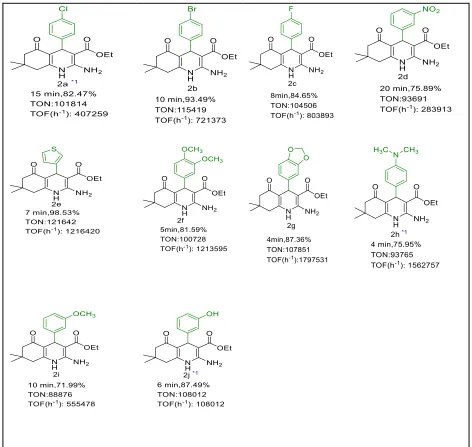
Table 1: Effect of CS/CuNPs catalyst on the synthesis of polyhydroquinolines 2 a-j using various aromatic aldehydes**
*1[36] **Reaction conditions: dimedone (3.6 mmol), aromatic aldehyde (3.6mmol), ethylcyanoacetoacetate (3.6 mmol),
ammoniumacetate (28.8 mmol) and 0.1g of catalyst in10 ml absolute ethanol under ultrasonic irradiation at 80°C for 15 min.; TON: (turnover number, yield of product/ per mol of Cu); TOF: (turn over frequency, TON/time of reaction).
existing in Table 1. A remarkably high TON and TOF values were found with small mass of catalyst. Considering such cyclocondensation reactions, chitosan decorated copper nanoparticles is considered to be a suitable efficient catalyst. Basically, catalytic activity of nanoparticles is related to the size of the particles and the good dispersion of active species on the catalyst’s support. Therefore, extensive characterization of the most efficient CS/CuNPs catalyst was attained and presented in the next section.
Many catalysts have been used for one pot-catalytic synthesis of organic precursors utilizing nanocrystalline and nanoparticle catalysts such as ClO4/Zr-MCM-41 nanoparticles [37], Fe3O4@B-MCM-41[38], and ZnO nanoparticles [39]. All of these catalysts showed pronounced catalytic activity due to their nanosized and large surface area features. In contrary to that the produced % yield of products especially after re-use of catalysts for four time was not sufficient relative to our proposed catalyst in the present work. In order to study the sustainability of the present efficient catalyst towards four components one-pot catalytic synthesis of novel quinoline derivatives under ultrasound irradiation, the re-use test was carried out and the results are given in the following section.
3.2 Reusability Procedure
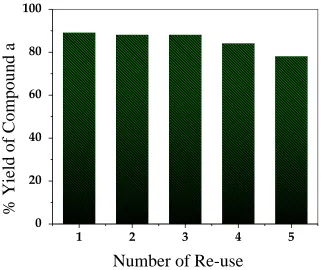
Reusability is crucial for supported catalysts [40]. Therefore, the same catalytic particles were used after filtration from the reaction mixture for several reactions under the same conditions. Typically, after 15 min ultrasound irradiation, CS/CuNPs was filtered and washed 4-6 times with hot ethanol to remove all the unreacted educts then dried at room temperature for 24 h. The dried catalyst was used in the subsequent runs and the results are displayed in Figure 2.
1
2
3
4
5
0
20
40
60
80
100
% Yield of Compound a
Number of Re-use
Figure 2. Robust feature of CS/CuNPs catalyst after five times r-use.
3.3 Catalyst Characterization 3.3.1 FTIR
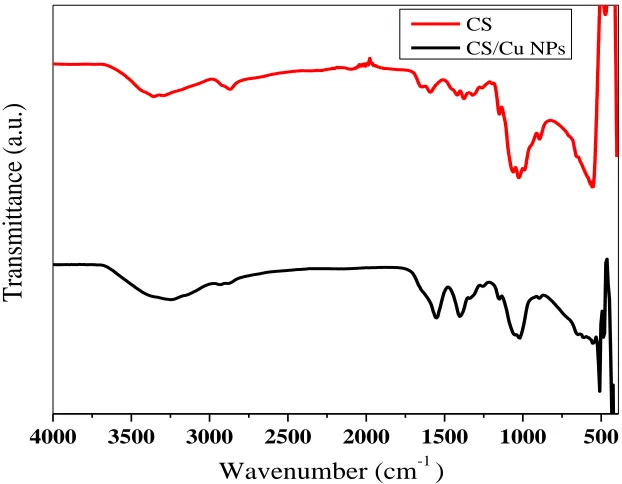
FT-IR spectra of chitosan and CS/CuNPs Figure 3 displayed a broad band for OH and NH stretching of amine groups located at 3250 cm−1. The existence of band at 1553 cm−1 is due to the presence of the NH2 groups. Stretching vibrations due to C-OH and C-N appeared consequently in the absorption bands in the range 1016 and 1402 cm−1 .The absorption band placed at 2936 cm−1 is credited to the C−H stretching mode of methylene groups[41] . The decoration of chitosan by copper nanoparticles resulted in the formation of new intense peaks in the fingerprint region at low -frequency (600-500 cm-1) due to formation of Cu−N and Cu−O coordinate bonds. Furthermore, the peak at 612 cm-1 assigns for CuNPs–chitosan interaction, indication that NPs were capped by the biopolymer [34].
4000 3500 3000 2500 2000 1500 1000 500
CS
CS/Cu NPs
Tr
an
smit
ta
nc
e (
a.u
.)
Wavenumber (cm
-1)
Figure 3. FTIR spectra of pure chitosan and CS/CuNPs catalyst.
3.3.2 TGA analyses
100 200 300 400 500 600
100
Temperature (
oC)
CS/Cu NPs CS
Mass (%)
100
Figure 4. TGA of chitosan (CS) and CS/CuNPs.
3.3.3 XRD analyses
X-ray diffraction patterns of pure chitosan (CS) and chitosan decorated copper nanoparticles (CS/CuNPs) are displayed in Figure 5. Some characteristic peaks for chitosan at 2θ = 11.5o and 22.5o were observed [45,46]. A slight right shift with wider peak at 2θ=23o
recommends the decrease in crystallinity after anchoring copper nanoparticles in the chitosan structure. The main structure of chitosan was not disturbed with the absence of any characteristic peaks for copper nanoparticles. This observation suggests the dispersion of copper nanoparticles over the surface of chitosan and the structure of chitosan was not changed during the preparation method.
11 22 33 44 55 66 77
Coun
ts (a.u.)
2
(
o)
CS/CuNPs CS
2.3.4 SEM-EDX
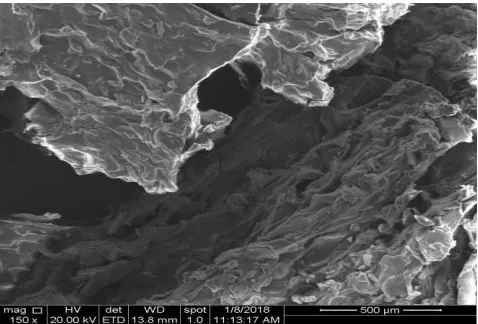
The morphology of chitosan decorated copper nanoparticles sample (CuNPs) described by SEM image Figure 6 displayed asymmetrical deposits of chitosan. The nonattendance of copper nanoparticles could be ascribed to the good scattering of copper nanoparticles over chitosan. EDX spectra Figure 7 showed copper in addition to carbon, nitrogen and oxygen elements. The atomic % of copper should be complemented by XPS analysis in order to give accurate turnover number of copper relative to the total atomic percentage derived from ICP-AES analysis.
Figure 6. SEM image for CS/CuNPs.
3.3.5 XPS and HRTEM
XPS peaks at 932.7 and 952.5 eV corresponding to Cu2p3/2 and Cu2p1/2, respectively, which confirmed the presence of copper, which is not appeared in XRD patterns. Copper nanoparticles are fashioned in three diverse oxidation states, which could improve the catalytic efficacy of the synthesized catalyst. The number of moles of copper nanoparticles was detected from both EDX and XPS analyses for the determination of turnover number of active species. TEM images (Figure 8 right-side) show copper nanoparticles are well dispersed over chitosan. The corresponding selected area diffraction (SAED pattern) shows uniform distribution of copper NPs in two faces (111) and (110). These information about the uniform distribution of copper species with different oxidation states in different crystallographic faces could deliver elucidation of the superior catalytic activity of the catalyst and the suitability of the catalyst’s support in avoiding the agglomeration of copper nanoparticles.
Figure 8. XPS (left-side) and HRTEM images (right-side) for CS/CuNPs
4. Tentative Mechanism
Scheme 2: proposed mechanism for the synthesis of quinolone derivatives.
5
.
ConclusionsA series of chitosan decorated copper nanoparticles were successfully synthesized using green methods. All the investigated catalysts showed high catalytic performance towards the synthesis, in acceptable yield, of novel quinoline derivatives at very short time under ultrasonic irradiation. CS/CuNPs catalyst showed superior TOF for the synthesis of novel quinoline derivatives of expected biological activity. Thanks to the well dispersion of nanoparticles over natural inactive good support the pronounced superior catalytic efficacy was attained. The re-use of this particular catalyst for five times without appreciable change in its catalytic efficacy open the gate towards promising noble metal free catalysts for fine chemical products utilizing green protocol.
Acknowledgments
K.S.A. acknowledges chemistry department, faculty of science, King Abdulaziz University for providing the lab facilities for doing the research during her MSc. Thesis.
References and Notes
[1] Kwiek, J. J., Haystead, T. A., Rudolph, J., 2004. Kinetic mechanism of quinone oxidoreductase
2 and its inhibition by the antimalarial quinolines. Biochemistry, 43(15), pp.4538-4547.
[2] Kogn, L. K., Pavam, C., Veronese, D., Coelho, F., De, C. J., Almeida, W. P., 2006.
Antiproliferative effect of Baylis–Hillman adducts and a new phthalide derivative on human
tumor cell lines. European Journal of Medicinal Chemistry, 41(6), pp.738-744.
[3] Ahmed, N., Badahdah, K., Qassar, H., 2017. Novel quinoline bearing sulfonamide derivatives
and their cytotoxic activity against MCF7 cell line. Medicinal Chemistry Research, 26(6),
pp.1201-1212.
[4] Roma, G., Di, B. M., Grossi, G., Mattioli, F., Ghia, M., 2000. 1, 8-Naphthyridines IV.
9-substituted N, N-dialkyl-5-(alkylamino or cycloalkylamino)[1, 2, 4] triazolo [4, 3-a][1, 8] naphthyridine-6-carboxamides, new compounds with aggressive and potent
anti-inflammatory activities. European Journal of Medicinal Chemistry, 35 (11), pp.1021-1035.
[5] Bekhit, A. A., El-sayed, O. A., Aboulmagd, E., Park, J. Y., 2004. Tetrazolo [1, 5-a] quinoline as
a potential promising new scaffold for the synthesis of novel anti-inflammatory and antibacterial
[6] Dube, D., Blouin, M., Brideau, C., Chan, C. C., Desmarais, S., Ethier, D., Falgueyret, J. P.,
Friesen, R. W., Girard, M., Girard, Y., 1998. Quinolines as potent 5-lipoxygenase inhibitors:
synthesis and biological profile of L-746,530. Bioorganic & Medicinal Chemistry Letters, 11(8),
pp1255-1260.
[7] Ko, T. C., Hour, M. J., Lien, J. C., Teng, C. M., Lee, K, H., Kuo, S. C., Huang, L. J., 2001.
Synthesis of 4-alkoxy-2-phenylquinoline derivatives as potent antiplatelet agents. Bioorganic &
Medicinal Chemistry Letters, 11(3), pp.279-282.
[8] Murganantham, N., Sivkumar, R., Anbalagan, N., Gunaskaran,V., Leonard, J. T., 2004.
Synthesis, anticonvulsant and antihypertensive activities of 8-substituted quinoline derivatives.
Biological and Pharmaceutical Bulletin, 27(10), pp.1683-1687.
[9] Das, B., Ravikanth, B., Ramu, R., Rao, B. V., 2006. An efficient one-pot synthesis of
polyhydroquinolines at room temperature using HY-zeolite. Chemical and Pharmaceutical
Bulletin, 54(7), pp.1044-1045.
[10] Sapkal, S. B., Shelke, K. F., Shingate, B. B., Shingare, M. S., 2009. Nickel
nanoparticle-catalyzed facile and efficient one-pot synthesis of polyhydroquinoline derivatives via Hantzsch
condensation under solvent-free conditions. Tetrahedron Letters, 50(15), pp.1754-1756.
[11] Dodoni, A., Massi, A., Minghini, E., Bertolasi, V., 2004. Multicomponent Hantzsch
cyclocondensation as a route to highly functionalized 2-and dihydropyridylalanines, 2-and 4-pyridylalanines, and their N-oxides: preparation via a polymer-assisted solution-phase
approach. Tetrahedron, 60(10), pp.2311-2326.
[12] Karade, N. N., Budhewar, V. H., Shinse, S. V., Jadhav, W. N., 2007. L-proline as an efficient
organo-catalyst for the synthesis of polyhydroquinoline via multicomponent Hantzsch reaction.
Letters in Organic Chemistry, 4(1), pp.16-19.
[13] Pilli, S., Bhunia, P., Yan, S., Leblanc, R., Tyagi, R., Surampalli, R., 2011. Ultrasonic
pretreatment of sludge: a review. Ultrasonics Sonochemistry, 18(1), pp.1-18.
[14] Hussain, S., Jadhav, S., Rai, M., Farooqui, M., 2014. One-pot neda catalyzed Knovenagel
condensation under ultrasonic irradiation in solvent-free medium. International Journal of
Pharmaceutical, Chemical & Biological Sciences, 4(1), pp.126-128.
[15] Polshettiwar, V., Varma, R. S., 2010. Green chemistry by nano-catalysis. Green Chemistry,
12(5), pp.743-754.
[16] Rostamizadeh, S., Shadjou, N., Azad, M., Jalali, N., 2012. (α-Fe2O3)-MCM-41 as a
magnetically recoverable nanocatalyst for the synthesis of pyrazolo [4, 3-c] pyridines at room
temperature. Catalysis Communications, 26(9), pp.218-224.
[17] Mokhtar, M., Saleh, T., Ahmed, N., Al-Thabaiti, S., Al-Shereef, R., 2011. An eco-friendly
N-sulfonylation of amines using stable and reusable Zn–Al–hydrotalcite solid base catalyst under
ultrasound irradiation. Ultrasonics Sonochemistry, 18(1), pp.172-176.
[18] Mokhtar, M., Saleh, T., Basahel, S. N., 2012. Mg–Al hydrotalcites as efficient catalysts for
aza-Michael addition reaction: a green protocol. Journal of Molecular Catalysis A: Chemical, 353(2),
pp. 122-131.
[19] Saleh, T. S., Narasimharao, K., Ahmed, N. S., Basahel, S. N., Al-Thabaiti, S., Mokhtar, M.,
2013. Mg–Al hydrotalcite as an efficient catalyst for microwave assisted regioselective 1,
3-dipolar cycloaddition of nitrilimines with the enaminone derivatives: A green protocol. Journal of
Molecular Catalysis A: Chemical, 367(2), pp.12-22.
[20] Narasimharao, K., Al-Sabban, E., Saleh, T., Gallastegui, G. A., Sanfiz, C. A., Basahel, S. N.,
Al-Thabaiti, S., Alyoubi, A., Obaid, A., Mokhtar, M., 2013. Microwave assisted efficient protocol
for the classic Ullmann homocoupling reaction using Cu-Mg-Al hydrotalcite catalysts. Journal of
Molecular Catalysis A: Chemical, 379(11), pp.152-162.
[21] Bagabas, A. A., Mokhtar, M., Akhmedov, V. M., Narasimharao, K., Basahel, S. N., Al-Rabiah,
A., 2014. Ru–C–ZnO composite catalysts for the cynthesis of methyl isobutyl ketone via single
[22] Basahel, S. N., Ahmed, N., Narasimharao, K., Mokhtar, M., 2016. Simple and efficient protocol for synthesis of pyrido [1, 2-a] pyrimidin-4-one derivatives over solid heteropolyacid catalysts.
RSC Advances, 6(15), pp.11921-11932.
[23] Koga, H., Tokunaga, E., Hidaka, M., Umrmura, Y., Saito, T., Isogal, A., Kitaoka, T., 2010.
Topochemical synthesis and catalysis of metal nanoparticles exposed on crystalline cellulose
nanofibers. Chemical Communications, 46(45), pp.8567-8569.
[24] Wang, X., Hu, P., Xue, F., Wei, Y., 2014. Cellulose-supported N-heterocyclic
carbene-palladium catalyst: synthesis and its applications in the Suzuki cross-coupling reaction.
Carbohydrate Polymers, 114(9), pp.476-483.
[25] Rinudo, M., 2006. Chitin and chitosan: properties and applications. Progress in Polymer
Science, 31(7), pp.603-632.
[26] Baig, R. N., Varma, R. S., 2013. Copper on chitosan: a recyclable heterogeneous catalyst for
azide–alkyne cycloaddition reactions in water. Green Chemistry, 15(7), pp.1839-1843.
[27] Yang, B., Mao, Z., Zhu, X., Wan, Y. 2015. Functionalised chitosan as a green, recyclable,
supported catalyst for the copper-catalysed Ullmann CN coupling reaction in water. Catalysis
Communications, 60(2), pp.92-95.
[28] Baig, R. N., Nadagouda, M. N., Varma, R. S., 2014. Ruthenium on chitosan: a recyclable
heterogeneous catalyst for aqueous hydration of nitriles to amides. Green Chemistry, 16(4),
pp.2122-2127.
[29] Yan, K., Chen, A., 2014. Selective hydrogenation of furfural and levulinic acid to biofuels on the
ecofriendly Cu–Fe catalyst. Fuel, 115(1), pp.101-108.
[30] Hardy, J. J., Hubert, S., Macquarrie, D. J., Wilson, A. J., 2004. Chitosan-based heterogeneous
catalysts for Suzuki and Heck reactions. Green Chemistry, 6(1), pp. 53-56.
[31] Qiu, Y., Ma, Z., Hu, P., 2014. Environmentally benign magnetic chitosan/Fe2O3 composites as
reductant and stabilizer for anchoring Au NPs and their catalytic reduction of 4-nitrophenol.
Journal of Materials Chemistry A, 2(33), pp.13471-13478.
[32] Zhou, J., Dong, Z., Yang, H., Shi, Z., Zhou, X., Li, R., 2013. Pd immobilized on magnetic
chitosan as a heterogeneous catalyst for acetalization and hydrogenation reactions. Applied
Surface Science, 279(8), pp.360-366.
[33] Frindy, S., Elkadib, A., Lahcini, M., Primo, A., Garcia, H., 2015. Copper nanoparticles stabilized
in a porous chitosan aerogel as a heterogeneous catalyst for C−S cross‐coupling.
ChemCatChem, 7(20), pp.3307-3315.
[34] Manikandan, A., Sathiyabama, M., 2015. Green synthesis of copper-chitosan nanoparticles
and study of its antibacterial activity. Journal of Nanomedicine & Nanotechnology, 6(1), pp.1-5.
[35] Huang, H., Yang, X., 2004. Synthesis of chitosan-stabilized gold nanoparticles in the
absence/presence of tripolyphosphate. Biomacromolecules, 5(9), pp.2340-2346.
[36] Kumar, S., Sharma, P., Kapoor, K.K., Hundal, M.S., 2008.An efficient, catalyst-and
solvent-free, four-component, and one-pot synthesis of polyhydroquinolines on grinding. Tetrahedron
64, pp.536-542.
[37] Abdollahi, A., M., Hoseinkhan, S., 2016. ClO4/Zr-MCM-41 nanoparticles prepared at mild
conditions: a novel solid acid catalyst for the synthesis of polyhydroquinolines. Journal of the
Iranian Chemical Society, 13(7), pp.1339-1347.
[38] Abdollahi, A., M., Rezaeipoor, A., 2016. Fe3O4@ B-MCM-41: a new magnetically recoverable
nanostructured catalyst for the synthesis of polyhydroquinolines. Journal of Magnetism and
Magnetic Materials, 398(1), pp.205-214.
[39] Kassaee, M., Masrouri, H., Movahedi, F., 2010. ZnO-nanoparticle-promoted synthesis of
polyhydroquinoline derivatives via multicomponent Hantzsch reaction. Monatshefte für
Chemie-Chemical Monthly, 141(12), pp.317-322.
[40] Webb, J., D., Macquarrie, S., Mceleney, K., Crudden, C., M., 2007. Mesoporous
Journal of Catalysis, 252(11), pp.97-109.
[41] Sudheesh, N., Sharma, S., K., Shukla, R., S., 2010. Chitosan as an eco-friendly solid base
catalyst for the solvent-free synthesis of jasminaldehyde. Journal of Molecular Catalysis A:
Chemical, 321(1-2), pp.77-82.
[42] Kumari, S., Pathak, D., D., 2015. Synthesis and development of chitosan anchored copper (II)
Schiff base complexes as heterogeneous catalysts for N-arylation of amines. Tetrahedron
Letters, 56(27), pp. 4135-4142.
[43] Antony, R., David, S., T., Saravanan, K., Karuppasamy, K., Balakumar, S., 2013. Synthesis,
spectrochemical characterisation and catalytic activity of transition metal complexes derived
from Schiff base modified chitosan. Spectrochimica Acta Part A: Molecular and Biomolecular
Spectroscopy, 103(2), pp. 423-430.
[44] Tirkistani, F. A., 1998. Thermal analysis of some chitosan Schiff bases. Polymer Degradation
and Stability, 60(1), pp.67-70.
[45] Kumar, S., Dutta, P., Koh, J., 2011. A physico-chemical and biological study of novel chitosan–
chloroquinoline derivative for biomedical applications. International Journal of Biological
Macromolecules, 49(3), pp.356-361.
[46] Roberts, G. A., 1992. Chitin Chemistry. Macmillan International Higher Education.