University of Oxford
Digital Supply Chains for Industry 4.0
Taxonomy of Approaches
Petar Radanliev
Oxford E - Research Centre, Oxford University, 7 Keble Road, Oxford, OX1 3QG, United Kingdom
Introduction
The area of research for this paper is the field of supply chain architecture, design and engineering, in a digital (new and non-existent supply chain) and integration context. To evaluate the present approaches in supply chain practice, the paper begins with a review of existing supply chain models, which cover the relevant aspects in the context of digital supply chain integration. The research areas reviewed in the paper are: supply chain architecture, supply chain design, supply chain engineering, and supply chain integration. There is a vast number of developed or proposed supply chain models focused on one or more specific research areas. The objective of this paper is to group the factors in recognisable clusters and to derive with a new set of principles for digital supply chain architecture, design and engineering.
Research Objectives
The research problems investigated are related to integration of supply chain architecture, design and engineering. The research objectives of this paper are: 1. To derive with a set of principles for a digital supply
chain architecture with multiple supply chain participants.
2. To derive with set of principles for digital supply chain integration design.
3. To develop a supply chain engineering principles based on the architecture and design criteria for systematically integrating individual activities towards pre-defined digital integration areas.
To relate the criteria to the methodology, a hierarchical concept map and conceptual diagram are applied. The objectives of the paper are oriented around external and salient dimensions, which directly affect the supply chain architecture, design and engineering and consist of elements, forces and factors.
Engineering the supply chain requires a design that possesses the flexibility of a complex adaptive system, consisting of interlinking architecture, with external dimensions and system germane internal elements. The complexity of the subject, the multiple environments, dimensions, elements and concepts, require a research that does not set any limits to the conceptual, analytical or empirical nature of the existing approaches present in practice. This present the rational for applying a taxonomy approach to investigate the integration engineering of supply chain architecture, design and engineering, and building a framework for integrating the existing supply chain approaches.
The objectives of this paper are to critically analyse the key supply chain concepts and approaches, to assess the fit between the research literature and the practical issues of supply chain architecture, design and engineering, and to develop a methodology that could be used by practitioners when integrating supply chain architecture and design with strategy engineering.
Taxonomy approach is applied to consider criteria for strategy architecture, hierarchical strategy design, strategy engineering, and integration of supply chain architecture, design and engineering as a conceptual system. The results from this paper derived with the findings that the relationship between supply chain architecture, design and engineering is weak and challenges remain in the process of adapting and aligning operations.
This paper also derived with a novel approach for addressing these obstacles, based on a new methodology. The novelty that derives from this paper is a methodology for integrating supply chain architecture, design and engineering, with criteria that enable decomposing and building a digital (new and non-existent) supply chain as a system. The paper revealed a number of tools and mechanism which enabled the development of a new methodology for integrating the architecture, design and engineering of a supply chain. The review derived with improvements to current and existing theories for analysing interdependencies within and between their individual contexts. This issue is addressed with a hierarchical method for network design, applied for building and combining the integration criteria.
Structure of the paper
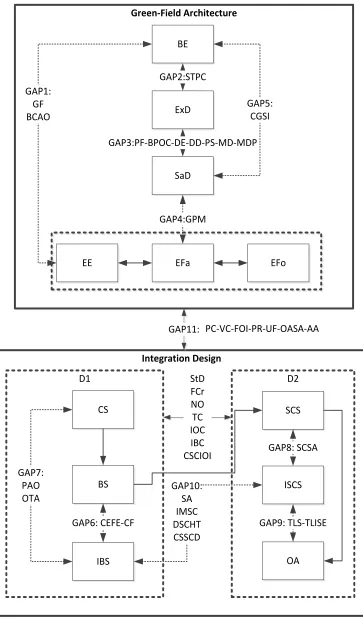
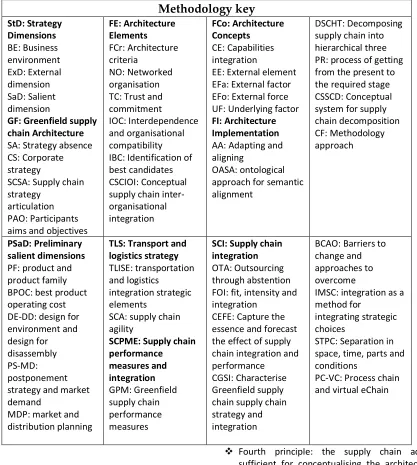
This paper is structured in the following order: firstly the research aim and objectives are defined, along with the rationale for the study; secondly, the reasoning behind key tenants of the methodology are discussed in detail, with specific observations from existing literature on this topic. This step relates the key tenets to existing literature and elaborates on the benefits from this methodology to practitioners and academics in the fields of supply chain management; thirdly, the methodology that derived from this study is presented (Figure 1) followed by the principles key (Table 1) containing the full list of abbreviations of the key tenets; and finally, the emerging principles are analysed to clarify how the key tenets are applied to the new methodology for engineering the digital supply chain architecture and design.
Taxonomy of Approaches
The literature review is focused on revealing the tools and mechanisms that enabled this paper to derive with a principles for digital supply chain integration architecture, design and engineering. The objective of this literature review is to analyse the key tenets that enabled the architecture for inter-relating supply chain operations.
Digital strategic integration
The process of merging distinct digital operational areas into the supply chain area, creates an urgency to integrate the information and physical flow into relationships that link these areas and fosters ‘trust and commitment’ (TC) with supply chain partners (Bozarth et al., 2009). Pathak et al. (2007) designed a set of principles based on TC, however, the principles would benefit from being tested with case study and action research, in a similar way that other frameworks combined such methods (Martínez-Olvera and Shunk, 2006, Martínez-(Martínez-Olvera, 2008, Narasimhan et al., 2008, Perez-Franco et al., 2010). In addition, these frameworks would benefit from criteria to evaluate and measure performance of integrating supply chain participants into a ‘networked organisation’ (NO) (Sukati et al., 2012). Where performance depends on ‘identification of best candidates (IBC) (Lee and Billington, 1992), and requires measurement system for ‘interdependence and organisational compatibility’ (IOC) in supply chain design (Beamon, 1998).
Characterising digital integration
‘Supply chain strategy integration’ (SCI) is described as a ‘single entity system’ or a ‘confederation’ (Mentzer, 2001) and a ‘networked organisation’ (Ivanov, 2009). The ‘single entity system’ should be focused on ‘capturing the essence and forecasting the effect’ of supply chain integration and performance (CEFE) (Mentzer, 2001), through combining resources and capabilities (Narasimhan et al., 2008). In addition, to ‘characterise greenfield supply chain strategy and integration’ (CGSI) the functional activities should be investigated to identify actual instead of desired strategy outcomes (Cigolini et al., 2004).
Strategic integration represents an effective method for implementing strategic choices and further research is required to include the ‘architecture implementation’ (FI) in
integration (He and Lai, 2012). To address this, an algorithm has been described for selecting best supply chain integration strategy through separation in ‘space, time, parts and conditions’ (STPC) for scenarios when problems occur (Nikulin et al. 2013). The soundness and the logic behind (Nikulin et al. 2013) approach could be applied as a tool to build upon a methodology for supply chain strategy architecture. Such methodology should embrace collaborative commerce and synchronisation of supply chain information flow, promoting flexibility and effectiveness (Kim, 2006, Frohlich and Westbrook, 2001, Vickery et al., 2003, Manthou et al., 2004, Al-Mudimigh et al., 2004).
Categorising digital integration activities
Supply chain competences lead to diverse performance advantages in various business environments (Closs and Mollenkopf, 2004), but the same practices and patterns cannot be applicable in every industry context to achieve superior performance (Vickery et al., 2003, Van der Vaart and van Donk, 2008, Nikulin et al., 2013). Factors that improve performance in the context of supply chain integration and performance have been categorised into attitudes, practices and patterns (Van der Vaart and van Donk, 2008). The relationship between these clusters remains elusive and the number of ‘architecture elements’ (FE) and ‘architecture concepts’ (FCo), should be validated through further research. Formulating supply chain strategies in the context of ‘digital architecture’ (GF) with a singular focus on integration and performance (Frohlich and Westbrook, 2001), presents limitations (Rosenzweig et al., 2003, Perez-Franco et al., 2010, Childerhouse and Towill, 2011), because various supply chain aspects should be considered in the design and architecture stage, and supply chain integration activities have a unique set of benefits (Swink et al., 2007).A holistic methodology for supply chain design (Melnyk et al. 2013) concluded that supply chain design must consider the ‘external dimension’ (ExD). The study recommended a process for uncovering the various pieces that orchestrate the overall supply chain architecture and design, through investigating the ‘underlying factors’ (UF) and ‘salient dimensions’(SaD), such as ‘external elements’ (EE), ‘factors’ (EFa), and ‘forces’ (EFo) (Melnyk et al. 2013).
The design process could apply a ‘conceptual approach for supply chain inter-organisational integration’ (CSCIOI) (Perez-Franco et al., 2010). Alternatively, conceptual system can be verified with system dynamics and mathematical modelling (Ivanov, 2009), however, mathematical modelling could hardly calculate with precision the perceptions of the individual decision maker perceptions. Engineering systems literature integrated a system dynamics principles to decompose supply chain and tested the approach though dynamic analysis (Hafeez et al., 1996). The engineering system approach could be applied as a visualisation tool for presenting and interlinking multiple supply chain areas with external business dimensions (Lertpattarapong, 2002), but such approach could hardly comprehend the supply chain complexities and multiple variables in ‘integration as a method for integrating strategic choices’ (IMSC), leading to the conclusion that conceptual architectures and supply chain decomposition design are stronger visualisation tools. Nevertheless, engineering design techniques such as the Pugh Controlled Convergence (Pugh, 1990), the Enhanced Quality Function Deployment (Clausing, 1992), the Design Structure Matrix (Eppinger et al., 1994) the Engineering System Matrix (Bartolomei et al., 2007), and the ‘techniques tool matrix’ (Cigolini et al., 2004), can be applied in combination with ‘cascading strategy’ (Narasimhan et al., 2008), to case study, action research and grounded theory to build the architecture, design and engineering of a supply chain strategy as a conceptual system (Perez-Franco et al., 2010). Such an approach can be combined with supply chain decomposition (Schnetzler et al., 2007) to address the ‘architecture criteria’ (FCr) problem.
Digital conceptual engineering
‘Conceptual model’ approach (CM) has been applied for strategy architecture to evaluate decision makers strategic goals (Cigolini et al., 2004, Narasimhan et al., 2008, Perez-Franco et al., 2010). ‘Conceptual system for supply chain decomposition’ (CSSCD), could integrate operational level employees to identify relationship between the vision and goals and for explaining the relationship between concepts (Platts et al., 1996, Menda and Dilts, 1997).
Ontological semantic alignment for digital
design
Alternatively, an ‘ontological approach can be applied for semantic alignment’ (OASA) where knowledge elicitation, containing, mapping and merging should represent the foundations for adapting or aligning supply chain principles (Sakka et al., 2011). The process should conceptualise strategy as a system of choices, patterns or decisions to address the phenomenon of ‘strategy absence’ (SA) in strategy architecture (Inkpen and Choudhury, 1995). The process should start by reaching a consensus on the ‘preliminary salient dimensions’ (PSaD) and strategic objectives (Platts et al., 1996, Menda and Dilts, 1997). The process can be further clarified by applying ‘architecture criteria’ (FC), such as: procedure, process and participation, which require communication mechanisms to enable concept understanding (Inkpen and Choudhury, 1995). The concept understanding should apply design ‘integration
criteria’ (EC) through systematic innovation (Sheu and Lee, 2011), as a method for distilling innovation to strategy. However, strategy absence must be addressed through the architecture criteria prior to applying the integration criteria, because systematic innovation brings strategy dynamics through the ‘process chain and virtual eChain’ (PC-VC) feedback mechanisms, whereas strategy absence effectively disables the feedback mechanisms and reduces the ‘supply chain agility’ (SCA).
The feedback mechanisms enable the process of: (1) anticipating the demand for a product, market standards and influencers, product variety and life cycle (Fisher, 1997); (2) investigating the internal and external factors (Narasimhan et al., 2008); (3) determine the supplier or customer focus and level of integration (Frohlich and Westbrook, 2001); and (4) enable building trust and commitment, or interdependence and organisational compatibility (Mentzer, 2001). These feedback mechanisms enable building upon the supply chain architecture criteria and until present, the architecture criteria has not been built upon and combined with the ‘integration criteria’ (EC): visibility (Inkpen and Choudhury, 1995, Fisher, 1997), acceptance (Saad et al., 2002), participation (Menda and Dilts, 1997, Zhou and Chen, 2001, Qureshi et al., 2009), communication (Tracey et al., 1999), formality (Andrews et al., 2009), adaptability (Sakka et al., 2011, Saad et al., 2002), integration (Bozarth et al., 2009), effectiveness (Fisher, 1997) flexibility (Kim, 2006) and responsiveness (Fisher, 1997). Building upon and combining the criteria would represent a novel contribution from synthesising existing knowledge for deriving new findings.
Digital supply chain engineering in uncertain
environments
In this context, the conceptual system approach has been proven effective for ‘supply chain strategy articulation’ (SCSA) and optimal solution detection (Perez-Franco et al., 2010).
Supply chain efficiency of digital architectures
The process of determining the underlying factors of salient dimensions in supply chain engineering, should be focused on preserving core-activities and outsource non-core activities (Gilley and Rasheed, 2000). For example, in the ‘transport and logistics strategy’ (TLS) third party logistic partnerships enable cost reduction combined with improvement in service and operational efficiency (Sheffi, 1990), bringing into focus the ‘transportation and logistics integration strategic elements’ (TLISE). In this context, further investigation of a potential ‘fit’ between companies outsourcing intensities and vertical strategic integration could strengthen existing understanding of the ‘outsourcing through abstention’ (OTA) problem (Gilley and Rasheed, 2000). Since greater collective operational activities need to be advanced through supply chain alliances, then the strategic problem of ‘integration as a method for integrating strategic choices’ (IMSC) grows into one of a degree (Frohlich and Westbrook, 2001), however, the right level of ‘fit, intensity and integration’ (FOI) should be identified to optimise performance (Jayaram and Tan, 2010).Engineering the performance of digital
architectures
Existing frameworks such as Kaplan and Norton (1996), which was expanded by Brewer and Speh (2000), are applicable to specific supply chain categories ‘supply chain performance measures and integration’ (SCPME). These frameworks are not applied to evaluate strategy architecture that can be defined as ‘digital performance measures’ (GPM) where measuring performance in effect
refers to forecasting performance. The most advanced performance measurement system identified is the SCOR model (SCC, 2001) because the model is applied to industry and has evolved through feedback from industry. However, in an uncertain market demand and continuous new product development, flexibility and feasibility should also be included in the performance measures (Perez-Franco et al., 2010).
Engineering the environmental dimensions for
digital architectures
Supply chain engineering must anticipate ‘product and product family’ (PF) in the design process, while supply chain architecture must be designed in accordance to the ‘best product operating cost’ (BPOC) (Lamothe et al., 2006, Lo and Power, 2010, Liu and Hipel, 2012). The supply chain design must anticipate ‘design for environment, design for disassembly’ (DE-DD) (Clendenin, 1997). Supply chain strategy architecture should be focused on: (1) optimising the company strategy and service elements through ‘postponement strategy and market demand’ (PS-MD) (Korpela et al., 2001b); (2) the relationship between buyer and supplier in the ‘strategy dimensions’ (StD) (Van der Vaart and van Donk, 2008, Closs and Mollenkopf, 2004); (3) the supply chain functions must be based on the ‘business environment’ (BE); (5) the supply chain integration strategy must be based on the ‘market and distribution planning’ (MDP) strategies (Narasimhan and Kim, 2002).
Methodology
University of Oxford
FIGURE 1:
Methodology for digital integration
ExD BE
SaD
EFa
EE EFo
GAP1: GF BCAO
GAP2:STPC
GAP3:PF-BPOC-DE-DD-PS-MD-MDP
GAP4:GPM
BS
IBS
Green-Field Architecture
ISCS
OA GAP5:
CGSI
CS SCS
GAP6: CEFE-CF GAP7:
PAO OTA
GAP8: SCSA
GAP9: TLS-TLISE GAP10:
SA IMSC DSCHT CSSCD
Integration Design
D1 D2
GAP11:
StD FCr NO TC IOC IBC CSCIOI
TABLE 1:
Abbreviations of the key tenets from the methodology
Methodology key
StD: Strategy Dimensions BE: Business environment ExD: External dimension SaD: Salient dimensionGF: Greenfield supply chain Architecture
SA: Strategy absence CS: Corporate strategy
SCSA: Supply chain strategy
articulation PAO: Participants aims and objectives
FE: Architecture Elements FCr: Architecture criteria NO: Networked organisation TC: Trust and commitment
IOC: Interdependence and organisational compatibility IBC: Identification of best candidates CSCIOI: Conceptual supply chain inter-organisational integration FCo: Architecture Concepts CE: Capabilities integration
EE: External element EFa: External factor EFo: External force UF: Underlying factor
FI: Architecture Implementation
AA: Adapting and aligning
OASA: ontological approach for semantic alignment
DSCHT: Decomposing supply chain into hierarchical three PR: process of getting from the present to the required stage CSSCD: Conceptual system for supply chain decomposition CF: Methodology approach
PSaD: Preliminary salient dimensions
PF: product and product family BPOC: best product operating cost DE-DD: design for environment and design for disassembly PS-MD: postponement strategy and market demand
MDP: market and distribution planning
TLS: Transport and logistics strategy
TLISE: transportation and logistics
integration strategic elements
SCA: supply chain agility
SCPME: Supply chain performance measures and integration GPM: Greenfield supply chain performance measures
SCI: Supply chain integration OTA: Outsourcing through abstention FOI: fit, intensity and integration
CEFE: Capture the essence and forecast the effect of supply chain integration and performance CGSI: Characterise Greenfield supply chain supply chain strategy and integration
BCAO: Barriers to change and approaches to overcome
IMSC: integration as a method for
integrating strategic choices
STPC: Separation in space, time, parts and conditions
PC-VC: Process chain and virtual eChain
Principles emerging from the taxonomy of approaches
The process of building methodology (FIGURE 1) is relying on a number of key tenets.
v First principle: in supply chain architecture, to understand the companies’ real strategies the architecture must be interacting with the design (activities) (Porter, 1996, Cigolini et al., 2004, Andrews, 1982, Bozarth et al., 2009, Perez-Franco et al., 2010, Sukati et al., 2012).
v Second principle: to understand how supply chains are designed, ‘tacit knowledge’ should be considered as instrumental in distinguishing between the engineering the strategy and the design of the activities (Perez-Franco et al., 2010, Sukati et al., 2012).
v Third principle: supply chain can be engineered as a conceptual system where the architecture is based on a conceptual design (Bozarth et al., 2009, Perez-Franco et al., 2010, Melnyk et al. 2013).
v Fourth principle: the supply chain activities are sufficient for conceptualising the architecture, design and engineering (Bozarth et al., 2009, Cigolini et al., 2004, Perez-Franco et al., 2010, Melnyk et al. 2013).
v Fifth principle: supply chain architecture contains engineering and design where the engineering is the central idea of the supply chain design (Perez-Franco et al., 2010) but the integrated design is representative of the participants and the design determines the architecture (Mentzer, 2001, Narasimhan et al., 2008, Melnyk et al. 2013).
v Sixth principle: the supply chain engineering relies on the integrated design and the design is the foundations of the architecture that is determined by the integrated design (Inkpen and Choudhury, 1995, Sukati et al., 2012, Nikulin et al. 2013), where the design represent a set of ideas incorporated in the engineering that; supplement, assist and enable the architecture (Martínez-Olvera and Shunk, 2006, Schnetzler et al., 2007, Martínez-Olvera, 2008, Perez-Franco et al., 2010, Melnyk et al. 2013).
Conclusion
The methodology derived with the conclusion that digital supply chain architecture, design and engineering represents a dynamic process, and should be analysed in individual contexts. The critical summary of literature reviewed resulted in identifying the main themes (Table 1) necessary for generating a new methodology (Figure 1). The main themes are categorised in key tenants. The key tenants are catalogued for addressing several problems present in architecting, designing and engineering digital supply chains. These are critically appraised, with specific observations, to identify and catalogue the key tenants needed for building the methodology.
The hierarchical method for network design was applied for building and combining the architecture, design and engineering criteria. This approach was supported with principles from DSCHT, and combined with the techniques from CPPR and ATC. The new principles contribute to knowledge with: (1) architecting the supply chain elements from multiple supply chain participants; (2) designing the participants’ main aims and objectives, and (3) engineering the process of getting from the present to the required stage. The new supply chain principles are also aimed at anticipating operational capabilities through internal competencies and by considering inter-organisational integration in combination with internal operations reformulation.
The methodology is further clarified by applying the process engineering criteria: procedure, process and participation. The concept verification applied architecture and integration criteria as a method for strategy engineering. The new methodology enables building upon the supply chain engineering criteria that until present, has not been built upon and combined with the design criteria: visibility, acceptance, participation, communication, adaptability, integration, effectiveness flexibility and responsiveness. Combining the criteria represents a holistic approach for supply chain architecture and result in deriving new understandings of digital supply chain engineering.
This research is part of research paper series related to this topic (Nicolescu, Huth, Radanliev, & De Roure, 2018b; Nurse, Radanliev, Creese, & De Roure, 2018; P. Radanliev et al., 2018; P. Radanliev, De Roure, Nicolescu, & Huth, 2019; P Radanliev et al., 2018; Petar Radanliev, 2019a, 2019b, 2014, 2015a, 2015c, 2015b, 2016; Petar Radanliev et al., 2019; Petar Radanliev, Charles De Roure, Nurse, Burnap, & Montalvo, 2019; Petar Radanliev et al., 2019, 2018, 2019, 2019, 2019, 2019, 2019, 2019, 2019; Petar Radanliev, Rowlands, & Thomas, 2014; Petar Radanliev, De Roure, Nurse, Montalvo, & Burnap, 2019a, 2019b; Petar Radanliev, De Roure, Cannady, et al., 2019)(Nicolescu, Huth, Radanliev, & De Roure, 2018a; Petar Radanliev, De Roure, Nurse, Rafael, & Burnap, 2019; Petar Radanliev et al., 2019, 2019; Taylor, P., Allpress, S., Carr, M., Lupu, E., Norton, J., Smith et al., 2018).
References
Abdur Razzaque, M., & Chen Sheng, C. (1998). Outsourcing of logistics functions: a literature survey. International Journal of Physical Distribution & Logistics
Management, 28(2), pp.89–107.
Al-Mudimigh, A. S., Zairi, M., & Ahmed, A. M. M. (2004).
Extending the concept of supply chain: The effective
management of value chains. International Journal of
Production Economics, 87(3), pp.309–320.
Andrews, K. R. 1982. The Concept of Corporate Strategy. In C.R. Christensen, K. R. Andrews, J. L. Bower, R. G. Hamermesh And M. E. Porter (Eds.), Business Policy: Text And Cases, Irwin, Homewood, Il.
Andrews, R. B., George A. Law, J. W., Richard, M., (2009). Strategy Formulation, Strategy Content and Performance: An Empirical Analysis. Public
Management Review, 11, pp.1-22.
Beamon, B.M., 1998. Supply Chain Design and Analysis: Models and Methods. International Journal of Production Economics, 55(3), pp. 281–294 Bogataj, M., and Bogataj, L. (2001). Supply chain
coordination in spatial games. International Journal of
Production Economics, 71(1-3), pp.277–285.
Bozarth, C.C., Warsinga, D.P., Flynnb, B.B., Flynn, E.J., 2009.
The impact of supply chain complexity on
manufacturing plant performance.Journal of
Operations Management, 27(1), pp.78–93.
Brewer, P. C., & Speh, T. W. (2000). Using the balanced scorecard to measure supply chain performance.
Journal of Business Logistics, 21(1), 75–94.
Childerhouse, P., & Towill, D. R. (2011). Arcs of supply chain integration. International Journal of Production
Research, 49(24), pp.7441–7468.
Cigolini, R., Cozzi, M., & Perona, M. (2004). A new framework for supply chain management.
International Journal of Operations & Production
Management, 24(1), pp.7–41.
Clausing, D. (1992). Enhanced quality function deployment (EQFD). [Cambridge, Mass.] : Massachusetts Institute of Technology, MIT Center for Advanced Engineering
Study, MIT Press.
Clendenin, J. A. (1997). Closing the Supply Chain Loop: Reengineering the Returns Channel Process. The
International Journal of Logistics Management, 8(1),
pp. 75–86.
Closs, D. J., & Mollenkopf, D. A. (2004). A global supply chain framework. Industrial Marketing Management,
33(1), pp.37–44.
Dotoli, M. Fanti, M. P., Melonia., and Zhoub, M.C., 2007. A multi-level approach for network design of integrated supply chains. Interna-tional Journal of Production Research. 43 (20), pp 4267-4287
Dubois, A., Hulthén, K., and Pedersen, A.C. (2004). Supply chains and interdependence: a theoretical analysis.
Journal of Purchasing and Supply Management, 10(1),
pp.3–9.
Eppinger, S. D., Whitney, D. E., Smith, R. P., & Gebala, D. A. (1994). A model-based method for organizing tasks in product development. Research in Engineering
Design, 6(1), pp.1–13.
Frohlich, M. & Westbrook, R., 2001. Arcs of Integration: An
International Study of Supply Chain Strategies. Journal
of Operations Management. 19 (2001), pp. 185–200. Gilley, K. M., & Rasheed, A. (2000). Making More by Doing
Griffis, S. E., Bell, J. E., and Closs, D. J. (2012). Metaheuristics in Logistics and Supply Chain Management. Journal of Business Logistics, 33(2), pp.90–106.
Hafeez, K., Griffiths, M., Griffiths, J., & Naim, M. M. (1996). Systems design of a two-echelon steel industry supply chain. International Journal of Production Economics,
45(1-3), pp.121–130.
He, Y., & Lai, K. K. (2012). Supply chain integration and service oriented transformation: Evidence from Chinese equipment manufacturers. International
Journal of Production Economics, 135(2), pp.791–799.
Hipel, K. W. (2012). A Hierarchical Decision Model to Select Quality Control Strategies for a Complex Product. IEEE Transactions on Systems, Man, and Cybernetics - Part
A: Systems and Humans, 42(4), pp.814–826.
Inkpen, A., & Choudhury, N. (1995). The seeking of strategy where it is not: Towards a theory of strategy absence.
Strategic Management Journal, 16(4), pp.313–323.
Ivanov, D. (2010). An adaptive framework for aligning (re)planning decisions on supply chain strategy, design, tactics, and operations. International Journal
of Production Research, 48(13), pp.3999–4017.
Jayaram, J. & Tan, K.C., 2010. Supply Chain Integration with Third-Party Logistics Providers.International Journal
of Production Economics, 125 (2), pp. 262–271.
Kaplan, R. & Norton, D., 1996. Using the balanced scorecard as a strategic management system. Harvard Business Review, 74 (1), pp. 75-85
Kim, D. (2006). Process chain: A new paradigm of collaborative commerce and synchronized supply chain. Business Horizons, 49(5), pp.359–367. Korpela, J., Lehmusvaara, A., & Tuominen, M. (2001). An
analytic approach to supply chain development.
International Journal of Production Economics, 71
(1-3), pp.145–155.
Korpela, J., Lehmusvaara, A., Tuominen, M., Lamothe, J., Hadj-Hamou, K., Aldanondo, M., Siferd, S. P. (2001). Customer service based design of the supply chain.
International Journal of Production Economics, 69(2),
pp.193–204.
Lamothe, J., Hadj-Hamou, K., & Aldanondo, M. (2006). An optimization model for selecting a product family and designing its supply chain. European Journal of
Operational Research, 169(3), pp.1030–1047.
Lee, H. & Billington, C., (1992). Managing supply chain inventory: pitfalls and opportunities. Sloan management review, 33(3), pp.64–73.
Lertpattarapong, C. (2002). Applying System Dynamics Approach to the supply chain management problem,
MSc Thesis, Massachusetts Institute of Technology,
MIT Press.
Lee, H., Padmanabhan, V. & Whang, S., (1997). The bullwhip effect in supply chains1. Sloan management
review, 38(3), pp.93–102.
Lo, S. M., & Power, D. (2010). An empirical investigation of the relationship between product nature and supply chain strategy. Supply Chain Management: An
International Journal, 15(2), pp.139–153.
Manthou, V., Vlachopoulou, M., & Folinas, D. (2004). Virtual e-Chain (VeC) model for supply chain collaboration.
International Journal of Production Economics, 87(3),
pp. 241–250.
Martínez-Olvera, C. (2008). Methodology for realignment of supply-chain structural elements. International
Journal of Production Economics, 114(2), pp.714–722.
Martínez-Olvera, C., & Shunk, D. (2006). Comprehensive framework for the development of a supply chain strategy. International Journal of Production
Research, 44(21), pp.4511–4528.
Mckone-Sweet, K., & Lee, Y.T. (2009). Development and Analysis of a Supply Chain Strategy Taxonomy. Journal
of Supply Chain Management, 45(3), pp.3–24.
Melnyk, S. A., Narasimhan, R., & DeCampos, H. A. (2013). Supply chain design: issues, challenges, frameworks and solutions. International Journal of Production
Research, 52(7), pp.1887–1896.
Menda, R. & Dilts, D., (1997). The manufacturing strategy formulation process: linking multifunctional viewpoints. Journal of Operations Management, 15(4), pp.223–241.
Mentzer, J.T., DeWitt, W., Keebler, J.S., Min. S., Nix, N.W., Smith, C.D., Zacharia, Z.G. (2001). Defining Supply
Chain Management. Journal of Business Logistics,
22(2), pp.1–25.
Miller, D. & Friesen, P.H., 1978. Archetypes of Strategy Formulation. Management Science, 24(9), pp.921– 933.
Narasimhan, R., Kim, S.-W. & Tan, K.-C., 2008. An Empirical Investi-gation of Supply Chain Strategy Typologies and Relationships to Performance. International
Journal of Production Research, 46(18), pp.5231 –
5259.
Nikulin, C., Graziosi, S., Cascini, G., Araneda, A., & Minutolo, M. (2013). An Algorithm for Supply Chain Integration based on OTSM-TRIZ. Procedia - Social and Behavioral
Sciences, 75, pp.383–396.
Pathak, S. D., Day, J. M., Nair, A., Sawaya, W. J., & Kristal, M. M. (2007). Complexity and adaptivity in supply networks: building supply network theory using a complex adaptive systems perspective. Decision
Sciences, 38(4), pp.547–580.
Perez – Franco, R. J, Sheffi, Y. Silbey, S., Frey, D., Singh, M., Leveson, N. 2010. A methodology to capture, evaluate and reformulate a firm's supply chain strategy as a conceptual system. PhD Thesis, MIT Press
Platts, K., Mills, J. & Neely, A., (1996). Evaluating manufacturing strategy formulation processess. International Journal of Production Economics: Proceedings of the 8th International Working Seminar on Production Economics, 46-47, pp. 233–240 Porter, M. (1996). What is Strategy? Harvard Business
Review, 61-78.
Pugh, S. (1990). Total Design: Integrated Methods for Successful Product Engineering, Addison-Wesley
Wokingham, UK.
Qu, T., Huang, G. Q., Cung, V.-D., & Mangione, F. (2010). Optimal configuration of assembly supply chains using analytical target cascading. International
Journal of Production Research, 48(23), pp.6883–
Qureshi, M. N., Kumar, P., & Kumar, D., 2009. Selection of Transportation Company: An Analytic Network Process Approach. Icfai Journal of Supply Chain
Management, 6(2), pp.26-38.
Rao, P., & Holt, D. (2005). Do green supply chains lead to competitiveness and economic performance?
International Journal of Operations & Production
Management, 25(9), pp.898–916.
Rosenzweig, E. D., Roth, A. V, & Dean, J. W. (2003). The influence of an integration strategy on competitive capabilities and business performance: An
exploratory study of consumer products
manufacturers. Journal of Operations Management,
21(4), pp.437–456.
Saad, M., Jones, M., & James, P. (2002). A review of the progress towards the adoption of supply chain management (SCM) relationships in construction.
European Journal of Purchasing & Supply
Management, 8(3), pp.173–183.
Sakka, O., Millet, P.-A., & Botta-Genoulaz, V. (2011). An ontological approach for strategic alignment: a supply chain operations reference case study. International
Journal of Computer Integrated Manufacturing,
24(11), pp.1022–1037.
Scc. (2001). Supply-Chain Operations Reference-Model. Pittsburgh: Supply Chain Council, Inc., Retrieved From The World Wide Web:
Http://Www.Supply-Chain.Org.
Schnetzler, M. J., Sennheiser, A., & Schönsleben, P. (2007). A decomposition-based approach for the
development of a supply chain strategy. International
Journal of Production Economics, 105(1), pp. 21–42.
Shah, J., & Singh, N. (2001). Benchmarking Internal Supply Chain Performance: Development of a Framework.
The Journal of Supply Chain Management, 37(1),
pp.37–47.
Sheffi, Y., (1990). Third party logistics: present and future prospects. Journal of Business Logistics, 11(2), pp.27– 39.
Sheu, D. D., & Lee, H.-K. (2011). A proposed process for systematic innovation. International Journal of
Production Research, 49(3), pp.847–868.
Soni, G., & Kodali, R. (2010). Internal benchmarking for assessment of supply chain performance.
Benchmarking: An International Journal, 17(1), pp.44–
76.
Sukati, I., Hamid, A. B., Baharun, R., & Yusoff, R. M. (2012). The Study of Supply Chain Management Strategy and Practices on Supply Chain Performance. Procedia -
Social and Behavioral Sciences, 40, pp.225–233.
Swink, M., Narasimhan, R., & Wang, C. (2007). Managing beyond the factory walls: Effects of four types of strategic integration on manufacturing plant performance. Journal of Operations Management,
25(1), pp.148–164.
Tracey, M., Vonderembse, M. A., & Lim, J.S. (1999). Manufacturing technology and strategy formulation: keys to enhancing competitiveness and improving performance. Journal of Operations Management,
17(4), pp.411–428.
Van der Vaart, T., & van Donk, D. P. (2008). A critical review of survey-based research in supply chain integration.
International Journal of Production Economics, 111(1),
pp.42–55.
Van Donk, D. P., & van der Vaart, T. (2005). A case of shared resources, uncertainty and supply chain integration in the process industry. International Journal of
Production Economics, 96(1), pp.97–108.
Vickery, S. K., Jayaram, J., Droge, C., & Calantone, R. (2003). The effects of an integrative supply chain strategy on customer service and financial performance: an analysis of direct versus indirect relationships. Journal
of Operations Management, 21(5), pp.523–539.
Zhou, S., & Chen, R. (2001). A decision model for selecting participants in supply chain. Journal of Shanghai
University (English Edition), 5(4), pp.341–344.
Zsidisin, G. A., & Siferd, S. P. (2001). Environmental purchasing: a framework for theory development.
European Journal of Purchasing & Supply
Management, 7(1), pp.61–73.
Nicolescu, R., Huth, M., Radanliev, P., & De Roure, D. (2018a). Mapping the values of IoT. Journal of Information Technology, 1–16.
https://doi.org/10.1057/s41265-018-0054-1 Nicolescu, R., Huth, M., Radanliev, P., & De Roure, D.
(2018b). State of The Art in IoT - Beyond Economic Value. Retrieved from https://iotuk.org.uk/wp- content/uploads/2018/08/State-of-the-Art-in-IoT-–-Beyond-Economic-Value2.pdf
Nurse, J. R. C., Radanliev, P., Creese, S., & De Roure, D. (2018). Realities of Risk: ‘If you can’t understand it, you can’t properly assess it!’: The reality of assessing security risks in Internet of Things systems. Living in the Internet of Things: Cybersecurity of the IoT - 2018, 1–9. https://doi.org/10.1049/cp.2018.0001 Radanliev, P. (2014). A conceptual framework for supply
chain systems architecture and integration design based on practice and theory in the North Wales slate mining industry (British Library). https://doi.org/ISNI: 0000 0004 5352 6866
Radanliev, P. (2015a). Architectures for Digital Supply Chain Integration. Journal of Supply Chain and Operations Management, 13(2). Retrieved from
https://www.csupom.com/uploads/1/1/4/8/1148956 79/2015n5p5.pdf
Radanliev, P. (2015b). Engineering Design Methodology for Digital Supply Chain Architectures Taxonomic Scheme. Journal of Operations and Supply Chain Management, 8(2), 52–66.
https://doi.org/10.12660/joscmv8n2p52-66 Radanliev, P. (2015c). Digital Architecture for Sustainable
Supply Chain Strategy Formulation. International Journal of Supply Chain Management, 4(2), 62–67. Retrieved from
http://ojs.excelingtech.co.uk/index.php/IJSCM/article /view/1060/pdf
Radanliev, P. (2016). Supply Chain Systems Architecture and Engineering Design: Digital Supply Chain Integration. Operations and Supply Chain Management: An International Journal, 9(1). Retrieved from
forum.org/journal/abstract/oscm-volume-9-issue-1- 2016/supply-chain-systems-architecture-and-engineering-design-digital-supply-chain-integration Radanliev, P. (2019a). CYBER RISK IMPACT ASSESSMENT.
University of Oxford.
Radanliev, P. (2019b). Cyber Risk Management for the Internet of Things. University of Oxford.
Radanliev, P., Charles De Roure, D., Maple, C., Nurse, J. R. C., Nicolescu, R., & Ani, U. (2019). Cyber Risk in IoT Systems. In Journal of Cyber Policy.
https://doi.org/10.13140/RG.2.2.29652.86404 Radanliev, P., Charles De Roure, D., Nurse, J. R. C., Burnap,
P., & Montalvo, R. M. (2019). Methodology for designing decision support supply chain systems for visualising and mitigating cyber risk from IoT technologies. In Working paper.
https://doi.org/10.13140/RG.2.2.32975.53921 Radanliev, P., De Roure, C. D., Nurse, .R.C., Nicolescu, R.,
Huth, M., Cannady, C., & Montalvo, R. M. (2018). Integration of Cyber Security Frameworks, Models and Approaches for Building Design Principles for the Internet-of-things in Industry 4.0. Living in the Internet of Things: Cybersecurity of the IoT - 2018, (CP740), 41 (6 pp.)-41 (6 pp.).
https://doi.org/10.1049/cp.2018.0041
Radanliev, P., De Roure, D. C., Nurse, J. R. C. C., Nicolescu, R., Huth, M., Cannady, S., & Montalvo, R. M. (2019). New developments in Cyber Physical Systems, the Internet of Things and the Digital Economy – future developments in the Industrial Internet of Things and Industry 4.0.
https://doi.org/10.13140/RG.2.2.14133.93921 Radanliev, P., De Roure, D. C., Nurse, J. R. C., Montalvo, R.
M., & Burnap, P. (2019a). Standardisation of cyber risk impact assessment for the Internet of Things (IoT). https://doi.org/10.13140/RG.2.2.27903.05280 Radanliev, P., De Roure, D. C., Nurse, J. R. C., Montalvo, R.
M., & Burnap, P. (2019b). The Industrial Internet-of-Things in the Industry 4.0 supply chains of small and medium sized enterprises. In Working paper. https://doi.org/10.13140/RG.2.2.14140.49283 Radanliev, P., De Roure, D. C., Nurse, J. R. C., Rafael, M. M.,
& Burnap, P. (2019). Supply Chain Design for the Industrial Internet of Things and the Industry 4.0. https://doi.org/10.13140/RG.2.2.36311.32160 Radanliev, P., De Roure, D., Cannady, S., Montalvo, R. .,
Nicolescu, R., & Huth, M. (2018). Economic impact of IoT cyber risk - analysing past and present to predict the future developments in IoT risk analysis and IoT cyber insurance. Living in the Internet of Things: Cybersecurity of the IoT - 2018, (CP740), 3 (9 pp.). https://doi.org/10.1049/cp.2018.0003
Radanliev, P., De Roure, D., Cannady, S., Montalvo, R. M., Nicolescu, R., & Huth, M. (2019). Analysing IoT cyber risk for estimating IoT cyber insurance.
https://doi.org/10.13140/RG.2.2.25006.36167 Radanliev, P., De Roure, D., Nicolescu, R., & Huth, M.
(2019). A reference architecture for integrating the Industrial Internet of Things in the Industry 4.0. In Working paper.
https://doi.org/10.13140/RG.2.2.26854.47686
Radanliev, P., De Roure, D., Nicolescu, R., Huth, M., Montalvo, R. M., Cannady, S., & Burnap, P. (2018). Future developments in cyber risk assessment for the internet of things. Computers in Industry, 102, 14–22. https://doi.org/10.1016/J.COMPIND.2018.08.002 Radanliev, P., De Roure, D., Nurse, J. R., Burnap, P., Anthi,
E., Ani, U., … Mantilla Montalvo, R. (2019). Cyber risk from IoT technologies in the supply chain-discussion on supply chains decision support system for the digital economy. University of Oxford.
https://doi.org/10.13140/RG.2.2.17286.22080 Radanliev, P., De Roure, D., Nurse, J. R. C. C., Nicolescu, R.,
Huth, M., Cannady, S., & Montalvo, R. M. (2019). Cyber risk impact assessment – assessing the risk from the IoT to the digital economy.
https://doi.org/10.13140/RG.2.2.11145.49768 Radanliev, P., De Roure, D., Nurse, J. R. C., Nicolescu, R.,
Huth, M., Cannady, S., & Montalvo, R. M. (2019). Cyber Security Framework for the Internet-of-Things in Industry 4.0.
https://doi.org/10.13140/RG.2.2.32955.87845 Radanliev, P., DeRoure, D., Nurse, J. R. C., Burnap, P., Anthi,
E., Ani, U., … Montalvo, R. M. (2019). Definition of Cyber Strategy Transformation Roadmap for
Standardisation of IoT Risk Impact Assessment with a Goal-Oriented Approach and the Internet of Things Micro Mart. In Working paper.
https://doi.org/10.13140/RG.2.2.12462.77124 Radanliev, P., Roure, D. C. De, Nurse, J. R. C., Burnap, P.,
Anthi, E., Ani, U., … Montalvo, R. M. (2019). Cyber risk from IoT technologies in the supply chain – decision support system for the Industry 4.0.
https://doi.org/10.13140/RG.2.2.17286.22080 Radanliev, P., Roure, D. C. De, Nurse, J. R. C., Burnap, P.,
Anthi, E., Ani, U., … Montalvo, R. M. (2019). Definition of Internet of Things (IoT) Cyber Risk – Discussion on a Transformation Roadmap for Standardisation of Regulations, Risk Maturity, Strategy Design and Impact Assessment (No. 201903.0080.v1). https://doi.org/10.13140/RG.2.2.17305.88167 Radanliev, P., Roure, D. C. De, Nurse, J. R. C., Burnap, P.,
Eirini Anthi, Ani, U., … Montalvo, R. M. (2019). Design principles for cyber risk impact assessment from Internet of Things (IoT). In Wokring paper. https://doi.org/10.13140/RG.2.2.33014.86083 Radanliev, P., Roure, D. De, Nurse, J. R. C., Nicolescu, R.,
Huth, M., Cannady, S., & Montalvo, R. M. (2019). Cyber Risk impact Assessment - Assessing the Risk from the IoT to the Digital Economy. University of Oxford.
https://doi.org/10.20944/PREPRINTS201903.0109.V1 Radanliev, P., Roure, D. De, Nurse, J. R. C., Nicolescu, R.,
Huth, M., Cannady, S., & Montalvo, R. M. (2019). New Developments in Cyber Physical Systems, the Internet of Things and the Digital Economy – Discussion on Future Developments in the Industrial Internet of Things and Industry 4.0.
https://doi.org/10.20944/PREPRINTS201903.0094.V1 Radanliev, P., Rowlands, H., & Thomas, A. (2014). Supply
Strategy Formulation. In R. Setchi, R. J. Howlett, M. Naim, & H. Seinz (Eds.), Cardiff: Sustainable Design and Manufacturing 2014, Part 2, International Conference (pp. 839–850). Cardiff: Future Technology Press.