IMPACT OF BANKING SUPERVISION ON THE COST-EFFICIENCY OF BANKS: A STUDY OF FIVE DEVELOPING ASIAN COUNTRIES
Liang, Lien-Wen1+
Dash Altankhuyag2
1Associate Professor, Department of Banking & Finance, Chinese Culture University,Taiwan
2General Manager, Luxury Stone Craft Granite and Marble LLC, USA
(+ Corresponding author)
ABSTRACT
Article History
Received: 5 November 2018 Revised: 6 December 2018 Accepted: 15 January 2019 Published: 22 February 2019
Keywords
Banking Cost-efficiency Banking supervision Financial regulations Stochastic frontier approach Stochastic metafrontier function.
JEL Classification:
C33, G21, G28.
The main purpose of banking supervision is to ensure stable banking operations, minimize the risk to the stability of financial systems, increase banking efficiency, and promote competitiveness. However, the question is whether, and how, banking supervision benefits or damages banking efficiency. The purpose of this study is to investigate the different effects of financial regulations on the cost-efficiency of the banking industries in India, Thailand, Bangladesh, Malaysia, and Mongolia, by employing the stochastic frontier approach (SFA) and stochastic metafrontier function (SMF) for a sample of 141 commercial banks between 2000 and 2010. The findings show that bank efficiency is not significantly influenced by the minimum capital requirements; however, higher capitalization helps to alleviate agency problems between managers and shareholders, and gives shareholders greater incentives to monitor management’s performance and ensure that their banks operate efficiently. Finally, for banking supervision in the five countries, SMF is estimated under the metafrontier cost function, whether a technology gap ratio (TGR) or meta-cost efficiency (MCE). It is revealed that Indian banks have the best results with TGR and MCE at 0.7527 and 0.6715, respectively, while Thailand has the lowest TRG value at 0.4608 and Malaysia the lowest MCE value at 0.3531.
Contribution/Originality:This study is one of very few that has investigated how banking supervision benefits or damages banking efficiency in developing Asian countries. Instead of programming techniques, we applied SMF proposed by Huang et al. (2014) to obtain the estimates of the metafrontier. We found that banking efficiency is not significantly influenced by capital regulations, but that higher capital ratios are related to greater efficiency.
1. INTRODUCTION
Banking is one of the most regulated industries in the world (Santos, 2001; Chortareas et al., 2012; Fernando and Nimal, 2014; Syadullah, 2018) the purpose of financial supervision being to restrict high-risk business practices and protect depositors. Tightening up regulations may reduce the probability of bank crises, but too many restrictions on banks’ activities harm profitability and efficiency. In his autobiography, the former Federal Reserve Chair (Greenspan, 2007) praises financial markets as the most effective, commenting that only the foolish would require more financial regulation.
Asian Economic and Financial Review ISSN(e): 2222-6737
ISSN(p): 2305-2147
DOI: 10.18488/journal.aefr.2019.92.213.231 Vol. 9, No. 2, 213-231
Since the 1970s, most of the world’s major economies have adopted deregulation policies to promote financial liberalization and internationalization, thereby accelerating economic growth and development. Since the 1980s, many new emerging economies have started to follow their example and also promote financial deregulation. However, the US subprime crisis alerted governments worldwide to the necessity for reinstating control over the banking sector; the reversion to narrow banking from universal banking has thus been discussed (De Grauwe, 2008).
The trend in financial liberalization, initially led by the United States, has also contributed to gradual financial reform across the world. Since the 1990s, the European Union and developed Asian countries, such as Japan, South Korea, Singapore, and Taiwan, have gradually implemented regulations to relax banking restrictions and permit financial liberalization. This has resulted in the financial systems of many countries starting to encourage competition, allowing more flexible and diverse financial operations and significantly enhancing banking efficiency and competiveness. Consequently, no conflict exists between financial liberalization and stability.
However, the illusion of harmony between financial liberalization and stability collapsed during the 2007 subprime mortgage crisis, which reflects the correlation between financial liberalization and fragility explained by Hellmann et al. (1994) and Demirgüç-Kunt and Detragiache (1998). In addition, the reduced entry barriers consequent to financial liberalization could reduce the franchise values of banks: banks must take greater risks to offset their loss of monopoly profits, which reduces internal risk management and increases financial instability. To some extent, this explains the 2008 financial crisis.
Minsky (1982) developed the financial instability hypothesis in the 1980s, arguing that instability is not endogenous to a capitalist economy but a normal phenomenon; economic stability is maintained by changes in institutional structures, policies, and exogenous reactions of economic units. Therefore, Minsky believed governments must intervene on occasion to control financial instability and offered useful analysis and advice to financial regulatory authorities. Barth et al. (2004; 2006; 2008) used economic theories to provide conflict predictions and discussed the effects of laws, regulations, and supervisory policies on the performance of banks.
Following the 2008 financial crisis, many studies focused on the importance of strengthening banking capital requirements to reduce the risk and prevent the failure of banks (Gorton and Winton, 1995; Hovakimian and Kane, 2000; Barth et al., 2013). In contrast, some studies found that excessive regulation could interfere with banking performance: insufficient capital could increase the risk of bank bankruptcies, while excessive capital could increase bank costs unnecessarily, thereby leading to adverse effects on customers and the efficiency of the banking system (Chortareas et al., 2012; Chidoko and Mashavira, 2014; Yuliansyah, 2015; Yamaguchi, 2018). The effect of financial supervision on banking performance has always been debatable, but DeYoung (1998) found that there were very few studies investigating the issue. In fact, Berger and Humphrey (1997) summarized 122 studies focusing on the efficiency of financial institutions but only 28 studies on government policies. Specifically, little empirical evidence exists on the relationship between regulatory and supervisory policies and various aspects of banking performance and efficiency (Chortareas et al., 2012).
We employ Battese and Coelli (1995) stochastic frontier approach (SFA) to implement the maximum likelihood estimation method for determining the stochastic cost function and inefficient model simultaneously. By estimating the effect of the extent of banking supervision, we then determine the critical factors affecting the cost inefficiency of banks in India, Thailand, Bangladesh, Malaysia, and Mongolia. Finally, using Huang et al. (2014) metafrontier approach, we calculate the technology gap ratios (TGR) and meta-cost efficiencies (MCE) of these banks to compare their efficiency.
2. LITERATURE REVIEW
2.1. Effect of Financial Supervision on Banking Efficiency
The few studies on the impact of financial liberalization, regulation, and supervision on banking efficiency are inconclusive (Mester, 1996; Berger and Humphrey, 1997; Barth et al., 2001; Claessens and Laeven, 2004; Orji et al., 2018). Fernández and Gonzalez (2005) examined a sample of listed banks over the same period and found evidence that in those countries with low accounting and auditing requirements and more powerful supervisory authorities, the risk-taking behavior of managers may be reduced. Moreover, they indicated that the higher the restrictions on banking activities, the lower the probability of a banking crisis.
In fact, several researchers have shown that financial regulation and supervision have a positive impact on banking efficiency. Demirgüç-Kunt et al. (2006) believed that effective banking supervision could improve banking operations; however, if banking supervision is the core issue, then banks must comply with information disclosure policies. Beck et al. (2006) also believed that financial supervisory measures promoted by the government reduced market failures and corruption in banks and improved banking intermediary functions.
Other researchers have stated that financial regulation and supervision exert negative effects, though. Becker (1983) and Shleifer and Vishny (1989) argued that strong financial supervisory measures were unfavorable to banking performance, especially when banks might put their own interests above the benefit to society. Barth et al. (2001) highlighted that the more banking activities were restricted, the more likely banking efficiency would be reduced. Levine (2004) noted that government regulations might negatively affect commercial banks as well. Barth et al. (2004) went further and examined the effects of regulation and supervision on the stability, development, and performance of banks: when the empirical results revealed a negative correlation between banking regulations and banking stability and development, they argued that successful government supervision should authorize the private sector but not restrict banking activities. Demirguc–Kunt et al. (2004) used financial ratios to investigate the effect of banking regulations, market structure, and state institutions on financial intermediation costs: the empirical results also showed how more stringent restrictions on banking services and activities increased financial intermediation costs. Furthermore, Hermes and Nhung (2010) found a positive correlation between financial liberalization and banking efficiency, indicating again that increasing restrictions increased the possibility that efficiency would decline. Barth et al. (2013) and Haque and Brown (2017) similarly demonstrated that tighter restrictions on banking activities negatively affected banking efficiency.
Another issue of concern regarding financial supervision is capital adequacy. When the International Convergence of Capital Measurement and Capital Standards (Basel I) was implemented in early 1992, along with Basel II in 2007 and Basel III in 2013, capital adequacy became an important measure. Banking regulations requiring higher capital adequacy could positively affect the banking sector (Mester, 1996; Laeven and Levine, 2009). However, some studies reached different conclusions: some found adequate capital increased risk-taking behavior (Besanko and Kanatas, 1996; Blum, 1999).
Laeven and Levine (2009) specifically found that the highest minimum capital requirement enhanced bank stability while the lowest could reduce operational risks. As well as showing a positive correlation between more stringent regulations and banking efficiency, Barth et al. (2013) found that a strengthening of official supervisory powers was only positively associated with banking efficiency in countries with independent regulatory authorities. Behr et al. (2010) previously found that stronger market competition reduced the franchise values of banks, indicating a negative correlation between adequate capital and risk. Cheng et al. (2010) explored the different effects supervision policies exerted on the cost-efficiency of Taiwanese and Japanese banks: the empirical results revealed that after the implementation of a differentiated supervision policy, increasing capital adequacy requirements or decreasing non-performing loan ratios reduced cost-efficiency.
subsequently divided financial supervisory measures into capital adequacy requirements, restrictions on banking activities, market discipline, official supervisory powers, and deposit insurance, among others, to determine the effects of each on banking performance. Their empirical results revealed that more positive official supervision and enhanced market discipline were positively correlated to efficiency, while regulation of banking activities could lead to negative effects on cost-efficiency and positive effects on profit efficiency. Finally, Georgios et al. (2012) showed how capital adequacy requirements and official supervisory powers could positively affect banking performance, which could be significantly increased by further enhancing those requirements or powers. In contrast, restrictions on banking activities and domestic supervision could adversely affect banking performance.
2.2. Investigation into the Banking Efficiency of Five East Asian Countries
With regard to such issues as banking efficiency in Asian countries, most developed countries place great importance on the share structures (Fukuyama et al., 1999; Morck et al., 2000), mergers and acquisitions (Lee et al., 2013) and size of McKillop et al. (1996); Drake et al. (2006) and impact of financial crisis on Huang et al. (2014) public and private institutions.
In developing countries, studies presenting literature reviews of banking and efficiency have attracted much attention. Bhattacharyya et al. (1997) conducted a study on the efficiency of commercial banks in India to investigate the effects on banking performance of reforms in the financial sectors: the results revealed that both banking performance and efficiency in India improved from a more liberalized environment. Using data envelopment analysis (DEA), Sathye (2003) also measured the efficiency of commercial banks in India, discovering that the average efficiency was lower than the global standard and improvements were still required. Thus, compared with domestic public and private banks, foreign ones are more efficient. Das and Ghosh (2009) used DEA as well, to investigate both the cost- and profit efficiencies of Indian commercial banks in terms of financial liberalization and the significance of income and non-efficient activities in banks that exhibit high cost- and low profit efficiency.
For Thailand, Chantapong (2005) investigated the effect of foreign investments on the efficiency of commercial banks. The empirical results showed how the business structure, management, and key clients of foreign banks differed from domestic ones, and they appeared more efficient in capital adequacy and overdue loans. This study further assumed that the entry of foreign banks and competition generated from mergers and acquisitions had improved the cost-efficiency of domestic banks. Okuda and Rungsomboon (2006) revealed a difference in cost-efficiency skills between foreign and domestic banks, based on empirical results of the reduction in operational costs of domestic banks after changes to Thailand’s monetary policies. Finally, Chansarn (2008) conducted an empirical analysis of different-sized banks in Thailand, and the results showed that size did not affect banking performance, particularly in cost and income management; in other words, there were no differences found between banks of different sizes.
Yasmeen (2011) investigated the technical efficiency and productivity growth of commercial banks in Bangladesh and found that enhancements in technical efficiency not only increased the number of efficient banks but also improved their efficiency. Uddin and Suzuki (2011) meanwhile, investigated the performance of commercial banks following financial reform in Bangladesh and discovered that whereas the income and cost-efficiency of a sample of banks had increased by 15.28 percent in 2001, the increase was 37.84 percent in 2008. Similarly, non-performing loans (NPL) and return on assets (ROA) also revealed an improvement in banking performance, indicating the statistically significant positive impact of foreign ownership; on the other hand, although private ownership positively affects income efficiency, ROA, and NPL, cost-efficiency is negatively affected.
banks in Malaysia. Their results showed the pure technical efficiency of domestic banks was below their size efficiency, indicating they lacked efficiency in cost control in comparison to their size. In contrast, the pure technical efficiency is greater than size efficiency in foreign banks. Tahir et al. (2010) employed the stochastic frontier approach (SFA), though, to investigate cost- and profit efficiencies between domestic and foreign banks in Malaysia. Their results showed that while cost-efficiency was higher in domestic than foreign banks, their profit efficiency was lower. In fact, during the study period, one-third of domestic banks experienced low profitability.
Finally, for Mongolia, Gan–Ochir (2008) demonstrated that strengthening financial supervision and regulation is most effective in dealing with the risks associated with capital inflows. Thus, the authorities should continue to upgrade their supervisory framework by improving prudent regulation and supervision of the liquidity and operational risks of banks. In Mongolia, the banking industry is significantly more competitive than previously, and likely to become more so as new competitive pressures from overseas emerge as a result of new banking technologies. Therefore, Tegshee (2009) examined the major factors behind the banking sector’s competitiveness and profitability and discovered that the profitability and scale efficiency of commercial banks were positively and significantly related to competitiveness. Finally, Tsolmon (2010) noted that the efforts to restructure the Mongolian banking sector during the 1990s had limited success: the banking crises resulted in bank closures and significant injections of public funds. However, financial reform has progressed since 2000, particularly in bank restructures and privatization: the findings suggested efficient banking distribution channels could be developed to enhance the ability of banks to collect and mobilize financial resources, while adopting the Basel Accord would encourage better risk management and provide financial stability.
To conclude, most studies on banking efficiency in various developed countries in Asia focused on public and private institutions and their share structures. However, as financial regulatory and supervisory measures vary significantly across developed and developing countries and the stringency of those measures could greatly affect banking performance, this study further analyzes this issue.
3. MODEL SPECIFICATION AND VARIABLE SELECTION
Based on Battese and Coelli (1995) this study defines the following stochastic translog cost function with three inputs and three outputs.
3.1. Stochastic Cost Frontier Function
2
1 3
0 1 1 2 2 3 3 1 3 11 1
2 2 2
1
ln
ln
ln
ln
ln
ln
(ln
)
2
it it it
it it it it
it it it
TC
P
P
Y
Y
Y
Y
P
P
P
2 2
22 2 33 3 12 1 2 13 1 3 23 2 3
1
1
(ln
)
(ln
)
ln
ln
ln
ln
ln
ln
2
Y
it2
Y
it
Y
itY
it
Y
itY
it
Y
itY
it
2 2
1 3 1 3 1
11 33 13 11 1
2 2 2 2 2
1
1
ln
ln
ln
ln
ln
ln
2
2
it it it it it
it
it it it it it
P
P
P
P
P
Y
P
P
P
P
P
3 1 3 1
13 1 21 2 23 2 31 3
2 2 2 2
ln
ln
itln
ln
itln
ln
itln
ln
itit it it it
it it it it
P
P
P
P
Y
Y
Y
Y
P
P
P
P
3 33 3 2ln
ln
itit it it
it
P
Y
v
u
P
where
TC
it represents the decision-making unit’s (DMU) total cost,Y
n represents the nth output (loans,investment, and non-interest income, respectively),
P
m represents the mth input price (price of funding, labor, andcapital, respectively), i represents the banking firm,
, , , , and
represent the parameters to be estimated,it
v
andu
it represent random error terms that are assumed individually and mutually independent, andu
itrepresents a function of firm-specific factors that affect cost inefficiency. Specifically,
u
it belongs to a truncatednormal distribution given by ~
, 2
u it
it N m
u
.We also identify the following regression model for capturing the main determinants of X-inefficiency:
, (2)
where is a dummy variable that provides for the minimum capital requirement: it is set to 1 if the capital
adequacy ratio complies with the minimum requirement and 0 otherwise, at time t. In addition, represents the
equity to total assets ratio at time t, represents the net interest margin (NIM) at time t, represents the
Herfindahl–Hirschman Index (HHI) at time t, and is a vector of parameters to be estimated.
3.2. Stochastic Metafrontier Approach
Huang et al. (2014) model is used to estimate the cost function. Suppose that for the jth cost group, such as a
country, the stochastic frontier of the ith DMU, or a bank, in the tth period is modeled as:
( ) Vjit Ujit
j
jit t jit
C f X e , j = 1, 2, …, J; i = 1, 2, …,
N
j; t = 1, 2, …, T, (3)where
C
jit andX
jit denote the cost and input vectors, respectively, of the ith bank from the jth group in the tthperiod. We note that the function
f
tj(
‧
)
of the cost frontier has both a subscripted t and superscripted j, meaningthe individual group-specific cost technology may vary across groups and time. For example, in Xjit tj
jit j
t
X
e
f
(
)
,j t
denotes the parameters associated with the jthgroup’s frontier in the tth period. Following standard stochasticfrontier modeling, the random errors
V
jit represent statistical noise and the non-negative random errorsU
jit costinefficiency. Here, we assume
V
jit is distributed independently and identically as(
0
,
)
2 ) (j V
N
and independent ofjit
U
, which follows the truncated normal distribution as 2 ( )[
j(
),
(
)]
jit v j jit
N
Z
Z
, whereZ
jit are exogenousvariables.
(
)
jit jit U jit jit j V
t jit
C
CE
e
f
X
e
(4)Cost-efficiency is accounted for by the group-specific exogenous variables
Z
jit. Whereas Battese et al. (2004)applied mathematical programming, Huang et al. (2014) used the stochastic frontier model to estimate the metafrontier cost. The common underlying metafrontier cost function for all groups in the tth period is defined as
(
f
tM(
X
jit))
, where the function is the same for all groups, j = 1, 2, …, J. By definition, the metafrontier(
f
tM(
X
jit))
envelops all individual group frontiers(
(
))
jt jit
f
X
, expressed as follows:(
)
(
)
UMjitj M
t jit t jit
f
X
f
X
e
, j = 1, 2, …, J; i = 1, 2, …,N
j; t = 1, 2, …, T, (5)where 1> M jit
U
>0. Hence,f
tM(
X
jit)
f
tj(
X
jit)
and the ratio of the jth group’s cost frontier to themetafrontier is defined as TGR:
(
)
1
(
)
M jit j U t jit j it M t jitf
X
TGR
e
f
X
. (6)It is construed that the technology gap is due to the choice of a particular technology according to both the economic and non-economic environments. Thus, the technology gap component in (4) is specific to group, DMU, and time. Moreover, TGR depends on the accessibility and extent of adoption of the available metafrontier cost technology.
At a given input level
X
jit, a DMU’s observed cost(
)
jt jit
f
X
relative to the metafrontierf
tM(
X
jit)
consists of three components: TGR ( )
( ) j t jit j it M t jit f X TGR f X
, the DMU’s cost-efficiency ( )
( ) jit jit U j U t jit j it j t jit
f X e
CE e
f X
,
and a random noise component
( ) jit jit V jit U j t jit C e
f X e . Based on (6), it is therefore defined as:
(
)
jit
V
jit j j
it it
M
t jit
C
TGR
CE
e
f
X
(7)The DMU’s cost-efficiency with respect to the metafrontier cost efficiency (
MCE
jit) is defined as:( ) jit
jit j j
jit M V it it
t jit
C
MCE TGR CE
f X e
(8)
The problems with the mixed approach of Battese et al. (2004) and O’Donnell et al. (2008) arise from using the
mathematical programming technique and omitting the j( )
t jit
f X error in estimating j( )
t jit
f X . Consequently, the
statistical properties of the metafrontier estimates in the second step are unknown. In contrast, Huang et al. (2014)
used metafrontier stochastic frontier regression in the second step to estimate and consider the error of j( )
t jit
3.3. Economies of Scale and Scope
A bank’s economies of scale can help show how banks manage their average costs relative to a proportional change in their outputs. Therefore, we investigate whether banks possess economies of scale and scope, and define the measure of economies of scale (SE) as:
*
3 *
1
( , ) ( , )
i i i
C P Y SE
Y C P Y
. (9)
If SE > 1, then a bank faces decreasing returns to scale, indicating it is experiencing diseconomies of scale. If SE = 1, then a bank is operating at constant returns to scale. If SE < 1, then a bank achieves increasing returns to scale, implying the larger the bank, the lower its operating costs.
Economies of scope exist when the total cost of a firm producing several outputs is lower than the sum of the
costs to produce each output individually. In the case of a bank producing three outputs ( , and ), as
suggested by Mester (1996) the degree of economies of scope (SC) is estimated by:
* * * *
1 1 2 3 1 2 2 3 1 2 3 3 1 2 3
* 1 2 3
( 2 , , , ) ( , 2 , , ) ( , , 2 , ) ( , , , )
( , , , )
m m m m m m m m m
C Y Y Y Y P C Y Y Y Y P C Y Y Y Y P C Y Y Y P SC
C Y Y Y P
. (10)
An estimate of SC > 0 indicates economies of scope and SC < 0 diseconomies of scope.
4. EMPIRICAL RESULTS
4.1. Data Source and Variable Definition
The data set used to determine the SFA efficiency consists of individual bank data sourced from unconsolidated statements in BankScope. Our sample includes all commercial banks in India, Thailand, Bangladesh, Malaysia, and Mongolia, with reference to the World Bank (WB)’s regulation and supervision database developed by Barth et al. (2004; 2008). Our sample comprises 141 commercial banks from these five developing Asian countries, about which complete data are available for the period between 2000 and 2010.
Table-1. Variable Definitions and Descriptive Statistics
Unit: US thousands; people, % Variable Description India Thailand Bangladesh Malaysia Mongolia
Mean Std. Dev. Mean Std. Dev. Mean Std. Dev. Mean Std. Dev. Mean Std. Dev.
Total Cost(TC) Interest Cost + Labor Cost + Other Operating
Costs
542,138 1,223,285 293,539 417,796 54,663 73,279 4,374,045 6,994,227 10,862 18,231
Input
Input Deposits 9,028,311 17,435,864 8,762,937 10,774,485 724,584 939,203 5,980,861 9,249,898 165,688 236,058
Input Labor 11,199,606 21,719,511 10,537,552 12,668,521 864,652 1,145,447 7,141,046 11,069,054 243,465 341,877
Input Fixed Assets 102,396 173,560 181,868 254,842 11,472 19,815 40,432 59,114 6,805 6,924
Price of Funding Interest Cost ÷ Deposits 0.083 0.159 0.034 0.040 0.063 0.034 0.030 0.023 0.077 0.058
Price of Labor Labor Cost ÷ Labor 0.010 0.006 0.009 0.006 0.011 0.004 0.006 0.004 0.013 0.011
Price of Capital Other Operating Costs ÷ Fixed Assets 1.120 1.543 1.330 1.410 1.460 2.929 11.986 61.289 0.764 0.488
Output
Output Loans 6,534,137 12,890,908 7,460,475 8,994,664 575,736 690,143 4,374,045 6,994,227 101,802 133,045
Output Investments 10,020,273 19,416,181 9,715,474 11,723,305 729,680 884,400 5,806,101 9,206,502 202,251 299,605
Output Operating Income 135,838 292,231 93,289 147,431 21,602 30,937 68,099 113,417 4,049 8,626
The following subsections explain the variables in the inefficiency model.
4.1.1. Capital Regulation
Chortareas et al. (2012) pointed out that capital adequacy rules specify the amount of capital each bank should hold. Insufficient capital increases the risk of bank failure, while excessive capital imposes unnecessary costs on banks and their customers, which adversely affects the efficiency of the banking system. In this study, whether the capital adequacy ratio complies with the minimum capital requirement is used as the proxy (dummy) variable, which is set to 1 if the ratio is compliant and 0 otherwise. Pasiouras (2008); Fiordelisi et al. (2011); Chortareas et al. (2012) and Haque and Brown (2017) have shown that capital regulation can improve banking efficiency, because higher capital requirements could lower their risk-taking behavior (Blum, 1999); thus, improving information availability, increases efficiency in turn. However, Pasiouras et al. (2009) and Sassi (2013) found that capital regulation led to lower profit efficiency, because banks substitute loans with less risky assets.
4.1.2. Bank Capitalization
The level of bank capitalization, represented by the equity to total assets ratio, illustrates the increased motivation of shareholders to monitor management and the increased capacity to generate shareholder value (Lensink et al., 2008). Indeed, higher capitalization helps alleviate agency problems between managers and shareholders (Mester, 1996) and Goddard et al. (2004) and Iannotta et al. (2007) demonstrated that capital ratio is associated with positive profitability.
4.1.3. Intermediation
We use NIM—interest income minus interest expense divided by interest-earning assets—as a proxy for the intermediation variable (Barth et al., 2006). As NIM measures the gap between what the bank receives from loans and what the bank pays to depositors, a high NIM may indicate inefficient intermediation, which is reflected in a higher interest rate spread between lending and savings rates (Beck et al., 2010).
4.1.4. Market Concentration
We use the Herfindahl–Hirschman Index (HHI)—the sum of the square of the market shares (assets) of individual banks in each country—as a proxy for market concentration, with a higher value indicating greater monopoly power. We expect greater market concentration to be negatively associated with banking efficiency: potentially, fewer banks dominating the market can inhibit competition and exert an adverse effect on efficiency (Demirguc–Kunt et al., 2004).
4.2. Metafrontier Estimation
Table-2. Empirical Results of the Metafrontier Cost Function
Variables Coefficient Standard Error t-ratio
Constant 10.4751 *** 0.1142 91.7582
lnY1 -0.2127 *** 0.0226 -9.4003
lnY2 -0.2482 *** 0.0189 -13.1572
lnY3 -0.6392 *** 0.0508 -12.5805
ln(P1/P2) 0.1892 *** 0.0452 4.1821
ln(P3/P2) 2.1361 *** 0.0533 40.0869
½ × (lnY1)2 -0.7051 *** 0.0261 -26.9823
½ × (lnY2)2 0.2909 *** 0.0134 21.7681
½ × (lnY3)2 0.5341 *** 0.0706 7.5613
lnY1 × lnY2 0.3990 *** 0.0235 16.9706
lnY1 × lnY3 0.1929 *** 0.0302 6.3888
lnY2 × lnY3 0.1633 *** 0.0166 9.8219
½ × (ln(P1/P2))2 -1.0263 *** 0.1174 -8.7432
½ × (ln(P3/P2))2 -0.1418 *** 0.0270 -5.2593
ln(P1/P2) × ln(P3/P2) -0.3982 *** 0.0741 -5.3752
lnY1 × ln(P1/P2) -0.4324 *** 0.0559 -7.7328
lnY1 × ln(P3/P2) 0.1386 *** 0.0433 3.2032
lnY2 × ln(P1/P2) 0.1220 *** 0.0461 2.6446
lnY2 × ln(P3/P2) 0.3177 *** 0.0363 8.7581
lnY3 × ln(P1/P2) -2.2357 *** 0.1584 -14.1157
lnY3 × ln(P3/P2) -1.6912 *** 0.0839 -20.1650 Environment variables
Constant 0.5670 *** 0.0709 7.9987
Capital regulation 0.1035 0.0654 1.5821
Bank capitalization -1.0660 *** 0.0852 -12.5110
Intermediation -0.6837 ** 0.1034 -6.6143
Market concentration 2.4915 *** 0.1666 14.9584 2 2
u v
0.3115 *** 0.0172 18.1509Gamma 0.3271 *** 0.0434 7.5449
Log likelihood function -1060.904
Note: Y1, loans; Y2, investment; Y3, non-interest income; P1, price of funding; P2, price of labor; P3, price of capital. ***, **,
and * represent statistical significance at the 1%, 5%, and 10% levels, respectively.
4.2.1. Capital Regulation
Although official capital adequacy regulations play a crucial role in aligning the incentives of shareholders with depositors and other creditors, leading to more cautious lending and better banking performance (Keeley and Furlong, 1990; Kaufman, 1992; Barth et al., 2006) our results reveal that there is no statistically significant relationship between the minimum capital requirement and banking efficiency: the regulations exert no considerable influence on banking supervision.
4.2.2. Bank Capitalization
The results in Table 2 show that bank capitalization has a positive and statistically significant effect on banking efficiency, which confirms that higher capital ratios are related to greater efficiency and supports the argument that higher capitalization helps alleviate agency problems between managers and shareholders (Mester, 1996; Kalyvas and Mamatzakis, 2014): shareholders have greater incentives to monitor management’s performance and ensure their bank operates efficiently (Eisenbeis et al., 1999).
4.2.3. Intermediation
4.2.4. Market Concentration
In these developing Asian countries, the empirical results show that the higher the market concentration, the lower the cost-efficiency of a bank (Dabla-Norris and Holger, 2007) which means that it is difficult to compete where there is high market concentration. This differs from the general conclusion that in developed countries a higher market concentration benefits banking (Jeon and Miller, 2002; Pilloff and Rhoades, 2002). However, whereas the competitive market provides the incentive for bank managers to improve performance, as well as information on appropriate incentive schemes, the lack of competition allows a relaxation in efforts to perform better (Berger and Hannan, 1989; Allen and Gale, 2000).
4.3. Technology Gap Ratio and Meta-Cost Efficiency
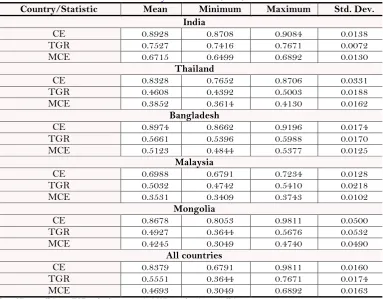
As shown in Table 3 and Figure 1, the average CEs for each country range from 0.6988 to 0.8974. Malaysia’s cost-efficiency is the lowest, with the other countries averaging over 0.8. Further analysis of their TGR and MCE provides estimates of the efficiency values for each country, which are all at the same metafrontier cost function. Table 3 and Figure 2 show that the estimated TGR lies between 0.3644 and 0.7671. The average TGR value of Thailand is the lowest at 0.4245, whereas India’s is the highest at 0.7527.
Table-3. Summary Statistics for CE, TGR, and MCE
Country/Statistic Mean Minimum Maximum Std. Dev.
India
CE 0.8928 0.8708 0.9084 0.0138
TGR 0.7527 0.7416 0.7671 0.0072
MCE 0.6715 0.6499 0.6892 0.0130
Thailand
CE 0.8328 0.7652 0.8706 0.0331
TGR 0.4608 0.4392 0.5003 0.0188
MCE 0.3852 0.3614 0.4130 0.0162
Bangladesh
CE 0.8974 0.8662 0.9196 0.0174
TGR 0.5661 0.5396 0.5988 0.0170
MCE 0.5123 0.4844 0.5377 0.0125
Malaysia
CE 0.6988 0.6791 0.7234 0.0128
TGR 0.5032 0.4742 0.5410 0.0218
MCE 0.3531 0.3409 0.3743 0.0102
Mongolia
CE 0.8678 0.8053 0.9811 0.0500
TGR 0.4927 0.3644 0.5676 0.0532
MCE 0.4245 0.3049 0.4740 0.0490
All countries
CE 0.8379 0.6791 0.9811 0.0160
TGR 0.5551 0.3644 0.7671 0.0174
MCE 0.4693 0.3049 0.6892 0.0163
Note: CE, cost-efficiency; TGR, technology gap ratio; MCE, metafrontier cost-efficiency.
Figure-1. CE for Banks Note: CE, cost-efficiency.
Figure-2. TGR for Banks Note: TGR, technology gap ratio.
Figure-3. MCE for Banks Note: MCE, metafrontier cost-efficiency.
4.4. Economies of Scale and Scope
Table 4 indicates the average values for the economies of scale and scope. The economies of scale average for Indian banks is 1.0060, indicating constant returns to scale. The averages for banks in Thailand, Bangladesh, and Malaysia are 0.5354, 0.3586, and 0.4198, respectively, showing increasing returns to scale, larger size, and lower operating costs. For Mongolian banks, the average is 2.5467, revealing decreasing returns to scale and diseconomies of scale.
The economies of scope averages for Malaysian, Thai, and Indian banks are 5.1060, 1.2928, and 0.3696, respectively, implying scope economies and demonstrating that diversification in financial products reduces costs. However, the averages for Bangladeshi and Mongolian banks are –0.8319 and –0.4212, respectively, indicating diseconomies of scope.
Table-4. Estimated Economies of Scale and Scope
Country Economies of Scale Economies of Scope
India 1.0060 0.3696
Thailand 0.5354 1.2928
Bangladesh 0.3586 -0.8319
Malaysia 0.4198 5.1060
Mongolia 2.5467 -0.4212
5. CONCLUSION
This study uses the stochastic frontier approach (SFA) of Battese and Coelli (1995) and stochastic metafrontier function (SMF) of Huang et al. (2014) to explore the different effects of financial regulations on the cost-efficiency of banking in India, Thailand, Bangladesh, Malaysia, and Mongolia from 2000 to 2010. The findings show that banking efficiency is not significantly influenced by minimum capital requirements; however, higher capitalization helps to alleviate agency problems between managers and shareholders, and provides shareholders with greater incentives to monitor management’s performance and ensure their bank operates efficiently. The empirical results also show that the higher the interest rate spread, the greater the profit and cost-efficiencies, and the higher the market concentration, the lower the cost-efficiency of banks in developing Asian countries.
For banking supervision, the estimated SMF under the metafrontier cost function of the five countries, whether considering TGR or MCE, reveals Indian banks have the best results at 0.7527 and 0.6715, respectively, while Thailand has the lowest TGR value at 0.4608 and Malaysia the lowest MCE value at 0.3531.
The outcome for economies of scale and scope reveal that Thailand, Bangladesh, and Malaysia have increasing returns to scale, implying that the larger the bank, the lower the operating costs. On the other hand, Bangladeshi and Mongolian banks have diseconomies of scope, indicating that expanding scope does not enhance but diminishes the value of businesses in their portfolios.
Notes
2. We use stochastic frontier analysis (SFA) rather than DEA because of its main advantage in allowing us to distinguish between inefficiency and other stochastic shocks in the estimation of efficiency scores (Yildirim and Philippatos, 2007).
3. As data on the number of employees are not available from the database, the price of labor is defined as total assets, the definition used by Huang et al. (2015).
Funding: This study received no specific financial support.
Competing Interests: The authors declare that they have no competing interests.
Contributors/Acknowledgement: Both authors contributed equally to the conception and design of the study.
REFERENCES
Allen, F. and D. Gale, 2000. Comparing financial systems. Cambridge and London: MIT Press.
Barth, J.R., G. Caprio and R. Levine, 2004. Bank regulation and supervision: What works best? Journal of Financial Intermediation, 13(2): 205–248.
Barth, J.R., G. Caprio and R. Levine, 2006. Rethinking bank regulation: Till angels govern. Cambridge: Cambridge University Press.
Barth, J.R., G.J. Caprio and R. Levine, 2008. Bank regulations are changing: For better or worse? Comparative Economic Studies, 50(4): 537–563.Available at: https://doi.org/10.1057/ces.2008.33.
Barth, J.R., J.G. Caprio and R. Levine, 2001. Banking systems around the globe: Do regulations and ownership affect performance and stability? In: Mishkin, F. S. (Ed.), Prudential supervision: What works and what doesn’t. U.S.A: Published in January 2001 by University of Chicago Press. pp: 31–96.
Barth, J.R., C. Lin, Y. Ma, J. Seade and F.M. Song, 2013. Do bank regulation, supervision and monitoring enhance or impede bank efficiency? Journal of Banking & Finance, 37(8): 2879-2892.Available at: https://doi.org/10.1016/j.jbankfin.2013.04.030.
Battese, G.E. and T.J. Coelli, 1995. A model for technical inefficiency effects in a stochastic frontier production function for panel data. Empirical Economics, 20(2): 325-332.Available at: https://doi.org/10.1007/bf01205442.
Battese, G.E., D.P. Rao and C.J. O'donnell, 2004. A metafrontier production function for estimation of technical efficiencies and technology gaps for firms operating under different technologies. Journal of Productivity Analysis, 21(1): 91-103.Available at: https://doi.org/10.1023/b:prod.0000012454.06094.29.
Beck, T., A. Demirgüç-Kunt and R. Levine, 2006. Bank supervision and corruption in lending. Journal of Monetary Economics, 53(8): 2131-2163.Available at: https://doi.org/10.1016/j.jmoneco.2005.10.014.
Beck, T., R. Levine and A. Levkov, 2010. Big bad banks? The winners and losers from bank deregulation in the United States. The Journal of Finance, 65(5): 1637-1667.Available at: https://doi.org/10.1111/j.1540-6261.2010.01589.x.
Becker, G.S., 1983. A theory of competition among pressure groups for political influence. The Quarterly Journal of Economics, 98(3): 371-400.Available at: https://doi.org/10.2307/1886017.
Behr, P., R.H. Schmidt and R. Xie, 2010. Market structure, capital regulation and bank risk taking. Journal of Financial Services Research, 37(2-3): 131-158.Available at: https://doi.org/10.1007/s10693-009-0054-y.
Berger, A.N. and T.H. Hannan, 1989. The price–concentration relationship in banking. Review of Economics and Statistics, 71(2): 291–299.
Berger, A.N. and D.B. Humphrey, 1997. Efficiency of financial institutions: International survey and directions for future research. European Journal of Operational Research, 98(2): 175-212.Available at: https://doi.org/10.1016/s0377-2217(96)00342-6.
Bhattacharyya, A., C.K. Lovell and P. Sahay, 1997. The impact of liberalization on the productive efficiency of Indian commercial banks. European Journal of Operational Research, 98(2): 332-345.Available at: https://doi.org/10.1016/s0377-2217(96)00351-7.
Blum, J., 1999. Do capital adequacy requirements reduce risks in banking? Journal of Banking & Finance, 23(5): 755-771.Available at: https://doi.org/10.1016/s0378-4266(98)00113-7.
Chansarn, S., 2008. The relative efficiency of commercial banks in Thailand: DEA approach. International Research Journal of Finance and Economics, 18(3): 53-68.
Chantapong, S., 2005. Comparative study of domestic and foreign bank performance in Thailand: The regression analysis. Economic Change and Restructuring, 38(1): 63-83.Available at: https://doi.org/10.1007/s10644-005-4523-5.
Cheng, C.P., L.W. Liang and C.W. Hsu, 2010. The impact of differentiated supervision on the cost efficiency of Taiwanese and Japanese banking. The Taiwan Journal of Applied Economics: 145-189.
Chidoko, C. and N. Mashavira, 2014. An analysis of corporate governance in the banking sector of Zimbabwe. Humanities and Social Sciences Letters, 2(3): 174-180.
Chortareas, G.E., C. Girardone and A. Ventouri, 2012. Bank supervision, regulation, and efficiency: Evidence from the European union. Journal of Financial Stability, 8(4): 292-302.Available at: https://doi.org/10.1016/j.jfs.2011.12.001.
Claessens, S. and L. Laeven, 2004. What drives bank competition some international evidence. Journal of Money, Credit and Banking, 36(3): 563–584.Available at: https://doi.org/10.1353/mcb.2004.0050.
Dabla-Norris, M.E. and F. Holger, 2007. Bank efficiency and market structure: What determines banking spreads in Armenia?. International Monetary Fund(7-134).
Das, A. and S. Ghosh, 2009. Financial deregulation and profit efficiency: A nonparametric analysis of Indian banks. Journal of Economics and Business, 61(6): 509-528.Available at: https://doi.org/10.1016/j.jeconbus.2009.07.003.
De Grauwe, P., 2008. The banking crisis: Causes, consequences and remedies, CEPS Policy Brief, No. 178. Brussels: Centre for European Policy Studies.
Demirgüç-Kunt, A. and E. Detragiache, 1998. The determinants of banking crises in developing and developed countries. Staff Papers, 45(1): 81-109.Available at: https://doi.org/10.2307/3867330.
Demirgüç-Kunt, A., I. Love and V. Maksimovic, 2006. Business environment and the incorporation decision. Journal of Banking and Finance, 30(11): 2967-2993.Available at: https://doi.org/10.1016/j.jbankfin.2006.05.007.
Demirguc–Kunt, A., L. Laeven and R. Levine, 2004. Regulation, market structure, institutions, and cost of financial intermediation. Journal of Money, Credit and Banking, 36: 593–622.Available at: https://doi.org/10.1353/mcb.2004.0045.
DeYoung, R., 1998. Management quality and X-inefficiency in national banks. Journal of Financial Services Research, 13(1): 5-22.
Drake, L., M.J. Hall and R. Simper, 2006. The impact of macroeconomic and regulatory factors on bank efficiency: A non-parametric analysis of Hong Kong’s banking system. Journal of Banking & Finance, 30(5): 1443-1466.Available at: https://doi.org/10.1016/j.jbankfin.2005.03.022.
Eisenbeis, R.A., G.D. Ferrier and S.H. Kwan, 1999. The informativeness of stochastic frontier and programming frontier efficiency scores: Cost efficiency and other measures of bank holding company performance. Federal Reserve Bank of Atlanta, Working Paper, 99–23.
Fernández, A.I. and F. Gonzalez, 2005. How accounting and auditing systems can counteract risk-shifting of safety-nets in banking: Some international evidence. Journal of Financial Stability, 1(4): 466-500.Available at: https://doi.org/10.1016/j.jfs.2005.07.001.
Fernando, J.R. and P. Nimal, 2014. Does risk management affect on bank efficiency? An analysis of Sri Lankan banking sector. International Journal of Management and Sustainability, 3(2): 97-110.
Fukuyama, H., R. Guerra and W.L. Weber, 1999. Efficiency and ownership: Evidence from Japanese credit cooperatives. Journal of Economics and Business, 51(6): 473-487.Available at: https://doi.org/10.1016/s0148-6195(99)00020-x.
Gan–Ochir, D., 2008. Capital flows and their implication for central bank policies: The case of Mongolia. Bank of Mongolia. Georgios, C.E., C. Girardone and A. Ventouri, 2012. Bank supervision, regulation, and efficiency: Evidence from the European
union. Journal of Financial Stability, 8(4): 292-302.Available at: https://doi.org/10.1016/j.jfs.2011.12.001.
Goddard, J., P. Molyneux and J.O. Wilson, 2004. The profitability of European banks: A cross-sectional and dynamic panel analysis. The Manchester School, 72(3): 363-381.
Gorton, G. and A. Winton, 1995. Bank capital regulation in general equilibrium, NBER Working Paper, 5244. Greenspan, A., 2007. The age of turbulence: Adventures in a new world. U.S.A: Publisher: Penguin Books.
Haque, F. and K. Brown, 2017. Bank ownership, regulation and efficiency: Perspectives from the Middle East and North Africa (MENA) region. International Review of Economics & Finance, 47: 273-293.Available at: https://doi.org/10.1016/j.iref.2016.10.015.
Hellmann, T., K. Murdock and J. Stiglitz, 1994. Addressing moral hazard in banking: Deposit rate control vs. Capital requirements. Mimeo: Stanford University.
Hermes, N. and V.T.H. Nhung, 2010. The impact of financial liberalization on bank efficiency: Evidence from Latin America and Asia. Applied Economics, 42(26): 3351–3365.Available at: https://doi.org/10.1080 /00036840802112448.
Hovakimian, A. and E.J. Kane, 2000. Effectiveness of capital regulation at US commercial banks, 1985 to 1994. The Journal of Finance, 55(1): 451-468.Available at: https://doi.org/10.1111/0022-1082.00212.
Huang, C.J., T.-H. Huang and N.-H. Liu, 2014. A new approach to estimating the metafrontier production function based on a stochastic frontier framework. Journal of Productivity Analysis, 42(3): 241-254.Available at: https://doi.org/10.1007/s11123-014-0402-2.
Huang, T.-H., D.-L. Chiang and C.-M. Tsai, 2015. Applying the new metafrontier directional distance function to compare banking efficiencies in Central and Eastern European countries. Economic Modelling, 44: 188-199.Available at: https://doi.org/10.1016/j.econmod.2014.10.029.
Iannotta, G., G. Nocera and A. Sironi, 2007. Ownership structure, risk and performance in the European banking industry. Journal of Banking & Finance, 31(7): 2127-2149.Available at: https://doi.org/10.1016/j.jbankfin.2006.07.013.
Jeon, Y. and S.M. Miller, 2002. Bank concentration and performance. Working Paper, 2002–25.
Kalyvas, A.N. and E. Mamatzakis, 2014. Does business regulation matter for banks in the European union?. Journal of International Financial Markets, Institutions and Money, 32: 278-324.Available at: https://doi.org/10.1016/j.intfin.2014.06.007.
Kaufman, G.G., 1992. Capital in banking: Past, present and future. Journal of Financial Services Research, 5(4): 385-402. Keeley, M.C. and F.T. Furlong, 1990. A reexamination of mean-variance analysis of bank capital regulation. Journal of Banking
& Finance, 14(1): 69-84.Available at: https://doi.org/10.1016/0378-4266(90)90036-2.
Laeven, L. and R. Levine, 2009. Bank governance, regulation and risk taking. Journal of Financial Economics, 93(2): 259-275.Available at: https://doi.org/10.1016/j.jfineco.2008.09.003.
Lee, T.-H., L.-W. Liang and B.-Y. Huang, 2013. Do mergers improve the efficiency of banks in Taiwan? Evidence from stochastic frontier approach. The Journal of Developing Areas, 47(1): 395-416.Available at: https://doi.org/10.1353/jda.2013.0017.
Lensink, R., A. Meesters and I. Naaborg, 2008. Bank efficiency and foreign ownership: Do good institutions matter? Journal of Banking & Finance, 32(5): 834-844.Available at: https://doi.org/10.1016/j.jbankfin.2007.06.001.
Levine, R., 2004. Finance and growth: Theory and evidence, in Aghion P and S Durlauf (eds), Handbook of Economic Growth, Elsevier, 1: 865–934.
Mester, L.J., 1996. A study of bank efficiency taking into account risk-preferences. Journal of Banking & Finance, 20(6): 1025-1045.Available at: https://doi.org/10.1016/0378-4266(95)00047-x.
Minsky, H.P., 1982. Can ―it‖ happen again?: Essays on instability and finance. Armonk, New York: M.E. Sharpe Inc.
Morck, R., M. Nakamura and A. Shivdasani, 2000. Banks, ownership structure, and firm value in Japan. The Journal of Business, 73(4): 539-567.Available at: https://doi.org/10.1086/209654.
O’Donnell, C.J., D.P. Rao and G.E. Battese, 2008. Metafrontier frameworks for the study of firm-level efficiencies and technology ratios. Empirical Economics, 34(2): 231-255.Available at: https://doi.org/10.1007/s00181-007-0119-4.
Okuda, H. and S. Rungsomboon, 2006. Comparative cost study of foreign and Thai domestic banks in 1990–2002: Its policy implications for a desirable banking industry structure. Journal of Asian Economics, 17(4): 714-737.Available at: https://doi.org/10.1016/j.asieco.2006.06.012.
Omar, M.A., A.R.A. Rahman, R.M. Yusof and M.E.S.M. Rasid, 2006. Efficiency of commercial banks in Malaysia. Asian Academy of Management Journal of Accounting and Finance, 2(2): 19-42.
Orji, A., J.E. Ogbuabor, A.N. Okon and O.I. Anthony-Orji, 2018. Electronic banking innovations and selected banks performance in Nigeria. The Economics and Finance Letters, 5(2): 46-57.Available at: https://doi.org/10.18488/journal.29.2018.52.46.57.
Pasiouras, F., 2008. International evidence on the impact of regulations and supervision on banks’ technical efficiency: An application of two-stage data envelopment analysis. Review of Quantitative Finance and Accounting, 30(2): 187-223.Available at: https://doi.org/10.1007/s11156-007-0046-7.
Pasiouras, F., S. Tanna and C. Zopounidis, 2009. The impact of banking regulations on banks' cost and profit efficiency: Cross-country evidence. International Review of Financial Analysis, 18(5): 294-302.Available at: https://doi.org/10.1016/j.irfa.2009.07.003.
Pilloff, S.J. and S.A. Rhoades, 2002. Structure and profitability in banking markets. Review of Industrial Organization, 20(1): 81-98.
Santos, J.A., 2001. Bank capital regulation in contemporary banking theory: A review of the literature. Financial Markets, Institutions & Instruments, 10(2): 41-84.Available at: https://doi.org/10.1111/1468-0416.00042.
Sassi, H., 2013. The impact of bank regulations and institutions on efficiency in selected MENA banks. International Journal of Economics and Finance, 5(8): 84-100.Available at: https://doi.org/10.5539/ijef.v5n8p84.
Sathye, M., 2003. Efficiency of banks in a developing economy: The case of India. European Journal of Operational Research, 148(3): 662-671.Available at: https://doi.org/10.1016/s0377-2217(02)00471-x.
Shleifer, A. and R.W. Vishny, 1989. Management entrenchment: The case of manager-specific investments. Journal of Financial Economics, 25(1): 123-139.
Syadullah, M., 2018. ASEAN banking efficiency review facing financial services liberalization: The Indonesian perspective. Asian Development Policy Review, 6(2): 88-99.Available at: https://doi.org/10.18488/journal.107.2018.62.88.99.
Tahir, I.M. and N.M.A. Bakar, 2009. Evaluating efficiency of Malaysian banks using data envelopment analysis. International Journal of Business and Management, 4(8): 96-106.
Tahir, I.M., N.M.A. Bakar and S. Haron, 2010. Cost and profit efficiency of the Malaysian commercial banks: A comparison between domestic and foreign banks. International Journal of Economics and Finance, 2(1): 186-197.Available at: https://doi.org/10.5539/ijef.v2n1p186.
Tegshee, L., 2009. Determinants of competition of commercial banks in Mongolia. Master’s Thesis, Published by National Cheng Kung University, Taiwan, R.O.C.. pp:1-64.
Tsolmon, E., 2010. Mongolian banking system. Ulaanbaatar: Economic Research Institute for Northeast Asia.
Uddin, S.S. and Y. Suzuki, 2011. Financial reform, ownership and performance in banking industry: The case of Bangladesh. International Journal of Business and Management, 6(7): 28-39.Available at: https://doi.org/10.5539/ijbm.v6n7p28. Yamaguchi, M., 2018. Are foreign banks in China homogenous?: Classification of their business patterns. Journal of Accounting,
Yasmeen, W., 2011. Technical efficiency in the Bangladeshi banking industry: A non-parametric analysis. The 2011 Barcelona European Academic Conference, Barcelona, Spain. pp: 1099-1109.
Yildirim, H.S. and G.C. Philippatos, 2007. Efficiency of banks: Recent evidence from the transition economies of Europe, 1993– 2000. European Journal of Finance, 13(2): 123-143.Available at: https://doi.org/10.1080/13518470600763687. Yuliansyah, Y., 2015. Attributes influencing strategic alignment in the service sector: An Indonesian banking sector case study.
International Journal of Business, Economics and Management, 2(2): 34-48.Available at: https://doi.org/10.18488/journal.62/2015.2.2/68.2.34.48.