Modification of the Riemann problem and the application for the boundary
conditions in computational fluid dynamics
MartinKyncl1,aandJaroslavPelant1,b
1Aerospace Research and Test Establishment (VZL ´U),
Beranov´ych 130, 199 05 Praha - Letˇnany, Czech Republic
Abstract. We work with the system of partial differential equations describing the non-stationary compressible turbulent fluid flow. It is a characteristic feature of the hyperbolic equations, that there is a possible raise of discontinuities in solutions, even in the case when the initial conditions are smooth. The fundamental problem in this area is the solution of the so-called Riemann problem for the split Euler equations. It is the elementary problem of the one-dimensional conservation laws with the given initial conditions (LIC - left-hand side, and RIC - right-hand side). The solution of this problem is required in many numerical methods dealing with the 2D/3D fluid flow. The exact (entropy weak) solution of this hyperbolical problem cannot be expressed in a closed form, and has to be computed by an iterative process (to given accuracy), therefore various approximations of this solution are being used. The complicated Riemann problem has to be further modified at the close vicinity of boundary, where the LIC is given, while the RIC is not known. Usually, this boundary problem is being linearized, or roughly approximated. The inaccuracies implied by these simplifications may be small, but these have a huge impact on the solution in the whole studied area, especially for the non-stationary flow. Using the thorough analysis of the Riemann problem we show, that the RIC for the local problem can be partially replaced by the suitable complementary conditions. We suggest such complementary conditions accordingly to the desired preference. This way it is possible to construct the boundary conditions by the preference of total values, by preference of pressure, velocity, mass flow, temperature. Further, using the suitable complementary conditions, it is possible to simulate the flow in the vicinity of the diffusible barrier. On the contrary to the initial-value Riemann problem, the solution of such modified problems can be written in the closed form for some cases. Moreover, using such construction, the local conservation laws are not violated. Algorithms for the solution of the modified Riemann problems were coded and used within our own developed code for the solution of the compressible gas flow (the Euler, the Navier-Stokes, and the RANS equations). Numerical examples show superior behaviour of the suggested boundary conditions. Constructed boundary conditions are robust and accelerate the convergence of the method. The original result of our work is the analysis of various modifications of the Riemann problem and its applications.
1 Introduction
Undoubtedly, the boundary conditions play important role in the computational fluid dynamics (CFD). We work with the system of equations describing non-stationary compress-ible turbulent fluid flow, i.e. the Reynolds-Averaged Navier-Stokes (RANS) equations in 2D and 3D. We focus on the numerical solution of these equations, and on the bound-ary conditions. We suggest the original approach to the boundary conditions. The aim is to satisfy the conserva-tion laws in the close vicinity of the boundary. Usually, the boundary problem is being linearized, or roughly aprox-imated. The inaccuracies implied by these simplifications may be small, but it has a huge impact on the solution in the whole studied area, especially for the non-stationary flow. In our approach we try to be as exact as possible. There-fore we use the analysis of the so-called Riemann problem
for the 2D/3D split Euler equations in order to construct
the boundary values (for the density, velocity, pressure).
a e-mail:[email protected] b e-mail:[email protected]
We solve the boundary modifications of this initial-value problem. The crucial problem of many numerical methods for the solution of the compressible flow lies in the
evalu-ation of the so-called fluxes through the edges/facesΓi jof
the particular elements. The state values in the vicinity of
the edgeΓi jare known at time instanttk, and these values
form the initial conditions (LIC - left-hand side, and RIC - right-hand side) for the so-called Riemann problem for
the 2D/3D split Euler equations. The exact (entropy weak)
[13, pages 221-225], where the RIC is constructed in a spe-cial way, in order to obtain the desired solution. Using the analysis of the Riemann problem we show, that the RIC for the local problem can be partially replaced by the suitable complementary condition. Some of the suggested bound-ary conditions were shown in [8] (by preference of pres-sure, temperature, velocity,...). We complement the bound-ary problem suitably, and we show the analysis of the re-sulting uniquely-solvable modified Riemann problem. We construct own algorithm for the solution of this boundary problem. It can be used within various methods in CFD. The algorithm was coded and used within our own devel-oped code for the solution of the compressible gas flow (the Euler, NS, and RANS equations).
2 The Riemann Problem for the Split Euler
Equations
For many numerical methods dealing with the two or three dimensional equations, describing the compressible flow,
it is useful to solve the Riemann problem for the3D split
Euler equations. We search the solution of the system of
partial differential equations in timetand space (x, y,z)
∂ ∂t +
∂u
∂x =0
∂u
∂t +
∂(p+u2)
∂x =0
∂v ∂t +
∂uv
∂x =0
∂w ∂t +
∂uw ∂x =0
∂E
∂t +
∂u(E+p) ∂x =0,
(1)
equipped with the initial conditions
(x,t)=L,u(x,t)=uL,p(x,t)=pL, x<0, (2)
(x,t)=R,u(x,t)=uR,p(x,t)=pR, x>0. (3)
Vectoru=(u, v, w) denotes the velocity,density,p
pres-sure,E=e+|u|2is the total energy, withedenoting the
specific internal energy. We assume the equation of state for the calorically ideal gas
e= p
(γ−1).
‘Split’ means here that we still have 5 equations in 3D,
but the dependence ony,z(space coordinates) is neglected,
and we deal with the system for one space variablex. The
system (1) is considered in the setQ∞=(−∞,∞)×(0,+∞).
The solution of this problem is fundamentally the same as the solution of the Riemann problem for the 1D Eu-ler equations, see [9, page 138]. In fact, the solution for the pressure, the first component of the velocity, and the density is exactly the same as in one-dimensional case. It is a characteristic feature of the hyperbolic equations, that there is a possible raise of discontinuities in solutions, even in the case when the initial conditions are smooth, see [12, page 390]. Here the concept of the classical solution is too restrictive, and therefore we seek a weak solution of this problem. To distinguish physically admissible so-lutions from nonphysical ones, entropy condition must be introduced, see [12, page 396]. By the solution of the
prob-lem (1),(2),(3) we mean theweak entropy solutionof this
problem inQ∞. The analysis to the solution of this
prob-lem can be found in many books, i.e. [9], [12], [13]. The
general theorem on the solvability of the Riemann problem can be found in [9, page 88].
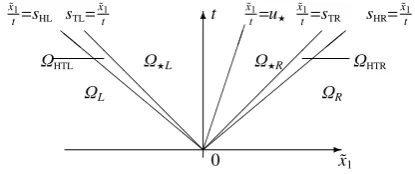
The solution is piecewisesmoothand its general form
can be seen in Fig. 1, where the system of half lines is drawn.
-6t
˜
x1
0
@ @ @ @ @ @
l l l l l l l l
,,
,,
,,
,,
˜ x1
t=sHL sTL=
˜ x1
t
˜ x1
t=u ˜ x1
t=sTR sHR=
˜ x1
t
ΩHTL
ΩL
ΩL ΩR
ΩR
ΩHTR
Fig. 1. Structure of the solution of the Riemann problem (1),(2),(3)
These half lines define regions, where solution is either constant or given by a smooth function. Let us define the
open sets calledwedges(see Fig. 1):
ΩL=wedge(L−∞,sHL),
ΩHTL=wedge(sHL,sTL),
ΩL=wedge(sTL,u∗),
ΩR =wedge(u,sTR),
ΩHTR=wedge(sTR,sHR),
ΩR =wedge(sHR,L+∞).
Using the theory in [9], [12], [13], we can write the solu-tion for the primitive variables as
(,u, v, w,p)|ΩL =(L,uL, vL, wL,pL),
(,u, v, w,p)|ΩL =(L,u, vL, wL,p),
(,u, v, w,p)|ΩR =(R,u, vR, wR,p),
(,u, v, w,p)|ΩR =(R,uR, vR, wR,pR).
The folowing relations for these variables hold:
u=uL+
⎧⎪⎪ ⎪⎪⎪⎨ ⎪⎪⎪⎪⎪ ⎩
−(p−pL)
2
(γ+1)L
p+γγ−+11pL
1
2
,p>pL
2 γ−1aL
1− p
pL
(γ−1)/2γ
,p≤pL
(4)
L=
⎧⎪⎪⎪ ⎪⎨
⎪⎪⎪⎪⎩L
γ−1 γ+1pLp+1
pL p+γ−
1 γ+1
,p>pL
L ppL
1
γ, p
≤pL
(5)
s1
T L=
⎧⎪⎪⎪ ⎨
⎪⎪⎪⎩uL−aL
γ+1 2γ
p pL +
γ−1
2γ, p>pL
u−aL ppL
(γ−1)/2γ
, p≤pL
(6)
u=uR+
⎧⎪⎪⎪ ⎪⎪⎨ ⎪⎪⎪⎪⎪ ⎩
(p−pR)
2
(γ+1)R
p+γγ−+11pR
1
2
,p>pR,
− 2 γ−1aR
1− ppR(γ−1)/2γ
,p≤pR
(7)
R=
⎧⎪⎪⎪ ⎪⎨
⎪⎪⎪⎪⎩R
p pR+γ−
1 γ+1 γ−1 γ+1
p pR+1,
p>pR
R ppR
1
γ, p
≤pR
(8)
s3T R =⎧⎪⎪⎪⎨⎪⎪⎪⎩uR+aR
γ+1 2γ
p pR +
γ−1
2γ ,p>pR
u+aR ppR
(γ−1)/2γ
, p≤pR
HereaL =
γpL/L, aR =
γpR/R, andγdenotes
the adiabatic constant. Furthers1
T Ldenotes ”unknown left
wave speed”,s3
T R”unknown right wave speed”. Note, that
the system (4) - (9) is the system of 6 equations for 6
un-knownsp,u,LR,s1T L,s3T R.
Solution for the Pressurep
The combination of the equations (4), (7) gives the implicit
equation for the unknown pressurep
uL+F1L(p)=uR+F3R(p),
with
F1L(p)=
⎧⎪⎪ ⎪⎪⎪⎨ ⎪⎪⎪⎪⎪ ⎩
−(p−pL)
2
(γ+1)L
p+γ−1 γ+1pL
1 2
, p>pL
2
γ−1aL
1− ppL(γ−1)/2γ
, p≤pL.
,
F3R(p)=
⎧⎪⎪ ⎪⎪⎪⎨ ⎪⎪⎪⎪⎪ ⎩
(p−pR)
2
(γ+1)R
p+γ−1 γ+1pR
1 2
, p>pR,
− 2
γ−1aR
1− pp
R (γ−1)/2γ
, p≤pR.
This is a nonlinear algebraic equation, and one cannot express the analytical solution of this problem in a closed
form. The solutionpcan be found as the root of the
func-tionF(p) defined as
F(p)=F3R(p)−F1L(p)+uR−uL. (10)
The analysis of this function can be found in [9]. Here we
state, thatF(p) is monotone and concave. Also the analytic
expression for its derivative is available. For a positive
so-lution for the pressureF(0)<0 is required. This gives the
pressure positivity condition
uR−uL<
2
γ−1(aL+aR). (11)
The Newton method can be used to find the root ofF(p)=
0. With the pressurepknown, we use the equations
(4)-(9) to obtain the whole solution.
Remarks
– Once the pressurepis known, the solution on the
left-hand side of the contact discontinuity depends only on the left-hand side initial condition (2). And similarily,
withpknown, only the right-hand side initial
condi-tion (3) is used to compute the solucondi-tion on the right-hand side of the contact discontinuity.
– The solution inΩL∪ΩHT L∪ΩL(across 1 wave)
(solv-ability in general case)
The solution components inΩL∪ΩHT L∪ΩLregion
must satisfy the system of equations (4)-(6). It is a
sys-tem of three equations for four unknowns (L,p,u,
s1
T L). We have to add another equation in order to get
the uniquely solvable system inΩL∪ΩHT L∪ΩL. This
is the key problem for the outlet boundary condition.
– The equation (4) can be written as the equation for
pressure, see [8]
p=P(u), (12)
P(u)=
PS(u), u<uL,
PR(u), uL≤u<uL+γ−21aL,
with
PS(u)=
2pL+γ+21L(uL−u)
2+(u
L−u)
4LγpL+2L(γ+21)2(uL−u)2
2 ,
PR(u)=pL
⎛ ⎜⎜⎜⎜⎜
⎝−u+uL+
2
γ−1aL 2
γ−1aL
⎞ ⎟⎟⎟⎟⎟ ⎠
2γ γ−1
.
3 Boundary Condition by Preference of
Pressure
Using this boundary condition, we try to prescribe given static pressure at the face. This boundary condition corre-sponds to the real-world problem, when we deal with the experimentally obtained pressure distribution at the bound-ary. The conservation laws must be satisfied in close vic-nity to the boundary face. We use the analysis of the in-complete Riemann problem to construct the values for the density and the pressure at each boundary face. The fol-lowing notation is used (some values are used only for an INLET case)
B static density at the boundary (unknown)
pB static pressure at the boundary (unknown)
uB velocity vector at the boundary (in global
coordi-nates) (unknown)
uB normal component of velocity at the boundary
(lo-cal coordinates) (unknown)
n unit outer normal to facen=(n1,n2,n3)
L static density near the wall, time 0
pL static pressure near the wall, time 0
uL velocity vector, state near the wall at time 0
uL normal component of velocity, state near the wall
at time 0,uL=uL·n
pGIVENgiven value for the pressure (=desired pressure at
the face)
GIVENgiven value for the density (=desired INLET
den-sity at the face)
d given INLET velocity directiond=(d1,d2,d3)
At the vicinity of the boundary we solve the modified Rie-mann problem for the split Euler equations (1), introduced in Section 2, with the left-hand side initial condition (2)
and thecomplementary conditions(prescribed pressure).
p=pGIVEN, (13)
pR=p, (14)
Herepdenotes the pressure inΩL∪ΩRpart of the
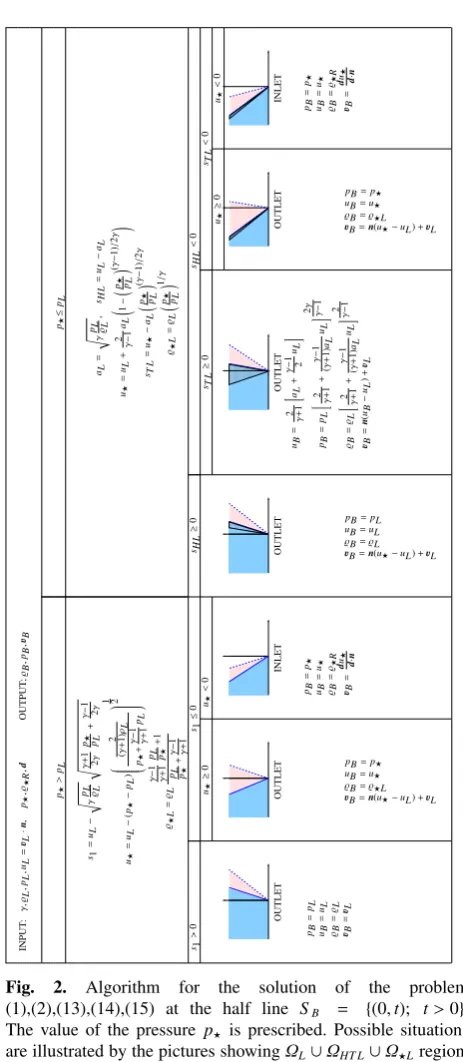
solu-tion of the Riemann problem for the split Euler equasolu-tions, shown in Section 2. This way we have prescribed the de-sired pressure value whenever it is possible (see the general form of the solution in Section 2). Now it is possible to use (4),(5),(6) Further we must discuss all the possibilities of the left (shock, rarefaction) and the middle (discontinuity) wave in the solution, which is shown in figure 2. In the case ofoutlet(u ≥0), the transformation of the velocity into the global coordinates is
uB=n(uB−uL)+uL.
HereuB denotes the computed velocity in the normal
di-rection. In the case of aninlet(u<0) we mustprescribe
another conditionsin order to obtain a uniquely solvable system. Here we may choose (for example) arbitrary den-sityGIVENand the direction of the velocityd.
R =GIVEN, uB=d|u|, with uB·n=u (15)
Then it is
pB =pGIVEN, B=GIVEN, uB= d
u
d·n.
The analysis of this problem was shown also in [8].
INPUT : γ, L , pL , uL = uL · n , p , R , d OUTPUT ; B , pB , uB p > pL p ≤ pL s1 = uL − γ pLL γ
+
1
2
γ
ppL
+ γ − 1 2 γ u = uL − ( p − pL ) ⎛ ⎜ ⎜ ⎜ ⎜ ⎜ ⎜ ⎜ ⎜ ⎜ ⎝ 2 ( γ + 1) ρL p + γ − 1 γ + 1 pL ⎞ ⎟ ⎟ ⎟ ⎟ ⎟ ⎟ ⎟ ⎟ ⎟ ⎠ 1 2 L = L γ − 1 γ + 1
pLp
+
1
pL p
+ γ − 1 γ + 1 aL = γ pL,L
s HL = uL − aL u = uL + 2 γ − 1 aL 1−
pp
L (γ− 1) / 2 γ s TL = u − aL ppL (γ− 1) / 2 γ L = L pp
L 1/γ s1 > 0 s1 ≤ 0 s HL ≥ 0 s HL < 0 u ≥ 0 u < 0 s TL ≥ 0 s TL < 0 u ≥ 0 u < 0 OUTLET OUTLET INLET 000000000000000000000000000000000000000000000000000000000000000000000000000000000000000000000000000000000000000000000000000000000000000000000000000000000000000000000000000000000000000000000000000000000000000000000000000000000000000000000000000000000000000000000000000000000000000000000000000000 111111111111111111111111111111111111111111111111111111111111111111111111111111111111111111111111111111111111111111111111111111111111111111111111111111111111111111111111111111111111111111111111111111111111111111111111111111111111111111111111111111111111111111111111111111111111111111111111111111 OUTLET 00000000000000000000000000000000000000000000000000000000000000000000000000000000000000000000000000000000000000000000000000000000000000000000000000000000000000000000000000000000000000000000000000000000000000000000000000000000000000000000000000000000000000000000000000000000000000000000000000000000000000000000000000000000000000000000000000000000000000000000000000000000000000000000000000000000000000000000000000000000000000000000000000000000000000000000000000000000000000000 11111111111111111111111111111111111111111111111111111111111111111111111111111111111111111111111111111111111111111111111111111111111111111111111111111111111111111111111111111111111111111111111111111111111111111111111111111111111111111111111111111111111111111111111111111111111111111111111111111111111111111111111111111111111111111111111111111111111111111111111111111111111111111111111111111111111111111111111111111111111111111111111111111111111111111111111111111111111111111 OUTLET 000000000000000000000000000000000000000000000000000000000000000000000000000000000000000000000000000000000000000000000000000000000000000000000000000000000000000000000000000000000000000000000000000000000000000000000000000000000000000000000000000000000000000000000000000000000000000000000000000000000000000000000000000000000000000000000000000000000000000000000000000000000000000000000000000000000000000000000000000000000000000000000000000000000000000000000000000000000000000000000000000000000000000000000000000000000000000000000000000000000000000000000000000000000000000000000000000000000000000000000000000000000000000000000000000000000000000000000000000000000000000000000000000000000000000000000000000000000000000000000000000000000000000000000000000000000000000000000000000000 111111111111111111111111111111111111111111111111111111111111111111111111111111111111111111111111111111111111111111111111111111111111111111111111111111111111111111111111111111111111111111111111111111111111111111111111111111111111111111111111111111111111111111111111111111111111111111111111111111111111111111111111111111111111111111111111111111111111111111111111111111111111111111111111111111111111111111111111111111111111111111111111111111111111111111111111111111111111111111111111111111111111111111111111111111111111111111111111111111111111111111111111111111111111111111111111111111111111111111111111111111111111111111111111111111111111111111111111111111111111111111111111111111111111111111111111111111111111111111111111111111111111111111111111111111111111111111111111111111 OUTLET 000000000000000000000000000000000000000000000000000000000000000000000000000000000000000000000000000000000000000000000000000000000000000000000000000000000000000000000000000000000000000000000000000000000000000000000000000000000000000000000000000000000000000000000000000000000000000000000000000000000000000000000000000000000000000000000000000000000000000000000000000000000000000000000000000000000000000000000000000000000000000000000000000000000000000000000000000000000000000000000000000000000000000000000000000000000000000000000000000000000000000000000000000000000000000000000000000000000000000000000000000000000000000000000000000000000000000000000000000000000000000000000000000000000000000000000000000000000000000000000000000000000000000000000000000000000000000000000000000000 111111111111111111111111111111111111111111111111111111111111111111111111111111111111111111111111111111111111111111111111111111111111111111111111111111111111111111111111111111111111111111111111111111111111111111111111111111111111111111111111111111111111111111111111111111111111111111111111111111111111111111111111111111111111111111111111111111111111111111111111111111111111111111111111111111111111111111111111111111111111111111111111111111111111111111111111111111111111111111111111111111111111111111111111111111111111111111111111111111111111111111111111111111111111111111111111111111111111111111111111111111111111111111111111111111111111111111111111111111111111111111111111111111111111111111111111111111111111111111111111111111111111111111111111111111111111111111111111111111 INLET pB = pL uB = uL B = L uB = uL pB=p uB=u
B=L uB=n(u−uL)+uL pB = p uB = u B = R uB = d
u d·n pB=pL uB=uL
B=L uB=n(u−uL)+uL uB
=
2 γ+1
aL
+
γ
−
1u2
L
pB
=
pL 2 γ+
1 + γ − 1 ( γ + 1) aL uL 2 γ γ − 1 B = L 2 γ+
1 + γ − 1 ( γ + 1) aL uL
2 γ−1
uB = n ( uB − uL ) + uL pB=p uB=u
B=L uB=n(u−uL)+uL pB = p uB = u B = R uB = d
u d·n
Fig. 2. Algorithm for the solution of the problem (1),(2),(13),(14),(15) at the half line SB = {(0,t); t>0}.
The value of the pressure p is prescribed. Possible situations are illustrated by the pictures showingΩL∪ΩHT L∪ΩLregion.
The sought boundary state located at the time axis, marked red.
input data solution
Test uL p B uB pB
1 1.0 4.57991 1 -0.50000 4.57991
2 -1.0 0.12913 0.23175 0.50000 0.12913
3 2.0 0.5 1.0 2.0 1.0
4 2.0 3.0 1.0 2.0 1.0
5 2.0 6.77045 3.2593 0.00002 6.77045
6 2.0 8.0 1 -0.23607 8.0
4 Boundary Condition by Preference of
Velocity
Here we show the boundary condition prefering the pre-scribed given velocity at the face. The conservation laws must be satisfied in close vicnity to the boundary face. Therefore we use the analysis of the incomplete Riemann problem to construct the values for the density and the velocity at each boundary face. The following notation is used (some values are used only for an INLET case)
B static density at the boundary (unknown)
pB static pressure at the boundary (unknown)
uB velocity vector at the boundary (in global
coordi-nates) (unknown)
uB normal component of velocity at the boundary
(lo-cal coordinates) (unknown)
n unit outer normal to facen=(n1,n2,n3)
L static density near the wall, time 0
pL static pressure near the wall, time 0
uL velocity vector, state near the wall at time 0
uL normal component of velocity, state near the wall
at time 0,uL=uL·n
uGIVEN given velocity vector (=desired value at the face)
uGIVENgiven value for the normal vcomponent of
veloc-ity (=desired normal velocity at the face)
uGIVEN=uGIVEN·n
GIVENgiven value for the density (=desired INLET
den-sity at the face)
At the vicinity of the boundary we solve the modified Rie-mann problem for the split Euler equations (1), introduced in Section 2, with the left-hand side initial condition (2)
and thecomplementary conditions(prescribed normal
com-ponent of velocity).
u=uGIVEN, (16)
uR=u, (17)
Hereudenotes the normal component of velocity inΩL∪
ΩR part of the solution of the Riemann problem for the
split Euler equations, shown in Section 2. This way we have prescribed the desired normal component of velocity whenever it is possible (see the general form of the solution in Section 2). Now it is possible to use (12),(5),(6). Further we must discuss all the possibilities of the left (shock, rar-efaction) and the middle (discontinuity) wave in the solu-tion, which is shown in figure 3. The tangential velocities
are conserved (same as “left” values) in the case ofoutlet
(u ≥0), and the velocity vector in the global coordinates
is
uB=n(uB−uL)+uL.
HereuB denotes the computed velocity in the normal
di-rection. In the case of aninlet(u<0) we mustprescribe
another conditionsin order to obtain a uniquely solvable system. Here we may choose (for example) arbitrary den-sityGIVENand the whole vector of velocity
R=GIVEN, uR =uGIVEN. (18)
For example, it is possible to choose the densityR
us-ing the given entropy index po
oγ (po, oare some reference
values for the pressure and the density)
R =p1/γ/
po
γo
1/γ
=o
p
po
1/γ
Another possibility is to conserve (choose) the total
temperature θ0 for the inlet case. Then, using
thermody-namic relations (energy equation for a perfect gas), it is
R =
p
Rθ0 1−γ−21|uGIVEN|
2
γRθ0
. (19)
Letθ0 = θ0R = pR/(RR 1+γ−21 |uR|
2
γpR/R
) anduGIVEN =uR.
Then, using (19), it isR=RppR.
The algorithm for the construction of the primitive
vari-ablesB,uB,pBat the boundary face is shown in Fig. 3. The
complete analysis of this problem is shown in [8].
INPUT : γ, L , pL , uL = uL · n , u = uR · n , R , uR OUTPUT ; B , pB , uB u < uL u ≥ uL D = 4 L γ pL +
2(L
γ
+
1)22
( uL − u )2 p = 1 2 2p L + γ − 1 2 L ( uL − u )2 + ( uL − u ) √ D s1 = uL − γ pL L γ
+
1
2
γ
p pL
+ γ − 1 2 γ L = L γ − 1 γ + 1
pL p
+
1
pLp
+ γ − 1 γ + 1 aL = γ pL,L
s HL = uL − aL p = pL ⎛ ⎜ ⎜ ⎜ ⎜ ⎜ ⎜ ⎜ ⎜ ⎝− u + uL + 2 γ − 1 aL 2 γ − 1 aL ⎞ ⎟ ⎟ ⎟ ⎟ ⎟ ⎟ ⎟ ⎟ ⎠ 2 γ γ − 1 s TL = u − aL pp
L (γ− 1) / 2 γ L = L pp
L 1/γ s1 ≥ 0 s1 < 0 s HL ≥ 0 s HL < 0 u ≥ 0 u < 0 s TL ≥ 0 s TL < 0 u ≥ 0 u < 0 OUTLET OUTLET INLET 000000000000000000000000000000000000000000000000000000000000000000000000000000000000000000000000000000000000000000000000000000000000000000000000000000000000000000000000000000000000000000000000000000000000000000000000000000000000000000000000000000000000000000000000000000000000000000000000000000 111111111111111111111111111111111111111111111111111111111111111111111111111111111111111111111111111111111111111111111111111111111111111111111111111111111111111111111111111111111111111111111111111111111111111111111111111111111111111111111111111111111111111111111111111111111111111111111111111111 OUTLET 00000000000000000000000000000000000000000000000000000000000000000000000000000000000000000000000000000000000000000000000000000000000000000000000000000000000000000000000000000000000000000000000000000000000000000000000000000000000000000000000000000000000000000000000000000000000000000000000000000000000000000000000000000000000000000000000000000000000000000000000000000000000000000000000000000000000000000000000000000000000000000000000000000000000000000000000000000000000000000 11111111111111111111111111111111111111111111111111111111111111111111111111111111111111111111111111111111111111111111111111111111111111111111111111111111111111111111111111111111111111111111111111111111111111111111111111111111111111111111111111111111111111111111111111111111111111111111111111111111111111111111111111111111111111111111111111111111111111111111111111111111111111111111111111111111111111111111111111111111111111111111111111111111111111111111111111111111111111111 OUTLET 000000000000000000000000000000000000000000000000000000000000000000000000000000000000000000000000000000000000000000000000000000000000000000000000000000000000000000000000000000000000000000000000000000000000000000000000000000000000000000000000000000000000000000000000000000000000000000000000000000000000000000000000000000000000000000000000000000000000000000000000000000000000000000000000000000000000000000000000000000000000000000000000000000000000000000000000000000000000000000000000000000000000000000000000000000000000000000000000000000000000000000000000000000000000000000000000000000000000000000000000000000000000000000000000000000000000000000000000000000000000000000000000000000000000000000000000000000000000000000000000000000000000000000000000000000000000000000000000000000 111111111111111111111111111111111111111111111111111111111111111111111111111111111111111111111111111111111111111111111111111111111111111111111111111111111111111111111111111111111111111111111111111111111111111111111111111111111111111111111111111111111111111111111111111111111111111111111111111111111111111111111111111111111111111111111111111111111111111111111111111111111111111111111111111111111111111111111111111111111111111111111111111111111111111111111111111111111111111111111111111111111111111111111111111111111111111111111111111111111111111111111111111111111111111111111111111111111111111111111111111111111111111111111111111111111111111111111111111111111111111111111111111111111111111111111111111111111111111111111111111111111111111111111111111111111111111111111111111111 OUTLET 000000000000000000000000000000000000000000000000000000000000000000000000000000000000000000000000000000000000000000000000000000000000000000000000000000000000000000000000000000000000000000000000000000000000000000000000000000000000000000000000000000000000000000000000000000000000000000000000000000000000000000000000000000000000000000000000000000000000000000000000000000000000000000000000000000000000000000000000000000000000000000000000000000000000000000000000000000000000000000000000000000000000000000000000000000000000000000000000000000000000000000000000000000000000000000000000000000000000000000000000000000000000000000000000000000000000000000000000000000000000000000000000000000000000000000000000000000000000000000000000000000000000000000000000000000000000000000000000000000 111111111111111111111111111111111111111111111111111111111111111111111111111111111111111111111111111111111111111111111111111111111111111111111111111111111111111111111111111111111111111111111111111111111111111111111111111111111111111111111111111111111111111111111111111111111111111111111111111111111111111111111111111111111111111111111111111111111111111111111111111111111111111111111111111111111111111111111111111111111111111111111111111111111111111111111111111111111111111111111111111111111111111111111111111111111111111111111111111111111111111111111111111111111111111111111111111111111111111111111111111111111111111111111111111111111111111111111111111111111111111111111111111111111111111111111111111111111111111111111111111111111111111111111111111111111111111111111111111111 INLET pB = pL uB = uL uB = uL B = L
pB=p uB=u
B=L uB=n(u−uL)+uL pB = p uB = u uB = uR B = R pB = pL uB = uL uB = uL B = L pB = pL 2 γ+
1 + γ − 1 ( γ + 1) aL uL 2 γ γ − 1 uB =
2 γ+1
aL
+
γ
−
1u2
L uB = n ( uB − uL ) + uL B = L 2 γ+
1 + γ − 1 ( γ + 1) aL uL
2 γ−1
pB=p uB=u
B=L uB=n(u−uL)+uL pB = p uB = u uB = uR B = R
Fig. 3. Algorithm for the solution of the problem (1),(2),(16),(17),(18) at the half line SB = {(0,t); t>0}.
Possible situations are illustrated by the pictures showing the regionΩL∪ΩHT L∪ΩLwith the sought boundary state located
5 Boundary Condition by Preference of
Temperature
Using this boundary condition, we try to prescribe given static temperature at the face, comlete analysis was shown in [8]. The conservation laws must be satisfied in close vicnity to the boundary face. We use the analysis of the incomplete Riemann problem to construct the values for the density, pressure and velocity. The following notation is used (some values are used only for an INLET case)
B static density at the boundary (unknown)
pB static pressure at the boundary (unknown)
uB velocity vector at the boundary (in global
coordi-nates) (unknown)
uB normal component of velocity at the boundary
(lo-cal coordinates) (unknown)
n unit outer normal to facen=(n1,n2,n3)
L static density near the wall, time 0
pL static pressure near the wall, time 0
uL velocity vector, state near the wall at time 0
uL normal component of velocity, state near the wall
at time 0,uL=uL·n
θGIVEN given value for the pressure (=desired
tempera-ture at the face)
GIVENgiven value for the density (=desired INLET
den-sity at the face)
d given INLET velocity directiond=(d1,d2,d3)
At the vicinity of the boundary we solve the modified Rie-mann problem for the split Euler equations (1), introduced in Section 2, with the left-hand side initial condition (2)
and thecomplementary conditions(prescribed pressure).
θL=θGIVEN, (20)
θR=θL, (21)
HereθLdenotes the static temperature inΩLpart of the
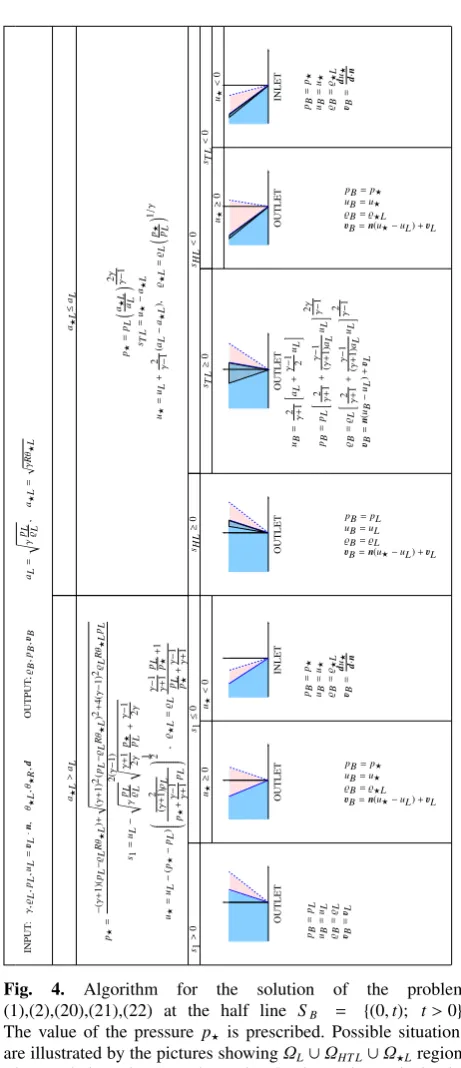
solution of the Riemann problem for the split Euler equa-tions, shown in Section 2. This way we have prescribed the desired temperature value whenever it is possible (see the general form of the solution in Section 2). Now it is pos-sible to use (4),(5),(6) together with the equation of state
L= RpθL.We must discuss all the possibilities of the left
(shock, rarefaction) and the middle (discontinuity) wave in
the solution, which is shown in figure 4. In the case of
out-let(u ≥ 0), the transformation of the velocity into the
global coordinates is
uB=n(uB−uL)+uL.
HereuBdenotes the computed velocity in the normal
direc-tion. In the case of aninlet(u<0) we use the condition
(21), which ensures that pR = p,uR = u, R = R =
L.Further it is possible to prescribe the direction of the
velocityd
uB=d|u|, with uB·n=u. (22)
Then it is
uB= d
u
d·n.
INPUT : γ, L , pL , uL = uL · n ,θ L ,θ R , d OUTPUT ; B , pB , uB aL = γ pL,L
a
L
=
γ
R
θ L
a L > aL a L ≤ aL p = − ( γ + 1)( pL − L R
θ L
)
+
(γ
+
1)
2(p
L
−
L
R
θ L
)2 + 4( γ − 1) 2 L R
θ L
pL 2( γ − 1) s1 = uL − γ pLL γ
+
1
2
γ
ppL
+ γ − 1 2 γ u = uL − ( p − pL ) ⎛ ⎜ ⎜ ⎜ ⎜ ⎜ ⎜ ⎜ ⎜ ⎜ ⎝ 2 ( γ + 1) ρL p + γ − 1 γ + 1 pL ⎞ ⎟ ⎟ ⎟ ⎟ ⎟ ⎟ ⎟ ⎟ ⎟ ⎠
1 2 ,
L = L γ − 1 γ + 1
pLp
+
1
pLp
+ γ − 1 γ + 1 p = pL a L aL 2 γ γ − 1 s TL = u − a L u = uL + 2 γ − 1 ( aL − a L ) , L = L pp
L 1/γ s1 > 0 s1 ≤ 0 s HL ≥ 0 s HL < 0 u ≥ 0 u < 0 s TL ≥ 0 s TL < 0 u ≥ 0 u < 0 OUTLET OUTLET INLET 000000000000000000000000000000000000000000000000000000000000000000000000000000000000000000000000000000000000000000000000000000000000000000000000000000000000000000000000000000000000000000000000000000000000000000000000000000000000000000000000000000000000000000000000000000000000000000000000000000 111111111111111111111111111111111111111111111111111111111111111111111111111111111111111111111111111111111111111111111111111111111111111111111111111111111111111111111111111111111111111111111111111111111111111111111111111111111111111111111111111111111111111111111111111111111111111111111111111111 OUTLET 00000000000000000000000000000000000000000000000000000000000000000000000000000000000000000000000000000000000000000000000000000000000000000000000000000000000000000000000000000000000000000000000000000000000000000000000000000000000000000000000000000000000000000000000000000000000000000000000000000000000000000000000000000000000000000000000000000000000000000000000000000000000000000000000000000000000000000000000000000000000000000000000000000000000000000000000000000000000000000 11111111111111111111111111111111111111111111111111111111111111111111111111111111111111111111111111111111111111111111111111111111111111111111111111111111111111111111111111111111111111111111111111111111111111111111111111111111111111111111111111111111111111111111111111111111111111111111111111111111111111111111111111111111111111111111111111111111111111111111111111111111111111111111111111111111111111111111111111111111111111111111111111111111111111111111111111111111111111111 OUTLET 000000000000000000000000000000000000000000000000000000000000000000000000000000000000000000000000000000000000000000000000000000000000000000000000000000000000000000000000000000000000000000000000000000000000000000000000000000000000000000000000000000000000000000000000000000000000000000000000000000000000000000000000000000000000000000000000000000000000000000000000000000000000000000000000000000000000000000000000000000000000000000000000000000000000000000000000000000000000000000000000000000000000000000000000000000000000000000000000000000000000000000000000000000000000000000000000000000000000000000000000000000000000000000000000000000000000000000000000000000000000000000000000000000000000000000000000000000000000000000000000000000000000000000000000000000000000000000000000000000 111111111111111111111111111111111111111111111111111111111111111111111111111111111111111111111111111111111111111111111111111111111111111111111111111111111111111111111111111111111111111111111111111111111111111111111111111111111111111111111111111111111111111111111111111111111111111111111111111111111111111111111111111111111111111111111111111111111111111111111111111111111111111111111111111111111111111111111111111111111111111111111111111111111111111111111111111111111111111111111111111111111111111111111111111111111111111111111111111111111111111111111111111111111111111111111111111111111111111111111111111111111111111111111111111111111111111111111111111111111111111111111111111111111111111111111111111111111111111111111111111111111111111111111111111111111111111111111111111111 OUTLET 000000000000000000000000000000000000000000000000000000000000000000000000000000000000000000000000000000000000000000000000000000000000000000000000000000000000000000000000000000000000000000000000000000000000000000000000000000000000000000000000000000000000000000000000000000000000000000000000000000000000000000000000000000000000000000000000000000000000000000000000000000000000000000000000000000000000000000000000000000000000000000000000000000000000000000000000000000000000000000000000000000000000000000000000000000000000000000000000000000000000000000000000000000000000000000000000000000000000000000000000000000000000000000000000000000000000000000000000000000000000000000000000000000000000000000000000000000000000000000000000000000000000000000000000000000000000000000000000000000 111111111111111111111111111111111111111111111111111111111111111111111111111111111111111111111111111111111111111111111111111111111111111111111111111111111111111111111111111111111111111111111111111111111111111111111111111111111111111111111111111111111111111111111111111111111111111111111111111111111111111111111111111111111111111111111111111111111111111111111111111111111111111111111111111111111111111111111111111111111111111111111111111111111111111111111111111111111111111111111111111111111111111111111111111111111111111111111111111111111111111111111111111111111111111111111111111111111111111111111111111111111111111111111111111111111111111111111111111111111111111111111111111111111111111111111111111111111111111111111111111111111111111111111111111111111111111111111111111111 INLET pB = pL uB = uL B = L uB = uL pB=p uB=u
B=L uB=n(u−uL)+uL pB = p uB = u B = L uB = d
u d·n pB=pL uB=uL
B=L uB=n(u−uL)+uL uB = 2 γ + 1 aL + γ − 1 2 uL pB = pL 2 γ+
1 + γ − 1 ( γ + 1) aL uL 2 γ γ − 1 B = L
2 γ+
1 + γ − 1 ( γ + 1) aL uL 2 γ − 1 uB = n ( uB − uL ) + uL pB=p uB=u
B=L uB=n(u−uL)+uL pB = p uB = u B = L uB = d
u d·n
Fig. 4. Algorithm for the solution of the problem (1),(2),(20),(21),(22) at the half line SB = {(0,t); t>0}.
The value of the pressure p is prescribed. Possible situations are illustrated by the pictures showingΩL∪ΩHT L∪ΩLregion.
The sought boundary state located at the time axis, marked red.
input data solution (rounded)
uL θL B uB pB θB
0.0 4500.0 7.0492 -2434.5 9105332.5 4500.0 0.0 300.00 1.5000 -62.370 129171.2 300.00 0.0 270.00 1.1547 26.345 89486.3 270.00 0.0 200.00 0.54528 255.83 31303.2 200.00 0.0 100.00 0.50235 278.89 27908.2 193.55 200.0 240.00 0.88342 312.22 61512.3 242.58 200.0 260.00 1.0507 257.13 78413.4 260.00
Table 2.The initial datauL, θLand the solutionB,uB,pB for
6 Boundary Condition by Preference of
Total Quantities and Direction of Velocity
Using this boundary condition, we try to prescribe given total quantities at the face, comlete analysis was shown in [8], [5]. The conservation laws must be satisfied in close vicnity to the boundary face. We use the analysis of the incomplete Riemann problem to construct the values for the density, pressure and velocity. The following notation is used (some values are used only for an INLET case)B static density at the boundary (unknown)
pB static pressure at the boundary (unknown)
uB velocity vector at the boundary (in global
coordi-nates) (unknown)
uB normal component of velocity at the boundary
(lo-cal coordinates) (unknown)
n unit outer normal to facen=(n1,n2,n3)
L static density near the wall, time 0
pL static pressure near the wall, time 0
uL velocity vector, state near the wall at time 0
uL normal component of velocity, state near the wall
at time 0,uL=uL·n
po given value for the total pressure (=desired total
pressure at the face)
θo given value for the total temperature (=desired
to-tal temperature at the face)
d given INLET velocity directiond=(d1,d2,d3)
At the vicinity of the boundary we solve the modified Rie-mann problem for the split Euler equations (1), introduced in Section 2, with the left-hand side initial condition (2)
and thecomplementary conditions(prescribed direction
of velocity and given total quantities).
uB=d|uB|, with uB·n=u. (23)
θR=θo
1−γ−1
2a2
o
u2
, with a20=γRθ0(d·n)2, (24)
p=po
θR
θ0
γ/(γ−1)
(25)
u<0. (26)
Hereθo > 0,po > 0 are given constants, R denotes the
characteristic gas constant, andγis the adiabatic constant.
The equations (24),(25) are considered for the velocityu∈
− 2a2
o (γ−1),
2a2
o (γ−1)
. The equations (24),(25) come from the
idea, that thetotal pressure poand thetotal temperatureθo
are known (prescribed) in the regionΩR.
According to analysis shown in [5], there are two
pos-sibillities for the 1-wave, either there is a1-shock wave
and the sought velocityucan be found as a root of the
function
F(u)=po
1−γ−1 2a2
o
u2
γ/(γ−1)
−PS(u), (27)
considered foru<uL,−
2a2
o
(γ−1) <u <0,and withPS(u)
defined in (12).
Or there is a1-rarefaction wave, and the velocityu
can be computed combining (24),(25),(12) as
u= 2 uL+
2 γ−1aL
−√DIS
2
1+ 2a2L
(γ−1)a2
o
po
pL
(γ−1)/γ, (28)
DIS=4
po pL
(γ−1)/γ 2a2
L
(γ−1)a2o ⎡ ⎢⎢⎢⎢⎢ ⎢⎢⎣ 2a2o
(γ−1)+ 4a2
L
(γ−1)2
po pL
(γ−1)/γ −
uL+γ2aL−1
2⎤⎥⎥⎥⎥⎥
⎥⎥⎦.
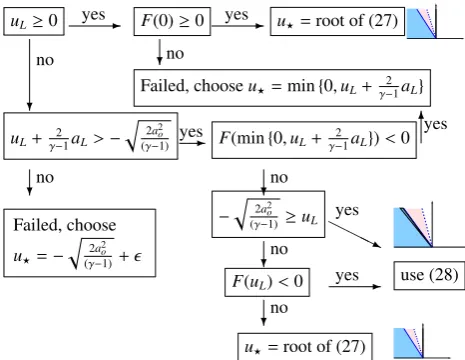
Summarizing the above possibilities of the 1-shock and the 1-rarefaction wave we can construct the algorithm in
figure 5. for the computation of the velocityuin thestar
region.
-yes
uL≥0
?
no
F(0)≥0 yes- u=root of (27)
?no
Failed, chooseu=min{0,uL+γ−21aL}
uL+γ−21aL>−
2a2
o
(γ−1) yes- F(min{0,uL+
2
γ−1aL})<0
6yes
?no
?no
Failed, choose
u=−
2a2
o
(γ−1)+
− 2a2
o
(γ−1) ≥uL
HHHjyes 000000000000000000000000000000000000000000000000000000000000000000000000000000000000000000000000000000000000000000000000000000000000000000000000000000000000000000000000000000000000000000000000000000000000000000000000000000000000000000000000000000000000000000000000000000000000000000000000000000000000000000000000000000000000000000000000000000000000000000000000000000000000000000000000000000000000000000000000000000000000000000000000000000000000000000000000000000000000000000000000000000000000000000000000000000000000000000000000000000000000000000000000000000000000000000000000000000000000000000000000000000000000000000000000000000000000000000000000000000000000000000000000000000000000000000000000000000000000000000000000000000000000000000000000000000000000000000000000000000 111111111111111111 111111111111111111 111111111111111111 111111111111111111 111111111111111111 111111111111111111 111111111111111111 111111111111111111 111111111111111111 111111111111111111 111111111111111111 111111111111111111 111111111111111111 111111111111111111 111111111111111111 111111111111111111 111111111111111111 111111111111111111 111111111111111111 111111111111111111 111111111111111111 111111111111111111 111111111111111111 111111111111111111 111111111111111111 111111111111111111 111111111111111111 111111111111111111 111111111111111111 111111111111111111 111111111111111111 111111111111111111 111111111111111111 111111111111111111 111111111111111111 111111111111111111 111111111111111111 111111111111111111 111111111111111111 111111111111111111 111111111111111111 111111111111111111 111111111111111111
?no
F(uL)<0 yes- use (28)
?no
u=root of (27)
Fig. 5.Algorithm for the velocity solutionu <0.In the case of failure, the problem doesn’t have a solution, and the values are chosen.
Knowing the velocityuwe compute the pressure p
using (25), and the densityR = RpθR.At last we set the
boundary values as
pB=p, B=R, uB= d
u
d·n.
The problem (1),(2), (25), (24) has a unique solution for
the initial data satisfyinguL+γ2−1aL>−
2a2
o
(γ−1), andF(min{0,uL+
2
γ−1aL})>0.In the case ofuL+
2
γ−1aL≤ −
2a2
o
(γ−1) there is
no solution. In this case we prescribe the velocity u =
− 2a2
o
(γ−1) +,with > 0 being a small positive constant.
If F(min{0,uL+ γ2−1aL}) ≤ 0 then the problem does not
have a negative solution, and for the practical applications
we choose the velocity u = min{0,uL+ γ2−1aL}, or we
use the boundary condition preferring the static pressure
p=po, see [2, 8], in this case.
Let ˜p0,θ˜0 be the given total quantities together with the
giventangential velocity components:vtandwtare the
velocity components in the direction ofoandp. Hereo·n=
0,|o|=1,andp=n×o.Then we set
d=−n, θ0=θ˜o−γ−
1
2γR (v
2
t +w2t), p0=p˜0
θ0
˜
θ0
γ
γ−1
,
and we use the same algorithm (figure 5.) for the
compu-tation of the velocityu.Then it is pB = p, B =R,
and
7 Inlet Boundary Condition by Preference
of Massflow
Using this boundary condition, we try to prescribe given total quantities at the face, comlete analysis was shown in [7]. The conservation laws must be satisfied in close vic-nity to the boundary face. We use the analysis of the in-complete Riemann problem to construct the values for the density, pressure and velocity. The following notation is used (some values are used only for an INLET case)
B static density at the boundary (unknown) pB static pressure at the boundary (unknown)
uB velocity vector at the boundary (in global coordi-nates) (unknown)
uB normal component of velocity at the boundary (lo-cal coordinates) (unknown)
n unit outer normal to facen=(n1,n2,n3)
L static density near the wall, time 0 pL static pressure near the wall, time 0
uL velocity vector, state near the wall at time 0 uL normal component of velocity, state near the wall
at time 0,uL=uL·n
G given inlet massflow (=desired massflow at the face)
θ0 given value for the total temperature (=desired
to-tal temperature at the face)
d given INLET velocity directiond=(d1,d2,d3)
At the vicinity of the boundary we solve the modified Rie-mann problem for the split Euler equations (1), introduced in Section 2, with the left-hand side initial condition (2) and thecomplementary conditionsprescribing the mass flow,direction of velocity, and total temperature inΩR given as
uR =G, (29)
uB=d|uB|, with uB·n=u. (30)
θR=θo
1−γ−1 2a2
o u2
, with a20=γRθ0(d·n)2, (31)
u<0, (32)
whereG ≤ 0 is given constant (G = mass f lof ace areaw). Hereγ andRare gas constants. The equation (31) is considered for
the velocityu ∈
− 2a2 o
(γ−1),0
. In general, there are two possibilities of the wave pattern, which may interest us. We seek the unknown velocityuas a root of the function
F(u)=G(u)−G, whereG(u)=u P(u)
Rθ(u), (33) withP(u) defined in (12), and
θ(u)=θ0
⎛
⎜⎜⎜⎜⎝1−γ−1 2
u2
a2 0
⎞ ⎟⎟⎟⎟⎠, u∈
⎛ ⎜⎜⎜⎜⎜ ⎜⎜⎝−
2a2
0
γ−1,0 ⎞ ⎟⎟⎟⎟⎟ ⎟⎟⎠.
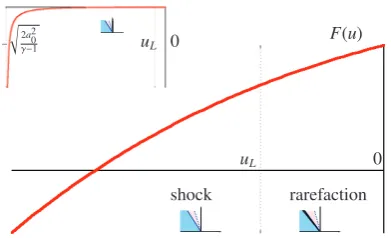
The figure 6. shows example of such function for the cho-sen values. The function F(u) is monotone, and it has a
unique root ifuL+γ2−1aL>−
2a2 0 γ−1.
Once the velocityu < 0 is known, it is possible to compute the remaining values
B=G/u, pB=p(u),uB= d u
d·n.
0 uL
shock rarefaction F(u)
−
2a2 0
γ−1 uL 0
Fig. 6.Graph of the functionF(u) (red line) for given valuesθ0=
273.15, γ=1.4, L=1.25,pL=100000,uL=−50,G=−200.
uL+γ−21aL>−
2a2 0
γ−1 yes- u=root of (33)
?no
ERROR, NO SOLUTION. Low temperatureθ0at the inlet.
Fig. 7.Algorithm for the velocity solutionu <0.In the case of
failure, the problem doesn’t have a solution, and the values are chosen.
Let ˜θ0be the given total temperature together with the given tangential velocity components:vtandwtare the veloc-ity components in the direction ofoandp. Hereo·n=0, |o|=1,andp=n×o.Then we set
d=−n, θ0=θ˜o−γ−
1
2γR(v2t +w2t),
and we use the same algorithm (figure 7.) for the compu-tation of the velocityu.Then it is pB = p, B =R, and
B=G/u, pB =p(u),
uB=(n1u+o1vt+p1wt,n2u+o2vt+p2wt,n3u+o3vt+p3wt,).
input data solution
uL pL G B u p
40 70000 -44.3198 1.2853 -34.481 100558.8 -100 70000 -171.582 1.1693 -146.74 88080.1 -200 100000 -185.547 1.1427 -162.38 85285.7 -300 70000 -244.851 0.89857 -272.49 60920.9 -600 70000 -207.065 0.49508 -418.24 26444.9
Table 3.The initial datauL,pL,Gand the solutionB,u, p
8 Outlet Boundary Condition by
Preference of Massflow
Using this boundary condition, we try to prescribe given total quantities at the face, comlete analysis was shown in [6, 7]. The conservation laws must be satisfied in close vic-nity to the boundary face. We use the analysis of the in-complete Riemann problem to construct the values for the density, pressure and velocity. The following notation is used (some values are used only for an INLET case)
B static density at the boundary (unknown) pB static pressure at the boundary (unknown)
uB velocity vector at the boundary (in global coordi-nates) (unknown)
uB normal component of velocity at the boundary (lo-cal coordinates) (unknown)
n unit outer normal to facen=(n1,n2,n3)
L static density near the wall, time 0 pL static pressure near the wall, time 0
uL velocity vector, state near the wall at time 0 uL normal component of velocity, state near the wall
at time 0,uL=uL·n
G given inlet massflow (=desired massflow at the face)
At the vicinity of the boundary we solve the modified Rie-mann problem for the split Euler equations (1), introduced in Section 2, with the left-hand side initial condition (2) and thecomplementary conditionsprescribing the mass flow
uR =G, (34)
whereG ≥0 is given constant (G = mass f lof ace areaw). We are interested in the solution withu>0, andsL?<0,which
guarantees the possibility of the values to be prescribed at the boundary. In general, there are two possibilities of the wave pattern, which may interest us.
– 1-shock wave
Here, we are interested in the solution withs1<0,u>
0.Let us construct the functionFS(u), using the rela-tions (4),(5)
FS(u)=uL(u)−G, (35)
where
L(u)=L
(γ−1)pL+(γ+1)PS(u) (γ+1)pL+(γ−1)PS(u),
and PS(u) defined in (12). The sought velocityu is
the root of this function FS(u). It iss1 < 0 foru <
uX =uL2+(γ−1)M
2 L
(γ+1)M2
L ,
withM2
L=u2L/γp,see [8]. The first derivative isFS >0 foru <min{uL,uX}. The problem has a solution with the 1-shock wave ifFS(min{uL,uX})> 0.
– 1-rarefaction wave
Let us assume the solution with the 1-rarefaction wave. Using (4),(5),(34), the velocity u is the root of the function
FR(u)=uL
1−γ−1 2aL
(u−uL)
2
γ−1
−G, (36)
defined in the intervaluL<u<uL+γ2−aL1.It isFR(uL)= LuL−G. The first derivative is zero at the pointsu1=
uL+γ2−aL1, u0= γγ+−11 uL+γ2a−L1
. DerivativeFR(u)>0 in the interval (0,u0) andF(u)<0 foru ∈(u0,u1).The
maximum of the functionFRis at the pointu0. We are
interested in the solution withsT L<0. This is satisfied only foy u<u0.
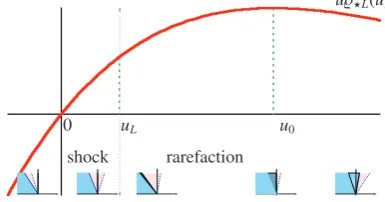
0 uL u0
shock rarefaction
uL(u)
Fig. 8.Example of the function uL(u), hereuL = 20, γ =
1.4, L=1.25,pL=100000.
Algorithm
Here we present the possible algorithm for the solution of the sought values at the boundary.
F(uL)=uLL−G i f F(uL)>0 t h e n
u= r o o t o f FS(u), u∈(0,min{uX,uL}), (35) .
e l s e
i f uL>u0 t h e n
u=uL
e l s e i f (u1<u0)
u=u1−ε
e l s e
i f F(u0)<0 t h e n
u=u0
e l s e
u= r o o t o f FR(u), u∈(uL,u0), (36) .
end e n d i f end end
Compute pB=p, B=L u s i n g (12),(5).
The resulting boundary velocity in the global coordi-nates isuB=n(uB−uL)+uL.
input data solution
uL G GB B uB pB
-20 1 1.00 1.174034 0.8517646 91596.49 -20 50 50.00 1.011280 49.44231 74326.85 -20 150 130.35 0.4730351 275.5533 25655.28 20 1 1.00 1.323527 0.7555568 108333.1 20 100 100.00 0.9684777 103.2548 69960.27 20 200 150.45 0.5330942 282.2200 30328.54 400 10.0 10.00 3.218839 3.106711 421919.0 400 100 100.00 3.059145 32.68887 385170.7
400 600 500 1.25 400 100000
Table 4.Outlet boundary condition by preference of massflow.
9 EXAMPLES
9.1 The Flow Around the Obstacle
Here we present a computational result of the 2D
non-stationary inviscid channel flow at Mach numberM=0.67.
A body immersed in the flowing fluid establishes a certain wave pattern which evolves in time and eventually exits the channel. At figure 1 we show, that the fixed (values are fixed at the boundary) and linearized (as described in [9]) boundary conditions do not give the expected result in time. The inlet is located left, outlet right, other boundaries are considered as wall. The fixed boundary conditions give incorrect results near boundaries. The linearized boundary condition reflects the waves into the domain, leading to the oscillations in the solution. The new suggested boundary
conditions do not suffer from these drawbacks. The
resid-ual behavior (shown right) demonstrates this result.
Fig. 9.Incompressible flow, body in the channel. Comparison of the various boundary conditions.
9.2 The Shortened Domain Example
The following numerical example shows superior behav-ior of the suggested boundary condition. This is the test case of the the inviscid flow through the Double Circular Arc (DCA) blade cascade DCA08. The blades of this cas-cade are composed of two circular arcs with the relative thickness 8%. At the inlet we use the boundary condition
conserving the total pressure po = 101325 Pa, the total
temperatureθo =273.15 K, and the direction of the
veloc-ityαIN =5.2◦. At the outlet, the outlet boundary condition
with the averaging technique described in [8], preferring
the pressurep=45722.351 Pa in average. The part of the
inlet flow is supersonic. It can be seen in figure 10 (left), that the used inlet boundary condition does not reflect the shock waves into the computational area. The right pic-ture shows that this boundary condition can be used on the shortened computational domain with the similar re-sult. Constructed boundary condition is robust and accel-erates the convergence of the method, it can be also used on the shortened domains. This is the original result of our work.
Fig. 10.The compressible gas flow, transonic regime. Two com-putations with the same boundary data. The bottom picture shows the computation with the shortened inlet part. Inlet located left. Pressure isolines, density and Mach number isolines, highlighted Mach number 1.
9.3 The Outlet Mass Flow Example
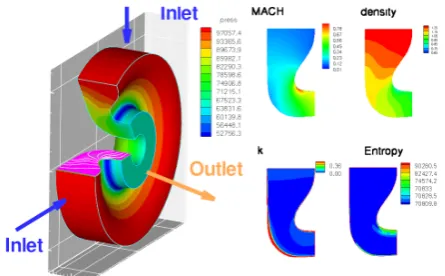
The developed software with presented boundary condi-tions was used for the simulation of the compressible
tur-bulent flow in the 3D axis-symmetrical channel. Axisxis
the axis of symmetry. Example is shown in figure 11. At the inlet we used the boundary condition shown in section 6, conserving the total pressure, total temperature, and zero
tangential velocity, withθo =273.15 K ,po =101325 Pa.
The boundary condition shown in section 8 was used at
the outlet, with the given massflowG = 4.0 kg·s−1·m−2.
At each face, the value G was computed (in each
iter-ation) in order to match the massflow across the whole
boundary. The boundary condition preffering the zero
nor-mal velocity was used in the case of the inviscid flow. For the viscous turbulent flow, this condition was modi-fied by the zero velocity at the wall, and wall temperature
θW ALL =273.15 K was set. FurtherkW ALL =0 m2·s−2and
ωW ALL=cωβy6μ2
s, cω 6
β =120.Here byyswe mean the
dis-tance between the face and the center of the neighbouring element.
Fig. 11.3D axis-symmetrical turbulent flow, 3D geometry shape, results at chosen 2D crosscuts.
Another example demonstrates the capabilities of the new boundary condition in the use with the unstationary
Fig. 12.3D axis-symmetrical turbulent flow, density isolines and velocity profile at the outlet, 2D crosscut.
crosscut shown at figure 13, the inlet is located at the left
part of the boundary, the outlet points away from axis x.
Inlet boundary condition with the preference of total
quan-tities was used at the inlet,θo=875.00 K,po=101905 Pa.
The mass flowG =0.75kg·s−1·m−2 was preferred at the
outlet (in average). Wall temperature was set toθW ALL =
875.00 K. The computational mesh in 2D crosscut
con-sisted of 89x87 quadrilaterals.
Fig. 13.3D axis-symmetrical turbulent flow, 3D geometry shape, results at chosen 2D crosscuts.
Conclusion
This paper is focused on the boundary conditions for 3D compressible flow, and summarizes the work presented in [2], [8], [5], [6], [7], and other publications. The algorithms for the construction of 3D boundary conditions are pre-sented. The work is based on the analysis of the Riemann Problem for the split Euler equations and the modifications of this problem. Here the left hand side initial condition is replaced by various complementary conditions. The solu-tion of such problems is shown.
Acknowledgment
The results originated with the support of Ministry of the Interior of the Czech Republic, project SCENT, Grant MSM 0001066902 of the Ministry of Education of the Czech Re-public, and Ministry of Industry and Trade of the Czech Republic for the long-term strategic developmentof the re-search organization. The authors acknowledge this sup-port.
References
1. C. J. Kok. AIAA Journal, Vol.38., No. 7., (2000).
2. M. Kyncl and J. Pelant. Applications of the
Navier-Stokes equations for 3d viscous laminar flow for symmet-ric inlet and outlet parts of turbine engines with the use
of various boundary conditions.Technical report R3998,
VZL ´U, Beranov´ych 130, Prague, (2006).
3. V. Dolejˇs´ı Discontinuous Galerkin method for the
numerical simulation of unsteady compressible flow.
WSEAS Transactions on Systems, 5(5):1083-1090,
(2006)
4. M. Kyncl and J. Pelant. Numerical Simulation of the
Flow Around Diffusible Barriers.Experimental fluid
me-chanics 2012, EFM 2012, Hradec Kr´alov´e (Czech Re-public) (2012).
5. M. Kyncl and J. Pelant. The Initial-Boundary Riemann
Problem for the Solution of the Compressible Gas Flow. ECCOMAS 2014, ECFD VI, 20.-25.7.2014, Barcelona, Spain (2014).
6. M. Kyncl and J. Pelant. The Initial-Boundary Riemann
Problem for the Solution of the Compressible Gas Flow. Applied Mechanics and Materials, Vol. 821, pp. 70-78, 2016.
7. M. Kyncl and J. Pelant.Analysis of the Boundary
Prob-lem with the Preference of Mass Flow.ECCOMAS 2016,
5.-10.6.2016, Crete Island, Greece (2016).
8. M. Kyncl. Numerical solution of the three-dimensional
compressible flow.Master’s thesis, Prague, (2011).
Doc-toral Thesis.
9. M. Feistauer, J. Felcman, and I. Straˇskraba.
Mathemati-cal and Computational Methods for Compressible Flow. Oxford University Press, Oxford, (2003).
10. M. Kyncl and J. Pelant. Implicit method for the 3d
Euler equations. Technical report R5375, VZL ´U,
Bera-nov´ych 130, Prague, (2012).
11. M. Kyncl and J. Pelant. Implicit method for the
3d RANS equations with the k-w (Kok) Turbulent
Model. Technical report R5453, VZL ´U, Beranov´ych
130, Prague, (2012).
12. M. Feistauer.Mathematical Methods in Fluid
Dynam-ics. Longman Scientific & Technical, Harlow, (1993).
13. E. F. Toro. Riemann Solvers and Numerical Methods