________ Environment and Sustainable Development _ CHAPTER
20
Overview of Principles and Application of
Environmental Risk Assessment
E.M Mwangi1 and Eucharla.U. Kenya2
20.1 Introduction
E
nvironmental risk assessment (ERA)is the examination of the risks resulting from technology, that threaten ecosystems, human beings, animals, etc .It provides a technical basis for evaluating current environmental conditions and forecasting futureconditions under selected scenarios. Itis focussed on predicting the probability of effects of an action or condition on the health of humans and environmental resources. It is aimed at identifying all possible types of environmental hazards to which a particular geographic region or specific communities are exposed, and assessing the risk in terms of historical as well as probable ecological, human, property and other losses associated with these hazards. Box 1 below summarises definitionof critical words used in this assessment. As an environmental management tool, the goal of ERA is to attain the desired development and growth without unduly harming humans or the environment, by minimising the possible damage to various environmental components, and to ensure a long-term sustainability of the overall environment.While advances in science and technology enhance the well being of humans, they can also introduce the potential for adverse consequences which public policy makers, corporation heads, small business entrepreneurs and individuals must make decisions about. Every environmental change occurs with some probability of negative consequences associated with it. Environmental risks and hazards are also a major focus of research, general concern and, public policy. As a result, environmental policy makers and natural resource managers are increasingly searching for reliable and quantitative methods of estimating the risk of such occurrences, based on both direct and indirect observations.
As an adverse outcome that could result from a proposed human action, or any unexpected natural event, environmental risk has been the preoccupation of humankind for a long time. The various approaches adopted attempt to describe the level of either qualitatively (i.e. by putting risks into categories such as 'high', 'medium' or 'low') or quantitatively (with a numerical estimate). Qualitative risk assessment is as old as human history and, through intuitive approaches, has been
'Gnlversity of Nairobi; School of Biological Sciences: [email protected]
2Kenyatta University; Department of Biochemistry and Biotechnology: [email protected]
________ Environment andSustaiilable Development -.:...__
fundamental for both survival and evolution. Human beings learnt early to observe
the type of adverse health defects that exposure to particular plants predisposed
them to. They recognized both qualitatively and quantitatively that some products
of the environment posed risks. The effects they noted were almost invariably
those that occurred immediately. Even today, long-term effects are difficult to
discern, especially as life spans become shorter and other health problems suchas
infectious diseases become more prevalent. The use of risk assessment as a tool
in the decision-making process has become increasingly important over the last
few decades as itbecame evident that situations could not continue being judged
simply as either 'safe' or'unsafe',
iv. Receptor: That entity which receives and is affected by the risk agent such ecosystems, people, plants and animals.
Source: UNEP-IETC, 1996.
Box 1: Important Definitions
i. Hazard: Aproperty or situation that in particular circumstances could lead to harm; A situation or condition that is dangerous and has
potential to cause harm; the potential of an agent to cause harm or adverse effect to a receptor, or simply sources of potential harm Consequently, hazard assessment isthus the identification of hazards, their potential receptors (people, environmental components), and the determination of the consequences
ii. Exposure: Is the concentration, amount or intensity of a particular physical or chemical agent or environmental agent that reaches the
target population, organism, organ, tissue or cell, usually expressed in numerical terms of substance concentration, duration and frequency (for chemical agents and micro-organisms) or intensity (for physical agents such as radiation).
iii.Risk: Risk expresses the likelihood/chance/probability that the harm from a particular hazard/danger is realized. It is thus a function of hazard
+
exposure. i.e. the probability that a harmful event (a disaster) e.g. death, injury or loss) arising from exposure to a risk agent will occur. As such, risk assessment is thus the procedure in which the risks posed by inherent hazards involved in processes or situations are estimated either quantitatively or qualitatively.In the engineering field, risk assessment has a fairlylong history and tradition, attempting to make operating systems and structures more reliable. Health risk assessment has also developed to quantify the risks to people from exposure to various substances or activities. ERA is a more recent application, which also has
________ Environment and Sustainable Development ~ __
some added difficulties. Many professionals within the environmental field including environmental engineers, industrial ecologists, and hazardous waste managers recognize the importance of incorporating elements of risk assessment with life;
-cycle assessments. These are analytical tools that have become increasingly part of standard environmental management practice in industry, Life-cycle assessment, risk assessment, and a combined framework of the two can be used in the estimation of environmental damage from an ongoing or proposed industrial process.
Conventionally, the main outputs of an ERA are but not limited to:
@ Risk management plan
@ Communication plans
@ Sustainable development.
In today's world of innovation, technology is and will continue to be a major risk agent, whether from a physical, chemical or biological dimension. On this basis arise the notions of:
@ Physical risk such as Dams, dykes: flood, erosion hazardous, hence physical harm,
@ Chemical risks such as use of agrochemicals and industrial chemicals (pesticides and paints)
@ Biological risks such as production of GMO, biological pests-weed control, diseases.
ERA thus concerns itself with the following three basic questions:
@ What can go wrong because of a certain action or condition? I.e. what impacts might affect human health and the health of natural environment etc. @ What is the range and magnitude of these adverse impacts? i.e. What number
of people and geographical area could be affected? Etc.
@ How likely are these adverse consequences? I.e. With what frequency might they occur or what evidence is there to judge their likelihood, and what data are available?
Risk assessment generally forms the basis of the insurance industry. It is widely applied by chemical and pharmaceutical industries to study risks from production, consumption and disposal of synthetic chemicals (Chemical Risk Assessment). Application of ERA has expanded to include physical disturbances and biological agents. Essentially, ERA may be conducted for any activity or condition that will likelycause a harmful consequence. Three broad applications of ERA are:
@ Chemical.evaluations such as estimation of the risk of release of toxic chemicals such as DDT and furans to agricultural farms, and local population
@ Site assessments such as selection for a petrochemical industrial park or a
@ the design of regulations for instance in determining societal acceptable risk
levels, which may form the basis ofenvironmental standards;
@ providing a basis forsite-specific decisions, for instance in land-use planning
or sitting of hazardous installations;
@ prioritisation of environmental risks for instance in the determination of which
chemical to regulate first;
@ comparison of risks, for instance to enable comparisons to be made in
resource allocation for controlling different types of risks or to allow risk
substitution decisions to be made.
______ ~_ Environment andSustainable Development _
nuclear power plant and
@ In natural resource assessments such a regional marine or terrestrial.
ecosystem.
Geographic and thematic scopes of ERA can rang~ from micro-ERA (wherein
a single pollutant is the agent and the workers as well as local residents are the
receptors) to a macro-ERA involving many risk sources spanning national and
international scales, which can be called cumulative risk assessment. (Note the
value of integration in assessment)
For purposes of environmental management ERAbecomes instrumental in among
others:
In industry, ERA is used among others to:
@ Check and enhance compliance with legislation
@ Promote product safety
@ Enhance financial planning
@ Assist in site-specific decision-making
@ Prioritisation and evaluation of risk reduction measures
20.2
Types and M
.
e
thodologies of Environmental Risk
Assessment
Various categories of ERA can be distinguished on the basis of application. This
chapter willfocus on three that have direct bearing to most communities, thus:
a. Human Health Risk Assessment (HHRA)
Is concerned with risks that endanger human health such as:
@ Physical risks such as from radiation: Due to the nature of nuclear risks, many international organisations are involved in radiation risk assessment
1-
---
-
-
Environment and Sustainable Development _ such as the International Commission on radiological Protection (ICRP) andthe United Nations Scientific Committee on the Effects of Atomic Radiation
(UNSCEAR). r
@ Chemical risks e.g. from exposure to agro-chemicals, industrial chemicals and carcinogenic. All human health risk assessments of chemicals include hazard identification, dose-response assessment; exposure assessment and risk estimation/characterisation. Environmental exposure to chemicals can
be direct - as a result of industrial emission to the air, land and or water of a risk agent or indirect through water or the food chain.
@ Biological risks such as risks associated with biological agents of concern to
public health like particular strains of pathogenic microbes, introduction of
genetically modified or engineered organisms and food safety risks. Biological risks are of particular concern when it comes to food safety risk assessment
and risk assessment of genetically modified ·organisms ..
b. Ecological Risk Assessment (EcoRA)
This means assessment of the risks posed by the presence of substances released
to the environment by man, on all.living organisms in the variety of ecosystems,
which make up the environment. EcoRA tends to focus on risks from chemicals and
qenetlcally modified organisms (GMOs) among others. Environmental pollution for
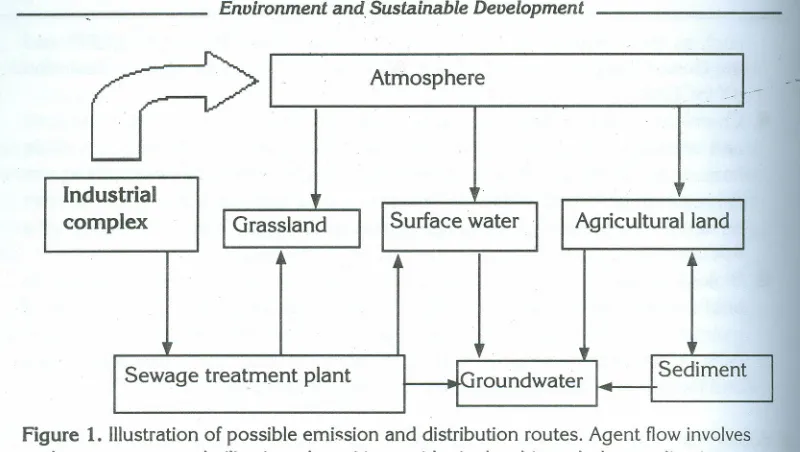
instance can have widespread effect on ecosystems (Figure 1).Lately in Kenya the
effects of introducing exotic plant species like Prosopis Juliflora are r~ising serious
health and socio-economic concerns. Further, in many mining centres, average
atmospheric lead concentrations reach 0.5-0.3 fLg/m3 and exceed 1 OOOp,g/g in
dust and soils. The people of Kabwe, in Zambia, face aserious threat from lead and
zinc mining activities. At its peak, Kabwe was the largest and richest lead mine in
Africa. Unfortunately there were few pollution controls. The vegetation, water and
soil are contaminated and about 90 000 children are at risk from lead poisoning.
Concentrations of 5fLg/dl threaten brain development; in Kabwe, many children
have concentrations exceeding 300 fLg/dl. Average blood level is 60 -120 fLg/dl
(UNEP, 2006). . .
c. Applied Industrial Risk Assessment
This concerns itself with all risks associated with industrial systems and their
development. Examples include; non-routine industrial releases, site specific routine .industrial releases, transportation risks, financial risks, industrial application such as
contaminated sites, emissions and effluents, product risk assessment, and waste
management among others. In Kenya, risks to human health and the physical
.environment are more observable in the manufacturing industry, food industry,
service industries, building and construction and the famous Jua Kali sector.
__ ---::- Environment and Sustainable Development
Atmosphere
Industrial
complex Grassland Surface water Agricultural land
Sewage treatment plant I----I*'-Iroundwater 1-+-+Sediment
Figure 1.Illustration ofpossible emission and distribution routes. Agent flowinvolves such processes as volatilisation, deposition, acid rain, leaching, sludge application,
ero-.sion, and food chain transfers. NB: readers should attempt to link these processes tothe arrows in the figure.
20
.
3 Overview of Risk Assessment Methods
The decision to undertake a risk assessment is influenced by many factors, the most
important being the identification phase, which provides a guide as to when a risk
assessment should be undertaken. In general, risk assessments will be needed for
products, processes, situations and activities where there is a plausible increased
chance of significant consequences for human beings.
There are several models of risk assessment and definitions for the relevant terms
therefore vary considerably. The principle of risk assessment originated from
concern over chemicals and other stressors of human health and the environment
especially dating back to the 1970s (Sanvido, et al. 2006). A four-step paradigm
for assessment was established by the National Research Council of the United
States that includes hazard identification, hazard characterization, exposure
assessment and risk characterization (NRC 1983). Describing the problem inclear
and unambiguous terms prior to any assessment assists in enabling the assessors
select the level and type of assessment methodology to be used. It also improves
the risk management decisions to be taken since it provides an important baseline
for the initial conditions. This is critical should the process or eventual decision
be challenged or audited. Setting out to describe the problem involves several
important steps as outlined below:
Defining the intention:
This involvesa complete definition of the intention for the assessment. Sometimes
______ --'-/_ Environment and Sustainable Development _
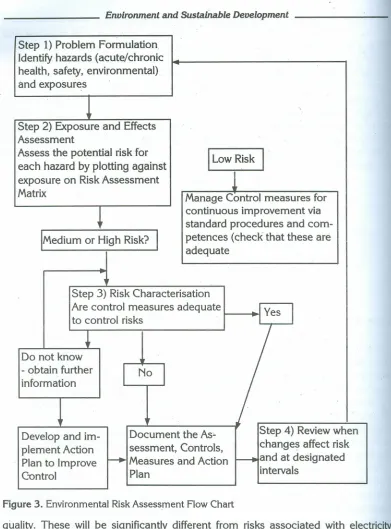
the intention may be to act in order to reduce risk, which in itself does not alter either the need for, or the nature of, the risk assessment. At times, it may be possible, and even easy; to make implicit and clear assumptions or to take into account the knowledge needs of the assessment. This fact may not be known to the users of the risk assessment later. Recording the definition of the intention provides significant benefits to users by stating exactly what was' taken into consideration. A good statement of the intention also makes the assessment amenable to.future monitoring and feedback. In addition, it assists in determining the causes of any discrepancies that might arise between an assessment's forecasts and outcomes. Four factors are particularly important in this regard as illustrated in figure 2, while a schematic flow of events is illustrated in figure 3.
Baseline
Source
Pathway
Receptor
Impact
Figure 2: An illustration of the (ERA) process from baseline to forecast
The baseline refers to the situation at the time an intention was defined. It describes the state of the environment within the immediate locality of an expected event and over the area where harm may be expected. The baseline should include all relevant previous hazards that may affect the outcome of a particular assessment. For example, if the intention is to establish a new project that would involve diversion of water from a river to a distant city, there might be a risk of low water flow affecting communities downstream. Existing levels of water abstraction through any other activity such as irrigation or another diversion would thus be a critical piece of baseline information.
The components of an assessment are the critical elements. The connections between the source of a hazard, the pathway, the receptor, and the impact must be borne in mind during problem formulation stage and the assessment. It is important to show this connectivity and to distinguish between potential and actual linkages among these four elements. Each of the risk elements has unique characteristics that may affect the eventual outcome or consequences. For example, since the composition and combustion by products of a factory that uses diesel are different from one that relies mainly on electricity, the effects of one will be different from those of the other. Assessing the risks associated with diesel combustion requires the estimation of emissions from diesel engines and their relative effects on air
342
AQuid~ for Higher Education in Kenya________ Environment andSustalitable Development _
Step 1) Problem Formulation Identify hazards (acute/chronic health, safety, environmental) .
and exposures
1
-,Step 2) Exposure and Effects Assessment
Assess the potential risk for
ILOWRiSk I each hazard by plotting against
exposure on Risk Assessment
Matrix Manage Control measures for
continuous improvement via standard procedures and c
om-IMedium or High Risk?
I
petences (check that these are adequateStep 3) Risk Characterisation
Are control measures adequate
IYes
I
to control risks~
Do not know - obtain further
I
NoI
information
Step 4) Review when Develop and im- Document the As~
plement Action sessment, Controls, changes affect risk Plan to Improve ~ Measures and Action
--
-
and at designatedC-ontrol Plan intervals
Figure 3. Environmental Risk Assessment Flow Chart
quality. These will be significantly different from risks associated with electricity use, which further differ among themselves depending on whether it is generated through hydro or thermal plants.
________ Environment andSUstainable Development _
factory, the risk that a pollutant relating to the manufactured products will reach an underground aquifer may be no different from that emanating from an electric powered factory, but the diesel powered production process may well speciflcally contribute to pollution arising from the type of fuel used. In both cases, these risks depend on the relationship between groundwater flow, wind, rainfall regimes, and geological conditions.
The forecast is a projection of what would be the likely situation after the intention. This involves a certain degree of extrapolation from those results in order to predict the extent of risk associated with an event or process. Obviously, this is a fairly difficult task but some of the most important consequences may be easy to appreciate. A good example may be drawn from the risks associated with the periodic flooding in the river Nzoia in western Kenya. The scenario, before a flood may be veIYsimilar to the situation after, yet much havoc will have occurred during the floods themselves. This may be contrasted with the possible decommissioning of a new geothermal power station at a site like Olkaria. After the decommissioning, one can be reasonably certain that the adjacent land and vegetation communities will be exposed to higher levels of waste gases for a fairly long time, which would affect the plant communities well into the future.
20.4 Evaluating Risk Assessment
Methods
There are a number of criteria that may be used for evaluating risk'assessment methods including the logical soundness (for example, Itsjustificatlon based on theoretical arguments or scientific knowledge, and the validity of the underlying assumptions (Department. of Environment 199,5).These are summarised below.
)
@ Completeness - whether a method can address all aspects of the problem and the degree to which it excludes issues simply because they are hard to accommodate;
@ Accuracy - the precision with which measurements are made. This influences
the level of confidence attached to the results', biases resulting from undue weight ~eing given to particular considerations and, the sensitivity of results to both untestable and untestable assumptions; .
@ Acceptability- for example, .how compatible is a method with existing processes. can it be viewed as either rational and fair and, how well is it understood by all affected parties;
@ Practicality - is it feasible with the level of expertise, time and input data·
required?;
@ Effectiveness or usefulness of results. The range of'applicability across different
risks'and problem areas and how easily are the conclusions amenable to generalisation in relation to other problem areas?
Volume II
_______ ...,...Environment andSustainable Development _
Setting the limits for ERA
An important requirement for any risk assessment is ensuring that its limits ate clearly spelt out. These must consider the spatial extent and time-scales over which the assessment is to be undertaken, when the output is required, the resource requirements, purpose and, the weight of decisions to which the assessment will contribute. It is important to document the grounds for selecting these limits. The controlling factors: that the timing, intensity and duration for a hazardous event are often controlled by one or more factors may appear self-evident, but it is important for the selection of risk reduction options to elaborate these aspects clearly. Modifying these factors will often be a key consideration in the goals of the assessment.. If controlling factors are not considered in the problem formulation stage, it may be difficult to choose the most appropriate risk reduction options. In relation to the example of flooding, factors such as the prevailing meteorological conditions, state of any flood defences, soil moisture deficits and, topographic profiles, will be important controlling factors. Although factors that control policy are initiallydifficult to identify, their link to the hazard itself is critically important. In the example of power generation, the policy options to reduce the environmental impact may be influenced by the degree of a society's reliance on electricity, which makes the future population growth one of the controlling factors.
Developing a practical model for Risk Assessment
Conceptual models are useful tools in problem formulation since they present in both visual and written form the hypothesised relationships between sources, pathways and receptors. Developing models for use in real life situations is, however, still a challenge. One such model was published relatively early in the development of the risk assessment processes at the National Academy of Sciences of the United States.
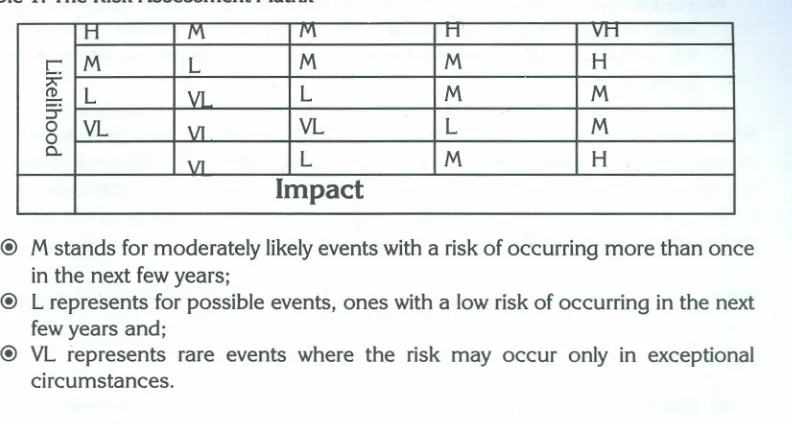
It has proven to be particularly influential as a template for later assessments. This involves the formulation of risk likelihood and impact matrix as illustrated in table 1 below. An assessment needs to have some way of comparing risks so that efforts
.can be concentrated on addressing those that are mos~ important. The standard approach is to give each risk a relative score depending on-a combination of its likelihood and its impact, as shown in the risk likelihood and impact matrix. This defines the very high (H) risks (those with both a high likelihood of occurring and a high impact) as the ones, which demand the most immediate attention.
In this matrix, likelihood and impact are classified as follows:
Likelihood: The probability of the threat being reallsed expressed as Very High (VH), High (H), Medium (M), Low (L) or Very Low (VL).
@ VH and H are almost certain events. Here the risk is likelyto occur ayear or at
frequent intervals thereafter.
________ Environment andSustainable Development _
Table 1.The Risk Assessment Matrix
H M JV\ H VH
r M L M M H
~
VI L M M
~ L
s:
VL L M
0 VL \n
0 0..
\n L M H
Impact
@ M stands for moderately likelyevents with a risk of occurring more than once
in the next few years;
@ L represents for possible events, ones with a low risk of occurring in the next
few years and;
@ VL represents rare events where the risk may occur only in exceptional
circumstances.
Assigning the best estimate of likelihood can be fairlysimple or may be complicated
by other factors. For example, detailed historical records of flooding can give
an indication of the likelihood of future flooding. On the other hand, to assign
likelihood would be difficult where little or no previous data exists, for example,
that a contractor on an important project willbecome bankrupt before completion.
In trying to predict and describe future events, an assessment needs to recognise
that there will be a degree of uncertainty - this will involve judgement as wellas
measurement, and the precise value willnot be known exactly in advance.
Impact: this stands for the effect that willbe expressed if a hazard or threat is actually
realised. It is classified as High (H),Medium (M),Low (L) orVery Low (VL)as defined
below:
@ H- these are events likely to bring about huge financial loss, death and very
serious legal concerns (for example high risk of successful legal challenge).
Such events would result in major environmental impact and loss of public confidence.
@ _Mrefers to disasters involving major financial losses, significant public health
effects and potentially serious legal implications (such as the risk of successful
legal challenge). They involve significant environmental impact and long-term
damage to reputation.
@ L- an event with a low impact could result in medium financial losses, minor
or reversible health effects. This is likely to cause reprioritising of delivery,
have minor impact on the environment and bring about short-term damage
to reputation. It could also raise minor legal concerns.
Volume /I
__ ---''-- Environment and·Sustainable Development
@ VL-these are impacts likelyto result in low financial losses, involve no public health effects and, have negligible effects on service delivery. As such they are unlikely to affect the environment, damage reputation, or carry ~egar implications.
In assessing the impact, both the potential spatial and temporal scale of the consequences should be taken into account. For example, a pollution incident on a large-scale farm could be wide-ranging and have significant impact on nearby watercourses. A major incident at a power plant could also produce harmful environmental impacts that extend far into the future.
20
.
5 Conventional Environmental Risk Assessment Steps
In executing an ERA, the following steps are generally followed:
@ Planning and scooping: This is the stage in the Ecological Risk Assessment process where it is determined what the extent of the problem is likely to be. For instance, the scope of US EPA risk assessments describes what is currently known about the environmental risk at a particular site that will (or can) be analysed. The scope is defined according to who or what is at risk of adverse effects from identifiable sources andstressors through several routes of exposure over varied time frames
@ Problem formulation. i.e. What is the problem to be assessed' and why, which components of an ecosystem (the sum of an the living organisms and the physical factors in a particular area) should be protected? Problem formulation also includes the development of a conceptual model: a representation of how the particular contaminants at a site are expected to behave in the environment. The conceptual model is based on fate (e.g., does a contaminant break down in the environment or is it persistent?) and transport (how does a contaminant move through the environment and where does it end out?). The.purpose of the problem formulation and the conceptual model is used to narrow attention to the animals and/or plants likely to be exposed to the contaminants at the site. In risk assessment language, the species that may be exposed to contaminants are called "receptors". For this step, the risk assessor gathers information about the site that can help determine the potential risk to plants and animals found at the site being studied. Information can come from a variety of sources, including a site visit, historical information, and data from previous sampling of the area. The following issues should be addressed:
@ Environmental setting;
i.Contaminants known or suspected to be at the site;
ii.Contaminant movement physically within the site and through the local
food chain; ,
________ Environment and Sustainable Development _
iii.What plants and animals may be harmed by contaminants at the site; iv. How the plants or animals come in contact with the contaminants; v.What are the effects on the plants and animals that are exposed.
@ Hazard identification: i.e. What hazard (danger) exists? (Lethal radiation)
@ Release Assessment. i.e. How likely is the release-to'occur, and how much
will be released? E.g. to air (atmosphere), to water (hydrosphere), to soil (lithosphere); or directly to humans and other fauna and flora.
@ Exposure Assessment. i.e. How does released material (agent) reach the
receptor (humans, ecosystems, animals, plants etc); and what dose- or
.concentration does the receptor receive? According to EPA,calculation of Stressor Response and Exposure Estimates is the quantitative (statistical) determination of what plants and animals are exposed and to what degree they are exposed and if that level of exposure is likely or not to cause harmful ecological effects. The calculations of risk and estimated exposure involve the calculation of hazard quotients (the ratio of chemical contaminant concentration to a selected screening benchmark) for the former; and, for the latter, the use of various parameters (area use, food ingestion rates, bioaccumulation rates, bio-availability, life-stage, body weight, and dietary composition) to determine the levels of exposure to a chemical contaminant by a selected plant or animal (receptor).
@ Consequence Assessment: i.e.What is the effect on the receptor (significant or insignificant); lethal or mild etc.
@ Risk Estimation: i.e.a quantitative or qualitative measure of risk.
@ Risk Evaluation: i.e. How important is the risk to those affected, those who
create it, and those who control it? (Attaching value to the risk: level of significance).
@ Risk Characterization: Is the analysis and integration of information gathered
during the risk assessment process into a summary and description of the data and risks associated with the site (specific to ecological risk assessment)
@ Risk Management: i.e. The range of practical and specific actions that will be
taken to either:
i. Eliminate the risk ii. Transfer the risk
iii. Reduce risk to acceptable levels iv. Retain risk
Details on the above steps can be found in a variety of literature. As an example however, risk evaluation attempts to define what the estimated risk actually means to the people concerned WIthor affected by the risk, and also how people perceive risks. Suffice is to say that different people perceive risks differently.For instance:
348
AGuide for Higher Education IiriKenya________ Environment and Sustainable Development ..,.-_
@ Street children and urban elites willperceive the risks of staying in the streets
and scavenging on-city wastes differently..To the street child, the risk is minimum or none at all, while to the urban elite, the risk will be certainly very high.
@ Settling at a contaminated site will carry different risk levels between the
homeless and the landowner.
Note that 100% safety is impractical in real life scenarios. How safe is safe enough is a fundamental question when talking about risk.As such ERA characterizes the risk posed by a situation and then the process of risk management will eventually lead to a choice of action that will achieve the desired (acceptable or tolerable) level of safety. From the examples mentioned above, poverty and acceptance of risks appear to be positively correlated. A survey of the .Jua Kali sector in Nairobi would form acIassical case study in this regard. Acceptable or tolerable risk levels can also be target group specific. For instance risk assessment and management procedures done by government are aimed at producing socially acceptable risk levels, while that done by a company is restricted to company community benefits. Some common approaches towards acceptable risk decision-making include:
@ Professional judgement where technical experts devise solutions.
~ Using historical precedent to guide decision-making
@ Formal analysis, where theory-based procedures for modelling problems and calculating the best decision are used (i.e. scientific tests followed by
guidelines on safety ranges).
Environmental risks are normally dealt with through:
@ Risk reduction (most common approach).
@ Risk transfer (e.g. to insurance companies and is dependent on affordabiJity)
@ Risk elimination: This is often very difficult due to-the multiple socio-economic and political repercussions that often arise, as has been demonstrated in global dialogue on the reduction and or elimination of green house gasses and persistent organic pollutants.
Some of the approaches used in environmental risk reduction include:
@ Substitution: i.e. can the risk agent be substituted by another less risky one?,
what are the risks of the new agent being introduced?, Is the new agent as effective?
@ Information and awareness: Providing information about the safe use and disposal of agents can reduce the risks that could occur in practice.
@ Education: This tends to allow the public and users to choose lower risk options and force the manufacturers into the production of less risky agents.
________ Environment and Sustainable Development _
20.6 Conclusion and Recommendations
As a science, ERA is fraught with uncertainty, requiring that a range of probabilities
be reported rather than hard-edged matter of fact statements. Limitations of data
and knowledge force researchers to make assumptions throughout the process.
Sometimes the definitions of environmental damage are laid down in statutes, but
appropriate criteria are often lacking and have to be selected on the basis of sound
scientific reasoning and rational judgment. Environmental risks will continue to
be part and parcel of our lives as long as the tradition-modernity transformation continues. The impact on environmental and human health will depend on the
effectiveness of risk management options in place. With increasing poverty in
Kenya, an increasing percentage of the population will continue to accept risks for
survivals sake. As such much progress in reducing environmental risks will depend on the willingness of government to create conditions that will allow effective risk monitoring and implementation of necessary legislation and policy. Civilsociety, the private sector and each citizen willhave to play their rightful roles within the principle of the common good in pursuit of sustainable environmental risk management.
While risk assessment establishes whether a risk is present and, if so, the range
or magnitude of that risk, in the risk management process, the results of the
risk assessment are integrated with other considerations, such as economic or
legal concerns, to reach decisions regarding the need for and practicability of
implementing various risk reduction activities. The United States Environmental Protection Agency (EPA) for instance assesses and manages human and ecological risks from exposure to toxic chemicals and other pollutants through an integrated
multi-stage process that considers multiple endpoints, sources, pathways and
routes of exposure. This approach allows for community-based decision-making,
flexibility,a focus on all of the environmental media, and seeks a significant, holistic
reduction of risk. The process begins by identifying hazards, assessing exposure
risks and then characterizing that risk. Once the risk has been fully characterized,
a strategy for responding to that risk in the best interests of public health and the environment can then be established.
Risk managers should also effectively communicate the results of risk assessment
to interested parties and the general public. Risk communication should comprise
both formal and informal processes of communication among various parties
who are potentially at risk from or are otherwise interested in the site of concern.
Community-based advisory groups would be instrumental in maximising the
benefits of such information. In Kenya, examples of waste and clean up risks would be associated with industrial effluents and dumping of solid wastes like is the case at
Dandora Dump site. An integrated framework that links important stakeholders like
the National Environment ManafJement Authority (NEMA),relevant lead agencies,
________ Environment and Sustainable Development _
civil society and communities living in affected areas is necessary. NEMA may be
viewed as the equivalent of EPA, in which case it should be strengthened and fully
empowered to execute its mandate.
20.7 Review Questions
i. Critically examine the relationship between environmental risk assessment
and environmental impact assessment and auditing.
ii. Using local examples explain the ways.in which ERA can contribute' to
sustainable community development
iii. Critically examine the environmental risks associated with your current
occupation and suggest ways of mitigating them.
iv. How would you go about assessing environmental risks associated with
commercial ornamental horticulture?
Bibliogrytphy
Covello,V.T. and Merkhofer, M.W. (1993). Risk Assessment Methods: Approaches
for Assessing Health and Environmental Risks, New York,NY, USA,
Fairman, R., Mead, CD, and Williams,W.P. 1999. Environmental Risk Assessment
- Approaches, Experiences and Information Sources. European Environment
Agency.
Hilbeck, A and Andow, D.A (eds) (2004) Environmental Risk Assessment of
Genetically Modified Organisms Volume 1: A Case Study of Bt Maize in
Kenya. CABI Publishing, Wallingford, UK.
Hilbeck,A;Andow,D and Fontes, E.M.G (eds) 2006. Environmental RiskAssessment
of Genetically Modified Organisms, Volume 2. Methodologies for Assessing
Bt Cotton in Brazil.CABI Publishing.
Kay,R.and Adler, J. (1999). Coastal Planning and Management. E and FN Spon,
London .
National Research Council 1983. Risk assessment in the federal government:
Managing the process. NRC.National Academy Press, Washington, DC
Sanvido, 0., Stark, M., Romeis, J. and Bigler, F. 2006. Ecological Impact of
Genetically Modified crops: Experience from ten years of experimental field
research and commercial cultivation. Swiss Expert Committee for Biosafety,
Switzerland. .
Sonnemann, G,; Castells, F and Schuhmacher, M (2003). Integrated Life-Cycle and
Risk Assessment for Industrial Processes. CRC Press.
United Nations Environment Programme -International Environmental Technology
Centre. 1996. Environmental Risk Assessment for Sustainable Cities. IETe
technical Publication 3.
URL: http://wwW.epa.gov/ebtpages/enviriskmanagement/html. (Last updated on
20th January 2007).