Construction of Lightweight S-Boxes using Feistel
and MISTY structures (Full Version
?)
??Anne Canteaut, S´ebastien Duval, and Ga¨etan Leurent Inria, project-team SECRET, France
{Anne.Canteaut, Sebastien.Duval, Gaetan.Leurent}@inria.fr
Abstract. The aim of this work is to find large S-Boxes, typically operating on 8 bits, having both good cryptographic properties and a low implementation cost. Such S-Boxes are suitable building-blocks in many lightweight block ciphers since they may achieve a better security level than designs based directly on smaller S-Boxes. We focus on S-Boxes corresponding to three rounds of a balanced Feistel and of a balanced MISTY structure, and generalize the recent results by Li and Wang on the best differential uniformity and linearity offered by such a construction. Most notably, we prove that Feistel networks supersede MISTY networks for the construction of 8-bit permutations. Based on these results, we also provide a particular instantiation of an 8-bit permutation with better properties than the S-Boxes used in several ciphers, including Robin, Fantomas or CRYPTON.
Keywords:S-Box, Feistel network, MISTY network, Lightweight block-cipher.
1
Introduction
A secure block cipher must follow Shannon’s criteria and provide confusion and diffusion [42]. In most cases, confusion is achieved with small substitution boxes (S-Boxes) operating on parts of the state (usually bytes) in parallel, and diffusion is achieved with linear operations mixing the state. The security of the cipher is then strongly dependent on the cryptographic properties of the S-Boxes. For instance, the AES uses an 8-bit S-Box based on the inversion in the finite field with 28 elements. This S-Box has the smallest known differential probability and linear correlation, and then allows the AES to be secure with a small number of rounds, and to reach very good performances. However, it is not always the best option for constrained environments. In software, an S-Box can be implemented with a look-up table in memory, but this takes 256 bytes for the AES S-Box, and there might be issues with cache-timing attacks [7]. In hardware, the best known implementation of the AES S-Box requires 115 gates [13]; this hardware description can also be used for a bit-sliced software implementation [24]. For some constrained environments, this cost might be too high. Therefore, the field of lightweight cryptography has produced many alternatives with a smaller footprint, such asTea[48],Crypton[28,29],Noekeon[15],PRESENT[11],Katan[16], LBlock [49],Prince[12], Twine[45], the LS-Designs [22], or Pride [2]. In particular, many of those lightweight ciphers use S-Boxes operating on 4-bit words, or even on a smaller alphabet like in [1]. But, reducing the number of variables increases the values of the optimal differential probability and linear correlation. Therefore, more rounds are required in order to achieve the same resistance against differential and linear attacks.
An alternative approach when constructing a lightweight cipher consists in using larger S-Boxes, typically operating on 8 bits like in the AES, but with a lower implementation cost. Then, we search for S-Boxes with better implementations than the AES S-Box, at the cost of suboptimal cryptographic properties. Finding 8-bit S-Boxes which offer such an interesting trade-off is a difficult problem: they cannot be classified like in the 4-bit case [26,17], and randomly chosen S-Boxes have a high implementation cost [47]. Therefore, we focus on constructions based on smaller S-Boxes and linear operations. This general approach has been used in several previous constructions: Cryptonv0.5 [28] (3-round Feistel),Crypton v1.0 [29] (2-round SPN),Whirlpool[5] (using five small S-Boxes),Khazad[4] (3-round SPN),Iceberg[43] (3-round SPN),Zorro[20] (4-round
?
Full version of the extended abstract published in the proceedings of SAC 2015.
??
Feistel with mixing layer), and the LS-Designs [22] (3-round Feistel and MISTY network). As in [22], we here focus on constructions with a 3-round Feistel network, or a 3-round balanced MISTY network, because they use only 3 smaller S-Boxes, but can still provide good large S-Boxes. And we study the respective merits of these two constructions, since this comparison is raised as an open question in [22].
The Feistel and MISTY structures have been intensively studied in the context of block cipher design, and bounds are known for the maximum expected differential probability (MEDP) [37,38,3,31] and maximum expected linear potential (MELP) [36,3]. However, those results are not relevant for the construction of S-Boxes, because they only consider the average value over all the keys, while an S-Box is unkeyed. Therefore, the differential and linear properties of the Feistel and MISTY constructions need to be analyzed in the unkeyed setting. Such a study has been initiated recently by Li and Wang [27] in the case of 3 rounds of a Feistel network. In this work, we expand the results of Li and Wang, by giving some more general theoretical results for unkeyed Feistel and MISTY structures, with a particular focus on the construction of 8-bit permutations.
Our contributions. We first explain why the usual MEDPandMELPnotions are meaningless in the unkeyed setting. In particular we exhibit a 3-round MISTY network where there exists a differential with probability higher than theMEDP for any fixed key, but this optimal differential depends on the key. Then, Section 3 gives some lower bounds on the differential uniformity and linearity of any 3-round balanced MISTY structure, which involve the properties of the three inner S-Boxes. Section 4 then focuses on the construction of 8-bit permutations. Similar results on 3-round Feistel networks are detailed in Section 5, which generalize the previous result from [27]. Most notably, we show that 3 rounds of a Feistel network with appropriate inner S-Boxes provide better cryptographic properties than any 3-round MISTY network, explaining some experimental results reported in [22]. Section 6 then gives an instantiation of such an 8-bit permutation, which offers a very good trade-off between the cryptographic properties and the implementation cost. It can be implemented efficiently in hardware and for bit-sliced software, and has good properties for side-channel resistant implementations with masking. In particular, this S-Box supersedes the S-Boxes considered in many lightweight ciphers including CRYPTON, Robin and Fantomas.
2
From keyed constructions to unkeyed S-Boxes
2.1 Main cryptographic properties for an S-Box
In this paper, we focus on S-Boxes having the same number of input and output bits. The resistance offered by an S-Box against differential [10] and linear [30] cryptanalysis is quantified by the highest value in its difference table (resp. table of linear biases, aka linear-approximation table). More precisely, these two major security parameters are defined as follows.
Definition 1 (Differential uniformity [35]). Let F be a function from Fn2 into Fn2. For any pair of differences(a, b)in Fn2, we define the set
DF(a→b) ={x∈F2n |F(x⊕a)⊕F(x) =b}.
The entry at position (a, b) in the difference table of F then corresponds to the cardinality of DF(a→b)and will be denoted by δF(a, b).
Moreover, the differential uniformity ofF is
δ(F) = max
a6=0,bδF(a, b).
Obviously, the differential uniformity of an S-Box is always even, implying that, for any F, δ(F)≥2. The functionsF for which equality holds are named almost perfect nonlinear (APN) functions.
Definition 2 (Walsh transform of an S-Box). Let F be a function from Fn
2 into Fn2. The Walsh transform of F is the function
Fn2 ×Fn2 →Z
(a, b) 7→λF(a, b) =Px∈Fn2(−1)
b·F(x)+a·x.
Moreover, thelinearityof F is
L(F) = max a,b∈Fn2,b6=0
|λF(a, b)|.
Indeed, up to a factor 2n, the linearity corresponds to the bias of the best linear relation between the input and output ofF:
PrX[b·F(X) +a·X = 1] = 1 2n
2n−1−1 2
X
x∈Fn2
(−1)b·F(x)+a·x
=1 2
1−λF(a, b) 2n
.
It is worth noticing that, for any fixed output maskb∈Fn2, the functiona7→λF(a, b), corresponds to the Walsh transform of then-variable Boolean component ofF:x7→b·F(x). In particular, it enjoys all properties of a discrete Fourier transform, for instance the Parseval relation.
2.2 Constructing S-Boxes from smaller ones
If this paper we focus on the construction of S-Boxes using several smaller S-Boxes. Indeed small S-Boxes are much cheaper to implement that large S-Boxes:
– for table-based software implementations, the tables are smaller;
– for hardware implementations, the gate count is lower;
– for bit-sliced software implementation, the instructions count is lower;
– for vectorized implementation, small S-Boxes can use vector permutations.
In many cases, implementing several small S-Boxes requires less resources than implementing a large one. Therefore, constructing S-Boxes from smaller ones can reduce the implementation cost. The Feistel construction is a well-known construction to build a 2n-bit permutation from smaller n-bit functions, introduced in 1971 for the design of Lucifer (which later became DES [33]). It is a good candidate for constructing large S-Boxes from smaller ones at a reasonable implementation cost. In particular, this construction has been used for the S-Boxes ofCryptonv0.5 [28], ZUC [19] (forS0), Robin [22] and iScream [21]. The MISTY construction introduced by Matsui [31] uses a different structure, but offers a similar level of security. The main advantage of the MISTY network is that it can offer a reduced latency because the first two S-Boxes can be evaluated in parallel. Therefore it is a natural alternative to Feistel networks for the construction of lightweight S-Boxes, and it has been used in the design of Fantomas [22] and Scream [21]. In order to reduce the number of gates used for implementing the construction, we focus onbalancedMISTY networks, while the MISTY block cipher proposed in [32] is unbalanced and combines an (n−1)-bit S-Box and an (n+ 1)-bit S-Box.
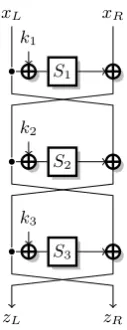
The two structures we study are depicted in Figures 1 and 2. It is worth noticing a major difference between the two: the function resulting from the Feistel construction is always invertible (since one round is an involution, up to a permutation of the outputs), while the function resulting
from the MISTY construction is invertible if and only if all the inner S-Boxes are invertible.
S3 S2 S1 xR
xL
zR
zL
k1
k2
k3
Fig. 1.3-round MISTY network
S3 S2 S1
xR
xL
zR
zL
k1
k2
k3
Fig. 2.3-round Feistel network
Definition 3 (MEDP and MELP). LetFK be a family of function fromFn2 intoF n
2. The MEDP is the maximum probability of a differential, averaged over all keys:
MEDP(FK) = max a6=0,b
1 2k
X
K∈Fk2
δFK(a, b) 2n .
The MELPis the maximum potential of a linear approximation, averaged over all keys:
MELP(FK) = max a,b6=0
1 2k
X
K∈Fk2 λ
FK(a, b) 2n
2
.
The following theorem shows that theMEDP andMELPof a Feistel or MISTY network can be bounded.
Theorem 1 (Feistel or MISTY, averaged over all keys, [37,38,3,31]).
Given S1, S2 and S3 threen-bit permutations, let p= maxiδ(Si)/2n and q= maxi(L(Si)/2n)2. Then the family of functions(FK)K=(K1,K2,K3)∈F32k defined by 3 rounds of a Feistel or of a MISTY
network withSi as inner functions verifies
MEDP(FK)≤p2 andMELP(FK)≤q2.
This theorem is very powerful for the construction of iterated block ciphers: it shows that a big function with strong cryptographic properties can be built from small functions with strong cryptographic properties. However, for the design of an S-Box from smaller S-Boxes, it is of little use. Indeed, we are interested in the properties of a single fixed S-Box, rather than the average properties of a family of S-Boxes. For a fixed (a, b) the theorem proves that the average values of δFK(a, b) and λFK(a, b) are bounded, therefore there exist at least one key for which the value is smaller than or equal to the average. However, it might be that the valuesa, bwhere the maximum is reached are not the same for every key. Therefore if we select a key so thatδFK(a, b) is small for ana, bmaximizing the average probability, the maximum can be reached for another entry of the differential table.
More strikingly, we discovered some choices ofS1,S2,S3such that the maximum differential probability of the functions in the corresponding family is always higher than theMEDP.
Example 1. We consider a MISTY structure with three identical S-Boxes: Si= [A,7,9,6,0,1,5,B,3,E,8,2,C,D,4,F].
The relevant property for the construction of an S-Box is the maximum differential probability (respectively maximum linear potential). Therefore, we could derive some information on this quantity forFK for some fixed keys from the knowledge of the average value of the maximal differential probability, i.e., theEMDP(resp.EMLP), which may significantly differ from theMEDP
(resp.MELP). We would like to point out that there is a confusion between the two notions in [32]: the definition corresponds to the expected maximum differential probability (respectively expected maximum linear potential), while the theorems apply to theMEDPandMELP.
Analysis of Feistel and MISTY structures with fixed key. In order to study the properties of Feistel and MISTY structures for the construction of lightweight S-Boxes, we must study these structures with a fixed key. Equivalently, we can consider the structures without any key, because a structure with a fixed key is equivalent to an unkeyed one with different S-Boxes. Indeed, using an S-BoxSi with round keyki is equivalent to usingSi0 :x7→Si(x+ki) as an S-Box without any key. In the following, we always consider a key-less variant.
In a recent analysis of the fixed-key Feistel structure [27], Li and Wang derive the best differential uniformity and linearity which can be achieved by a 3-round Feistel cipher with a fixed key, and give examples reaching this bound. Their main results are as follows:
Theorem 2 (Feistel unkeyed, [27]).Let S1, S2 andS3be three n-bit S-Boxes andF be the2n -bit function defined by the corresponding3-round Feistel network. Then,δ(F)≥2δ(S2). Moreover, ifS2 is not a permutation, δ(F)≥2n+1.
If n= 4,F satisfiesδ(F)≥8. If equality holds, thenL(F)≥64.
3
S-Boxes obtained from 3 rounds of MISTY
3.1 Our results
In this paper, we generalize the bounds of Li and Wang [27] on Feistel structures, and derive bounds for MISTY structures. The results are very similar for the two structures, but for a MISTY structure, optimal results are only achieved with non-invertible inner functions. Therefore, our work shows that Feistel structures allow better results than MISTY structures for the design of invertible 8-bit S-Boxes.
More precisely, we introduce two new S-Box propertiesδmin andLmin in order to derive our bounds: Lmin is the smallest linearity we can have for a non-trivial component of the S-Box. Similarly,δminis the smallest value we can have for the maximum maxbδ(a, b) within a row in the difference table. In particular, for any 4-bit functionS,δmin(S)≥2 andLmin(S)≥4. Moreover, if S is a 4-bit permutation, thenδmin(S)≥4 andLmin(S)≥8.
We first present the general lower bounds we obtain on the differential uniformity and linearity of 3 rounds of a Feistel and of a MISTY construction.
1. For a Feistel network with inner S-BoxesS1, S2andS3:
– δ(F)≥δ(S2) max (δmin(S1), δmin(S3))
– ifS2 is not a permutation,δ(F)≥2n+1.
– ifS2 is a permutation,δ(F)≥ max
i6=2,j6=i,2 δ(Si)δmin(Sj), δ(Si)δmin(S
−1 2 )
.
– L(F)≥ L(S2) max (Lmin(S1), Lmin(S3))
– ifS2 is a permutation,L(F)≥ max
i6=2,j6=i,2 L(Si)Lmin(Sj), L(Si)Lmin(S
−1 2 )
. 2. For a MISTY network with inner S-BoxesS1,S2 andS3:
– δ(F)≥δ(S1) max (δmin(S2), δmin(S3))
– ifS1 is not a permutation,δ(F)≥2n+1.
– ifS1 is a permutation,δ(F)≥ max
i6=1,j6=1,i δ(Si)δmin(Sj), δ(Si)δmin(S
−1 1 )
;
– L(F)≥max (L(S1)Lmin(S2),L(S2)Lmin(S1), L(S3)Lmin(S1));
– ifS3 is a permutation,L(F)≥ L(S1)Lmin(S3−1).
– ifS1 is a permutation,L(F)≥ L(S3)Lmin(S2).
Ifn= 4 this yields for both constructions:
δ(F)≥8 andL(F)≥48. Moreover,L(F)≥64 unlessδ(F)≥32.
For the MISTY construction with n = 4, if F is a permutation, we obtain tighter bounds: δ(F) ≥ 16 and L(F) ≥ 64. This implies that the Feistel construction is more appropriate for constructing 8-bit permutations. We will also show that all these bounds forn= 4 are tight. We now detail the results first in the case of the MISTY construction, and then for the Feistel construction.
3.2 Differential uniformity of 3 rounds of MISTY
Our lower bound on the differential uniformity of the 3-round MISTY relies on the evaluation of the number of solutions of some differentials for which the input difference of one of the 3 S-Boxes is canceled (see Figure 3).
Proposition 1. Let S1,S2 and S3 be threen-bit S-Boxes and F be the2n-bit function defined by the corresponding3-round MISTY network. Then, for all a,b andc inFn2, we have:
(i) δF(0ka, bkc) =δS1(a, c)×δS3(c, b⊕c) ; (ii) If S1 is bijective,
δF(ak0, bkc) =δS2(a, a⊕c)×δS3(a, b⊕c) ; (iii) δS1(a, b)×δS2(b, c)≤δF(bka, ckc)≤
X
d∈Fn2
δS1(a, b⊕d)×δS2(b, c⊕d)×γS3(d)
whereγS3(d) is 0 ifδS3(d,0) = 0and 1 otherwise. Most notably, ifS3 is bijective,
δF(bka, ckc) =δS1(a, b)×δS2(b, c).
Proof. Let xbe the input of the MISTY network, and let xL andxR be its left and right parts respectively. The three results that we prove correspond to the configurations depicted on Figure 3.
(i) x= (xL, xR) satisfiesF(xLkxR)⊕F(xLk(xR⊕a)) =bkcif and only if
S3(S1(xR)⊕xL)⊕S3(S1(xR⊕a)⊕xL) =b⊕c, S2(xL)⊕S1(xR)⊕xL⊕S2(xL)⊕S1(xR⊕a)⊕xL=c ⇔
S3(S1(xR)⊕xL)⊕S3(S1(xR⊕a)⊕xL) =b⊕c, S1(xR)⊕S1(xR⊕a) =c or equivalently
xR∈DS1(a→c) andxL∈S1(xR)⊕DS3(c→b⊕c).
Hence, we deduce that there are exactlyδS1(a, c) values ofxR, and for each of those,δS3(c, b⊕c)
values ofxL, such thatxverifies the differential.
(ii) x= (xL, xR) satisfiesF(xLkxR)⊕F((xL⊕a)kxR) =bkcif and only if
S3(S1(xR)⊕xL)⊕S3(S1(xR)⊕xL⊕a) =b⊕c, S2(xL)⊕S1(xR)⊕xL⊕S2(xL⊕a)⊕S1(xR)⊕xL⊕a=c ⇔
S1(xR)⊕xL ∈DS3(a→b⊕c),
S2(xL)⊕S2(xL⊕a) =a⊕c or equivalently,
xL∈DS2(a→a⊕c) andS1(xR)∈xL⊕DS3(a→b⊕c).
IfS1 is invertible, for any fixedxL, each one of theδS3(a, b⊕c) values defined by the second
S3 S2 S1
δxR=a
δxL= 0
δyR=c
δx0R= 0
δx0L=c
δy0R= 0
δx00R=c
δx00L=c
δy00R=b⊕c
δzR=c
δzL=b
3.1.S2 inactive.
S3 S2 S1
δxR= 0
δxL=a
δyR= 0
δx0R=a
δx0L=a
δyR0=a⊕c
δx00R=a
δx00L=c
δyR00=b⊕c
δzR=c
δzL=b
3.2.S1 inactive.
S3 S2 S1
δxR=a
δxL=b
δyR=b
δx0R=b
δx0L= 0
δy0R=c
δx00R= 0
δx00L=c
δy00R= 0
δzR=c
δzL=c
3.3.S3inactive.
Fig. 3.Red values indicate differences. The interest of these differentials is that for each of them, only 2 S-Boxes influence the 3-round differential (under the condition thatS1 is invertible for 3.2 and thatS3 is invertible for 3.3).
(iii) (xL, xR) satisfiesF(xLkxR)⊕F((xL⊕b)k(xR⊕a)) =ckc if and only if
S3(S1(xR)⊕xL)⊕S3(S1(xR⊕a)⊕xL⊕b) = 0, S2(xL)⊕S1(xR)⊕xL⊕S2(xL⊕b)⊕S1(xR⊕a)⊕xL⊕b=c ⇔
S3(S1(xR)⊕xL)⊕S3(S1(xR⊕a)⊕xL⊕b) = 0, S2(xL)⊕S1(xR)⊕S2(xL⊕b)⊕S1(xR⊕a) =b⊕c
.
This equivalently means that there exists some d∈Fn2 such that
xR∈DS1(a→b⊕d), xL∈DS2(b→c⊕d),
S3(S1(xR)⊕xL)⊕S3(S1(xR⊕a)⊕xL⊕b) = 0, i.e.,
xR∈DS1(a→b⊕d), xL∈DS2(b→c⊕d) andS1(xR)⊕xL∈DS3(d→0).
Then, for any fixedd∈Fn2 such thatδS3(d,0) = 0, no pair (xL, xR) satisfies the third condition.
IfδS3(d,0)>0, then some of the values (xL, xR) defined by the first two conditions may also
satisfy the third one, and ifd= 0, the third condition is always satisfied. It then follows that δS1(a, b)×δS2(b, c)≤δF(bka, ckc)≤
X
d∈Fn2
whereγS3(d) is 0 ifδS3(d,0) = 0 and 1 otherwise. Moreover, ifS3 is bijective,δS3(d,0)>0 if
and only ifd= 0, implying that the two previous bounds are equal, i.e., δF(bka, ckc) =δS1(a, b)×δS2(b, c).
These three particular types of differentials provide us with the following lower bound on the differential uniformity of any 3-round MISTY network.
Theorem 3. Let S1,S2 and S3 be threen-bit S-Boxes and letF be the 2n-bit function defined by the corresponding 3-round MISTY network. Then,
δ(F)≥δ(S1) max (δmin(S2), δmin(S3)) whereδmin(S) = min
a6=0maxb δS(a, b). Moreover,
– ifS1 is a permutation,
δ(F)≥ max
i6=1,j6=1,imax δ(Si)δmin(Sj), δ(Si)δmin(S
−1 1 )
,
– ifS1 is not a permutation,δ(F)≥2n+1.
Proof. The result is a direct consequence of Prop. 1. We here derive the bounds from the first item in Prop. 1; the other cases can be similarly deduced from the two other items. Let us first consider a pair of differences (α, β) which achieves the differential uniformity ofS1, i.e.,δ(S1) =δS1(α, β).
Then, we choosea=αandc=β, and get that, for anyb∈Fn2, δF(0kα, bkβ) =δ(S1)×δS3(β, β⊕b).
Then, we can choose forb the value which maximizesδS3(β, β⊕b). This value is always greater
than or equal toδmin(S3). Similarly, we can now consider a pair of differences (α, β) which achieves the differential uniformity ofS3, i.e.,δ(S3) =δS3(α, β). In this case, we choosec=αandb=α⊕β,
and get that, for anya∈Fn2,
δF(0ka,(α⊕β)kα) =δS1(a, α)×δ(S3).
We then choose forathe value which maximizesδS1(a, α) which is always greater than or equal to
δmin(S1−1) whenS1is a permutation.
Let us now assume thatS1 is not bijective. This means that there exists some nonzeroa∈Fn2 such that δS1(a,0)≥ 2. Then, we deduce from the first item in Prop. 1, with b = c = 0, that
F(xLkxR)⊕FK(xL⊕akxR) = (0,0) hasδS1(a,0)×δS3(0,0)≥2×2
n= 2n+1 solutions in
F22n.
3.3 Linearity of 3 rounds of MISTY
The lower bound on the linearity of a three-round MISTY structure can be derived in a similar way.
Proposition 2. Let S1, S2 and S3 be threen-bit S-Boxes andF the2n-bit function defined by the corresponding3-round MISTY network. Then, for all a,bandc inFn2, we have:
(i) λF(akb,0kc) =λS1(b, c)λS2(a⊕c, c) (ii) λF(akb, ckc) =λS1(b, a)λS3(a, c)
(iii) IfS1 is bijective,λF(ak0, bkc) =λS2(a, b⊕c)λS3(b⊕c, b)
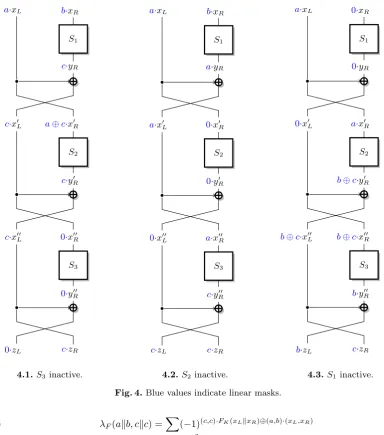
Proof. The following three results correspond to the configurations depicted on Figure 4.
(i) λF(akb,0kc) =X
(xR,xL)∈(Fn2)2
(−1)c·S2(xL)⊕c·S1(xR)⊕c·xL⊕a·xL⊕b·xR
=X
xR∈Fn2
(−1)c·S1(xR)⊕b·xRX xL∈Fn2
(−1)c·S2(xL)⊕(a⊕c)·xL
S3 S2 S1 b·xR a·xL c·yR
a⊕c·x0R
c·x0L
c·y0R
0·x00R
c·x00L
0·y00R
c·zR
0·zL
4.1.S3 inactive.
S3 S2 S1 b·xR a·xL a·yR
0·x0
R
a·x0
L
0·y0
R
a·x00
R
0·x00
L
c·y00
R
c·zR
c·zL
4.2.S2 inactive.
S3 S2 S1
0·xR
a·xL
0·yR
a·x0
R
0·x0
L
b⊕c·y0
R
b⊕c·x00
R
b⊕c·x00
L
b·y00
R
c·zR
b·zL
4.3.S1inactive.
Fig. 4.Blue values indicate linear masks.
(ii) λF(akb, ckc) =
X
(xR,xL)∈(Fn2)2
(−1)(c,c)·FK(xLkxR)⊕(a,b)·(xL,xR)
=X
(xR,xL)∈(Fn2) 2
(−1)c·S3(S1(xR)⊕xL)⊕a·xL⊕b·xR
We setxL=S1(xR)⊕z and observe that, for any fixedxR,z takes all possible values inFn2 whenxL varies, implying that
λF(akb, ckc) =
X
xR∈Fn2 X
z∈Fn2
(−1)c·S3(z)⊕a·(z⊕S1(xR))⊕b·xR=λ
S1(b, a)λS3(a, c).
(iii) λF(ak0, bkc) =
X
(xR,xL)∈(Fn2)2
(−1)(b,c)·FK(xLkxR)⊕(a,0)·(xL,xR)
=X
(xR,xL)∈(Fn2)2
(−1)b·S3(S1(xR)⊕xL)⊕[b⊕c]·[S1(xR)⊕S2(xL)]⊕[a⊕b⊕c]·xL
IfS1 is bijective, we setxR=S1−1(z⊕xL). Using that, for any fixed xL,z takes all possible values inFn2 whenxR varies, we deduce that
λF(ak0, bkc) =
X
xL∈Fn2
(−1)(b⊕c)·S2(xL)⊕a·xL X z∈Fn2
(−1)b·S3(z)⊕(b⊕c)·z
As in the differential case, the previous three linear approximations provide us with a lower bound on the linearity of any 3-round MISTY network. This bound involves both the linearity of the constituent S-Boxes and another quantity denoted byLmincomputed from the table of linear biases as follows.
Definition 4 (Lmin). LetF be an n-bit S-Box. We define
Lmin(F) = min b∈Fn2,b6=0
max a∈Fn2
|λF(a, b)|.
Most notably,Lmin(F)≥2n2 and this bound is not tight whenF is bijective.
Proof. By definition,Lmin(F) is the smallest linearity achieved by a componentFb:x7→b·F(x) of F, whenb varies inFn
2\ {0}. Since anyFb is ann-variable Boolean function, its linearity is at least 2n2 with equality if and only ifFb is bent [41]. Since bent functions are not balanced, none of the
components of a permutation is bent, implying thatLmin(F)>2 n
2 whenF is a permutation.
We then derive the following lower bound on the linearity of any 3-round MISTY network.
Theorem 4. Let S1,S2 and S3 be threen-bit S-Boxes and letF be the 2n-bit function defined by the corresponding 3-round MISTY network. Then,
L(F)≥max (L(S1)Lmin(S2), L(S2)Lmin(S1), L(S3)Lmin(S1)) .
Moreover, if S1 is a permutation, L(F) ≥ L(S3)Lmin(S2); if S3 is a permutation, L(F) ≥ L(S1)Lmin(S3−1), and if bothS1 andS3 are permutations, thenL(F)≥ L(S2)Lmin(S3−1).
Proof. Let us first choose a pair of masks (α, β) for someSi which achieves the linearityL(Si). For i= 1 ori= 2, we use the first item in Prop. 2 and deduce that, for anyγ,
|λF(γkα,0kβ)|=L(S1)|λS2(γ⊕β, β)|
|λF((α⊕β)kγ,0kβ)|=L(S2)|λS1(γ, β)|.
Fori= 3, we use the second item in Prop. 2 and get
|λF(αkγ, βkβ)|=L(S3)|λS1(γ, α)|.
Moreover, whenS1 is a permutation, the third item in Prop. 2 applies, and for (α, β) such that |λS3(α, β)|=L(S3), we get
|λF(γk0, βk(α⊕β))|=L(S3)|λS2(γ, α)|.
Then, in all these four cases, we choose forγ the nonzero value which maximizes the right-hand term in the product, i.e., which maximizes the Walsh transform of the involved component ofSj. By definition,Lmin(Sj) is then a lower bound for this right-hand term.
The last statements in the theorem are derived from the second (resp. third) item in Prop. 2, by choosing (α, β) such that|λS1(α, β)|=L(S1) (resp. |λS2(α, β)|=L(S2)). Then we obtain
|λF(βkα, γkγ)|=L(S1)|λS3(β, γ)|
|λF(αk0, γkβ⊕γ)|=L(S2)|λS3(β, γ)|,
where the second equality holds whenS1 is a permutation. Then, ifS3is a permutation, we use that, for any fixedβ 6= 0,
max γ∈Fn2
|λS3(β, γ)| ≥ Lmin(S
−1 3 ).
4
Application to 8-bit S-Boxes
4.1 Differential uniformity
The following bound on the differential uniformity of any 3-round MISTY network overF82 is a direct consequence of Theorem 3.
Corollary 1. Any8-bit function F corresponding to a 3-round MISTY network satisfies δ(F)≥8. Proof. The bound clearly holds when S1 is not bijective, since we known from Theorem 3 that δ(F)≥32 in this case. IfS1is bijective, thenδ(S1)≥4 since APN permutations overF4
2 do not exist, as proved in [23, Th. 2.3]. Obviously, any 4-bit S-BoxS satisfiesδmin(S)≥2, implying that
δ(F)≥δ(S1)δmin(S2)≥8.
Besides this general result, we can provide some necessary conditions on the constituent S-Boxes to achieve the previous lower bound. This result relies on the following lemma.
Lemma 1. LetS1be a 4-bit permutation withδ(S1) = 4andS2 and S3 be two4-bit functions. Let F be the8-bit function defined by the corresponding 3-round MISTY network. If δ(S2)≥4or if δ(S3)≥4, thenδ(F)≥16.
Proof. Here, S2 andS3 play a symmetrical role. Then, we assume Wlog thatδ(S3)≥4. Let us consider nonzero differencesaandbsuch that δS3(a, b)≥4. ThenDS3(a→b) contains an affine
subspace of dimension 2 ofF42. Indeed, if we choosex∈DS3(a→b), there existsc∈F
4
2\ {0},c6=a, such thatDS3(a→b)⊇ {x, x⊕a, x⊕c, x⊕c⊕a}. Hence, we get that
S3(x)⊕S3(x⊕c) =S3(x⊕a)⊕S3((x⊕a)⊕c) and
S3(x)⊕S3(x⊕(c⊕a)) =S3(x⊕a)⊕S3((x⊕a)⊕(c⊕a))
Thus the three rows defined bya,cand (a⊕c) in the differential table ofS3contain a value greater than or equal to 4.
From the first item in Prop. 1, we deduce that, for anyα∈ {a, c, a⊕c}, we can choose someb such that, for anyγ,
δF(0kγ, bkα) =δS1(γ, α)×δS3(α, b⊕α)≥4δS1(γ, α).
Therefore,δ(F)≥16 unless the three columns in the difference table ofS1defined by a difference in{a, c, a⊕c}do not contain any 4. LetC(S1) denote the set of columns in the difference table of an S-Box which consist of 0s and 2s only:
C(S1) ={b∈F42\ {0} :δS1(a, b)≤2,∀a6= 0}.
Amongst all equivalence classes of 4-bit permutationsS1withδ(S1) = 4, only 12 satisfy #C(S1)≥3. Moreover, 3 of them have their setC(S1) included in the set C(S0
1) of a function in another class, hence we ignore them.
We can check that none of these setsC(S) contains a subset with 3 elements stable by addition. Furthermore, this property is invariant under affine transformation. Indeed, forS0=A2◦S◦A1, we have
δS0(a, b) =δS(L1(a), L−21(b))
whereL1 andL2 are the linear parts ofA1andA2. It follows thatC(S0) =L2(C(S)). Therefore,
the configuration needed for havingδ(F)<16 never appears.
We can now deduce some necessary conditions to achieveδ(F) = 8.
Theorem 5. Let S1,S2 andS3 be three 4-bit S-Boxes and letF be the 8-bit function defined by the corresponding 3-round MISTY network. Then,δ(F) = 8implies that S1 is a permutation with δ(S1) = 4 andS2 andS3 are two APN functions. Otherwise, δ(F)≥12.
Proof. Since δ(F)≥32 whenS1 is not bijective, we only need to focus on the case whereS1 is a permutation. If any of the constituent S-BoxesSi has differential uniformity strictly greater than 4, i.e.,δ(Si)≥6, we deduce from Theorem 3 thatδ(F)≥δ(Si)δmin(Sj)≥12. Therefore,δ(F) = 8 can be achieved only ifδ(S1) = 4,δ(S2)≤4, andδ(S3)≤4. The fact thatδ(F)≥16 when at least one of the S-BoxesS2 orS3 has differential uniformity 4 is proved in Lemma 1.
We can then prove that the lower bound in Corollary 1 is tight by exhibiting three 4-bit S-Boxes satisfying the previous conditions which lead to a 3-round MISTY network with differential uniformity 8.
Example 2. The following 4-bit S-Boxes yield an 8-bit S-Box with differential uniformity 8 and linearity 64 when used in a MISTY structure:
S1= [4,0,1,f,2,b,6,7,3,9,a,5,c,d,e,8] S2= [0,0,0,1,0,a,8,3,0,8,2,b,4,6,e,d] S3= [0,7,b,d,4,1,b,f,1,2,c,e,d,c,5,5]
With bijective inner S-Boxes. We now focus on the case where the three inner S-Boxes are permutations since this guarantees that the resulting MISTY network is a permutation. We have proved that, in this case, the lowest possible differential uniformity we can obtain is 12. Here, we refine this result and show that the differential uniformity cannot be lower than 16. This improved bound exploits the following lemma on the difference tables of 4-bit permutations.
Lemma 2. Let S1, S2 and S3 be 4-bit permutations. Then, there exists a nonzero difference γ∈F42\ {0} such that at least one of the following statements holds:
– The difference table of S1 has at least one value greater than or equal to 4 in Columnγ and the difference table ofS2 has at least one value greater than or equal to 4 in Rowγ;
– The difference table of S1 has at least one value greater than or equal to 4 in Columnγ and the difference table ofS3 has at least one value greater than or equal to 4 in Rowγ,
– The difference table of S2 has at least one value greater than or equal to 4 in Rowγ and the difference table ofS3 has at least one value greater than or equal to 4 in in Rowγ.
Proof. This result relies on an exhaustive search over the equivalence classes defined by composition on the left and on the right by an affine transformation, exactly as in the classification of optimal 4-bit S-Boxes in [17,26]. There are 302 equivalence classes for 4-bit permutations. From each of the classes we picked a representative, and checked that its difference table has at least six rows defined by some nonzero input differenceawhich contain a value greater than or equal to 4. Let R(S) denote the corresponding set (of size at least six):
R(S) =
a∈F4
2\ {0} :∃b∈F 4
2\ {0}, δS(a, b)≥4 . Therefore, if there exists no difference γ ∈ F4
2\ {0} satisfying one of the three statements in the lemma, then this would mean that the three setsR(S2),R(S3) andR(S−1
We then deduce the following refined lower bound on the differential uniformity of a 3-round MISTY network overF8
2 with inner permutations.
Theorem 6. Let S1,S2 andS3 be three 4-bit permutationsand letF be the 8-bit function defined by the corresponding 3-round MISTY network. Then,δ(F)≥16.
Proof. The result is a direct consequence of Prop. 1 combined with the previous lemma. Indeed, Lemma 2 guarantees the existence of a, b and c such that at least one of the three following properties holds:
– δS1(a, c)≥4 andδS3(c, b⊕c)≥4, – δS2(a, a⊕c)≥4 andδS3(a, b⊕c)≥4, – δS1(a, b)≥4 andδS2(b, c)≥4.
In each of these three situations, Prop. 1 exhibits a differential (α, β) forF withδF(α, β) = 16.
4.2 Linearity
In order to apply Theorem 4 to the case of 8-bit MISTY network, we need to estimate the best linearity (andLmin) for 4-bit S-Boxes. It is well-known that the lowest linearity for a 4-bit permutation is 8. But, this result still holds if the S-Box is not bijective.
Lemma 3. Any 4-bit S-BoxS satisfiesL(S)≥8. Proof. Assume that there exists some S fromF4
2intoF42withL(S)<8, i.e., withL(S)≤6. Then, all nonzero Boolean components ofS, Sc :x7→c·S(x) withc6= 0, satisfyL(Sc)≤6. From the classification of all Boolean functions of at most 5 variables by Berlekamp and Welch [6], we deduce that anySc,c6= 0, is affine equivalent either tox1x2x3x4+x1x2+x3x4or tox1x2+x3x4, because these are the only classes of Boolean functions with linearity at most 6. LetL1(resp.L2) denote the set of all nonzeroc∈F42such thatScbelongs to the first (resp. second) class. Since the degree is invariant under affine transformations,L1 (resp.L2) corresponds to the components with degree 4 (resp. with degree at most 2). The sum of two components of degree at most 2 has degree at most 2, implying thatL2∪ {0}is a linear subspaceV ofF42. It follows that the projection ofS onV can be seen as a function fromF42into F
dimV
2 with linearity 4, i.e., a bent function. It has been shown by Nyberg [34] that, if a functionF fromFn2 intoF
m
2 is bent, thenm≤n/2. Therefore, dimV ≤2. But, the sum of any two componentsSc of degree 4 cannot have degree 4 since there is a single monomial of degree 4 of 4 variables. We deduce that, ifL1 containstwords of weight 1 (i.e., ifS hast coordinates with linearity 6), then
#L2≥
t
2
+ 24−t−1>3,
for all 0≤t≤4, a contradiction.
Combined with the previous lemma and with Definition 4, Theorem 4 provides the following lower bound on the linearity of a 3-round MISTY network overF8
2.
Corollary 2. Any8-bit functionF corresponding to a 3-round MISTY network satisfiesL(F)≥32. This bound is of marginal interest since, up to our best knowledge, L(S) = 32 is the lowest known linearity for an 8-bit S-Box. But, once again, the previous lower bound can be improved when focusing on permutations. Indeed, we can exploit thatLmin(S)≥8 for any 4-bit permutation:
Lemma 4. For any 4-bit permutation S, the table of linear biases of S has at least one value greater than or equal to8 on every row and column.
Proof. This result is obtained by an exhaustive search over all affine equivalence classes. The 302 representatives have been examined, and we could check the result for each of them.
Proposition 3. LetS1,S2 andS3 be three 4-bit S-Boxes and letF be the 8-bit function defined by the corresponding 3-round MISTY network. If any of the three inner S-Boxes is a permutation, thenL(F)≥64. Most notably, if L(F)<64, thenδ(F)≥32.
The last statement in the previous theorem is deduced from the first item in Theorem 3. While it shows that 3-round MISTY withL(F)<64 would be of little interest, we now show that their linearity is at least 48.
We first observe that if there is a nonzero linear mask c with |λS3(0, c)| ≥ 4, then we have
|λF(0k0, ckc)| = 16×4 = 64 according to Prop. 2. Therefore we study the functions such that |λS(0, c)|<4 for all nonzeroc.
Lemma 5. The only 4-bit functions S with |λS(0, c)|<4for all nonzeroc are the permutations, and the functions with image size 15.
Proof. The property∀c6= 0 :|λS(0, c)|<4 depends only on the set of images ofS, with multiplicity. This results is obtained by an exhaustive search over all the multisets of 16 elements in{0, . . . ,15}. We have tested the property over all 300540195 multisets; only the multiset with 16 distinct values and the 240 multisets with 15 distinct values satisfy it.
Lemma 6. For any 4-bit functionsS with image size 15 or 16, the table of linear biases ofS has at least one value greater than or equal to 6 in every column (i.e.∀c6= 0 :∃a,|λS(a, c)| ≥6). Proof. The property is invariant under affine equivalence. Therefore, we obtain the result by an exhaustive search over the affine equivalence classes ofS with image size 15 or 16. According to the classification of 4-bit permutations [17], there is a set of 302 permutationsPk such that any 4-bit permutationP can be decomposed asP =β◦Pk◦α, whereα, β are affine permutations.
LetS be a 4-bit function with image size 15. We denote byπi,j the projectioni7→j;x6=i7→x. There exist a permutationP, and a projectionπi,j such thatS=πi,j◦P. Using the decomposition P=β◦Pk◦α, we show thatS is affine equivalent to a functionπa,b◦Pk:
S=πi,j◦β◦Pk◦α=β◦πβ−1(i),β−1(j)◦Pk◦α.
We have tested the property for all 302 permutationsPk and all 72480 functionsπa,b◦Pk.
This allows to prove the following improved bound.
Theorem 7. Let S1,S2 andS3 be three 4-bit S-Boxes and letF be the 8-bit function defined by the corresponding 3-round MISTY network. ThenL(F)≥48.
Proof. The result is immediate if there exists a nonzerocwith|λS3(0, c)| ≥4. Otherwise, we choose
aandbsuch that|λS1(b, a)| ≥8, and Lemmas 5 and 6 show that there existscwith |λS3(a, c)| ≥6.
We have|λF(akb, ckc)| ≥48 from Prop. 2.
We conjecture that any MISTY network with 4-bit inner functions actually satisfiesL(F)≥64, but it seems hard to prove without a full classification of the 4-bit functions.
5
S-Boxes obtained from a 3-round Feistel network
5.1 Differential uniformity of a 3-round Feistel construction
Proposition 4. Let S1,S2 and S3 be threen-bit S-Boxes and F be the2n-bit function defined by the corresponding3-round Feistel network. Then, for all a,b andcin Fn2, we have:
(i) δF(0||a, b||c) =δS2(a, c)×δS3(c, a⊕b) ; (ii) If S2 is bijective,
δF(a||b, c||a)|=δS1(a, b)×δS3(a, c) ; (iii) δF(a||b, c||0) =δS1(a, b⊕c)×δS2(c, a).
Proof.
(i) x= (xL, xR) satisfiesF(xL||xR)⊕F(xL||(xR⊕a)) =b||c if and only if
S2(S1(xL)⊕xR⊕a)⊕S2(S1(xL)⊕xR) =c S3(yR⊕c)⊕S1(xL)⊕xR⊕a⊕S3(yR)⊕S1(xL)⊕xR=b or equivalently,
S1(xL)⊕xR∈DS2(a→c) andyR∈DS3(c→a⊕b).
The function (xL, xR)7→((S1(xL)⊕xR), yR) is a permutation since it corresponds to 2 rounds of the Feistel construction. Therefore, the number ofx= (xL, xR) satisfying the differential is δS2(a→c)×δS3(c→a⊕b).
(ii) x= (xL, xR) satisfiesF(xL||xR)⊕F((xL⊕a)||(xR⊕b)) =c||aiff
S2(S1(xL⊕a)⊕xR⊕b)⊕xL⊕a⊕S2(S1(xL)⊕xR)⊕xL =a S3(yR⊕a)⊕S1(xL⊕a)⊕xR⊕b⊕S3(yR)⊕S1(xL)⊕xR=c The first equality corresponds to
S2(S1(xL⊕a)⊕xR⊕)⊕S2(S1(xL)⊕xR) = 0, which is equivalent to
S1(xL⊕a)⊕xR⊕b=S1(xL)⊕xR ifS2 is a permutation. Therefore, (xL, xR) satisfies the differential iff
xL ∈DS1(a→b) andyR∈DS3(a→c).
For any fixedxL∈DS1(a→b), there areδS3(a, c) values ofxR=S
−1
2 (xL⊕yR)⊕S1(xL) which provide a valid input.
(iii) x= (xL, xR) satisfiesF(xL||xR)⊕F((xL⊕a)||(xR⊕b)) =c||0 iff
S2(S1(xL⊕a)⊕xR⊕b)⊕xL⊕a⊕S2(S1(xL)⊕xR)⊕xL= 0 S3(yR)⊕S1(xL⊕a)⊕xR⊕b⊕S3(yR)⊕S1(xL)⊕xR=c The second equation is equivalent to
xL∈DS1(a→b⊕c)
and the first one corresponds to
S1(xL)⊕xR∈DS2(c→a).
From these three particular types of differentials, we deduce a lower bound on the differential uniformity of a 3-round Feistel construction, similar to Theorem 3.
Theorem 8. Let S1,S2 and S3 be threen-bit S-Boxes and letF be the 2n-bit function defined by the corresponding 3-round Feistel network. Then,
– ifS2 is a permutation,
δ(F)≥ max i6=2,j6=2,imax
δ(Si)δmin(Sj), max
i6=2 δ(Si)δmin(S
−1 2 )
,
– ifS2 is not a permutation,δ(F)≥2n+1.
Proof. The result whenS2 is not a permutation has been proved in [27]. From the first item in the previous theorem, we now deduce that
δ(F)≥δ(S2)δmin(S3) andδ(F)≥δ(S3)δmin(S2−2)
where the second inequality requires thatS2is a permutation. Indeed, the first result is obtained by choosing (a, c) such thatδS2(a, c) =δ(S2) and by taking the maximum over allb. When we choose
(a⊕b, c) such thatδS3(c, a⊕b) =δ(S3) and take the maximum over alla, we get the second result
using that
max
α6=0δS2(α, β) = maxα6=0δS −1
2 (β, α)≥δmin(S
−1 2 ) whenS2 is a permutation.
The second item in Prop. 4, which holds whenS2 is a permutation, leads to δ(F)≥δ(S1)δmin(S3) andδ(F)≥δ(S3)δmin(S1).
The first inequality is obtained by choosing (a, b) such thatδS1(a, b) =δ(S1) and by taking the
maximum over allc, and the second one by choosing (a, c) such thatδS3(a, c) =δ(S3) and then
taking the maximum over allb. The third item in Prop. 4 leads to
δ(F)≥δ(S1)δmin(S2−1) andδF ≥δ(S2)δmin(S1).
The first inequality is obtained by choosing (a, b⊕c) such thatδS1(a, b⊕c) =δ(S1) and by taking
the maximum over allc whenS2is a permutation, and the second one by choosing (a, c) such that δS2(c, a) =δ(S2) and then taking the maximum over allb.
Also, forn= 4, we can exhibit a necessary condition on the S-Boxes to achieve the lower bound δ(F) = 8, by using the same technique as for the MISTY construction. Indeed, we have a result analogous to Lemma 1.
Lemma 7. LetS2be a 4-bit permutation withδ(S2) = 4andS1 and S3 be two4-bit functions. Let F be the 8-bit function defined by the corresponding 3-round Feistel network. If δ(S1)≥4 or if δ(S3)≥4, thenδ(F)≥16.
Proof. LetC(S) denote the set of columns in the difference table of an S-Box which consist of 0s and 2s only. Then, the first item in Prop. 4 shows thatδ(F)≥16 unlessC(S2) contains all the rows in the difference table ofS3 with a value greater than or equal to 4. Also, the third item in Prop. 4 shows thatδ(F)≥16 unlessC(S2) contains all the rows in the difference table ofS1 with a 4. We have shown in the proof of Lemma 1 that this situation cannot occur.
Therefore, we deduce the following condition for obtaining a 3-round Feistel construction over
F82with differential uniformity 8.
Theorem 9. Let S1,S2 andS3 be three 4-bit S-Boxes and letF be the 8-bit function defined by the corresponding 3-round Feistel construction. Then,δ(F) = 8implies thatS2 is a permutation withδ(S2) = 4andS1 andS3 are two APN functions. Otherwise,δ(F)≥12.
5.2 Linearity of a 3-round Feistel construction
Proposition 5. Let S1, S2 and S3 threen-bit S-Boxes and F the2n-bit function defined by the corresponding3-round Feistel construction. Then, for all a,b andc inFn
2, we have:
(i) λF(a||b,0||c) =λS1(a⊕c, b)λS2(b, c) (ii) λF(a||0, b||c) =λS2(b, a)λS3(a⊕c, b)
(iii) IfS2 is bijective,λF(a||b, b||c) =λS1(a, b)λS3(c, b)
Proof. (i) λF(a||b,0||c) =
X
(xR,xL)∈(Fn2) 2
(−1)c·xL+c·S2(S1(xL)⊕xR)⊕a·xL⊕b·xR
= X
xL∈Fn2
(−1)(a⊕c)·xL+b·S1(xL) X z∈Fn2
(−1)c·S2(z)+b·z
=λS1(a⊕c, b)λS2(b, c)
where we set z = S1(xL) +xR and we use the fact that, for any fixed xL, xR 7→ z is a permutation.
(ii) λF(a||0, b||c) =
X
(xR,xL)∈(Fn2)2
(−1)c·yR+b·S3(yR)+b·(S1(xL)⊕xR)⊕a·xL
=X
(yR,z)∈(Fn2) 2
(−1)c·yR+b·S3(yR)+b·z+a·(yR+S2(z))
=λS2(b, a)λS3(a⊕c, b)
where we use that the function (xL, xR)7→(yR, z) is a permutation since it corresponds to two rounds of the Feistel construction.
(iii) λF(a||b, b||c) =
X
(xR,xL)∈(Fn2)2
(−1)c·yR+b·S3(yR)+b·xR+b·S1(xL)⊕a·xL+b·xR
= X
xL∈Fn2
(−1)b·S1(xL)⊕a·xL X y∈Fn2
(−1)c·y+b·S3(y)
=λS1(a, b)λS3(c, b)
using thatxR7→y=xL⊕S2(S1(xL)⊕xR) is a permutation for any fixed xL whenS2 is a permutation.
We then deduce the following lower bound on the linearity of any 3-round Feistel construction.
Theorem 10. LetS1,S2 and S3 be three n-bit S-Boxes and let F be the 2n-bit function defined by the corresponding 3-round Feistel network. Then,
L(F)≥ L(S2) max (Lmin(S1), Lmin(S3)) .
Moreover, if S2 is a permutation,
L(F)≥ L(S1) max Lmin(S−21), Lmin(S3)
andL(F)≥ L(S3) max Lmin(S1), Lmin(S2−1) . Proof. From the first item in the previous theorem, we deduce that
L(F)≥ L(S1)Lmin(S−1
2 ) andL(F)≥ L(S2)Lmin(S1) where the first inequality requires thatS2 be a permutation.
The second item in Prop. 5 provides
where the second inequality holds whenS2 is a permutation.
From the third item in Prop. 5, we get that, whenS2 is a permutation L(F)≥ L(S1)Lmin(S3) andL(F)≥ L(S3)Lmin(S1).
The previous general bound can be improved in the case n = 4, exactly as for the MISTY construction. First, we get the following proposition as a direct consequence of Lemma 4.
Proposition 6. LetS1, S2 andS3 be three4-bit S-Boxes and letF be the8-bit function defined by the corresponding 3-round Feistel network. If any of the three inner S-Boxes is a permutation, then
L(F)≥64. Most notably, ifL(F)<64, thenδ(F)≥32.
Even if 3-round Feistel withL(F)<64 would be of very little interest, we can show that their linearity is at least 48.
Theorem 11. Let S1,S2 andS3 be three4-bit S-Boxes and letF be the8-bit function defined by the corresponding 3-round Feistel network. Then
L(F)≥48.
Proof. The previous theorem shows that the result holds ifS2is a permutation. Assume that S2 is not a permutation, i.e., there exists some nonzero output maskcsuch thatλS2(0, c)>0. Using the
first item in Prop. 5, we get that
λF(c||0,0||c) =λS1(0,0)λS2(0, c) = 16λS2(0, c).
The result then holds if there exists some nonzerocsuch thatλS2(0, c)≥4. Otherwise, we deduce
from Lemmas 5 and 6 that
L(F)≥48.
6
Constructions
We now use the previous results to design concrete 8-bit invertible S-Boxes optimized for lightweight implementations. We use Feistel and MISTY networks, and select 4-bit S-BoxesSi’s with a low-cost implementation that provide good cryptographic properties of the resulting 8-bit S-Box. Such S-Boxes have been considered as good candidates for many lightweight construction (e.g. the LS-designs [22]), but their respective merits and their cryptographic properties remained open.
We focus on implementing functions with a low gate count for hardware implementations, and a low instruction count for bit-sliced implementations (for table-based implementations, the table size is independent of the concrete S-Boxes). Moreover, we focus on implementations with a small number of non-linear gates, because non-linear gates are much harder to implement than linear gates in some dedicated settings such as masking [40], multi-party computation, or homomorphic encryption [1]. Bit-slicing can be used as an implementation technique to take advantage of some platform characteristics (for instance, it yields the fastest known implementation of AES on some Intel processors [24]), but it can also be a design criterion. Indeed, using a bit-sliced S-Box allow compact implementations without tables, and good performances both in software and hardware. In addition, S-Boxes implemented in this way are easier to protect against side-channel attacks with masking. Therefore, this approach is used by many lightweight designs such asSerpent[9], Noekeon[15],Keccak[8], RobinandFantomas[22],Pride [2],Prøst[25], orAscon [18]. This makes the construction of S-Boxes with a low gate count particularly relevant for lightweight cryptography.
Following the previous sections, the best results we can achieve for an 8-bit invertible S-Box are:
With a Feistel network: δ(F) = 8 and L(F) = 64.
We can provide some examples fulfilling these bounds: Example 2 is optimal for the MISTY construction, and an example for the Feistel construction is now exhibited. It is worth noticing that these results explain the compared properties of the S-Boxes obtained by the simulations reported in [22]. Since Feistel networks can reach a better security, we will mostly consider this construction. In this case, the optimal differential uniformity can be reached only ifS1, S3are APN, andS2 is a permutation withδ(S2) = 4, as proved in Th. 9. Note that, in some other contexts, the MISTY construction presents some advantages since it offers better performance in terms of throughput and latency because the first two S-Boxes can be evaluated in parallel.
6.1 Feistel network with low gate count and instruction count
Rather than choosing S-BoxesS1,S2andS3 with good properties first, and then searching for an efficient implementation of these S-Boxes (as in [39,13] for instance), we take the opposite approach, following Ullrichet al.[46]. We build gate descriptions of S-Boxes, and we test their cryptographic properties until we find a good candidate. Indeed, we do not have to specify in advance the 4-bit S-BoxesS1,S2,S3. Instead, we look for a good implementation of a permutation with δ(S) = 4 for S2, a good implementation of an APN function forS1 andS3, and we test the properties of the resulting Feistel structure. With good probability, this results in a Feistel networkF withδ(F) = 8 andL(F) = 64.
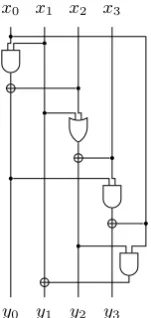
Following Ullrichet al., we run a search oriented towards bit-sliced implementations. We consider sequences of software instructions, with instructionsAND,OR,XOR,NOT, andMOV, using at most 5 registers. This directly translates to a hardware representation: theMOVinstruction become a branch while the other instructions represent the corresponding gates. There are 85 choices of instructions at each step, but we use an equivalence relation to restrict the search. For S2, we can directly reuse the results of [46]: they give an optimal implementation of a 4-bit permutation withδ(S) = 4. ForS1 andS3, we implemented a version of their algorithm, and searched for APN functions. We found that there is no construction of an APN function with 9 or fewer instructions. There are solutions with 10 instructions, but they have at least 6 non-linear instructions (AND,OR), which is not efficient for a masked implementation. Finally, with 11 instructions, there are constructions of APN functions with 4 non-linear instructions, 5XORinstructions, and 2MOV(copy) instructions. This search requires about 6000 core-hours of computation. The branching factor of our search is close to 10, while Ullrichet al.report a branching factor of less than 7; this is because we do not restrict the search to permutations (indeed, 4-bit APN functions are not permutations). This results in a very efficient 8-bit S-Box with good cryptographic properties, using 12 nonlinear gates, and 26 XORs. According to Theorem 9 and to the following Lemma, this is the optimal number of non-linear gates.
Lemma 8. LetSbe a 4-bit permutation withδ(S)≤4or a 4-bit APN function. Any implementation ofS requires at least 4 non-linear gates.
Proof. If S can be implemented with 3 non-linear gates or less, then the algebraic expression of the output variables is a linear combination of the input variables, and of the 3 polynomials corresponding to the output of the 3 non-linear gates. Therefore, there exists a linear combination of the input and output variables that sums to a constant, i.e. L(S) = 16. According to the classification of 4-bit permutation in [17], any permutation with δ(S) = 4 satisfies L(S) ≤ 12. Furthermore, the classification of 4-bit APN functions [14] shows that they satisfyL(S) = 8, which proves the lemma.
x0 x1 x2 x3
y0 y1 y2 y3
5.1.S1, APN function withδ(S1) = 2. S1= [0,0,4,d,c,0,0,5,8,0,7,6,5,a,2,4]
x0 x1 x2 x3
y0 y1 y2 y3
5.2.S2, permutation withδ(S2) = 4. S2= [0,8,6,d,5,f,7,c,4,e,2,3,9,1,b,a]
Fig. 5.Construction of a lightweight S-BoxS with a three-round Feistel (S1, S2, S1) satisfyingδ(S) = 8 andL(S) = 64.
6.2 Unbalanced MISTY structure
Finally, we consider an alternative to MISTY structures as studied in this paper. Instead of dividing the input into two halves of equal size, we consider unbalanced networks. The idea is to split the 8 input bits in two inequal parts of 3 and 5 bits. Thus, the MISTY network will use only 3 and 5 bit S-Boxes. The advantage of 3- and 5-bit S-Boxes is that invertible S-Boxes withδ= 2 exist, contrarily to the case of 4-bit S-Boxes. We managed to obtain 8-bit S-BoxesS with δ(S) = 8 using unbalanced MISTY networks, which is better than the lower boundδ(S)≥16 proved for balanced MISTY networks. However, this method uses 5-bit S-Boxes, which are more complicated to implement than 4-bit S-Boxes.
Example 3. We consider a 3-round unbalanced MISTY structure, with 5-bit permutationsS1, S3 and a 3-bit permutationS2. AfterS1and S3, the 3-bitxL is xored in the 3 MSB ofxR; afterS2 the 3 MSB of the 5-bitxL are xored intoxL. The following S-Boxes define an 8-bit S-Box with δ= 8 andL= 64:
S1= [00,01,02,04,03,08,0d,10,05,11,1c,1b,1e,0e,18,0a, 06,13,0b,14,1f,1d,0c,15,12,1a,0f,19,07,16,17,09] S2= [2,5,6,4,0,1,3,7]
S3= [00,01,02,04,03,08,10,1c,05,0a,1a,12,11,14,1f,1d, 06,15,18,0c,16,0f,19,07,0e,13,0d,17,09,1e,1b,0b]
This shows that generalizing our results to the unbalanced case, especially for the MISTY construction, may be of interest.
7
Conclusion
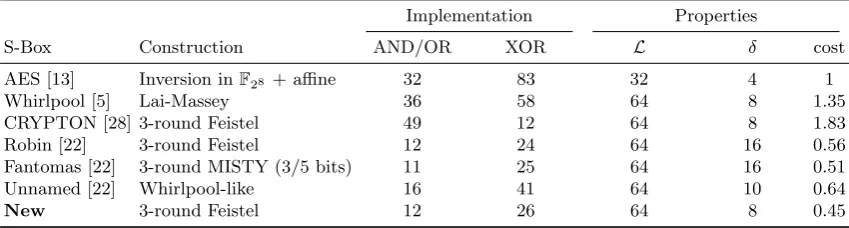
Table 1.Comparison of some 8-bit S-Boxes.δandLrespectively denote the differential uniformity and the linearity of the S-Box (see Section 2.1 for the definitions), the last column presents the relative overall implementation cost (taking 1 for the AES).
Implementation Properties
S-Box Construction AND/OR XOR L δ cost
AES [13] Inversion inF28 + affine 32 83 32 4 1
Whirlpool [5] Lai-Massey 36 58 64 8 1.35
CRYPTON [28] 3-round Feistel 49 12 64 8 1.83
Robin [22] 3-round Feistel 12 24 64 16 0.56
Fantomas [22] 3-round MISTY (3/5 bits) 11 25 64 16 0.51
Unnamed [22] Whirlpool-like 16 41 64 10 0.64
New 3-round Feistel 12 26 64 8 0.45
References
1. Albrecht, M., Rechberger, C., Schneider, T., Tiessen, T., Zohner, M.: Ciphers for MPC and FHE. In: Advances in Cryptology - EUROCRYPT 2015, Part I. LNCS, vol. 9056, pp. 430–454. Springer (2015) 2. Albrecht, M.R., Driessen, B., Kavun, E.B., Leander, G., Paar, C., Yal¸cin, T.: Block Ciphers - Focus on the Linear Layer (feat. PRIDE). In: Advances in Cryptology - CRYPTO 2014. LNCS, vol. 8616, pp. 57–76. Springer (2014)
3. Aoki, K., Ohta, K.: Strict Evaluation of the Maximum Average of Differential Probability and the Maximum Average of Linear Probability. IEICE TRANSACTIONS on Fundamentals of Electronics, Communications and Computer Sciences E80A(1), 2–8 (1997)
4. Barreto, P.S., Rijmen, V.: The KHAZAD Legacy-Level Block Cipher. NESSIE submission 5. Barreto, P.S., Rijmen, V.: The WHIRLPOOL Hashing Function. NESSIE submission
6. Berlekamp, E.R., Welch, L.R.: Weight distributions of the cosets of the (32, 6) Reed-Muller code. IEEE Transactions on Information Theory 18(1), 203–207 (1972)
7. Bernstein, D.J.: Cache-timing on AES. In: Symmetric-Key Encryption Workshop - SKEW 2005 (2005),
http://cr.yp.to/antiforgery/cachetiming-20050414.pdf
8. Bertoni, G., Daemen, J., Peeters, M., Assche, G.V.: The Keccak reference (January 2011), http: //keccak.noekeon.org/
9. Biham, E., Anderson, R.J., Knudsen, L.R.: Serpent: A new block cipher proposal. In: Fast Software Encryption - FSE ’98. LNCS, vol. 1372, pp. 222–238. Springer (1998)
10. Biham, E., Shamir, A.: Differential Cryptanalysis of DES-like Cryptosystems. J. Cryptology 4(1), 3–72 (1991)
11. Bogdanov, A., Knudsen, L.R., Leander, G., Paar, C., Poschmann, A., Robshaw, M.J.B., Seurin, Y., Vikkelsoe, C.: PRESENT: An Ultra-Lightweight Block Cipher. In: Cryptographic Hardware and Embedded Systems - CHES 2007. LNCS, vol. 4727, pp. 450–466. Springer (2007)
12. Borghoff, J., Canteaut, A., G¨uneysu, T., Kavun, E.B., Knezevic, M., Knudsen, L.R., Leander, G., Nikov, V., Paar, C., Rechberger, C., Rombouts, P., Thomsen, S.S., Yal¸cin, T.: PRINCE - A Low-Latency Block Cipher for Pervasive Computing Applications Extended Abstract. In: Advances in Cryptology -ASIACRYPT 2012. LNCS, vol. 7658, pp. 208–225. Springer (2012)
13. Boyar, J., Peralta, R.: A new combinational logic minimization technique with applications to cryptology. In: International Symposium on Experimental Algorithms - SEA 2010. LNCS, vol. 6049, pp. 178–189. Springer (2010)
14. Brinkmann, M., Leander, G.: On the classification of APN functions up to dimension five. Des. Codes Cryptography 49(1-3), 273–288 (2008)
15. Daemen, J., Peeters, M., Assche, G.V., Rijmen, V.: Nessie proposal: NOEKEON (2000)
16. De Canni`ere, C., Dunkelman, O., Knezevic, M.: KATAN and KTANTAN - A family of small and efficient hardware-oriented block ciphers. In: Cryptographic Hardware and Embedded Systems - CHES 2009. LNCS, vol. 5747, pp. 272–288. Springer (2009)
17. De Canni`ere, C.: Analysis and Design of Symmetric Encryption Algorithms. Ph.D. thesis, KU Leuven (2007)
18. Dobraunig, C., Eichlseder, M., Mendel, F., Schl¨affer, M.:Asconv1. CAESAR Competition (2014),
http://competitions.cr.yp.to/round1/asconv1.pdf
20. G´erard, B., Grosso, V., Naya-Plasencia, M., Standaert, F.: Block ciphers that are easier to mask: How far can we go? In: Cryptographic Hardware and Embedded Systems - CHES 2013. LNCS, vol. 8086, pp. 383–399. Springer (2013)
21. Grosso, V., Leurent, G., Standaert, F.X., Varici, K., Durvaux, F., Gaspar, L., Kerckhof, S.: SCREAM & iSCREAM Side-Channel Resistant Authenticated Encryption with Masking. CAESAR competition (2014),http://competitions.cr.yp.to/round1/screamv1.pdf
22. Grosso, V., Leurent, G., Standaert, F.X., Varıcı, K.: LS-designs: Bitslice encryption for efficient masked software implementations. In: Fast Software Encryption - FSE 2014. LNCS, Springer (2014)
23. Hou, X.D.: Affinity of permutations ofFn2. Discrete Applied Mathematics 154(2), 313 – 325 (2006) 24. K¨asper, E., Schwabe, P.: Faster and timing-attack resistant AES-GCM. In: Cryptographic Hardware
and Embedded Systems - CHES 2009. LNCS, vol. 5747, pp. 1–17. Springer (2009)
25. Kavun, E.B., Lauridsen, M.M., Leander, G., Rechberger, C., Schwabe, P., Yal¸cın, T.: Prø st. CAESAR Proposal (2014),http://proest.compute.dtu.dk
26. Leander, G., Poschmann, A.: On the Classification of 4 Bit SBoxes. In: Arithmetic of Finite Fields -WAIFI. LNCS, vol. 4547, pp. 159–176. Springer (2007)
27. Li, Y., Wang, M.: Constructing S-boxes for Lightweight Cryptography with Feistel Structure. In: Cryptographic Hardware and Embedded Systems – CHES 2014, LNCS, vol. 8731, pp. 127–146. Springer (2014)
28. Lim, C.H.: CRYPTON: A New 128-bit Block Cipher. AES submission (1998)
29. Lim, C.H.: A Revised Version of CRYPTON - CRYPTON V1.0. In: Fast Software Encryption – FSE’99. LNCS, vol. 1636, pp. 31–45. Springer (1999)
30. Matsui, M.: Linear cryptanalysis method for DES cipher. In: Advances in Cryptology—EUROCRYPT’93. LNCS, vol. 765, pp. 386–397. Springer (1994)
31. Matsui, M.: New Structure of Block Ciphers with Provable Security against Differential and Linear Cryptanalysis. In: Fast Software Encryption - FSE’96. LNCS, vol. 1039, pp. 205–218. Springer (1996) 32. Matsui, M.: New Block Encryption Algorithm MISTY. In: Fast Software Encryption - FSE’97. LNCS,
vol. 1267, pp. 54–68. Springer (1997)
33. National Institute of Standards and Technology: Data Encryption Standard. FIPS Publication 46-2 (December 1993)
34. Nyberg, K.: Perfect nonlinear S-boxes. In: Advances in Cryptology - EUROCRYPT’91. LNCS, vol. 547, pp. 378–385. Springer-Verlag (1991)
35. Nyberg, K.: Differentially uniform mappings for cryptography. In: Advances in Cryptology - EURO-CRYPT ’93. LNCS, vol. 765, pp. 55–64. Springer (1993)
36. Nyberg, K.: Linear approximation of block ciphers. In: Advances in Cryptology - EUROCRYPT ’94. LNCS, vol. 950, pp. 439–444. Springer (1994)
37. Nyberg, K., Knudsen, L.R.: Provable security against differential cryptanalysis. In: Advances in Cryptology - CRYPTO ’92. LNCS, vol. 740, pp. 566–574. Springer (1992)
38. Nyberg, K., Knudsen, L.R.: Provable security against a differential attack. J. Cryptology 8(1), 27–37 (1995)
39. Osvik, D.A.: Speeding up Serpent. In: AES Candidate Conference. pp. 317–329 (2000)
40. Rivain, M., Prouff, E.: Provably secure higher-order masking of AES. In: Cryptographic Hardware and Embedded Systems, CHES 2010. LNCS, vol. 6225, pp. 413–427. Springer (2010)
41. Rothaus, O.S.: On ”bent” functions. J. Comb. Theory, Ser. A 20(3), 300–305 (1976)
42. Shannon, C.E.: Communication Theory of Secrecy Systems. Bell system technical journal 28(4), 656–715 (1949)
43. Standaert, F., Piret, G., Rouvroy, G., Quisquater, J., Legat, J.: ICEBERG : An involutional cipher efficient for block encryption in reconfigurable hardware. In: Fast Software Encryption - FSE 2004. LNCS, vol. 3017, pp. 279–299. Springer (2004)
44. Stern, J., Vaudenay, S.: CS-Cipher. In: Fast Software Encryption - FSE ’98. LNCS, vol. 1372, pp. 189–205. Springer (1998)
45. Suzaki, T., Minematsu, K., Morioka, S., Kobayashi, E.:Twine: A lightweight block cipher for multiple platforms. In: Selected Areas in Cryptography - SAC 2012. LNCS, vol. 7707, pp. 339–354. Springer (2012)
46. Ullrich, M., De Canni`ere, C., Indesteege, S., K¨u¸c¨uk, ¨O., Mouha, N., Preneel, B.: Finding Optimal Bitsliced Implementations of 4x4-bit S-Boxes. In: SKEW 2011 Symmetric Key Encryption Workshop, Copenhagen, Denmark. pp. 16–17 (2011)
47. Wegener, I.: The complexity of Boolean functions. Wiley-Teubner (1987)
48. Wheeler, D.J., Needham, R.M.: TEA, a Tiny Encryption Algorithm. In: Fast Software Encryption -FSE’94. LNCS, vol. 1008, pp. 363–366. Springer (1994)