Power Aware Wireless Sensor Node Design
Using PSoC
Sham P Nayse
1, Mohammad Atique
2, Anita Agrawal
3Research Student of SGB Amravati University, India1
Associate Professor, Dept Computer Science, SGB Amravati University, Amravati, India2
Assistant Professor in EEE Dept, BITS- Pilani, K.K.Birla Goa Campus3
Abstract: This paper explores the features of reconfigurable architecture and programmable capability which are available with mixed array technology and the working results of performance developed wireless sensor nodes. A sensor node integrates sensing, processing and communication sub-systems. Several researchers have demonstrated operational nodes with low-power consumption. Our major focus for this article is to use the strategy of scheduling process. In sensor node and its network there is a scope to schedule processor tasks as per the objective of the application. Using this approach the result shows that the overall power consumption is reduced and it is observed in tune of 20_50%, as compared to conventional environment and practices.
Keywords: Power efficient Node, Sensor Node Design, System on Chip, WSN
I. INTRODUCTION
Sensor nodes are battery driven elements and hence operate on an extremely economical energy budget. Further, they must have a lifetime of the order of months to years, since replacement of battery is not an option for networks with hundreds and thousands of physically embedded nodes. In some cases, these networks may be required to operate solely on the energy scavenged from the environment through seismic, photovoltaic or thermal conversion. This transforms energy consumption into the most important factor that determines sensor node lifetime [1]. Conventional low-power design techniques and hardware architectures can provide solutions which are insufficient for these highly energy-constrained systems. Energy optimization, in the case of sensor networks, is much more complex, since it involves not only reducing the energy consumption of a single sensor node but also maximizing the lifetime of an entire network. The network lifetime can be maximized only by incorporating energy awareness into every stage of wireless sensor network design and operation, thus empowering the system with the ability to make dynamic tradeoffs between energy consumption, system performance and operational fidelity..
II. BACKGROUND
This article describes architectural utilization and algorithmic approach for the programmable system on chip platform which designers can use to enhance the energy awareness of wireless sensor networks. The scope of this paper is limited to design of application based sensor node and its firmware. The analysis of the power consumption characteristics of the typical sensor node architectures and identification of various factors that affect system lifetime have been already carried out [2]. They followed a presented suite of techniques which perform aggressive energy optimization while targeting all stages of sensor node design. There are several inferences that can be drawn from their result.
• Using low-power components and trading off unnecessary performance for power savings during node design can have a significant impact upto a few orders of magnitude.
• The node power consumption is strongly dependent on the operating modes of the components. For example, Table 1 shows that the WINS node consumes only around one-sixth of the power when the MCU is in Sleep mode, than when it is in Active mode.
• Due to extremely small transmission distances, the power consumed while receiving data can often be greater than the power consumed while transmitting packets, as is evident from Figure. 2. Thus, conventional network protocols, which usually assume the receive power to be negligible, are no longer efficient for sensor networks, and customized protocols which explicitly account for receive power have to be developed instead.
proposed network protocols have often ignored this fact, leading to fallacious savings in power consumption, as pointed out in [3.4]. Therefore, the radio should be completely shut off whenever possible to obtain energy savings.
Our proposed approach will help in maximizing network lifetime which requires the use of a well-structured design methodology that will enable energy-aware design and operation of all aspects of the sensor network, from the underlying hardware platform to the specific application based network protocols. Adopting such approach ensures that energy awareness is incorporated not only into individual sensor nodes but also into groups of communicating nodes and the entire sensor network. Figure 1 shows the brief architectural blocks of a typical sensor node. A system architecture of a canonical wireless sensor node is comprised of four subsystems: i) a computing subsystem consisting of a microprocessor or microcontroller, ii) a communication subsystem consisting of a short range radio for wireless communication, iii) a sensing subsystem (consisting of a group of sensors and accouters) data acquisition system which links the node to the physical world and iv) a power supply subsystem, which houses the battery, the dc-dc converter and the rest of the nodes. These are presented in figure 1.
Typical working life cycle of the sensor node is described in the following order. Basic operations of sensor node are a) Reading the physical parameter with the help of sensor in terms of electrical signal, either voltage, current, pulse etc. b) Amplification for weak signal and filtration of noise. c) Data conversion with the help of ADC, d) Further data processing or validation e) Re_sampling of data, if required f) Data storage in memory, f) timer to maintain required sample rate and synchronization for further communication with hub or other elements of sensor network..
III. DESIGN METHODOLOGY
In addition to sensing and communicating its own data to other nodes, a sensor node also acts as a router, forwarding packets meant for other nodes. In fact, for typical sensor network scenarios, a large portion (around 70%) of all packets received by a sensor node need to be forwarded to other destinations. Typical sensor node architectures implement most of the protocol processing functionality on the main computing engine. Hence, every received packet, irrespective of its final destination, travels all the way to the computing subsystem and gets processed, resulting in a high energy overhead. The use of intelligent radio hardware CyFi enables the packets that need to be forwarded to be identified and redirected from the communication subsystem itself, allowing the computing subsystem to remain in Sleep mode, saving energy.
While power management of individual sensor nodes reduces energy consumption, it is important for the communication between nodes to be conducted in an energy efficient manner as well. Since the wireless transmission of data accounts for a major portion of the total energy consumption, power management decisions that take into account the effect of inter node communication yield significantly higher energy savings. Further, incorporating power management into the communication process enables the diffusion of energy awareness from an individual sensor node to a group of communicating nodes, thereby enhancing the lifetime of entire regions of the network. To achieve power-aware communication it is necessary to identify and exploit the various performance-energy tradeoff knobs that exist in the communication subsystem.
For adopting energy awareness in wireless sensor and its communication network, some of the following issues may be taken into consideration; a) power consumption in each state of the node for a typical desired task. b) The frequency of the state occurring in enter life cycle of the sensor node. c) Time required for each state. d) Traffic Distribution, e) Topology Management and g) Routing and communication network protocol
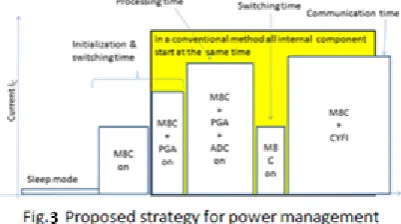
In our proposed methodology a typical sensor node life cycle operating schedule structure is as shown in Figure. 3. These are the different possible working stages of the node in a green house soil monitoring environment. For this purpose, we used WUWSN*. (IPR INTELLECTUAL PROPERTY RIGHTS, App. Number 453/MUM/2013).
The node state diagram shows four different working stages of the sensor node. The task of the sensor node is to collect information about the surrounding with a data sampling rate Sr, which is done in “Data Acquisition Mode” and shown in yellow color in figure. 3. This figure shows the sequence of flow of the node states. “INT” is the initialization process which starts from power on or reset. In this stage, the sensor indentifies itself in the network with the help of guide mode. Each node is preprogrammed with a default configuration and possesses a reconfigurable capability when it is in the network. After INT, it checks the flag and time tick and switches over to the other mode of operation. There are different timings like A B & C for predefined sleep and to add process delay to synchronize with real time application. Other modes are as described earlier viz: DTM, data transmission mode or communication mode, SM, synchronization mode and GM, guide mode.
.
Figure 2 shows that wireless sensor node is broadly working in four stages; ideally it should be more in sleep mode as shown with brown block. The typical architecture of the sensor node uses the PSoC as a main controller which is known for mixed array technology along with the CPU core. The PSoC Core is a powerful engine that supports a rich instruction set along with different CPU core like M8C, 8051 and ARM with low power architecture. In this architecture user has the flexibility to feed different power to different blocks, either analog or digital. Further user can use this block for required modules like programmable gain amplifier PGA, analog to digital convertor, Communication module like SPI or I2C. The power of each block can be switched on or off with the help of API.
In short we are controlling the power to the block which are in use and to other blocks, power is disconnected using the API and used architecture. In conventional architecture this feature does not exist. This strategic approach is out of scope for that model. For optimization of working for this approach we took a set of readings at different stages of the used model and carried out some lab experiment and the following observations were made.
TABLEI LAB READING
Description Current
1 Only CPU On 80 μA
2 CPU in sleep mode 4 μA
3 CPU + PGA on 120 μA
4 CPU + PGA + ADC on 950 μA
5 CPU + PGA+ADC+ Radio on 3.5 mA 6 CPU + PGA+ADC+ Radio in (Tx) 32 mA 7 CPU + PGA+ADC+ Radio in (Rx) 22 mA
8 CPU + Radio in (Tx) 30 mA
9 CPU + Radio in ideal 3 mA
10 CPU + Radio in (Rx) 22 mA
The above table shows the laboratory reading of typical wireless sensor node at different stages of working. These readings show the required current of each block or combination of blocks. These blocks are the user defined components which can be placed in SOC for performing the specific task. The power consumption of the node in a specific mode depends on the group of blocks which are actually involved for that process. Shaded parts are used for radio mode which is considered in routing and communication mode. The computation of the power consumption for specific task or mode is a complex job. The amount of power consumed by the node for its entire lifecycle can be defined as follows:
Plc = n1*t1*p1 + n2*t2*p2 + …. +nm*tm*pm
Where Plc – total power consumption for entire lifecycle of the node: p – power required by process or mode
t – time taken by process or mode
n – no of times the process or mode executes m – total no of processes or modes
IV.CONCLUSION
From the above observation, we can conclude that those conventional system designs which are not having an option to control power in a live system, will work in either of the stages 5, 6 or 7 of the above table. This will be the flat consumption of power throughout the sensor operation if we apply the proposed strategy explained in figure 2. If the sensor node is working for a time interval along with switching mechanism which is available in PSoC architecture, then the overall power consumption in the sensor node will be different at different stages of operation. Power is the product of current and time t. In the proposed method, designer can switch off the other devices when it is not required and this can reduce the power consumption of that PSoC block which is either analog or digital. It may take some more time for switching but in overall schedule this is very small. The average power will be lesser than the conventional (flat power where all blocks are getting the power) approach due to instantaneous current switch by on and off of the user block in PSoC. With the above readings, it will be in the order of 20-50%. The exact value is difficult to be found out in laboratory because the time required for communication packets are uncertain. It has waiting period for acknowledgement packets and again it will be uncertain in wireless network.
REFERENCES
[1] Raghunathan, Curt Schurgers, Sung Park, Mani B. Srivastava “Energy-Aware Wireless Microsensor Networks”, IEEE SIGNAL PROCESSING MAGAZINE pp 40-49, (MARCH 2002).
[2] V. Raghunathan, P. Spanos, and M. Srivastava, “Adaptive power-fidelity in energy aware wireless embedded systems,” presented at IEEE Real Time Systems Symposium, 2001.
[3] Y. Xu, J. Heidemann, and D. Estrin, “Geography-informed energy conservation for ad hoc routing,” Mobicom, 2001, pp. 70-84.