Physics Potential of a Radio Surface Array at the South Pole
Frank G.Schröder1,2,for the IceCube-Gen2 Collaboration
1Institute of Experimental Particle Physics, Karlsruhe Institute of Technology (KIT), Karlsruhe, Germany
2Bartol Research Institute, Department of Physics and Astronomy, University of Delaware, Newark, DE, USA
Abstract.A surface array of radio antennas will enhance the performance of the IceTop array and enable new, complementary science goals. First, the accuracy for cosmic-ray air showers will be increased since the radio array provides a calorimetric measurement of the electromagnetic component and is sensitive to the position of the shower maximum. This enhanced accuracy can be used to better measure the mass composition, to search for possible mass-dependent anisotropies in the arrival directions of cosmic rays, and for more thorough tests of hadronic interaction models. Second, the sensitivity of the radio array to inclined showers will increase the sky coverage for cosmic-ray measurements. Third, the radio array can be used to search for PeV photons from the Galactic Center. Since IceTop is planned to be enhanced by a scintillator array in the near future, a radio extension sharing the same infrastructure can be installed with minimal additional effort and excellent scientific prospects. The combination of ice-Cherenkov, scintillation, and radio detectors at IceCube will provide unprecedented accuracy for the study of high-energy Galactic cosmic rays.
1 Introduction: Present Situation
The sensitivity to the electromagnetic component will be achieved for zenith anglesθ 40◦by the installation of a scintillator array at the surface [5]. This array enable the calibration of the effect of the snow coverage. Furthermore, it will enhance the mass sensitivity of IceTop by measuring the electron-muon ratio in combination with the ice-Cherenkov tanks. However, systematic uncertainties due to the limitations of the hadronic interaction models will remain. To use the full potential of IceCube for cosmic-ray science, an additional detector for the electromagnetic shower component is required. While the classic techniques of fluorescence and atmospheric Cherenkov light are restricted in duty cycle (at the South Pole to periods of clear weather during the winter months), the radio array can operate continuously and in coincidence with any of the particle detectors.
2 Scientific Potential of a Radio Extension of the Surface Array
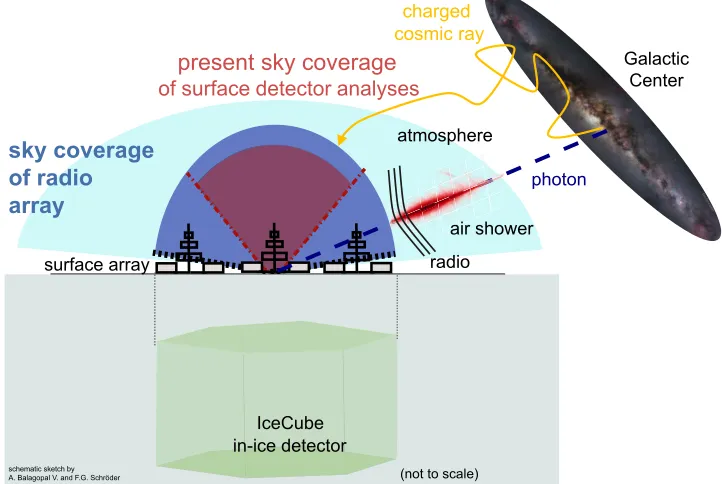
Given the recent progress of the radio technique for measurement of air showers [6, 7], a surface array of antennas at the South Pole is ideal for enhancing the performance of IceCube for cosmic-ray detection. The radio array will provide a calorimetric measurement of the electromagnetic shower component and is sensitive to the position of its maximum. If triggered by the particle detector arrays, it will improve the total measurement accuracy for showers above its energy threshold. Additionally, the radio array can measure inclined showers for which IceTop in its current configuration as well as the future scintillator array have a poor reconstruction accuracy. Therefore, the sky coverage for all types of cosmic-ray analyses will be significantly enhanced by the radio array. The combination of improved accuracy and sky coverage will enhance the performance of IceCube for several of its present science goals and enable it to study new aspects:
IceCube in-ice detector
(not to scale)
present sky coverage
of surface detector analyses
sky coverage
of radio
array
charged cosmic ray
photon
Galactic Center
air shower radio atmosphere
surface array
schematic sketch by A. Balagopal V. and F.G. Schröder
skysurvey .org
The sensitivity to the electromagnetic component will be achieved for zenith anglesθ 40◦ by the installation of a scintillator array at the surface [5]. This array enable the calibration of the effect of the snow coverage. Furthermore, it will enhance the mass sensitivity of IceTop by measuring the electron-muon ratio in combination with the ice-Cherenkov tanks. However, systematic uncertainties due to the limitations of the hadronic interaction models will remain. To use the full potential of IceCube for cosmic-ray science, an additional detector for the electromagnetic shower component is required. While the classic techniques of fluorescence and atmospheric Cherenkov light are restricted in duty cycle (at the South Pole to periods of clear weather during the winter months), the radio array can operate continuously and in coincidence with any of the particle detectors.
2 Scientific Potential of a Radio Extension of the Surface Array
Given the recent progress of the radio technique for measurement of air showers [6, 7], a surface array of antennas at the South Pole is ideal for enhancing the performance of IceCube for cosmic-ray detection. The radio array will provide a calorimetric measurement of the electromagnetic shower component and is sensitive to the position of its maximum. If triggered by the particle detector arrays, it will improve the total measurement accuracy for showers above its energy threshold. Additionally, the radio array can measure inclined showers for which IceTop in its current configuration as well as the future scintillator array have a poor reconstruction accuracy. Therefore, the sky coverage for all types of cosmic-ray analyses will be significantly enhanced by the radio array. The combination of improved accuracy and sky coverage will enhance the performance of IceCube for several of its present science goals and enable it to study new aspects:
IceCube in-ice detector
(not to scale)
present sky coverage
of surface detector analyses
sky coverage
of radio
array
charged cosmic ray photon Galactic Center air shower radio atmosphere surface arrayschematic sketch by A. Balagopal V. and F.G. Schröder
skysurvey .org
Figure 1. Schematic sketch of a potential radio extension of the IceCube surface array. The radio array will improve the accuracy and extend the field of view to lower elevations. In addition to cosmic-ray measurements, the radio array can search for photons of PeV energy from the Galactic Center.
Energy Spectrum and Mass Composition
The flux and mass composition of the primary cosmic rays as a function of the energy are classical measures in cosmic-ray science. Features in these observables carry information on the propagation and the origin of the cosmic rays. Due to the lower systematic uncertainties of the radio technique, the surface antenna array will increase the per-event precision and the absolute accuracy. Finally, the energy scale of IceCube can be compared to other cosmic-ray experiments with a radio extension [8].
Mass-dependent Anisotropy
Weak, but statistically significant anisotropies in the all-particle flux of primary cosmic rays have been discovered below 2 PeV [9] and above 8 EeV [10]. The maximum energy of cosmic rays produced in the Milky Way is presumed to be in this energy range. However, the arrival directions in this energy range are remarkably isotropic, possibly because of the overlaping of different anisotropies of Galactic and extragalactic cosmic rays. Since extragalactic cosmic rays below 1019eV seem to be mainly protons or alpha particles [11], [12], but Galactic cosmic rays at these energies have a significantly heavier composition [13], [14], to investigate this requires an event-to-event separation of light and heavy cosmic rays. While the scintillator extension will provide this separation for nearly vertical showers, the radio extension will provide it for more inclined events.
Particle Physics in Air Showers
The separate measurement of the electromagnetic component by the radio array, of the electrons and low-energy muons by the particle detectors at the surface, and of the high-energy muons in the ice will enable more thorough tests of hadronic interaction models. Improving the knowledge of air-shower physics at multi PeV energies, and in particular understanding the ’muon deficit’ in the models, is necessary to better quantify the muon background in neutrino measurements by IceCube.
PeV Photon Search
Photon induced showers emit a slightly stronger radio signal than showers initiated by cosmic-ray nuclei and contain an order of magnitude fewer muons. Thus, the combination of radio and muon detectors is ideal to search for photons. The Galactic Center, a promising candidate source of PeV photons [15], is continuously visible at 61◦ zenith from the South Pole, thus providing significant discovery potential.
Pathfinder for the Next Generation
In addition to its primary goals, a radio surface array will serve as a pathfinder for next generation projects. In particular, it can be used to study the potential of a large-scale array of surface antennas in combination with other extensions of IceCube-Gen2, e.g., for calibration of an in-ice radio array. Due to the large radio footprint of inclined showers [16], a radio surface array could veto very inclined events, even if the shower core is far outside the array. Furthermore, by using antennas developed for the Square Kilometer Array (SKA), a radio extension of IceTop will become its natural pathfinder. The SKA has a complementary science case, since it will measure the radio signal of air showers in great detail [17], but will not feature muon detectors.
3 Performance
-0.5 km 0 0.5 km -0.5 km
0 0.5 km
Scintillators
IceTop tanks Scintillators with hub
Figure 2. Left:Mapoftheparticle-detectorarraysatthesurfaceofIceCube;theIceToparrayinoperationsince severalyears,andtheproposedscintillatorarray.Right:SKAprototypeantennausedforfirsttestsatKIT.
the electromagnetic shower component responsible for the radio emission is similar for all primary particles, these results can be used to estimate the general performance for cosmic rays. With present simulations, many key parameters were estimated approximately. Prototype measurements and further simulation studies are needed to optimize the configuration of the final array.
Threshold: few PeV
At a radio quiet site the most relevant backgrounds are thermal and Galactic radio noise. This was confirmed for the South Pole by earlier measurements at lower frequencies using RASTA surface antennas at the ARA testbed [18], [19]. In addition there is human-made temporary RFI at the South Pole that will be easy to filter for externally triggered radio measurements. According to our simulation study assuming a thermal noise of 300 K, the optimum band for detection of air showers is around 100−190 MHz. Using the detection criterion of AERA [20] and Tunka-Rex [21], i.e., a signal-to-noise ratio of ten in at least three antennas, the threshold will depend on the arrival direction of the shower and is expected of order a few PeV.
Aperture:0◦to approximately70◦zenith angle
For vertical showers the radio footprint is smallest and will have a diameter of order 250 m. Full sky coverage requires an antenna spacing dense enough to cover at least three antennas in any possible circle of this diameter. Hence, around 80 antennas within the 1 km2 area of IceTop are required for full sky coverage including vertical showers.
Primary particle: direction, energy, mass
-0.5 km 0 0.5 km -0.5 km
0 0.5 km
Scintillators
IceTop tanks Scintillators with hub
Figure2.Left:Mapoftheparticle-detectorarraysatthesurfaceofIceCube;theIceToparrayinoperationsince severalyears,andtheproposedscintillatorarray.Right:SKAprototypeantennausedforfirsttestsatKIT.
the electromagnetic shower component responsible for the radio emission is similar for all primary particles, these results can be used to estimate the general performance for cosmic rays. With present simulations, many key parameters were estimated approximately. Prototype measurements and further simulation studies are needed to optimize the configuration of the final array.
Threshold: few PeV
At a radio quiet site the most relevant backgrounds are thermal and Galactic radio noise. This was confirmed for the South Pole by earlier measurements at lower frequencies using RASTA surface antennas at the ARA testbed [18], [19]. In addition there is human-made temporary RFI at the South Pole that will be easy to filter for externally triggered radio measurements. According to our simulation study assuming a thermal noise of 300 K, the optimum band for detection of air showers is around 100−190 MHz. Using the detection criterion of AERA [20] and Tunka-Rex [21], i.e., a signal-to-noise ratio of ten in at least three antennas, the threshold will depend on the arrival direction of the shower and is expected of order a few PeV.
Aperture:0◦to approximately70◦zenith angle
For vertical showers the radio footprint is smallest and will have a diameter of order 250 m. Full sky coverage requires an antenna spacing dense enough to cover at least three antennas in any possible circle of this diameter. Hence, around 80 antennas within the 1 km2 area of IceTop are required for
full sky coverage including vertical showers.
Primary particle: direction, energy, mass
Since the frequency band of the proposed extension of IceTop will be wider than that of current radio arrays, the reconstruction accuracy is expected to be at least as good as that of similarly sparse arrays. LOPES achieved better than 05◦direction accuracy with a timing precision of about 1 ns [22], and
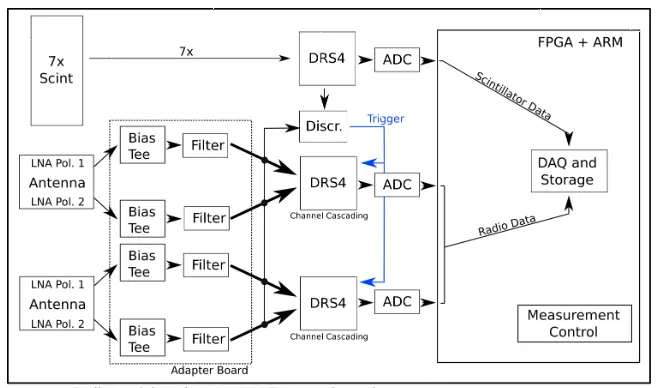
Figure 3.Schematics of the TAXI electronis for the data-acquisition. The TAXI system presently recording data of seven scintillators running at IceTop can easily be adapted to record radio data in addition. In a first prototype two antennas with two polarizations each will be attached.
an array diameter of only 200 m [23]. Tunka-Rex and AERA feature an energy accuracy of the order of 15 % [24], [25], which can probably be improved down to 10 % (per-event precision and absolute scale). The primary mass can be statistically reconstructed by the measurement ofXmax, and by the ratio of the radio amplitude and the muon number. Interpolating between LOFAR and Tunka-Rex results [26], [27], theXmaxprecision will be around 20−30 g/cm2, which corresponds to the average
difference between showers initiated by protons and helium nuclei. According to the simulation
studies performed for the Pierre Auger Observatory [28], the radio-muon combination is at least as sensitive to the mass composition and provides a complementary method. Being the first experiment combining both methods for the multi-PeV energy range will provide unprecedented accuracy for high-energy Galactic cosmic rays.
4 Ideas of the Realization of the Radio Array
The radio array can be realized in a cost-effective manner by attaching antennas to the planned
the South Pole. The installation of two SKALA antennas at IceCube is planned for January 2019 to perform first measurements triggered by the already operating scintillator prototypes.
5 Conclusion
Thanks to the demonstrated progress in the radio technique, and given the window of opportunity provided by the installation of the scintillator array, the time is ripe for a radio extension of IceTop. Despite the modest resources needed for adding antennas to the scintillator array, the physics potential of the radio surface array is bright. It has breakthrough potential in the search for PeV photons from the Galactic Center and the search for mass-dependent anisotropies, along with significant progress in standard cosmic-ray physics. The expected accuracy and sky coverage will make the combination of IceTop, the new scintillators and the antennas an outstanding cosmic-ray detector.
References
[1] IceCube Collaboration, Nucl. Inst. Meth. A700, 188 (2013) [2] IceCube Collaboration, Phys. Rev. D88, 042004 (2013)
[3] W.D. Apel, et al. - KASCADE-Grande Coll., Astropart. Phys.95, 25 (2017) [4] Pierre Auger Coll., Physical Review D91, 032003 (2015)
[5] IceCube-Gen2 Collaboration, Proceedings of ScienceICRC2017, 401 (2017) [6] F.G. Schröder, Prog. Part. Nucl. Phys.93, 1 (2017)
[7] T. Huege, Physics Reports620, 1 (2016)
[8] W.D. Apel, et al. - LOPES and Tunka-Rex Colls., Physics Letters B763, 179 (2016) [9] IceCube Collaboration, Astrophysical Journal826, 220 (2016)
[10] Pierre Auger Coll., Science357, 1266 (2017) [11] Pierre Auger Coll., JCAP04, 038 (2017)
[12] V. de Souza for the Pierre Auger and Telescope Array Coll., PoSICRC2017, 522 (2017) [13] W.D. Apel, et al. - KASCADE-Grande Coll., Phys. Rev. Lett.107, 171104 (2011) [14] IceCube Collaboration, Proceedings of ScienceICRC2017, 514 (2017)
[15] A. Balagopal V. et al., EPJ C78, 111 (2018) [16] Pierre Auger Coll., JCAP10, 026 (2018)
[17] T. Huege, et al. (SKA Focus GroupHigh Energy Cosmic Particles), EPJ WoC135, 02003 (2017) [18] S. Böser for the ARA and IceCube Coll., AIP Conference Proceedings1535, 116 (2013) [19] P. Allison, et al. - ARA Coll., Astropart. Phys.35, 457 (2012)
[20] Pierre Auger Coll., Physical Review D93, 122005 (2016)
[21] P.A. Bezyazeekov, et al. - Tunka-Rex Coll., Nucl. Inst. Meth. A802, 89 (2015) [22] F.G. Schröder et al., Nucl. Inst. Meth. A615, 277 (2010)
[23] W.D. Apel, et al. - LOPES Coll., JCAP09, 025 (2014)
[24] Pierre Auger Coll., Physical Review Letters116, 241101 (2016) [25] P.A. Bezyazeekov, et al. - Tunka-Rex Coll., JCAP01, 052 (2016) [26] S. Buitink et al. -LOFAR Coll., Phys. Rev. D90, 082003 (2014)
[27] P.A. Bezyazeekov, et al. - Tunka-Rex Coll., Phys. Rev. D97, 122004 (2018) [28] E. Holt for the Pierre Auger Coll., AIP Conference Proceedings (2018), this issue [29] T. Karg et al., 6th ARENA, 2014, Anapolis, USA (2014), arXiv:1410.4685 [30] E. de Lera Acedo et al., Experimental Astronomy39, 567 (2015)