Attacks in Stream Ciphers: A Survey
Gustavo Banegas
Department of Computer Science, Federal University of Santa Catarina
[email protected]
August 26, 2014
Applied Cryptography, Stream Cipher, Block Cipher, Attacks’ types, Finite Fields
Abstract
Nowadays there are different types of attacks in block and stream ciphers. In this work we will present some of the most used attacks on stream ciphers. We will present the newest techniques with an example of usage in a cipher, explain and comment. Previous we will
1
INTRODUCTION
Over the years, many ciphers was developed. There are block and stream ciphers for all kind of applications. However, we need to guarantee the security of that ciphers. Then, we developed different attacks to test the resistence of our ciphers.
In this work, we will present the constitution of block and stream ciphers. We will show the difference between them.
We will discuss about the most importants attacks for stream ciphers. We will present the most importante works in the area, explain the attack and give an exam-ple of application. We selected nine attacks, but there are many others. The attacks that we select are: Exhaustive Search, Algebraic, Correlation, Fault, Distinguish-ing, Chosen-IV, Slide, Cube, Time-Memory Trade-off and Guess and Determine. To made this selection, we choose historical importance, efficiency of the attack and newest attacks.
1.1
Papers Organization
In the Section 2 we will discuss about block and stream ciphers, we will give the difference between them and examples of ciphers. After the concept of ciphers, in the Section 3 we will discuss about the attacks in stream ciphers. We will explain how the attack works, the most relevants work in the area and example of the application. In the Section 4 we will give a brief discussion about all the work and the importance of the attacks.
2
TYPES OF CIPHERS
2.1
Block Ciphers
A concept of block ciphers was determined by Menezes et al [61]:
“A block cipher is a function which mapsn-bit plaintext blocks ton -bit ciphertext blocks; n is called the blocklength. It may be viewed as a simple substitution cipher with large character size. The function is parameterized by a k-bit key K, taking values from a subsetK(the key space) of the set of allk-bit vectorsVk. It is generally assumed that the key is chosen at random. Use of plaintext and ciphertext blocks of equal size avoids data expansion.” [61]
In mathematical terms, we can define block ciphers like as:
Definition 1. Ann-bit block cipher is a functionE:Vn×K→V n, such that for each keyK∈K,E(P,K)is an invertible mapping (the encryption function forK) fromVntoVn , writtenEK(P). The inverse mapping is the decryption function, denotedDK(C). C=EK(P) denotes that ciphertextC results from encrypting plaintextPunderK. [61]
2.1.1 Operation Modes of Block Ciphers
Talking about block ciphers, we have four most common modes of operation: ECB(Eletronic codebook, CBC(Cipher-block Chaining), CFB(Cipher feedback) and OFB(Output feedback). We will do a explanation about this four modes of operation.
ECB Mode:
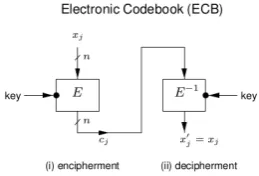
This mode produces identical ciphertext, because the blocks are enciphered inde-pendently of other blocks. In the algorithm of ECB mode from Menezes et al [61], we can verify this property of this mode. To help to understanding we have the Figure 1 and the Algorithm 1.
Figure 1: ECB Operation Mode of block ciphers
Algorithm 1:Algorithm of ECB mode.
Data:k-bit key K;n-bit plaintext blocksx1, . . . ,xn
Result: produce ciphertext blocksc1, . . . ,cn; decrypt to recover plaintext. 1. Encryption: for 1≤ j≤n,cj←EK(xj).
2. Decryption: for 1≤j≤n,xj←EK−1(cj). CBC Mode:
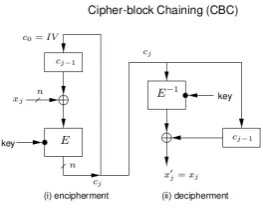
bit error in chiphertext blockcj, then affects all the other blocks aftercj. In the Algorithm 2 we can see this dependency.
Figure 2: CBC Operation Mode of block ciphers
Algorithm 2:Algorithm of CBC mode.
Data:k-bit key K;n-bitIV;n-bit plaintext blocksx1, . . . ,xn
Result: produce ciphertext blocksc1, . . . ,cn; decrypt to recover plaintext. 1. Encryption:
c0←IV;
for 1≤ j≤n,cj←EK(cj−1⊕xj). 2. Decryption:
c0←IV;
for 1≤ j≤n,xj←cj−1⊕EK−1(cj). CFB Mode:
In this operation the plain text is ciphered inr-bits plaintext units. This operation is needed, because some applications needr-bits ciphered and transmitted without delay. Thisris fixed,r<n(oftenr=1 orr=8). In the Algorithm 3 we can understand better this operation.
Algorithm 3:Algorithm of CFB mode.
Data:k-bit key K;n-bitIV;r-bit plaintext blocksx1, . . . ,xn(1<r<n) Result: producer-bit ciphertext blocksc1, . . . ,cn; decrypt to recover plaintext. 1. Encryption:I1←IV. (Ijis the input value in a shift register.)
Fori≤j≤n:
• Oj←EK(Ij). (Compute the block cipher output)
• tj←therleftmost bits ofOj.
• cj←xj⊕tj.
• Ij+1←2r·Ij+cj mod 2n.
2. Decryption:I1←IVfor 1≤ j≤n, upon receiveingcj:
xj←cj⊕tj, wheretj,OjandIjare computed as above.
In the Figure 3 we can understanding better the Algorithm 3. OFB Mode:
In the last most common operation, we have a mode of operation that is used for applications in which all error propagation must be avoided. This operation is similar to CFB, the difference is that the output of the encryption block function
Figure 3: CFB Operation Mode of block ciphers
Algorithm 4:Algorithm of OFB( ISO 10116) mode.
Data:k-bit key K;n-bitIV;r-bit plaintext blocksx1, . . . ,xn(1<r<n) Result: producer-bit ciphertext blocksc1, . . . ,cn; decrypt to recover plaintext. 1. Encryption:I1←IV. (Ijis the input value in a shift register.)
Fori≤j≤n, given plaintext blockxj:
• Oj←EK(Ij). (Compute the block cipher output)
• tj←therleftmost bits ofOj.
• cj←xj⊕tj.
• Ij+1←Oj.
2. Decryption:I1←IVfor 1≤ j≤n, upon receiveingcj:
xj←cj⊕tj, wheretj,OjandIjare computed as above.
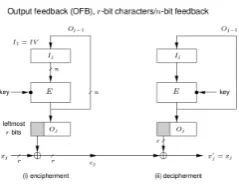
In the Figure 4 we can understanding better the Algorithm 4.
Figure 4: OFB Operation Mode of block ciphers
We present the most common operations mode of the block cipher, exists others operations like: Propagating cipher-block chaining (PCBC) and Counter (CTR). [61]
2.1.2 Examples of Block Ciphers
Nowadays in terms of ciphers exists a lot of block ciphers, in this subsection we will present the block ciphers used by National Institute of Standards and Technol-ogy (NIST). According to NIST, they use this block ciphers: AES [37] [38], Triple DES [39], and Skipjack [57] [65].
2.2
Stream Ciphers
In the subsection 2.1 we talked about block ciphers, now we will talk about other class of ciphers the stream ciphers. The principal difference between this two types of ciphers is in block ciphers we cipher a block of data per time and in stream ciphers we cipher a stream of data.
“Block ciphers tend to simultaneously encrypt groups of characters of a plaintext message using a fixed encryption transformation.” [61]
In the block ciphers we had the operation modes, in stream ciphers we have something like this. We have stream ciphers based on linear feedback shift reg-isters(LFSRs) and stream ciphers that does not use LFSRs. In this work we will discuss attacks on stream ciphers based on LFSRs, because the attacks consists at the LFSRs.
2.2.1 Examples of Stream Ciphers
There exists a lot of streams cipher, we will present stream ciphers used by Eu-ropean Network of Excellence in Cryptology(ECRYPT). The EUROCRYPT has a project called eSTREAM, this project is promoting the design of efficient and compact stream ciphers suitable for widespread adoption [46] [49].
The stream ciphers recommended by ECRYPT are: HC-128 [77], Grain v1 [52], Rabbit [20], MICKEY 2.0 [9], Salsa20/12 [13], Trivium [27] and SOSE-MANUK [12].
3
ATTACKS’ TYPES
In this section we will present the attacks’ types, we also explain and discuss what is the use of the attack.
It is important to understand that all the attacks have one purpose. The purpose is to discover the key used in the process of ciphering and deciphering. Each attack has a method to try to discover the key that was used, we will give some examples of the application of the attack.
3.1
Exhaustive Search Attack
The exhaustive search attack is also called brute force. The method of this attack is to search through all possible states, checking for a match between the resulting and the observed keystream.
Fortunately, Babbage [8] in 1995 improved the exhaustive search attack in stream ciphers. He defined two attacks in this area.
In the first attack, the attacker first procuces a list ofn-bit subsequences, sorted in lexographic (or numberic) order. Then the attacker select a random candidate state in this list and check, if the selected state produces the output of cipher, then the attacker found the initial state else he continus try to find the initial state [8].
The second attack was defined by Babbage [8] as:
“ LetVbe a vector space of dimensionnoverGF(2), with each possi-ble KG(Keystream Generator) state an element of V. The initial state, which we wish to determine, iss0, and the state transition function is
linear, and so can be represented by ann×nmatrixA, so thatsi=s0Ai.
3.2
Algebraic Attack
The algebraic attack is used in stream ciphers based in LFSRs. This attack try to find the initial state given some keystream bits.
The algebraic attacks has two steps. In the first step, the attack tries to find a system of equations in the bits of the secret keyKand the output bitsZt[6]. If it has enough low degree equations and known key bits stream, then the secret keyK
can be recovered by solving this system of equations in a second step. This system could be solved using Groebner bases [19] [26], XL , XSL and others [70] [33].
For Courtois [35] the algebraic attack can be defined in a synchronous stream cipher, which has a states∈GF(2)n. At each clocktthe statesis updated by a “connection function”s→L(s)that is assumed to be linear overGF(2). Then a combine f is applied tos, to produce the output bitbt= f(s). The goal for the attack is to find the initial state ofs[35] [34].
Flori et al [48] approach how to avoid the algebraic attacks using a good binary strings distribution. Unfortunately, they just had a conjecture and do not have a theorem. However, Wang and Johansson [75] proved that is capable to have a Boolean function [28] [24] [30] with fast algebraic immunity and higher order nonlinearity. To determinate the computation of immunity against algebriac and fast algebriac attack you can consult the Armknecht et al work [7].
Using this attack Orumiehchiha et al [67] recovered both initial state and secret key, from WG-7 cipher [58], with the time complexity 227.
3.3
Correlation Attack
The correlation attack was proposed by Siegenthaler in 1985 [73]. An important work in this area was elaborated by Meier and Staffelbach [60]. After them, Mi-haljevi and Goli [63] was one of the promising work. Other important work is from Anderson [5], he started the search for the optimum correlation attack. They opened the world of cryptanalysis to correlation attack.
The correlation attack is defined as:
“The correlation attack exploits the existence of a statistical depen-dence between the keystream and the output of a single constituent LFSR.” [29]
In the Figure 5, we can see how works a stream cipher based on LFSR. The random noise in the Figure 5 is the keystream (LFSRs), the functionh(x)is to expand the secret key and the outputKiis the secret key.
Figure 5: The idea of a stream cipher with LFSR
In the Figure 6 we can see the idea of the correlation attack. Using this attack Mihaljevi et al [62] recovered the internal state of LILI-128 [31] in a complexity time of the order 235.
In the work of Wei et al [76], they presented a new correlation attack on nonlin-ear combining generators. In the moment, we have a good review about correlation attacks in Meier work [59] and in the work of Canteaut [29].
3.4
Fault Attack
Figure 6: The idea of Correlation attack involving several constituent LFSRs
attacks in block ciphers, but the first application of this attack in stream cipher was developed by Hoch and Shamir [54].
In this attack, the attacker can apply some bit flipping faults to either the RAM or the internal register of the cryptographic device. However, he had only a partial control over their number, location and timing. This model tries to reflect a situa-tion in which the attacker has the possesion of the physical device, and the faults are transient rather than permanent [54].
A good work in this area was developed by Barenghi et al [11], they talk about this technique and where it can be applied. In their work has examples using stream ciphers and block ciphers.
In the work of Banika et al [10], they used in the Grain family [52] [51] [2] to recover the initial state of the LFSRs.
3.5
Distinguishing Attack
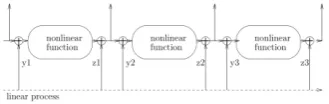
The distinghuishing attacks in stream ciphers was introduced by Coppersmith et al [32]. In the Figure 7, they illustrated a style of cipher that can be used in this attack.
Figure 7: A style of cipher to which Coppersmith techniques apply
The technique defined by Coppersmith et al [32] is:
“ An attack is specified by a linear functionl, and by a decision rule for the following hypothesis-testing problem: The two distributions that we want to distinguish are:
Cipher.The Cipher distribution isDc=hl(xj+yj,NF(xj)+zj)ij=1,2,...,
where theyjzjsare chosen at random from the appropriate linear sub-space (defined by the linear process of the cipher), and thexjsare random and independent.
Random. Using the same notations, the “random process” distribu-tion isDr=hl(xj,x0j)ij=1,2,..., where thexj’s andx0j’s are random and independent. We call the functionl, the distinguishing characteristic used by attack. ”[32]
explained how they create a new scenario for this attack. For an example, they used this new scenario in the LEX cipher [14] of the eSTREAM project [46].
An example of cyptoanalisys using this attack, is the work of Noferesti et al [66]. They reduced the complexity of the attack fromO(232)toO(230.79)in the Bivium cipher [22], a simplified version of Trivium [27].
3.6
Chosen-IV Attack
In the Chosen-IV attack one of the relevant work in this area is from Joux and Muller [55]. To understand more about this attack we should bring the definition from Joux and Muller work:
“In general, a stream cipher produces a pseudo random sequencePRNG(K,IV) from a secret keyKand an initialization vectorIV. Then, the cipher-textCis computed from the plaintextPby:
C=PRNG(K,IV)⊕P. The main idea behind the use of initializa-tion vectors is to generate different pseudorandom sequences without necessarily changing the secret key, since it is totally insecure to use twice the same sequence.” [55]
Then, this attack exploits the weaknesses in the key scheduling algorithm of the stream cipher. The attack tried to extract from the memory, the initial state of the LFSR. Like the algebraic attack, in the subsection 3.2, the chosen-IV attack created a system of equations. This system of equations is created using the parts from the key recovered in the memory, more specifically in the vector IV.
In the work of Englund et al [45], they explained how this attack works. Also, they proposed different algorithms to improve the search and gave a pratical demon-stration of this algorithm.
Using this attack, Joux and Muller [55] recovered the key in a complex time of 272and used 236 bytes of memory. For other examples, we can cite the work of Ding and Guan [40], who explored the weakness of the Grain-128 stream [51]. Biryukov et al [15] also used the attack in SNOW 3G⊕to reduce the complexity to recover the key, they recovered the key in practical complexities 257 time and 233keystream.
3.7
Slide Attack
The first time that the slide attack appeared in the literature was with Biryukov and Wagner [17]. They used the attack in TREYFER, WAKE-ROFB and others block ciphers. In 2000 they improved the slide attack and used in other block ciphers [18]. More recently slide attacks have been applied to other stream ciphers, such as Trivium with Priemuth-Schmid and Biryukov [69].
The main idea of the attack is defined by Biryukov and Wagner like:
“The idea is to slide one copy of the encryption process against another copy of the encryption process, so that the two processes are one round out of phase.” [17]
In the Figure 8 shows the typical slide attack. We letX0 andX00 denote two
plaintexts, withXj=Fj(Xj−1)andX0j=Fj(X0j−1). With this notation, we line up
X1next toX00, andXj+1next toX0j. Now, we suppose thatFj=Fj+1 for allj≥1; this is the assumption required to make the slide attack work. The observation is that if we have a matchX1=X00, then we will also haveXr=Xr0−1. Therefore, we
call a pair(P,C),(P0,C0)of known plaintexts (with corresponding ciphertexts) a slid pair ifF(P) =P0andF(C) =C0[17].
Using this technique Alhamdan et al [4], they demonstrated a slid property of the loaded state of the Sfinks cipher [23]. They demonstrated how to recover the key in the state update of the cipher as well.
3.8
Cube Attack
The cube attack is relative new. It has been introduced by Dinur and Shamir [41] in 2009.
“The attack exploits the existence of low degree polynomial represen-tation of a single output bit (as a function of the key and plaintext bits) in order to recover the secret key. In order to derive the secret key, the attacker sums this bit over all possible values of a subset of the plain-text bits. The summations are used in order to derive linear equations in the key bits which can be efficiently solved.” [42]
According with Dinur and Shamir [42], this attack can be applied in almost any cryptosystem. In this paper we talked about stream cipher and fortunatelly the lats work of Dinur and Shamir is specific about cube attacks in stream ciphers [42].
There is many works that use the cube attacks, we have the work of Mroczkowski and Szmidt [64] using cube attack on Trivium [27]. Other important work is the work from Abdul-Latip et al[1], they extended the cube attack and combine with other techiniques. Also, Zhao et al [78] used the same techiniques in the PRESENT cipher [21] and the key search space can be reduced to 28for PRESENT-80 with 28.95chosen plaintexts and to 27for PRESENT-128 with 29.78chosen plaintexts.
3.9
Time-Memory Trade-off Attack
Cryptanalytic Time/Memory Tradeoff started with Hellman [53] in 1980. In his work, Hellman introduced this attack in block ciphers withNpossible keys in time
Tand memoryMrelated by the tradeoff curveT M2=N2for 1≤T≤N. Howerever, Biryukov and Shamir [16] extended this attack for stream ciphers. The Time/Memory/Data Tradeoff Attack has two phases:
“During the preprocessing phase (which can take a very long time)the attacker explores the general structure of the cryptosystem, and sum-marizes his findings in large tables (which are not tied to particular keys). During the realtime phase, the attacker is given actual data produced from a particular unknown key, and his goal is to use the precomputed tables in order to find the key as quickly as possible.” [16]
In any time-memory tradeoff attack there are five key parameters:
• N: represents the size of the search space.
• P: represents the time required by the preprocessing phase of the attack.
• M: represents the amount of random access memory (in the form of hard disks or DVDs)available to the attacker.
• D: represents the amount of realtime data available to the attacker.
In the work of Broek and Poll [25] has a comparison of time-memory trade-off attacks on stream ciphers. Other relevant work in this area is the Khoo and Tan [56], they used the time-memory-data trade-off attack on different block ciphers.
Using this attack, Verdult et al [74] recovered the key from Hitag2 stream ci-pher in 360 seconds. The importance of the Hitag2 is primarily used in RFID transponder systems manufactured by Philips/NXP, and used by many car manu-facturers for unlocking car doors remotely [36].
3.10
Guess and Determine Attack
According with Ahmadi and Eghlidos [3] the Guess and Determine Attack is de-fined as:
“ In GD attacks, the attacker first guesses (the values of) a set of state elements of the cryptosystem, called a basis; hence, the name. The basis can correspond to different elements of different states (multiple times). Next, she determines the remaining state elements and run-ning key sequence, and compares the resulting key sequence with the observed key sequence. If these two sequences are equal, then the guessed values are true and the cryptosystem has been broken, other-wise the attacker should repeat the above scenario with other guessed values. ” [3]
Moreover, Ahmadi and Eghlidos [3] improved the guess and determine(GD) attack using a heuristic. Using this new techinique, they examined the resistence of the SOSEMANUK [12]. If they used the GD attack, then they have a result ofO(2224)complexity. Using the new algorithm they have a result ofO(2102)
complexity.
Other application of this attack was proposed by Sha and Mahalanobis [72]. They used the GD attack on the A5/1 Stream cipher. Using the GD attack they recovered the key in a time complexity of 248.5, wich is much less than the brute-force attack with a complexity of 264.
In the moment, Dunkelman and Keller [43] made a cryptanalysis of the stream cipher LEX [14] and in this cryptanalysis they used the GD attack.
An example of first work with GD attack was produced by Pasalic [68]. He started the GD attacks on LFSRs for stream ciphers.
4
CONCLUSION
In this work, we review the idea of block and stream ciphers. Explained the meth-ods of operation of the block cipher. Also, we review the attacks in stream ciphers in the literature. We presented attacks and techniques derived from this attack. We explained the main idea of the attack and the application of the cipher. We saw there is ciphers, recommend by NIST and ECRYPT, susceptible of these attacks.
Unfortunately, we can not explain all the attacks in stream ciphers. The at-tacks in ciphers will grow up as the development of new ciphers are made. This will happen because we will develop ciphers based in other type of mathematical problem.
References
low-degree non-linear equations. In Bruce S. N. Cheung, Lucas Chi Kwong Hui, Ravi S. Sandhu, and Duncan S. Wong, editors,ASIACCS, pages 296– 305. ACM, 2011.
[2] Martin Agren, Martin Hell, Thomas Johansson, and Willi Meier. Grain-128a: A new version of grain-128 with optional authentication. Int. J. Wire. Mob.
Comput., 5(1):48–59, December 2011.
[3] H. Ahmadi and T. Eghlidos. Heuristic guess-and-determine attacks on stream ciphers.Information Security, IET, 3(2):66–73, June 2009.
[4] A. Alhamdan, H. Bartlett, E. Dawson, L. Simpson, and K.K.-H. Wong. Slide attacks on the sfinks stream cipher. InSignal Processing and Communication
Systems (ICSPCS), 2012 6th International Conference on, pages 1–10, Dec
2012.
[5] Ross Anderson. Searching for the optimum correlation attack. In Bart Pre-neel, editor, Fast Software Encryption, volume 1008 of Lecture Notes in Computer Science, pages 137–143. Springer Berlin Heidelberg, 1995.
[6] Frederik Armknecht. Improving fast algebraic attacks. In Bimal Roy and Willi Meier, editors,Fast Software Encryption, volume 3017 ofLecture Notes in Computer Science, pages 65–82. Springer Berlin Heidelberg, 2004.
[7] Frederik Armknecht, Claude Carlet, Philippe Gaborit, Simon Knzli, Willi Meier, and Olivier Ruatta. Efficient computation of algebraic immunity for algebraic and fast algebraic attacks. In Serge Vaudenay, editor,Advances in
Cryptology - EUROCRYPT 2006, volume 4004 ofLecture Notes in Computer
Science, pages 147–164. Springer Berlin Heidelberg, 2006.
[8] S. H. Babbage. Improved ldquo;exhaustive search rdquo; attacks on stream ciphers. InSecurity and Detection, 1995., European Convention on, pages 161–166, May 1995.
[9] Steve Babbage and Matthew Dodd. The mickey stream ciphers. In Matthew Robshaw and Olivier Billet, editors, New Stream Cipher Designs, volume 4986 ofLecture Notes in Computer Science, pages 191–209. Springer Berlin Heidelberg, 2008.
[10] Subhadeep Banik, Subhamoy Maitra, and Santanu Sarkar. A differential fault attack on the grain family of stream ciphers. In Emmanuel Prouff and Patrick Schaumont, editors,Cryptographic Hardware and Embedded Systems CHES 2012, volume 7428 ofLecture Notes in Computer Science, pages 122–139. Springer Berlin Heidelberg, 2012.
[11] A. Barenghi, L. Breveglieri, I. Koren, and D. Naccache. Fault injection at-tacks on cryptographic devices: Theory, practice, and countermeasures.
Pro-ceedings of the IEEE, 100(11):3056–3076, Nov 2012.
[12] Cme Berbain, Olivier Billet, Anne Canteaut, Nicolas Courtois, Henri Gilbert, Louis Goubin, Aline Gouget, Louis Granboulan, Cdric Lauradoux, Marine Minier, Thomas Pornin, and Herv Sibert. Sosemanuk, a fast software-oriented stream cipher. In Matthew Robshaw and Olivier Billet, editors,New Stream Cipher Designs, volume 4986 ofLecture Notes in Computer Science, pages 98–118. Springer Berlin Heidelberg, 2008.
[13] DanielJ. Bernstein. The salsa20 family of stream ciphers. In Matthew Rob-shaw and Olivier Billet, editors,New Stream Cipher Designs, volume 4986 ofLecture Notes in Computer Science, pages 84–97. Springer Berlin Heidel-berg, 2008.
[15] Alex Biryukov, Deike Priemuth-Schmid, and Bin Zhang. Differential resyn-chronization attacks on reduced round snow 3gŁ. In MohammadS. Obaidat, GeorgeA. Tsihrintzis, and Joaquim Filipe, editors,e-Business and
Telecom-munications, volume 222 ofCommunications in Computer and Information
Science, pages 147–157. Springer Berlin Heidelberg, 2012.
[16] Alex Biryukov and Adi Shamir. Cryptanalytic time/memory/data tradeoffs for stream ciphers. In Tatsuaki Okamoto, editor, Advances in Cryptology
ASIACRYPT 2000, volume 1976 of Lecture Notes in Computer Science,
pages 1–13. Springer Berlin Heidelberg, 2000.
[17] Alex Biryukov and David Wagner. Slide attacks. InProceedings of the 6th
International Workshop on Fast Software Encryption, FSE ’99, pages 245–
259, London, UK, UK, 1999. Springer-Verlag.
[18] Alex Biryukov and David Wagner. Advanced slide attacks. In Bart Preneel, editor, Advances in Cryptology EUROCRYPT 2000, volume 1807 of Lec-ture Notes in Computer Science, pages 589–606. Springer Berlin Heidelberg, 2000.
[19] W. Boege, R. Gebauer, and H. Kredel. Some examples for solving systems of algebraic equations by calculating groebner bases. J. Symb. Comput., 2(1):83–98, January 1986.
[20] Martin Boesgaard, Mette Vesterager, and Erik Zenner. New stream cipher designs. chapter The Rabbit Stream Cipher, pages 69–83. Springer-Verlag, Berlin, Heidelberg, 2008.
[21] A. Bogdanov, L.R. Knudsen, G. Leander, C. Paar, A. Poschmann, M.J.B. Robshaw, Y. Seurin, and C. Vikkelsoe. Present: An ultra-lightweight block cipher. In Pascal Paillier and Ingrid Verbauwhede, editors, Cryptographic
Hardware and Embedded Systems - CHES 2007, volume 4727 ofLecture
Notes in Computer Science, pages 450–466. Springer Berlin Heidelberg,
2007.
[22] Julia Borghoff, LarsR. Knudsen, and Mathias Stolpe. Bivium as a mixed-integer linear programming problem. In MatthewG. Parker, editor,
Cryp-tography and Coding, volume 5921 ofLecture Notes in Computer Science,
pages 133–152. Springer Berlin Heidelberg, 2009.
[23] An Braeken, Joseph Lano, Nele Mentens, Bart Preneel, and Ingrid Ver-bauwhede. Sfinks: A synchronous stream cipher for restricted hardware environments. InSKEW - Symmetric Key Encryption Workshop, 2005.
[24] An Braeken and Bart Preneel. On the algebraic immunity of symmetric boolean functions. In Subhamoy Maitra, C.E. Veni Madhavan, and Rama-rathnam Venkatesan, editors,Progress in Cryptology - INDOCRYPT 2005, volume 3797 ofLecture Notes in Computer Science, pages 35–48. Springer Berlin Heidelberg, 2005.
[25] Fabian Broek and Erik Poll. A comparison of time-memory trade-off attacks on stream ciphers. In Amr Youssef, Abderrahmane Nitaj, and AboulElla Hassanien, editors,Progress in Cryptology AFRICACRYPT 2013, volume 7918 ofLecture Notes in Computer Science, pages 406–423. Springer Berlin Heidelberg, 2013.
[26] B. Buchberger.Gr¨obner-Bases: An Algorithmic Method in Polynomial Ideal
Theory.Reidel Publishing Company, Dodrecht - Boston - Lancaster, 1985.
Backes, Stefanos Gritzalis, and Bart Preneel, editors, Information Secu-rity, volume 4176 ofLecture Notes in Computer Science, pages 171–186. Springer Berlin Heidelberg, 2006.
[28] A. Canteaut and M. Videau. Symmetric boolean functions. Information
Theory, IEEE Transactions on, 51(8):2791–2811, Aug 2005.
[29] Anne Canteaut. Correlation attack for stream ciphers. In HenkC.A. van Tilborg and Sushil Jajodia, editors,Encyclopedia of Cryptography and Secu-rity, pages 261–262. Springer US, 2011.
[30] Claude Carlet. A survey on nonlinear boolean functions with optimal alge-braic immunity suitable for stream ciphers.Vietnam Journal of Mathematics, 41(4):527–541, 2013.
[31] Andrew Clark, Ed Dawson, J. Fuller, Jovan Dj. Golic, H.-J. Lee, William Millan, S.-J. Moon, and Leone Simpson. The lili-ii keystream generator. In
Proceedings of the 7th Australian Conference on Information Security and
Privacy, ACISP ’02, pages 25–39, London, UK, UK, 2002. Springer-Verlag.
[32] Don Coppersmith, Shai Halevi, and Charanjit Jutla. Cryptanalysis of stream ciphers with linear masking. In Moti Yung, editor,Advances in Cryptology
CRYPTO 2002, volume 2442 ofLecture Notes in Computer Science, pages
515–532. Springer Berlin Heidelberg, 2002.
[33] Nicolas Courtois, Er Klimov, Jacques Patarin, and Adi Shamir. Efficient algorithms for solving overdefined systems of multivariate polynomial equa-tions. InIn Advances in Cryptology, Eurocrypt2000, LNCS 1807, pages 392– 407. Springer-Verlag, 2000.
[34] Nicolas T. Courtois and Willi Meier. Algebraic attacks on stream ciphers with linear feedback. InProceedings of the 22Nd International Conference
on Theory and Applications of Cryptographic Techniques, EUROCRYPT’03,
pages 345–359, Berlin, Heidelberg, 2003. Springer-Verlag.
[35] NicolasT. Courtois. Fast algebraic attacks on stream ciphers with linear feed-back. In Dan Boneh, editor,Advances in Cryptology - CRYPTO 2003, vol-ume 2729 ofLecture Notes in Computer Science, pages 176–194. Springer Berlin Heidelberg, 2003.
[36] NicolasT. Courtois, Sean ONeil, and Jean-Jacques Quisquater. Practical al-gebraic attacks on the hitag2 stream cipher. In Pierangela Samarati, Moti Yung, Fabio Martinelli, and ClaudioA. Ardagna, editors,Information Secu-rity, volume 5735 ofLecture Notes in Computer Science, pages 167–176. Springer Berlin Heidelberg, 2009.
[37] Joan Daemen and Vincent Rijmen. Aes proposal: Rijndael, 1998.
[38] Joan Daemen and Vincent Rijmen.The Design of Rijndael. Springer-Verlag New York, Inc., Secaucus, NJ, USA, 2002.
[39] Des. Data encryption standard. InIn FIPS PUB 46, Federal Information Processing Standards Publication, pages 46–2, 1977.
[40] L. Ding and J. Guan. Related key chosen iv attack on grain-128a stream cipher.Information Forensics and Security, IEEE Transactions on, 8(5):803– 809, May 2013.
[41] Itai Dinur and Adi Shamir. Cube attacks on tweakable black box polyno-mials. In Antoine Joux, editor, Advances in Cryptology - EUROCRYPT 2009, volume 5479 ofLecture Notes in Computer Science, pages 278–299. Springer Berlin Heidelberg, 2009.
[43] Orr Dunkelman and Nathan Keller. Cryptanalysis of the stream cipher lex.
Designs, Codes and Cryptography, 67(3):357–373, 2013.
[44] H. Englund, M. Hell, and T. Johansson. A note on distinguishing attacks. In
Information Theory for Wireless Networks, 2007 IEEE Information Theory Workshop on, pages 1–4, July 2007.
[45] Hkan Englund, Thomas Johansson, and Meltem Snmez Turan. A framework for chosen iv statistical analysis of stream ciphers. In K. Srinathan, C.Pandu Rangan, and Moti Yung, editors, Progress in Cryptology INDOCRYPT 2007, volume 4859 ofLecture Notes in Computer Science, pages 268–281. Springer Berlin Heidelberg, 2007.
[46] EUROCRYPT.eST REAM: the ECRYPT stream cipher project, March 2014.
[47] Niels Ferguson, Bruce Schneier, and Tadayoshi Kohno.Cryptography Engi-neering - Design Principles and Practical Applications.Wiley, 2010.
[48] Jean-Pierre Flori, Hugues Randriam, Grard Cohen, and Sihem Mesnager. On a conjecture about binary strings distribution. In Claude Carlet and Alexan-der Pott, editors, Sequences and Their Applications SETA 2010, volume 6338 ofLecture Notes in Computer Science, pages 346–358. Springer Berlin Heidelberg, 2010.
[49] Kris Gaj, Gabriel Southern, and Ramakrishna Bachimanchi. Comparison of hardware performance of selected phase 2 eSTREAM candidates. InState of
the Art of Stream Ciphers, SASC 2007, Bochum, Germany, Jan-Feb 2007.
[50] Jian Guo, Thomas Peyrin, Axel Poschmann, and Matt Robshaw. The led block cipher. In Bart Preneel and Tsuyoshi Takagi, editors,Cryptographic
Hardware and Embedded Systems CHES 2011, volume 6917 of Lecture
Notes in Computer Science, pages 326–341. Springer Berlin Heidelberg,
2011.
[51] M. Hell, T. Johansson, A. Maximov, and W. Meier. A stream cipher proposal: Grain-128. InInformation Theory, 2006 IEEE International Symposium on, pages 1614–1618, July 2006.
[52] Martin Hell, Thomas Johansson, and Willi Meier. Grain; a stream cipher for constrained environments. Int. J. Wire. Mob. Comput., 2(1):86–93, May 2007.
[53] M.E. Hellman. A cryptanalytic time-memory trade-off.Information Theory, IEEE Transactions on, 26(4):401–406, Jul 1980.
[54] Jonathan J. Hoch and Adi Shamir. Fault analysis of stream ciphers. In Chryp-tographic Hardware and Embedded Systems CHES 2004, Lecture Notes in Computer Science, pages 240–253. Springer-Verlag, 2004.
[55] Antoine Joux and Frdric Muller. A chosen iv attack against turing. In Mit-suru Matsui and RobertJ. Zuccherato, editors,Selected Areas in Cryptogra-phy, volume 3006 ofLecture Notes in Computer Science, pages 194–207. Springer Berlin Heidelberg, 2004.
[56] Khoongming Khoo and Chik How Tan. New time-memory-data trade-off attack on the estream finalists and modes of operation of block ciphers. In
Proceedings of the 7th ACM Symposium on Information, Computer and
Com-munications Security, ASIACCS ’12, pages 20–21, New York, NY, USA,
2012. ACM.
[57] Lars Knudsen and David Wagner. On the structure of skipjack. Discrete
[58] Yiyuan Luo, Qi Chai, Guang Gong, and Xuejia Lai. A lightweight stream cipher wg-7 for rfid encryption and authentication. InGlobal
Telecommuni-cations Conference (GLOBECOM 2010), 2010 IEEE, pages 1–6, Dec 2010.
[59] Willi Meier. Fast correlation attacks: Methods and countermeasures. In An-toine Joux, editor,Fast Software Encryption, volume 6733 ofLecture Notes in Computer Science, pages 55–67. Springer Berlin Heidelberg, 2011.
[60] Willi Meier and Othmar Staffelbach. Fast correlation attacks on certain stream ciphers. Journal of Cryptology, 1(3):159–176, 1989.
[61] Alfred J. Menezes, Scott A. Vanstone, and Paul C. Van Oorschot.
Hand-book of Applied Cryptography. CRC Press, Inc., Boca Raton, FL, USA, 1st
edition, 1996.
[62] Miodrag J. Mihaljevi, Sugata Gangopadhyay, Goutam Paul, and Hideki Imai. Internal state recovery of keystream generator lili-128 based on a novel weak-ness of the employed boolean function. Information Processing Letters, 112(21):805 – 810, 2012.
[63] MiodragJ. Mihaljevi and JovanDj. Goli. Convergence of a bayesian iterative error-correction procedure on a noisy shift register sequence. In RainerA. Rueppel, editor,Advances in Cryptology EUROCRYPT 92, volume 658 of
Lecture Notes in Computer Science, pages 124–137. Springer Berlin Heidel-berg, 1993.
[64] Piotr Mroczkowski and Janusz Szmidt. Corrigendum to: The Cube Attack on Stream Cipher Trivium and Quadraticity Tests. Technical report, 2011.
[65] NIST. Skipjack and kea algorithm specifications. Technical report, May 1998.
[66] Z. Noferesti, N. Rohani, J. Mohajeri, and M.-R. Aref. Distinguishing attack on bivium. InComputer and Information Technology (CIT), 2010 IEEE 10th International Conference on, pages 1075–1078, June 2010.
[67] Mohammad Ali Orumiehchiha, Josef Pieprzyk, and Ron Steinfeld. Crypt-analysis of wg-7: a lightweight stream cipher.Cryptography and Communi-cations, 4(3-4):277–285, 2012.
[68] E. Pasalic. On guess and determine cryptanalysis of lfsr-based stream ci-phers. Information Theory, IEEE Transactions on, 55(7):3398–3406, July 2009.
[69] Deike Priemuth-Schmid and Alex Biryukov. Slid pairs in salsa20 and triv-ium. InProceedings of the 9th International Conference on Cryptology in
India: Progress in Cryptology, INDOCRYPT ’08, pages 1–14, Berlin,
Hei-delberg, 2008. Springer-Verlag.
[70] H{aavard Raddum and Igor Semaev. New technique for solving sparse equation systems. Cryptology ePrint Archive, Report 2006/475, 2006. http://eprint.iacr.org/.
[71] Bruce Schneier. Description of a new variable-length key, 64-bit block ci-pher (blowfish). In Ross Anderson, editor,Fast Software Encryption, volume 809 ofLecture Notes in Computer Science, pages 191–204. Springer Berlin Heidelberg, 1994.
[72] Jay Shah and Ayan Mahalanobis. A new guess-and-determine attack on the a5/1.CoRR, abs/1204.4535, 2012.
[73] T. Siegenthaler. Decrypting a class of stream ciphers using ciphertext only.
[74] Roel Verdult, Flavio D. Garcia, and Josep Balasch. Gone in 360 seconds: Hijacking with hitag2. InProceedings of the 21st USENIX Conference on
Security Symposium, Security’12, pages 37–37, Berkeley, CA, USA, 2012.
USENIX Association.
[75] Qichun Wang and Thomas Johansson. A note on fast algebraic attacks and higher order nonlinearities. In Xuejia Lai, Moti Yung, and Dongdai Lin, editors,Information Security and Cryptology, volume 6584 ofLecture Notes in Computer Science, pages 404–414. Springer Berlin Heidelberg, 2011.
[76] Yongzhuang Wei, E. Pasalic, and Yupu Hu. A new correlation attack on nonlinear combining generators.Information Theory, IEEE Transactions on, 57(9):6321–6331, Sept 2011.
[77] Hongjun Wu. The stream cipher hc-128. In Matthew J. B. Robshaw and Olivier Billet, editors, The eSTREAM Finalists, volume 4986 of Lecture Notes in Computer Science, pages 39–47. Springer, 2008.