Dustin Moody and Ray Perlner
National Institute of Standards and Technology, Gaithersburg, Maryland, USA
[email protected],[email protected]
Abstract. In 2014, Gligoroski et al. proposed code-based encryption and sig-nature schemes using list decoding, blockwise triangular private keys, and a nonuniform error pattern based on “generalized error sets.” The general ap-proach was referred to asMcEliece in the World of Escher.This paper demon-strates attacks which are significantly cheaper than the claimed security level of the parameters given by Gligoroski et al. We implemented an attack on the proposed 80-bit parameters which was able to recover private keys for both en-cryption and signatures in approximately 2 hours on a single laptop. We further find that increasing the parameters to avoid our attack will require parameters to grow by (at least) two orders of magnitude for encryption, and may not be achievable at all for signatures. The final publication is available at springer via http://dx.doi.org/10.1007/978-3-319-29360-8 8 .
Key words: Information Set Decoding, Code-based Cryptography, McEliece PKC, McEliece in the World of Escher
1 Introduction
The McEliece cryptosystem [1] is one of the oldest and most studied candidates for a postquantum cryptosystem. McEliece’s original scheme used Goppa codes, but other families of codes have been proposed, such as moderate density parity check codes [2] and low rank parity check codes [3, 4]. Recently, Gligoroski et al. [5, 6] proposed a new approach to designing a code-based cryptosystem. Their approach uses a blockwise-triangular private key to enable decryption and signatures through a list decoding algorithm. The error vector in both cases is characterized, not by a maximum Hamming weight t, as is typical for code-based cryptosystems, but by an alphabet of allowed `-bit substrings known as thegeneralized error set. Claimed advantages of this approach include a straightforward signature scheme and the ability to analyze security by using the tools of algebraic cryptanalysis.
scheme of Gligoroski et al. We will refer to their scheme as McEliece Escher, since it was introduced in their paper McEliece in the World of Escher [5, 6]. We demonstrate that information set decoding techniques are much more effective against the McEliece Escher scheme than suggested by the authors’ original security analysis.
Gligoroski et al. were aware of both categories of information set decoding attacks on their scheme, but their analysis of these attacks was incomplete. Most seriously, they believed that information set decoding only produced a distinguisher on the private key, rather than a full key recovery, and they failed to consider the application of information set decoding to find a valid error vector in the signature setting. Landais and Tillich [15] applied similar tech-niques to convolutional codes, which have similar structure to the private keys used by McEliece Escher. We offer improvements to the existing approaches, including showing how to take advantage of the structured permutation used by McEliece Escher to disguise the private generator matrix.
Furthermore, we show our attacks are practical. Using the proposed pa-rameters for 80-bits of security, we were able to recover private keys for both encryption and signatures in less than 2 hours on a single laptop. We find that increasing the parameters to avoid our attack will require parameters to grow by (at least) two orders of magnitude for encryption, and may not be practical at all for signature.
2 Background: McEliece schemes
2.1 Public and Private Keys
Gligoroski et al. [5] construct their scheme along the lines of the original McEliece cryptosystem. The public key is a k×ngenerator matrixGpub for a
linear code over F2. To encrypt a message, the sender encodes ak-bit message
m as an n bit codeword and then intentionally introduces errors by adding a low-weight error vector e. The ciphertext is then given by:
c=mGpub+e.
Gligoroski et al. also introduce a signature scheme by applying the decoding algorithm to a hashed message. A signatureσ is verified by checking
H(m) =σGpub+e,
for an appropriately formated error vectoreand a suitably chosen hash function
H.
Similar to the ordinary McEliece scheme,Gpub is constructed from a
struc-tured private generator matrix G, an arbitraryk×kinvertible matrix S, and an n×npermutation matrix P.
For encryption,Gpub must be chosen in such a way that the private key allows unique decoding of a properly constructed ciphertext. For signatures, on the other hand,Gpub must be constructed to allow some decoding (not necessarily
unique) of a randomly chosen message digest.
It will sometimes be helpful to characterize the public and private codes by their parity check matrices. The private parity check matrix,H is a (n−k)×n
matrix, related to the private generator matrix Gby the relation
GHT = 0.
Similarly, it is easy to construct a public parity check matrix Hpub from Gpub,
characterized by the relationGpubHpubT = 0. This will be related to the private
parity check matrix as
Hpub=S0HP,
whereS0is an (n−k)×(n−k) invertible matrix andP is the same permutation matrix as in Equation (1).
2.2 Private Generator and Parity Check Matrices
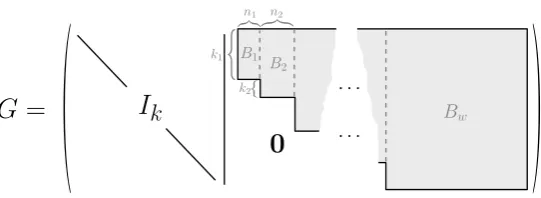
To construct the binary (n, k) code used in the McEliece Escher scheme, the (private) generator matrix is of the form illustrated in Figure 1. Each blockBi
Fig. 1.The private generator matrix
z}|{
{
n1
k1
G
=
(
I
k Bw)
0
B1
B2
z}|{n2
{
k2 · · ·
· · ·
is a random binary matrix of dimension (Pij=1kj)×ni, so that k=k1+k2+
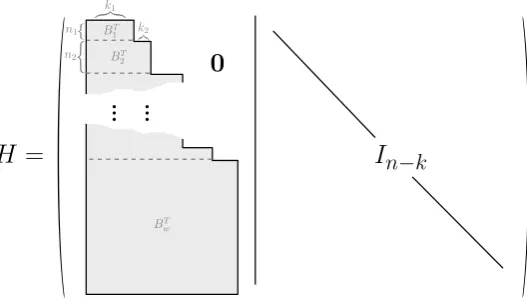
· · ·+kw andn=k+n1+n2+· · ·+nw. The corresponding private parity check
matrix is depicted in Figure 2, and has a similar block-wise structure. For ease of notation, we will let K= (k1, k2, .., kw) andN = (n1, n2, .., nw).
2.3 Error Sets
Fig. 2.The private parity check matrix
z}|{
{
k1
H
=
(
)
0
z}|{
{ k2
I
n−k... ...
n1n2
BT
1
BT
2
BT
w
Escher scheme instead restricts the error space by choosing each `-bit subseg-ment from a limited alphabet, called an error set. Error sets may be analyzed in terms of a density parameter ρ given by the formula
ρ=|E|1/`.
For the proposed parameters, the error set is alwaysE ={00,01,10}. This error set has granularity`= 2 and densityρ=√3.
Since public key operations require the encrypter or verifier to distinguish between valid and invalid error vectors, the permutationP used to disguise the private generator and parity check matrices must necessarily be of a special form. The action of P needs to rearrange`-bit segments of the rows, but leave the segments themselves intact. In other words,P must consist of `×`blocks which are either 0 or the identity matrixI`.
3 Improving Information Set Decoding for the Error Vector
Information set decoding may be used to recover m and efrom the ciphertext
c=mGpub+e. The basic strategy involves guessingk bits of the error vector
and recovering the rest by linear algebra. One of the simplest information set decoding algorithms is given in Algorithm 1.
It should be clear that the number of iterations this algorithm requires is inversely proportional to the probability that an attacker can guess k bits of the error vector. As in the case of standard McEliece, the most probable guess for these k bits is the all zero vector. However, since McEliece Escher uses a nonuniform error pattern, the choice of the permutation P0 has a significant effect on the probability of success. In their security analysis, Gligoroski et al. assumed that P0 would be of similar form to the secret permutation matrix
Algorithm 1:Information set decoding for the error vector
Input: ciphertextc, and a parameterk
Output: messagem, errore
1. Permute the bits of the ciphertext by a random permutation matrixP0:
c0=cP0= (mGpub+e)P
0
=mGpubP0+eP0
=m(A|B) + (e01|e
0
2)
= (mA+e01)|(mB+e
0
2),
whereAande01 are the firstkcolumns of the permuted generator matrixGpubP0 and permuted error vectoreP0, respectively.
2. IfAis not invertible, go to step 1.
3. Guesse01. If correct the message can be reconstructed as
m= ((mA+e01)−e
0
1)A
−1
.
The error vector is thene=c−mGpub.
4. If the error vector is properly formed (i.e., the Hamming weight is less thantfor standard McEliece, or composed of`-bit substrings from the proper generalized error set in McEliece Escher), returnmande. Otherwise go back to step 1 and start over with a new permutationP0.
set. Thus the probability of each guess is ρ−k. However, an attacker can do better by choosing a permutation that always separates the bits of an `-bit block. For example, each bit is 0 two-thirds of the time when the error set is
E = {00,01,10}, but both bits are 0 only one-third of the time. By guessing one bit within each 2-bit block, an attacker achieves a success probability of (2/3)k, which is a significant improvement over the value (1/√3)k assumed by Gligoroski et al.’s security analysis. Concretely, when used against Gligoroski et al.’s claimed 80-bit secure code with parameters (n, k) = (1160,160), the probability of a single guess of k bits of the error vector improves from 2−127 to 2−94.
Similar improvements are available for more sophisticated decoding algo-rithms. In Section 5.1 of [5], Gligoroski et al analyze modifications to several information set decoding algorithms [8, 10–14], including several that use meet-in-the-middle strategies to try several guesses at once, and apply them to the case where k = 256. For our purposes these algorithms may be characterized by the number of bitsk+λwhich are guessed, along with the Hamming weight
p of those guesses. Wheneverp·log2(√3)<(k+λ) log2(√2
3),the modification described above decreases the complexity of decoding by a factor of at least 2(k+λ) log2(√23)−p·log2(
√
3)
most efficient algorithm analyzed by Gligoroski et al., sincepis apparently too large. This algorithm, adapted from the BJMM algorithm [14], is quoted as achieving a complexity of 2123. It is possible that some sort of hybrid approach will provide an improvement. Nonetheless, for the remainder of this paper, we will assume that Gligoroski et al.’s analysis of the complexity of attacking the encryption algorithm, by direct search for a unique patterned error vector, is correct.
Algorithm 1, modified so that as many`-bit blocks as possible of the error are spit between e01 and e02, is however an extremely effective method for sig-nature forgery. For the error set E = {00,01,10}, when a 2-bit block is split between e01 and e02, the bit in e01 may be forced to 0, and the pair of bits will remain within the error set, whether the corresponding bit in e02 is set to 0 or 1. If all the bits of e01 are set to 0, then the probability for the resultant error vector e to be a valid error vector is (
√
3
2 )n−2k. For the claimed 80-bit secure signature code with parameters (n, k) = (650,306), this probability is approximately 2−8.
4 Information Set Decoding for the Private Key
Information set decoding techniques can also be used to find low weight ele-ments in the row spaces of matrices. In our case, we are interested in the public generator and parity check matrices, Gpub and Hpub. Note that elements of
these public row spaces are related to the elements of the row spaces of the private generator and parity check matrices by the permutationP used in the construction of the public key:
vGpub= ((vS)G)P,
v0Hpub= ((v0S0)H)P,
where v and v0 are k and (n−k)-bit row vectors respectively. Consequently, the result of an information set decoding attack on Gpub or Hpub will simply
be the image underP of a low weight element of the row space ofGorH. We thus examine the space of low weight vectors for encryption and signatures.
Recall the description of the private generator and parity check matrices given in Section 2.2. For encryption, the private key operation requires main-taining a list of at least ρk1 entries. This means thatk
1 must be small in order for the scheme to be efficient. The firstn1rows ofH are forced by construction to have nonzero bits only in the (n1 +k1) columns Cj(H), with 1 ≤ j ≤ k1 or k+ 1 ≤ j ≤ k+n1. Linear combinations of these rows will then produce approximately n1+k1
t
2−k1 distinct row vectors of weightt. The general attack
strategy will be to seek to sample from the images under P of this space of low weight row vectors, which are constrained to only contain nonzero bits in columnsCj, with the same bounds onj as above. We thereby learn the images
of those target columns, and once learned they can be removed fromHpub. The
for the parity check matrix of a code of the same structure with w0 = w−1,
N0 = (n2, .., nw),K0 = (k2, .., kw). Applying this strategy recursively will allow
us to identify the underlying block structure and construct a new private key of the same form, which will allow the attacker to decode ciphertexts or message digests using exactly the same algorithm used by the holder of the original private key.
For signatures, the private key operation requires maintaining a list of at least (2/ρ)nw entries. In order for the scheme to be efficient,n
w must be small.
The lastkwrows ofGhave zero bits everywhere, except possibly in the (kw+nw)
columnsCj(G), indexed by (k−kw+1)≤j≤kand (n−nw+1)≤j≤n. Linear
combinations of the rows will produce approximately kw+nw
t
2−nw distinct row
vectors of weightt. Similarly as done for encryption, the strategy for signatures will be to seek to sample from the images under P of this space of low weight row vectors, learning the images of the aforementioned target columns. Once the columns have been learned, they can be removed fromGpuband the process
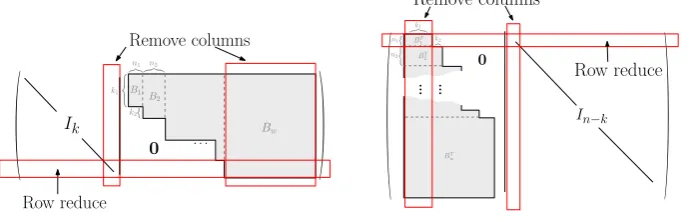
recursively repeated since the row space of the matrix formed by the remaining columns of G is that of a parity check matrix for a code of the same form with w0 = w−1, N0 = (n1, .., nw−1), K0 = (k1, .., kw−1). See Figure 3 for an illustration of the strategy for both encryption and signatures.
Fig. 3.Removing columns and row-reducing leaves a smaller code of the same form.
· · ·
· · ·
Remove columns
Row reduce
z}|{
{
n1 k1
(
Ik Bw)
0B1
B2
z}|{n2
{
k2
z}|{
{
k1
(
0)
z}|{
{ k2
In−k
... ...
n1
n2
BT
1
BT
2
BT w
Remove columns
Row reduce
trying the subroutine on all appropriately sized subsets of the list will be of insignificant cost compared to the information set decoding steps.
The subroutine proceeds as follows (see Alg. 2). The input is a list of target columns, containing at least (k1+ 1) of the target columns for encryption (or at least (nw+ 1) of the target columns for signatures). These columns may
gen-erally be obtained by combining the nonzero positions of a small number (e.g. two) of the target vectors produced by an information set decoding algorithm, such as Stern’s algorithm.
Algorithm 2:Subroutine to complete the list of target columns
Input: A setSof columns
Output: A set of columns S’⊇S, and a flag “Success” or “Failure”
1. Check whether removing the columns ofS from the public matrix reduces the rank.
– If all of the columns are from the target set, then removing the columns inS will likely reduce the rank of the public matrix by|S| −k1 for encryption (or|S| −nw for signatures).
2. For each columnC not inS, check whether the rank of the public matrix is decreased whenCis removed in addition to those already inS.
(a) if the rank is decreased, addCtoS and repeat step 2.
(b) if the rank stays the same for eachC /∈S, returnS0 =S and go to the last step to determine success.
3. The algorithm succeeds if the rank stops decreasing atn−k−n1 for encryption (or k−kwfor signatures). Otherwise output failure.
4.1 Using the Nonrandom P
The attack outlined in the previous section does not take into account the constraints on the permutation P used to disguise the private keyG (or H). In particular, the permutation leaves blocks of ` consecutive columns intact. Thus, there is additional information about the location of our target columns that we did not use. In particular, if the column Cj is in our target set, we
can be confident that all the columns Cbj−1 ` c+1
, ..., Cbj−1
` c+` are also in the
The modified version of Stern’s algorithm proceeds as shown in Algorithm 3. Note the Stern’s algorithm window size will be denoted L, instead of the standard l, to avoid confusion with the granularity.
Algorithm 3:Modified Stern’s Algorithm
Input: a matrixGpub, parametersp, t, L, `
Output: a vector in the row space ofGpub which has block-weightt 1. Permute the columns ofGpub :
G0pub=GpubP
0
,
whereP0 is a permutation matrix consisting of`×`blocks which are either zero or the identity, but otherwise chosen randomly.
2. Check that the firstkcolumns of the new matrixG0pubform an invertible matrixA. IfAis not invertible, go back to step 1.
3. Left-multiply byA−1, resulting in a matrix of the form
M=A−1G0pub=
Ik|Q
.
4. Search for low-weight row-vectors among linear combinations involving small subsets of the rows ofM:
(a) Divide the rows ofM into two equal length lists, i.e., for 0< i≤ k
2`, and forB= (b1, .., b`)∈F ` 2
xi,B= `
X
r=1
brrowi`+r(M).
Similarly, for 2k`< j≤k `
yj,B= `
X
r=1
brrowj`+r(M).
(b) Compute each possible sum of all subsets of sizepof thexi,B, as well as for all possible sums ofpof theyj,B. Check for collisions on bits (k+ 1), . . . ,(k+L):
bitsk+1,...,k+L`(xi1,B1+. . .+xip,Bp) = bitsk+1,...,k+L`(yj1,B1+. . .+yjp,Bp).
(c) When such a collision is found, compute the sumsof the 2pcolliding row vectors
s=xi1+. . .+xip+yj1+. . .+yjp.
If the block-weight of any suchsis equal totreturnsP0. Otherwise, go back to step 1.
a randomly chosen P0 this probability is
Prob(n, k, p, `, L, t) =
n/` t
−1
k/(2`)
p
2
(n−k−L)/` t−2p
,
and the equivalent probability for an attack on Hpub is
Prob(n, n−k, p, `, L, t) =
n/` t
−1
(n−k)/(2`)
p
2
(k−L)/` t−2p
.
The approximate number D of distinct target vectors of a given weightt is
Dsig ≈
(kw+nw)/`
t 2
`−1t·2−nw,
for signature, and for encryption
Denc≈
(n1+k1)/`
t 2
`−1t·2−k1.
The expected number E of target vectors required for a successful attack is
Esig ≈
log kw
kw+nw
logkw+nw−t`
kw+nw
,
for signature, and for encryption
Eenc≈
log n1
n1+k1
logn1+k1−t`
n1+k1
.
The total number of iterations of the modified Stern’s algorithm is therefore
isig ≈ &
log( kw
kw+nw)
log(kw+nw−t`
kw+nw )
' ·
(kw+nw)/`
t
−1
2`−1−t2nw
·
n/` t
k/(2`)
p
−2
(n−k−L)/` t−2p
−1
,
and
ienc ≈ &
log( n1
n1+k1)
log(n1+k1−t`
n1+k1 )
' ·
(n1+k1)/`
t
−1
2`−1−t2k1
·
n/` t
(n−k)/(2`)
p
−2
(k−L)/` t−2p
−1
5 Experimental Results
We implemented the attacks described in the previous section on a stan-dard laptop with a 2.2 GHZ Intel core i7 processor. We used the parame-ters suggested by Gligoroski et al. for 80 bits of security. Concretely, for en-cryption n = 1160, k = 160, ` = 2, w = 17, with K = (32,8,8, ...,8) and
N = (32,32, ...,32,488). We used parameters (t, p, L) = (11,1,9) for the modi-fied Stern’s algorithm, which needed approximately 1000 iterations in our trials. The predicted value from the analysis in the previous section was 2500. The total wall time for the computation to recover a private key was on average less than 2 hours.
For signatures, we have n = 650, k = 306, ` = 2, w = 6, with K = (84,48,48,48,48,30) and N = (48,48,48,48,48,104). The modified Stern pa-rameters we used were (t, p, L) = (40,1,7). With such a high value for t, a higher number of iterations were needed, usually less than 10,000 (the pre-dicted value was around 4900). The total wall time was again less than 2 hours on average.
6 Countermeasures
Attempts to increase the security of McEliece Escher by altering the parameters are severely constrained by the requirement that ρk1 be small for encryption
and that (2/ρ)nw be small for signatures.
One possiblility would be to try to decrease ρ (or 2/ρ), as appropriate, to allow k1 ornw to increase. This, however, turns out to be counterproductive.
Due to the attack in Section 4.1, we see what really matters for security is that
k1/` be large for encryption, or nw/` be large for signatures. Asymptotically,
there will be 2` vectors in the row space of Hpub of block-weight no more than
k1/`+ 1 and 2` vectors in the row space of Gpub of block-weight no more than
nw/`+ 1. The factor of 2` will make up for the increased cost per iteration of
the modified Stern’s algorithm with p = 1, but the probability of success per iteration will remain at approximately (kn)k1/`for encryption and (n−k
n )nw/`for
signatures. Encryption requires (ρ`)k1/`to be small for efficiency andk
1/`to be large for security. Thus the ideal value forρand`would minimizeρ`. Likewise, the signature scheme requires ((2ρ)`)nw/`to be small for efficiency and n
w/`to
be large for security. Hence, the ideal value for ρ and` would minimize (2ρ)`.
While it is possible to decreaseρ (or ρ2) by increasing`, the consequence is that ρ` and (2ρ)` both increase at least linearly in` for error sets of the proper form (for security, the generalized error set cannot impose linear constraints on the error vector, e.g., by forcing a bit of the error vector to always be 0). Thus, fixing nk and the security level, we find that the cost of decryption increases when we increase `.
A better idea is to greatly increasenw for encryption andkw for signatures.
effect of decreasing the probability that a given nonzero bit (or `-bit block) of a target vector will be placed outside the information set by a randomly chosen (block) permutation. This is a much better solution for signatures than for en-cryption. For typical parameters, the modified Stern’s algorithm requires ∼30 nonzero blocks to fall outside the information set when attacking a signature. Thus, bringing the cost of the attack from ∼230 to ∼280 should only require
n−k
n to fall from about 0.5 to about 0.15. That is, the size of the 80-bit-secure
code increases from a 650×304 bit generator matrix to a 2000×1654 bit gener-ator matrix. For attacking typical encryption parameters, the modified Stern’s algorithm only requires ∼6 nonzero blocks to fall outside the information set. This means kn needs to fall from about 0.15 to 0.0005. The result is that for an 80-bit-secure code, the size would increase from 1160×160 to 300,000×160.
There is however an additional complication created by the above counter-measure for signatures. A code with error set E={00,01,10} can be trivially broken whenever n−nk <0.5 due to the attack described at the end of Section 3. This attack may be generalized to apply to other error sets, whenever there is a linear projection from F`2 → F`
0
2 with `0 ≤ nk` such that an element of F`2 with a certain fixed projection onto F`
0
2 is a member of the error set with very high probability. Thus in order to avoid attack, the error set must be chosen so that there is no such projection. We have not found any way to do this that makes the honest party’s signing operation (list decoding for signatures) asymptotically more efficient than both attacks (ISD for the error vector and ISD for the private key.)
7 Conclusion
We demonstrate practical attacks on the proposed parameters of McEliece Escher. The poor choice of parameters is a demonstration of the general prin-ciple that code-based schemes should be designed in such a way as to avoid all practical distinguishers on the public key, since distinguishers can often be modified, at little cost, to create private-key recovery attacks. Additionally, our cryptanalysis demonstrates that information set decoding techniques can be modified to take advantage of code-based schemes whose private keys are disguised by a structured, rather than a completely random, permutation ma-trix. The recent cryptanalysis of cyclosymmetric-MDPC McEliece by Perlner [17] is another example of this general principle. This technique is especially effective in creating signature forgeries.
References
1. McEliece, R.J.: A Public-Key Cryptosystem Based On Algebraic Coding Theory. Deep Space Network Progress Report44(1978) 114–116
2. Misoczki, R., Tillich, J.P., Sendrier, N., Barreto, P.S.L.M.: MDPC-McEliece: New McEliece Variants from Moderate Density Parity-Check Codes. Cryptology ePrint Archive, Report 2012/409 (2012)http://eprint.iacr.org/2012/409.
3. Gaborit, P., Murat, G., Ruatta, O., Zemor, G.: Low Rank Parity Check codes and their application to cryptography. In Lilya Budaghyan, Tor Helleseth, M.G.P., ed.: The International Workshop on Coding and Cryptography (WCC 13), Bergen, Norway (2013) 13 p. ISBN 978-82-308-2269-2.
4. Gaborit, P., Ruatta, O., Schrek, J., Zmor, G.: RankSign: An Efficient Signature Algorithm Based on the Rank Metric. In Mosca, M., ed.: Post-Quantum Cryptography. Volume 8772 of Lecture Notes in Computer Science. Springer International Publishing (2014) 88–107 5. Gligoroski, D., Samardjiska, S., Jacobsen, H., Bezzateev, S.: McEliece in the World of Escher. Cryptology ePrint Archive, Report 2014/360 (2014)http://eprint.iacr.org/ 2014/360.
6. Gligoroski, D.: A New Code Based Public Key Encryption and Signature Scheme Based on List Decoding. (“Workshop on Cybersecurity in a Post-Quantum World,” NIST, Gaithersburg MD, USA, 2015)
7. Prange, E.: The Use of Information Sets in Decoding Cyclic Codes. Information Theory, IRE Transactions on8(1962) 5–9
8. Lee, P., Brickell, E.: An Observation on the Security of McEliece’s Public-Key Cryptosys-tem. In Barstow, D., Brauer, W., Brinch Hansen, P., Gries, D., Luckham, D., Moler, C., Pnueli, A., Seegmller, G., Stoer, J., Wirth, N., Gnther, C., eds.: Advances in Cryptology EUROCRYPT 88. Volume 330 of Lecture Notes in Computer Science. Springer Berlin Heidelberg (1988) 275–280
9. Leon, J.: A Probabilistic Algorithm for Computing Minimum Weights of Large Error-correcting Codes. Information Theory, IEEE Transactions on34(1988) 1354–1359 10. Stern, J.: A Method for Finding Codewords of Small Weight. In Cohen, G., Wolfmann,
J., eds.: Coding Theory and Applications. Volume 388 of Lecture Notes in Computer Science. Springer Berlin Heidelberg (1989) 106–113
11. Finiasz, M., Sendrier, N.: Security Bounds for the Design of Code-Based Cryptosystems. In Matsui, M., ed.: Advances in Cryptology ASIACRYPT 2009. Volume 5912 of Lecture Notes in Computer Science. Springer Berlin Heidelberg (2009) 88–105
12. Bernstein, D., Lange, T., Peters, C.: Smaller Decoding Exponents: Ball-Collision De-coding. In Rogaway, P., ed.: Advances in Cryptology CRYPTO 2011. Volume 6841 of Lecture Notes in Computer Science. Springer Berlin Heidelberg (2011) 743–760
13. May, A., Meurer, A., Thomae, E.: Decoding Random Linear Codes in ˜O(20.054n). In Lee, D., Wang, X., eds.: Advances in Cryptology ASIACRYPT 2011. Volume 7073 of Lecture Notes in Computer Science. Springer Berlin Heidelberg (2011) 107–124
14. Becker, A., Joux, A., May, A., Meurer, A.: Decoding Random Binary Linear Codes in 2n/20: How 1 + 1 = 0 Improves Information Set Decoding. In Pointcheval, D., Johansson,
T., eds.: Advances in Cryptology EUROCRYPT 2012. Volume 7237 of Lecture Notes in Computer Science. Springer Berlin Heidelberg (2012) 520–536
15. Landais, G., Tillich, J.P.: An Efficient Attack of a McEliece Cryptosystem Variant Based on Convolutional Codes. In: Post-Quantum Cryptography. Springer (2013) 102–117 16. Otmani, A., Tillich, J.P.: An Efficient Attack on All Concrete KKS Proposals. In Yang,
B.Y., ed.: Post-Quantum Cryptography. Volume 7071 of Lecture Notes in Computer Science. Springer Berlin Heidelberg (2011) 98–116