without Noise Reduction
Dongxi Liu
CSIRO, Marsfield, NSW 2122, Australia [email protected]
Abstract. We present a new fully homomorphic encryption (FHE) scheme that is efficient for practical applications. The main feature of our scheme is that noise reduction considered essential in current FHE schemes, such as boot strapping and modulus switching, is not needed in our scheme, because it allows arbitrarily large noises in its ciphertexts. A ciphertext in our scheme is a vector with its dimension specified as a security pa-rameter of the encryption key. The dimension of ciphertexts does not change with homomorphic operations and all ciphertext elements are in a finite domain, so our scheme is compact. In addition, our scheme can directly encrypt big integers, rather than only bit messages.
We proved the hardness of recovering encryption keys from any number of ciphertexts with chosen plaintexts and then the semantic security of our scheme. The hardness of recovering keys from ciphertexts is based on the approximate greatest common divisors problem. We implemented a prototype of our scheme and evaluated its concrete performance ex-tensively from the aspects of encryption, decryption, homomorphic op-erations, and bitwise operators over ciphertexts. The efficiency of our scheme is confirmed by the evaluation result.
Keywords: Fully Homomorphic Encryption, Implementation, Practical Effi-ciency
1
Introduction
Homomorphic encryption has the attractive property of permitting computa-tion over encrypted data. An encrypcomputa-tion scheme is fully homomorphic if the encrypted data can be homomorphically added and multiplied. In a theoretical breakthrough work, Gentry described the first fully homomorphic encryption (FHE) scheme [8]. Following Gentry’s scheme, there are currently a number of FHE schemes with various improvements, such as weaker security assumptions, shorter public keys, or better asymptotic efficiency [1, 4, 7, 16, 9, 2, 3].
In the FHE scheme proposed by Brakerski, Gentry and Vaikuntanathan [2, 3], they described another noise reduction mechanism called modulus switching, which can achieve better asymptotic performance than bootstrapping. However, there is no implementation and concrete performance evaluation in [2, 3] and it is not clear whether their scheme is efficient enough for practical applications. In addition to the performance problem, noise reduction increases the complexity of current FHE schemes for understanding and implementing. In [13], Naehrig, Lauter and Vaikuntanathan only implemented the somewhat version of the FHE scheme proposed by Brakerski and Vaikuntanathan in [1].
Noise reduction is essential for current FHE schemes because their ciphertexts cannot be decrypted correctly if the noises in ciphertexts reach a certain limit. Since homomorphic operations (in particular homomorphic multiplications) can increase the noises in the resulting ciphertexts, noise reduction mechanisms must be applied together with homomorphic operations to reduce the noises accumu-lated in the resulting ciphertexts.
In this paper, we propose a symmetric FHE scheme that allows arbitrarily large noises in a ciphertext and the resulting ciphertexts generated through any number of homomorphic operations can always be decrypted correctly regardless of the amount of noises accumulated in them. Hence, our scheme does not need any noise reduction mechanism.
A ciphertext in our scheme is a vector, with the dimension specified as a pa-rameter of the encryption key. The ciphertexts can be homomorphically added or multiplied, and these homomorphic operations do not change their dimensions. In addition, the ciphertext elements are defined in a finite domain specified by a modulus. Hence, our scheme is compact. The features of no noise reduction and compactness make our scheme efficient and also make it simple to implement and use.
We proved the security of our scheme from two aspects. First, we proved that the secret components in an encryption key cannot be recovered from any number of ciphertexts with chosen plaintexts by the adversary. This proof is based on the hardness of the approximate greatest common divisors problem. Then, we proved the semantic security of our scheme; intuitively, our scheme is semantically secure because the noises in a ciphertext can be arbitrarily large and if the secret key components cannot be found from ciphertexts, the large noises cannot be removed by the adversary to distinguish ciphertexts.
A prototype of our scheme has been implemented in Java and extensively evaluated on a Dell XPS 13 laptop from multiple perspectives: the performance of encryption and decryption, the performance of homomorphic operations, and the performance of bitwise operators over ciphertexts. A keyword-based 1-out-of-n oblivious tra1-out-of-nsfer protocol is also impleme1-out-of-nted as a1-out-of-n applicatio1-out-of-n of our scheme to evaluate its usability in practical applications.
takes about 1 second to evaluate the high degree polynomial P1000
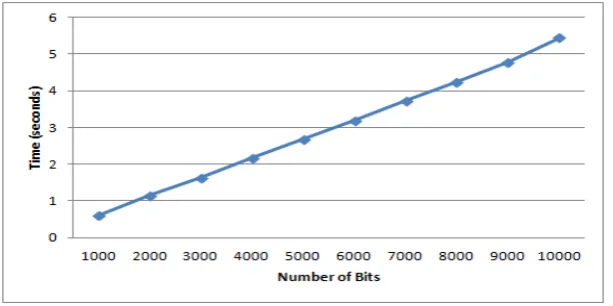
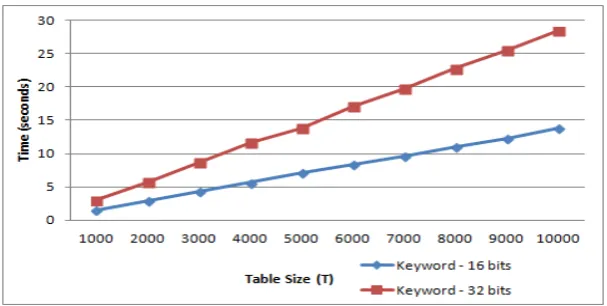
i=1 xii, and 0.5 second to compare the bitwise encryption of two integers with 1000 bits. In the test of retrieving a value from a table with 1000 entries based on an encrypted keyword, our scheme takes about 2 or 3 seconds, depending on whether the keyword is represented in 16 bits or 32 bits. The efficiency of our scheme makes it suitable for many practical applications, such as statistics over encrypted data [13] and query over encrypted relational databases [15, 14].
The rest of this paper is organized as follows. We give an overview of our scheme in Section 2, followed by its construction in Section 3 and correctness proof in Section 4. We prove the security of our scheme in Section 5, with the implementation and evaluation result presented in Section 6. In Section 7, we conclude the paper.
2
An Overview of Our Scheme
Letqbe a prime andZq be the set of integers moduloq. The modulusqis public in our scheme. Given the secret key K(n), an integer v ∈ Zq in our scheme is encrypted into the ciphertext (c1, ..., cn+1), where ci ∈ Zq. The dimension of a ciphertext is determined by the parameter n in the key K(n). The security parameter of our scheme includesnandq, which both determine the size of key space, and they are chosen by users who want to encrypt their data.
We denote the encryption and decryption operations of our scheme by the following notations.
Enc(K(n), v) = (c1, ..., cn+1)
Dec(K(n),(c1, ..., cn+1)) =v
For the key K(n), our scheme provides a public evaluation key P EK = {pekij|1 ≤ i ≤ n+ 1,1 ≤ j ≤ n+ 1}, which is used when performing homo-morphic multiplication. AP EK elementpekij is obtained from the encryption
Enc(K(n), sekij), wheresekij ∈Zq is a secret evaluation key element, derived fromK(n). Hence,pekij is also a n+ 1 dimensional vector.
In the following, we suppose the ciphertexts C = (c1, ..., cn+1) and C0 =
(c01, ..., c0n+1) are encrypted with the keyK(n) for discussing the homomorphic properties of our scheme.
2.1 Homomorphic Addition
The homomorphic addition of CandC0 is defined as a vector addition, that is,
C⊕C0 = (c1+c01 modq, ..., cn+1+c0n+1 modq). Our scheme supports additive
homomorphism by ensuring the following condition.
Dec(K(n), C⊕C0) =Dec(K(n), C) +Dec(K(n), C0)modq
Letd∈ZqanddC= (d∗c1modq, ..., d∗cn+1modq). According to the additively
2.2 Homomorphic Multiplication
With the public evaluation keyPEK, the homomorphic multiplication ofCand
C0, denoted byC⊗P EKC0, is defined by the following expression.
((c1∗c01)pek11)⊕((c1∗c02)pek12)⊕...⊕((cn+1∗cn0+1)pek(n+1)(n+1))
Our scheme is multiplicatively homomorphic by ensuring the following con-dition.
Dec(K(n), C⊗P EKC0) =Dec(K(n), C)∗Dec(K(n), C0)modq
Thus, we can evaluate any degree of polynomials over ciphertexts by using homomorphic operations⊕,and⊗P EK. Note that our scheme does not need any noise reduction schemes (e.g., boot strapping and modulus switching) to be used together with homomorphic operations. Moreover, our scheme is com-pact, since all homomorphic operations do not change the dimension of resulting ciphertexts and each ciphertext element is an integer inZq.
3
Construction of Our Scheme
We define the structure of keyK(n), the encryption and decryption algorithms, and the secret and public evaluation keys in this section. All random integers are uniformly sampled fromZq.
3.1 Structure of K(n)
A keyK(n) in our scheme is a tuple of four secret components (Γ, Π, Θ, Φ). For a keyK(n), we requiren≥3, such that there exist integers h≥2 andm≥1, satisfyingn=h+m. The component Γ is a list [k1, ..., kn], where each ki is a tuple of random integers inZq.
ki=
(a, si1, ..., sim, ti) if 1≤i≤h;
(siu, ..., sim, ti) ifh+ 1≤i≤n−1 andu=i−h+ 1; (ti) ifi=n.
As shown by the above definition ofki, different choices ofhandmcan lead to different structures of Γ. On the other hand, hand m can be derived from the structure of Γ, so they do not need to be explicitly kept in the key. For correctness, we requirea6= 0 and ti6= 0 for 1≤i≤h.
The componentΠ of keyK(n) is a random permutation of the set{1, ..., n+ 1}. SupposeΠ ={d1, ..., dn+1}. Then, we have the notationΠ(i) =j, such that
i =dj. The component Θ is a list of l random integers in Zq, and we require
3.2 Encryption
We have two levels of encryption. The lower level encryption can only be used a limited number of times (at mostn−1 times) for a keyK(n) for the security reason to be discussed below, while the upper level encryption can be used any number of times to encrypt values inZq, including secret evaluation keys.
3.3 Lower Level Encryption
The lower level encryption is denoted by Encl(K(n), v) = (c1, ..., cn+1). The
lower level encryption algorithm only uses the componentsΓ andΠ in K(n) to define eachci, as shown below, wherer1, ...,rh,rs1,...,rsm,rv1,...,rvh−1 andrr
are random integers uniformly sampled fromZq, and S(i) =Σjm=1sij∗rsj.
cΠ(i)=
a∗ti∗(v+Σhj=1−1rvj) +S(i) +ti∗(ri−rh) modq ifi= 1;
a∗ti∗(−rvi−1) +S(i) +ti∗(ri−ri−1) modq if 2≤i≤h;
rsu+Σjm=u+1sij∗rsj+ti∗rrmodq ifh+1≤i≤n−1 andu=i−h;
rsm+ti∗rrmodq ifi=n;
rrmodq ifi=n+ 1.
In our scheme, the lower level encryption is only used to generate the com-ponent Φ in K(n) (as a part of key generation). Suppose in K(n), we have
Θ = [θ1, ..., θl], where l ≤ n−2. Then, we generate Φ = [φ1, ..., φl+1], with φi defined below.
φi=
Encl(K(n), θi) ifi≤l;
Encl(K(n),1) ifi=l+ 1.
Hence, the lower level encryption is used at mostn−1 times. Note thatφl+1 is
an encryption of the integer 1.Θ andΦinK(n) will be used in the upper level encryption.
3.4 Upper Level Encryption
We denote the upper level encryption byEnc(K(n), v) = (c1, ..., cn+1). That is,
the encryption described in Section 2 is the upper level encryption. Let Θ = [θ1, ..., θl] and Φ = [φ1, ..., φl+1] in K(n). Then, the upper level encryption is
defined as
Enc(K(n), v) = (ru1φ1)⊕(ru2φ2)⊕...⊕(rul+1φl+1)
whereru1,...,andrulare random integers uniformly sampled fromZqandrul+1=
3.5 Decryption
Our decryption algorithm recovers a valuevfrom a ciphertext (c1, ..., cn+1) with
the keyK(n) by taking the following steps.
(1)RR =cΠ(n+1)modq;
(2)RSm=cΠ(n)−tn∗RRmodq;
(3)RSu =cΠ(i)−ti∗RR−Σjm=u+1sij∗RSj modq,forufromm−1 to 1 andi=u+h;
(4)F =Σh
i=1((cΠ(i)−Σjm=1sij∗RSj)/ti) modq; (5)v =F/amodq.
The correctness conditiona6= 0 andti6= 0 (1≤i≤h) forK(n) ensures the validity of decryption steps (i.e., no division by zero). We prove the correctness of our scheme in the next section.
In the above definition, the decryption algorithm is described in five steps by using intermediate variables, such asRSuandF. Actually, we can fuse these steps by replacing each intermediate variable (F, RSi or RR) by its definition recursively until all intermediate variables are removed. After fusion, we get a linear form of the decryption algorithm.
v=dk1∗cΠ(1)+...+dkn+1∗cΠ(n+1)modq
where dk1, ..., and dkn+1, called linear decryption keys, are defined over Γ in
K(n). The linear decryption keys will be used to define the secret and public evaluation keys in the next section.
From the linear form of decryption, we can see if the lower level encryption is used ntimes or more for a keyK(n), then the linear decryption keys can be obtained by solvingnequations under chosen-plaintext attacks. For this security reason, our scheme requires the lower level encryption be used at mostn−1 times and only used for generatingΦ. The upper level encryption works by randomly combining vectors inΦ(i.e., using the ciphertexts inΦas a basis), so the upper level encryption does not generate independent vectors and can be securely used any number of times.
wherew=a∗(t1∗t2∗t3) modq.
dk1=t2∗t3/wmodq
dk2=t1∗t3/wmodq
dk3=t1∗t2/wmodq
dk4=−(t2∗t3∗s11+t1∗t3∗s21+t1∗t2∗s31)/wmodq
=−(dk1∗s11+dk2∗s21+dk3∗s31) modq
dk5= (t2∗t3∗s11+t1∗t3∗s21+t1∗t2∗s31)∗s42/w
−(t2∗t3∗s12+t1∗t3∗s22+t1∗t2∗s32)/wmodq
=−dk4∗s42−(dk1∗s12+dk2∗s22+dk3∗s32) modq
dk6= (t2∗t3∗s11+t1∗t3∗s21+t1∗t2∗s31)∗(t4−s42∗t5)/w
+(t2∗t3∗s12+t1∗t3∗s22+t1∗t2∗s32)∗t5/wmodq
=−dk4∗(t4−s42∗t5) + (dk1∗s12+dk2∗s22+dk3∗s32)∗t5modq
To define secret evaluation keys in the next section, we need to permutate the keys dk1, ..., dkn+1 into dk01, ..., dk0n+1, such that dkj0 =dki if Π(i) =j for 1≤i≤n+ 1 and 1≤j≤n+ 1. Sincedkj0 ∗cj =dki∗cΠ(i), the linear form of
decryption can be written into the following new form, whereΠ is not needed any more.
v=dk10 ∗c1+...+dk0n+1∗cn+1modq
3.6 Secret and Public Evaluation Keys
Recall that our scheme provides a public evaluation key P EK = {pekij|1 ≤
i ≤ n+ 1,1 ≤ j ≤ n+ 1} for homomorphic multiplication. An element in
P EK is an encryption of a secret evaluation key element sekij, that is,pekij=
Enc(K(n), sekij).
Given Dec(K(n), C) = v and Dec(K(n), C0) = v0, our scheme ensures
Dec(K(n), C ⊗P EK C0) = v ∗ v0 mod q. Let C = (c1, ..., cn+1) and C0 =
(c0
1, ..., c0n+1). From the multiplicatively homomorphic property, we can
deter-mine the following condition that must be satisfied bysekij.
Dec(K(n), C⊗P EKC0)
=Dec(K(n),((c1∗c01)pek11⊕...⊕(cn+1∗c0n+1)pek(n+1)(n+1)))
=Σin=1+1Σjn=1+1(ci∗c0j)∗Dec(K(n), pekij)) modq =Σin=1+1Σjn=1+1(ci∗c0j)∗sekij modq
The secret evaluation key is derived from the linear form of our decryption algorithm. ForDec(K(n), C) =v and Dec(K(n), C0) =v0, we have their corre-sponding linear decryption forms.
v =Σin=1+1dk0i∗ci modq
v0=Σjn=1+1dk0j∗c0jmodq
By multiplyingvand v0, we can get the following equations.
v∗v0modq
= (Σin=1+1dki0∗ci)∗(Σjn=1+1dk0j∗c0j) modq =Σin=1+1Σnj=1+1(dki0∗ci∗dkj0 ∗c0j) modq =Σin=1+1Σnj=1+1(ci∗c0j∗dk0i∗dkj0) modq
Thus, by definingsekij =dki0∗dkj0 modq, we haveΣ n+1
i=1Σ
n+1
j=1(ci∗c0j∗sekij) =
v∗v0modq, meaning that this definition ofsekij satisfies the required condition. Note that eachsekijis also a value inZq, so it can be encrypted as other plaintext values.
4
Correctness of Our Scheme
We prove the correctness of additive homomorphism for our lower level encryp-tion algorithm, and then extend the proof to other cases.
4.1 Additive Homomorphism
SupposeNvaluesvb(1≤b≤N) are encrypted intoN ciphertexts (cb1, ..., cbn+1),
under the keyK(n), with the lower level encryption algorithm. For correctness proof we do not care the number of times the lower level encryption is used. In the following, we prove that Dec(K(n),(ΣN
b=1c
b
1modq, ..., ΣNb=1c
b
n+1modq)) =
ΣN
b=1vbmodq. Letrb
1, rb2,...,rhb, rsb1, ..., rsbm, rv1b,...,rvhb−1 and rrb be the random numbers
used in the encryption ofvb. Then, we have the following definition for the sum of each ciphertext element. LetS(i) =Σm
j=1sij∗(ΣbN=1rsbj).
ΣbN=1cbΠ(i)=
a∗ti∗(ΣNb=1(vb+Σjh=1−1rvjb)) +S(i) +ti∗(ΣbN=1(r1b−rbh)) modq, ifi= 1;
a∗ti∗(ΣNb=1(−rv
b
i−1)) +S(i) +ti∗(ΣbN=1(r
b i −r
b
i−1)) modq,
if 2≤i≤h;
ΣbN=1rsbu+Σjm=u+1sij∗(ΣbN=1rs (b)
j ) +ti∗(ΣbN=1rr
b) modq, ifh+1≤i≤n−1 andu=i−h;
ΣbN=1rsbm+ti∗(ΣbN=1rr
b) modq, ifi=n;
Based on the above definition, the proof below checks each decryption step, eventually showing that the decryption result is ΣbN=1vb.
– RR=ΣN b=1c
b
Π(n+1)modq = Σ
N b=1rr
b modq
– RSm=ΣbN=1c
b
Π(n)−tn∗RRmodq
=ΣN b=1rs
b
m+tn∗(ΣbN=1rr
b)−t
n∗(ΣbN=1rr
b) modq =ΣbN=1rsbmmodq
– For u from m−1 to 1 and i = u+h, we can recursively have RSu =
ΣN b=1rs
b umodq.
RSu=ΣbN=1cbΠ(i)−ti∗RR−Σ
m
j=u+1sij∗RSjmodq =ΣN
b=1rsbu+Σjm=u+1sij∗(ΣNb=1rsbj) +ti∗(ΣbN=1rrd)−ti∗RR −Σm
j=u+1sij∗RSj modq =ΣN
b=1rsbumodq
– Let F = F1+F2h, where F1 and F2h are defined below. Then we have
F=a∗(ΣN
b=1vb) modq.
F1= (ΣbN=1c
b
Π(1)−Σ
m
j=1s1j∗RSj)/t1modq
= (a∗t1∗(ΣbN=1(vb+Σjh=1−1rv
b
j)) +S(1) +t1∗(ΣbN=1(r
b
1−rhb)) −Σm
j=1s1j∗RSj)/t1modq
= (a∗t1∗(ΣbN=1(vb+Σjh=1−1rv
b
j)) +t1∗(ΣNb=1(r
b
1−r
b
h)))/t1modq
=a∗(ΣbN=1(vb+Σjh=1−1rv
b j)) +Σ
N b=1(r
b
1−rbh) modq =a∗ΣN
b=1vb+a∗ΣbN=1Σ
h
j=2rvjb−1+ΣNb=1(r
b
1−rbh) modq
F2h=Σih=2(ΣbN=1c
b Π(i)−Σ
m
j=1sij∗RSj)/timodq =Σh
i=2(a∗ti∗(ΣbN=1(−rv
b
i−1)) +S(i) +ti∗(ΣbN=1(r
b
i −rib−1))
−Σm
j=1sij∗RSj)/ti modq =Σh
i=2(a∗ti∗(ΣbN=1(−rvib−1)) +ti∗(ΣbN=1(rbi −rib−1)))/timodq =Σh
i=2a∗(ΣbN=1(−rvbi−1)) +Σih=2(ΣbN=1(rbi−rib−1)) modq
=Σh
i=2a∗(ΣbN=1(−rvbi−1)) +ΣbN=1(rhb−rb1) modq
– At last, according to the last step of the decryption algorithm, the decryption result isΣN
b=1vb=F/amodq.
4.2 Other Cases
Suppose the value v is encrypted into (c1, ..., cn+1) under the key K(n), with
the random numbers r1, r2,...,rh,rs1,..., and rsm, rv1,..., rvh−1, and rr. The
proof of Dec(K(n),(d∗c1 mod q, ..., d∗cn+1 mod q)) = d∗v mod q has the
same structure as the above proof for additive homomorphism. To obtain the proof, we replaceΣN
b=1cbΠ(i)in the above proof withd∗cΠ(i),ΣNb=1vb withd∗v,
ΣN b=1rs
b
j withd∗rsj, etc. These proofs imply the correctness of the upper level encryption, since it is defined over homomorphic operations⊕and.
is defined over⊕and. Hence, the above proofs can establish the correctness of multiplicative homomorphism, together with the correctness of secret evaluation keys, which is discussed in the previous section.
5
Security Analysis
We first prove that it hard to recover the secret components Γ and Φ in a key K(n) from ciphertexts. Then based on the hardness of the key recovery problem, we prove the semantic security of our scheme. The hardness of our key search problem is based on the approximate greatest common divisors (AGCD) problem.
5.1 The AGCD Problem
This problem is proposed by Howgrave-Graham [12]. Given any number of the approximate multiples ai =p∗qi+ri ofp, wherep, qi andri are integers, the problem is to find the hidden common divisorp. Note thatqi and ri change in eachai. There are algorithms proposed in [5, 6] to recoverp, but this problem is still believed to be hard and used by fully homomorphic encryption schemes, such as [16, 7]. In particular, ifri can be as large asp, it is impossible to reconstruct
pfrom any number of approximate multiplesai [6].
5.2 Hardness of Recovering Φ and Γ
The component Φ in a key K(n) is a list of secret vectors that are linearly combined to generate ciphertexts in the upper level encryption. We prove that it is hard to recover the secret vectors inΦfrom any number of ciphertexts.
Theorem 1. Given any number of ciphertexts from the upper level encryption with K(n), it is hard to recoverΦ inK(n).
Proof 1 Let Φ= [φ1, ..., φl+1], where l ≤n−2, andφi = (φi1, ..., φi(n+1)). As
shown in the upper level encryption, a ciphertext (c1, ..., cn+1)is defined as:
c1 =Σli+1=1rui∗φi1modq
...
cn+1=Σli+1=1rui∗φi(n+1)modq
In the first ciphertext elementc1,φi1(1≤i≤l+ 1)are the common divisors
to be recovered. We prove that it is hard to find the secret value φ11 from the
first element c1 of any number of ciphertexts.
Let r1 = Σil+1=2rui∗φi1. Then, we have c1 = ru1∗φ11+r1 mod q. Since
rui (1 ≤ i ≤ l+ 1) are random numbers generated for each encryption, r1 is
a number unknown to the adversary and randomly changes for each encryption even if the adversary chooses plaintexts. Moreover, r1 can be bigger than φ11.
Hence, it is hard to recover φ11 from the first element c1 of any number of
The upper level encryption in our scheme is built over the lower level encryp-tion, in which theΓ component ofK(n) is used. The componentΓ consists of
ntuples of secret values, with each tuple independently used in the lower level encryption. Among a ciphertext, the element cΠ(n) has the simplest definition
which involves the secret value tn. In this section, we prove that it is hard to recovertn and the proofs for other secret values inΓ are similar.
Theorem 2. Given any number of ciphertext elements cΠ(n) from the upper
level encryption withK(n), it is hard to findtn inΓ.
Proof 2 Let Φ = [φ1, ..., φl+1], where l ≤ n−2, and φi = (φi1, ..., φi(n+1)).
Thus, from the lower level encryption, we have
φiΠ(n)=rsim+tn∗rrimodq
and the elementcΠ(n) from the upper level encryption is defined as:
cΠ(n)=Σil=1+1rui∗φiΠ(n)modq
=Σil+1=1rui∗(rsim+tn∗rri) modq
=Σil+1=1rui∗rsim+tn∗(Σil=1+1rui∗rri) modq
The rest of the proof is similar to the above one. Since rui (1≤i≤l+ 1) are random numbers generated for each encryption, we know that Σil=1+1rui∗rsim is a number unknown to the adversary and randomly changes for each encryption. Moreover, Σil+1=1rui∗rsim can be bigger than tn. Hence, it is hard to recovertn from the element cΠ(n) of any number of ciphertexts according to the hardness
of the AGCD problem.
For a ciphertext vector, the adversary cannot know exactly which element is
cΠ(n), since he does not know the permutationΠ in K(n). Hence, it is harder
for the adversary to recovertn fromcΠ(n).
5.3 Semantic Security
We analyze the semantic security of our scheme by proving the indistinguisha-bility of ciphertexts under chosen-plaintext attacks (i.e., IND-CPA).
Theorem 3. Given two plaintextsvandv0chosen by a probabilistic polynomial-time adversary, and a ciphertextCthat encryptsvorv0withK(n), the adversary can only distinguish whether C encrypts v or v0 with a probability negligibly higher than 12.
Proof 3 In our scheme, only the element cΠ(1) in C is dependent on v or v0.
Thus, if the adversary cannot distinguish whethercΠ(1) encryptsvorv0, then he
i ≤ n+ 1) cannot be exploited to determine secret key values used in cΠ(1).
Hence, we consider onlycΠ(1) to prove the semantic security of our scheme.
Let Θ = [θ1, ..., θl],Φ = [φ1, ..., φl+1], and φi = (φi1, ..., φi(n+1)), where l ≤
n−2. Thus, from the lower level encryption, by letting S =Σjm=1s1j∗rsij, we have
φiΠ(1)=
a∗t1∗(θi+Σhj=1−1rvij) +S+t1∗(ri1−rih) modqif1≤i≤l
a∗t1∗(1 +Σjh=1−1rvij) +S+t1∗(ri1−rih) modq ifi=l+ 1
Letv00is eithervorv0. Then,cΠ(1) from the upper level encryption is defined
as:
cΠ(1)=Σil=1+1rui∗φiΠ(1)modq
=a∗t1∗(Σil=1rui∗θi+rul+1+Σil=1+1rui∗(Σjh=1−1rvij))+
Σil+1=1rui∗(Σjm=1s1j∗rsij) +t1∗(Σli+1=1rui∗(ri1−rih)) modq =a∗t1∗v00+Σil+1=1rui∗(a∗t1∗(Σjh=1−1rvij)+
Σm
j=1s1j∗rsij+t1∗(ri1−rih)) modq
Note that v00 = Σil=1rui ∗θi+rul+1 according to the upper level encryption
algorithm.
Ifv6= 0andv0 6= 0, then the expressions ofa∗t1∗vmodqanda∗t1∗v0modq
generate the same value from 1 toq−1 with the same probability, since q is a prime anda6= 0andt16= 0are uniformly sampled fromZq. Hence, at this case, the probability of distinguishing whether cΠ(1) encrypts v or v0 is just 12, since
the definition ofcΠ(1) differs only on the two indistinguishable expressions when
encryptingvorv0 . In the following, we discuss the case wherev= 0andv06= 0. The case where v6= 0 andv0 = 0is similar.
LetW =Σil=1+1rui∗(a∗t1∗(Σjh=1−1rvij) +Σjm=1s1j∗rsij+t1∗(ri1−rih))−
ru1∗a∗t1∗rv11modq. Then,at this case, we have eithercΠ(1)=W+ru1∗a∗
t1∗rv11modqorcΠ(1)=a∗t1∗v0+W+ru1∗a∗t1∗rv11modq, depending on
whether v orv0 is encrypted. The advantage of distinguishing these twocΠ(1) is
negligible, if the advantage of distinguishing the value ofru1∗a∗t1∗rv11modq
from the value of a∗t1∗v0+ru1∗a∗t1∗rv11modqis negligible, since the rest
part of eachcΠ(1) (i.e., W) is the same.
Further,a∗t1is the common factor in the expressionsru1∗a∗t1∗rv11modq
anda∗t1∗v0+ru1∗a∗t1∗rv11modq. Hence, the values of these two expressions
can be distinguished only with a negligible advantage, if the advantage of distin-guishing the value ofru1∗rv11modqfrom the value of v0+ru1∗rv11modqis
negligible.
The value ofru1∗rv11modqis from a distribution, where the probability of
ru1∗rv11modq= 0is 2∗qq∗−q1, while the probability ofru1∗rv11modq=z, where
the value of v0+ru1∗rv11 modq is from a distribution, where the probability
of ru1∗rv11modq=v0 is 2∗qq∗−q1, while the probability of ru1∗rv11modq=z,
where z6=v0, is qq−∗q1. That is, the two expressions have different provability for their values 0 and v0, and the same probability for otherq−2values.
Thus, the advantage of distinguishing the value ofru1∗rv11modqfrom the
value of v0+ru1∗rv11 modq is 2∗(2∗qq∗−q1−qq−∗q1) = 2∗(q∗qq) = 2q. Let the bit
length of qbe b. Then, the advantage is a negligible function with respect to the bit length b.
Moreover, since the adversary cannot know exactly which element is cΠ(1),
it is harder for him to distinguish whether Cencrypts vor v0.
6
Implementation and Evaluation
We have implemented a prototype of our scheme in Java and evaluated its con-crete performance on a Dell XPS 13 laptop. In our implementation, all values (plaintexts, keys, random numbers and ciphertext elements) are represented with the Java classBigInteger and Eclipse is used to run Java programs.
6.1 Configuration
The public modulus q in our experiment is q = 100000000000031, which is a prime and thus a value inZq can be as big as 1014. The keyK(n) is configured to have n = 5, with h = 3 and m = 2. Hence, the linear decryption keys
dki (1 ≤ i ≤ 6) for our experiment are the same as the example defined in Section 3.5.
We choosel= 2, such that Θ= [θ1, θ2] andΦ= [φ1, φ2, φ3]. The three
inde-pendent vectors inΦmean that three linear decryption keys can be determined, with another three left as free variables. Hence, the space for linear decryption keys is 1014∗3= 1042>2128.
Homomorphic Enc AES Enc Homomorphic Dec AES Dec
0.22 0.25 0.02 0.17
Table 1.Performance of Encryption and Decryption (seconds)
6.2 Performance of Encryption and Decryption
In our evaluation, we randomly generate 10000 integers, each of which has 5 digits (e.g., 34845), and then use our encryption scheme and the AES algorithm to encrypt each integer, respectively. After all encryptions, we decrypt each cor-responding ciphertext with our scheme and AES. Table 1 shows the average time of encryption and decryption performed by our scheme and AES. We can see our scheme is slightly faster than AES for encryption, while much faster for decryption.
Fig. 1.Time for RunningΣN
i=1xii over Encryptedxi
6.3 Performance of Homomorphic Operations
We evaluate the performance of homomorphic addition and multiplication with high-degree polynomials over ciphertexts. The polynomial we used has the form
ΣiN=1xii, wherexiis the encryption of a randomly generated integer of five digits. The exponential function xii is calculated by using the following formula.
xii=
xi(x2i)
i−1
2 modqifiis odd
(x2
i)
i
2 modq ifiis even
Figure 1 gives the time for evaluatingΣN
6.4 Operations over Encrypted Bits
Bitwise encryption allows the comparison of encrypted integers. We have imple-mented a library that has functions to encrypt integers bitwise, and to support comparison, addition, and multiplication with bitwise operators, such as AND, XOR and NOT. In the following, we evaluate the performance of our scheme when comparing bitwise encryption of integers.
LetV =v1v2...vN andV0=v10v20...v0N be the binary representation ofV and
V0. We only report the performance of comparing whetherV is bigger thanV0. We use the following expression, which returns 1 ifV > V0, and 0 otherwise.
(v1⊕v10)v1+ (v1⊕v10 ⊕1)(v2⊕v02)v2+...+
(v1⊕v10 ⊕1)...(vN−1⊕vN0 −1⊕1)(vN ⊕vN0 )vN
In the above expression, ⊕ is overloaded to represent the XOR operation and defined asv⊕v0=v+v0−2vv0.
Fig. 2.Performance of Comparing Encrypted Integers
In this experiment, we encrypt each bit vi and vi0 of V and V0, and then evaluate the above expression over encrypted bits. Figure 2 gives the perfor-mance with the bit numberN increasing from 1000 to 10000. As shown by this experiment, we can efficiently compare bitwise encryption of integers with our scheme.
6.5 An Application: Keyword-Based Oblivious Transfer
and a value Vi for 1 ≤i ≤ T. The keyword KWi is assumed to be unique in the table, and the table is not encrypted by the sender. A receiver may want to retrieve an entry by specifying a keyword KWr.
Fig. 3.Performance of Oblivious Transfer
Let KWi == KWr denote 1 if the two keywords KWi and KWr match, and 0 otherwise. Without considering the oblivious requirement, the sender can answer the receiver’s request by sending the result of the following expression.
(KW1==KWr)∗V1+...+ (KWT ==KWr)∗VT
If KWr is not a valid keyword in the table, the result is 0; otherwise, only the valueVi with the matched keyword is returned, since we assume each keyword is unique.
To make the transfer oblivious, the receiver encrypts the requestKWrin bits with his own key K(n), and then sends the encrypted keyword to the sender, together with the modulus, the public evaluation key, and an encryption of 1 (i.e., Enc(K(n),1)). Note that for an integer v, we havevEnc(K(n),1)) =
Enc(K(n), v)). Hence, Enc(K(n),1)) is used by the sender to change a table entry (KWi, Vi) into an entry encrypted with the receiver’s key K(n). Note that KWi needs to be encrypted in bits for supporting comparison, whileVi is just encrypted as an integer. After such encryption, the above expression can be evaluated over ciphertexts with homomorphic operations.
7
Conclusion
In this paper, we presented a new FHE scheme, which allows arbitrarily large noises in ciphertexts. Hence, it does not need any noise reduction mechanism, such as bootstrapping and modulus switching, which is considered as the most essential technique in current FHE schemes. Our scheme is compact, since homo-morphic operations do not change the size of ciphertexts. These features makes our scheme efficient and also makes it simple to implement and use in data processing applications.
We proved the security of our scheme from two aspects: the hardness of find-ing secret key values from ciphertexts and semantic security. The hardness of recovering secret key values from ciphertexts is based on the approximate GCD problem. We implemented a prototype in Java and evaluated the performance on encryption, decryption, homomorphic operations, and bitwise operators over ci-phertexts. An 1-out-of-n oblivious transfer protocol has been implemented as an application of our scheme and its performance is also evaluated. Our evaluation confirmed that our scheme is efficient for practical applications.
References
1. Z. Brakerski, , and V. Vaikuntanathan. Fully homomorphic encryption from ring-lwe and security for key dependent messages. InProceedings of the 31st Annual Conference on Advances in Cryptology, CRYPTO’11, pages 505–524, Berlin, Hei-delberg, 2011. Springer-Verlag.
2. Z. Brakerski, C. Gentry, and V. Vaikuntanathan. (leveled) fully homomorphic encryption without bootstrapping. InITCS, pages 309–325, 2012.
3. Z. Brakerski, C. Gentry, and V. Vaikuntanathan. (leveled) fully homomorphic encryption without bootstrapping.ACM Trans. Comput. Theory, 6(3):13:1–13:36, July 2014.
4. Z. Brakerski and V. Vaikuntanathan. Efficient fully homomorphic encryption from (standard) lwe. InProceedings of the 2011 IEEE 52nd Annual Symposium on Foun-dations of Computer Science, FOCS ’11, pages 97–106, Washington, DC, USA, 2011. IEEE Computer Society.
5. Y. Chen and P. Q. Nguyen. Faster algorithms for approximate common divisors: Breaking fully-homomorphic-encryption challenges over the integers. In Proceed-ings of the 31st Annual International Conference on Theory and Applications of Cryptographic Techniques, EUROCRYPT’12, pages 502–519, Berlin, Heidelberg, 2012. Springer-Verlag.
6. H. Cohn and N. Heninger. Approximate common divisors via lattices. IACR Cryptology ePrint Archive, 2011:437, 2011.
7. J.-S. Coron, A. Mandal, D. Naccache, and M. Tibouchi. Fully homomorphic en-cryption over the integers with shorter public keys. In Proceedings of the 31st annual conference on Advances in cryptology, CRYPTO’11, pages 487–504, Berlin, Heidelberg, 2011. Springer-Verlag.
9. C. Gentry and S. Halevi. Fully homomorphic encryption without squashing using depth-3 arithmetic circuits. InProceedings of the 2011 IEEE 52Nd Annual Sympo-sium on Foundations of Computer Science, FOCS ’11, pages 107–109, Washington, DC, USA, 2011. IEEE Computer Society.
10. C. Gentry and S. Halevi. Implementing gentry’s fully-homomorphic encryption scheme. InProceedings of the 30th Annual international conference on Theory and applications of cryptographic techniques: advances in cryptology, EUROCRYPT’11, pages 129–148, Berlin, Heidelberg, 2011. Springer-Verlag.
11. S. Halevi and V. Shoup. Bootstrapping for helib. In Advances in Cryptology -EUROCRYPT 2015 - 34th Annual International Conference on the Theory and Applications of Cryptographic Techniques,, pages 641–670, 2015.
12. N. Howgrave-Graham.Cryptography and Lattices, volume 2146 ofLecture Notes in Computer Science, chapter Approximate Integer Common Divisors, pages 51–66. 2001.
13. M. Naehrig, K. Lauter, and V. Vaikuntanathan. Can homomorphic encryption be practical? InProceedings of the 3rd ACM Workshop on Cloud Computing Security Workshop, CCSW ’11, pages 113–124, New York, NY, USA, 2011. ACM.
14. R. A. Popa, C. M. S. Redfield, N. Zeldovich, and H. Balakrishnan. Cryptdb: protecting confidentiality with encrypted query processing. In Proceedings of the Twenty-Third ACM Symposium on Operating Systems Principles, SOSP ’11, pages 85–100, 2011.
15. S. Tu, M. F. Kaashoek, S. Madden, and N. Zeldovich. Processing analytical queries over encrypted data. InProceedings of the 39th international conference on Very Large Data Bases, PVLDB’13, pages 289–300, 2013.