ISSN(Online): 2320-9801 ISSN (Print): 2320-9798
I
nternational
J
ournal of
I
nnovative
R
esearch in
C
omputer
and
C
ommunication
E
ngineering
(An ISO 3297: 2007 Certified Organization)
Vol. 3, Issue 5, May 2015
Implementation of Algorithm for Remotely
Access & Control Smart Phone Devices
Dr. D. N. Chaudhari, Prof. P. L. Ramteke
Professor, Department of CSE, Jawaharlal Darda Institute of Engineering & Technology, Yavatmal, Maharashtra, India Associate Professor, Department of IT, HVPM‟s College of Engineering & Technology, Amravati, Maharashtra, India
ABSTRACT: The mobile-based application development Industry is increasingly growing up, due to the huge and intensive use of applications in mobile devices. Most of them are running on Android based Operating System.There are several issues & emerging guidelines that developers follows when building a new business or social based model for smartphones.The use of modern Smartphone encourages by recent powerful devices such as Apple‟s iPhone, Samsung„s Galaxy, Google‟s Android devices etc. In general Smartphone application usage is rapidly growing & expanding throughout the globe. There are need set of emerging guidelines for how to build the new best possible Smartphone applications to remotely handle smart phone and hence need to design such algorithms. Intelligence of mobile has created a wide range of opportunities for researchers, academicians, scientists,engineers and developers to create new applications for end users and business Industries. Information technology Industryenormously concentrates on how to best build smart phone based applications widely. There are various issues in Cutting-edge research andapplications development on computational intelligence in mobile environments. So the basic aim of this paper is to develop and design algorithms or model for remotely accessing and control smart phone devices. The Various object oriented intelligent development approaches contributes in addressing these issues as well as discover other potential elements in mobile technology. The combination of mobile computing and computational intelligence focuses on remote access of smart phone.
KEYWORDS: RemotelyAccess Smart Phone, Wireless Network, Streaming Data & Media,Video Codec, HTTP, Real Time Streaming protocol
I. INTRODUCTION
ISSN(Online): 2320-9801 ISSN (Print): 2320-9798
I
nternational
J
ournal of
I
nnovative
R
esearch in
C
omputer
and
C
ommunication
E
ngineering
(An ISO 3297: 2007 Certified Organization)
Vol. 3, Issue 5, May 2015
Fig.1.1 Wireless Network Architectures
As the user moves from one access point to another, the call can be maintained using Mobile IP, involving servers maintained by user's ISP and not by wireless network operator(s). Mobile IP can operate over diverse wireless access technologies. If the operators of Wi-Fi, Wi-MAX or Wi-Mobile network wishes to maintain more control over traffic passing, they can build an IMS network. Alternatively if they already operate cellular network, they can provide access to their existing IMS network, as shown by the dashed lines in above fig.1.1. Over the past decade, there has been increase the use of new mobile technologies such as Bluetooth and wireless local area networks that use protocols different than standard digital mobile technologies such as 2g, 2.5, and 3g. A summary of these technologies including speeds and ranges are shown in table 1 [5].
II. BACKGROUND OF STREAMING MEDIA
Streaming Media is multimedia that is constantly received by and presented to an end-user while being delivered by a provider. The stream refers as a process of delivering media in this manner than the medium itself. A client media player can begin playing data such as movie before the entire file has been transmitted. Distinguished delivery method applies specifically to telecommunications networks, as most of delivery systems are either inherently streaming (e.g., radio, television) or inherently non-streaming (e.g., books, video cassettes, audio CDs). The term "streaming media" can apply to media other than video and audio such as live closed captioning, and real-time text, which are all considered "streaming text". The term "streaming" was first used in the early 1990s as a better description for video on demand on IP networks.
III.LIVE STREAMING
ISSN(Online): 2320-9801 ISSN (Print): 2320-9798
I
nternational
J
ournal of
I
nnovative
R
esearch in
C
omputer
and
C
ommunication
E
ngineering
(An ISO 3297: 2007 Certified Organization)
Vol. 3, Issue 5, May 2015
IV.RELATED PROPOSED WORK
Conceptual idea
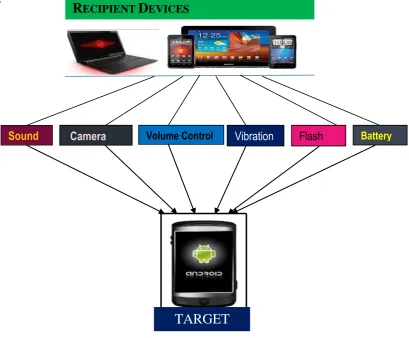
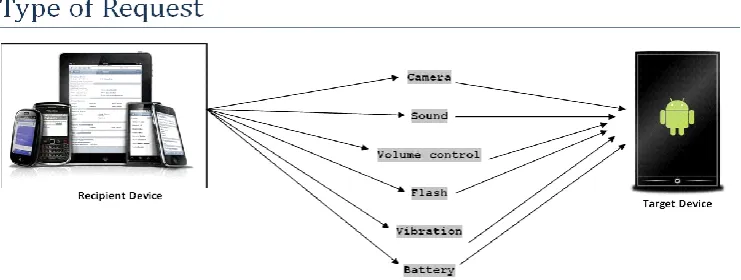
The proposed model for remote access to smartphone may be operated in the Android based Operating System. Recipient device may access and control the components of target device (remote user) such as camera which view live feed in various resolutions and switching Camera from front to back and vice versa, Sound media which play MP3 pre-recorded sound, Volume media used to increase or decrease sound volume, Flash hardware Turning On-Off the camera flashlight, Vibrate android OS will vibrate device, and battery android device checking status of battery shown in fig. 1.2 below.
Fig 1.2 Conceptual Research Ideas
With the rapid growth in mobile communication technology and networking, it is apparent that to make smart mobile phone more sharpen and powerful. Therefore the basic aim of this research is to formulate strategy and study the effects or impact of remotely access users or smart phone to integrate communication more closely with business processes as well as social and business concern issues.
Problem Statement
It is difficult and hard to access data or useful information of “smart phone users” remotely. There is tremendous development in mobile technology including operating system platforms. The Cellular technology is one which allows an efficient utilization of frequencies enabling the connection of large number of users. There are some actions that are necessary in order to obtain such connection for accessing reliable and secure data over mobile network. However there are many challenges. This proposed research work is focused to design programming model using java and XML platform to remotely track and control the resources of smart phone and its access.
TARGET
DEVICE
R
ECIPIENT
D
EVICES
Volume Control
Vibration
Camera
Flash
ISSN(Online): 2320-9801 ISSN (Print): 2320-9798
I
nternational
J
ournal of
I
nnovative
R
esearch in
C
omputer
and
C
ommunication
E
ngineering
(An ISO 3297: 2007 Certified Organization)
Vol. 3, Issue 5, May 2015
V. PROPOSED ALGORITHM
The Algorithm of proposed model‟s CLIENT COMPONENT (TARGET DEVICE) has been into two independent sub modules
A and B given below:
A. Web browser based i.e. HTTP:
Step A.1. Get the IP address of remote device
Step A.2. Open the IP address in browser such as Firefox or Google Chrome Step A.3. Send request to connect with recipient device
Step A.4. If connected, the video streaming will be displayed in the browser
Step A.5. Send client desired commands such as vibrate phone, turn flash On/Off, Increase/Decrease device volume, play sound on the remote device.
B. Network Stream Player such as VLC media player: Step B.1. Get the IP address of remote device
Step B.2. Open the IP address in VLC media player as network stream Step B.3. Play the network stream to view video from th remote device
VI.RESULT ANALYSIS AND DISCUSSION
H.264 Video codec
It is dominant video coding standard in transmission and storage of video data. The new H.264 video standard has achieved significant improvements in terms of compression over existing standards despite of fact having same basic coding framework similar to existing standards, but H.264 introduces many new features. Result tested by comparing H.264 standard with previous existing standards like MPEG-4 and MPEG-2 in terms of PSNR, NOISE ESTIMATION, BLURRING and MSE.In this test we took 10 frames of video and then compared these frames for different parameters for H.264, MPEG-4 and MPEG-2. These sequences are in CCIR- 601 format (720 x 480) at 30 fps frame rate. The H.264 encoder was configured to have five frames for inter motion search, motion vector resolution, context-based adaptive binary coding for symbol coding, and rate-distortion optimized mode decision. For MPEG-2 bit rates were chosen such that encoded video qualities (PSNR values) are close to corresponding H.264 video streams. MPEG-2 sequences were generated in constant bit-rate mode.This metric is calledPeak Signal-to Noise Ratio or PSNR and is the ratio between maximum signal power and that of affecting noise. It is given by,
PSNR=
PSNR=
ISSN(Online): 2320-9801 ISSN (Print): 2320-9798
I
nternational
J
ournal of
I
nnovative
R
esearch in
C
omputer
and
C
ommunication
E
ngineering
(An ISO 3297: 2007 Certified Organization)
Vol. 3, Issue 5, May 2015
Fig.1.3 Comparison of PSNR for MPEG2, MPEG4 and H.264
It is clear that PSNR value for MPEG2 in around 21, for MPEG4 it is varying in between 29 and 32 and for H.264 it is between 38 and 41. Thus H.264 shows higher PSNR value.
Noise Estimation
In image de-noising the noise is assumed to be known as Additive Gaussian White Noise (AWGN) However, in real applications the noise is unknown and non-additive. The standard deviation of noise is a function of image brightness (called Noise Level Function), measurable by fixing the camera and taking multiple shots of a static scene. Thus we defined a Noise Level Function and with the help of which we estimated noise for various frames in different algorithms.
Fig.1.4 Comparison of Noise Estimation for MPEG2, MPEG4 and H.264
Fig.1.4 shows comparison of MPEG2, MPEG4 and H.264 for noise estimation, that when same video passed through same channel, H.264 shows high noise immunity whereas maximum noise was in the oldest standard MPEG2, and noise level lie for MPEG4 lie in between H.264 and MPEG2.
MSE- Mean square error provides the cumulative squared error between the original image and processed (Compressed) image. It is given by
ISSN(Online): 2320-9801 ISSN (Print): 2320-9798
I
nternational
J
ournal of
I
nnovative
R
esearch in
C
omputer
and
C
ommunication
E
ngineering
(An ISO 3297: 2007 Certified Organization)
Vol. 3, Issue 5, May 2015
Where I (i,j) is the original image and K(i,j) is the compressed image. It is thus used here for estimating noise level for each video sequence thus giving the average of square of errors. The error is the amount by which the value implied by the estimator differs from the quantity to be estimated. The main difference occurs because of randomness or because the estimator doesn't account for information that could produce a more accurate estimate. As it can see that highest MSE is for MPEG2, around 500, for MPEG4 it is around 200 and for H.264 it is around 1. Hence H.264 provides minimum MSE as compared to previous standards.
Blurring
All coding standard techniques based on block based motion compensation become ineffective when blurring takes place in video sequence. Blurring generally takes place in video sequence when relative motion between the captured scenes is faster the exposure time of camera. It also takes place when a object in a video is focused and defocused again and again. Fig.1.5 shows blurring in three formats.
Fig.1.5 Comparison of Blurring for MPEG2, MPEG4 and H.264
From figure 1.5 it is clear that blurring in H.264 is less than MPEG2 and MPEG4, depicted by red plus sign. Presented an evaluation of the new video coding standard H.264 compared to existing video coding standards in terms of PSNR, Noise Estimation, MSE and Blurring. We performed encoding tests at wide range of rates for both low- and high-latency application and found that H.264 is superior to existing video standards. When coding blurred scenes in video sequences, bit rate reductions of up to 65% were achieved for H.264
VII. IMPLEMENTATION
The proposed model for remote access to smartphone has been implemented in the Android 4.4 Kitkat Operating System. Client interface will help the user to send command by just clicking the buttons. This is shown in the screen shots. The following commands are implemented.
ISSN(Online): 2320-9801 ISSN (Print): 2320-9798
I
nternational
J
ournal of
I
nnovative
R
esearch in
C
omputer
and
C
ommunication
E
ngineering
(An ISO 3297: 2007 Certified Organization)
Vol. 3, Issue 5, May 2015
User Interface, setting and notification panel
Fig. 1.7User Interface, Setting and notification panel
This is main screen which informs about the IP address for Hyper Text Transfer Protocol & Real Time Streaming Protocol connection. Various parameters are setting to control remotely. Notification of service is in notification bar.
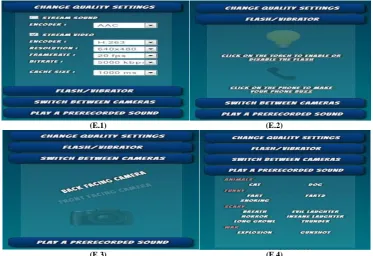
We are able to make various settings with respect to audio & video encoder, video image resolution, and frame rate, bitrates & cache size shown in Fig 1.8 (E.1). It is ability to control smart phone‟s Flash of remote device using Enable/Disable button of Flash as well as control device vibration using Vibration on/off button shown in Fig 1.8 (E.2)
(E.1) (E.2)
(E.3) (E.4)
Fig 1.8 Showing Quality Setting, Flash/Vibrator, Switch between Camera & Play a Pre-recorded Sound
It is also ability to switch smart phone‟s Camera of remote device from front to back and vice versa and Play pre-recorded sound of remote device shown in Fig.1.8 (E.3 & E.4).
ISSN(Online): 2320-9801 ISSN (Print): 2320-9798
I
nternational
J
ournal of
I
nnovative
R
esearch in
C
omputer
and
C
ommunication
E
ngineering
(An ISO 3297: 2007 Certified Organization)
Vol. 3, Issue 5, May 2015
VIII. CONCLUSION AND FUTURE SCOPE
The proposed model has been implemented in android operating system. It was tested in Smartphones such as Samsung Galaxy Grand, Micromax Canvas Ego and plus 2.. The conclusions drawn from proposed system is that, the proposed model facilitates accessing of mobile device from a remote location using any mobile device or Laptop or Desktop PC. The system has been designed in such a way that mobile device used for accessing the remote android device, need not be an android device. The system allows user to view videos even if he is at some remote place. The system provides functionality of online video streaming so that user can view videos from web browser. The system proves that Android OS can be manipulated and device can be used remotely.
The futures Scope for this research work are listed below:
The remote connection through Wi-Fi Network or GPRS can be replaced by SMS.
The Google Cloud Messaging can be used to run application without user interface.
REFERENCES
1 Yeung Siu Fung and John C.S.Lui, “Secure Real Time streaming Protocol for Hierarchical Proxy caching”,International Journal Of Network Security,Jan-2008
2. Arjan Durresi and Raj Jain, "RTP, RTCP, and RTSP - Internet Protocols for Real-Time Multimedia Communication: The Industrial Information Technology Handbook”, edited by Richard Zurawski, Published by CRC Press, ISBN: 084-330777, Jan 2005 3. Voice on net, http://von.com
4. David Wright, “Wireless technologies for Mobile Computing and commerce”,IEEE, University of Ottawa, Canada-pg. 1175 Ch. 3.35- of “Mobile Computing: Concepts, Methodologies, Tools, and Applications- David Taniar Monash University, Australia, 2009
5. Phillip OllaMadonna & Joseph Tan Wayne State University, USA,“The M-Health Reference Model: An Organizing framework for Conceptualizing Mobile Health Systems”, 2010
6. Mark Ward,“Stream Smoke DZA and R.F.C.'s the Outsiders Album”, 16 Nov, 2014
7. J.F.Kurose& K.W.Ross, “Computer Networking –A Top-down approach featuring the internet”, 2nd edition, 2003
8. P.L.Ramteke, Dr.D.N.Chaudhary, “Design and Analysis Smartphone Application development methodology”, International Journals of Recent and Innovation Trends in Computing & Communication,ISSN: 2321-8169 Vol. 2, Issue 11 Nov 2014
9. Apple‟s Quick Time, http://www.apple.com/quicktime
10. Joo-Hwee Lim, Yiqun Li, Yilun You,“Chevallet, J.-P, ”Scene Recognition with Camera Phones for Tourist Information Access", IEEE
International Conference page(s): 100 - 103, 2-5 July 2007
11. P.L.Ramteke, Dr.D.N.Chaudhary, “Eclipse Java Based Modelling Platforms for Smart Phone”, International Journal of Computer Engineering &Technology ISSN (Print): 0976-6367 ISSN (Online): 0976-6375 Volume 4, Issue 2, March-April- 2013 pp.260-266 12. Real networks, http://www.realnetworks.com
13. Microsoft‟s Window media player, http://www.microsoft.com/windows/windowsmedia/ 14. http://computer.howstuffworks.com/internet/basics/streaming-video-and-audio.htm
15. Jin-Suk Kang, Byeong-Hee Roh,"Development of tangible user interface for linking context modelling and 3D map in smartphone", InternationalConference page(s): 44 – 49, 18-20 Oct., 2010
16. Palmer, N., Kielmann, T., Bal, H., “Serialization for Ubiquitous Systems: An Evaluation of High Performance Techniques on Java Micro Edition", The Second International Conference page(s): 356 - 361, Sept. 29 2008-Oct. 4 2008
17. Kemp, R., Palmer, N., Kielmann, T., Seinstra, F., Drost, N., Maassen, J., Bal, H., "Identify Multimedia Cyber Foraging from a Smartphone", 11th IEEE International Symposium page(s): 392 - 399, 14-16 Dec. 2009
18. Munoz, L.U.H., Woolley, S.I., “A user-centered mobile health device to manage life-threatening anaphylactic allergies and provide support in allergic reactions", Information Technology and Applications in Biomedicine, 9th International Conference page(s): 1 - 4, 4-7 Nov. 2009 19. Kiran, R.B., Patel, S., “Implementing mobile phone as a multi-purpose controller using 3D sensor technology", Computer Science and
Information Technology, 3rd IEEE International Conference page(s): 584 - 588, Volume: 2 Issue: 2, 9-11 July 2010
20. Kukka, H., Kruger, F., Ojala, T., “BlueInfo: Open Architecture for Deploying Web Services in WPAN Hotspots", IEEE International Conference page(s): 984 - 991, 6-10 July 2009
21. Feida Lin, Weiguo Ye, "Operating System Battle in the Ecosystem of Smartphone Industry", IEEC. International Symposium page(s): 617 - 621, 16-17 May 2009
BIOGRAPHY
ISSN(Online): 2320-9801 ISSN (Print): 2320-9798
I
nternational
J
ournal of
I
nnovative
R
esearch in
C
omputer
and
C
ommunication
E
ngineering
(An ISO 3297: 2007 Certified Organization)
Vol. 3, Issue 5, May 2015