Position Based and Cognitive Radio in
VANET for Avoiding Traffic Congestion
G. Geetha
1, G. Michael
*21
Professor & Head, Dept. of CSE, Jerusalem College of Engineering, Chennai, Tamil Nadu, India
2Associate Professor, Dept. of CSE, Bharath University, Chennai, Tamil Nadu, India
*Corresponding Author
ABSTRACT: Inter-Vehicle Communication System (IVCS) built in a city environment faces greater challenges because of uneven distribution of vehicular nodes, mobility constrained, and difficult signal reception due to radio obstacles such as high rise buildings. This paper proposes a new position-based routing scheme designed specifically for IVCS in a city environment and for the roadside equipment using a Cognitive Radio to allocate a multiple channel for communicating between vehicles and infrastructure to provide a safety messaging to handle emergency situation. Currently VANET is implemented using ETT and ETX system which uses Waited Corrective (WC ETT) mechanism. The delay incurred in this system is improved here by making use of Cognitive Radio which allocates multiple channels simultaneously. This paper also proposes to use A-star Algorithm for inter-vehicle communication which supports dynamic status updates on neighbors, sink and their energy levels so as to extended WSN lifetime.
KEYWORDS: Vehicular Communication; A-star Algorithm; Fuzzy Logic; Cognitive Radio; Roadside Infrastructure; Position Based Routing.
I. INTRODUCTION
A Vehicular Ad-Hoc Network, or VANET, is a form of Mobile Ad-Hoc Network, to provide communication among nearby vehicles and between vehicles and nearest fixed equipment, usually described as Roadside Equipment. The VANET used to providing safety and comfort for passenger. Having VANET inside vehicle need only small electronic device, which will provide Ad-Hoc Network connectivity for the passengers inside the vehicle. By this device operating this network does not need complicated connection and server communication[1]. Each vehicle equipped with VANET device will be a node in the Ad-Hoc network and can receive and relay others messages through the wireless network. In vehicular Ad-Hoc network using different ad-hoc networking technologies such as Wi-Fi IEEE 802.11 b/g, WiMAX IEEE 802.16, Bluetooth, IRA, ZigBee for easy, accurate, effective and simple communication between vehicles on dynamic mobility.
Vehicular Ad-Hoc Networks
VANETs have turned into an important research area over the last few years. VANETs are distinguished from MANET by their hybrid network architectures, node movement characteristics, and new application scenarios. Characteristics
Drive behavior, constraints on mobility, and high speeds create unique Characteristics in VANETs. These characteristics distinguish them from other mobile ad hoc networks, and the major characteristics are as follows:
High mobility and Rapid changing topology Geographic position available
Mobility modeling and predication Hard delay constraints
No power constraint
This class is divided into two subclasses: topology-based and position-based routing protocols. In topology-based routing, each node should be aware of the network layout, also should able to forward packets using information about available nodes and links in the network[2]. In contrast, position-based routing should be aware of the nodes locations in the packet forwarding.
Topology-Based Routing Protocols
Topology-based routing protocol usually a traditional MANET routing protocol, it uses link's information which stored in the routing table as a basis to forward packets from source node to destination; it commonly categorized into three categories (base on underlying architecture) Proactive (periodic), Reactive (on-demand) and Hybrid.
a. Reactive Routing Protocols
Reactive routing protocol (also called as On-Demand) reduce the network overhead by maintaining routes only when needed, that the source node start a process of route discovery and made a route request message to the destination. After the message received by destination it will send a route reply message to the source node[3].
Ad-Hoc On-Demand Distance Vector
AODV offers low network overhead by reducing message flooding in network that when compared to proactive routing protocols, besides reducing the requirement of memory size and by minimizing the routing tables which keep only entries for recent active routes, also keeps next hop for a route rather than the whole route[4]. It also providing dynamically updates for adapting the route condition and eliminated looping in routes by using destination sequence number. However, it causes large delays in a route discovery, also route failure may require a new route discovery which produces additional delays that decrease the data transmission rate and increase the network overhead
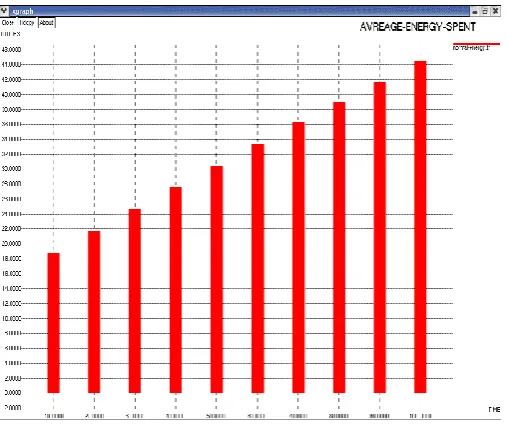
Fig 1 Energy Estimation of AODV
b. Postion-Based Routing Protocols
Position or geographic routing protocol is based on the positional information in routing process; where the source sends a packet to the destination using its geographic position rather than using the network address[5]. When the source need to send a packet, it usually stores the position of the destination in the packet header which will help in forwarding the packet to the destination without needs to route discovery, route maintenance, or even awareness of the network topology.
Challenges Of Position-Based Routing In IVCS
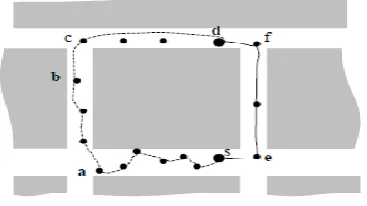
At b, it is found that c is nearer to d than s, at which the packet enters into perimeter-mode[7]. Thus, the packet switches back to greedy mode at b, and then reaches its destination d through c. It can be seen that this route is very long in terms of hop count. In fact, s can reach a, and a can reach b, both in one hop[8]. This shows that the perimeter-mode which packet employs to recover from local maximum is very inefficient and time-consuming. Another observation is that the packet can actually travel from s to d via a route that passes through e and f (shown as solid line), which is much shorter.
Fig 2 Challenges of position-based routing in IVCS
However, this route is not exploited because the perimeter-mode of GPSR based on right hand rule is biased to a specific direction when selecting for the next hop. It should be noted that in a city environment, the constrained mobility and frequently encountered obstacles can effectively force GPSR to run into perimeter-mode frequently[9]. As a result, the performance of GPSR could deteriorate dramatically, and therefore may not be suitable for IVCS.
c. Anchor-Based Street And Traffic Aware Routing
A-star search algorithm is a widely used graphic searching algorithm. It is also a highly efficient heuristic algorithm used in finding a variable or low cost path. It is considered as one of the best intelligent search algorithms that combines the merits of both depth-first search algorithm and breadth-first algorithm.
A-star path searching algorithm uses the evaluation function (usually denoted f (n)) to guide and determine the order in which the search visits nodes in the tree. The evaluation function is given as:
f (n) = g(n) + h(n)
where g(n) is the actual cost from the initial node (start node) to node n (i.e. the cost finding of optimal path), h(n) is the estimated cost of the optimal path from node n to the target node (destination node), which depends on the heuristic information of the problem area[10]. Generally, A-star algorithm maintains two lists, an OPEN list and a CLOSE list. The OPEN list is a priority queue and keeps track of the nodes in it to find out the next node with least evaluation function to pick. The CLOSE list keeps track of nodes that have already been examined. Initially, the OPEN list contains the starting node[11]. When it iterates once, it takes the top of the priority list, and then checks whether it is the goal node (destination node). If so, the algorithm is done. Otherwise, it calculates the evaluation function of all adjacent nodes and adds them to the OPEN list. After the A-star algorithm is completed, it will find a solution if a solution exists. If it doesn’t find a solution, then it can guarantee that no such solution exists. A-star algorithm will find a path with the lowest possible cost. This will depend
Fig 3 Energy Estimation of A-STAR
A-star algorithm may be expressed as following:
1) Put the source node s0, f (s0) attached, into the OPEN list. Let the CLOSE list is empty. 2) If the OPEN is empty, exit, and the search is fail.
3) Move out the first node N form the OPEN list, which has the smallest f (.) in the list, and put it into the CLOSE list; number the node as n.
4) If the node N is the goal node, the search is finished, exits. 5) If the node N cannot spread, turn to step 2.
6) Spread the node N, there will be a group of nodes, all of which are f (n) attached; add the nodes to the OPEN list, then turn to step 3; Especially, for the gotten nodes in this step, some processing will be done as follows:
a) Examine the OPEN list and the CLOSE list to find whether (some of) the nodes have been included in them. For the nodes that have been included, if they are ancestor node of the node N, delete them; If they are not (the ancestor node), delete them too, but for they are spread on the second time, it is needed to review them and find whether the corresponding f (n), the back pointers of the nodes and even those of the corresponding descendant nodes are needed to be changed[12]. The rule of such changing is “choosing the short path based on f(n).”
b) For the nodes that have not been included in the OPEN lit and the CLOSE list, put them into the OPEN after assigning the back pointer that points to the node N, then, based on f(n), sort all the nodes in the OPEN list in ascending order.
Related Work
II. IMPLEMENTATION OF A-STAR
In the new routing method, the base station prepares the routing schedule and broadcast it to each node. A-star algorithm which is used to find the optimal route from the node to the base station is applied to each node. A-star algorithm creates a tree structure in order to search optimal routing path from a given node to the base station.
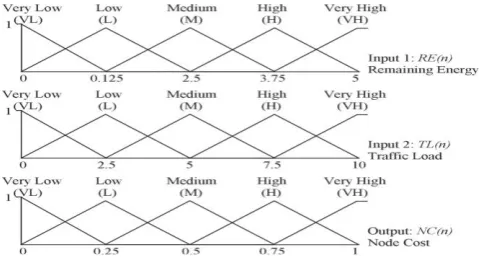
Fig 5 Membership graph for the inputs (remaining energy and traffic load) and the output (node cost).
The tree node is explored based on its evaluation function f(n). The function we used is given as:
f (n) = NC(n) + (1/MH(n)).
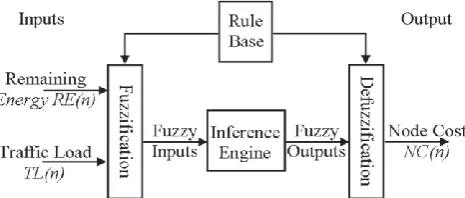
Where NC (n) is the node cost of node n, which takes value [0…1], and can be calculated by the fuzzy approach. The fuzzy approach is considered for the remaining energy and the traffic load of node n to calculate the optimal cost for node n. MH (n) is the short distance from node n to the base station. As a result, the node n that has largest f (n) value will be chosen as the optimal node.
Cognitive Radio
Cognitive radio is used for passing message from roadside unit to vehicles with using a access point with the beacon message for each area to obtain the information of moving vehicles in that area and the vehicle moved out from that region the next access point will provide the information to the vehicle[13]. So that cognitive radio maintain access point for each and every area to obtain the information of the vehicle and provide the safety message to the vehicle to avoid emergency event occurred in that area so that the driver will slow down the vehicles to avoid accident and traffic in that place[14]. They use ETX and ETT in combination of WCETT using OLSR routing protocol for finding vehicles information and used a terms are
ETX
ETX, Expected Transmission Count, is an attempt to create a metric better suited for wireless networks. The metric represents the number of times a node expects to send or resend a packet for the receiving node to receive a non-corrupt packet. However, the metric does not consider link speed or available bandwidth. ET X is calculated as
ETX=1/LQ*NLQ
Where LQ is the link quality and NLQ is the neighbor link quality.
ETT
ETT, Expected Transmission Time, is a metric that is built on ETX. ETT tries to estimate the time it would take to send a packet on a link by multiplying the ETX with the size of the packet divided by the link capacity as shown in Equation 2. This gives the time it should take to send a packet including the resends if needed.
ETT is calculated using the following algorithm.
Where S is the packet size, which is measured in bytes and B is the link capacity, which is measured using packet-pair technique.
Performance Evaluation
Energy Model, as implemented in ns, is a node attribute. The energy model represents level of energy in a mobile host. The energy model in a node has a initial value which is the level of energy the node has at the beginning of the simulation. This is known as initialEnergy_. It also has a given energy usage for every packet it transmits and receives. These are called txPower_ and rxPower_. EnergyModel(energy) requires the initial-energy to be passed along as a parameter.
Fig 6 Energy Estimation for AODV and A-STAR
The other class methods are used to decrease the energy level of the node for every packet transmitted ( DecrTxEnergy(txtime, P_tx)) and every packet received ( DecrRcvEnergy (rcvtime, P_rcv)) by the node. P_tx and P_rcv are the transmitting and receiving power (respectively) required by the node’s interface or PHY. At the beginning of simulation, energy_ is set to initialEnergy_ which is then decremented for every transmission and reception of packets at the node. When the energy level at the node goes down to zero, no more packets can be received or transmitted by the node. If tracing is turned on, line
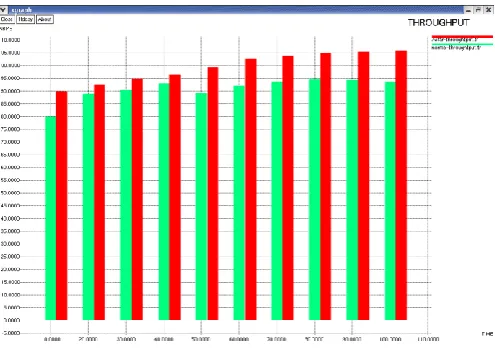
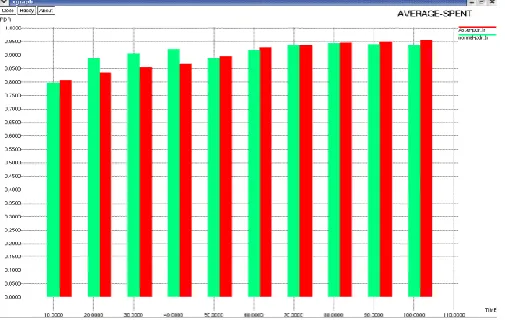
Likewise the performance is made for delay, throughput and packet delivery ratio between AODV and A-STAR to show the better performance of A-STAR because A-STAR will check the high efficient node in the network to deliver the packet to the destination so that energy can be saved for the remaining nodes in the network
Fig 7 Delay for AODV and A-STAR
It is one of the dimensional parameters of the network which gives the fraction of the channel capacity used for useful transmission selects a destination at the beginning of the simulation i.e., information whether or not data packets correctly delivered to the destinations. Throughput is the average rate of successful data packets received at destination. It is usually measured in bits per second (bit/s or bps), and sometimes in data packets per second
Fig 8 Throughput for AODV and A-STAR
Fig 9 Packet delivery ratio for AODV and A-STAR
III. CONCLUSION
This project has high social relevance and usefulness to provide a safety message to all the vehicles in the environment to avoid unwanted event in the network so that communication has been made between Vehicle to vehicle using A-star protocol as well as vehicle to infrastructure using cognitive radio using access point to allocate multiple channel in the network region to the vehicles so that the message can be send to vehicle and from the end of the network region from that vehicle the message has been passed to the next region of the network using access point to provide a information to the vehicle by using infrastructure so that the delay can be reduced by using a cognitive radio
ACKNOWLEDGEMENT
I would like to express my sincere gratitude to my guide Dr. G Geetha, Professor, Department of Computer Science and Engineering, Jerusalem College of Engineering, for her guidance, constant encouragement and support. Her extensive vision and creative thinking has been a source of inspiration for me since this time
REFERENCES
1. Florian Knorr, Daniel Baselt, Michael Schreckenberg, and Martin Mauve, “Reducing Traffic Jams Via VANETs,“ IEEE Transaction on Vehicular Technology, Vol. 61, NO. 8, Oct 2012.
2. Saravanan, T., Srinivasan, V., Udayakumar, R., "A approach for visualization of atherosclerosis in coronary artery", Middle - East Journal of Scientific Research, ISSN : 1990-9233, 18(12) (2013) pp. 1713-1717.
3. Sooksan Panichpapiboon and Wasan Pattara-atikom, “A Review of Information Dissemination Protocols for Vehicular Ad Hoc Networks,” IEEE Communication Surveys & Tutorials, 2012
4. Udayakumar R., Khanaa V., Saravanan T., "Analysis of polarization mode dispersion in fibers and its mitigation using an optical compensation technique", Indian Journal of Science and Technology, ISSN : 0974-6846, 6(S6) (2013) pp. 4767-4771.
5. D. Baselt, M. Mauve, and B. Scheuermann, “A top-down approach to inter-vehicle communication (poster),” in Proc. 3rd Annu. IEEE VNC,2011, pp. 123–130.
6. A. Lakas and M. Chaqfeh, “A novel method for reducing road traffic congestion using vehicular communication,” in Proc. IWCMC, 2010,
pp. 16–20.
7. Vijayaragavan S.P., Karthik B., Kiran T.V.U., Sundar Raj M., "Robotic surveillance for patient care in hospitals", Middle - East Journal of Scientific Research, ISSN : 1990-9233, 16(12) (2013) pp. 1820-1824
8. C. Sommer, O. K. Tonguz, and F. Dressler, “Adaptive beaconing for delay sensitive and congestion-aware traffic information systems,” in Proc. 2nd IEEE VNC, 2010, pp. 1–8.
9. J. W. Wedel, B. Schünemann, and I. Radusch, “V2X-based traffic congestion recognition and avoidance,” in Proc. 10th ISPAN, 2009, pp. 637–641.
11. J. Mittag, F. Thomas, J. Härri, and H.Hartenstein, “A comparison of single- and multi-hop beaconing in Vanets,” in Proc. 6th ACM Int. Workshop VANET, 2009, pp. 69–78.
12. F. Kargl, E. Schoch, B.Wiedersheim, and T.Leinmüller, “Secure and efficient beaconing for vehicular networks,” in Proc. 5th ACM Int.Workshop VANET, 2008, pp. 82–83.
13. F. Kargl, E. Schoch, B.Wiedersheim, and T. Leinmüller, “Secure and efficient beaconing for vehicular networks,” in Proc. 5th ACM Int. Workshop VANET, 2008, pp. 82–83.
14. Thooyamani K.P., Khanaa V., Udayakumar R., "An integrated agent system for e-mail coordination using jade", Indian Journal of Science and Technology, ISSN : 0974-6846, 6(S6) (2013) pp. 4758-4761.
15. M. Artimy, “Local density estimation and dynamic transmission-range assignment in vehicular ad hoc networks,” IEEE Trans. Intell. Transp. Syst., vol. 8, no. 3, pp. 400–412, Sep. 2007.
16. Dr. T.Nalini, Dr.K.Manivannan, Vaishnavi Moorthy, Efficient Remote Data Possession Checking In
Critical Information Infrastructures Ensuring
Data Storage Security In Cloud Computing, International Journal of Innovative Research in Computer and Communication Engineering, ISSN (Online): 2320 – 9801,pp 12-18, Vol. 1, Issue 1, March 2013
17. Dr.K.P.Kaliyamurthie, Cervical Cancer Screening and Classification
Using Acoustic Shadowing, International Journal of Innovative Research in Computer and Communication Engineering, ISSN(Online): 2320-9801,pp 1659-1662, Volume 1, Issue 8, October 2013
18. Dr.K.P.Kaliyamurthie, Automated Information Retrieval System Using Correlation Based Multi- Document Summarization Method, International Journal of Innovative Research in Computer and Communication Engineering, ISSN(Online): 2320-9801,pp 4328-4335, Vol. 1, Issue 7, September 2014
19. Dr.K.P.Kaliyamurthie, D.Parameswari, Modelling Cloud Storage, International Journal of Innovative Research in Computer and Communication Engineering, ISSN: 2249-2651,pp 1-5, Volume1 Issue3 Number2–Dec2011
20. Dr.K.P.Kaliyamurthie, D.Parameswari, Implementation of Customized Greencall
Algorithm for Energy-Efficient Of Wireless