1
Towards Privacy-Preserving and Efficient
Attribute-Based Multi-Keyword Search
Zhidan Li, Wenmin Li, Fei Gao, Wei Yin, Hua Zhang, Qiaoyan Wen, Kaitai Liang
Abstract—Searchable encryption can provide secure search over encrypted cloud-based data without infringing data confidentiality and data searcher privacy. In this work, we focus on a secure search service providing fine-grained and expressive search functionality, which can be seen as a general extension of searchable encryption and called attribute-based multi-keyword search (ABMKS). In most of the existing ABMKS schemes, the ciphertext size of keyword index (encrypted index) grows linearly with the number of the keyword associated with a file, so that the computation and communication complexity of keyword index is limited toO(m), wheremis the number of the keyword. To address this shortage, we propose the first ABMKS scheme through utilizing keyword dictionary tree and the subset cover, in such a way that the ciphertext size of keyword index is not dependent on the number of underlying keyword in a file. In our design, the complexity of computation and the complexity of the keyword index are at mostO(2·log(n/2)) for the worst case, but O(1)for the best case, wherenis the number of keyword in a keyword dictionary. We also present the security and the performance analysis to demonstrate that our scheme is both secure and efficient in practice.
Index Terms—Searchable encryption, keyword dictionary tree, subset cover, attribute-based multi-keyword search, encrypted index.
F
1
I
NTRODUCTIONB
EING offered advanced cloud-based data storage [1], [2] and the cloud computing services [3], Internet data owners (DO) prefer to outsource the massive amount of data and expensive data computation to remote cloud. To rapidly occupy a piece of data outsourcing market, cloud service providers (CSP), such as Alibaba Cloud, Google AppEngine, and Dropbox, have prepared themselves to pro-vide flexible and multi-functional data services for Internet data users (DU) to meet various needs, e.g., data sharing, retrieving, and cooperative computing [4], [5], [6]. However, data privacy and access control over the outsourced data must be guaranteed in practice. To this end, DO may be recommended to encrypt their data via some encryption techniques (such as AES, RSA) before outsourcing the data to CSP. This approach can protect the data privacy, security and somewhat data integrity. Nevertheless, it also brings side effects, at the same time, to DU and CSP. For example, if the outsourced data is encrypted, standard plaintext-based search mechanism may be applicable no more. This paper deals with the case where a privacy-preserving search over encrypted data is needed.In order to address the search problem over encrypted data, searchable encryption (SE) has been proposed in the literature. Combining encryption with secure search, it can be used to protect privacy of search query but also the confi-dentiality of outsourced data. Specifically, it enables a valid data user to generate a trapdoor based on some specified query “description” for cloud server, so that the server can
• Z. Li, W. Li, F. Gao, H. Zhang and Q. Wen are with State key Laboratory of Networking and Switching Technology, Beijing University of Posts and Telecommunications, Beijing 100876, China.
• K. Liang is with Department of Computer Science, University of Surrey, Guildford GU2 7XH, UK
• W. Yin is with the National Computer Network Emergency Response Technical Team/Coordination Center of China, Beijing 100020, China • Corresponding author: [email protected]
use the trapdoor to search over the encrypted data without violating data confidentiality and search privacy.
Songet al.[7] seminally proposed the notion of keyword
search over encrypted data, called Searchable Symmetric Encryption (SSE), in which users have to securely share key for data encryption. Later, SE was designed in the public-key context [13], [14], [15], which can resolve the problem of secret key distribution yielded by SSE. The follow-up research works [19], [20], [21], [22], [23], [25], [26], [27] were proposed to achieve various functionalities under the umbrella of public key based SE, for example, these works [19], [20], [21] focus on single keyword query, while the papers [25], [27] consider to enable users to make multi-keyword search.
In practice, DOs may prefer to maintain secure access control over their outsourced data, so that the unauthorized data user can not gain access to the data. One of the promis-ing technologies called ciphertext-policy attribute-based en-cryption (CP-ABE) has been used to inject access control pol-icy into data encryption. Zhenget al.[19] proposed a new primitive called attribute-based keyword search (CP-ABKS) by integrating SE and ABE. In their CP-ABKS schemes, an access policy tree is associated with ciphertext and a private key is associated with user attributes. If the attributes satisfy the policy tree and the trapdoor matches the keywords ciphertext (encrypted indexes) simultaneously, then the ci-phertext can be located and further decrypted. Some follow-up research works [26], [27] that are proposed to achieve multi-keyword search based on [19]. However, there is a limitation in most of the existing attribute-based multiple keyword search schemes (ABMKS), e.g., [26], [27]. Due to the number of keyword increases in the multi-keyword search, the size of encrypted index and the computational complexity are bounded byO(m), wheremis the number of keyword embedded in a file.
de-2 sign a Towards Privacy-Preserving and Efficient
Attribute-Based Multi-Keyword Search (TPPE-ABMKS) through uti-lizing keyword dictionary tree and the subset cover. Our TPPE-ABMKS can achieve multi-keyword search with fine-grained access control and the number of the encrypted index is relatively small, which is not dependent on the number of underlying keywords in a file. The contribution of this paper is summarized as follows.
1) We, for the first time, provide a secure multi-keyword search service with short-size ciphertext of keyword index. Our number of the encrypted index is not linear with the number of keyword embedded in a file. To the best of our knowledge, our design is the first of its type that achieves short-size ciphertext of keyword index in the model of MKS. More specifically, by designing the tools of keyword dictionary tree and the subset cover, in our scheme, the complexity of computation and the complexity of the encrypted index are at most
O(2·log(n/2)) for the worst case butO(1)for the best case, where nis the number of keyword in a keyword dictionary in system.
2) We show that our design is selectively secure a-gainst the chosen-keyword attack via the formal security analysis, and our performance evaluation proves that the scheme is efficient in terms of both the computation and communication overhead, in particular, the time cost of the ciphertext generation and data retrieve are more efficient than that of the existing ABMKS schemes.
The rest of this paper is organized as follows. In Section 2, we present an overview of related work. In Section 3, we briefly review some basic primitives which will be used in this paper and we also define the main building blocks for our construction. We then present the system and threat models of our scheme, the construction, and the security model in Section 4. In Section 5, the proposed scheme is presented. Section 6 presents the security analysis of the prosed scheme. Section 7 shows the experimental analysis of the proposed scheme and the comparison with some related works. We conclude the paper in Section 8.
2
R
ELATEDW
ORKSE was first proposed by Songet al.[7], which allows DOs or DUs to generate a trapdoor that can be used by cloud server to search over the outsourced encrypted data. The existing SE schemes can be categorized into two branches: SEs in the symmetric-key context [7], [9], [10], [11], [12] and the ones in public-key scenario [13], [14], [15], [16], [17], [18]. In order to quickly obtain the encrypted record, researchers have been working on the keyword-based in-formation retrieval to achieve various functionalities and practical needes. The research works in [9], [11] have been proposed SE in the multi-users setting, where DOs can enforce an access control policy by distributing some secret keys to authorized system users. Some SE schemes focus on improving the level of keyword security and privacy. Chen
et al.[23] proposed a public key encryption with keyword
search in dual-server model, which can resist the keyword
guessing attack. Later on, Liu et al. [6] and Miao et al.
[27] presented the verifiable SE schemes by using public-auditing technique, respectively. Their schemes guarantee that DUs can prevent the semi-trusted CSP from tampering the sharing data and returning false search results.
Attribute-based encryption (ABE) [30], [31] is a useful data encryption tool for enforcing access control policy via cryptographic technique. It makes sure that if a user has a legitimate credential, then he/she can decrypt a given ciphertext which is encrypted according to an access control policy [30], [31]. With the special features of ABE, Zheng
et al. [19] proposed a new secure search service called
attribute-based keyword search (ABKS). After that, [26], [27] were proposed to achieve extended functionalities (e.g., multi-keyword search) based on [19]. In ABKS, keywords are encrypted according to an access control policy, and a legitimate DU can generate trapdoors that can be used by server to search over the encrypted data. ABKS can maintain access control but also privacy-preserving keyword search in practice.
In order to enable DUs to make queries over multiple keywords at the same time, Golleet al.[28] proposed the concept of conjunctive keyword search. Later on, Parket al.
[29] extended the notion into public key system. [26], [27] were put forth to achieve advanced functionalities in the multi-keyword search in public-key context. These schemes are denoted as attribute-based multiple keyword search (ABMKS) in this paper. However, the computation cost of keyword index generation is relatively high in [26], [27], which is growing linearly with the number of keyword em-bedded in a file. Recall that the complexity of keyword index ciphertext is O(m), where m is the number of keyword embedded in a file.
3
P
RELIMINARIESWe give a brief review of some basic primitives which will be used in this paper in Sections 3.1 and 3.2. We also define the main building blocks of our scheme in Sections 3.3-3.6.
3.1 Bilinear Map
LetGandGT be two multiplicative cyclic groups of prime
orderp,gbe a generator of the groupG, a bilinear mapping e:G×G−→GT satisfies following properties [30]:
• Bilinearity:e(ga, gb) =e(g, g)ab,∀g∈
G,∀a, b∈Z∗p.
• Nondegeneracy:e(g, g)6= 1.
• Computability: there is an efficient algorithm to com-putee(ga, gb),∀g∈G,∀a, b∈Z∗
p
3.2 Access Tree
LetT be an access tree [30] representing an access control policy. In T, each non-leaf node denotes a threshold gate and is described by its a threshold value and children notes. Letnumvrepresent the number of children notes for a node v, and the children notes from left to right be labeled as
1, ..., numv. The kv (kv≤numv) represents the threshold
value for the nodev, whenkv=1, the notev is an OR gate;
otherwisekv=numv, it is an AND gate. Each leaf node ofT
3
15
13 14
9 10 11 12
1 2 3 4 5 6 7 8
w1 w2 w3 w4 w5 w6 w7 w8
KDT
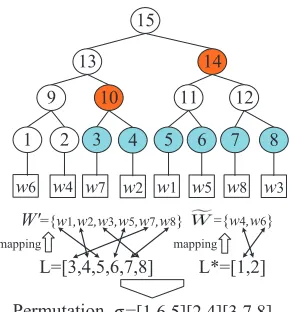
Fig. 1: Example of a Keyword Dictionary Tree
mapping mapping
15
13 14
9 10 11 12
1 2 3 4 5 6 7 8
Permutation
W'={w1,w2,w3,w5,w7,w8} ={w4,w6}
L=[3,4,5,6,7,8] L*=[1,2]
w6 w4 w7 w2 w1 w5 w8 w3
=[1,6,5][2,4][3,7,8]
Fig. 2: Example of a Changed Dictionary Tree
In order to easy understand the access tree, we give some few functions. Let parent(v)denote the parent of nodev. Ifv
is a leaf node, att(v)represents the attribute associated with the leaf nodev. Let index(v)represent the label of the node
v, andTvrepresent the subtree ofT rooted at nodev.
Tv(γ)=1denotes that the attribute setγmeets the access
tree Tv. If v is a non-leaf node, we can compare Tv(γ)
recursively as follows: computeTv0(γ)for all childrenv0of the nodev, if at leastkvchildren of the nodevreturn 1, then
Tv(γ)=1. Ifvis a leaf node, andatt(v)∈γ, thenTv(γ)=1.
3.3 Keyword Dictionary Tree
In this section, we first give the definition of the Keyword Dictionary Tree (KDT). LetW = [w1, ..., wn]be the keyword
dictionary in the system, KDT denotes a full binary tree with
nleaves, and the leaf node Libe associated with a keyword wi as in Fig. 1 (hereafter, we set n=8 in all the examples
to easy understand). In a KDT tree, from left to right, from bottom to top, the nodes of the tree is labeled with1, ...,2n−
1. We give an example as in Fig. 1. The bottom left node of the KDT holds number 1, and the root node of KDT holds number 15.
3.4 Changed Dictionary Tree and the Path note
We call the KDT as an original dictionary tree (ODT), if the leaf Li of it is labeled with the keyword wi. The changed
dictionary tree (CDT) denotes that the positions of all the
15
13 14
9 10 11 12
1 2 3 4 5 6 7 8
w1 w2 w3 w4 w5 w6 w7 w8
=[1,6,5][2,4][3,7,8]
15
13 14
9 10 11 12
1 2 3 4 5 6 7 8
w6 w4 w7 w2 w1 w5 w8 w3
ODT CDT
Keyword position permuted by
Fig. 3: The Generation of the Changed Dictionary Tree
keywords in the ODT are changed. The CDT is defined as follows.
Let W0 = [w01, ..., wm0 ] be the keyword set for one
file fi, and Wf=W/W0 denote the difference of set-s W and W0, e.g., as shown in Fig. 2, W=[w1, ..., w8],
W0=[w1, w2, w3, w5, w7, w8], then Wf=[w4, w6]. DO will
choose|W0|continuous leaf nodes of ODT, in which these leaf nodes are denoted as L, and L∗ is the remain of leaf nodes in ODT, e.g., as shown in Fig. 2, L=[3,4,5,6,7,8], and L∗=[1,2].
For each leaf node in L and L∗, it will be randomly labeled with one keyword in W0 and Wf, respectively, as shown in Fig. 2,1→w6,2→w4,3→w7,4→w2,5→w1,6→w5, 7→w8, and8→w3. Thus, all of the keyword labeled with the leaf node of ODT is changed. We state that there exists a permutationσ=[1,6,5][2,4][3,7,8], where [1,6,5] indicates that leaf node 1 is labeled with keywordw6, leaf node 6 is labeled with keyword w5, and leaf node 5 is labeled with keywordw1. The[2,4]and[3,7,8]follow the same rule as
[1,6,5].
We note that CDT is generated by changing the keyword order of the ODT with the permutationσ, and theσhas at least2·m!·(n−m)!= 2×[m×(m−1)×...×2×1]×
[(n−m)×(n−m−1)×...×2×1]different possibilities in total. Sincen is a relatively large number, theσ will be very hard to be guessed (considering (n−m)! or m! is a very large number, e.g.,n= 1000,m= 100). As shown in Fig. 3, we present an example of generation of CDT by using
σ=[1,6,5][2,4][3,7,8].
LetW∗= [w1∗, ..., w∗m∗]be a query keyword set, for each
w∗
i ∈W∗, let path(w∗i) = [Ωwi,1, ...,Ωwi,l](wherel =1+log
n) be the path nodes of the keywordw∗i, which starts from the leaf node labeled withwito the root node in CDT, e.g.,
in Fig.2, path(w4) = [2,9,13,15].
3.5 Subset Cover
In this section, we give the definition of the subset cover for a keyword setW0. For the keyword setW0in the CDT, with the subset cover technique [32], DO selects root nodes of the minimum cover sets in the CDT tree that can cover all of the leaf nodes inW0, denoted as cover(W0) = [Ω1, ...,Ωt],
wheretis the number of node in cover(W0)andt≤2·log (n/2), e.g., as in Fig 2. WhenW0= [w1, w2, w3, w5, w7, w8],
4
7
5 6
1 2 3 4
7
5 6
1 2 3 4
X=[2,3,4] Cover(X)=[2,6]
X=[2,3] Cover(X)=[2,3]
Fig. 4: An Example when n=22
=4
...
... ...
... ... ...
... ...
1 ... ...
Case 1:keyword Wÿlabeled with right(or left ) half nodes of CDT
...
... ...
... ... ...
... ...
1 ... ...
Case 2:keyword Wÿlabeled with right and left half nodes of CDT
2k
2
2k+
-
12
2k+
-
12k 2k+1
1
2k+ 2k+1
2k+1
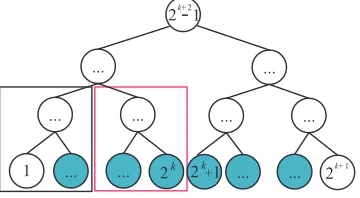
Fig. 5: An Example when n=2k+1
Theorem 1. In the CDT, for each keyword setW0 for a file, we have that t ≤ 2· log (n/2), where t is the number of node in cover(W0), and when t= 2·log(n/2), the half of nodes in the subset cover(W0)are labeled with the right half nodes of the CDT, and the remaining half of nodes in cover(W0)are labeled with the left half nodes of the CDT.
Proof. We will prove it by using mathematical induction. First, when n=4, as shown in Fig. 4, we know that the maximum value oftis2≤2=2·log(4/2), Theorem 1 holds.
Second, assuming that the theorem 1 holds whenn= 2k, then
t≤2·log(n/2) = 2·log(2k/2) = 2(k−1)
It can be deduced that the Theorem 1 holds whenn= 2k+1.
Now we prove that the Theorem 1 holds whenn= 2k+1. As shown in Fig. 5, in case 1, the keyword W0 are continuously labeled with only right (or left) half nodes of CDT. We find that it is same as the situation thatn0 = 2k (The CDT withn0= 2kleaf nodes in dotted rectangle), then
t≤2·log(n0/2) = 2·log(2k/2) = 2(k−1)<2k=
2·log(2k+1/2)
=2·log(2n/2)
.
As shown in Fig. 5, in case 2, the keyword W0 are continuously labeled with both right and left half of CDT, the keywords in W0 that are labeled with the left half leaf nodes of CDT denoted asWlef t, and the keywords in W0 that are labeled with the right half leaf nodes of CDT denoted asWright.
Consider the keyword Wlef t and cover(Wlef t) (where tlef tdenotes the number of nodes in cover(Wlef t)). Because W0 are continuously labeled with the leaf nodes in CDT, we note that tlef t≤1+log(2k/2)=k (As shown in Fig. 5,
the number of cover note in the black rectangle is log (2k/2), and the number of cover note in the red rectangle is
1). Similarly, we havetright≤1+log(2k/2)=k. Therefore, we
havet=tlef t+tright≤k+k=2k=2·log(2k+1/2)=2·log(n/2).
Therefore the Theorem 1 is proved.
Theorem 2. In the CDT, for each keyword setW0, the number of node in the subset cover(W0)=t≤m, wheretis the number of node in cover(W0),mis the number of keyword in keyword set
W0.
Proof. As the example shown in Fig. 2, recall that the key-words inW0are continuously labeled with the leaf nodes in CDT, then there must exist two keywords that have the same cover node in CDT. Thus, it is easy to prove thatt≤m.
Theorem 3. From Theorem 1 and Theorem 2, we have thatt≤
M in{2·log(n/2), m}
3.6 Key Idea of Keyword Index Ciphertext Generation
and Match
In this section, we present the idea of keyword index ci-phertext generation, and the process of whether a query keyword setW∗matches the keyword setW0 = [w10, ..., wm0 ] embedded in a file.
When a DO wants to share a file, and the keywords set
W0is the keyword set embedded in it. First, DO generates a permutationσwithW0as in the Section 3.4, and obtains the cover(W0)as in the Section 3.5. Then DO chooses an access policy treeT, and encrypts the permutationσbased on the access policy tree by using ABE scheme.
cover(W0)=[Ω1, ...,Ωt]
Note that DO will use all the elements of cover(W0)to build the keyword index ciphertext instead ofW0. We will give more details of it in the Encrypt algorithm in Section 5. Thus the complexity of computation and size is reduced from m to t. As in the Theorem 3, we have proved that
t≤M in{2·log(n/2), m}.
LetW∗= [w∗1, ..., w∗m∗]be the query keyword set chosen
by a data user. If the data user’s attributes set satisfies the access policy treeT, then he/she can get the permutation
σ, which means that he/she is allowed to generate the CDT as in the Section 3.4. Thus, for eachwi∗∈W∗, the data user can get the path(w∗i)from the CDT.
path(w∗i) = [Ωw∗
i,1, ...,Ωw∗i,l], wherel=1+logn
To verify whether the query keyword set W∗ ⊆ W0, we need to check that whether there is an element in both path(wi∗)and cover(W0), for eachwi∗∈W∗. We present this
5
W∗⊆W0⇐⇒path(w∗i)T
cover(W0)6=∅,∀wi∗∈W∗. Otherwise, ifW∗ 6⊆W0, then there exists one keyword
wi satisfies path(wi∗)
T
cover(W0) = ∅. For example, as in Fig. 2, if W0=[w1, w2, w3, w5, w7, w8],W∗=[w1, w2, w5, w8],
we see that
path(w1) = [5,11,14,15], path(w2) = [4,10,13,15], path(w5) = [6,11,14,15], path(w8) = [7,12,14,15],
cover(W0) = [10,14].
Note that
path(w1)
T
cover(W0)=14, path(w2)T
cover(W0)=10, path(w5)T
cover(W0)=14, path(w8)
T
cover(W0)=14.
Remark. Using the above method to generate keyword index ciphertext, the complexity of keyword index cipher-text and the computation complexity is at most O(2·log (n/2)) for the worst case, but we state that the complex isO(1)for the best case (In this case, the number of node in the cover(W0)is only1), wherenis number of the keywords in keyword dictionary W. It is to say the number of the keyword index ciphertext can be reduced to only one.
4
P
ROBLEMF
ORMULATIONSIn this section, we present the system and threat models, the scheme construction, and the security model.
4.1 System and Threat Models
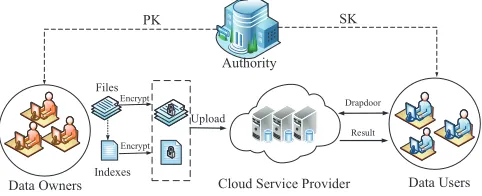
In Fig. 6, we present the system model of our scheme, which involves four entities: DO, DU, CSP and Authority.
The DO encrypts the data filesF as well as correspond-ing keyword index with an access policy before uploadcorrespond-ing them to the CSP. The CSP provides the storage services and executes keyword search operations on behalf of the DU. When a DU wants to make a search query over the encrypt-ed data, he will generate a trapdoor by his specifiencrypt-ed query keywords and submit it to the CSP. The CSP will retrieve the DO’s encrypted data according to the specified keywords by the corresponding trapdoor, if the user’s attributes satisfy the access policy and the trapdoor matches the keyword index. The role of Authority is to issue credentials (PK/SK) to data owners/users, and the credentials are sent over secure communication channel.
The threat model of our system is defined as follows. DO, Authority and the authorized DUs are fully trusted, but the CSP is trusted-but-curious entity which honestly executes the protocol but attempts to learn some sensitive information, e.g., the query keyword information.
4.2 The Construction of TPPE-ABMKS Scheme
In this section, we present the overview of our scheme which consists of eight algorithms.
• Setup(λ). The Setup algorithm takes as input the security parameterλ. It initializes the global system parameter, and outputs the master key M SK and the public keyP K.
Data Users
Cloud Service Provider Files
Indexes Encrypt
Encrypt
Upload
Drapdoor
Result
Data Owners Data Users
Authority
PK SK
Fig. 6: Basic Framework of Our Scheme
• KeyGen(P K, M SK, S). The KeyGen algorithm takes as input data user’s attribute setS, the authori-ty uses theM SKto generate the private keySKfor the data user.
• Encrypt(P K,T,ODT, F, W0). The Encrypt algo-rithm takes as input files set F and the keyword dictionary W. For each file f ∈ F, DO generates the permutation σ by using the keyword set W0
corresponding to the filef, then encrypts the filefby using the symmetric keyK to get the ciphertextC, encrypts theσandKby using ABE to get the cipher-textI1, generates the encrypted indexI2according to W0. At last sends the ciphertextCT ={C, I1, I2}to the CSP.
• GenTK(P K, SK). The GenTK algorithm takes as input public keyP Kand the private keySKfor us-er’s attribute setS, user generates the transformation keyT Kand the corresponding retrieving keyRK. • Transform(CT, T K). The Transform algorithm
takes as input the ciphertext CT and the transfor-mation key T K, it outputs a partially decrypted ciphertextCT0 ={CT0
1, CT20}.
• Decrypt(CT10, RK). The Decrypt algorithm takes as input the transformed ciphertext CT10 and the retrieving keyRK, it outputs the permutationσand the symmetric keyK.
• Trapdoor(P K, SK, RK, W∗,ODT, σ). The trap-door algorithm takes as input the public key P K, private keySKand corresponding keyRK, queried keyword set W∗, original dictionary tree ODT, the permutationσ, it outputs the trapdoorTW∗ accord-ing to the query keyword W∗ and the data user’s attribute setS.
• Retrieve(P K, CT0, TW∗). The Retrieve algorithm takes as input the ciphertextCT0 and the trapdoor
TW∗. CSP checks whetherTW∗ satisfies the cipher-textI1 and the encrypted indexI2. If it holds, then returns the correspondingCto user, otherwise, out-puts⊥.
4.3 Security Model
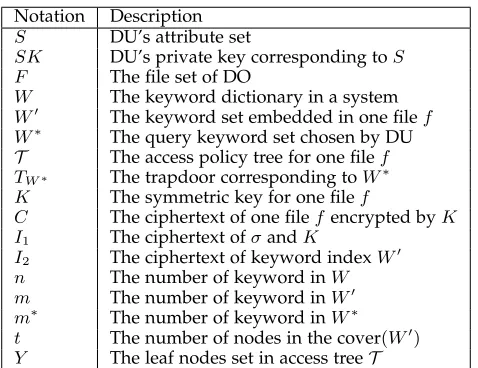
6 TABLE 1: Notation in TPPE-ABMKS
Notation Description
S DU’s attribute set
SK DU’s private key corresponding toS F The file set of DO
W The keyword dictionary in a system
W0 The keyword set embedded in one filef W∗ The query keyword set chosen by DU T The access policy tree for one filef TW∗ The trapdoor corresponding toW∗
K The symmetric key for one filef
C The ciphertext of one filefencrypted byK I1 The ciphertext ofσandK
I2 The ciphertext of keyword indexW0
n The number of keyword inW m The number of keyword inW0 m∗ The number of keyword inW∗ t The number of nodes in the cover(W0)
Y The leaf nodes set in access treeT
set plaintext of the keywords set ciphertext except for the search tokens and the result. We present the security model by utilizing the indistinguishability against chosen-keyword attack (CKA) game as follows.
Definition 1. IND-CKA Game:
• Setup: The challengerCruns the setup algorithm to gener-ate the public parametersP Kand the master keyM SK, and gives the public parametersP K to the adversaryA. Note that the master keyM SKis kept by the challenger C. The adversaryAchooses an access treeT, which is sent to the challenger.
• Phase 1:Acan adaptively query the following oracles for polynomial time, and the challengerCinitializes an empty keyword listLkw and an empty setD.
1) OKeyGen(S): On input a set of attributesS, the challenger C runs the KeyGen algorithm to get
SKS and sets D=D
S
S. It then returns it to adversaryA.
2) OGenT K(SK): On input a set of attributes S,
if S ∈ D, the challenger C runs the GenTK
algorithm to getT KS. Otherwise, the challenge runs the KeyGen algorithm to getSKS, and runs GenTK to getT KS. It then returns theT KS to adversaryA.
3) OT rapdoor(SK, W∗): On input a set of keyword W∗and theSK, the challengerCruns the Trap-door algorithm to getTW∗and setsLkw=LkwS
W∗, if the attributes setSsatisfies the policy tree T . It then returns it to adversaryA.
• Challenge:Arandomly chooses two keyword setW1∗and
W∗
2, where W1∗, W2∗ ∈/ Lkw, it means that W1∗, W2∗
cannot be queried in OT rapdoor. Then, the challenge T picks a randomb∈ {0,1}and encrypts Wb∗asCT∗by using Encrypt algorithm. Finally,C returnsCT∗ to the adversaryA.
• Phase 2:Acontinues to query the oracles as in Phase 1, but the restriction is that(S, W1∗)and(S, W2∗)cannot be the input toOT rapdoor if the attribute setSsatisfies the access policyT.
• Guess:Aoutputs a guess bitb0, and wins the IND-CKA
game ifb0=b; otherwise, it fails.
Let|Pr[b0 =b]−1
2|be the advantage ofAwinning the above
IND-CKA game.
Definition 2. Our scheme is IND-CKA secure if the advantage of any PPTAwinning the IND-CKA game is negligible.
Besides, our scheme is selectively IND-CKA secure if an Int stage is added before the Setup algorithm where the adversary Aclaims the two keyword setsW1∗,W2∗ which to be attacked.
5
O
URD
ESIGNWe present some notations used in our construction in the TABLE 1 and our design below.
• Setup(λ)→(P K, M SK): This algorithm is execut-ed by authority, given a security parameter λ, the authority first chooses a bilinear groupG of prime order pwith generator g. It then chooses two ran-dom numbersα1,α2 ∈ Z∗
p and two hash functions H1:{0,1}∗→G,H2:{0,1}∗→Z∗p. Finally, it generates
the public keyP Kand master keyM SKas follows:
P K ={G, g, h=gα2, e(g, g)α1}
M SK={α2, gα1}
• KeyGen(P K, S, M SK)→SK: This algorithm is ex-ecuted by authority, given a DU’s attribute setS, the authority first chooses a random numberr∈Z∗p, and
randomly choosesri ∈ Z∗p for each attributei ∈S.
Finally, it outputs DU’s private keySKas follows:
SK={D=g(α1+r)/α2,
∀i∈S:Di =grH1(i)ri, D0i=gri}
• Encrypt(P K,T,ODT, F, W)→CT: This algorithm is executed by DO. LetF={f1, ..., fN}be the file set
to be shared, in order to easy understand, we encrypt one filef ∈ F to explain the Encrypt algorithm, let
theW = [w1, ..., wn]be the keyword dictionary, and
theW0= [w01, ..., w0m]be the keyword set forf.
DO will encrypt thef under the corresponding symmetric keyKto generate the ciphertextC (e.g., Using AES to encrypt thef, this is out of the scope of our discusses).
After that, DO will generate theσand cover(W0) for filef as follows.
1) As in Section 3.4, DO will randomly generate a permutationσby usingW0.
2) As in Section 3.4, DO will generate the CDT by usingσand ODT.
CDT←−σ ODT
3) As in Section 3.5, DO will get the cover(W0) corresponding toW0.
cover(W0)=[Ω1, ...,Ωt]
As shown in the Theorem 3, we state that t ≤
7 [1,6,5][2,4][3,7,8], then the cover(W0) = [10,14].
Then, DO computes the ciphertext I1 andI2 for the filef as follows:
1) For each node v in the in the access policy tree T, choose a polynomial qv in a
top-down manner, the degreedv ofqv iskv−1,
where kv is the threshold value of the
n-ode v. For the root nodeR ofT, randomly choose s ∈ Z∗
p and set qR(0) = s, then
randomly choosedRother points to build the
polynomial qR. For the non-root nodev, set qv(0) = qparent(v)(index(v)) and randomly
choosedvother points to build the
polynomi-alqv.
LetY be the set of leaf nodes in the access tree
T and computeI1={Iσ||K,{θ, θy, θy0}}
Iσ||K= (σ||K)·e(g, g)α1s.
θ=hs, θy=gqy(0), θ 0
y=H1(att(y))qy(0),∀y∈Y.
2) Compute I2 = {cover(W0),{IΩi}i=t i=1} with
the permutation σ and the cover(W0) = [Ω1, ...,Ωt]
IΩi =e(g, g)α1sH2(Ωi||σ||K), i∈[1, t].
Note that in order to encrypt the σ||K, the item
σ||K will be encoded into the forma of the element in groupGT, it is out of the scope of our discusses.
Finally, outputsCT ={C, I1, I2}for the filef.
• GenTK(P K, SK)→T K: This algorithm is execut-ed by DU, it takes into the public keyP K and the user’s private key SK = {D = g(α1+r)/α2, D
i =
grH1(i)ri, D0
i = gri} for a set of attributes S. It
chooses a random valueu∈Z∗
p, and computes
trans-formation keyT Kand the corresponding retrieving keyRK:
T K={S, D∗=Du, Di∗=Dui, D0i∗=Di0u}
RK=u
• Transform(T K, CT)→(CT0&⊥): This algorithm is executed by cloud service provider (CSP), after get-ting user’s attributes setSfromT K, then CSP checks whether the S can meet T. If S can not meet T, it outputs ⊥; otherwise, it runs the algorithm as follows:
1) If the nodexis a leaf node in theT, we let
i=att(x) and define as follows: if i∈S, then computeθxas follows;
θx=
e(D∗i, θx)
e(D0∗
i , θx0) = e(g
ru·H1(i)riu, gqx(0))
e(griu, H1(i)qx(0))
=e(g, g)ru·qx(0)
(1)
2) If the nodexis a no-leaf node in theT, we get the θx by computing θx0 in a recursive manner, wherex0 is the children nodes ofx.
TheSxis an arbitrarykxset of children nodes x, if there exists no such a set, set θx0=⊥; otherwise, computeθx0 as
θx=
Y
x0∈S
x
θ∆i,S0x(0)
x0
= Y
x0∈Sx
(e(g, g)ru·qx0(0))∆i,S0
x(0)
= Y
x0∈S
x
(e(g, g)ru·qparent(z)(index(z)))∆i,S0x(0)
= Y
x0∈S
x
(e(g, g)ru·qx(i))∆i,S0
x(0)
=e(g, g)ru·qx(0)
(2) wherei=index(x0),Sx0={index(x0) :x0 ∈Sx}
If the tree is satisfied byS, we can get that
A=θroot=e(g, g)ru·qR(0)=e(g, g)rus, and
com-pute the partially-decrypted ciphertextpdcas
pdc=e(θ, D∗)/A
=e(hs, g(α1+r)·u/α2)/e(g, g)rsu
=e(g, g)α1su
(3)
Then outputCT0 ={CT10, CT20}, and returnCT10
to DU.
CT10 ={Iσ||K, pdc}
CT0
2={C, I2}
• Decrypt(RK, CT10)→(σ||K): This algorithm is
executed by DU, on receiving the CW0 from CSP, then obtain theσandK by using retrieve key RK
as
Iσ||K/pdc
1
RK = (σ||K)·e(g, g)α1s/(e(g, g)α1su)1u
=σ||K
Thus, the DU gets the permutation σ and the symmetric keyKcorresponding to the fileF.
• Trapdoor(P K, SK, RK, W∗,ODT, σ)→TW∗: When a user wants to issue a search query according to keyword set W∗=[w∗1, ..., wm∗∗], where m is the number of the keywords included inW∗.
After getting the permutationσandK, DU will generate the CDT and {path(w∗i)}i=m∗
i=1 with ODT
andσas follows.
1) CDT←−σ ODT as in Section 3.4.
2) For each w∗i ∈ W∗, obtain the path nodes path(w∗i)as in Section 3.4.
path(w∗i)=[Ωw∗
i,1, ...,Ωw∗i,l],l=1+logn.
Then, computeT1andT2as follows:
T1={S, D∗=DRK, Di∗=DRKi , D0i∗=Di0RK}
={S, D∗=Du, D∗i =Diu, D0i
∗ =D0i
u
}
T2={path(w∗i),TbΩ
w∗i,j =
H2(Ωw∗
i,j||σ||K)
RK }
={path(w∗i),TbΩ
w∗i,j =
H2(Ωw∗
i,j||σ||K)
u }
8 Note thatT1 =T Kis computed by DU as in the
GenTK phase.
Finally, returnTW∗={T1, T2}.
• Retrieve(P K, CT0, TW∗)→(C&⊥): This algorithm is executed by CSP, and it works as follow. IfS does satisfyT, the CSP will terminate the search process; otherwise, the CSP works as follows.
For each path(w∗
i)for the keyword w∗i ∈W∗, if
there exists one case that cover(W0)T
path(w∗i) =∅, CSP breaks the retrieve and outputs⊥. It is because that W∗ ⊆ W0 ⇐⇒ path(w∗i)T
cover(W0) 6= ∅,
∀wi∈W∗as described in Section 3.6.
Otherwise, we letΩi=cover(W0)Tpath(wi∗),i∈
[1, m∗]. Check
i=m∗
Y
i=1
IΩi
?
=
i=m∗
Y
i=1
pdcTbΩ
i (4)
If it does not hold, return⊥; otherwise, it means that TrapdoorTW∗matches the keyword index ciphertext
I, then send the correspondingC to the user. Once gaining all the search results from CSP, the user can decrypt them by using the corresponding symmetric keyK.
Correctness analysis. If the user’s attribute setS satis-fies the access policy tree T and the queried keyword set satisfiesW∗⊆W, we have that
i=m∗ Y
i=1
IΩi =
i=m∗ Y
i=1
e(g, g)α1sH2(Ωi||σ||K) (5)
i=m∗
Y
i=1
pdcTbΩ
i =
i=m∗
Y
i=1
(e(g, g)α1su)TbΩ i
=
i=m∗
Y
i=1
(e(g, g)α1su)
H2 (Ωi||σ||K) u
=
i=m∗ Y
i=1
(e(g, g)α1sH2(Ωi||σ||K)
(6)
Therefore, we can state that the Eq. (4) holds ifW∗⊆W.
6
S
ECURITYA
NALYSISIn this section, we present the security analysis of our scheme proposed in Section 5. Our scheme is secure based on the following theorems.
Theorem 4. Given the random oracleH1and the one-way hash
functionH2, the TPPE-ABMKS scheme is secure against
IND-CKA in the generic bilinear group model.
Proof. In the IND-CKA game, A wants to distinguish
e(g, g)α1sH2(Ωi||σ0) from e(g, g)α1sH2(Ωi||σ1). Given η∈
Z∗p,
the advantage of distinguishing e(g, g)α1sH2(Ωi||σ0) from
e(g, g)ηis same as the advantage of distinguishinge(g, g)η from e(g, g)α1sH2(Ωi||σ1). Then, if A has a advantage to
break the IND-CKA game, then it has the advantage/2in distinguishinge(g, g)α1sH2(Ωi||σ0)frome(g, g)η. We present
the following IND-CKA game as follows.
Setup:The challenger C randomly choosesα1,α2 ←
Z∗pand outputs public key(e, g, H1, H2, h=gα2, e(g, g)α1).
Achooses an access policy treeT∗and sends it toC.
H1(attj) is simulated as follows: If attj has not been
queried before, the challengerC choosesr∗j from Zp, adds
(attj, rj∗)toOH1 and outputsg
rj∗
; otherwise the challenger
Creturnsgrj∗by only retrievingr∗
j fromOH1.
Phase1:Acan query the following oracles:
1) OKeyGen(S): The challengerCrandomly choosesr∗
from Z∗p and computesD = g(α1+r
∗)/α
2. For each
attributeattj ∈S, the challengerCrandomly
choos-es r∗j ∈ Zp, then computesDj = gr
∗
·H1(attj)r
∗
j
and Dj0 = grj∗. Finally, it returns the secret key
SKS = (D,{Dj, D0j})to the adversaryA.
2) OGenT K(SK): The challenger C searches the S in
the set D. If there exists the tuple, it randomly choosesu∈Zpand generates theT KS andRK,
T KS =SKSu
RK =u
otherwise, the challenger C runs the KeyGen algo-rithm to getSKS, and runs GenTK to getT KS.
3) OT rapdoor(SK, W∗) : The challenger C generates
the TrapdoorTW∗ = (T1, T2), whereT1 =T KS =
SKRK
S ,RK =u.
The T2 is generated as follows: The challenger
chooses a permutationσand generates the CDT by
σ as in Section 3.4, for each keyword wi ∈ W∗,
generates the path(w∗i) = [Ωw∗
i,1, ...,Ωw∗i,l], where
path(wi∗)represents the path nodes set, which con-sists of the nodes originate from the leaf node associated with the keyword wi∗ up to the root node of the tree CDT, then computes TbW
Ωw∗
i,j
=
H2(Ωwi∗,j||σ)
u , i ∈ [1, m], j ∈ [1,log n], and sets
T2={Ωw∗
i,TbWΩw∗
i,j
}. If the attributes setSsatisfies the policy treeT∗, the challenger adds the keyword setW∗to the keyword listLkw.
Challenge phase:TheAgive two keyword setsW0∗,W1∗
to be challenged on, whereW0∗,W1∗ ∈/ Lkw and the length
ofW0∗is equal toW1∗, the challenger randomly choosess∈
Zp, a symmetric keyKand computes secret shares ofsfor
each leaves inT∗. The challenger chooses λ← {0,1} and generates a permutation σλ corresponding to Wλ∗. If λ =
0, it runs the Encrypt algorithm to generate the ciphertext corresponding to keyword setW∗
λ and outputs
Iσλ = (σλ||K)e(g, g)
α1η,θ=hη, {Ii =e(g, g)α1ηH2(Ωi||σλ||K)}i∈[1,t],
{θy =gqy(0), θ0y =H1(att(y))qy(0)}∀y∈Y by selecting
η∈Z∗
p;
otherwise, it outputs
Iσλ = (σ λ||K)e(g, g)
α1s,θ=hs, {Ii =e(g, g)α1sH2(Ωi||σλ||K)}i∈[1,t],
{θy=gqy(0), θy0 =H1(att(y))qy(0)}∀y∈Y
Phase2 :This phase is like Phase 1, but the restriction is thatW0∗,W1∗have not been issued in Phase 1.
Guess: The adversaryAoutputs a guess forλ0∈{0,1}. Ifλ0 =λ,Awins the IND-CKA game; otherwise, it fails. We can note that ifAcan constructe(g, g)χα1sH2(Ωi||σλ||Ki)
9 TABLE 3: Computational Cost Comparison
Scheme PAB-MKS Ours
KeyGen (2s+2)·EG+s·H1 (2s+2)·EG+sH1
Encrypt (m+2|Y|+3)·EG+|Y|·H1+m·H2 (t+1)·EGT+(2|Y|+1)·EG+|Y|·H1+t·H2
Trapdoor (2s+3)·EG+m∗·H2 (2s+1)·EG+(m∗·logn)·H2
Retrieve (2s+4)·P+s·EGT (2s+1)·P+(s+2m∗-1)·EGT
TABLE 2: Notation used in performance evaluation
Notation Description
P The bilinear pairing operation
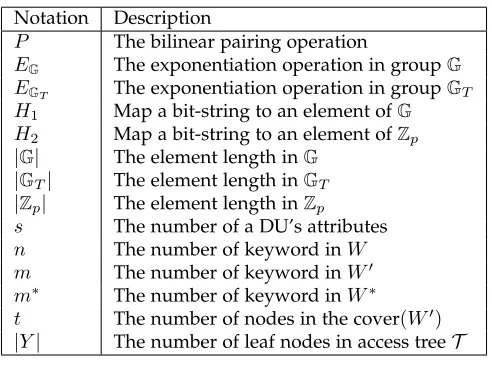
EG The exponentiation operation in groupG EGT The exponentiation operation in groupGT H1 Map a bit-string to an element ofG H2 Map a bit-string to an element ofZp
|G| The element length inG
|GT| The element length inGT
|Zp| The element length inZp s The number of a DU’s attributes
n The number of keyword inW m The number of keyword inW0
m∗ The number of keyword inW∗ t The number of nodes in the cover(W0)
|Y| The number of leaf nodes in access treeT
TABLE 4: Storage Cost Comparison
Scheme PAB-MKS Ours KeyGen (2s+1)·|G| (2s+1)·|G|
Encrypt (m+2|Y|+3)·|G| (t+1)·|GT|+(2|Y|+1)·|G| Trapdoor(2s+3)·|G| (2s+1)·|G|+(m∗·logn)·|Zp|
e(g, g)α1sH2(Ωi||σ0). Therefore, we need to prove that the
adversary A can rebuilt e(g, g)δα1sH2(Ωi||σλ) by using the
term e(g, g)δ
with a negligible probability. It means that
A cannot gain non-negligible advantage in the IND-CKA game. Asα1scan be rebuilt by using(α1+r∗)/α2,qy(0), α2s due to((α1+r∗)/α2)(α2s) = α1s+r∗s,Aneeds to
cancelr∗s, which needs to use the termsrj∗,r∗+rj∗,qy(0), r∗jqy(0). Because ofqy(0) is the secret share ofsaccording
to the access treeT∗. But the adversaryAcannot rebuiltr∗s for that the terms outlined above can only be rebuilt only if the attribute setScan meetT∗.
Therefore, we prove thatAgains a negligible advantage in the IND-CKA game. It is to say that our scheme is secure against IND-CKA. This completes the proof.
7
P
ERFORMANCEE
VALUATIONIn this section, we present the efficiency analysis for our scheme in terms of both complexity and actual execution time, and further compare our scheme with the state-of-the-art PAB-MKS [27]. TABLE 2 defines the notation used in comparison.
In the theoretical analysis, we mainly show the computa-tional and storage cost complexity in TABLE 3 and TABLE 4, respectively. We mainly consider the time-consuming oper-ations, namely, bilinear pairing operationP, exponentiation operationEGin groupG, exponentiation operationEGT in
groupGT, hash operationH1andH2. We do not consider
the multiplication operations because they are much more lightweight than the above operations.
7.1 Theoretical Comparison
In TABLE 3, we present the comparison of computation cost under the same access control policy treeT. We observe that the complexity of KeyGen in our scheme is the same as that of the PAB-MKS [27].
In the PAB-MKS scheme, the encryption cost is more expensive than that of our scheme. Specifically, the former scheme computation cost is (m + 2|Y|+ 3)·EG +|Y| · H1 +m·H2, while in our scheme the computation cost is(t+ 1)·EGT+ (2|Y|+ 1)·EG+|Y| ·H1+t·H2. We note
thatt≤2·log(n/2), wherenis the number of keyword in the keyword dictionaryW,mis the number of keyword in
W0embedded in one file, thentm, e.g., whenn= 1000,
t≤2·log1000/2≤18, and the minimum keyword number in a file is aboutm= 100.
We state that the computation cost of Trapdoor and Retrieve in our scheme is also less than that of PAB-MKS.
The computation cost of Trapdoor generation in PAB-MKS and our scheme are(2s+ 3)·EG+m∗·H2and(2s+
1)·EG+ (m∗·logn)·H2, respectively.
The computation cost of retrieve in PAB-MKS and our scheme are(2s+ 4)·P +s·EGT and(2s+ 1)·P + (s+ 2m∗−1)·EGT, respectively.
In TABLE 4, we present the comparison of storage cost. With the same reason shown as in TABLE 3, the storage cost of keyword index ciphertext (the output of Encrypt algorithm) in our scheme is less than that in PAB-MKS scheme, while the storage cost of KeyGen in our scheme is same as that of PAB-MKS. Our scheme has higher storage in Trapdoor, but it is acceptable and it is only one-time operation.
7.2 Experimental Performance
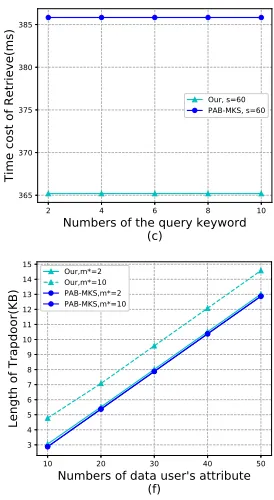
To present the practicability of our scheme in practice, we implement the scheme and PAB-MKS [27] with real-world dataset using Python language, and further run the experi-ment tests for 100 times, in which the dataset includes 1000 distinct keywords extracted from 500 PDF files (academic papers) provided by the Google Scholar. The maximum number of the keywords in a file is 200 while the minimum is 100. Our experimental platform is on Ubuntu 16.04 LTS with Intel Core i3 Processor 4170 CPU @3.70GHZ with 10.0 GB of RAM. Since these two schemes are highly depen-dent on the basic cryptographic operations in the pairing computation, we implement PBA-MKS and our scheme in software based on the libfenc library [33], using a 224-bit (|G|=|GT|=224 bits, Zp=224 bits) MNT elliptic curve from
10
20 30 40 50 60 70 80 90 100 Number of leaf nodes in the policy tree(a) 32 64 128 256 512 1024 Tim e c ost of Ci ph ert ex t g en era tio n(m s) Our,m=100 PAB-MKS,m=100
10 20 30 40 50
Numbers of data user's attribute (b) 200 300 400 500 600 700 800 900 1000 1100 1200 Tim e c ost of Tr ap do or ge ne rat ion (m s) Our,m*=2 Our,m*=10 PAB-MKS,m*=2 PAB-MKS,m*=10
2 4 6 8 10
Numbers of the query keyword(c) 365 370 375 380 385 Tim e c ost of Re tri ev e(m s) Our, s=60 PAB-MKS, s=60
10 15 20 25 30 35 40 45 50 Numbers of User's Attributes(d) 1 2 3 4 5 Le ng th of Ke y(K B) Our PAB-MKS
20 40 60 80 100
Number of leaf nodes in the policy tree(e) 6 8 10 12 14 16 Le ng th of Cip he rte xt( KB
) PAB-MKS, m=100Our, m=100
10 20 30 40 50
Numbers of data user's attribute(f) 3 4 5 6 7 8 9 10 11 12 13 14 15 Le ng th of Tra pd oo r(K B) Our,m*=2 Our,m*=10 PAB-MKS,m*=2 PAB-MKS,m*=10
100 120 140 160 180 200 Number of keyword in a file(g) 8 10 12 Le ng th of Cip he rte xt( KB
) PAB-MKS,|Y|=20Our, |Y|=20
Fig. 7: The performance of the PABE-MKS and our scheme
To bring convenience in comparison, in PAB-MKS and our scheme, we encrypt the keyword sets of each file by us-ing the same access control policyT. For example, the policy tree T is “AND” access tree: (A1 AND A2 AND,...,AND
A|Y|), whereAiis an attribute. We set the number of DU’s
attribute s∈[10,20,30,40,50], the number of leaf node in the access policy tree|Y|∈[20,40,60,80,100], the number of keyword in each filesm=100, and the number of keyword in the querym∗∈[2,4,6,8,10].
Fig. 7a presents the computation time cost of ciphertext generation which is executed by DO. As described in TABLE 3, the ciphertext generation time cost of the scheme PAB-MKS is affected by two factors, the number of keyword embedded in a file (m) and the number of leaf nodes (|Y|) in policy tree T, while the ciphertext generation time is affected bytand|Y|in our scheme. We further setm= 100 and n = 1000 in the Encrypt phase. Because t ≤ 2·log (n/2) ≤ 18, and thent m, thus, we have that the cost time of ciphertext generation in our scheme is efficient than PAB-MKS. When |Y| = 60, the computation cost time is 131ms for us, while the PAB-MKS scheme needs946ms to generate a ciphertext.
Fig. 7b presents the computation time cost of gener-ating a trapdoor which is executed by DU. As described in TABLE 3, the trapdoor generation time cost of the scheme PAB-MKS and our scheme is affected by two factors:
m∗ and s. The PAB-MKS scheme and our scheme need (2s+3)·EG+m∗·H2,(2s+1)·EG+(m∗·logn)·H2in trapdoor generation phase, respectively. Because the hash operation
H1 is much more efficient than the exponentiation opera-tions [19], then the hash operation almost can be ignored. Thus, the trapdoor generation cost in our scheme is efficient than that of PAB-MKS. As Fig. 7(b), we can see that when
m∗ = 2andm∗ = 10, the our cost of generating trapdoor is efficient than that in PAB-MKS scheme, respectively. For example, whens= 50,m∗= 10, our scheme (requiring809 ms) outperforms the PAB-MKS scheme (1186ms) by around 300ms.
11 we can state that our scheme is efficient than PAB-MKS in
retrieving process. For example, whens= 50,m∗ = 6, our scheme only takes74.636748ms.
As described in TABLE 4, the storage cost of KeyGen algorithm in PAB-MKS and our scheme are (2s+ 1)· |G|, (2s+ 1)· |G|, respectively. As shown in Fig. 7d, the storage cost of KeyGen algorithm in our scheme is the same as that in PAB-MKS.
Fig. 7e and Fig. 7g present the ciphertext size of PAB-MKS and our scheme. As the analysis in TABLE 4, the number of keyword index ciphertext of PAB-MKS is affected bym and|Y|, while ours is affected by t and |Y|. Due to
t≤2·log(n/2), as shown in Fig. 7e, when settingm= 100, as the number|Y| decreases, our scheme outperforms the PAB-MKS in terms of storage cost in Encrypt algorithm. For instance, when settingn = 1000,m = 100,|Y| = 60, the ciphertext length of PAB-MKS is 12.19 KB, while ours is 8.42KB. As shown in Fig. 7g, when setting|Y|= 20, with the increase of keyword numberm, the number of keyword index ciphertext in our scheme is constant, while that of PAB-MKS is linearly growing withm.
Fig. 7f presents the trapdoor size of the two schemes. As the analysis in TABLE 4, compared with PAB-MKS, the trapdoor size in our scheme is slightly more than PAB-MKS due to the extra item (m∗·log n)|Zp|. For example, when
setting s = 50, m∗ = 10, the trapdoor size of PAB-MKS and ours are12.875KB and 14.578 KB, respectively. Then our scheme is still acceptable in practice since the Trapdoor algorithm is a one-time cost.
8
C
ONCLUSIONIn this paper, we’ve proposed an efficient ABMKS with short-size ciphertext of keyword index which provides se-cure multi-keyword search service with fine-grained access control. Its number of search index is very small, being independent on the number of underlying keyword in a file. The formal security analysis shows that our scheme is secure. Moreover, the performance evaluation demonstrates that the scheme is efficient in terms of both the computation and communication overhead in practice.
A
CKNOWLEDGMENTSThis work is supported by NSFC (Grant Nos. 61672110, 61671082, 61976024, 61972048)
R
EFERENCES[1] Kamara, S., & Lauter, K. (2010, January). Cryptographic cloud storage. In International Conference on Financial Cryptography and Data Security (pp. 136-149). Springer, Berlin, Heidelberg. [2] Yu, Y., Li, Y., Au, M. H., Susilo, W., Choo, K. K. R.,&Zhang, X.
(2016, July). Public cloud data auditing with practical key update and zero knowledge privacy. In Australasian Conference on Infor-mation Security and Privacy (pp. 389-405). Springer, Cham. [3] JoSEP, A. D., KAtz, R., KonWinSKi, A., Gunho, L. E. E., PAttERSon,
D.,&RABKin, A. (2010). A view of cloud computing. Communica-tions of the ACM, 53(4).
[4] Quick, D.,&Choo, K. K. R. (2013). Dropbox analysis: Data rem-nants on user machines. Digital Investigation, 10(1), 3-18.
[5] Quick, D.,& Choo, K. K. R. (2016). Big forensic data reduction: digital forensic images and electronic evidence. Cluster Computing, 19(2), 723-740.
[6] Liu, Z., Li, T., Li, P., Jia, C.,&Li, J. (2018). Verifiable searchable encryption with aggregate keys for data sharing system. Future Generation Computer Systems, 78, 778-788.
[7] Song, D. X., Wagner, D.,&Perrig, A. (2000, May). Practical tech-niques for searches on encrypted data. In Proceeding 2000 IEEE Symposium on Security and Privacy. S&P 2000 (pp. 44-55). IEEE. [8] Bellare, M., Boldyreva, A.,&O’Neill, A. (2007, August).
Determin-istic and efficiently searchable encryption. In Annual International Cryptology Conference (pp. 535-552). Springer, Berlin, Heidelberg [9] Bao, F., Deng, R. H., Ding, X., &Yang, Y. (2008, April). Private
query on encrypted data in multi-user settings. In International Conference on Information Security Practice and Experience (pp. 71-85). Springer, Berlin, Heidelberg.
[10] Chai, Q.,&Gong, G. (2012, June). Verifiable symmetric searchable encryption for semi-honest-but-curious cloud servers. In 2012 IEEE International Conference on Communications (ICC) (pp. 917-922). IEEE.
[11] Curtmola, R., Garay, J., Kamara, S.,&Ostrovsky, R. (2011). Search-able symmetric encryption: improved definitions and efficient con-structions. Journal of Computer Security, 19(5), 895-934.
[12] Kamara, S., Papamanthou, C.,&Roeder, T. (2012, October). Dy-namic searchable symmetric encryption. In Proceedings of the 2012 ACM conference on Computer and communications security (pp. 965-976). ACM.
[13] Boneh, D., Di Crescenzo, G., Ostrovsky, R.,&Persiano, G. (2004, May). Public key encryption with keyword search. In International conference on the theory and applications of cryptographic tech-niques (pp. 506-522). Springer, Berlin, Heidelberg.
[14] Hwang, Y. H., & Lee, P. J. (2007, July). Public key encryption with conjunctive keyword search and its extension to a multi-user system. In International conference on pairing-based cryptography (pp. 2-22). Springer, Berlin, Heidelberg.
[15] Li, J., Wang, Q., Wang, C., Cao, N., Ren, K.,& Lou, W. (2010, March). Fuzzy keyword search over encrypted data in cloud com-puting. In 2010 Proceedings IEEE INFOCOM (pp. 1-5). IEEE. [16] Bellare, M., Boldyreva, A.,&O’Neill, A. (2007, August).
Determin-istic and efficiently searchable encryption. In Annual International Cryptology Conference (pp. 535-552). Springer, Berlin, Heidelberg. [17] Baek, J., Safavi-Naini, R.,&Susilo, W. (2008, June). Public key en-cryption with keyword search revisited. In International conference on Computational Science and Its Applications (pp. 1249-1259). Springer, Berlin, Heidelberg.
[18] Cui, B., Liu, Z., & Wang, L. (2015). Key-aggregate searchable encryption (KASE) for group data sharing via cloud storage. IEEE Transactions on computers, 65(8), 2374-2385.
[19] Zheng, Q., Xu, S.,&Ateniese, G. (2014, April). VABKS: verifiable attribute-based keyword search over outsourced encrypted data. In IEEE INFOCOM 2014-IEEE Conference on Computer Communica-tions (pp. 522-530). IEEE.
[20] Zhang, R., Xue, R., Yu, T.,&Liu, L. (2016, June). PVSAE: A public verifiable searchable encryption service framework for outsourced encrypted data. In 2016 IEEE International Conference on Web Services (ICWS) (pp. 428-435). IEEE.
[21] Sun, W., Yu, S., Lou, W., Hou, Y. T.,&Li, H. (2014). Protecting your right: Verifiable attribute-based keyword search with fine-grained owner-enforced search authorization in the cloud. IEEE Transactions on Parallel and Distributed Systems, 27(4), 1187-1198. [22] Huang, Q., & Li, H. (2017). An efficient public-key searchable encryption scheme secure against inside keyword guessing attacks. Information Sciences, 403, 1-14.
[23] Chen, R., Mu, Y., Yang, G., Guo, F.,& Wang, X. (2015). Dual-server public-key encryption with keyword search for secure cloud storage. IEEE transactions on information forensics and security, 11(4), 789-798.
[24] Miao, Y., Ma, J., & Liu, Z. (2016). Revocable and anonymous searchable encryption in multi-user setting. Concurrency and Com-putation: Practice and Experience, 28(4), 1204-1218.
[25] Miao, Y., Ma, J., Liu, X., Jiang, Q., Zhang, J., Shen, L., & Liu, Z. (2017). VCKSM: Verifiable conjunctive keyword search over mobile e-health cloud in shared multi-owner settings. Pervasive and Mobile Computing, 40, 205-219.
[26] Miao, Y., Ma, J., Liu, X., Li, X., Jiang, Q., & Zhang, J. (2017). Attribute-based keyword search over hierarchical data in cloud computing. IEEE Transactions on Services Computing.
12 [28] Golle, P., Staddon, J.,&Waters, B. (2004, June). Secure
conjunc-tive keyword search over encrypted data. In International Confer-ence on Applied Cryptography and Network Security (pp. 31-45). Springer, Berlin, Heidelberg.
[29] Park, D. J., Kim, K.,&Lee, P. J. (2004, August). Public key encryp-tion with conjunctive field keyword search. In Internaencryp-tional Work-shop on Information Security Applications (pp. 73-86). Springer, Berlin, Heidelberg.
[30] Goyal, V., Pandey, O., Sahai, A., &Waters, B. (2006, October). Attribute-based encryption for fine-grained access control of en-crypted data. In Proceedings of the 13th ACM conference on Computer and communications security (pp. 89-98). Acm. [31] Bethencourt, J., Sahai, A.,&Waters, B. (2007, May).
Ciphertext-policy attribute-based encryption. In 2007 IEEE symposium on security and privacy (SP’07) (pp. 321-334). IEEE.
[32] Naor, D., Naor, M.,& Lotspiech, J. (2001, August). Revocation and tracing schemes for stateless receivers. In Annual International Cryptology Conference (pp. 41-62). Springer, Berlin, Heidelberg. [33] Green, M., Akinyele, A., & Rushanan, M. (2004). libfenc: The
functional encryption library. Avaiable from http://code. google. com/p/libfenc. Baodong Qin received the B. Sc. degree.
Zhidan Li received his bachelor’s degree at ZhengZhou university in 2013. Now he is doing research in the Institute of Network and Tech-nology at BUPT and his interests are focused on the network security and cryptography protocols. E-mail: [email protected]
Wenmin Lireceived the B.S. and M.S. degrees in Mathematics and Applied Mathematics from Shaanxi Normal University, Xi’an, Shaanxi, Chi-na, in 2004 and 2007, respectively, and the Ph.D. degree in Cryptology from Beijing University of Posts and Telecommunications, Beijing, China, in 2012. Her research interests include cryp-tography and information security. E-mail: [email protected]
Fei Gaoreceived the B.S. degrees and the Ph.D. degree in Cryptology from Beijing University of Posts and Telecommunications, Beijing, China, in 2002 and in 2007, respectively. Now he is a Professor, doctoral supervisor of Beijing Uni-versity of Posts and Telecommunications. Her research interests include Quantum cryptogra-phy protocol and its security analysis, Quantum Private Query, Quantum key distribution. E-mail: [email protected]
Wei Yin Wei Yin, received the B.S. degree in Mathematics and Applied Mathematics from Huaibei Normal University, Huaibei, Anhui, Chi-na, in 2012, and the Ph.D degree in cryptog-raphy from Beijing University of Posts and T-elecommunications, Beijing, China, in 2019. His research interests include public key cryptogra-phy, lattice cryptogracryptogra-phy, and provable security.
Hua Zhangreceived the BS degree in telecom-munications engineering from the Xidian Univer-sity in 1998, the MS degree in cryptology from X-idian University in 2005, and the Ph.D degree in cryptology from Beijing University of Posts and T-elecommunications in 2008. Now she is a lectur-er of Beijing Univlectur-ersity of Posts and Telecommu-nications. Her research interests include cryp-tography, information security and network secu-rity. E-mail: zhanghua [email protected]
Qiaoyan Wenreceived the B.S. and M.S. de-grees in Mathematics from Shaanxi normal U-niversity, Xi’an, China, in 1981 and 1984, re-spectively, and the Ph.D degree in cryptography from Xidian University, Xi’an, China, in 1997. She is a professor of Beijing University of Posts and Telecommunications. Her present research interests include coding theory, cryptography, in-formation security, internet security and applied mathematics. E-mail: [email protected]