A BOUNDED RATIONALITY MODEL
by
PRUDENCIANO ULJER GORDONCELLO
Thesis Submitted for the Degree Doctor of Philosophy to the Department of Applied Economics, Faculty of
Business, Victoria University of Technology P.O. Box 14428 MMC Melbourne
Victoria 3000, Australia
STA THESIS
331.76309599 GOR 30001004896280
Gordoncillo, Prudenciano Uljer
N
M E M O R Y
O F
L U Z V I M I N D A
C O R N I S T A
I l l
TABLE OF CONTENTS
Sections PAGE
Contents iv List of Tables viii List of Figures xi
Abstract xii Declaration of Originality xiv
Acknowledgment xv Chapter 1. Introduction
1.1. Significance of the Study 1 1.2. Objectives of the Research 6 1.3. Analytical Framework 8 1.4. Structure of the Dissertation 9
Chapter 2. Labour Supply Analysis: A Historical Perspective
2.1. Introduction 10 2.2. The Neoclassical Approach to Labour Analysis 11
2.3. Modifications on the Neoclassical Model 15 2.4. Critical Views on the Neoclassical Models 20 2.5. Alternative Theoretical Framework for Labour
Supply Analysis 28 2.6. Empirical Examples of Labour Supply Analysis 33
Chapter 3. Conceptual Framework
3.1. Introduction 37 3.2. TheTheory of Bounded Rationality 37
3.3. Labour Supply in a Bounded Rationality Model
3.3.1. Bounded Rationality 43 3.3.2. Absolute Poverty Threshold 47 3.3.3. Relative Poverty Threshold 48
3.3.4. Aversion to Work 49 3.3.5. Utility Function 49 3.4. Chapter Summary 70
Chapter 4. Analytical Methods
4.1. Introduction 72 4.2. The Variables 72 4.3. Hypotheses 74 4.4. Analytical Tools 78 4.5. The Models
4.5.1. The Labour Supply Function 79
4.5.2. The2SLS 80 4.5.3. The3SLS 81 4.5.4. Test for Structural Changes 82
4.5.5. The Logit Model 83
4.7. The Socio Economic Profile
4.7.1. Demography 89 4.7.2. Employment and Income 97
4.7.3. Farming Profile 102 4.7.4. Household Amenities 112
4.8. Chapter Summary 116 Chapter 5. Results and Discussions
5.1. Introduction
5.2. The Labour Supply Model
5.2.1. The Neoclassical Model 117 5.2.2. Labour Supply in a Bounded Rationality
Model 127 5.2.2.1. Work Aversion 131
5.2.2.2. R3 Function 146 5.2.2.3. Work Supply Function 148
5.2.2.4. Wage Rate Function 151 5.2.3. Test for Structural Changes
5.4.3.1. The Tenurial Structure 155 5.4.3.2. The Ecological Zone 156 5.4.3.3. The Croppmg Pattern 159
Chapter 6. Summary, Conclusions and Implications
6.1. Summary of Methodology
6.2. Summary of Findings
6.2.1. The Socio-demographic Profile
6.2.2. The Labour Supply
6.2.3. The Logit Model
6.3. Conclusions
6.4. Implications for Policy
185
185 186 187 187
6.4.1. Implications of the Labour Supply Model
6.4.2. Implications of the Logit Model
6.5. Implications for Further Research
188 191 192
BIBLIOGRAPHY
Annex A
Annex B
Annex C
AimexD
AnnexE
Annex F
Annex G
vu LIST OF TABLES
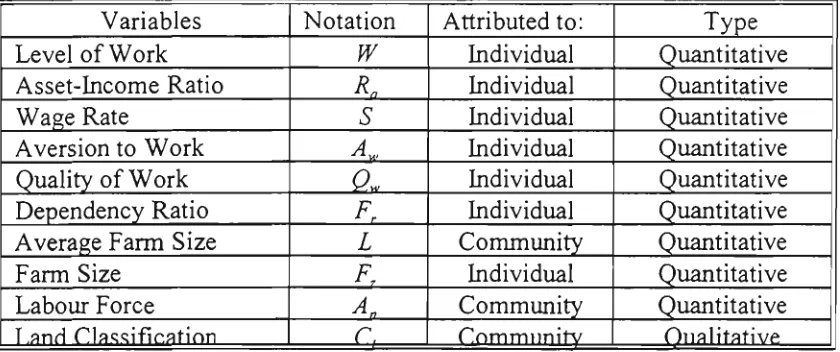
Tables Page 4.1. List of variables with notation and attributes. 77
4.2. Descriptive statistics on husband's age by ecological
zones, by region. 90 4.3. Descriptive statistics on wife's age by ecological
zones, by region. 91 4.4. Descriptive statistics on children's mean age by ecological
zones, by region. 92 4.5. Descriptive statistics on household size by ecological zones,
by region. 94 4.6. Descriptive statistics on husband's education by ecological
zone, by region. 95 4.7. Descriptive statistics on wife's education by ecological zone,
by region. 96 4.8. Descriptive statistics on the ratio of income earners to
household members by ecological zone, by region. 98 4.9. Descriptive statistics on employment (days per month) by
ecological zone by region. 99 4.10. Descriptive statistics on total farm income (000 pesos) by
ecological zone by region. 101 4.11. Total farm income distribution in rural Philippines. 103
4.12. Descriptive statistics on farm size (hectares) by region
by ecological zone. 105 4.13. Farm size distribution (area in hectares) by ecological zone. 107
4.14. Type of crops planted by farmers by region. 109 4.15. Distribution of farmers by tenure and by ecological zone. 111
4.17. Type of house owned, home ownership and homelot tenure by region.
4.18. Descriptive statistics on the value of asset owned (000 pesos) by ecological zone by region.
5.1. Estimated auxiliary R^ across regional models by region. 5.2. Estimated coefficient of the neoclassical linear labour
supply model.
5.3. Estimated coefficient of the neoclassical quadratic labour supply model.
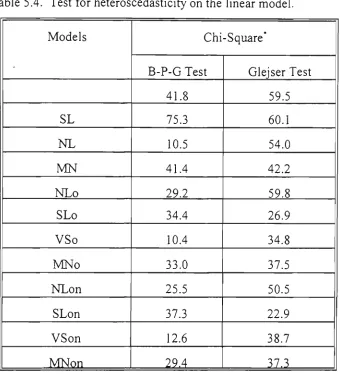
5.4. Chi-Square estimate for the test for heteroscedasticity of the linear labour supply model.
5.5. Estimates of farm work supply for Northern Luzon (NL). 5.6. Estimates of farm work supply for Southern Luzon (SL). 5.7. Estimates of farm work supply for Visayas (VS).
5.8. Estimates of farm work supply for Mindanao (MN). 5.9. Estimates of farm work supply with off-farm income for
Northern Luzon (NL^).
5.10. Estimates of farm work supply with off-farm income for Southern Luzon (SL^,).
5.11. Estimates of farm work supply with off-farm income for Visayas (VSJ.
5.12. Estimates of farm work supply with off-farm income for Mindanao (MNQ).
5.13. Estimates of farm work supply with off-farm and non-farm income for Northern Luzon (NL^n).
5.14. Estimates of farm work supply with off-farm and non-farm income for Southem Luzon (SL^^).
5.15. Estimates of farm work supply with off-farm and non-farm income for Visayas (VS^n).
114
115 120
121
124
128 132 133 134
135
136
137
138
139
140
141
IX
5.16. Estimates of farm work supply with off-farm and non-farm income
for Mindanao (MN^J. 143 5.17. Estimated parameters of tenure dummy on farm work supply with off
farm income for Visayas (VS^). 158 5.18. Estimated parameters of ecological zone dummy on farm work supply
for Southem Luzon (SL). 160 5.19. Estimated parameters of crop dummy in farm work supply
for Visayas (VS). 161 5.20. Estimates of the logit model for Northern Luzon (LNL). 166
5.21. Estimates of the logit model for Southem Luzon (LSL). 167
5.22. Estimates of the logit model for Visayas (LVS). 168 5.23. Estimates of the logit model for Mindanao (MN). 169 5.24. Estimates of the logit model with off-farm income for
Northern Luzon (NLJ. ] 70 5.25. Estimates of the logit model with off-farm income for
Southem Luzon (SLJ. 171 5.26. Estimates of the logit model with off-farm income for
Visayas (VS„). 172 5.27. Estimates of the logit model with off-farm income for
Mindanao (MNJ. 173 5.28. Estimates of the logit model with off-farm and non-farm
income for Northem Luzon (NL^n). 174 5.29. Estimates of the logit model with off-farm and non-farm
income for Southem Luzon (SLgJ. 175 5.30. Estimates of the logit model with off-farm and non-farm
income for Visayas (VS^J. 176 5.31. Estimates of the logit model with off-farm and non-farm
income for Mindanao (MN^J. 177 B. 1. The order conditions of structural equations. 207
Figures Page 2.1. The backward-bending labour supply curve. 16
2.2. The household production model. 19
2.3. Perlman's labour supply. 22 2.4. The household demand and labour supply. 25
3.1. The forward-falling labour supply curve. 40 3.2. The inverted forward-falling labour supply curve. 41
3.3. Income threshold and labour supply. 56 3.4. Income threshold and work aversion. 59 3.5. Approximated satisficing solutions. 62 3.6. Work allocation schedule at constant Y,. 66 3.7. Work allocation schedule at changing Y^. 67 3.8. Work allocation in a simultaneous system. 69 3.9. Schematic diagram of the determination of labour allocation. 71
4.1. Income distribution in rural Philippines (Lorenz /curve). 104 4.2. Land distribution in rural Philippines (Lorenz Curve). 108 5.1. Estimated forward falling labour supply curve for VS^^. 125 5.2. Labour supply in a bounded rationality framework for SL^. 154 5.3. Slope and intercept differential by tenure: T3 = 1
for TVS,. 157 5.4. Slope and intercept differential by crop: C, = 1 for CVS. 163
XI
ABSTRACT
In most developing countries like the Philippines the rural sector in general, and agriculture in particular play a significant role in economic development. Hence, relevant information on the rural workers and rural employment opportunities are necessary conditions for the development of appropriate programs and policies.
Economic development models adopted in most third-world economies are anchored on the neoclassical theory that work is a positive function of the wage rate. However, studies particularly in depressed agrarian societies have shown that the work is an inverse function of wage rate. Hence, there is a need to explore alternative analytical framework that can provide a more plausible explanation.
The estimates of the structural equations have indicated that the wage-work curve is downward-sloping. Further, the wage-work curve is influenced by other socio-economic variables including the dependency ratio, and qualitative attributes pertaining to tenure and cropping pattem. Therefore, the existing economic framework of the development programs carried out in the Philippines needs to be reexamined. The very broad classification rural workers as agricultural workers need to be changed considering the variation in work allocation behaviour across tenure and cropping patterns. Because of farm work aversion, there is the need to make farm less demeaning and burdensome by adopting appropriate technologies and by elimination of policies biased against agriculture.
Xlll
DECLARATION OF ORIGINALITY
I, PRUDENCIANO U. GORDONCILLO, hereby declare that the work embodied in this thesis is a result of original research and has not been submitted for a higher degree to any other university or academic institution.
The production of this research manuscript which took almost five years could not have been done without extemal support in terms of the financial, academic, personal and spiritual aspects of the entire research program.
I thank GOD for the blessings that He has given me and in particular for His gift of knowledge, courage, faith and perseverance that have helped me in the course of the research Program. I also would like to thank the parishioners at St. Michaels Catholic Church in North Melboume and the members of the Catholic Organisation of Students Down Under (COSDU) for providing the support for the spiritual needs of my family.
Financially, I owe a lot to the Australian Government for the scholarship award that was administered by the Australian Aid for Intemational Development (AusADD) and to the Philippine Government for the financial counterpart by granting me study leave with pay for the first three years of the Program. Without such financial support, this research program would not have been possible.
XV
made me welcome. Thus my gratitude is extended to all staff member of the department who in one way or another has made my stay in the department more comfortable. In particular, I thank Celestine, Trish, Jessie, Graham, Jim, Romana and Mario, among others.
The data set used in the analysis was derived from the Benchmark Data for the Comprehensive Agrarian Reform Program of the Philippines which was generated by the Institute of Agrarian Studies, College of Economics and Management, University of the Philippines Los Baiios, College, Laguna. The funding for the research grant was provided for by the Department of Agrarian Reform. Specifically, my debt of gratitude extends to Dr. Linda M. Penalba, Director of the Institute of Agrarian Studies for giving me access to the Benchmark Data set. I would also thank the staff at the institute for providing me with technical support in the entry, collection, and processing of some data gaps. In particular, word of thanks are extended to Mymy and Cecille for their help in the data processing and to Doris for her untiring effort to handle the financial and administrative concerns on my behalf
Personally, I would like to thank my friends and fellow students living in
Baranggay 2 (North Melboume) and in greater Melboume area for their support during
my stay here in Australia. Without my interaction with them, my stay in Australia would have been less enjoyable. To name a few, my appreciation is extended to Ned and family, Josie and family, Sarah and her Family, Nel and family, Celet and family, Felix and family, Goddie and Noli, among others.
tremendous help during my stay in Australia. In particular, I thank Ariel, Jake, Ray Tanghal, Ray Medinilla, Vic, Dante and Tony, among others.
I thank my wife Chichi and my daughters Mymy (10) and Nikki (5) for their love and support and for giving me much greater purpose in life. I would also thank my parents Amor and Basilia, my brothers and my sisters. My thoughts for them and my knowledge of their continuous support and prayers have strengthened my desire to pursue this academic program.
CHAPTER 1
INTRODUCTION
l.L Background
Most of the controversial and heated public economic policy debates in any economic society involves issues concerning labour economics in general, and work and wages in particular. There are, however, profound differences between the industrialised and developed economies and the underdeveloped and primarily agricultioral economies of the third world as far as the level and intensity of the arguments are concerned.
Ln the highly industrialised and developed economies, controversial labour issues are centred on wages, welfare payments, social security, taxation, work incentives, workplace environment or work safety, and discrimination, among others. Because of the nature of industrial workers and the level of sophistication that the advanced economies have achieved, union power is easily generated and harnessed. Hence, issues relevant to the workers are readily forwarded for discussion in the legislative or policy agenda of government. Otherwise, there is always the "street parliament" or the picket lines where issues are often resolved.
Unfortunately, workers in the agricultural sector of the third world economies are not organised. Consequently, rural workers are often merely referred to as the
clientele by government planners and policy makers. As such, they are simply
receptors of tailored programs and policies. In contrast, the labour related issues on income and access to work opportunities in the third world economies are often embodied in the prescribed conventional economic development paradigm. For instance, the popular wisdom behind the policy prescription for an agricultural based development of third world economies (Adelman, 1986 and Mellor, 1986) hinges on the neoclassical labour supply theory that the supply curve is a direct function of the wage rate. Specifically, Adelman (1986, p. 61) argued that: "...Labour-intensive
growth strategies...can therefore also be wage increasing policies, since an increase
in the demand for labour can either raise the quantity of labour or raise wages (or
both)...". Similarly, Mellor (1986, p. 77) stressed that: "...Developing countries have
Empirical work, however tend to indicate that the quantity of labour supplied is inversely related to the wage rate (Pencavel, 1986). For instance, Pencavel cited Douglas' (1934) estimate of the wage rate coefficient in US labour supply at about -0.1 to -0.2. It seemed that the methodology of the neoclassical economic analysis is inadequate in explaining this phenomenon.
It is in the context of the issues presented above that understanding rural labour issues is very crucial for the development of the Philippine Economy. Therefore, for planners and policy makers whose primary concern is the interest of the rural workers, acquisition of appropriate and accurate information is a necessary condition. At this juncture of its development, the Philippine economy can be characterised as predominantly agricultural. About 60 percent of its estimated 60.7 million people live in the rural areas; the agricultural sector accounts for roughly a quarter of the gross domestic product (GDP); and, nearly 63 percent of its estimated 24 million labour force is based in agriculture and rural industries (National Census and Statistics Office, 1990). Further, it must be noted that about 42 percent of the rural population live below the absolute poverty threshold (Comista, 1992). Hence, recent development issues and problems either directly or indirectly concern the rural labour. It is in this context that understanding the utilisation of rural labour is of paramount significance to Philippine development.
As of 1990, the Philippine goverrunent, through the National Economic and Development Authority (NEDA) has outlined an array of strategies and policies geared towards poverty alleviation and equity ranging from wage policies to the Comprehensive Agrarian Reform Program (CARP). Based on the NEDA Development Report, the legislated minimum wage structure are as follows:
Non-Agriculture
Agriculture
Plantation 85.58 pesos per day Non-Plantation „ 63.38 pesos per day
To put these figures in perspective, 114 Pesos is roughly equivalent to AUD 7,12 in 1990 exchange rate. Further, the average legislated minimum wage across the board is equivalent to an annual income of about 32,000 Pesos. Based on the GNP per capita (1990 prices) of about 18,240 pesos (NCSO, 1990), it is apparent that the individual is taking home an armual pay which is barely over half the legislated minimum wage.
Aside from the legislated wage floor, various non-wage benefit schemes were promulgated including:
1. tax exemptions; 2. profit sharing;
3. access to housing and livelihood support programs; and 4. additional support to sugar workers.
The development plan also outlines major programs to enhance rural/agricultiiral income. These programs include: Livelihood Enhancement for Agricultural Development (LEAD); Countryside Agro-Industrial Development (CAIDS); Integrated Area Development (IAD); and the Comprehensive Agrarian Reform Program (CARP).
Among the above policies and strategies, the legislated minimum wage is theoretically the policy that would immediately and directly affect the rural workers. However, it is common knowledge that the actual wages paid to hired rural workers in non-corporate or non-commercial agricultural enterprises are very much lower than the wage floor set by the govenmient.
attributed to the inability to consider appropriate information conceming on rural labour conditions during policy formulations. Most legislation and policies formulated to mitigate problems related to rural labour employment are often based on the framework which may not be reflective of the actual socio-economic conditions in the rural areas. This is an undesirable state because logic would dictate that effective policies on rural labour allocation hinges on the knowledge of the factors affecting labour utilisation, particularly in terms of what these factors are and how they affect labour allocation.
In the past, attempts were made to examine mral labour situations in the Philippines. Bautista (1986) examined the structure of rural employment opportunities. This, however, was limited in terms of method and scope. Analytically, the research was descriptive and the scope was limited to only three small villages. Rural manufacturing employment was also studied by Fabella (1987). The model estimated the proportion of rural labour employed by the sector with respect to some attributes including education, access to infrastructure, access to electricity, income, financial institutions, and technology. Evenson (1978) also examined the determinants of time allocation in rural Philippine Household. This empirical work was limited to the province of Laguna which is a constraint in so far as drawing broader policy implications to rural development problems. Further, the analysis was limited to a simple regression analysis based upon Becker's (1965) household production model.
5
A host of other critical empirical issues and questions are important in the formulation of appropriate policies for rural labour and rural development. These are: 1. What are the determinants of labour utilisation in the rural areas? Is
the decision to work primarily determined by the existing level of wages? If so, is work a positive function of wage rates or otherwise? 2. Is it reasonable to assume that income generated in the rural areas come only from wages? If non-work income is considerable, can it be a determinant of work allocation decisions?
3. Will there be differences in the work allocation behaviour among rural workers across the agrarian structure and across the type of agricultural employment?
4. What are the determinants of the level of wage rate? 5. What are the other determinants of labour utilisation?
6. Is there a formal labour market in the raral areas that determines the level of employment and level of wages? And, in employment, what are some of the terms and conditions of work?
To illustrate a specific case that highlights the significance of the aforementioned issues and concems on rural labour, consider the existing policy of a legislated minimum agricultural wage. It has been the policy of the Philippine government to establish a wage floor for agricultural workers. Based on the methodology of neoclassical economic analysis, the policy will resuh in unemployment since demand will be less than supply at the minimum wage. Within the same framework, the only way to mitigate unemployment is to induce demand so that the level of unemployment or the surplus labour can be absorbed. This analysis will only hold true if the labour supply is actually upward sloping. However, is wage rate really the primary determinant of work allocation? Or, is the number of hours of work a positive function of wage rate?
tremendous impact on agricultural input prices. If the argument is to be accepted that labour and capital are substitutable, then changing agricultural input prices would have significant effects on the demand and supply of labour. Similarly, the final impact would depend largely on the shape of the supply curve of labour.
The promotion of labour intensive agricultural technologies, cottage industries and the development of infrastmctures to increase cropping intensity would likewise have significant effects on labour supply and demand. Similarly, increased cropping intensity creates an upward pressure on labour demand; again, the actual effect would depend on the behaviour of the labour supply.
Finally, a better understanding of the rural workers could help provide appropriate measures to mitigate the problems associated with rural-urban migration. On one hand, rural-urban migration draws the more productive labour, real or potential, out of agriculture. On the other hand, movement of people from the rural areas to the urban areas cause congestion and a host of socio-economic problems associated with urban poverty.
Is this rural-urban migration phenomenon a consequence of the lack of employment opportunities in the rural areas? Or, is it because of the qualitative differences between rural and urban employment opportunities? Or, could it be attributed to a different work allocation behaviour?
The significance of understanding the rural labour situation goes beyond the implications for policy formulations. Relevant and accurate information on rural labour serves as a benchmark for impact assessment of programs and policies geared towards improving income, reducing income inequality and mitigating rural unemployment and ensuring rural development.
1.2. Objectives of the Research
7
Economic research, as an applied academic exercise involves the investigation of quantitative and qualitative events and the establishment of their relationships. Once the events are measured and their relationships established, steps can be developed to control events and influence them towards desirable outcomes. It is along this process that this research is hoped to make some contribution.
In general, the goal of the study is to analyse the state of rural labour in the Philippines and to explore indicative avenues for increasing labour employment opportunities in the rural areas. The general objectives can be broken down to more specific objectives as follows:
1. It is the aim of this research to establish the social and economic profile of rural workers. As mentioned earlier, knowing the socio-economic profile of the rural workers will not only provide policy makers the appropriate information for policy formulation but also serve as the benchmark for any impact evaluation of development programs and policies;
2. One of the specific concems of this research is to establish the types of rural workers. These categories will be established across the agrarian stmcture and across cropping patterns. Such classification of rural workers is relevant considering the existing classification. At present, for purposes of policy implementation, rural workers are simply categorised as agricultural workers without due considerations to the differences of workers across the agrarian stmcture and across cropping patterns;
4. The assessment of rural labour utilisation can be made more substantive by estimating the parameters of the factors that influence the level of labour ufilisafion. Hence, one of the specific objectives of this research is to develop models that can quantify the influence of socio-economic attributes to labour allocation;
5. It is argued in this research that the socio-economic attributes of the individual as well as the community will have an mfluence on employment opportunities. Therefore, one of the specific aims is to develop a model that can quantify the likelihood of access to gainful employment; and
6. Finally, it is the specific aim of this research to develop a policy framework for increasing employment opportunities in the rural areas of the Philippines. Such a framework will draw much of the needed inputs from the result of the preceding five specific objectives.
L3. Analytical Framework
Economic development models adopted in most third-world economies are anchored on the neoclassical theory that work is a positive function of the wage rate. However, studies particularly in depressed agrarian societies, have shown that work is an inverse function of wage rate. Hence, there is a need to explore alternative analytical framework that can provide a more plausible explanation.
L4. Structure of the Dissertation
The first chapter introduces the significance of the agriculture sector to the Philippine economy in general, and the significance of rural labour in rural development efforts of the Philippine government in particular. Also, the inefficacy of existing policies and programs has been stressed . This is due to the inadequacy of appropriate and relevant information on rural labour conditions and an inappropriate theoretical framework of the advocated policies and programs.
literature based on the neoclassical economic frarnework and those that do not follow the mainstream economic methodology. This is followed by the section that outlines an alternative theoretical framework for the analysis of labour supply. In particular, the third chapter outlines the framework of the theory of bounded rationality.
The fourth chapter covers the analytical methods which is further structured to include the following sections: the variables; the hypotheses; the analytical tools; and the models. Specifically, three models were developed in the chapter. One covers the labour supply function, another to test for structural differences in labour supply behaviour across the agrarian structure and across cropping patterns, and another for the logistic probability function.
The fifth chapter provides a description of the data set. It is also in this chapter that the socio-economic profile of rural workers is described and the estimates of the parameters of the models are presented including the inferences with respect to the parameter estimates.
Basically, this research will make use of secondary data available in various institutions in the Philippines involved in rural development. The data set will be subjected to rigorous descriptive and inferential statistical analysis. The descriptive part, which basically involves measures of central tendencies and distribution, will be sufficient to address the objectives involving the establishment of the socio-economic profile of the rural workers and the classification of rural workers.
Labour Supply Analysis: A Historical Perspective
2.1. Introduction
Labor economics, in general and labor supply, in particular has been one of the most contested issues in economics. The debates along this specific concem have been brought forth in the history of economic thought both at the theoretical and empirical levels.
Within the bounds of the theoretical debate, arguments are further structured within two levels. The first is within the context of the debate on the methodology of economics as a science. As Blaug (1980) noted, the debate on the methodology of science has been going on for more than one and a half centuries. In a nutshell, the debate on the methodology of science is centered on whether to test the theory is to simply verify it or whether it is appropriate to falsify in order to test its validity. The second level of the theoretical debate pertains to the conceptual framework of labor supply analysis which is anchored on the utility theory of demand for commodities. In essence, the mainstream neoclassical approach to the analysis of labor supply is derived by treating leisure as a normal commodity. Hence, the analysis is a straightforward extension of the utility theory for normal commodities which yields a downward-sloping demand curve for leisure and as a residual an upward-sloping supply of labor.
11 On the other hand, leisure is as complex, if not more, as a commodity as work. For one thing, it has been commonly argued that its price is the work foregone. But the demand for leisure time can not be isolated from the activity for which the leisure time is utilised. Otherwise, the price of leisure being equivalent to the wage rate foregone is simply the value of an idle time and not for leisure. Further, if wage is acceptable as the price of leisure, it can only be valid if the individual is willing to work at all levels of wages along the income-leisure or income-work plane. What would be the wage income foregone if in the first place the individual is not willing to work at all at a given range of wages? A more radical argument is raised by Bentivogli (1992, p. 108) on the price of leisure: "...If
leisure is simply considered as non-work, its price is given in terms of foregone
earnings from work (that is, the wage rate). A consumer price index would be
preferable if leisure were seen as consumption time " Further, it has been
generally raised as to whether it is appropriate to simply divide time between work and leisure.
At the empirical level, the arguments vary from the analytical methods to the measurement of the variables. For instance, Deaton and Maulbauer (1980) argued that the budget constraint in the neoclassical labor supply analysis is better treated as non-linear than linear constraint. Ln a literature survey, Bemdt (1991) has pointed out empirical arguments where the amount of work and the level of wages are simultaneously determined. Further, Bemdt (p.637) noted that: "...In
reviewing second generation empirical results...we emphasized that the
substantial heterogeneity that is observed in the estimates of wage and income
elasticities could be due in part to the fact that the various studies differ in terms
of estimation method, functional form and data base..."
2.2. The Neoclassical Approach to Labour Supply Analysis
possesses some attributes and properties which bear significant implications to the determination of social equilibrium. One among these properties is "utility" which in one form Pareto related to economic prosperity. Further, he noted that if "utility" is supposed to be used in the determination of the social equilibrium, then it has to be properly defined in a way that corresponds to a measure of quantities. However, it may not be necessary to determine the actual numerical differences in "utility" for it to be useful in the determination of social equilibrium. It is sufficient to represent the differences in "utility" in terms of mere indices as relative measures without having to know the exact measure of the difference. Pareto (1913, pp. 1456-1458) argued:
"... If we ask, 'Is Germany today, in the year 1913, more
powerful in prestige and military sense than she was in I860?', everyone will answer yes. But if we go on to ask by how much more powerful she is, no one will be able to answer. And we can go on with other questions of the kind that are susceptible of increase or decrease without our being able to represent them in their various stages by exact figures... Yet anybody can see that prosperity and power of France are greater than Ethiopia... Everyone understands, without any requirement of numerical definiteness that there was a difference... Even differences far less marked are perceptible and roughly invaluable, and for all lack of numerical precision, we still have an impression of the situation that does not go very far from the facts."
13 downward-sloping curves, and others have estimated backward-bending labour supply curves.
However, to better understand the theoretical developments of labour supply analysis, it is worthy to journey back into the earlier economic arguments forwarded for the analysis of time allocation and labour supply. In the earlier days of theoretical development. Knight (1921) contended that labour supply is always negatively inclined. He noted that:
"...If wages are raised, the marginal utility of income will be reduced. Thus the added disutility of the last unit of labour time will now exceed the added utility of the last unit of money wage. Hence the worker will want to shorten his working day when wages rise. "(pp. 314-315).
It is worthy to note that explicitly. Knight considered the idea of work disutility as the main argument of the work allocation behaviour. However, this has been neglected and avoided in the subsequent theoretical and empirical developments in labour economics.
To date, mainstream economic literatures on labour supply are derived from the neoclassical paradigm which is basically an application of the utility theory of consumer behaviour. King (1990) outlined the basic assumptions of the neoclassical labour supply model:
1. the quality of labour is constant;
2. income is only derived from work or there is no unearned income; 3. the preference function between leisure and work is independent; 4. the individual is free to choose how much labour to supply without
restrictions subject only to the limitation of time and wage rate; 5. work and leisure are the only possible uses of time; and
6. work is utility neutral.
non-satiation; and convexity. Finally, the individual is assumed to be rational in the sense that the individual faced with budgetary constraints behaves as a utility maximiser. Applying the conventional constrained optimization framework yields the well-known backward-bending labour supply (Annex A).
The dynamics of the income and substitution effects can be presented using the Slutsky equation (Bemdt, 1991). Such that.
'dW'
dS I gross
( dW^
dS 'dU-O W
^dW' dY
The left hand side of the equation is the gross substitution effect, the first term on the right side is the compensated substitution effect and the last term is the pure income effect. Since according to Naylor and Vernon (1969),
^dw}
dS ldU=0 < 0,
then the gross substitution effect depends upon the magnitudes of the compensated substitution effect and the pure income effect. If the compensated substitution effect is dominant, then the supply curve is downward sloping, otherwise, labour supply slopes upward.
Therefore, the actual shape of the labour supply curve, based on the neoclassical economic theory, is an empirical question because it can not be determined a priori whether or not work is inversely related to the level of wage rate.
15
"...// is generally accepted proposition of theoretical economics
that the effects of a change in the terms on which income from work can be obtained depend upon the elasticity of the demand for income in terms of efforts. If the elasticity of demand for income in terms of effort is greater than unity, then the effects of tax or a fall in wage rate will be a diminution of work done and the effects of a bounty or a rise in wage rate will be an increase in work done. If it is less than unity, then the opposite movements are to be expected..." (p. 126).
The preceding arguments have been the bases for subsequent developments of the labour supply theory. Friedman (1962) provided a refined argument for the backward-bending labour supply within the framework of the indifference curve analysis. He articulated that an increase in wage rate will have two economic effects. First, since the price of leisure is the value of work foregone, the rise in wage raises the price of leisure. Consequently, the worker will now exchange his leisure time for work. This is the substitution effect which at lower wages dominates the income effect. Given the same number of hours of work, an increase in wage rate raises the worker's income. This will allow the worker to buy more of the goods including leisure. This is the income effect which at higher wages dominates the substitution effect. Hence, across the work-wage plane, at lower wages the substitution effect is greater than the income effect and the supply curve slopes upwards. Beyond some point, the income effect will be greater than the substitution effect and the supply curve bends backwards.
King (1990 p. 56) provided a graphical outline of the backward-bending labour supply. In Figure 2.1, for wages below OS^, the substitution effect is greater than the income effect and work increases as wage rate increases. For wages above OS,, the income effect is greater than the substitution effect and work declines with increases in wage rate. There are however, distinct variations in the subsequent theoretical developments.
2.3. Modifications on the Neoclassical Model
3 o
JO CO
•5
C
dJ X I
I
p
17 shift the budgetary constraint of the conventional neoclassical model. The problem of maximisation remains technically unchanged.
Suppose Y3 is the level of non-work income, then the budgetary constraint can be formally expressed as:
Y = (H - W + Y^. (2.1)
The Lagrangean function then becomes:
L = U(E,Y) + X[S{H-E) + Y- Y].
Taking the first order conditions:
E^ = ^ - XS = 0 (2.2) dE dE
^ = ^ - X = 0. (2.3) dY dY
Therefore,
^^^^^ = S, (2.4)
dU/dY
maximising decision process. In his argument, he noted that the utility function is derived from the consumption of basic commodities which are products of combining purchased market goods and time. To illustrate the point, Becker cited examples such as food or meals which can either be bought from the market (ready to eat) without time input or produce solely at home without purchased market goods.
Given the market wage rate, the individual is faced with an allocation problem of his available time, i.e., 24 hours, among home work, market work, and time to be spent for the consumption of goods. If the marginal productivity of market work exceeds that of the marginal productivity of home work, then the individual enters the labour market. The allocation of the remaining time between time for work and time for the consumption of goods will be defined by the utility preference fimction subject to the budget constraint, that is, based on utility maximising behaviour.
Becker's modified approach has generated interest and considerable following among economists working in labour economics. As Binger and Hoffinan (1988, p. 488) noted: "...The beauty of Becker's household production
model is that it allows for an individual to do no homework or no market work. It
also provides an understanding of when an individual who has been exclusively
working at home will decide to enter the labour market..."
To illustrate the preceding arguments, consider Figure 2.2. The vertical axis represents the total consumption goods Z and the horizontal axis represents the available time for an individual. The household production of consumption goods is represented by the production possibility frontier (PPF) which indicates the combinations of time and market goods. Given the wage rate S, the budget line is segment LL' and the utility function is represented by the indifference curve
U. Points to the left of A represents a relationship where the marginal productivity
x>
>
O
(/)
• o
o o
ISO
c o
en C
o o o
J-1
0) T3 O
C
O
o
D O
o
C
LL'. This optimal condition is given at point B where the budget line is tangent to
the indifference curve. Conceptually, this is the point where the marginal rate of substitution between time and market goods is equal to the wage rate. Therefore, at point A, the level of work at home is W^, and at point B, the level of work offered to the market is W^ leaving the residual time E for the consumption of goods.
Apparently, as far as work and wage relationship is concerned, Becker's arguments yield results similar to that of the neoclassical model. In Becker's own words (p. 502): "...The effect of an uncompensated increase in earnings on hours
worked would depend on the relative strength of the substitution and income
effects. The former would increase hours, the latter reduce them; which
dominates cannot be determined a priori...".
2.4. Critical Views on the Neoclassical Labour Supply Analysis
The argument that the backward-bending labour supply is defined by the relative magnitudes of the income and substitution effects paved the way to some serious criticisms of the theory. From the theoretical formulation there is no apparent constraint that the supply curve will only have one inflection point, that is, there is only one point where the relative magnitude of the income and substitution effects changes. Since there is no strong reason to restrict the supply curve to always start as an upward sloping curve, Perlman (1969, pp. 10-11) contended that:
"...In the backward-sloping portion of a labour supply curve, the worker increases his leisure as well as his income. For the curve to turn around and move in a forward direction, as both income and leisure expand, the drive for added leisure must become weaker than the drive for added income...But it is not necessary to argue that the leisure saturation point must be reached before a backward-sloping supply curve bends forward... For the curve to bend forward, it is only necessary
21
higher consumption standards, so that the curve may soon bend backwards and so on... "
To illustrate the preceding argument Perlman showed an illustration as in Figure 2.3. At lower wages, and therefore lower income, the supply curve bends backward as work declines in response to increasing wages. As soon as the substitution effect dominates the income effect, demarcated by point A as the inflection point, the curve turns forward. Eventually, the curve again bends backward as income goals become target levels of aspirations and the income effect becomes dominant over the substitution effect.
While the preceding illustration showing a winding (s-shaped) supply curve seems horrifying, it is not really without good foundations even within the framework of Robbins (1930) argument. As he specifically noted (p. 126): "...We
cannot predict a priori what the effects of a change in taxation or of a change in
wage rates will be, we must ascertain the probable elasticity of demand for
income in terms of effort of the taxpayer or the wage earner concerned...". While
Robbins has been widely noted for this argument, in a much earlier work, Jevons (1871) has alluded to a similar point. Jevons argued that there are two effects when the conditions in relation to the products of labour are changed. In his(p.l96) own words:
"...When labour produces more commodity, there is more reward, and therefore more inducement to labour. If a workman can earn ninepence an hour instead of sixpence, may he not be induced to extend his hours of labour by this increased result? This would doubtless be the case were it not the very fact of getting half as much more than he did before, lowers the utility to him of any further addition. By the produce of the same number of hours he can satisfy his desires more completely; and if the irksomeness of labour has reached at all a high point, he may gain more by relaxing that labour than by consuming more products. This question thus depends upon the direction in
CO
a.
Q. 3 tn
u
3
O
x;
« —
t«
s
u
(U O. CO OJ 0) L< 3 M
r\>
. M
a.
—. en
CD O l
. ^
G £0
; - i
ij
o ^
3
r>
23
This implies that a backward-bending supply is just one of the various shapes in which the curve can behave depending upon the assumed elasticity of demand for income as the reference point. As Perlman has claimed "...Perhaps the reason
that the usual view sees the curve as bending only backwards rather than forward
is that it is easier to explain why a positively-sloped curve must eventually bend
backward rather than vice versa..." (p. 17).
Therefore, based on the preceding claim, the fact that the backward-bending supply curve has become the conventional argument is primarily by reason of convenience.
While Robbins, in the 1920s, generated interest among economists on his theoretical formulation of a backward-bending labour supply, in about the same time, a Russian agricultural economist developed a theoretical framework to explain the work allocation behaviour among Russian peasants. Chayanov (1925, pp. 68-69) outlined the following argument:
"...The degree of self-exploitation of labour is established by some relationship between the measure of demand satisfaction and the measure of the burden of labour. The economic activity of labour differs from any other activity in that the quantity of values that become available to the person running the farm agrees with the quantity of physical labour he has expended. But the expenditure of physical energy is by no means without limit for the human organism. After a comparatively small expenditure essential to the organism and accompanied by a feeling of satisfaction, further expenditure of energy requires an effort of will. The greater the quantity of work carried out by a man in a definite time period, the greater and greater drudgery for the man are the last (marginal) units of labour expended. On the other hand, the subjective evaluation of the values obtained by his marginal labour will depend on the extent of its marginal utility for the farm family. But since marginal utility falls with growth of the total sum of values that become
It is worthy to note the following important elements of Chayanov's theory: 1) the theory is based on the concept of utility; 2) the peasants seek for the solution of the problem of allocating the available human resource labour base on the utility of income and work; 3) it is assumed that there is a diminishing marginal utility of income; 4) there is an increasing disutility or dmdgery of work; 5) the measure of the consumer demand pressure is the ratio of the number of consumers to the number of workers; and 6) the household is not seeking for an optimal solution but a satisfactory or good solution based on subjective evaluation of the relationship between the diminishing marginal utility of income and the increasing drudgery of labour.
in OJ
X
a. 3 (/> 3 O
•V
CO
> o « •u
IH O
This proposition is realistic but it cannot be incorporated into the classical framework which is based on the indifference curve analyses of a utility function that is dependent upon mcome and leisure. Second, is the idea of a subjective equilibrium. This implies that the household, unlike the utility maximising assumption of the classical model, is simply seeking a satisfactory solution to the problem of work allocation. As Chayanov (p. 85.) noted: "...the net product of
the particular labour expenditure may be subjectively recognised by our family as
satisfactory or good compared with the subjective evaluation of the drudgery of
the same labour..."
Chayanov's theoretical formulations lay dormant for a considerable time. His arguments, for some reasons, failed to encroach into the mainstream economic literature. It was only in 1966 that his works were translated into English and were brought to the attention of the western world. As expected, more particularly since the arguments deviate from the neoclassical economic thought, criticisms were raised. Chibnik (1987) outlined some methodological problems of Chayanov's theory. However, it must be noted that while the said problems are complicated and difficuh, they are not absolute obstacles. These problems are: the measurement of the consumption requirements; the number of workers in the household; and the estimation of the total household product. In a more substantive context, Ellis (1988) forwarded some comments on Chayanov's model, notably the implicit assumption of substitutability of male and female labour in farm work, flexibility in the access to land, and the absence of engagement in the labour market. These concems limit the applicability of the model. Further, the model's predictive power only lies on the demographic attributes, and the model is incapable of predicting responses to the factors that influence the production fimction.
27
oversimplification of the utility fimction. Also, the assumption implies nonjointness of the household production which means that market goods and time can be split up between separate production processes for each output. Pollak and Wachter (1975) argued that nonjointness is a very restrictive assumption. It implies that time spent on the production process can not yield utility or disutility except for the consequence that it takes away time from leisure. Substitutability allows for the individual to choose between working for a wage and earn income to buy the goods or spend the time at home and produce the same goods. In order for the individual to choose the latter option, it is presumed that there are available resources at home other than time. In the extreme case, for those whose only resource is time, then the production possibility frontier (PPF) may have to be bounded. But more importantly, a considerable proportion of the bundle of commodities that an individual consumes is non-food items, e.g., consumer durables. Becker argues that the actual commodity that enters into the utility fimction are the services that these capital goods yield. This may seem technically plausible, but actual demand for such goods in reality is not measured in terms of the marginal cost of the services that the goods yield, but in terms of the actual cost of the consumer durables. This would have some significant implications on the decision making process. For example, if an individual wishes to enhance his utility by facilitating his mobility he, has to buy a car or avails of car rental services.
Further, in the case of capital goods or consumer durables, utility is not only derived from the services they yield. For instance, over and above the transport facility that a car offers, mere ov/nership has its own utility. The brand of the car is another utility issue. Furthermore, households are incapable of producing the service that consumer durables yield. Hence, the marginal productivity comparison which is the basis for the decision breaks down. In this case, there is only one choice, work for a wage in the labour market.
definition is apparently a problem. Is the trip to a movie an input to Z or Z itself? Which one is Z, eating or the prepared meal?
A more extreme criticism has been raised conceming the determination of the solution in the model. Rubin (1973) argued that Becker's model is indeterminate because the individual has to spend a considerable time working out the solution to the allocation problem. In his words: "...In particular, consider
the time which the consumer must spend in actually solving the problem. The
consumer must spend time solving the problem before he knows how much time to
spend... This does not mean that decisions are not made...what it does imply is
that such decisions can not be made optimally..." { p. 65).
2.5. Alternative Theoretical Framework for Labour Supply Anafysis
Almost all of the approaches to the labour supply analysis, including Becker's model, can be classified under the neoclassical framework. This generalisation excludes the propositions forwarded by Knight (1921) and Chayanov (1925). However, in a more basic context, the neoclassical has been subjected to various critical comments.
Central to the argument of the classical analysis is the very notion of individual rationality. At this point, it is worthy to note some basic notions of rationality to avoid confusion in differentiating whether not being rational is to be irrational. For instance, if to be rational is to buy more of a commodity as its price falls, it does not necessarily imply that to do the same as price increases is irrational. This is because rationality denotes a type of behaviour that is appropriate to the achievement of goals within the bounds of given constraints (Simon, 1964).
29 his income or budget. Finally, being rational, the individual maximises his utility by choosing within the limit of his income the combination of commodities that yield the highest utility. As a maximiser, Simon states that the individual settles for nothing less than the best. The solution to this problem of choice is unique and precise at the equilibrium condition where the marginal rate of substitution between conunodities is equal to the ratio of their prices.
The classical solution to the behavioural problem of choice seem fairly straightforward. However, a closer look both at the explicit and implicit assumptions of the classical framework would reveal that in the analysis, the individual is subjected to very restrictive conditions. The explicit assumption of perfect knowledge is impossible both in the context of the cost of acquiring the information and the time required to have them. Further, the analysis implies that the individual possesses the mathematical skill to perform the necessary calculus in the determination of the maximum solution!
The preceding arguments have been the bases for some of the criticisms of the classical framework. Most economists are aware of and have recognised these limitations of the theory but apparently have come to terms that the elegance of mathematical precision outweighs the validity of the criticisms.
However, some scholars have ventured mto the path of exploring alternative approaches to the behavioural problem of choice and allocation in economics incorporating some limitations to the classical notion of global rationality. The theoretical formulations of these altemative approaches are often categorised imder the "theories of bounded rationality" which refers to the incorporation of the constraints to the capability of the decision maker to collect and process the information and modification of the goals of the decision maker.
There are altemative ways in which boundaries to rationality can be explored. Simon (1972) outlined three models of bounded rationality: 1) a case where risk and uncertainty is involved; 2) when decision makers have limited information about altematives; and 3) a case where there is a limit to the individuals capacity to perform the complex calculation m search for the best choice.
In an earlier work, Simon (1955) developed a behavioural model of rational choice which incorporates limits to global rationality. In particular, the model assumes that the decision maker can not have the perfect knowledge of the choices available and that in reality, the decision maker does not consistently evaluate all the choices as to whether one altemative is as good, better, or worse than any other before the actual decision is made.
In his theoretical formulation, Simon provided some simplified assumptions that make the definition of rationality more realistic - a bounded rationality. First, in the case of the classical framework, the individual is assumed to have perfect knowledge of all altemative choices and all choices are evaluated simultaneously before a decision is made. This can be simplified by assuming that the knowledge of altemative choices is limited and the choices can be interpreted as either "satisfactory" or "unsatisfactory".
Second, the goal of the decision maker is different. Instead of assuming that the decision maker aims for the global maximum (maximiser), the goal is simply to achieve a good or "satisfactory" solution or aim for a "satisficing" condition.
Third, choices are not evaluated simultaneously. Instead, altematives are considered sequentially whether one is "satisfactory" or "unsatisfactory" relative to an aspiration level.
31 Each move in a game can be precisely evaluated whether it is a "won", "draw" or "lost" position by going back to the choice set of 10'^° elements. Obviously, evaluating each choice is highly improbable.
In reality, chess players categorised positions as "clearly lost", "clearly drawn", "clearly won", "won or drawn", "drawn or lost", etc., depending on the player's ability to map the choice set. If the relevant set is the "won" positions, then evaluations are done to see whether a position can be transformed into a "clearly won" position.
In an experiment, Simon established that in the actual game of chess the choice set is actually simplified. Considering a middle-game, he evaluated a sequence of eight moves by each player. This sequence could yield about 10^" legal variafions. Following the decision process discussed above, the line of play actually examined was reduced to 100 variations. This is a significant simplification from the ideal decision process to what is practical and actual.
Another illustration of a "satisficing" behaviour is an individual selling a house (Simon, 1955). In any given day, the person sets an acceptance price. If the individual receives one or more offers above the acceptance price, the highest offer is accepted. Otherwise, a new acceptance price is set the next day. In the classical framework, if the person has complete knowledge of the probability distribution of offers in each day, the acceptance price can be set to maximise the expected value of the sales price.
Simon (1955) fiirther argued that in the case of the "satisficing" behaviour, the unique solution is approximated by allowing the level of aspirations to move. If the aspiration level is readily achieved, then the person adjusts the aspiration
upwards. Conversely, if the individual finds it difficult to achieve the aspired level, then the aspiration is lowered. This is sometimes referred to as the "learning mle". This notion of an approximated unique solution is analogous to the subjective equilibrium condition earlier forwarded by Chayanov.
In their research, Baumol and Quandt (1974) explored some "mles of thumb" that are often used by firms in decision making which are outside the classical framework of maximisation. They argued that: "...Since all real world
decisions are made under conditions of imperfect information, calculations down
to the last decimal point is pointless in any event. One can easily formulate the
appropriate marginal conditions for what one may call an optimally imperfect
decision...'' (p. 23).
For the case of the learning rule, they have established that the solution to this technique converge and is in fact globally stable.
Most literature in mainstream economics adhere to the assumption of a simple and perfect world. Consequently, economic analyses, in most cases, do away with questions conceming the behaviour of an individual in an imperfect and constantly changing world. Likewise, as result of the said framework, the available standard tools and theoretical models are ill-equipped to address these questions. The main question is to set the parameters of an approach that would somehow embody the precision and the mathematical elegance of the classical framework and at the same time possess some flexibility. This is necessary to reconcile the maximising behaviour based on global rationality to that of the real status of the decision maker who actually has limited capability and information and is incapable of achieving the maximum solution to the problem of choice.
33
supports the idea that choice is governed by a principle that does not necessarily
maximise utility, as the subjects themselves would reckon their utility.. "
Holland and Miller (1991) outlined some advanced models towards an artificial adaptive agent (AAA). The main rationale for such models is that they possess the precision and consistency of the mathematical models and at the same time are as flexible as the corresponding linguistic models.
A step further, Arthur (1991) designed an artificial economic agent that act like a human agent. He developed an algorithmic behaviour model that, in his words: "...reproduces statistically the characteristics of human choice, including
the distinctive errors or departures from rationality that humans make..." (p. 354).
In the conclusion of the research, Arthur established that the artificial agent showed leaming behaviour similar to human behaviour, particularly in the concems of rationality. He concluded that the artificial leaming agent exhibit the behaviour of humans, that is, "...with frequency-dependent pay-offs, humans
meliorate rather than optimise and there is a threshold in discrimination among
pay-offs below which humans may lock in to suboptimal choices..." (p. 359).
Some other significant parameters of the classical model in the analysis of labour supply have been subjected to critical comments, notably, the budget line and the wage rate. Deaton and Muelbauer (1980) argued that in reality the budget line is not actually linear as is assumed in the classical framework. Further, they noted that even if workers are equally aware of the chance of unemployment, their differences in attitudes toward risk and job attributes may give rise to wage differentials. This implies that wages can not be assumed as exogenous.
2.6. Empirical Examples of Labour Supply Analyses
the utility maximizing framework. The second generation empirical studies were characterized as those that estimated parameters of models derived from the neoclassical constrained optimization framework. Further, second generation studies considered specification and estimation issues. For instance, there have been studies that considered dynamic modes and models that incorporated unobservable variables. In his review, Killingsworth noted the large variability of the parameter estimates across the vast array of empirical studies. However, he is still optimistic about the applicability of the neoclassical paradigm as indicated in his concluding statement: ''...at least temporarily, then, uncertainty about and
variation in actual magnitudes of labour supply estimates seem larger than it used
roie..."(page 432).
Pencavel (1986) also made an exhaustive review of literature on labour supply analysis including the work done by Killingsworth (1983). But, Pencavel is not as optimistic as Killingsworth about the standard neoclassical utility maximization framework. Pencavel noted that the empirical studies based on the static and the life-cycle models, in a number of instances, yield results that violate the model and consequently cast doubt on the empirical relevance of the neoclassical models. Of course these anomalies can be readily written off by justifying that there is nothing fundamentally wrong with the theory but rather the
violations are in terms of the auxiliary assumptions like specifications and measurement of variables, among others. Hence, few scholars have conducted empirical studies to test the theory. Most empirical studies are exercises to quantify a relationship that is presumed to be the truth.
Finally, Pencavel concluded (p 95) that: ''...As a by-product of this
concern about measurement, they have turned up a number of instances in which
the behavioural responses take on values that violate the theory's predictions.
Under these circumstances, the scientific procedure is surely to regard the theory
as it has been formulated and applied to date as having been refuted by the
evidence...""
35 supply, most empirical works derived their theoretical base from the classical framework. Although the empirical models are either of the conventional income-leisure model or of the household production model (hpm), e.g., Becker's model, they are categorised within the classical framework.
For the purpose of establishing the fundamental argimients of this thesis, it is helpfijl to cite some specific empirical studies on labour supply analysis. For instance, the common argument forwarded to explain the dominant evidence of a negatively-sloped supply curve of labour in poor agrarian communities is the notion of "limited aspiration and target income". As Taft (1955, p. 280) argued,
"...It has been observed in underdeveloped areas in countries which are not highly
industrialised, that an increase in wage will at least in the short-run, lead to a
reduction in supply. The worker appears to be interested in a given total income,
and will reduce his days of work if it can be earned in a shorter period of time..."
A broader application of the negatively-sloped supply curve of labour has been forwarded by Wiles (1956). He articulated that all individuals have a limit to the standard of living and as the standard is achieved, individuals tend to avoid work. This behaviour is universal. It is not confined to the semi-tribal Africans or to the British miners.
In 1965, Berg made a study to determine the validity of the "target income and limited aspiration" hypothesis in the case of dual-economies in Africa. He concluded in an argument that for the case of the individual labour supply, the hypothesis applies only for the period covering the early years of African history. In contemporary Africa, it is no longer appropriate to "committed" workers as wants increased in size and flexibility.
Bardhan (1984) and Sharif (1990) conducted empirical works with strong emphasis on the agrarian structure, i.e., land tenure. Ault and Rutman (1992) considered wealth, demographic and skill factors. Lass and Gempesaw (1992), in addition to wealth and other factors, introduced the possible impact of locational factors. Henreich Becker (1990) explored the implications of changes in production technologies into labour input decisions. Finegan (1962) and Rosenzweig (1978) both considered race as an important factor in labour supply analysis but Rosenzweig went further in incorporating climatic factors and the over-all economic state of the community.
Finally, it must be noted that for all of these few empirical works cited, all of the variables, notably wage rate and wealth, are treated as exogenous variables. The functional relationship must also be noted. For instance, the works of Sharif (1990), and Rosen and Welch (1971) modelled a quadratic functional relationship between work and wage rate which is indicative of the attempt to verify the existence of a backward-bending labour supply.
2.7. Chapter Summary