Wireless Networks And Cross-Layer Design: An
Implementation Approach
Vitthal B.Kamble1, Dr. M.U.Kharat2
1,2Department of Computer Engineering,University of Pune 1,2
G.H.Raisoni College of Engineering and Management, Wagholi, Pune-41101, India
Abstract- In this paper, we take holistic approach to the protocol architecture design in multihop wireless networks. Our aim is to integrate various protocol layers into a framework by considering them as distributed computations over network to solve some optimization problem. Our current theory integrates three functions-congestion controls, routing and scheduling in transport, network and link layers into a framework. Also we study rate optimization for multicast communications at the media access control (MAC) layer to achieve multicast reliability in wireless networks. We propose reliable multicast multihop wireless network using cross layer design client server based web application.
Index terms rate optimization, multicasting, reliable -multicast.
I. INTRODUCTION
The achievement of computer network communication has largely been a result of adopting a layered architecture like OSI reference model. With this architecture, its design and implementation is divided into simpler modules that are separately designed and implemented and then interconnected using the cross-layer concept With five-layers called a TCP/IP suit.
A protocol stack typically consists of five layers as application, transport (TCP), network (IP), data link (include MAC) and physical layer. Each layer have a functionality of control a subset of the decision variables, hide the complexity of the layer below and provides well defined services to the upper layer. Together, they allocate networked resources to provide reliable and usually best-effort communication service to a large pool of competing users.
However the layered architecture describes only abstract and high level aspects of the whole protocol design. Different layers of the network are put together in an adhoc manner and might not be optimal as a whole. In order to increase performance and achieve efficient resource allocation, we need to understand interactions across layers and carry out cross-layer design by direct communication and shared database across layers. Mostly, in wireless networks there have not existed a good interface between the physical and network layers. Wireless links are unreliable and wireless nodes usually rely on random access mechanism to access wireless channel. Thus performance of link layer is not guaranteed, which will result in performance problems for the whole networks such as degraded TCP performance. So we need cross-layer design, i.e., to exchange information between physical/link layer with higher layers in order to achieve better
performance. One approach to understand interactions across layers is to view the network as an optimization solver and various protocol layers as distributed algorithms solving an optimization problem. [1], [2], [4].
II. LITERATURE SURVEY A) Client-Server Networking Module
Client-server computing or networking is a distributed application architecture that partitions tasks or workloads between service providers (servers) and service requesters, called clients. Mostly the clients and servers operate over a computer network using separate hardware configurations. A server machine is a highly configured and high performance host machine that is able to run one or more server programs which share its resources like memory with clients. A client also shares any of its resources like memory. Clients therefore initiate and requests communication sessions with servers and await (listen to) incoming requests as a response. Thus it is request-response type of communication module.
B) Multihop Wireless Networks
An approach to design an overall framework for the protocol architecture in multi hops wireless networks, with the goal of achieving efficient resource allocation through cross-layer design. We first consider the network with fixed channel or single-rate devices, and calculate network resource allocation as a utility maximization problem with respect to rate constraints at the network layer and schedulability constraints at the link layer. We then use duality theory for decompose the system problem vertically into congestion control, routing and scheduling sub problems that communicate through congestion rates. Based on this decomposition, a distributed sub gradient algorithm for joint congestion control, routing and scheduling is took, and proved to solve the optimum of the system problem. We next extend the dual sub gradient algorithm to wireless multi hop networks with time-varying channels and adaptive multi-rate devices.
C) Cross-Layer Design
does not available a good interface between the physical and network layers. Wireless links are unreliable and wireless nodes usually rely on random access mechanism to access wireless channel. Thus, the performance of link layer is not guaranteed, which will result in performance problems for the whole network such as degraded TCP performance. So, we need cross-layer design, i.e., to exchange information between physical/link layer with higher layers in order to achieve better performance.
III. PROBLEM DEFINITION
Cross layer design in multihop wireless networks project is a Computer Networks project which is implemented in Microsoft visual studio ASP.Net platform. The main aim of this project is to implement a holistic approach for existing protocol architecture design in multihop and multicast wireless networks. Main intention is to merge different protocol layers in to cross-layer design framework by considering them as distributed computations inside multihop wireless network to reduce optimization problems. This project is explained using client server module and scheduling approach with download access and processor view display. Initially basic parameters are set and file is transferred and performance is calculated in existing architecture and same file is transferred and performance is calculated in proposed architecture. [1], [2], [3], [4], [5]
IV. PROPOSED SYSTEM
We propose a holistic approach to the protocol architecture design in multihop and multicast wireless networks. Our goal is to merge different protocol layers into a cross-layer design framework, by regarding them as distributed computations over the network to solve some optimization problem. Different layers carry out distributed computation on different subsets of the decision variables using local information to achieve individual optimality.
This approach and the associated utility maximization problem were originally proposed as an analytical tool for reverse engineering TCP congestion control where a network with fixed link capacities and pre specified routes is implicitly assumed. A natural framework for cross-layer design is then to extend the basic utility maximization problem to include decision variables of other layers, and seek decomposition such that different layers carry out distributed computation on different subsets of decision variables using local information to achieve individual optimality, and taken together, these local algorithms achieve the global optimality.
We consider wireless multi hop networks with fixed channels or single-rate devices, i.e., the capacity are a constant when link l is active. However, recent years have
seen the growing popularity and demand of multi-rate wireless network devices (e.g., 802.11a cards) that can adjust transmission rate according to the time-varying channel state and improve overall network utilization. Here, we consider the networks with time-varying channels and adaptive multi-rate devices.
V. SYSTEM ARCHITECTURE
Fig.1 Block Diagram
Fig1.dipicts the block diagram of the system. It is a client server based web application. It consists of six blocks as a server, client, MAC routing, ASCII encoding, start client and server. To start the system, we require initializing the server and client first. The clients and server are going to communicate in the form of request-response fashion. Once the server and client started, the client requests the IP of server. The server will give response as an IP address. The clients fetch the IP of server. Then the clients are checking availability of file on server. If the file is available on the server then clients are browsing the files. The server sends a file and clients are then receiving the file.
Once the files are received on the server then the clients are going to download the files. The downloading of file depends on the availability of memory on clients. The server asks the status of memory on clients. If the memory is free then the file transmission takes place successfully otherwise the file not transmitted and data will loss.
The MAC routing stores the IP address, port number, DNS IP, HOST IP, and Client ID Server ID and keeps the record of routing details of file. Also keeps the record of sending files and receiving files. It acts like data base for the communication between the clients and server.
Proposed Algorithm
Let S be a server, S Server
Ri be a clients, Ri Clients (Receivers), Ri= {r1, r2, r3, r4,……….rn}
Mi be a memory,Mi= {M1,M2,………,Mn} A be available memory, A Memory Ti be a time required to transmission in millisecond Ti= {t1, t2,…………..tn}
F be a file. 1. Initialize S. 2. Initialize Ri. 3. Ri requests IP of S. 4. S responds to Ri. 5. Ri fetch the IP of S. 6. Ri requests F on S. 7. Ri browse F on S. 8. S7.S sends the F. 9. Ri receiving the F. 10. Download F.
If (Mi>o) { Ri=F;
Print File transmission successfully; Else
Ri!=F File sending failed;
}}
And n T= ∑ t < 100 ms
i=1 11. Achieves reliable multicasting.
VI. SYSTEM EXECUTION SCENARIO
In the execution scenario source is a multiple clients (Receivers) and destination is a server computer. First of all start the server and clients. Then the clients are going to request the server IP (). The server will respond with its server IP (). After the clients are requesting the file. The server computer going to check the availability of a file and send the status of file to clients. If the file is available on server. The client requests the file for download. Then the server computer will check the path, memory, and resources available on the clients through destination router, MAC routing, and source router. The clients will send the status of memory and path. The server sends file for download through destination router. Then the MAC routing allows the file to multiple clients. It helps to
understand the working strategy of the system. Thus explains the overall execution and working strategy of system with stepwise.
Fig.2Shows the execution scenario with the sequence.
Fig.2 Sequence Diagram
VII RESULT DISCUSSION AND ANALYSIS
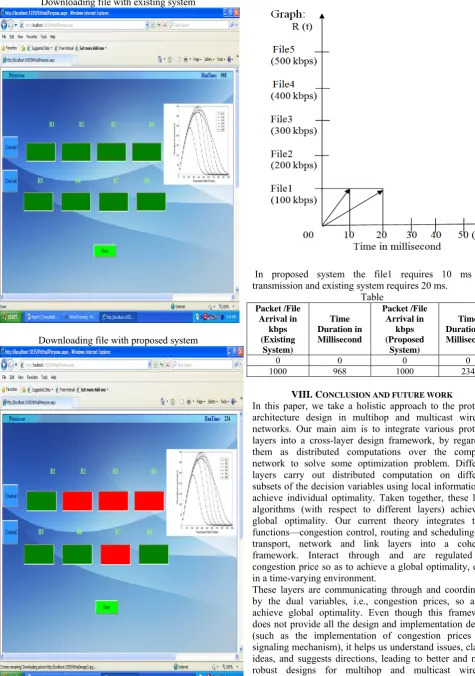
To start server the by executing the server code and get it connected with the clients. Then the approaches will be displayed as a existing system and proposed system. Latter the client requests to fetch the server IP and connect successfully. The client checks the availability of file on server. If file available then browse the file on server. The server sending the files and clients going to receive the file.The receivers downloading the files successfully depending on availability of memory. In the existing system the client receiving files on receivers with more time without the knowledge of resources. In proposed system the receivers receiving files with less time and the knowledge of resources.
Output Snapshots
Start_Server:
Start Client
Checks the availability of file
Receiving files on client
Downloading file with existing system
Downloading file with proposed system
In proposed system the file1 requires 10 ms for transmission and existing system requires 20 ms.
Table
Packet /File Arrival in
kbps (Existing
System)
Time Duration in Millisecond
Packet /File Arrival in
kbps (Proposed
System)
Time Duration in Millisecond
0 0 0 0 1000 968 1000 234
VIII. CONCLUSION AND FUTURE WORK
In this paper, we take a holistic approach to the protocol architecture design in multihop and multicast wireless networks. Our main aim is to integrate various protocol layers into a cross-layer design framework, by regarding them as distributed computations over the computer network to solve some optimization problem. Different layers carry out distributed computation on different subsets of the decision variables using local information to achieve individual optimality. Taken together, these local algorithms (with respect to different layers) achieve a global optimality. Our current theory integrates three functions—congestion control, routing and scheduling—in transport, network and link layers into a coherent framework. Interact through and are regulated by congestion price so as to achieve a global optimality, even in a time-varying environment.
REFERENCES
[1] Weiyan Ge, Student Member, IEEE, Junshan Zhang, Member, IEEE, and ShermannShen, Senior Member, IEEE “ A Cross-Layer Design Approach to Multicast in Wireless Networks ”, IEEE TRANSACTIONS ON WIRELESS COMMUNICATIONS, VOL. 6, NO. 3 MARCH 2007.
[2] ERIC SETTON, TAESANG YOO, XIAOQING ZHU, ANDREA GOLDSMITH, AND BERND GIROD STANFORD UNIVERSITY,“ CROSS-LAYER DESIGN OF AD HOC NETWORKS FOR REAL-TIME VIDEO STREAMING ”, IEEE Wireless Communications August 2005.
[3] Tim Verrall, David Westcott, and Lilin Xie “ Optimizing WAN Performance for the Global Enterprise”, White Paper Optimizing WAN Performance for the Global Enterprise, Intel Corporation May 2006.
[4] Sanjay Shakkottai, Theodore S. Rappaport and Peter C. Karlsson, “Cross-layer Design for Wireless Networks”, June 23, 2003. [5] V. Srivastavaand M. Motani, Cross-Layer Design: A Survey and the
Road Ahead, IEEE Communications Magazine, December 2005. [6] William Stallings,Wireless Communications and Networks, Pearson
Education Inc.at Prentice Hall © 2005.