Analysis for Deadlock Detection and Resolution
Techniques in Distributed Database
Shweta Thakur
1& Kunal Deswal
21 (Student, Dept. of Information Technology DCE, Gurgaon, India)
Email: [email protected]
2 (Student, Dept. of Information Technology DCE, Gurgaon, India)
ABSTRACT
In an appropriated nature, where the information is spread over a few destinations there are numerous concerns to manage, for example, concurrency control, stop. Deadlocks affect the general execution of the framework. A deadlock is a condition in a framework where a procedure can't continue in light of the fact that it needs to get an asset held by an alternate methodology which it itself is holding an asset that alternate process needs. In writing different systems have been examined which are utilized to forestall, identify and resolve the deadlocks. In this paper we have
investigated the deadlock location and
determination procedures that are utilized. We have audited in detail the calculations introduced by B.
M.Alom[2] for deadlock discovery and
determination in dispersed environment and found that when we rework the request of the transactions pair in the calculation by Aloms[2] then it totally neglects to catch the stops.
Keywords- Deadlocks, framework, transactions
1. INTRODUCTION
Conveyed database frameworks (DDBS) comprise of diverse number of destinations which are interconnected by a correspondence system. In such an asset imparting environment the database exercises can be performed both at the nearby and worldwide level so if the allotment of the asset is not appropriately controlled than it may prompt a circumstance that is alluded to as stop. In Distributed database framework display, the database is thought to be disseminated over a few
interconnected machine frameworks. Clients
communicate with the database by means of transactions. A transaction is arrangements of exercises, for example, read, composes, bolt, or open operations. In the event that the activities of a
transaction include information at a solitary site, the transaction is said to be nearby, then again a worldwide transaction include assets at a few destinations. A stop may happen when a transaction enters into hold up state, i.e. at the point when appeal is not conceded because of non-accessibility of the assets as the asked for asset is constantly held by an alternate holding up transaction. In such a circumstance, holding up transaction might never get an opportunity to transform its state. Stop
representation methods for their simple
identification have been talked about generally in the writing and graphical representation has been discovered to be most suitable and compelling procedure. A stop can be demonstrated by a cycle in the coordinated diagram called Wait-for-Graph (WFG) [4] that speaks to the conditions among the methodologies. A hub in the diagram G speaks to a transaction and a guided edge from vertex i to vertex j exist in G, if Ti (Transaction i) needs an asset, which is constantly held by Tj (Transaction j). For instance, in Fig 1 a transaction T1 has bolted information thing P and needs to bolt thing Q, T2 has bolted thing Q and needs to bolt thing P. For this situation the transactions are sitting tight for one another and no transaction can keep coming about into a halt.
In dispersed database framework three methods
are for the most part utilized for taking care of the halts: Deadlock shirking, Deadlock aversion and Deadlock discovery.
Deadlock Avoidance: Deadlock evasion is a methodology in which gridlocks are managed before they happen. At the point when a transaction asks for a lock on an information thing that has been bolted by some an alternate transaction in an inconsistent mode, the halt evasion calculation chooses if the asking for transaction can hold up or if one of the holding up transactions need to be prematurely ended.
Deadlock Prevention: It is an approach that keeps the framework from conferring a portion of bolts that will inevitably prompt a gridlock. This procedure requires pre acquisition of all locks. The transactions are obliged to bolt the whole information thing that they require before execution. Gridlock anticipation manages stop early.
Deadlock Detection: In this methodology, halt may have officially happened and the stop discovery system tries to identify it and gives the procedure by which it can be determined. In this manner the framework intermittently checks for them. The presence of a controlled cycle in the Wait-for-Graph shows a halt. One transaction in the cycle called victimized person is prematurely ended, in this way breaking the stop. We have dissected in detail the calculations introduced by B. M. Alom [2] for distinguishing and determining stops in nature's turf. In area 2, we talk about the transaction model. In segment 3, we take up the late work and break down the commitments made by a few specialists managing anticipation, identification and determining of the gridlocks. In area 4, we take a case to look at the working of systems by B. M Alom [2] in subtle elements. In area 5, we give the closing comments.
2. DISTRIBUTED TRANSACTION MODEL
We next take up a disseminated transaction model [1, 3] its general structure is indicated in Fig 2. In this every hub has the accompanying modules: a Transaction Manager (TM), a Data Manager (DM), a scheduler (S), and a Transaction Process (T). The Transaction Manager (TM) present at each one appropriated site controls the execution of every
transaction process (T).The transactions correspond with Tms, and thusly Tms speak with Data Managers (Dms), the Data Manager, deals with the real information at each one conveyed site. A solitary TM oversees every transaction executed in the DDBMS. The transaction issues every last bit of its database operations to its specific transaction chief.
Fig 2: Distributed Transaction Model
The Transaction supervisor controls the execution of the diverse transaction which requires the information thing for their execution. It does so by reaching with the information administrator present at that specific site. Anyhow if the transaction procedure obliges an information thing, which is not show at the site where it starts, the transaction administrator contacts the information chief of the other site where the obliged information thing really dwells. The scheduler thusly, at each one site, synchronizes the transaction asks for and performs gridlock location. A transaction may ask for different information questions all the while.
3. RELATED WORK
Diverse conveyed gridlock discovery and
gridlocks. Chandy et. al. [4] utilized a Transaction
Wait-for-Graph (TWFG) to speak to the status of transaction at the neighbourhood locales and tests to identify worldwide stop. They called the calculation, as test reckoning by which a transaction Ti figures out whether it is stopped or not. A test is issued if a transaction starts to hold up for an alternate transaction and gets engendered starting with one site then onto the next focused around the status of the transaction that got the test. The tests are implied just for stop location. A transaction sends at most one test in any test processing. On the off chance that the initiator of the test reckoning gets back the test, then it is included in a gridlock. They found that this plan does not experience the ill effects of false halt identification. Menasce D. A. et. al. [9] portrays two conventions for the location of gridlocks in disseminated information bases: a progressively composed and an appropriated. A diagram model, which portrays the state of execution of all transactions in the framework, is utilized by both conventions. A cycle in this diagram is a vital and sufficient condition for a halt to exist. Qinqin et. al. [14] have utilized the guideline of nearness grid, way framework and unequivocally joined part of basic coordinated chart in diagram hypothesis. They have proposed a model for identifying stop by investigating emphatically joined part from asset assignment diagram. The trial demonstrates that it can catch assets and courses of action included in halt successfully. B. M. Alom [2] has presented the halt identification and determination strategy which utilizes the idea of making the structure table named LTS and DTS for catching the nearby and worldwide stop. In this calculation at whatever point a gridlock cycle is distinguished, the needs of the transactions constituting the stop are checked. The transaction with the slightest need is prematurely ended so that the assets held by it can be set free and can be allowed over to the holding up transactions. Anyhow it has been observed that on the off chance that we revamp the request of transaction match in LTS and DTS than this calculation totally neglect to discover the gridlocks.
4. ILLUSTRATIVE EXAMPLE FOR PERFORMANCE ANALYSIS
Give us a chance to take two locales, Site1 and Site2. Various transactions are running on both the destinations. In this case we have considered
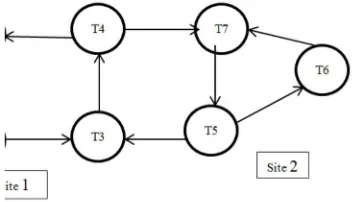
transactions T1, T2, T3, T4 executing on Site1 and transactions T5, T6, T7 executing on Site2 as indicated in Fig. 3. We have dissected the methods in the accompanying sub areas. 4.1 Using B. M. Alom Technique In this strategy two transaction structures are utilized: one is straight transaction structures (LTS) which is utilized to discover gridlock for each one site provincially and conveyed transaction structures (DTS), which is utilized to distinguish halts in nature's turf. On the off chance that any transaction Tp demands an information thing that is held by an alternate transaction Tq, estimations of p and q are put away on the neighbourhood transaction structure (LTS), where p and q speak to their comparing transaction numbers comparatively if there is an edge from Ta to Tb, both fitting in with distinctive locales, then a relating passage is carried out in their DTS. Separated from these transaction structures, they have utilized a transaction line which comprises of transaction id and their needs. The LTS for both the locales is indicated in Table 1.
Fig 3: A Distributed environment having 2 site
Table 1: LTS forSite1 and Site2
Table 2: Transaction queue with the priority_id
p q
1 2
2 3
3 4
4 1
p q 5 6 6 7 7 5
Tx_No P_id
1 1
2 2
3 3
4 4
Tx_No P_id
5 1
6 2
In LTS1 (Site1) there is one deadlock cycle
{1→2,2→3,3→4,4→1}and in LTS2 the deadlock
cycle is {5→6,6→7,7→5,}.According to table 2
the youngest transaction with lowest priority id is selected and it is aborted to make the system deadlock free. In the given scenario according to table 2 for LTS1 and LTS2 the transaction 4 and 7 is selected as they have the lowest priority. The
transaction pairs {4→1} and {7→5} are aborted.
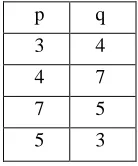
Now for detecting global deadlock, the intra connected transaction’s (those are connected to other sites) are seen to find out if there exist a global deadlock cycle. The DTS (Distributed transaction structure) for Site1 and Site2 is shown in Table 3.
Table 3: DTS for site 1 and site 2
The transaction queue for DTS is considered as it is created for LTS.As a result of which the transaction
pair {5→3} is aborted to free from global
deadlock. According to this approach, the TWFG without having any local or global deadlock cycle is shown in fig 4
Fig 4: A deadlock free TWFG of the two sites
We analyse that if we rearrange the transaction pair in LTS and DTS the BM Alom [2] technique completely fails to detect the local and global deadlock as there is a dependency of LTS and DTS structure on the directed edges of transaction wait for graph. We can eliminate this problem by passing on unique timestamp to each transaction.
5. CONCLUSIONS
Deadlocks in a distributed system radically reduce the performance of the system and therefore have to be detected and resolved as soon as possible for the efficiency of the systems. After analyzing various techniques we have found that the technique presented by B. M. Alom (section 4.1)[2] is detecting deadlocks correctly if the priorities are taken in the same order as taken by him in his paper but if we take any other order then it detects false deadlocks. It means that there is a complete dependency on directed edges of wait for graph in the B.M Alom technique [2]. The concept of time stamping could be used to abort the younger transaction in our future work.
6. REFERENCES
[1]. Alom B.M. Monjurul, Frans Alexander
Henskens, Michael Richard Hannaford,
Optimization of Detected Deadlock Views of Distributed Database, International Conference on Data Storage and Data Engineering , pp.44-48, ISBN: 978-0-7695-3958-4, 2010
[2]. Alom B.M. Monjurul, Frans Alexander Henskens, Michael Richard Hannaford,“Deadlock Detection Views of Distributed Database”, IEEE Sixth International Conference on Information Technology: New Generations, Page(s):730–737, 2009
[3]. Carlos F. Alastruey, Federico Fariña, Jose Ramon Gonzalez de Mendivil, “A Distributed Deadlock Resolution Algorithm for the AND Model” IEEE transactions on parallel and distributed systems, Vol. 10, No. 5, pp. 433-447, May 1999.
[4]. Chandy K. M., Hass L. M and Misra J, Distributed Deadlock Detection, ACM Transaction on Computer Systems, Vol.1, No.2, pp.144-56, 1983.
[5]. Elmagarmid A. K. A Survey of Distributed
Deadlock Detection Algorithms, SIGMOD
RECORD, Vol. 15, No.3, pp. 37-45, 1986.
[6]. Gray J., A Straw Man Analysis of the Probability of Waiting and Deadlocks in a Database Systems, IBM Research Report, 1981
p q
3 4
4 7
7 5
[7]. Ho G. S. and Ramamoorthy C. V., Protocols
for Deadlock Detection in Distributed Database
Systems IEEE Transaction on Software
Engineering, Vol. 8, No. 6, pp. 554-557, 1982.
[8]. Mehdi Hashemzadeh, Nacer Farajzadeh, Abolfazl T. Haghighat, "Optimal Detection and Resolution of Distributed Deadlocks in the Generalized Model," 14th Euromicro International Conference on Parallel, Distributed, and Network-Based Processing (PDP'06), pp.133-136, 2006
[9]. Menasce D. A. and Muntz R. R., Locking and Deadlock Detection in Distributed Data Bases, IEEE Transaction on Software Engineering, Vol. 5, No.3, pp. 195-202, 1979.
[10]. Merritt M. J. and Mitchell D. P. "A Distributed Algorithm for Deadlock Detection and Resolution," in ACM, Vol. 2, No. 3, pp. 95-99, 1984.
[11]. Singhal Mukesh “Deadlock Detection in Distributed System” IEEE transaction on Software Engineering, Vol. 4, No. 3, pp. 195-199, 1989.
[12]. Jain Kamal, MohammadTaghi Hajiaghayi and
Kunal Talwar, The Generalized Deadlock
Resolution Problem, autoomata, Languages and Programming, Lecture Notes in Computer Science,
2005, Volume 3580/2005, 103, DOI:
10.1007/11523468_69
[13]. Nacer Farajzadeh, Mehdi Hashemzadeh, Morteza Mousakhani, Abolfazl T. Haghighat, An Efficient Generalized Deadlock Detection and Resolution Algorithm in Distributed Systems, Fifth
International Conference on Computer and
Information Technology (CIT'05), pp.303-309, 2005
[14]. Qinqin Ni, Weizhen Sun, Sen Ma, Deadlock Detection Based on Resource Allocation Graph, Fifth International Conference on Information Assurance and Security, vol. 2, pp.135-138, 2009
[15]. Selvaraj Srinivasan, R. Rajaram, A
decentralized deadlock detection and resolution algorithm for generalized model in distributed systems, Distributed and Parallel Databases, Vol. 29, No. 4,pp. 261-276, DOI: 10.1007/s10619-011-7078-7