On a ‘time’ reparametrization in relativistic electrodynamics with travelling
waves
GaetanoFiore1,2,
1Dip. di Matematica e Applicazioni, Università di Napoli “Federico II”, Complesso Universitario MSA, Via Cintia, Napoli, Italy 2INFN, Sezione di Napoli, Complesso Universitario M. S. Angelo, Via Cintia, Napoli, Italy
Abstract. We briefly report on our method [23] of simplifying the equations of motion of charged particles in an electromagnetic (EM) field that is the sum of a plane travelling wave and a static part; it is based on changes of the dependent variables and the independent one (light-like coordinateξinstead of timet). We sketch its application to a few cases of extreme laser-induced accelerations, both in vacuum and in plane problems at the vacuum-plasma interface, where we are able to reduce the system of the (Lorentz-Maxwell and continuity) partial differential equations into a family of decoupled systems of Hamilton equations in 1 dimension. Since Fourier analysis plays no role, the method can be applied to all kind of travelling waves, ranging from almost monochromatic to socalled “impulses".
1 Introduction and set-up
The equation of motion of a particle with chargeqin ex-ternal electric and magnetic fieldsE(x),B(x) [x≡(ct,x)] in
its general form is non-autonomous and highly nonlinear: ˙
p(t)=qE[ct,x(t)]+qβ(t)∧B[ct,x(t)],
˙
x(t)= cp(t)
m2c2+p2(t);
(1)
hereβ≡v/c,p≡mv/1−β2is its relativistic momentum.
Usually, (1) is simplified assuming:
1. E,Bare constant or vary “slowly” in space/time; or
2. E,Bare “small" (so that nonlinear effects inE,Bare
negligible); or
3. E,B are monochromatic waves, or slow modula-tions of; or
4. the motion of the particle keeps non-relativistic.
The astonishing developments of Laser technologies (especiallyChirped Pulse Amplification[2, 3]) today al-low the construction of compact sources of extremely in-tense (up to 1023W/cm2) coherent EM waves, possibly
concentrated in very short laser pulses (fs). Even more intense/short (or cheaper) laser pulses by new
technolo-gies (thin film compression [4], etc.) will be soon avail-able. In particular, these lasers can be used for making small particle-accelerators based on Laser Wake Field Ac-celeration (LWFA) [5] in plasmas. Extreme conditions are present also in several violent astrophysical processes (see
e-mail: [email protected]
e.g. [6] and references therein). In either case the effects
are so fast, huge, highly nonlinear, ultra-relativistic that conditions 1-4 are not fulfilled. Alternative simplifying approaches are therefore desirable.
Here we summarize a new approach [23] that is espe-cially fruitful if in the spacetime regionΩof interest (i.e.,
where we wish to follow the charged particles’ worldlines)
E,Bcan be decomposed into a static part and a plane trans-verse travelling wave propagating in thezdirection:
E(x)= ⊥(ct−z)
pump=travelling wave
+Es(x) static
,
B(x)= k∧⊥(ct−z)
travelling wave
+Bs(x) static
, (2)
x=xi+yj+zk,⊥⊥k. We decompose vectors asu=u⊥+uzk.
We assumeonlythat⊥(ξ) is piecewise continuous and
a) ⊥has a compact support [0,l],
or a’) ⊥ ∈L1(R),
(3)
⇒ α⊥(ξ)≡− ξ
−∞dy
⊥(y)→0 asξ→−∞; (4)
α⊥is the travelling-wave part of the transverse EM
poten-tialA⊥. a)⇒α⊥(ξ)=0 ifξ≤0,α⊥(ξ)=α⊥(l) ifξ≥l. We
can treat on the same footing all such⊥, in particular:
1. A modulated monochromatic wave fulfilling (3):
⊥(ξ)= (ξ)
modul.
[ia1cos(kξ+ϕ)+ja2sin(kξ)]
carrier wave⊥ o(ξ)
(5)
⇒ −α⊥(ξ)=(ξ)
k2 o⊥(ξ)+O
1
k2
k(ξ2)⊥ o(ξ); (6)
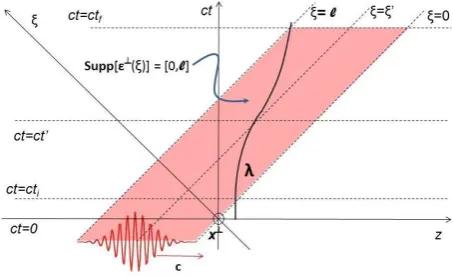
Figure 1.Every worldlineλand hyperplaneξ=C intersect once.
2. A superposition of waves of type 1.
3. An ‘impulse’ (few cycles, or even a fraction of).
The idea is: as no particle can reach the speed of lightc, ˜
ξ(t)=ct−z(t) is strictly growing, and we can adoptξ=ct−z
as a parameter on the worldlineλ(see fig. 1) and in the action functional of the particle:
S(λ)=−
λ
mc2dτ+qA(x)
=− t1
t0
dt mc2+qu
µA µ γ
L[x,˙x,t] =−
ξ1
ξ0 dξ
c
mc2+quˆµAˆ µ
ˆ
s
L[ˆx,ˆx,ξ]
;
(uµ)=(u0,u)≡(γ, γβ) is the 4-velocity, i.e. the
dimen-sionless version of the 4-momentum. A(x)=Aµ(x)dxµ=
A0(x)cdt−A(x)·dx is the EM potential 1-form, E = −∂tA/c− ∇A0, B = ∇ ∧A (we use Gauss CGS units),
and we denote ˆx(ξ)=x(t), ˆf(ξ,xˆ)≡f(ct,x), ˆf≡dfˆ/dξfor all functions f(ct,x). Applying Hamilton’s principle and the Legendre transform we find simplified Lagrange, and Hamilton equations where the argument of⊥is the
inde-pendent variableξ, rather than the unknownct−z(t), and the new kinetic momenta are the dependent variables.
2 General results for one particle
To parametrizeλbyξwe have to replace dτ/dt=1/γ=
1−x˙2/c2 (τis the particle proper time) by
1 ˆ
s ≡ d(cτ)
dξ =
1+2ˆz−xˆ⊥2 >0. (7)
From p=mdx/dτ,γ=dt/dτ we find that thes-factorsˆis
the light-like component ˆu−=γˆ−uˆz of the 4-velocityu=
(u0,u)≡(γ,γβ)=p0
mc2,mcp
(all these are dimensionless), and ˆ
u=sˆxˆ. ˆγ,uˆz,β,ˆ xˆcan be expressed asrational functions of ˆu⊥,sˆ:
ˆ
γ=1+uˆ ⊥2+sˆ2
2 ˆs , uˆz=γˆ−sˆ, βˆ=
ˆ
u
ˆ
γ, (8)
ˆ
x⊥= uˆ⊥ ˆ
s , zˆ=
1+uˆ⊥2
2 ˆs2 −
1
2 (9)
By Hamilton’s principle, any extremum λ of S is the
worldline of a possible motion of the particle with initial positionx0at timet0and final positionx1at timet1. Hence
it fulfills Euler-Lagrange equations in both forms d dt∂L∂˙x = ∂L
∂x anddξd ∂ˆ∂xL =∂∂Lxˆ, equivalent to (1). The Legendre
trans-form yields the HamiltoniansH≡x˙·∂L∂˙x−L=γmc2+qA0and
ˆ
H≡xˆ·∂L
∂xˆ−L=γˆmc2+qAˆ0. ˆHis arationalfunction of
ˆ
x,Πˆ≡∂∂xLˆ, or, equivalently, of ˆs,uˆ⊥:
ˆ
H(ˆx,Πˆ;ξ)=mc21+sˆ 2+uˆ⊥2
2 ˆs +qAˆ0(ξ,xˆ), (10)
where
mc
2uˆ⊥=Πˆ⊥−qAˆ⊥(ξ,xˆ),
mc2sˆ=−Πˆz−qAˆ−(ξ,xˆ), (11)
while H(x,P,t)= m2c4+(cP−qA)2+qA0 (P≡ ∂L∂x˙ =
p+qcA) is not. Eq. (1) are also equivalent to the Hamilton
equations ˆx=∂Hˆ ∂Πˆ, Πˆ
=−∂Hˆ
∂xˆ. All the new equations (in
particular these ones) can be also obtained more directly from the old ones by putting a caret on all dynamical vari-ables and replacing d/dtby (csˆ/γˆ)d/dξ. Along the solu-tions ˆHgives the particle energy as a function ofξ. Under the EM field (2) eqs (1) amount to (9) and
ˆ
u⊥= q mc2
(1+zˆ) ˆE⊥
s+(ˆx∧Bˆs)⊥+⊥(ξ)
,
ˆ
s= −q mc2
ˆ
Ez
s−xˆ⊥·Eˆ⊥s+(ˆx⊥∧Bˆ⊥s)z
,
(12)
while theenergy gain(normalized tomc2) is
E ≡ Hˆ(ξ1mc)−H2ˆ(ξ0) = ξ1
ξ0
dξq⊥·uˆ⊥
ˆ
s (13)
in the interval [ξ0, ξ1]. Once solved (9-12), analytically or
numerically, to obtain the solution as a function of twe just need to invert ˆt(ξ)=ξ+zˆ(ξ) and setx(t)=xˆ[ξ(t)]. If
Es,Bs=const then eq. (12) are solved by
ˆ
u⊥ = q mc2
K
−α(ξ)+(ξ+ˆz)Es+xˆ∧Bs⊥,
ˆ
s= −q
mc2
Kz+ξEz
s−xˆ⊥·E⊥s+(ˆx⊥∧Bs)z
(14)
(Kj are integration constants) whereby (9) become three
1storder ordinary differential equations (ODE)rationalin
the unknown ˆx(ξ).
Contrary to (9-12), (1) is a transcendental system, and the unknown z(t) appears in the argument of the rapidly varying functions⊥,α⊥in (1)
1, which now reads: 1
qp˙(t)=Es+β∧Bs+⊥[ct−z(t)] (·βk+1−βz).
Also determiningE(t) is more complicated.
2.1 Dynamics under Aµ=Aµ(t,z)
This applies in particular to (2) ifEs=Ezs(z)k,Bs=B⊥s(z),
choosing e.g. A0=−zdζEz
s(ζ), A⊥=α⊥−k∧ z
dζB⊥(ζ), Az≡0. As∂Hˆ/∂xˆ⊥ =0, we find ˆΠ⊥=qK⊥ =const, i.e.
the known result mc2
q uˆ⊥=K⊥−Aˆ⊥(ξ,zˆ). Settingv:=uˆ⊥2and
replacing in (9)2, (12)2we obtain
ˆ
z=1+vˆ 2 ˆs2 −
1
2, sˆ= −
q
Figure 1.Every worldlineλand hyperplaneξ=C intersect once.
2. A superposition of waves of type 1.
3. An ‘impulse’ (few cycles, or even a fraction of).
The idea is: as no particle can reach the speed of lightc, ˜
ξ(t)=ct−z(t) is strictly growing, and we can adoptξ=ct−z
as a parameter on the worldlineλ(see fig. 1) and in the action functional of the particle:
S(λ)=−
λ
mc2dτ+qA(x)
=− t1
t0
dt mc2+qu
µA µ γ
L[x,˙x,t] =− ξ1 ξ0 dξ c
mc2+quˆµAˆ µ
ˆ
s
L[ˆx,ˆx,ξ]
;
(uµ)=(u0,u)≡(γ, γβ) is the 4-velocity, i.e. the
dimen-sionless version of the 4-momentum. A(x)=Aµ(x)dxµ=
A0(x)cdt−A(x)·dx is the EM potential 1-form, E = −∂tA/c− ∇A0, B = ∇ ∧A(we use Gauss CGS units),
and we denote ˆx(ξ)=x(t), ˆf(ξ,xˆ)≡f(ct,x), ˆf≡dfˆ/dξfor all functions f(ct,x). Applying Hamilton’s principle and the Legendre transform we find simplified Lagrange, and Hamilton equations where the argument of⊥is the
inde-pendent variableξ, rather than the unknownct−z(t), and the new kinetic momenta are the dependent variables.
2 General results for one particle
To parametrizeλbyξwe have to replace dτ/dt=1/γ=
1−x˙2/c2 (τis the particle proper time) by
1 ˆ
s ≡ d(cτ)
dξ =
1+2ˆz−xˆ⊥2 >0. (7)
From p=mdx/dτ,γ=dt/dτ we find that thes-factorsˆis
the light-like component ˆu−=γˆ−uˆz of the 4-velocityu=
(u0,u)≡(γ,γβ)=p0
mc2,mcp
(all these are dimensionless), and ˆ
u=sˆxˆ. ˆγ,uˆz,β,ˆ xˆcan be expressed asrational functions of ˆu⊥,sˆ:
ˆ
γ=1+uˆ ⊥2+sˆ2
2 ˆs , uˆz=γˆ−sˆ, βˆ=
ˆ
u
ˆ
γ, (8)
ˆ
x⊥= uˆ⊥ ˆ
s, zˆ=
1+uˆ⊥2
2 ˆs2 −
1
2 (9)
By Hamilton’s principle, any extremum λ of S is the
worldline of a possible motion of the particle with initial positionx0at timet0and final positionx1at timet1. Hence
it fulfills Euler-Lagrange equations in both forms d dt∂L∂˙x = ∂L
∂x anddξd ∂ˆ∂xL =∂∂Lxˆ, equivalent to (1). The Legendre
trans-form yields the HamiltoniansH≡x˙·∂L∂x˙−L=γmc2+qA0and
ˆ
H≡xˆ·∂L
∂xˆ−L=γˆmc2+qAˆ0. ˆHis arationalfunction of
ˆ
x,Πˆ≡∂∂xLˆ, or, equivalently, of ˆs,uˆ⊥:
ˆ
H(ˆx,Πˆ;ξ)=mc21+sˆ 2+uˆ⊥2
2 ˆs +qAˆ0(ξ,xˆ), (10)
where
mc
2uˆ⊥=Πˆ⊥−qAˆ⊥(ξ,xˆ),
mc2sˆ=−Πˆz−qAˆ−(ξ,xˆ), (11)
while H(x,P,t)= m2c4+(cP−qA)2+qA0 (P ≡ ∂L∂x˙ =
p+qcA) is not. Eq. (1) are also equivalent to the Hamilton
equations ˆx=∂Hˆ ∂Πˆ, Πˆ
=−∂Hˆ
∂ˆx. All the new equations (in
particular these ones) can be also obtained more directly from the old ones by putting a caret on all dynamical vari-ables and replacing d/dtby (csˆ/γˆ)d/dξ. Along the solu-tions ˆHgives the particle energy as a function ofξ. Under the EM field (2) eqs (1) amount to (9) and
ˆ
u⊥= q mc2
(1+zˆ) ˆE⊥
s+(ˆx∧Bˆs)⊥+⊥(ξ)
,
ˆ
s= −q mc2
ˆ
Ez
s−xˆ⊥·Eˆ⊥s+(ˆx⊥∧Bˆ⊥s)z
,
(12)
while theenergy gain(normalized tomc2) is
E ≡ Hˆ(ξ1mc)−H2ˆ(ξ0) = ξ1
ξ0
dξq⊥·uˆ⊥
ˆ
s (13)
in the interval [ξ0, ξ1]. Once solved (9-12), analytically or
numerically, to obtain the solution as a function of t we just need to invert ˆt(ξ)=ξ+zˆ(ξ) and setx(t)=xˆ[ξ(t)]. If
Es,Bs=const then eq. (12) are solved by
ˆ
u⊥= q mc2
K
−α(ξ)+(ξ+ˆz)Es+xˆ∧Bs⊥,
ˆ
s= −q
mc2
Kz+ξEz
s−xˆ⊥·E⊥s+(ˆx⊥∧Bs)z
(14)
(Kj are integration constants) whereby (9) become three
1storder ordinary differential equations (ODE)rationalin
the unknown ˆx(ξ).
Contrary to (9-12), (1) is a transcendental system, and the unknown z(t) appears in the argument of the rapidly varying functions⊥,α⊥in (1)
1, which now reads: 1
qp˙(t)=Es+β∧Bs+⊥[ct−z(t)] (·βk+1−βz).
Also determiningE(t) is more complicated.
2.1 Dynamics under Aµ=Aµ(t,z)
This applies in particular to (2) ifEs=Ezs(z)k,Bs=B⊥s(z),
choosing e.g. A0=−zdζEz
s(ζ), A⊥=α⊥−k∧ z
dζB⊥(ζ), Az≡0. As∂Hˆ/∂xˆ⊥ =0, we find ˆΠ⊥ =qK⊥=const, i.e.
the known result mc2
q uˆ⊥=K⊥−Aˆ⊥(ξ,ˆz). Settingv:=uˆ⊥2and
replacing in (9)2, (12)2we obtain
ˆ
z= 1+vˆ 2 ˆs2 −
1
2, sˆ= −
q
mc2Ezs(ˆz)−2 ˆ1s∂∂vzˆˆ. (15)
Once solved the system (15) in the unknowns ˆ
z(ξ),sˆ(ξ), the other unknowns are obtained from
ˆ
x(ξ)=x0+Yˆ(ξ), Yˆ(ξ)≡ ξ
ξ0 dyuˆ(y)
ˆ
s(y). (16) If in additionBs≡0, thenAs≡0 (in the Coulomb gauge),
ˆ
u⊥(ξ)= q
mc2K⊥−α⊥(ξ) and ˆv=uˆ⊥2 are already known. The system (15) to be solved simplifies to
ˆ
z=1+ˆv 2 ˆs2 −
1
2, sˆ= −
q
mc2Ezs(ˆz). (17)
Some remarkables properties of the solutions are [23]:
1. Where⊥(ξ)=0 then ˆv(ξ)=vc=const, ˆH is
con-served, (17) is solved by quadrature.
2. The final transverse momentum is mcu⊥(ξf). Ifof
(5) varies slowly andu⊥(0)=0, thenu⊥(ξf)0.
3. ˆs(ξ) is insensitive to fast oscillations of⊥, contrary
tou, γ,β, which can be reobtained via (8).
3 Some exact solutions for
B
s,
E
s=
const
Letb⊥+bk≡qBs/mc2,e⊥≡qE⊥
s/mc2 (constants),w(ξ)≡
qK−α⊥(ξ)+ξE
s/mc2 (all dimensionless); (14) take the
more explicit form ˆ
ux=(ex−by)ˆz+byˆ+wx(ξ),
ˆ
uy=(ey+bx)ˆz−bxˆ+wy(ξ),
ˆ
s=(ex−by) ˆx+(ey+bx)ˆy−wz(ξ),
(18)
For anyEz
s,Bzs,E⊥s, ifB⊥s=k∧E⊥s, settingκ≡qE
z s
mc2 we find the following exact solutions (part of them are new):
( ˆx+iyˆ)(ξ)=(1−κξ)ib/κ ξ
0dζ
(wx+iwy)(ζ)
(1−κζ)1+ib/κ ,
ˆ
z(ξ)= ξ 0 dζ 2 1
(1−κζ)2+xˆ
⊥2(ζ)−1, sˆ(ξ)=1−κξ,
ˆ
u⊥(ξ)=(1−κξ) ˆx⊥(ξ), γˆ(ξ)=1−κξ+uˆz(ξ)
ˆ
uz(ξ)= 1
2(1−κξ) +(1−κξ)
ˆ
x⊥2(ξ)−1
2 ;
(19)
here we have adopted the initial conditionsx(0)=0=u(0).
We next analyze a few special cases.
3.1 CaseEs=Bs=0(zero static fields)
Then (19) becomes [7, 8]:
ˆ
s≡1, uˆ⊥=−qα⊥ mc2 , uˆ
z=uˆ⊥2
2 , γˆ=1+uˆ
z
ˆ
z(ξ)= ξ
ξ0 dyuˆ
⊥2(y)
2 , xˆ⊥(ξ)=
ξ
ξ0 dyuˆ⊥(y).
(20)
The solutions (20) induced by twox-polarized pulses and the correspondinge−trajectories in thezxplane are shown in fig. 2. Note that:
• The maxima ofγ,α⊥ coincide (and approximately
also of(ξ), if(ξ) is slowly varying).
• Sinceuz≥0, thez-drift is positive-definite.
Rescal-ing⊥ → a⊥, ˆx⊥,uˆ⊥ scale likea, whereas ˆz,uˆzscale like a2(hence the trajectory goes to a straight line in the limit
a→∞). This is due to magnetic forceqβ∧B.
• Corollary The finaluand energy gain read
u⊥
f=uˆ⊥(∞), uzf =Ef =
1
2u⊥f2=γf−1; (21)
Both are very small if the pulse modulationis slow [ex-tremely small if ∈S(R) or ∈C∞
c(R)].
Recall the Lawson-Woodward Theorem [10–13] (an outgrowth of the original Woodward-Lawson Theorem [14, 15]): in spite of large energy variations during the interaction, the final energy gainEf of a charged particle Pinteracting with an EM field is zero if:
i) the interaction occurs inR3vacuum (no boundaries); ii)Es=Bs=0and⊥is slowly modulated;
iii)vzcalong the whole acceleration path; iv) nonlinear (in⊥) effectsqβ∧Bare negligible;
v) the power radiated byPis negligible.
Our Corollary, as Ref. [9], states the same result if we relax iii), iv), but the EM field is aplanetravelling wave.
To obtain a non-zeroEf one has to violate some other
conditions of the theorem, as e.g. we see in next cases.
3.2 Case Es=0, Bs=Bzsk
Then (19) becomes ˆs≡1 and
( ˆx+iyˆ)(ξ)= ξ
0dζe
ib(ζ−ξ)(wx+iwy)(ζ), uˆ⊥=xˆ⊥,
ˆ
uz=zˆ=uˆ⊥2
2 =E=γˆ−1, zˆ(ξ)=
ξ
0dζ
ˆ
u⊥2(ζ)
2 .
(22)
(22) reduces to the solution of [16, 17] for monochromatic
⊥. This leads tocyclotron autoresonanceif−b=k=2π λ 1
l: for circular polarization wx(ξ)+iwy(ξ)eikξw(ξ),
( ˆx+iyˆ)(ξ)iW(ξ)eikξ, W(ξ)≡ ξ
0dζw(ζ)>0
where w(ξ)≡q(ξ)/kmc2; clearlyW(ξ) grows withξ. In
particular if⊥(ξ)=0forξ≥l≡, then for suchξ
ˆ
z(ξ)k2
2W2(l)2Ef, | ˆ
x⊥(ξ)|
ˆ
z(ξ) 2
kW(l)1;
3.3 Case Es=Ezsk, Bs=0
Then the solution (19) reduces to ˆs(ξ)=1−κ ξ,
( ˆx+iyˆ)(ξ)= ξ
0
dy(w
x+iwy)(y)
1−κy , zˆ(ξ)= ξ 0 dy 2
1+ˆv(y) [1−κy]2−1
;
(23) If⊥is slowly modulated the energy gain (13)Ef is
Figure 2. Solutions (20) and e−trajectories in thezxplane induced by twox-polarized pulses with carrier wavelengthλ=.8µm,
gaussian modulation(ξ)=aexp[−ξ2/2σ],σ=20µm2, eaλ/mc2=4,15 (left, right).
pointκM<0 if(ξ) has a finite support with a unique max-imum. Here is an acceleration device based on this solu-tion: att =0 the particle initially lies at rest withz00,
just at the left of a metallic gratingGcontained in thez=0
plane and set at zero electric potential; another metallic platePcontained in a planez=zp>0 is set at electric
po-tentialV =Vp. A short laser pulse⊥hitting the particle
boosts it into the latter region through the ponderomotive force; choosingqVp>0 impliesκ=−qVp/zpmc2<0, and
a backward longitudinal electric forceqEz
s. IfqVpis large
enough, thenz(t) will reach a maximum smaller thanzp,
then is accelerated backwards and exits the grating with energyEf and negligible transverse momentum. A large Ef requires extremely large|Vp|, far beyond the material
breakdown threshold, what prevents its realization as a static field (namely, sparks betweenG,Pwould arise and rapidly reduce|Vp|). A way out is to make the pulse itself generate such large|Ezs|within a plasma at the right time so
as to induce the it slingshot effect, as sketchily explained
at the end of next section.
4 Plane plasma problems
Assume that the plasma is initially in hydrodynamic con-ditions with all initial data [velocities, densities nh, EM
fields of the form (2)] not depending on x⊥. Then also
the solutions forB,E,uh,nh,∆xh≡xh(t,X)−X
(displace-ments) do not depend onx⊥. Herex
h(t,X) is the position
attof theh-th fluid material element with initial position
X≡(X,Y,Z);Xh(t,x) is the inverse (at fixedt). More
Figure 2. Solutions (20) and e−trajectories in thezxplane induced by twox-polarized pulses with carrier wavelengthλ=.8µm,
gaussian modulation(ξ)=aexp[−ξ2/2σ],σ=20µm2, eaλ/mc2=4,15 (left, right).
pointκM<0 if(ξ) has a finite support with a unique max-imum. Here is an acceleration device based on this solu-tion: att = 0 the particle initially lies at rest withz00,
just at the left of a metallic gratingGcontained in thez=0
plane and set at zero electric potential; another metallic platePcontained in a planez=zp>0 is set at electric
po-tentialV =Vp. A short laser pulse⊥ hitting the particle
boosts it into the latter region through the ponderomotive force; choosingqVp>0 impliesκ=−qVp/zpmc2<0, and
a backward longitudinal electric forceqEz
s. IfqVpis large
enough, thenz(t) will reach a maximum smaller thanzp,
then is accelerated backwards and exits the grating with energyEf and negligible transverse momentum. A large Ef requires extremely large|Vp|, far beyond the material
breakdown threshold, what prevents its realization as a static field (namely, sparks betweenG,Pwould arise and rapidly reduce|Vp|). A way out is to make the pulse itself generate such large|Ezs|within a plasma at the right time so
as to induce the it slingshot effect, as sketchily explained
at the end of next section.
4 Plane plasma problems
Assume that the plasma is initially in hydrodynamic con-ditions with all initial data [velocities, densities nh, EM
fields of the form (2)] not depending on x⊥. Then also
the solutions forB,E,uh,nh,∆xh ≡xh(t,X)−X
(displace-ments) do not depend onx⊥. Herex
h(t,X) is the position
attof theh-th fluid material element with initial position
X≡(X,Y,Z);Xh(t,x) is the inverse (at fixedt). More
specif-ically, we consider the impact of an EM plane wave with a pump of the type (3.a) on a cold plasma at equilibrium (figure below); the initial conditions are:
uh(0,x)=0, nh(0,x)=0 if z≤0,
j0(0,x)=
hqhnh(0,x)≡0,
E(0,x)=⊥(−z), B(0,x)=k∧⊥(−z)+Bs.
(24)
Then Maxwell eq.s∇·E=4πj0,∂tEz/c+4πjz=(∇∧B)z=0
(the current density isj=
hqhnhβh=
hqhnh uh
γh) imply [8]
Ez(t,z)=4π
hqhNh[Zh(t,z)], (25)
whereNh(Z)≡0Zdζnh(0,ζ): we thus reduce by one the
number of unknowns, expressingEzin terms of the (still
unknown) longitudinal motion. A⊥ is coupled to the
cur-rents throughA⊥ =4πj⊥(in the Landau gauges).
Includ-ing (24) this amounts to the integral equation
A⊥−α⊥−Bs
2 ∧x=2π
dsdζ θ(ct−s−|z−ζ|)θ(s)j⊥s c, ζ
. (26)
The right-hand side (rhs) is zero fort≤0, becauset=0 is
the beginning of the laser-plasma interaction. Withinshort
time intervals [0,t] (to be determineda posteriori) we can approximate A⊥(t,z)α⊥(ct−z)+Bs
2∧x; we also neglect
the motion of ions with respect to that of electrons. Then the Hamilton equations for the electron fluid with ‘time’ξ
and the initial conditions amount to (9) and
mc2sˆ
e(ξ,Z)=4πe2
N(ˆze)−N(Z)
+e(ˆx⊥ e∧Bˆ⊥s)z,
mc2uˆ⊥
e(ξ,Z)=eα⊥−e(ˆxe∧Bˆs)⊥,
(27)
ˆ
xe(0,X)=X, uˆe(0,X)=0 ⇒ sˆe(0,X)=1. (28)
this is a family parametrized by Z of decoupled ODEs
which can be solved numerically. The approximation on
A⊥(t,z) is acceptable as long as the so determined motion
makes |rhs(26)||α⊥+Bs
2∧x|; otherwise rhs(26) determines
the first correction toA⊥; and so on.
IfBs=0, again (27)2 is solved by ˆu⊥e(ξ)=eα⊥(ξ)/mc2,
while, settingv=uˆ⊥2, (9)
2, (27)1take [20] the form of (17)
∆zˆe=1+v
2 ˆs2−
1
2, sˆe=4 πe2
mc2
N[ˆze]−N(Z). (29)
Ifne(0,X)=n0=const forZ≥0, then as long as ˆze(ξ,Z)>0
(29), (28) reduce to thesameCauchy problemfor all Z:
∆= 1+v
2s2 −
1
2, s=M∆, (30)
∆(0)=0, s(0)=1 (31)
withM≡4πe2n0
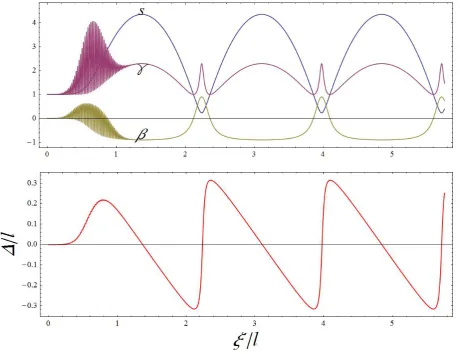
mc2 . In fig. 4 we show the solution if⊥is as in fig. 3 andn0=2×1018cm−3;s(ξ) is indeed insensitive to
the fast oscillations of⊥(see section 2.1). After the pulse
is passed it becomes periodic: a plasma travelling-wave of spacial periodξH 49µm follows the pulse. The other unknowns are obtained through (16). Replacing in rhs(26) we find thatA⊥α⊥is verified at least fort≤5ξH/c
The above results are based on a laser spot sizeR=∞
(plane wave). When including corrections due to the finite
R (based on causality and heuristic estimates), they im-ply: the impact of a very short and intense laser pulse on the surface of a cold low-density plasma (or gas, ionized
Figure 3. Normalized pump⊥ with carrier wavelength λ= 0.8µm, gaussian modulation(ξ)=aexp[−ξ2/2σ],σ=20µm2, eaλ/mc2=15, average pulse intensity 1019W/cm2, linear
polar-ization. l27µm is the length of the interval where the pump amplitudeovercomes the ionization threshold for the cold gas (here helium) yielding the plasma; under such pulses the thresh-olds for 1stand 2ndionization are overcome (i.e. Keldysh param-eters become smaller than 1) almost simultaneously [18, 19].
into a plasma by the pulse itself) may induce (for care-fully tunedR), beside a wakefield propagating behind the pulse [23, 24], also a backward acceleration and expulsion of surface electrons [20, 21] (slingshot effect), as
schemat-ically depicted in fig. 5. For reviews see also [22].
References
[1] G. Fiore, arXiv:1607.03482; submitted to J. Phys. A. [2] D. Strickland, G. Mourou, Opt. Commun.56(1985),
219.
[3] G. A. Mourou, T. S. Tajima, V. Bulanov, Rev. Mod. Phys.78(2006), 309.
[4] G. Mourou, S. Mironov, E. Khazanov, A. Sergeev, Eur. Phys. J.ST 223(2014), 1181.
[5] T. Tajima, J.Dawson, Phys.Rev.Lett.43(1979), 267. [6] T. Tajima, K. Nakajima, G. Mourou, Riv. N. Cim.40
(2017), 34.
[7] L.D. Landau, E.M. Lifshitz, The Classical Theory of Fields, 2nd edition, Pergamon Press, 1962.
[8] G. Fiore, J.Phys.A: M.Th.47(2014), 225501 [9] A. L. Troha et al., Phys. Rev.E 60(1999), 926. [10] J. D. Lawson, Eur. J. Phys.5(1984), 104.
[11] R. B. Palmer, inFrontiers of Particle Beams, Lecture Notes in Physics296, p. 607, Springer-Verlag, 1988. [12] R. B. Palmer, AIP Conf. Proc. No. 335 (1995), pp.
90-100; and references therein.
[13] E. Esarey, P. Sprangle, J. Krall Phys. Rev. E 52
(1995), 5443.
[14] P.M. Woodward, J. Inst. Electr. Eng.93(1947), 1554. [15] P. M. Woodward, J. D. Lawson, J. I.E.E.95, Part III
Figure 4.Solution of (29-8) corresponding to the pulse of fig. 3, initial densityne0(Z)=n0θ(Z),n0=2×1018cm−3.
Figure 5.Schematic stages of the slingshot effect.
[16] A.A. Kolomenskii, A.N. Lebedev, Sov. Phys. Dokl. 7 745 (1963); Sov. Phys. JETP 17 179 (1963).
[17] V. Ya. Davydovskii, Sov. Phys. JETP 16 629 (1963). [18] A. Pukhov,Rep. Prog. Phys.65(2002), R1-R55. [19] D. Jovanovi´c, R. Fedele, F. Tanjia, S. De Nicola, L.
A. Gizzi,Eur. Phys. J.D66(2012), 328.
[20] G. Fiore, S. De Nicola, PRAB 19(2016), 071302; NIMA829(2016), 104.
[21] G. Fiore, R. Fedele, U. de Angelis, Phys. Plasmas21
(2014), 113105.
[22] G. Fiore, Acta Appl. Math. 132 (2014), 261; Ricerche Mat.65(2016), 491-503.
[23] G. Fiore,On the impact of short laser pulses on cold diluted plasmas, in preparation.
![Figure 2. Solutions (20) and e− trajectories in the zx plane induced by two x-polarized pulses with carrier wavelength λ = .8µm,gaussian modulation ϵ(ξ) = a exp[−ξ2/2σ], σ=20µm2, eaλ/mc2 =4, 15 (left, right).](https://thumb-us.123doks.com/thumbv2/123dok_us/8066990.1345040/4.595.66.542.71.435/figure-solutions-trajectories-polarized-carrier-wavelength-gaussian-modulation.webp)
![Figure 3.Normalized pump(here helium) yielding the plasma; under such pulses the thresh-olds for 1 ϵ⊥ with carrier wavelength λ =0.8µm, gaussian modulation ϵ(ξ) = a exp[−ξ2/2σ], σ = 20µm2,eaλ/mc2 = 15, average pulse intensity 1019W/cm2, linear polar-izatio](https://thumb-us.123doks.com/thumbv2/123dok_us/8066990.1345040/5.595.307.540.80.249/figure-normalized-yielding-carrier-wavelength-gaussian-modulation-intensity.webp)