Generalizing Efficient Multiparty Computation
Bernardo David1?, Ryo Nishimaki2, Samuel Ranellucci1, and Alain Tapp3 1
Department of Computer Science Aarhus University, Denmark
{bernardo,samuel}@cs.au.dk 2 Secure Platform Laboratories
NTT, Japan
DIRO
Universit´e de Montr´eal, Canada
Abstract. We focus on generalizing constructions of Batch Single-Choice Cut-And-Choose Oblivi-ous Transfer and Multi-sender k-out-of-n ObliviOblivi-ous Transfer, which are at the core of efficient secure computation constructions proposed by Lindellet al.and the IPS compiler. Our approach consists in showing that such primitives can be based on a much weaker and simpler primitive called Verifiable Oblivious Transfer (VOT) with low overhead. As an intermediate step we construct Generalized Obliv-ious Transfer from VOT. Finally, we show that Verifiable OblivObliv-ious Transfer can be obtained from a structure preserving oblivious transfer protocol (SPOT) through an efficient transformation that uses Groth-Sahai proofs and structure preserving commitments.
Keywords:Oblivious Transfer, Structure Preserving Cryptography, Secure Computation, Universal Composability, Groth-Sahai Proof System, IPS compiler.
1
Introduction
Secure multiparty computation (MPC) allows mutually distrustful parties to compute functions on private data that they hold, without revealing their data to each other. Obtaining efficient multiparty computation is a highly sought after goal of cryptography since it can be employed in a multitude of practical applications, such as auctions, electronic voting and privacy preserving data analysis. Notably, it is known that secure two-party computation can be achieved from the garbled circuits technique first proposed by Yao [Yao86] and that general MPC can be obtained from a basic primitive called oblivious transfer (OT), which was introduced in [Rab81,EGL85]. The basic one-out-of-two oblivious transfer (OT2
1) is a two-party primitive where asender inputs two messagesm0, m1and areceiver inputs a bitc, referred to as thechoice bit. The receiver learns mc but not m1−c and the sender learns nothing about the receiver’s choice (i.e. c). This primitive was proven to be sufficient for achieving MPC in [Kil88,GMW87,CvdGT95].
Even though many approaches for constructing MPC exist, only recently methods that can be efficiently instantiated have been proposed. Among these methods, the IPS compiler [IPS08] stands out as an important construction, achieving MPC without honest majority in the OT-hybrid model. In this work, we will focus on the cut-and-choose OT based construction and the improvement of the IPS compiler introduced by Lindell et al. [LP11,LP12,LOP11,Lin13].
In the approaches for obtaining efficient MPC presented in [LP11,Lin13], the authors employ cut-and-choose OT, where the sender inputsspairs of messages and the receiver can choose to learn both messages
b0, b1from s2 input pairs, while he only learns one of the messages in the remaining pairs. A batch version of this primitive is then combined with Yao’s protocol to achieve efficient MPC. In the improvement of the IPS compiler, the authors employ Multi-sender k-out-of-n OT, wherej senders input a set ofnmessages out of which a receiver can choose to receive k messages. These complex primitives are usually constructed from
?
specific number-theoretic and algebraic assumptions yielding little insight to their relationship with other generic and potentially simpler primitives.
In parallel to the efforts for obtaining efficient MPC, research has been devoted to obtaining constructions of basic primitives that can be efficiently combined between themselves in order to obtain more complex prim-itives and protocols. One of the main approach taken towards this goal has been calledstructure preserving cryptography, which aims at constructing primitives where basically all the public information (e.g. signa-tures, public keys, ciphertexts and commitments) are solely composed of bilinear group elements. This allows for the application of efficient Groth-Sahai non-interactive zero knowledge (NIZK) proof systems [GS08] (GS-Proofs) and efficient composition of primitives. Until now, the main results in this area have been structure preserving signature and commitment schemes [AFG+10,AGHO11] and encryption [CHK+11].
Our Contributions: The central goal of this paper is to present general constructions of the primitives used as the main building blocks in the frameworks of [LP11,LOP11,LP12,Lin13] in the universal composability model [Can01]. In contrast to previous works, we presentgeneral reductions from such complex primitives to simpler variants of OT without relying on specific number theoretic assumptions. We present three main results:
– General constructions of Multi-sender k-out-of-n OT (MSOT) and Batch Single Choice Cut-and-Choose OT (CACOT) from Generalized OT (GOT): We show that MSOT and CACOT can be obtained GOT [IK97] combined with proper access structures. Differently from the original constructions of [LP11,LP12,LOP11,Lin13], our constructions are based on a simple generic primitive, not requiring Committed OT or specific computational assumptions. These constructions can be readily used to instantiate the MPC frameworks presented in [LP11,LP12,LOP11,Lin13].
– Generalized Oblivious Transfer based on Verifiable Oblivious Transfer: Verifiable Oblivious Transfer (VOT) [CC00,JS07,KSV07] is a flavor of 1-out-of-2 OT where the sender can reveal one of his messages at any point during the protocol execution allowing the receiver to verify that this message is indeed one of the original sender’s inputs. We show that GOT can be obtained from VOT, generalizing even more the constructions described before. Our generic construction of GOT may be of independent interest.
– Structure Preserving Oblivious Transfer (SPOT) and a generic composable constructions of Verifiable Oblivious Transfer:We introduce SPOT, which is basically a 1-out-of-2 OT compati-ble with GS-Proofs , i.e.the sender’s messages and the protocol transcript are generated from pairing product equations over bilinear groups, being represented solely by group elements. We then build on this characteristic to provide a generic (non black-box) construction of VOT from any SPOT protocol combined with structure preserving extractable or equivocable commitments and Groth-Sahai NIZKs. Differently from the VOT protocols of [CC00,JS07,KSV07], our constructions are modular and indepen-dent of specific assumptions. Moreover, we provide a concrete round optimal SPOT protocol based on a framework by Peikert et al. [PVW08] and observe that the protocols in [CKWZ13] fit our definitions. This notion is also of independent interest in other scenarios besides general MPC.
Our contributions are two-fold, showing that efficient MPC can be based on a weaker simpler primitive (i.e.VOT) and providing a generic method for constructing such a primitive. Our results generalize previous approaches for efficient MPC by providing constructions ultimately based on SPOT rather than the original Multi Sender k-out-of-n OT and Batch Single Choice Cut-and-Choose OT. Such general constructions help understand the relationship between these complex variants of oblivious transfer and simpler primitives.
1.1 Efficiency
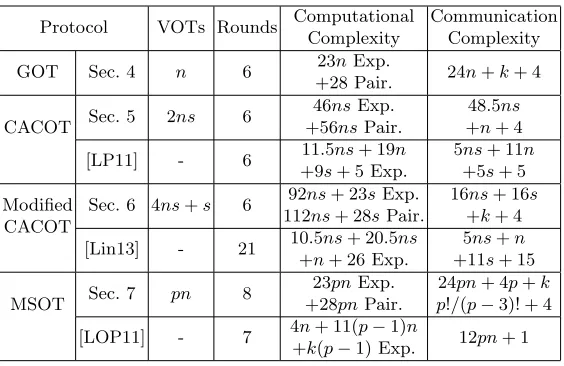
Our constructions are as efficient as the underlying NIZK proof system, structure preserving commitment and SPOT. Hence, they can easily take advantage of more efficient constructions of these primitives. In Table 1, we present an estimate of the concrete complexity of our protocols when instantiated with GS-Proofs and commitments [GS08] and our structure preserving variant of the DDH based UC secure OT of [PVW08] introduced in Section 3.
overheads, which is expected since we do not optimize our protocols for an specific number theoretic as-sumptions as in previous works. Notice that our VOT construction using the SPOT protocol from Section 3 as a building block has a small overhead 4 exponentiations and 1 round when used as a basic 1-out-of-2 OT protocol. TheReveal andVerification phases required by the VOT functionality introduce a higher overhead since they require generating and verifying a NIZK proof. We remark that independently of their concrete efficiency, our protocols are the first to realize MSOT and CACOT from generic primitives without relying on specific number theoretic assumptions.
Protocol VOTs Rounds Computational Complexity
Communication Complexity
GOT Sec. 4 n 6 23nExp.
+28 Pair. 24n+k+ 4
CACOT Sec. 5 2ns 6
46nsExp. +56nsPair.
48.5ns
+n+ 4
[LP11] - 6 11.5ns+ 19n +9s+ 5 Exp.
5ns+ 11n
+5s+ 5
Modified CACOT
Sec. 6 4ns+s 6 92ns+ 23sExp. 112ns+ 28s Pair.
16ns+ 16s
+k+ 4
[Lin13] - 21 10.5ns+ 20.5ns +n+ 26 Exp.
5ns+n
+11s+ 15
MSOT Sec. 7 pn 8
23pnExp. +28pnPair.
24pn+ 4p+k p!/(p−3)! + 4
[LOP11] - 7 4n+ 11(p−1)n
+k(p−1) Exp. 12pn+ 1
Table 1. Efficiency of our protocols compared to previous constructions based on DDH. The column VOTs shows the number of VOTs needed in our general constructions, “-” marks the previous protocols that do not enjoy general constructions. Exp. stands for exponentiations and Pair. stands for bilinear pairings.nandsexpress the number of inputs according to each protocol (explained in the respective sections),p is the number of senders in MSOT and
kis the number of messages transferred to the receiver. Communication complexity is stated in terms of number of group elements exchanged.
2
Preliminaries
Notations and Conventions. For anyn∈N\ {0}, let [n] be the set{1, . . . , n}. WhenD is a random variable
or distribution,y←R Ddenotes thatyis randomly selected fromDaccording to its distribution. IfSis a set, thenx←U S denotes thatxis uniformly selected fromS.y:=z denotes thaty is set, defined or substituted byz. Whenb is a fixed value,A(x)→b (e.g.,A(x)→1) denotes the event that machine (or algorithm)A
outputsb on input x. We say that a functionf :N→Ris negligible in λ∈Nif for every constant c∈N
there exists kc ∈N such thatf(λ)< λ−c for any λ > kc. Hereafter, we use f <negl(λ) to mean that f is negligible inλ. We writeX ≈ Yc to denote thatX andY are computationally indistinguishable.
Bilinear Groups. LetGbe a bilinear group generator that takes security parameter 1λas input and outputs a description of bilinear groups Λ:= (p,G,H,GT, e, g,ˆg) whereG, Hand GT are groups of prime orderp,
g and ˆg are generators inGandH, respectively,eis an efficient and non-degenerate mape:G×H→GT. If G= H, then we call it the symmetric setting. If G6= Hand there is no efficient mapping between the
groups, then we call it the asymmetric setting.
Symmetric External Decisional Diffie-Hellman Assumption. Intuitively, SXDH is the assumption that the DDH assumption holds for both groups G and H in a bilinear group Λ. Let GDDH1(1λ) be an algorithm that on input security parameter λ, generates parameters Λ := (p,G,H,GT, e, g,ˆg)
R
the bilinear group generator introduced in the previous paragraph.), chooses exponents x, y, z ←U Zp, and outputs I := (Λ, gx, gy) and (x, y, z). When an adversary is given I ← GR DDH1(1λ) andT ∈
G, it attempts
to distinguish whetherT =gxy orT =gz. This is called the DDH1 problem. The advantageAdvDDH1A (λ) is defined as follows:
AdvDDH1A (λ) := Pr
h
A(I, gxy)→1
(I, x, y, z)
R
← GDDH1(1λ);i
−PrhA(I, gz)→1
(I, x, y, z)
R
← GDDH1(1λ);i
Definition 1 (DDH1 assumption).We say that the DDH1 assumption holds if for all PPT (Probabilistic Polynomial Time) adversaries A,AdvDDH1A (λ)<negl(λ).
The DDH2 assumption is similarly defined in terms of groupH. If both DDH1 and DDH2 assumptions hold simultaneously, then we say that the symmetric external Diffie-Hellman (SXDH) assumption holds.
2.1 Universal Composability
The Universal Composability framework was introduced by Canetti in [Can01] to analyse the security of cryptographic protocols and primitives under arbitrary composition. In this framework, protocol security is analysed by comparing an ideal world execution and a real world execution under the supervision of anenvironment Z, which is represented by a PPT machine and has access to all communication between individual parties. In the ideal world execution, dummy parties (possibly controlled by a PPT simulator) interact directly with the ideal functionalityF, which works as a fully secure third party that computes the desired function or primitive. In the real world execution, severalPPT parties (possibly corrupted by a real world adversary A) interact with each other by means of a protocolπthat realizes the ideal functionality. The real world execution is represented by the ensemble EXECπ,A,Z, while the ideal execution is represented
by the IDEALF,S,Z. The rationale behind this framework lies in showing that the environmentZis not able
to efficiently distinguish between EXECπ,A,Z and IDEALF,S,Z, thus implying that the real world protocol
is as secure as the ideal functionality. It is known that a setup assumption is needed for UC realizing oblivious transfer as well as most “interesting” ideal functionalities [CF01]. In this work we consider security against static adversaries,i.e. the adversary can only corrupt parties before the protocol execution starts. We consider malicious adversaries that may deviate from the protocol in any arbitrary way. See [Can01] for further details.
Definition 2. A protocol π is said to UC-realize an ideal functionalityF if, for every adversary A, there exists a simulator S such that, for every environment Z, the following holds:
EXECπ,A,Z
c
≈IDEALF,S,Z
We present oblivious transfer (FOT), commitment (FCOM), and common reference string (FCRSD ) ideal functionalities in Appendix A.
3
Generic Construction of Verifiable OT from Structure Preserving OT
In this section, we introduce Structure Preserving Oblivious Transfer (SPOT) and use it to construct verifi-able oblivious transfer (VOT). SPOT will be the basic building block of our efficient general constructions of secure multiparty computation. It is first used in a general transformation that yields VOT, which will be used to obtain generalized oblivious transfer (GOT) and more complex primitives later on.
Structure Preserving Oblivious Transfer
Definition 3 (Structure Preserving Oblivious Transfer). A structure preserving oblivious transfer protocol taking inputs m0, m1 from the sender and c from the receiver defined over a bilinear group Λ := (p,G,H,GT, e, g,gˆ)must have the following properties:
1. Each of the sender’s input messagesm0, m1 consists of elements ofGor H.
2. All the messages exchanged between SandR(i.e. the protocol transcript) consist of elements ofGand H.
3. The relation between the protocol inputs m0, m1, c and a given protocol transcript is expressed by a set of pairing product equations or multi exponentiation equations.
Notice that our general transformations can be applied to any OT protocol in a bit by bit approach, by mapping the binary representation of each element in a given protocol to specific group elements representing 0 and 1 and applying GS proofs individually to each of those elements. However, this trivial approach is extremely inefficient. The number of GS proofs and group elements exchanged between parties would grow polynomially. The first OT protocol to fit this definition was proposed in [GH08], but it relies simultaneously on the SXDH, the DLIN and the q-hidden LSRW assumptions. A recent result by Choi et. al. [CKWZ13] also introduced OT protocols based on DLIN and SXDH that match out definition of SPOT. However, these protocols already require a GS proof themselves, introducing extra overhead in applications that combine SPOT with GS proofs.
Obtaining SPOT from Dual-Mode Cryptosystems
The starting point for constructing SPOT is the general framework for universally composable oblivious transfer protocols proposed by Peikert et al. [PVW08] (hanceforth called PVW). The PVW framework provides a black-box construction of UC secure OT from dual-mode cryptosystems, which were initially instantiated under the DDH, QR and LWE assumptions. Essentially, this framework relies on an information theoretical reduction from UC secure OT to dual-mode cryptosystems in the CRS model, such that the resulting OT protocol inherits the characteristics of the underlying dual-mode cryptosystem. In order to obtain an OT protocol compatible with GS-proofs, we convert the DDH based dual-mode cryptosystem construction of [PVW08] into a scheme secure under the SXDH assumption (which can also be used to instantiate GS proofs). This scheme is then plugged in the PVW framework to obtain a UC secure OT protocol. Note that, in the resulting protocol, the CRS, all protocol messages and inputs are composed solely by group elements. Moreover, all the protocol messages are generated by pairing product equations. Therefore, we obtain a SPOT protocol whose security follows from the PVW framework. Our SXDH dual-mode cryptosystem is constructed as follows:
– SetupMessy(1λ)Λ:= (p,
G,H,GT, e, g,ˆg)
R
← G(1λ),g 0, g1
U
←G,x0, x1
U
←Zpwherex06=x1. Lethb:=gbxb forb∈ {0,1},crs:= (g0, h0, g1, h1), andt:= (x0, x1). It outputs (crs, t).
– SetupDec(1λ) Λ := (p,
G,H,GT, e, g,gˆ)
R
← G(1λ), g 0
U
← G, y ←U Z∗p, g1 := g0y, x
U
← Zp, hb := gxb for
b∈ {0,1},crs:= (g0, h0, g1, h1), andt:=y. It outputs (crs, t).
– Gen(σ)r←U Zp,g:=grσ,h:=hrσ,pk:= (g, h)∈G2,sk:=r. It outputs (pk, sk).
– Enc(pk, b, m) For pk = (g, h) and message m ∈ G, reads (gb, hb) from crs = (g0, h0, g1, h1), chooses
s, t←U Zp, and computesu=gsbh t b, v=g
sht. It outputs ciphertext (u, v·m)∈
G2.
– Dec(sk, c)c= (c0, c1), It outputsc1/csk0 .
– FindMessy(t, pk) For inputt= (x0, x1) wherex06=x1,pk= (g, h), ifh6=gx0, then it outputsb= 0 as a messy branch. Otherwise, we haveh=gx0 6=gx1, so it outputsb= 1 as a messy branch.
– TrapGen(t) For inputt=y, it choosesr←U Zp, computespk:= (g0r, h r
0) and outputs (pk, sk:=r, sk1:=
r/y).
Theorem 1. The cryptosystem described above is a Dual-Mode Cryptosystem according to Definition 9 under the SXDH Assumption.
Obtaining VOT
Verifiable oblivious transfer is basically a 1-out-of-2 oblivious transfer where the sender may choose to open one of its input messages mb where b ∈ {0,1} at any time, in such a way that the receiver is able to verify that this message had indeed been provided as input. This notion is formalized by the following ideal functionality:
Functionality FV OT
FV OT interacts with a senderSa receiver Rand an adversaryS.
– Upon receiving (Send, sid, ssid, x0, x1) from the S, if the pairsid, ssidhas not been used, store (
sid, ssid, x0, x1) and send (Receipt, sid, ssid) toS,RandS .
– Upon receiving (Transfer, sid, ssid, c) fromR, check if a (Transfer, sid, ssid) message has already been sent, if not, send (transferred, sid, ssid, xc) to the receiver and (transferred, sid, ssid,) to S, otherwise ignore the message.
– Upon receiving (Open, sid, ssid, b) from the sender, send (reveal, sid, ssid, b, xb) to the receiver.
We will construct a general protocolπV OT that realizes FV OT from any universally composable SPOT protocol πSP OT by combining it with a structure preserving commitment πCOM (such as the schemes in [GS08][AFG+10]) and Groth-Sahai NIZK proofs. An interesting property of this generic protocol is that even though it was designed for an underlying structure preserving protocol that realizes the 1-out-of-2 OT functionalityFOT, it can be applied multiple times to the individual transfers of an adaptive OT protocol in order to obtain verifiable adaptive OT. In this case, the same CRS can be reused for all the individual transfers. Notice that this is the first generic construction of universally composable VOT.
We assume that both parties are running the underlying universally composable structure preserving oblivious transfer protocol SP OT and describe the extra steps needed to obtain VOT. In the context of
πCOM, we denote commitment to a message m by Com(m) and the opening of such a commitment by
Open(m).
Protocol πV OT: Sinputs two messagesm0, m1 andRinputs a choice bitc.
– Setup:A common reference string is generated containing the following information:
• The description of a bilinear groupΛ:= (p,G,H,GT, e, g,gˆ).
• The public parameters for an instance of a Groth-Sahai non-interactive zero knowledge proof system.
• The CRS for the underlying structure preserving commitment schemeπCOM.
• The CRS for the underlying UC structure preserving OTπSP OT.
– Commitment phase:Before startingπSP OT,Scommits tom0andm1by sending (sid, ssid,Com(m0),Com(m1)) toR, wherem0, m1∈ {0,1}n(Notice that it is possible to efficiently map the messages into corresponding
group elements that will serve as inputs toπSP OT [GH08]).
– πSP OT protocol execution:SandRrunπSP OT storing all the messages exchanged during the protocol execution up to the end ofπSP OT withS’s input (m0, m1) andR’s inputc or untilSdecides to reveal one of its messages.
– Reveal phase:IfSdecides to reveal one of its messagesmbwhereb∈ {0,1}at any point of the protocol execution it sends a decommitment to mb and a GS-proofψ that the messages exchanged up to that point of the execution contain a valid transfer of messagemb, sending (sid, ssid, b,Open(mb), ψ) toR. – Verification phase:After receiving the decommitment and the GS-proof,Rverifiesψand the
decom-mitment validity. If both are valid, it accepts the revealed bit, otherwise it detects thatSis cheating. If the protocol πSP OT did not reach its end yet, Sand Rcontinue by executing the next steps, otherwise they halt.
Before proceeding to the security proof we show that the protocol works correctly. First of all, notice that since πSP OT is a structure preserving oblivious transfer protocol it is possible to prove statements about the sender’s input messages and the protocol transcript using Groth-Sahai NIZK proof systems. Correctness of Protocol πV OT in the case that no Reveal phase happens follows from the correctness of protocolπSP OT. The correctness of the Reveal phase follows from the commitment scheme’s security and the GS-proof completeness and soundness. When S opens the commitment, R is able to check whether the revealed message is indeed one of the messages that Sused as input in the beginning of the protocol and by verifying the GS-proof, Ris able to check that the input message mb is contained in the messages exchanged by both parties meaning that this message is indeed used in the protocol execution. The full proof is presented in Appendix D.
4
Generalized Oblivious Transfer
Generalized Oblivious Transfer is an interesting application of Verifiable Oblivious Transfer. An interesting way of describing an OT is by describing the groups of messages that the receiver can get as sets in a collection. In the case of a simple OT, he can learn the values indexed by one of the sets in the collection
{{1},{2}}. The k-out-of-n OT is an OT with a collection that contains all the sets of index of k or less elements. This mindset allows us to present a very general form of oblivious transfer. There is an important link between generalized oblivious transfer and general access structures. The notationFGOT(I)denotes the instance of generalized oblivious transfer associated with the enclosed4collection I.
Definition 4. We define the following basic facts about enclosed collections:
– LetI ={1,2, ..., n} be a set of indices. A collectionA ⊆ P(I) ismonotoneif the fact thatB ∈ Aand
B ⊆ C implies thatC ∈ A.
– Anaccess structureis a monotone collectionAof non-empty sets ofI. A setSisauthorizedifS∈ A
and a setS0 isminimalif there exists no strict subsetS00 ofS0 such thatS00∈ A. – Thecomplementof a collectionCis defined asC∗={B ⊆I| ∃C∈ C, B=I−C}.
– We defineClosure(C) = {C⊆C0 |C0∈ C}.
– A collectionC isenclosedifC=Closure(C).
– An elementC∈ C ismaximalif there exists noC0∈ C such thatC⊆C0 andC6=C0.
Theorem 3. For every enclosed collectionC, there exists a unique access structureA such thatC∗=A
See [SSR08] for a full proof.
Definition 5. Asecret sharing schemeis a triplet of randomized algorithms (Share, Reconstruct, Check) over a message spaceMwith an access structureA. ShareA(s)always output shares(s1, . . . , sn)such that: (1) for allA∈ A, ReconstructA({(i, si)|i∈A}) =s,
(2) for any A06∈ A,{(i, si)|i∈A0} gives no information abouts.
CheckA(s1, . . . , sn) = 1 if and only if for all A∈ A, ReconstructA({(i, si)|i∈A}) =s. Definition 6. We say that shares(s1, . . . , sn)are consistent if
CheckA(s1, . . . , sn) = 1.
FunctionalityFGOT(I)
FGOT(I) interacts with a senderS, a receiverRand an adversarySand is parametrized by an enclosed collectionI.
– Upon receiving (Send, sid, ssid, m1, . . . , mn) from theS, if the pairsid, ssidhas not already been used, store (sid, ssid, m1, . . . , mn) and send (receipt, sid, ssid) toSandR.
– Upon receiving (Choice, sid, ssid, I) whereIis a set of indices, if no (Choice, sid, ssid) message was previously sent and I is inI, then for eachi∈ I, send (Reveal, sid, ssid, i, mi) toR and (Reveal,
sid, ssid) to the adversaryS.
4
4.1 Protocol
In this section, we will present a protocol that implementsFGOT in the
FV OT,FCOM −hybrid model with the aid of secret sharing. The protocol is inspired by [SSR08] but is secure against a stronger adversary. The fact that every enclosed collection is the complement of an access structure will be key to this construction. The protocol requires ninstances ofFV OT. The selection of the secret sharing scheme is dictated by the security parameter. Namely, for security parameter s, we require that the message space of the secret sharing scheme must have cardinality greater or equal to 2s. The size of the elements transferred in theFV OT is the maximum between the length of the messages and the size of the shares which depends on the underlying access structure. Let I be the enclosed collection that defines the subsets of messages that are accessible to the receiver.
Protocol: πGOT(I) (The sender has input (m1, . . . , mn) and the receiver has inputI∈ I.) 1. The sender selectsk1, ..., kn
U
← {0,1}l (one-time pads) 2. LetA=I∗, the sender selectss U
← Mand (s1, ..., sn) =ShareA(s).
3. The sender selects a set ofnunused ssids, denote these ids as (ssid1, . . . ,ssidn) and sends (Ids, sid, ssid, ssid1, . . . ,ssidn) to the receiver. For eachi∈[n], the sender sends (send, ki, si, sid, ssidi) toFV OT. 4. The receiver awaits (Ids, sid, ssid,ssid1, . . . ,ssidn) from the sender. He aborts if any of the ssid are not
unused. LetI ∈ I be the set of messages that the receiver wishes to receive. He setsbi = 0 wheni∈I otherwise he setsbi= 1. For eachi∈[n], the receiver sends (Transfer, bi, sid, ssidi) toFV OT and records the result.
5. The receiver executes the recover algorithm with the shares he received and obtains S. If the recon-struction failed, he chooses an arbitrary value forS instead. The receiver sends (commit, sid, ssid, S) to
FCOM.
6. The sender awaits (committed, sid, ssid) fromFCOM. Then, for eachi∈[n], the sender sends (open,1, sid, ssidi) to FV OT.
7. The receiver awaits for eachi∈[n], the message (reveal,1, si, sid, ssidi) fromFV OT. The receiver aborts if CheckA(s1, ..., sn)6= 1.
8. The receiver sends (open, sid, ssid) toFCOM. The sender on receipt of (reveal, sid, ssid, S) verifies that
S =sand if not, he aborts the protocol.
9. The sender sends zi=mi⊕ki to the receiver. ({mi|i∈[n]} is the set of messages) 10. The receiver for eachi∈I, outputs (i, mi) wheremi =zi⊕ki.
Theorem 4. πGOT securely realizesFGOT in theFV OT, FCOM hybrid model.
Proof. First, we note that the protocol is correct by construction. In our simulation, the simulator runs the adversary internally. Whenever the simulator receives a message from the environment, it forwards it to the adversary. Whenever the adversary would send a message to the environment, it sends the message to the environment. The simulator only uses and records the messages that the adversary would send to the honest parties.
(Corrupt static sender)The simulator awaits thatAsends the message (Ids, sid, ssid,ssid1, . . . ,ssidn), he aborts if one of the ids is not unused. For eachi∈[n], the simulator awaits that Asend the command (Send, ki, si, sid, ssidi) for the oblivious transfer functionality. The simulator then forwards the message (committed, sid, ssid) to A. For each i ∈ [n], the simulator awaits that A sends (open,1, sid, ssidi). The simulator checks if the shares are consistent, if not, the simulator aborts. The simulator extractsS and sends (reveal, sid, ssid, S) toA. For each i∈[n], the simulator awaits zi from A. For each i∈[n], the simulator setsmi=zi⊕ki, he then sends (Send, sid, ssid, m1, ..., mn) toFGOT.
extract the messages that a receiver could receive and sends them to the ideal functionality. Therefore, in this case, the real and ideal world are perfectly indistinguishable.
(Corrupt static receiver) Simulator generates a random secret s, a set of random ki and shares
si =Share(s) as well as unused (Ids, sid, ssid,ssid1, . . . ,ssidn) . The simulator awaits for each i∈[n], the command (transfer, bi, sid, ssidi) fromA. Simulator sets di =ki when bi = 0 and di =si when bi = 1 and then forwards toA, (transferred, bi, di, sid, ssidi). The simulator recordsI={i∈[n]|bi = 0}. The simulator awaits for the command (Commit, sid, ssid, S) fromA. The simulator then sends the message (Reveal, sid, ssid,1, si) toA. On reception of (open, sid, ssid, ,) checks ifS =S0 andI ∈ I, if it is not the case abort. The simulator selects random stringsri. The simulator sends (Choice, sid, ssid, I) toFGOT and awaits for eachi ∈[n], the message (reveal, sid, ssid, i, mi) fromFGOT. For all i ∈I, the simulator sends (mi⊕ki) and for alli6∈I, he sendsri toA.
First, we note that the shares and the keys are identically distributed in the real world and the ideal world. Therefore, the message received from the transfer messages and the reveal message are also identically distributed. Therefore, only the zi can give the ability to the environment to distinguish between the real and ideal world. Note that as long as the set I is within I then for each i 6∈ I, he only gets either a message encrypted using a one-time pad chosen uniformly at random or a message chosen uniformly at random. Therefore, in that case the real world and ideal world are indistinguishable. Thus, the only way that the environment can distinguish between the real and ideal world is if the adversary chooses a set of keys associated to a set of indices which is not in the enclosed collection and then correctly guesses the secret. If he doesn’t guess the secret correctly, then in both worlds the result is an abort which is indistinguishable. Therefore, the adversary can only allow the environment to distinguish between the real and ideal world by guessing the secret. We thus have that the probability of guessing between the real and ideal world is
|M|−1≤2−swhere|M|denotes the cardinality of the message space of the secret sharing scheme. We can therefore deduce that the real and ideal world are indistinguishable.
4.2 Basic Applications
The GOT protocol can be used in numerous applications. For example, it can be used to instantiatek -out-of-nOT using a (n-k)-out-of-nsecret sharing. Priced Oblivious Transfer can be instantiated using weighted secret sharing. The price of an objectmi is the weight of the sharesi. Another more complex application is multivariate oblivious polynomial evaluation presented in [Tas11]. Although the GOT protocol in that paper is different, the techniques we presented earlier could also be used to secure their protocol.
4.3 Insecurity of previously published GOT protocols
The GOT protocol presented in this article improves on the one from [SSR08] and [Tas11] significantly. We believe that their protocols are secure against semi-honest adversaries but unfortunately, a malicious sender can easily break the privacy of both schemes.
The protocol of [SSR08] works as follows: first the dealer generates shares for a randomly chosen secret, then the sender and receiver executeninstances of oblivious transfer where the receiver can learn either a share or a key chosen uniformly at random. The receiver then reconstructs the secret and sends it back to the sender. On receipt of a value, the sender checks that it is indeed the secret that he generated shares for. The sender can thus use the keys to encrypt messages and he is guaranteed that the receiver cannot learn a set of messages that is not within the enclosed collection.
However, it is possible for a malicious sender to determine if a specific message was chosen by the receiver. We will now proceed to demonstrate an attack on [SSR08]. An adversary wishes to learn if a receiver learns the messagemc. He selects a secretsand executes the share algorithm resulting in shares{si}. He replaces
5
Batch Single-Choice Cut-and-Choose OT
The Batch Single-Choice Cut-and-Choose OT (FCACOT) is an an instantiation of FGOT for a specific enclosed collection. The procedure was introduced in [LP11] and it was used to implement constant round secure function evaluation.
Definition 7 makes formal the enclose collection usedFCACOT. Informally, the data that will be trans-ferred has a three dimensional structure; a table of pairs. Each row is composed ofspairs and each column is composed ofnpairs. The receiver can learn two categories of element of the table. First he can learn exactly all the pairs for a subset of half the columns. In addition to that, independently for each line, he can either learn the first element of every pair or the second element of every pair.
Definition 7. Let Ti,j,k, wherei∈[n], j∈[s] andk∈ {0,1}. Let A(J, σ)whereJ ⊆[s], σ∈ {0,1}n be the following subset ofT: for alliand for allj ifj∈J bothTi,j,0andTi,j,1are in the set otherwise onlyTi,j,σ(i) belongs to the set. Let C0 =S
|J|=s/2,σA(J, σ) then we define C =Closure(C0). Furthermore any maximal element ofC can be uniquely specified by some J andσas defined previously.
We can now formally define the Batch Single-Choice Cut-and-Choose OT. Definition 8. FCACOT =FGOT(C).
Theorem 5. Any FCACOT can be implemented with 2ns calls toFV OT where the elements transferred by
FV OT are the maximum between twice the size of the secret and the value of the messages transferred. Proof. We will now show that there exists an efficient secret sharing scheme with an access structureC∗such
that its complement is the enclosed collectionC. We will use a combination of linear secret sharing (modp) to shares=σ-S+J-S modp, the sum of two secret. Thus, to reconstructs, the participant will need to reconstruct bothσ-S andJ-S. Letsijk,where i∈[n], j∈[s], k ∈ {0,1}, be the shares of the secret sharing implementing the access structureC∗. We constructs
ijk by the concatenation ofσ-SijkandJ-Sij as defined below.
– σ-Share: The sender selects a random σ-S. He shares σ-S using a n-out-of-n Secret Sharing resulting in shares σ-Si and then takes each Si and distributes each of them twice using an s/2-out-of-s secret sharing resulting in shares σ-Sij0,σ-Sij1.
– J-Share: The sender selects a randomJ-S and shares it using a s/2-out-of-ssecret sharing resulting in shares J-Sj. He then shares eachJ-Sj using an-out-of-nsecret sharing resulting in sharesJ-Sij where
J-Sij is a share ofJ-Sj.
6
Modified Cut-and-Choose from [Lin13]
The Cut-and-Choose OT from [Lin13] is very similar to the one in [LP11] but there are two important differences. First, the set of indices inJ is no longer size restricted (instead of sizes/2). In addition, for each
j6∈J, the receiver receives a special stringvjwhich will allow the receiver to prove thatj6∈J. Although, we could still use the protocol for generalized oblivious transfer defined above, the complement access structure is very complicated. Instead, we will present a hybrid of the protocols from [Tas11] and [SSR08] to realize this functionality.
The protocol follow the same basic structure as the previous protocol: (1) sharing of a secret, (2) verifiable oblivious transfer, (3) commitment, (4) proof of share validity and finally (5) the message encryption and transmission. Note that the input selection for each rowiis still denoted asσi.
Construction
Sharing
This part describes how a sender will generate shares of a secret. The reconstruct procedure of this secret sharing naturally follows from its description. This secret will then be used as in the previous protocols to ensure that the receiver does not learn keys for a set of indices which is not within the enclosed collection. The sharing will first split the secret into two shares, sc and sr. The receiver will be able to extract sc only if for each column, he either did not learn the verification string, or he did not learn one element from each pair. The purpose of sr is to ensure that for each row, for all pairs within that row he learned the first element, or he learned for all pairs the second element. The notationk-nis used as shorthand for{S⊂ {1, . . . , n} | |S| ≤k}. In particular, the notation Sharek-n denotes the sharing of a secret using ak-out-of-nsecret sharing.
(sc,sr) = share2-2(s)
(sr1, . . . ,srn) =sharen-n(sr) (sri10, . . . ,srin0) = shares-s(sri) (sri11, . . . ,srin1) = shares-s(sri) (sc1, . . . ,scs) = shares-s(sc) (sc1j, . . . ,scnj) = sharen-n(scj) (sc0ij0,sc1ij0) = share2-2(scij) (sc0
ij1,sc1ij1) = share2-2(scij)
Sender’s input to VOT
This part describes which messages will be sent by the sender to FV OT. We will use vidj,kidi,j,k,sridi,j,k indexed by variablei, j, k to denote distinct ssids.
(Send,sid,vidj, vj,scj) (Send,sid,kidi,j,k, kijk,sc0ijk) (Send,sid,sridi,j,k,srijk,sc1ijk)
Receiver’s input to VOT
These are the messages that the receiver will send toFV OT. We also add next to them a description of the values learned by the receiver. Note that these values allow the sender to reconstruct both sc and sr as well as get the keys for a set of indices within the enclosed collection.
For each j∈J, the receiver sends (Transfer,sid,vidj,1) toFV OT, he learns {scj|j ∈J}. For each j6∈J, the receiver sends (Transfer,sid,vidj,0) toFV OT, he learns {vj |j6∈J}. For each j∈J, i∈[n], k∈ {0,1}, the receiver sends toFV OT
(Transfer,sid,kidi,j,k,0), he learns{(kijk)|j∈J, i∈[n], k∈ {0,1}}. (Transfer,sid,sridi,j,k,0), he learns{(srijk)|j∈J, i∈[n], k∈ {0,1}}. For each j6∈J, i∈[n], the receiver sends to FV OT
(Transfer,sid,kidi,j,σi,0), he learns{(kijσi)|j6∈J, i∈[n]}.
(Transfer,sid,sridi,j,σi,0), he learns{(srijσi)|j6∈J, i∈[n]}.
(Transfer,sid,kidi,j,1−σi,1), he learns{sc
0
ij(1−σi)|j6∈J, i∈[n]}
(Transfer,sid,sridi,j,1−σi,1), he learns{sc
1
ij(1−σi)|j6∈J, i∈[n]}
Share reconstruction and commitment
Proof of share validity
The sender sends the messages described below toFV OT. This allows the receiver to check that the shares are consistent relative to the secret sharing defined in 6. If the shares are not consistent, the receiver aborts.
– for eachj∈J,
(Reveal,sid,vidj,1), the receiver learns scj. – for eachi∈[n], j∈J, k∈ {0,1}
(Reveal,sid,kidi,j,k,1), the receiver learns sc0i,j,k. (Reveal,sid,sridi,j,k,0), the receiver learns sri,j,k. (Reveal,sid,sridi,j,k,1) the receiver learns sc1i,j,k.
Message encryption and transmission
For each i ∈[n], j ∈ [s], k ∈ {0,1}, the sender encrypts the message mijk using kijk resulting in zi,j,k. He then sendszi,j,kto the receiver. For eachi∈[n], j6∈J, the receiver can decryptmi,j,σi since he knowski,k,σi.
For eachi∈[m], j∈J, the receiver can decryptmi,j,0, mi,j,1since he knows ki,j,0andki,j,1
7
Multi-sender k-Out-of-n OT
The Multi-sender k-out-of-n OT functionality was defined in [LOP11] where it was used to optimize the IPS compiler. The functionality involves p senders and one receiver. It is essentially many k-out-of-n OT executed in parallel with the same choice made by the receiver in each execution. This OT primitive can be implemented using ideas similar to the ones we presented to implement GOT in conjunction with the appropriate use of linear secret sharing.
The protocol is divided in four phases. In the first phases, the senders will construct/distribute the shares of a special secret sharing with value S. They must commit to this information. In the VOT phase, each sender will transfer a key for each message along with the associated share. The receiver will read the key associated with the messages he wishes to learn and otherwise he will obtain a share. The next phase is a verification phase, the receiver will commit toS which he could only obtain if he was requesting the samek
messages from each sender. The senders will open all their commitment so that the shares are validated by the receiver. If the verification phase succeeds, the receiver opensS which proved he only read a legal set of key. In the last phase, the senders will transmit all the messages encrypted with the appropriate key.
The following functionality and protocol involves p senders with n messages of length r each and one receiver. We denote the shares of a a-out-of-b linear secret sharing as{B}a-b.
FunctionalityFM SOT
FM SOT interacts with sendersP1, . . . , Pp and receiverPr
– Inputs: Forj = 1, . . . , p, upon receiving message (Send, sid, ssid, x1j, . . . , xnj) from a sender Pj, record allxij.
– Outputs:Upon receiving message (Transfer, sid, ssid, I ⊂[n]), check if |I|=k, if not abort. Send to receiver Pr, for eachj = 1, . . . , pandi∈I, the message (Receipt, sid, ssid, i, j, xij).
Protocol: (πM SOT)
– Preparation
1. Each sender aselects a random secretSa and broadcasts a non-interactive commitment toSa. We defineS=P
aSa.
5. Each senderccomputes for eachb, Sbc0 =X a
sabc. We have thatS00b ={S0bc}p-pand PSb00=S. – VOT’s
1. Each sender j selects uniformly at random a set ofn keyskij of length r(one-time pads). He also selectsnunused ids denoted byssidij and sends them to the receiver.
2. Each senderj, for eachi∈[n] sendsFV OT the message (Send,sid, ssidij, kij, Sij0 ).
3. LetI∈ I be the set of messages that the receiver wishes to receive, he setsbi= 0 ifi∈Iotherwise he setsbi= 1. For eachi, for each sender, the receiver sendsFV OT the message (Transfer,sid, ssidij, bi) and records the result.
– Verification
1. Receiver computesSb00={Sbc0 }p-p then S =PSb00 and broadcasts a non-interactive commitment to
S. The receiver commits to a randomS if he cannot reconstructS.
2. Each senderj, for eachi, player j sends (open,sid, ssidij,1) to FV OT, thus revealing his shares to the receiver.
3. Receiver verifies that the shares are consistent with a legal preparation phase and aborts otherwise. 4. Receiver revealsS and if the secret is invalid, the senders abort the protocol.
– Transfer
1. Each sender sendsmij⊕kij to the receiver who can now calculatemij for alli∈I. Theorem 6. πM SOT securely realizesFM SOT.
Proof. Due to the restriction of space, we will provide a proof sketch for security of multi-sender k-out-of-n OT.
(Corrupt senders)The senders are controlled by the environment. It can be shown that the situation is analogous to a single corrupt sender in the GOT simulator. As such, the protocol for multi-senderk-out-of-n
OT against corrupt senders follows the same simulation as a single corrupt sender in GOT. Therefore, the real model with corrupt sender can be simulated using the ideal functionality.
(Corrupt receiver)If the senders are controlled by many trusted third parties, this would be indistin-guishable from a single trusted third party that controls all the honest parties. It can be shown that for the receiver the situation is analogous to the GOT, As such the real model with corrupt sender can be perfectly simulated using the ideal functionality.
(Corrupt senders and corrupt receiver)The simulator selects random-shares for each honest partic-ipant and forwards any sharing toA. After receiving shares from theA, the simulator simulates commitment to the secrets for all honest player. The simulator selects random keys and simulates aFV OTfor each honest party. The simulator awaits that theA(acting as the receiver) sends a commitment command for a secretS
. The simulator reveals the share of honest parties to theAin a fashion that simulates the open command of VOT. The simulator reveals the commited shares and awaits the open command from the corrupt senders. The simulator awaits the open command from receiver and checks if secret matches the opened shares oth-erwise abort. The simulator extracts the set of messages that corrupt receiver chose by looking at honest sender’s VOT and seeing what value the receiver chose from them. The simulator sendsFM SOT the receiver’s choice and forwards either the appropriate messages or a random message to theA.
8
Conclusion
References
[AFG+10] Masayuki Abe, Georg Fuchsbauer, Jens Groth, Kristiyan Haralambiev, and Miyako Ohkubo.
Structure-preserving signatures and commitments to group elements. In Tal Rabin, editor,Advances in Cryptology CRYPTO 2010, volume 6223 of Lecture Notes in Computer Science, pages 209–236. Springer Berlin / Heidelberg, 2010.
[AGHO11] Masayuki Abe, Jens Groth, Kristiyan Haralambiev, and Miyako Ohkubo. Optimal structure-preserving signatures in asymmetric bilinear groups. In Proceedings of the 31st annual conference on Advances in cryptology CRYPTO’11, Lecture Notes in Computer Science, pages 649–666, Berlin, Heidelberg, 2011. Springer-Verlag.
[BCKL08] Mira Belenkiy, Melissa Chase, Markulf Kohlweiss, and Anna Lysyanskaya. P-signatures and noninteractive anonymous credentials. InTCC’08, volume 4948 ofLecture Notes in Computer Science, pages 356–374. Springer, 2008.
[Can01] Ran Canetti. Universally composable security: A new paradigm for cryptograpic protocols. InFOCS’01, 2001. Current Full Version Available at Cryptology ePrint Archive, Report 2000/067.
[CC00] C. Cachin and J. Camenisch. Optimistic fair secure computation. InAdvances in Cryptology CRYPTO 2000, pages 93–111. Springer, 2000.
[CF01] Ran Canetti and Marc Fischlin. Universally composable commitments. InProceedings of the 21st Annual International Cryptology Conference on Advances in Cryptology, CRYPTO ’01, pages 19–40, London, UK, 2001. Springer-Verlag.
[CHK+11] Jan Camenisch, Kristiyan Haralambiev, Markulf Kohlweiss, Jorn Lapon, and Vincent Naessens. Structure preserving CCA secure encryption and applications. In Dong Lee and Xiaoyun Wang, editors,Advances in Cryptology ASIACRYPT 2011, volume 7073 of Lecture Notes in Computer Science, pages 89–106. Springer Berlin / Heidelberg, 2011.
[CKWZ13] Seung Geol Choi, Jonathan Katz, Hoeteck Wee, and Hong-Sheng Zhou. Efficient, adaptively secure, and composable oblivious transfer with a single, global crs. In Kaoru Kurosawa and Goichiro Hanaoka, editors,
Public Key Cryptography, volume 7778 ofLecture Notes in Computer Science, pages 73–88. Springer, 2013. [CvdGT95] C. Cr´epeau, J. van de Graaf, and A. Tapp. Committed oblivious transfer and private multi-party
computation. Advances in Cryptology CRYPTO’95, pages 110–123, 1995.
[DHLW10] Yevgeniy Dodis, Kristiyan Haralambiev, Adriana L´opez-Alt, and Daniel Wichs. Cryptography against continuous memory attacks. InFOCS, pages 511–520. IEEE Computer Society, 2010.
[EGL85] S. Even, O. Goldreich, and A. Lempel. A randomized protocol for signing contracts. Communications of the ACM, 28(6):637–647, 1985.
[GH08] Matthew Green and Susan Hohenberger. Universally composable adaptive oblivious transfer. In Proceed-ings of the 14th International Conference on the Theory and Application of Cryptology and Information Security: Advances in Cryptology ASIACRYPT’08, Lecture Notes in Computer Science, pages 179–197, Berlin, Heidelberg, 2008. Springer-Verlag.
[GMW87] Oded Goldreich, Silvio Micali, and Avi Wigderson. How to play any mental game or a completeness theorem for protocols with honest majority. InSTOC’87, pages 218–229. ACM, 1987.
[GS08] Jens Groth and Amit Sahai. Efficient non-interactive proof systems for bilinear groups. In EURO-CRYPT’08, volume 4965 ofLecture Notes in Computer Science, pages 415–432. Springer, 2008.
[GS12] Jens Groth and Amit Sahai. Efficient noninteractive proof systems for bilinear groups.SIAM J. Comput., 41(5):1193–1232, 2012.
[GSW10] Essam Ghadafi, Nigel P. Smart, and Bogdan Warinschi. Groth-Sahai proofs revisited. InPKC’10, volume 6056 ofLecture Notes in Computer Science, pages 177–192. Springer, 2010.
[IK97] Y. Ishai and E. Kushilevitz. Private simultaneous messages protocols with applications. In Theory of Computing and Systems, 1997., Proceedings of the Fifth Israeli Symposium, pages 174–183. IEEE, 1997. [IPS08] Yuval Ishai, Manoj Prabhakaran, and Amit Sahai. Founding cryptography on oblivious transfer - effi-ciently. In CRYPTO’08, volume 5157 ofLecture Notes in Computer Science, pages 572–591. Springer, 2008.
[JS07] Stanislaw Jarecki and Vitaly Shmatikov. Efficient two-party secure computation on committed inputs. InProceedings of the 26th annual international conference on Advances in Cryptology EUROCRYPT’07, Lecture Notes in Computer Science, pages 97–114, Berlin, Heidelberg, 2007. Springer-Verlag.
[Kil88] J. Kilian. Founding crytpography on oblivious transfer. In Proceedings of the twentieth annual ACM symposium on Theory of computing, pages 20–31. ACM, 1988.
[KSV07] M. Kiraz, B. Schoenmakers, and J. Villegas. Efficient committed oblivious transfer of bit strings. Infor-mation Security, pages 130–144, 2007.
[LOP11] Y. Lindell, E. Oxman, and B. Pinkas. The IPS compiler: Optimizations, variants and concrete efficiency.
Advances in Cryptology–CRYPTO 2011, pages 259–276, 2011.
[LP11] Yehuda Lindell and Benny Pinkas. Secure two-party computation via cut-and-choose oblivious transfer. InTCC, volume 6597 ofLecture Notes in Computer Science, pages 329–346. Springer, 2011.
[LP12] Yehuda Lindell and Benny Pinkas. Secure two-party computation via cut-and-choose oblivious transfer.
J. Cryptology, 25(4):680–722, 2012.
[PVW08] Chris Peikert, Vinod Vaikuntanathan, and Brent Waters. A framework for efficient and composable oblivious transfer. InCRYPTO’08, volume 5157 ofLecture Notes in Computer Science, pages 554–571. Springer, 2008.
[Rab81] Michael O. Rabin. How to exchange secrets by oblivious transfer. Technical report, Aiken Compuation Laboratory, Harvard University, 1981. TR-81.
[SSR08] B. Shankar, K. Srinathan, and C.P. Rangan. Alternative protocols for generalized oblivious transfer. In
Proceedings of the 9th international conference on Distributed computing and networking, pages 304–309. Springer-Verlag, 2008.
[Tas11] T. Tassa. Generalized oblivious transfer by secret sharing.Designs, Codes and Cryptography, 58(1):11–21, 2011.
[Yao86] Andrew Chi-Chih Yao. How to generate and exchange secrets (extended abstract). InFOCS’86, pages 162–167. IEEE, 1986.
A
Ideal Functionalities
In this section we present the ideal functionalitiesFD
CRSandFOTas defined in [PVW08] andFCOMas defined in [CF01]. FunctionalityFOT only deviates from the definition of [PVW08] in that it takes inputsx0, x1an arbitrary domain D rather than {0,1}`, which is necessary since in SPOT those inputs must be elements from eitherGor H.
Functionality FOT
FOT interacts with a senderS, a receiver Rand an adversaryS and is parametrized by a domainD. – Upon receiving a message (sender, sid, ssid, x0, x1) fromS, wherex0, x1∈D, store (sid, ssid, x0, x1). – Upon receiving a message (receiver, sid, ssid, σ) fromR, check if a (sender, sid, ssid, . . .) message has been sent. If yes, send (transfer, sid, ssid, xσ) toRand (transfer, sid, ssid) toS and halt. If not, send nothing to R(but continue running).
FunctionalityFD
CRS
FD
CRS interacts with partiesP1, . . . , Pn and an adversaryS and is parametrized by an algorithmD. – When receiving a message (sid, ssid, Pi, Pj) from Pi, let crs ← D(1n), send (sid, ssid,crs) to Pi
and send (sid, ssid,crs, Pi, Pj) to the adversary. Next, when receiving (sid, ssid, Pi, Pj) fromPj(and onlyPj), send (sid, ssid,crs) toPj and toS, and halt.
Functionality FCOM
FCOM interacts with a senderS, a receiverRand an adversaryS.
– Commit Phase: Upon receiving a message (commit, sid, ssid,S,R, m) fromS, where m∈ {0,1}`, record the tuple (ssid,S,R, m) and send the message (committed, sid, ssid,S,R) toRandS. (The lengths of the strings `is fixed and known to all parties). Ignore any futurecommitmessages with the same ssidfromSto R.
B
A Summary of Groth-Sahai Proof System
Groth and Sahai presented efficient non-interactive proof systems based on bilinear groups [GS08]. They are quite common tools to construct cryptographic primitives and protocols and often called proofs. GS-proofs are either non-interactive witness indistinguishable (NIWI) or non-interactive zero-knowledge (NIZK) proofs for the satisfiability of equations such as pairing product equations, multi exponentiation equations. GS-proofs are not for general (NP) statements, but efficient and quite useful when witnesses for proofs consist ofgroup elements. The GS-proof system can be instantiated under the subgroup decision, SXDH, or decisional linear (DLIN) assumption. See the journal version [GS12] for full details of the GS-proof system since some errors in [GS08] were corrected (The correction was done by Ghadafi, Smart, and Warinschi [GSW10]).
Before we explain the GS-proof system, we explain Groth-Sahai commitment (GS-commitment) schemes since they are central components of the GS-proof system. Thus, we explain the GS-commitment scheme.
Groth-Sahai Commitment Scheme. First, parametersΛ:= (p,G,H,GT, e, g,ˆg)
R
← G(1λ) are generated. One important property of the GS-commitment is that we can directly commitgroup elements.
GS.ComSetup(Λ): It takes as inputΛand outputs CRScrscom.
GS.Commit(crscom, m, d): In order to commit messagem∈G, it takes as inputm, CRScrscom, and decom-mitment valuedand outputs commitmentc←R GS.Commit(crscom, m, d).
GS.ExpCom(crscom, m, b, d): It takes as input m ∈ Zp, base b ∈ G, crscom, and d and outputs (b, c) where
c←R GS.Commit(crscom, bm, d).
GS.Opening(crscom, c, m, d): Ifdis a valid decommitment for (m, c), then it outputs 1. Otherwise, it outputs 0. That is, GS.Opening(crscom, c, m, d) → 1/0. In the case of verifying that (b, c) is a commitment to exponent m,GS.Opening(crscom, c, bm, d)→1/0.
The setup algorithm of the GS-commitment scheme can output two types of CRS. Under one type of CRS, called extractable CRS, the commitment is perfectly binding, computationally hiding, and extractable. Under the other type of CRS, called equivocal CRS, the commitment is perfectly hiding, computationally binding, and equivocal. These two CRSs are computationally indistinguishable.
The GS-commitment scheme based on the SXDH assumption is as follows (The opening algorithm is omitted).
GS.ComSetup(Λ) It choosesα,α, β,ˆ β, ρ,ˆ ρˆ←U Zp and sets
Extractable CRS: u:= (g, gα),v:= (gρ, gρα),crscom:= (u,v) and extraction keyxk:=α. Equivocal CRS: u:= (g, gα),v:= (gρ, gρα+β),crs
com:= (u,v) and equivocation keyek:= (α, β).
GS.Commit(crscom, m, d): Form∈G, it choosesr1, r2
U
←Zp and computesc:= (ur11v r2
1 , m·u r1
2 v r2
2 )
If the CRS is an extractable one and we have trapdoorxk=α, we can extractmlike the decryption algorithm of the ElGamal encryption scheme. If the CRS is an equivocal one and we have trapdoor ek = (α, β), m, andd, we can openc to any valuem06=m.
Groth-Sahai Proof System. The proof system consists of the following algorithms.
GS.Setup(Λ): It takes as inputΛand outputs CRScrsgsfor the proof system. Note thatcrsgsincludescrscom in the Groth-Sahai commitment scheme.
GS.Prove(crsgs,Eqgs, ω): It takes as inputcrsgs, statementEqgs(some equation), and witnessω and outputs non-interactive (WI or ZK) proof of knowledge π.
GS.Vrfy(crsgs,Eqgs, π): It takes as inputcrsgs, Eqgs, andπand verifies the proof. If it is valid, then outputs 1, otherwise 0.
GS.ExtSetup(Λ): It outputscrsgs and trapdoortdext. Note that the distribution ofcrsgsis identical to a CRS generated byGS.Setup. This trapdoor is used to extract valid witnesses from valid proofs.
GS.Extract(crsgs, tdext, π): It takes as inputcrsgs,tdext, andπand extracts witnessω that satisfies the state-ment ofπ. This algorithm does not require any rewinding.
GS.SimProve(crsf, tdsim,Eqgs): It takes as inputcrsf,tdsim, andEqgs and outputs simulated proofeπforEqgs. It holds that GS.Vrfy(crsf,Eqgs,πe) = 1. This algorithm does not require any rewinding.
It is important that we can extract only witnesses that aregroup elements by using trapdoortdextin the GS-proof system. For example, if we use witness w ∈Zp, then we compute gw ∈G and generate a proof
with witnessgw. Thus, we can only extract gw. This is notwitself but an output of function F(w) :=gw. Therefore, it is said that the GS-proof system hasF-extractability [BCKL08].
In the GS-proof system, a statementEqgs consists of the following values:
Variables: {Xi}i∈G,{Yj}j ∈Hwherei∈[m],j ∈[n], and{xi0}i0,{yj0}j0 ∈Zp where i0∈[m0],j0∈[n0].
Constants: tT ∈ GT, T1 ∈ G, T2 ∈H,{Aj}j ∈G,{Bi}i ∈H, {aj}j,{bi}i,{γi,j}i,j,∈Zp where j ∈ [n] or
j ∈[n0] andi∈[m] ori∈[m0].
Groth and Sahai proposed how to construct non-interactive proofs of knowledge (NIPK) for various equations over bilinear groups such as pairing product equations and multiscalar multiplication equations as follows.
n Y
i=1
e(Ai, Yi)· m Y
i=1
e(Xi, Bi)· m Y i=1 n Y j=1
e(Xi, Yi)γi,j =tT,
n0 Y
i=1
Ayi
i · m Y
i=1
Xbi
i · m Y i=1 n0 Y j=1
Xγi,jyj
i =T1,
n Y
i=1
Yai
i · m0 Y
i=1
Bxi
i · m0 Y i=1 n Y j=1
Yγi,jxi
i =T2,
A proof includes GS-commitments{Ci}i,{Dj}j to {Xi}i∈G,{Yj}j ∈H.
The proof system satisfies the following properties as defined in [GS08,GS12]: Correctness: For allπ←R GS.Prove(crsgs,Eqgs, ω), it holdsGS.Vrfy(crsgs, π)→1. Extractability: For (crsgs, tdext)
R
← GS.ExtSetup(Λ) and proof π, if GS.Vrfy(crsgs, π) → 1, then witness
ω:=GS.Extract(crsgs, tdext, π) satisfies statement Eqgs with probability 1. CRS indistinguishability: Forcrsgs
R
←GS.Setup(Λ) andcrsf←R GS.SimSetup(Λ), it holdscrsgs c
≈crsf. Composable Witness Indistinguishability: For all PPTA, it holds that
AdvcpWIA (λ) := 2·Pr "
b=b0
f
crs←R GS.SimSetup(Λ); (Eqgs, ω0, ω1, s)
R
← A(crsf);
b← {U 0,1};π←R GS.Prove(crsf,Eqgs, ωb);b0
R
← A(s, π) #
−1 = 0.
Note that the GS-proof system provides ZK proofs for more restricted class of statements than those of WI proofs.
Composable Zero Knowledge: For all PPTA, it holds that
AdvcpZKA (λ) := 2·Pr
b=b0
(crsf, tdsim)←R GS.SimSetup(Λ); (Eqgs, ω, s)
R
← A(crsf, tdsim);
π0
R
←GS.Prove(crsf,Eqgs, ω);
π1
R
←GS.SimProve(crsf, tdsim,Eqgs);
b← {U 0,1};b0 ← AR (s, πb)
−1 = 0.
C
Dual-Mode Encryption and Structure Preserving OT
Definition 9 (Dual-Mode Encryption [PVW08]).A dual-mode encryption scheme with message space
{0,1}` consists of the following PPT algorithms(Setup,Gen,Enc,Dec,FindMessy,TrapGen):
– Setup(1λ, µ): On input security parameterλand modeµ∈ {0,1}, it outputs CRScrs and trapdoort. We letSetupMessy(·) :=Setup(·,0)andSetDec(·) :=Setup(·,1).
– Gen(σ): On input branch valueσ∈ {0,1}, it outputs public keypk and secret keysk on branch σ. – Enc(pk, b, m): On inputpk, branchb∈ {0,1}, and messagem∈ {0,1}`, it outputs ciphertextcon branch
b.
– Dec(sk, c): On input skandc, it outputs messagem.
– FindMessy(t, pk): On inputt andpk, it outputs branch valueb∈ {0,1} corresponding to a messy branch of pk.
– TrapGen(t): On input t, it outputs public key pk and corresponding secret keys for branches 0 and 1, respectively.
These algorithms must satisfy the following properties.
– Completeness for decryptable branch: For any µ ∈ {0,1}, any (crs, t) ←R Setup(1λ, µ), any σ∈ {0,1}, any (pk, sk)←R Gen(σ), and anym∈ {0,1}`,Dec(sk,Enc(pk, σ, m))→m.
– Indistinguishability of modes:crs0 c
≈crs1 where(crsµ, tµ)
R
←Setup(1λ, µ).
– Trapdoor identification of a messy branch: For any(crs, t)←R SetupMessy(1λ)and anypk,FindMessy(t, pk)→
b such that Enc(pk, b, m0) s
≈Enc(pk, b, m1)for any m0, m1∈ {0,1}`.
– Trapdoor generation of keys decryptable on both branches: For any (crs, t) ←R SetupDec(1λ) and any
σ∈ {0,1},(pk, skσ) s
≈Gen(σ)where(k, sk0, sk1)
R
←TrapGen(t).
C.1 Obtaining Structure Preserving Dual-Mode Encryption Scheme from SXDH
We construct a dual-mode encryption scheme from the SXDH assumption by adapting the DDH based construction of [PVW08] in Section 3. It is almost the same as the PVW construction since we just rewrite it over asymmetric bilinear groups. However, we write the proof sketch for confirmation.
Proof Sketch In messy mode, CRS is crs = (g0, g0x0, g1, gx11) and this is non-DDH tuple. In decryption mode, CRS iscrs= (g0, g0x, g1, gx1) and this is DDH tuple. These CRSs are computationally indistinguishable by the SXDH assumption. In messy mode, public key ispk= (grσ, hrσ) = (grσ, gxσσr) forx06=x1, so if we have trapdoor t = (x0, x1), we can testh=gx0 or not. If σ = 1, then it holdsh6=gx0 andb = 0 is the messy branch. Otherwise,b= 1 is the messy branch.
In decryption mode, public and secret keys are (pk, sk0, sk1) = ((g0r, hr0), r, r/y). Thus, the distribution of (pk, sk0) is completely the same asGen(0). If we setr:=r0y, then we can rewrite (pk, sk1) = (g
r0y
0 , h r0y
0 , r0) = (gr0
1, hr
0
1, r0) and this distribution is completely the same asGen(1) sincer0=r/y∈Zpis uniformly random.
C.2 UC OT based on Dual-Mode Encryption [PVW08]
Let mode ∈ {mes,dec}. Peikert, Water, and Vaikuntanathan proposed protocol dmmode as follows: Parties use the dual-mode encryption scheme described above. Sender S has input m0, m1 ∈ G, receiver R has
input σ ∈ {0,1}. S and R query Fmode
CRS with (sid,S,R) and gets (sid,crs). If mode is mes (resp. dec), then crs is generated by SetupMessy(resp. SetupDec). First, R computes (pk, sk)←R Gen(crs, σ) and sends (sid, ssid, pk) toS. WhenSreceives (sid, ssid, pk), it computesyb
R
←Enc(pk, b, mb) for eachb∈ {0,1}, and sends (sid, ssid, y0, y1) toR. WhenRreceives (sid, ssid, y0, y1), it outputs (sid, ssid,Dec(sk, yσ)).
The messages exchanged in protocoldmmode are all group elements, so it is compatible with the GS-proof system. The following commitment scheme based on the SXDH assumption is used to construct GS-proofs based on the SXDH assumption. The CRS iscrs:= (u:= (u1, u2),v:= (v1, v2)) whereu,v∈G2, the witness
isX ∈G, and the commitment isCom:= (ur11v r2
1 , X·u r1
2 v r2
2 ) wherer1, r2
U
←Zp.
In protocol dmmode, if the sender generates a commitment of mb by the above commitment scheme, then it can prove that the message inside encryption yb = Enc(pk, b, mb) is consistent with the message inside the commitment by the GS-proof system since the statement is a set of linear equations. That is, for (c0, c1) = (u, v·mb) = (gsbh
t b, g
sht·m
b) and Com := (com1, com2) = (ur11v r2
1 , u r1
2 v r2
2 ·mb), it should hold
c1/com2=gshtu−2r1v
−r2
2 . Equivalently,
gb hb 1 1 1 1 u1 v1
g h u−21v2−1
· s t r1 r2 :=
gsb·htb·1r1·1r2
1s·1t·ur1
1 ·v r2
1
gs·ht·(u−1 2 )r1(v
−1 2 )r2
=
gbshtb ur1
1 v r2
1
gshtu−r1
2 v
−r2
2
. (1)
This notation will be explained more precisely in the next section. Thus, we can use Groth-Sahai NIZK proofs for the linear equations above.
C.3 GS-Proofs for Relations Between Inputs and the Transcript
In order to prove that revealedmbis consistent with the messages exchanged in the OT protocol execution, we use Groth-Sahai NIZK proofs. In the UC OT protocol described above, the sender proves that the message inside encryption yb=Enc(pk, b, mb) is the samemb revealed by the sender. That is, for (c0, c1) = (u, v·mb) = (gbshbt, gsht·mb) andGS.Commit(crscom, mb,(r1, r2)) = (com1, com2) = (ur11v
r2
1 , u r1
2 v r2
2 ·mb), it holds thatc1/com2=gshtu−2r1v
−r2
2 . This is equivalent to the equation (1) in the previous section. Thus, we use Groth-Sahai NIZK proofs for the equation above.
We borrow the notation of Dodis, Haralambiev, L´opez-Alt, and Wichs [DHLW10]. The matrix multipli-cation ofA∈Gm×n andX ∈Zn×k is defined as follows.
A·X:=hai,xji:=
n Y
r=1
axr,j
i,r
where
A={ai,j}m×n=
—a>
1 —
· · ·
—a>
m—
, X={xi,j}n×k =
x1· · · xk
.
Letbi,j:=hai,xji. ForΥ ={γi,j}n×k ∈Hn×k, let
ti,j =
n Y
r=1
e(ai,r,γr,j)
and set A•Υ := {ti,j}n×k ∈ GnT×k. Dodis, et al [DHLW10] expressed GS NIZK for linear equations in a general form as follows.
b1,1 b1,2 · · · b1,N
b2,1 b2,2 · · · b2,N ..
. ... . .. ...
b1,M b2,M · · · bM,N w1 w2 .. . wN = c1 c2 .. . cM
where witnessω= (w1, . . . , wN). Group description is (p,G,H,GT, e, g, γ0)
R
GS.SimSetup: Outputs CRScrs:=Υ andtk:=twhereγ1, . . . , γK
U
←H,t:= (t1, . . . , tK)
U
←ZKp , and
Υ = γ PK
i=1ti
0 γ
t1
1 γ t2
2 · · · γ tK
K
γ0 γ1 1 · · · 1
γ0 1 γ2 · · · 1 ..
. ... ... . .. ...
γ0 1 1 · · · γK
∈H(K+1)×(K+1).
For the normal setup, we use γt0
0 where t0
U
←Zp instead ofγ
PK i=1ti
0 .
GS.Prove: For inputsEqgs:= (B∈GM×N,c∈GM) andω:=w ∈ZNp, it choosesR
U
←ZNp×K and outputs
π:= (∆,P) where
∆:= w1 .. . wN R
·Υ and P :=B·R.
Here, ∆∈HN×(K+1),P ∈GM×K.
GS.SimProve: For inputs Eqgs = (B ∈ GM×N,c ∈ GM) and tk = t, it chooses R
U
← ZNp×K and outputs
π:= (∆,P) where
∆:= 0 .. . 0 R
·Υ andP := c1 .. . cM B ·
−t1 · · · −tN
R
Here, ∆∈HN×(K+1) andP ∈GM×K.
GS.Vrfy: For inputπ= (∆,P), it outputs 1 iff it holds that
B•∆:=
c1 .. . cM P •Υ.
Thus, if we set K = 1 and instantiate this with the SXDH assumption, then we can obtain the GS NIZK proof for equation (1) and achieve a VOT protocol from our SPOT protocol.
D
Security Proof of
π
V OTIn order to prove the security of this protocol we construct simulator that interacts with an internal copy of the adversary Athat may corrupt parties, the ideal functionalityFV OT and an environment Z. For the sake of simplicity, we present the case of a corruptedSand that of a corruptedRseparately. In the trivial case where both parties are corrupted, the simulatorS simply forwards all the messages betweenZ andA. Analogously, when both parties are honest,S forwards all the messages between the partiesS, Rand Z.
In order to construct the simulators we will use the following setup:
Setup:SimulatorS generates a common reference string by computing the following information:
– The “simulated” public parameters for an of a Groth-Sahai NIZK proof system.
– The “simulated” CRS for the underlying structure preserving commitment schemeπComthat allows the simulator to generate an equivocal commitment using trapdoort.