© 2014, IJCSMC All Rights Reserved 552 Available Online atwww.ijcsmc.com
International Journal of Computer Science and Mobile Computing
A Monthly Journal of Computer Science and Information Technology
ISSN 2320–088X
IJCSMC, Vol. 3, Issue. 7, July 2014, pg.552 – 560
RESEARCH ARTICLE
Improved Markovian Model for Annotation
Based Image Retrieval using Multiple and
Synonymous Keywords
Himali P. Chaudhari
1, Prof. Dinesh D. Patil
2¹M.E. Student, Department of CSE, SSGBCOET, Bhusawal, Maharashtra, India ²Associate Professor, Head, Department of CSE, SSGBCOET, Bhusawal, Maharashtra, India
1
[email protected]; 2 [email protected]
Abstract— with the rapid growth of digital media, efficient and effective image retrieval techniques are desired. The process of image retrieval fails due to sensory gap. Annotation based image retrieval is one of the promising image retrieval technique because of its power to represent user queries and semantic contents of images. There are many methods presented for automatic annotation, indexing as well as annotation-based retrieval of images. Recently markov chain based method, Markovian Semantic Indexing is introduced which is efficient as compared to all previous methods. In this paper we propose a unique methodology for classification and annotation-based retrieval of pictures. The new methodology is also applicable within the context of an online image retrieval system. The new methodology is shown to possess bound theoretical blessings and additionally to attain higher precision versus Recall results compared to existing technique of MSI in Annotation-Based Image Retrieval (ABIR). The proposed system extends MSI by considering multiple keywords and synonyms in the user query. The experimental results demonstrate the performance of the proposed system.
Keywords— Markovian semantic indexing, image annotation, query mining, annotation-based image retrieval
1. INTRODUCTION
With the development of technology in the field of digital media generates the huge amount of digital image databases. It is very important to efficiently store and retrieve these images from databases. For this purpose many image retrieval techniques have been developed. In image retrieval, the retrieval process is based on query used: text and example based. When the user search for images by using a sample image, the retrieval is called example. If they use keywords, it is called query-by-text.
© 2014, IJCSMC All Rights Reserved 553
In order to reduce the semantic gap, the effective way is the image annotation. Searching collection of images is intuitive when adequate annotations are available. When the images are retrieved using these annotations, it is called as annotation-based image retrieval (ABIR).Words can be inherently semantic, and standard keyword-based search techniques can efficiently compute similarities between text-based queries and image captions, which satisfy the requirements of many image users. Of course, images have to be first annotated, but labelling of most of images is not done at production time, and online annotation is quite expensive. It is hence obvious that image auto-annotation has attracted more attention in the literature. Currently, only 10% of on-line image files have knowledgeable description (annotation). As a result, image search engines are solely ready to deliver precision of around forty two % and recall of around 12 %, whereas 60 % of programmed guests use a minimum of 2 totally different search engines since they're not glad by the retrieved content. The foremost common grievance is that search engines don't acknowledge content linguistics.
Given the user query, we proposed to study Markovian Semantic Indexing method for automatic image annotation, indexing and annotation based image retrieval. The properties of MSI make it particularly suitable for ABIR tasks when the per image annotation data is limited. The characteristics of the method make it also particularly applicable in the context of online image retrieval systems. In the case of ABIR image retrieval system, the process of retrieval failed because of sensory gap. Markov Chain based method for online image retrieval system is most efficient in terms of precision and recall rates. This approach is based on the concepts of mining user queries using Markov Chain model. The aim of the proposed approach is to present and extend the Markovian Semantic Indexing method of ABIR for image retrieval.
The proposed system enhances the existing method of image retrieval i.e. MSI by considering the synonymous and multiple keywords in the user query. The proposed system will identify the synonymous keywords in the user given query and solves the problem and then the refines the search result. The prevalence of synonyms tends to decrease the "recall" performance of retrieval systems. The fact that there are many ways to refer to the same object. Users in different contexts or with different needs, knowledge, or linguistic habits will describe the same information using different terms. The proposed system extends MSI by considering multiple keywords in the user query. These improvements to the existing system will make the proposed approach more efficient, robust as well as reliable.
2. RELATEDWORK
A wide variety of methods for CBIR have been proposed since the late nineties. Some of the popular CBIR systems are QBIC(Query by Image Content)[1],Photobook[2],VisualSEEK[3],WebSeek[3],Virage[4],Netra[5],MARS Multimedia Analysis and Retrieval Systems[6],FIRE- Flexible Image Retrieval Engine[7].Most of the work has focused upon quantifying image similarity and retrieving images similar to a query image. Although a lot of research has been conducted on the CBIR systems, the performance of CBIR systems is still insufficient due to the semantic gap. Many techniques have been proposed to bridge the well-known semantic gap problem .Image annotation is closely related to that of content-based image retrieval .It is one of the effective solutions to reduce the semantic gap. Annotations provide semantic information for improving the performance of system.
Mori et al [8] were the first to model a method for annotating image using grids in co-occurrences where each word assigned to the image is inherited by each region within the image. A reference work for this task, Duygulu et al. [9] proposed a novel approach that treated image annotation as a machine translation which translates textual keywords to visual keywords. Annotation-Based Image Retrieval systems incorporate more efficient semantic content into both text-based queries and image captions. A direct consequence is that many document retrieval and indexing techniques such as LSI [10], PLSI [11] were incorporated into ABIR systems.
Jia Li and James Z. Wang [12] proposed a real time computerized annotation system for collection of online pictures; ALIPR (Automatic Linguistic Indexing of Pictures - Real Time).This system can annotate any online image based on the pixel information stored in the image. The authors have also presented a novel D2 clustering algorithm and mixture modelling method. ALIPR has been tested by thousands of pictures from an Internet photo-sharing site, unrelated to the source of those pictures used in the training process. Its performance has also been studied at an online demonstration site where arbitrary users provide pictures of their choices and indicate the correctness of each annotation word. The experimental results show that a single computer processor can suggest annotation terms in real-time and with good accuracy.
© 2014, IJCSMC All Rights Reserved 554
Zhen Guo et al [14] proposed citation-topic (CT) model for modelling link documents. Trong-Ton Pham et al [15] were the first to apply LSA on multimedia documents for indexing and retrieval purposes. They have studied the effect of LSA on multimedia document retrieval and automatic image annotation.
Florent Monay et al [16] proposed an automatic image annotation model for latent space models namely Latent Semantic Analysis (LSA) and Probabilistic Latent Semantic Analysis (PLSA). They have discussed three annotation strategies for direct match, LSA and PLSA. Annotation by direct match and LSA are based on comparison and annotation by propagation while annotation with PLSA is based on statistical inference. Results of annotation by propagation (LSA and direct match) are better than annotation by inference (PLSA).
Florent Monay and Daniel GaticaPerez et al [20] proposed probabilistic latent space models for automatic image annotation called PLSA words. The model constrains the latent space by focusing on the textual features. The model consists of two steps learning parameters and annotation by inference respectively. This PLSA based annotation model is shown to outperform previous latent space models.
David M. Blei and Michael I. Jordan[21] extended the Latent Dirichlet Allocation (LDA) Model and proposed a model for modeling annotated data of multi-type, called correspondence latent Dirichlet allocation (Corr-LDA).They have described three models namely Gaussian multinomial mixture model (GM-Mixture), Gaussian Multinomial LDA(GM-LDA) and Correspondence LDA (Corr-LDA).Corr -LDA consists of GM-Mixture and GM –LDA.Corr-LDA model can be used for automatic image annotation, automatic region annotation, and text-based image retrieval. It can also be applied to any kind of annotated data such as video/closed-captions, music/text, and gene/functions.
Kobus Barnard et al [17] proposed a Multi-Modal Hierarchical Aspect Model and Mixture of Multi-Modal Latent Dirichlet Allocation model for image annotation. Multi-Modal Hierarchical Aspect Models is based on Hofmann’s hierarchical model for text while second model is the extension of LDA.
Li-Jia Li et al [18] proposed a new approach OPTIMOL: Automatic Online Picture collection via Incremental Model Learning for image dataset collection and model learning that uses object recognition techniques in an incremental method. Experimental results of OPTIMOL show that, it is capable of learning highly effective object category models and collecting object category datasets for larger image datasets with high accuracy.
Jianping Fan et al [19] proposed a new approach for hierarchical classification and multilevel annotation of large scale images. This approach uses multiple kernel learning algorithm and hierarchical boosting algorithm for SVM image classifier training and for achieving multilevel image annotation respectively.
3. EXISTING SYSTEM
Annotation-Based Image Retrieval (ABIR) systems are an endeavour to include a lot of economical linguistics content into each text-based queries and image captions (i.e. Google Image Search, Yahoo! Image Search). The Latent Semantic Indexing (LSI)-based approaches that were applied with magnified success in document classification and retrieval were incorporated into the ABIR systems to get a lot of reliable construct association. However, the extent of success within these makes an attempt is questionable; a reason for this lies in the sparseness of the per-image keyword annotation information compared to the quantity of keywords that are typically assigned to documents. There are many methods presented for automatic annotation, indexing as well as annotation-based retrieval of images. Recently markov chain based method for image annotation, indexing and annotation based image retrieval, Markovian Semantic Indexing is introduced which is efficient as compared to all previous methods. The properties of MSI make it particularly suitable for ABIR tasks when the per image annotation data is limited. This approach is based on the concepts of mining user queries using Markov Chain model. The characteristics of the method make it also particularly applicable in the context of online image retrieval systems.
Limitations of Existing System
1. Not much Accurate.
2. Single keyword
© 2014, IJCSMC All Rights Reserved 555
4. PROPOSED SYSTEM
The aim of the proposed approach is to present an improved markov chain based ABIR method for image retrieval. The proposed system will improve the results of MSI in terms of precision and recall rates. The proposed system enhances the existing method of image retrieval i.e. MSI with considering the synonymous and multiple keywords.
ADVANTAGES
1. The unified Markovian setup behind the proposed system allows the retrieval technique to benefit from the underlying
structure of the annotation data.
2. More Accurate.
3. Retrieves the best image based on the user query with the efficient processing.
4. Retrieves images with deeper dependencies.
5. Multiple keyword based
6. Synonym based
A. SYSTEM OVERVIEW
The projected approach are going to be bestowed within the framework of an internet image retrieval system (similar to Google image search) wherever users rummage around for pictures by submitting queries that are product of keywords. The queries fashioned by the users of an exploration engine are semantically refined, the keywords representing laconic linguistics when put next to text in documents or different vocabulary connected shows. The aim is to enhance user satisfaction by returning pictures that have the next likelihood to be accepted (downloaded) by the user. The idea is that the users rummage around for pictures by provision queries, every question being an ordered set of keywords. The system responds with an inventory of pictures. The user will transfer or ignore the retrieved pictures and issue a replacement question instead.
B. PROPOSED ALGORITHM:
1. Load the image dataset into the application.
2. To search for images submit the queries that are made up of keywords.
3. Generate possible Meaning of keywords using WordNet Dictionary.
4. Generate Multiple Synonyms of the specified query using WordNet Dictionary.
5. Retrieve tags according to synonyms applied on queries.
6. Calculate Euclidean Distance between query and keywords using Euclidean Distance Metric.
Distance between a point X (X1, X2, etc.) and a point Y (Y1, Y2, etc.) is:
7. Calculate Enhanced MSI Distance between query and keywords. Existing MSI Distance has been effectively executed
on single keyword without synonyms. In our proposed system we require multiple keywords with synonyms, so the proposed approach cannot be implemented using MSI. Thus we have enhanced the existing MSI Distance to get appropriate and efficient results for our new approach.
8. Calculate the probability of images to be retrieved using the query and matching with the generated synonyms. It is calculated from the distance of query with keywords.
© 2014, IJCSMC All Rights Reserved 556
Fig.1 Flow Chart of Proposed System
5. SYSTEM IMPLEMENTATION
© 2014, IJCSMC All Rights Reserved 557 Fig.2 GUI of the Proposed System
Fig.3 Generating Synonyms
© 2014, IJCSMC All Rights Reserved 558 Fig.5 Search Results
6. PERFORMANCEEVALUATION
In order to evaluate the performance of the proposed technique, we have used two retrieval statistics which are Precision and recall. Precision and recall are the most popular metrics for comparing CBIR, are also widely used for evaluating the effectiveness of automatic image annotation approaches.
Precision is defined as the ratio of the number of words that correctly retrieved to the total number of words retrieved in every image search.
While recall is the ratio of the number of words that retrieved correctly to the number of words.
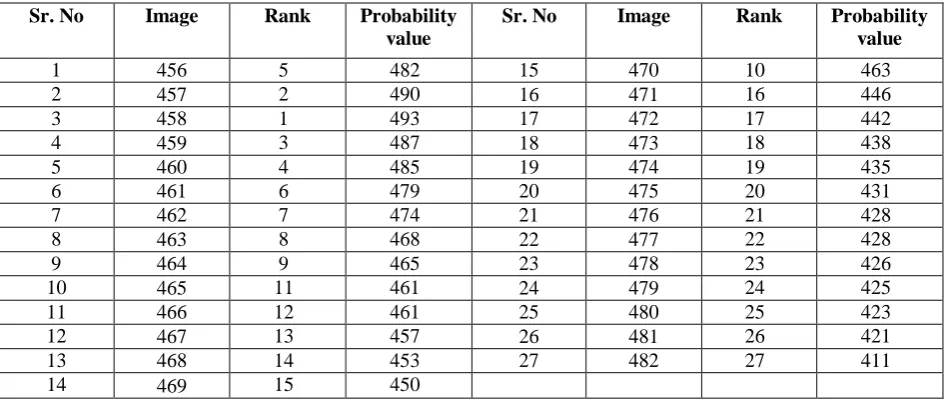
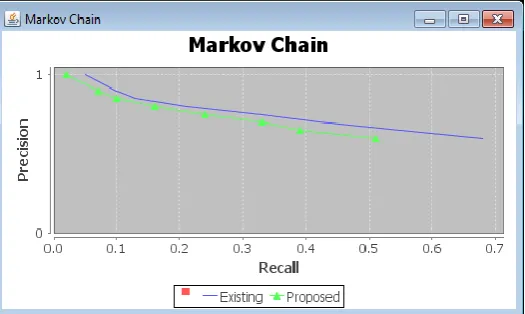
High precision means less irrelevant images are returned or more relevant images are retrieved, while high recall indicates that few relevant images are missed. Another way of presenting the performance of the system is by plotting precision and recall graph, in which precision values are plotted against values of recall.Table I shows the experimental results of our system for query red flower blossoms.
Table I
Experimental Results for Query Red Flower Blossoms
Sr. No Image Rank Probability
value
Sr. No Image Rank Probability
value
1 456 5 482 15 470 10 463
2 457 2 490 16 471 16 446
3 458 1 493 17 472 17 442
4 459 3 487 18 473 18 438
5 460 4 485 19 474 19 435
6 461 6 479 20 475 20 431
7 462 7 474 21 476 21 428
8 463 8 468 22 477 22 428
9 464 9 465 23 478 23 426
10 465 11 461 24 479 24 425
11 466 12 461 25 480 25 423
12 467 13 457 26 481 26 421
13 468 14 453 27 482 27 411
© 2014, IJCSMC All Rights Reserved 559 Fig 6. Comparison Graph of Existing and Proposed System
7. CONCLUSION
The main purpose of this paper is to provide an efficient and truly realizable approach for annotation based image retrieval. We proposed a replacement technique for mining user queries by shaping keyword connation as a property live between Markovian states sculptured when the user queries. The proposed system is shown to outperform previous annotation based methods of image retrieval.
REFERNECES
[1] Flickner, M., Sawhney, H., Niblack, W., Ashley, J., Huang, Q., Dom, B., Gorkani, M., Hafner, J., Lee, D., Petkovic,
D., Steele, D.,And Yanker, P. 1995. Query by image and video content: The QBIC system. IEEE Comput. 28, 9, 23– 32.
[2] Pentland, R. Picard, and S. Sclaroff. Photobook: Tools for content-based manipulation of image databases. IJCV, 18(3):233–254, 1996.
[3] J. R. Smith and S.-F. Chang. Visualseek: a fully automated content-based image query system. In Proc.ACM Multimedia '96, 1996.
[4] Gupta, R. Jain, Visual information retrieval, Commun. ACM 40(5) (1997) 70–79.
[5] Ma,W. And Manjunath, B. 1997. Netra: A toolbox for navigating large image databases. In Proceedings of the IEEE
International Conference on Image Processing (ICIP).
[6] The MARS web site: http://www.ifp.illinois.edu/~qitian/MARS.html
[7] The fire web site: http://www-i6.informatik.rwthaachen.
[8] Y.Mori, H.Takahashi and R.Oka, Image-to-word transformation based on dividing and vector quantizing images with
words. First International Workshop onmultimedia Intelligent Storage and Retrieval Management (1999).
[9] Duygulu P et al., Object Recognition as Machine Translation: Learning a Lexicon for a Fixed Image Vocabulary. in proceedings of 7th European Conference on Computer Vision, 2002.
[10] S. Deerwester, S. T. Tumais, T. K. Landauer, G. W. Furnas, and R. A. Harshman Indexing by latent semantic analysis, J. Soc. Inform. Sci. 41, 6 (1990), 391_407
[11] T. Hofmann, “Probabilistic Latent Semantic Indexing,” Proc. 22ndInt’l Conf. Research and Development in Information Retrieval (SIGIR’99), 1999
[12] J. Li and J. Wang, “Real-Time Computerized Annotation of Pictures,” Proc. ACM 14th Ann. Int’l Conf. Multimedia, 2006.
[13] D. Joshi, J.Z. Wang, and J. Li, “The Story Picturing Engine – A System for Automatic Text Illustration,” ACM Trans. Multimedia Computing, Comm. and Applications, vol. 2, no. 1, pp. 68-89, 2006.
[14] Z. Guo, S. Zhu, Y. Chi, Z. Zhang, and Y. Gong, “A Latent Topic Model for Linked Documents,” Proc. 32nd Int’l ACM SIGIR Conf. Research and Development in Information Retrieval (SIGIR), 2009.
[15] T.-T. Pham, N.E. Maillot, J.-H. Lim, and J.-P. Chevallet, “Latent Semantic Fusion Model for Image Retrieval and Annotation,” Proc. 16th ACM Conf. Information and Knowledge Management (CIKM), 2007.
© 2014, IJCSMC All Rights Reserved 560
[17] K.Barnard and D.A.Forsyth, Learning the semantics of words and pictures. IEEE International Conference on Computer Vision II, 408-415 (2001)
[18] L.-J. Li and G. Wang, and L. Fei-Fei, “OPTIMOL: Automatic Online Picture Collection via Incremental Model Learning,” Int’l J. Computer Vision, vol. 88, no. 2, pp. 147-168, 2010
[19] J. Fan and Y. Gao, and H. Luo, “Integrating Concept Ontology and Multitask Learning to Achieve More Effective Classier Training for Multilevel Image Annotation,” IEEE Trans. Image Processing, vol. 17, no. 3, pp. 407-426, Mar. 2008.
[20] Monay, F., Gatica-Perez, D.: Plsa-based image auto-annotation: constraining the latent space .In: Multimedia ’04: Proceedings of the 12th annual ACM international conference on Multimedia, New York, NY, USA, ACM Press (2004) 348–351